
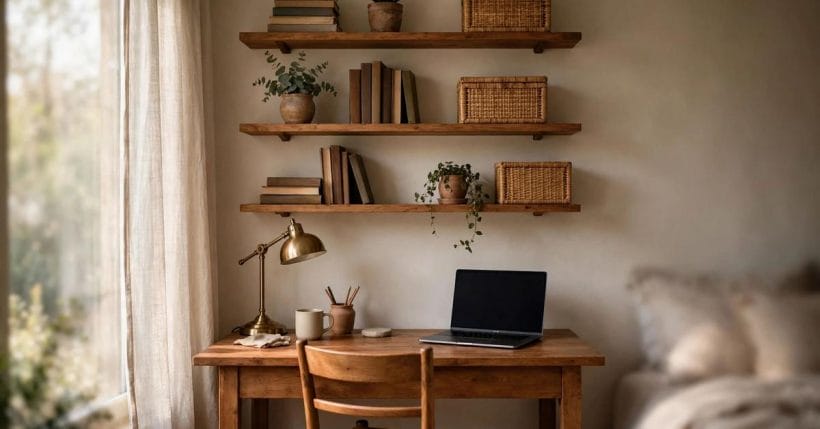
A bedroom office asks one wall to do two jobs at once. By day it holds a desk, a chair and everything work needs close at hand. By night the same room has to settle back into a place for rest, with the bed, soft bedding and quiet colours doing the talking. A desk with shelves above it suits that double life well, because the storage rises up the wall instead of spreading across the floor. The work stays in one tidy column, the floor stays clear, and the sleeping side of the room keeps its calm.
This guide looks at a desk and shelves in bedroom office settings only. It does not try to cover offices in spare rooms, living rooms or hallways, and it does not repeat general desk advice that belongs elsewhere. Every idea here is judged against the same test: does it help the desk work well without disturbing the bedroom around it? The sections below work through the wall, the desk, the shelves, light, colour and storage in turn, so you can plan the whole arrangement before anything is fixed to the wall.
It helps to begin by standing in the room and noticing how it is already used. Where does morning light fall, and where does the bed sit in relation to the door? Which wall is free for a full working day, and which wall would leave you facing glare or a draughty window? A desk wall that feels comfortable at nine in the morning and still looks calm at nine at night is worth more than a clever arrangement that only photographs well. Take your time with that first look, because the wall you choose shapes every decision that follows.
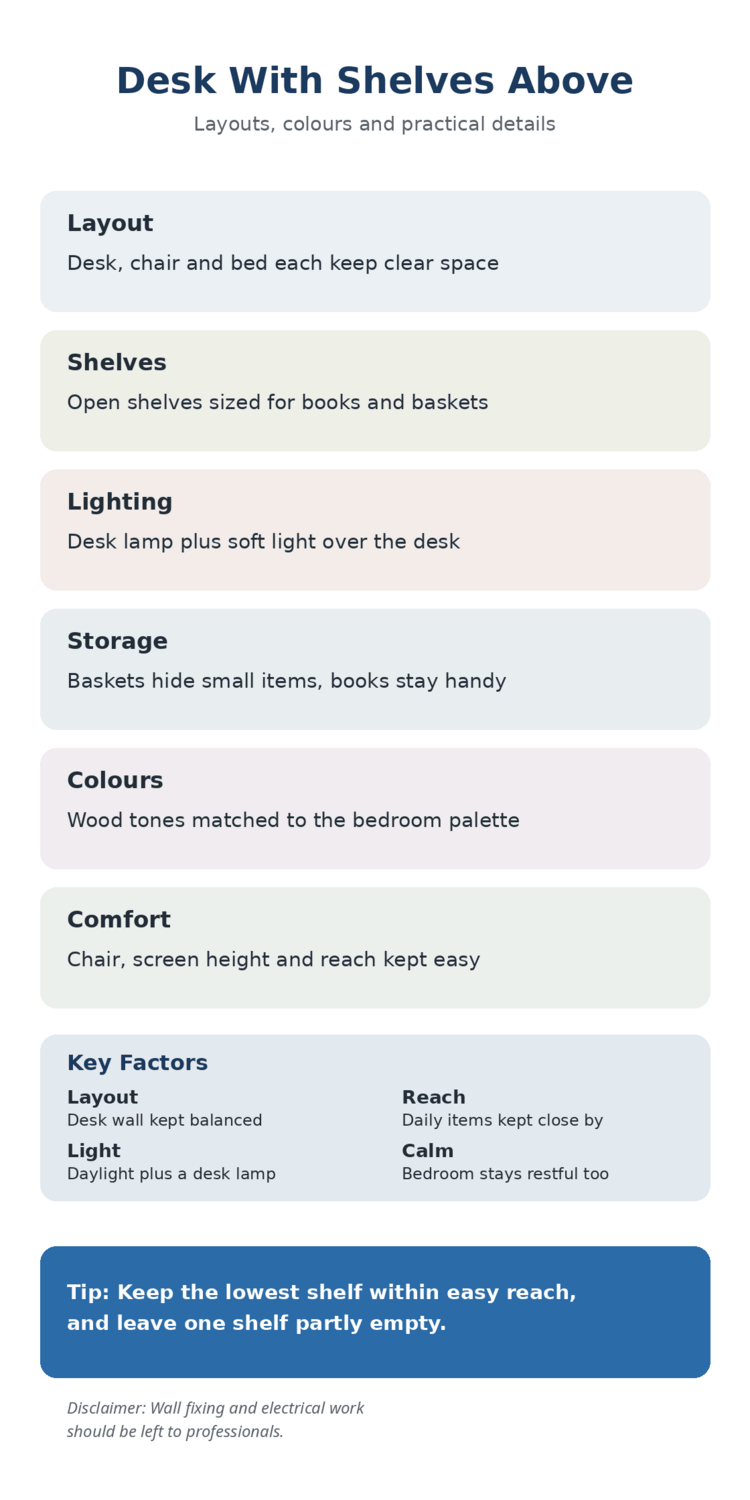
| Item | What it is |
|---|---|
| Start With the Wall, Not the Desk | The wall comes first because it decides how much room the desk and shelves can honestly take. |
| Choose the Desk for the Bedroom Corner | A bedroom desk earns its place by fitting the room, not by filling it. |
| Set the Shelves at a Comfortable Reach | Shelves above a desk only help if you can reach what is on them without standing up or stretching awkwardly. |
| Plan What Lives on Each Shelf | A shelf plan is really a plan for your working day. |
| Light the Desk Without Waking the Room | Light is where a bedroom desk most often goes wrong. |
| Match Wood Tones and Colours to the Bedroom | Colour is what makes a desk wall feel like it belongs in a bedroom rather than in an office block. |
| Keep the Work Zone and the Sleep Zone Apart | Sharing a room does not mean the two uses have to blur together. |
| Storage That Hides the Clutter | Open shelves show everything, which is both their charm and their risk. |
| Small Bedrooms and Awkward Corners | Small bedrooms are where a desk with shelves above truly earns its keep, because the wall gives you storage without taking floor space. |
| Fixing, Safety and Looking After the Shelves | Shelves above a desk carry weight, books are heavy, and a shelf that is not fixed properly is a risk to anyone sitting beneath it. |
1. Start With the Wall, Not the Desk
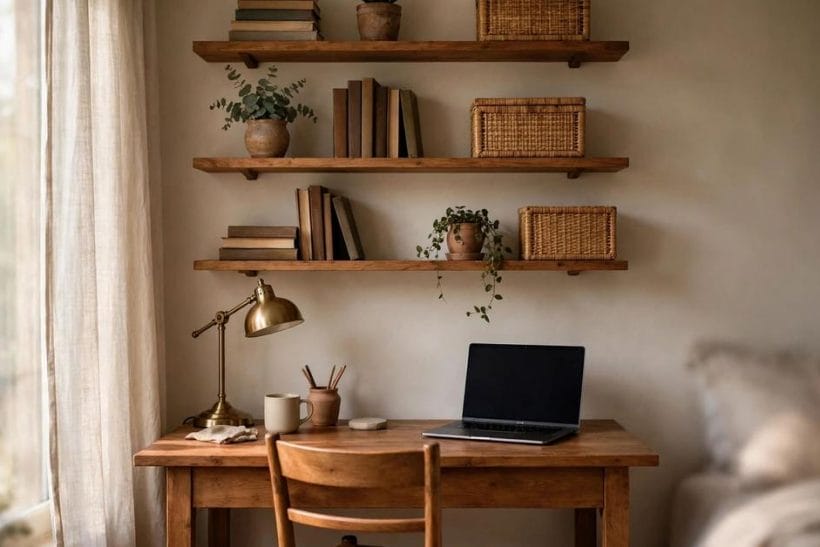
The wall comes first because it decides how much room the desk and shelves can honestly take. A wall beside the bed often works well, since the desk then sits in the natural flow of the room rather than blocking the way to the wardrobe or the window. A wall facing the bed can work too, giving you a view of the room while you work, but it puts the shelves in full sight from the pillow, so what sits on them matters even more. Either way, leave the path to the bed and the door clear, and check that the chair can slide back without hitting anything behind it.
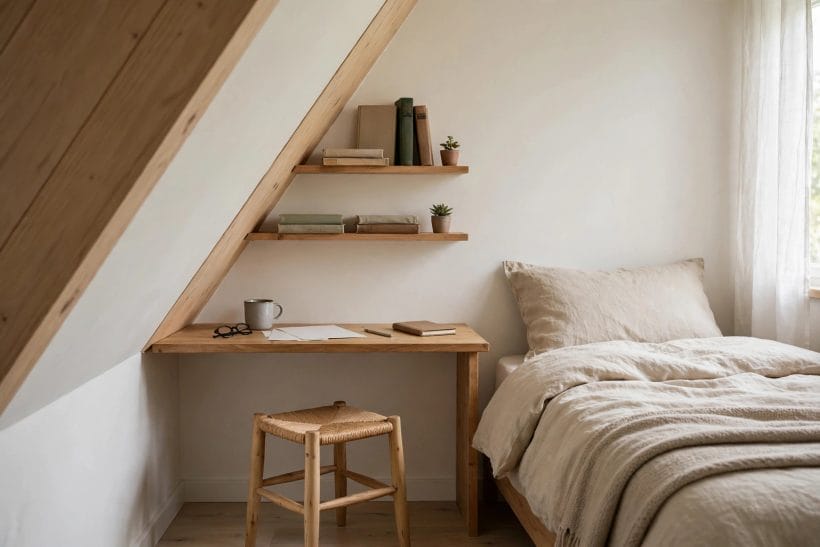
Also notice what already shares the wall. A radiator, a light switch, a plug socket or a sloping ceiling all shape where the desk can sit and how high the shelves can rise. Sockets are worth finding early, because a lamp and a laptop need power within easy reach, and trailing cables across the floor undo the tidiness the shelves are meant to bring. If the wall has a slope or a chimney breast, treat that as part of the design rather than an obstacle: a shorter desk or a staggered shelf run can follow the shape of the room instead of fighting it.
Finally, think about the view from the bed. The shelves will be one of the first things you see in the morning, so they should hold things that look restful as well as useful. Books, a plant and a closed basket read calmly. A pile of loose papers and tangled cables does not. Choosing the wall with both work and rest in mind is what separates a bedroom desk that lasts from one that slowly takes over the room.
2. Choose the Desk for the Bedroom Corner
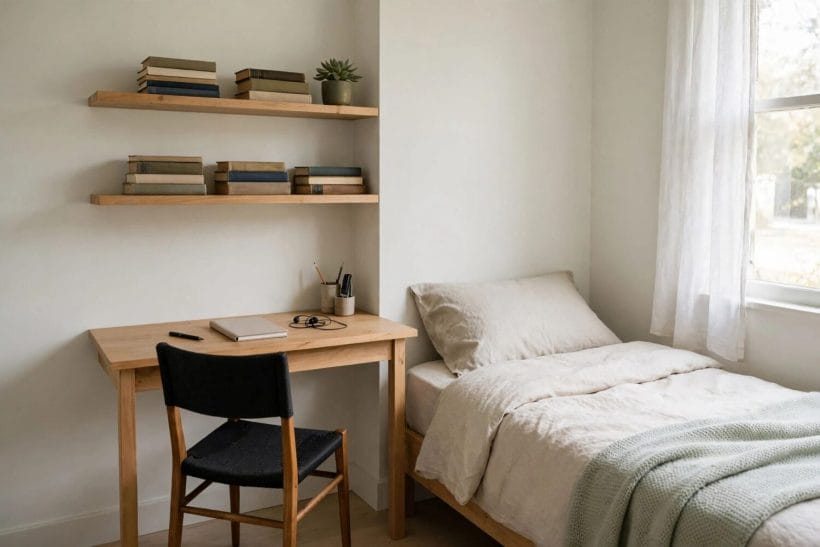
A bedroom desk earns its place by fitting the room, not by filling it. A slim desk with a plain top often suits a bedroom better than a deep, heavy one, because it leaves floor space for the bed and for moving around. The top should hold the things you use every day, a laptop or notebook, a lamp and a pen pot, with a little space left over for writing or sorting papers. If the top is already crowded before the working day starts, the desk is either too small for the job or holding things that belong on the shelves instead.
The chair matters as much as the desk. A chair that tucks fully under the desk keeps the room looking tidy when work is done, and it keeps the walkway clear at night. A bulky chair that sticks out into the room will catch your hip every time you pass the bed in the dark. Try the chair in the space, slide it in and out, and sit at the desk for a while before deciding. Comfort during a long working session and tidiness after it are both part of the same choice.
Colour and material help the desk sit quietly in a bedroom. A wood tone that echoes the bed frame or the wardrobe makes the desk feel like part of the room rather than an office dropped into it. Pale woods keep a small room feeling light, while darker woods suit a room that already has deep, warm tones. For more on how a whole working room is put together, see our home office ideas, and for the bedroom side of the balance, our tiny house bedroom ideas show how sleeping and working share small spaces.
3. Set the Shelves at a Comfortable Reach
Shelves above a desk only help if you can reach what is on them without standing up or stretching awkwardly. The lowest shelf should hold the things you reach for most, reference books, a notebook, a small basket of supplies, so they are a short arm movement away while you sit. Higher shelves suit things you need less often, spare notebooks, keepsakes, a plant that likes the light. When the everyday items live low and the rarely used items live high, the desk stays useful instead of becoming a display that gets in the way.
Spacing between shelves deserves the same thought. Books of different heights, a basket and a small plant all need different amounts of headroom, and a shelf run planned around the tallest item on it wastes the rest. Group items of similar height together where you can, and leave one shelf with a little breathing room rather than filling every level edge to edge. A shelf that is partly empty looks calm from the bed, and it leaves room for whatever the next season of work brings.
Depth matters too. A shelf deep enough for books and a basket, but shallow enough that nothing disappears behind the front row, is the sweet spot for a bedroom desk. Very deep shelves invite clutter to gather at the back, out of sight and out of mind, until the day you need something and cannot find it. Keep the depth modest, keep the front row honest, and let the shelves show what you actually use.
4. Plan What Lives on Each Shelf
A shelf plan is really a plan for your working day. Start by listing what you reach for daily, weekly and rarely, and give each group a home before anything is put up. Daily items belong on the lowest shelf or on the desk itself. Weekly items, files, reference material and chargers, belong a shelf higher, where they are visible but not underfoot. Rarely used items belong at the top, or in a closed basket where they do not add visual noise to the room.
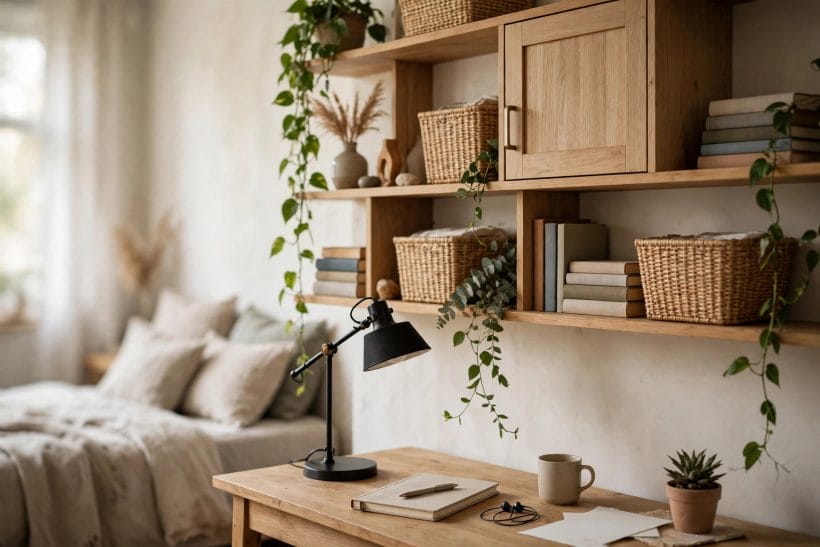
Baskets and boxes are the quiet heroes of a bedroom desk wall. They hold cables, chargers, spare pens and small supplies that would otherwise scatter across the desk and the shelves. Choose baskets that match each other in tone, even if they differ in size, so the wall reads as one calm arrangement rather than a collection of odd containers. Label them only if the labels stay out of sight from the bed, or skip labels and learn the arrangement by habit; a bedroom wall is not a stockroom, and it does not need to look like one.
Plants and personal items earn a place too, but a small one. A trailing plant softens the edge of a shelf, a framed photograph makes the desk feel like yours, and a favourite book or two reminds you why the space exists. The trick is proportion: if the personal items outnumber the working items, the shelves stop being useful storage and become a display shelf that happens to sit over a desk. A few chosen pieces, spaced with room around them, give the wall character without costing it its purpose.
5. Light the Desk Without Waking the Room
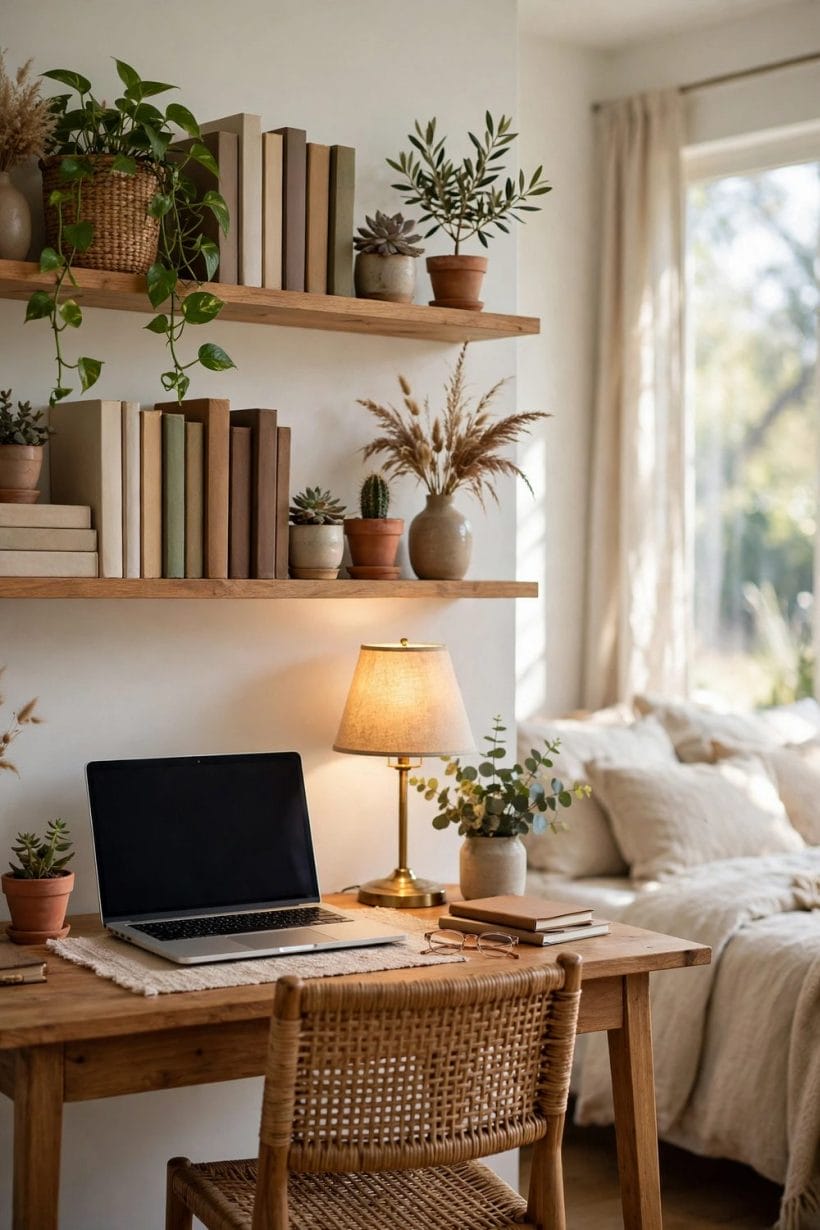
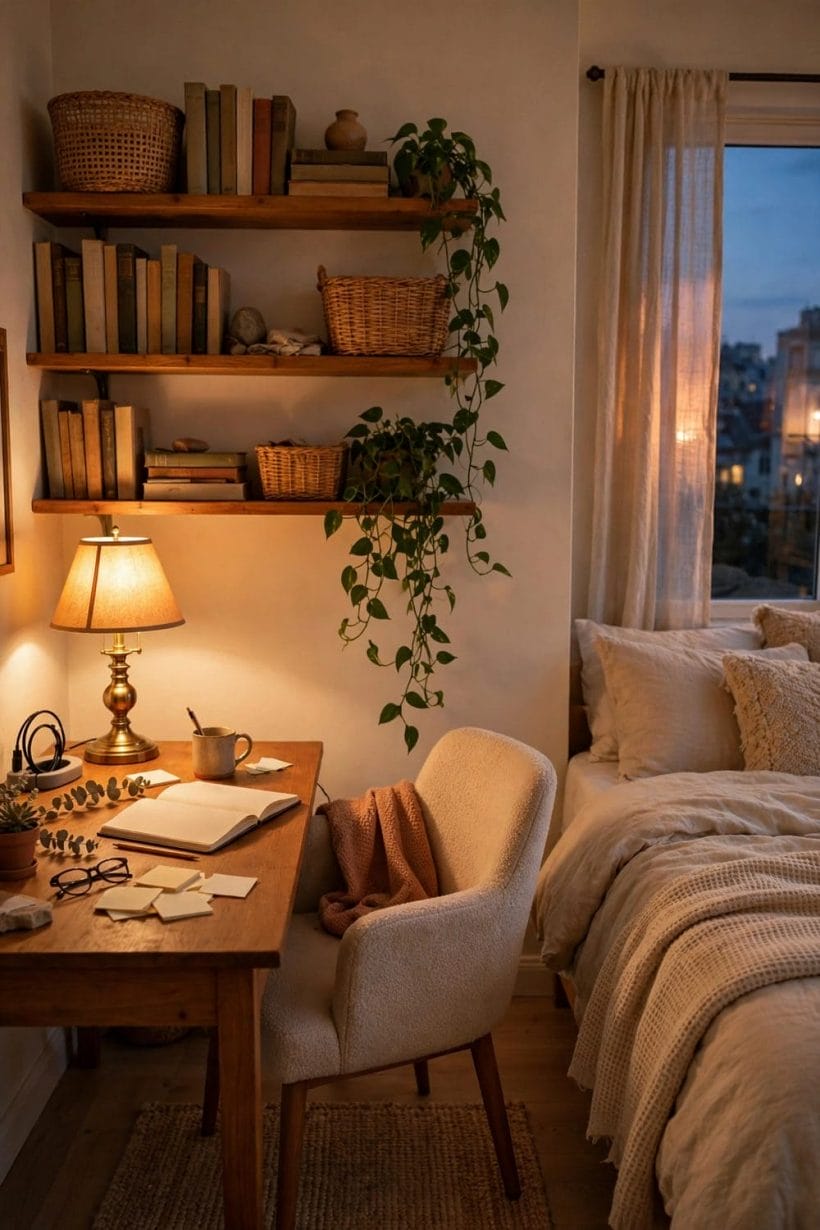
Light is where a bedroom desk most often goes wrong. A bright, cold light over the desk can make the whole room feel like an office at night, while a dim lamp leaves you squinting at your work. The answer is layers: daylight from the window during the day, a warm desk lamp for focused work, and, if the shelves carry a soft light strip, a gentle glow that washes the wall rather than glaring into the room. Each layer has its own job, and none of them needs to be harsh to be useful.
Position matters as much as brightness. A lamp to one side of the desk lights the work without shining straight into your eyes or casting your shadow across the page. A light under the lowest shelf lights the desk surface evenly and makes the shelves themselves look considered rather than gloomy. If the desk faces a window, watch for glare on a screen during bright hours, and use a sheer curtain or a slight change of angle to soften it. The goal is light that helps you work and still lets the room feel like a bedroom when the lamp goes off.
Evening work needs a little extra care. A bedroom is shared with sleep, even if you sleep alone, and a desk that blazes late into the night will keep the room feeling busy long after work ends. A warm lamp, a screen kept at a gentle brightness, and a habit of switching the shelf light off when work finishes all help the room settle. Light is not just a working tool here; it is the signal that tells the room whether it is a workspace or a place to rest.
6. Match Wood Tones and Colours to the Bedroom
Colour is what makes a desk wall feel like it belongs in a bedroom rather than in an office block. Start with what the room already has: the bed frame, the wardrobe, the floor and the bedding. A shelf wood that sits close to one of those tones will blend in naturally, while a shelf that introduces a completely new colour will demand attention every time you look at the wall. That is not always wrong, a pale shelf on a dark wall can be a lovely feature, but it should be a choice, not an accident.
Painted shelves offer another route. White or soft grey shelves disappear against a pale wall and let the books and baskets carry the colour. Painted shelves also suit rooms where the bed and furniture are already mixed, because they do not add another wood tone to reconcile. Whatever you choose, keep the palette narrow: one wood tone or one paint colour for the shelves, one accent colour from the bedding or a cushion, and the rest calm. A narrow palette reads restful, which is exactly what a bedroom wall should do.
Bedding and textiles do a lot of quiet work here too. A throw or cushion that picks up a tone from the shelves ties the desk wall to the sleeping side of the room, so the two halves of the room feel like one space. The same goes for a basket: a woven basket on a shelf echoes a woven throw on the bed, and the room feels gathered rather than divided. For colour-led bedroom thinking, our bedroom ideas and small bedroom ideas explore palettes that keep restful rooms feeling warm.
7. Keep the Work Zone and the Sleep Zone Apart
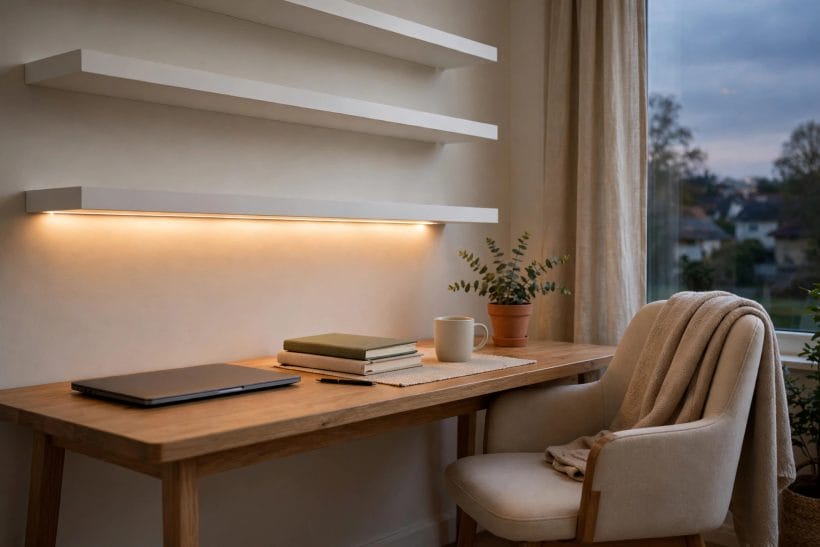
Sharing a room does not mean the two uses have to blur together. A clear edge between the desk area and the bed helps both: work stays contained, and sleep stays protected. The edge can be simple, a rug under the desk and chair, a change of wall colour behind the desk, or a small bookcase or plant that marks where one zone ends and the other begins. It does not need a screen or a divider; a visual cue is enough for the room to read as two places in one.
Habits reinforce the edge. Closing the laptop, clearing the desk top and switching off the desk lamp at the end of the working day tells the room that work is over, and it makes the morning start cleaner too. A desk that is left exactly as work ended it will greet you with yesterday’s clutter, while a desk cleared in a minute each evening stays welcoming. The shelves help here as well, because a tidy shelf run gives everything a home to return to, so clearing the desk is quick rather than a chore.
Sound and screens deserve a mention too. If work calls or video meetings happen at the desk, a door that closes, a soft rug that dulls footsteps, and headphones kept on the shelf all help the bedroom keep its quiet character. The aim is not to pretend the desk is not there; it is to let the room be a bedroom first and a workspace second, with the desk playing a tidy, contained part.
8. Storage That Hides the Clutter
Open shelves show everything, which is both their charm and their risk. The answer is not fewer shelves but smarter storage on them. Closed baskets hide the small, scruffy items, chargers, cables, spare supplies, while open sections display the books and objects that look good. Mixing open and closed storage on the same wall gives you the calm look of a styled shelf with the practicality of a cupboard, and it keeps the bedroom from feeling like a stationery drawer tipped onto the wall.
A small drawer unit or a desk with a drawer adds another layer of hiding space for papers and personal items that should not be on show. Papers in particular benefit from a home off the shelves: a drawer, a folder on a shelf, or a basket with a lid keeps them flat, tidy and out of sight, while still within reach. When papers have no home, they spread across the desk, then onto the shelves, then onto the bed, and the whole arrangement slowly unravels.
Regular pruning keeps the system honest. Once in a while, take everything off one shelf, keep what you use, and move the rest elsewhere. Shelves above a bedroom desk fill up quietly, a book here, a gadget there, until the wall that once looked calm looks crowded. A short, regular tidy, shelf by shelf, keeps the arrangement working and the bedroom restful. For shelf ideas in the sleeping part of the room, our floating shelf above bed ideas show how the same thinking works over a bed, a useful contrast to the desk wall.
9. Small Bedrooms and Awkward Corners
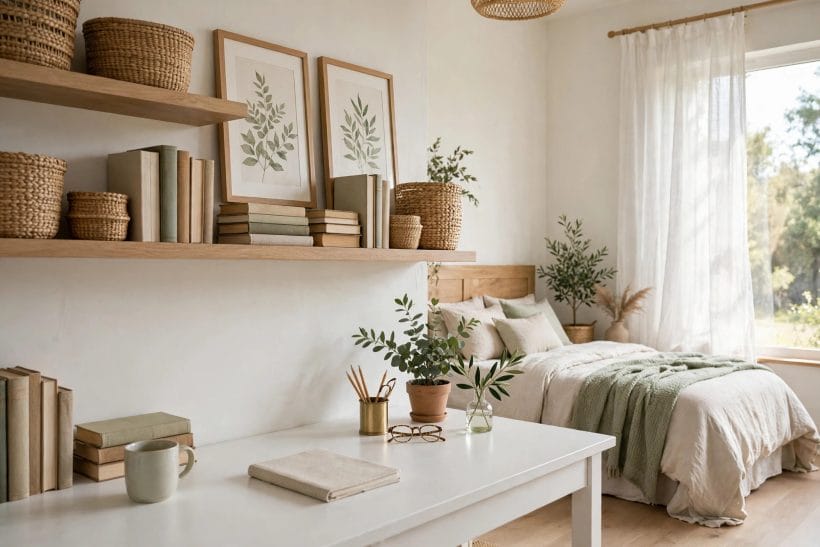
Small bedrooms are where a desk with shelves above truly earns its keep, because the wall gives you storage without taking floor space. A narrow desk in a corner, with two or three short shelves above it, can hold a full working setup in a footprint barely wider than the chair. The trick is to keep the desk narrow and the shelves short, so the arrangement fits the corner rather than overwhelming it. A desk that is too wide for its corner will push the chair into the bed or block the wardrobe, and no amount of shelf styling fixes that.
Awkward shapes can become advantages. A wall under a sloping ceiling suits a desk with low shelves that follow the slope, and a shallow alcove suits a desk fitted snugly inside it, with shelves filling the wall above. A chimney breast creates two natural desk walls, one on each side, and a wall beside a window gives the desk daylight without sacrificing the window itself. Look at what the room offers before assuming the desk needs a long, flat, empty wall; most bedrooms offer a corner or an alcove that works better.
For rooms where the bed takes most of the floor, a fold-down or wall-mounted desk surface is sometimes suggested, but that is a different arrangement from the one in this guide, and it brings its own fixing and safety questions. Whatever form the desk takes, the shelves above it still follow the same principles: everyday items low, rarely used items high, and a little empty space left on purpose. Our study room ideas and tiny bedroom ideas offer more small-space thinking that pairs well with this guide.
10. Fixing, Safety and Looking After the Shelves
Shelves above a desk carry weight, books are heavy, and a shelf that is not fixed properly is a risk to anyone sitting beneath it. Wall fixing is work for a professional where the wall type is uncertain, the load is heavy, or the fixing needs to carry weight safely over a place where someone sits. A professional can judge the wall, the fixings and the load together, and that judgement is worth more than any general guidance here. Never guess at fixings, and never hang a loaded shelf over a desk chair on fixings you are unsure about.
Electrical work follows the same rule. Adding a light under a shelf, moving a socket, or running a new supply for the desk is work for a qualified electrician. A plug-in lamp and a battery light are simple alternatives that need no wiring at all, and they suit a bedroom desk well. Keep cables tidy and away from walkways, use a small cable basket or clip to keep them off the floor, and check plugs and leads now and then for wear. A tidy cable run is a safety measure as much as a tidiness one.
Looking after the shelves is simple once they are up. Dust the shelves and the items on them regularly, since a bedroom gathers dust and a dusty shelf looks tired quickly. Check the fixings now and then, especially after a shelf has been loaded with new books, and tighten or ask a professional about anything that feels loose. A shelf wall that is checked, dusted and pruned stays safe, calm and useful for years, which is the whole point of building it well in the first place.
Final Considerations
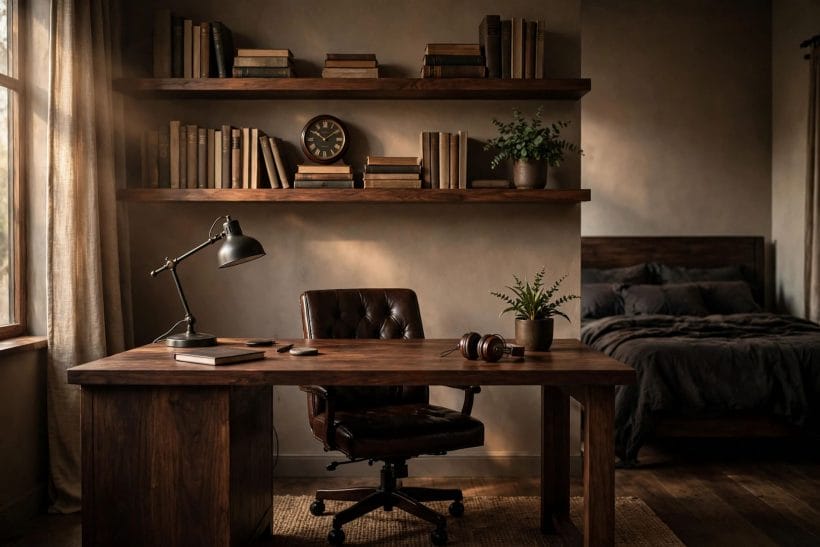
A desk with shelves above it works in a bedroom when the wall is planned as one arrangement, not as a desk with shelves added afterwards. Choose the wall with both work and rest in mind, set the desk to fit the room, keep everyday items within easy reach on the lowest shelf, and let light, colour and storage all point the same way: towards a room that works well by day and rests well by night. Leave a little empty space on purpose, clear the desk at the end of the working day, and the arrangement will keep paying you back.
Before anything is fixed to the wall, stand back and look at the whole room once more. Does the desk wall feel calm from the bed? Can the chair slide out freely? Is there a home for every item, and is the lowest shelf within easy reach? If the answer to each of those is yes, the plan is ready. If any answer is no, adjust the plan while it is still on paper, because moving a desk is easy and moving a fixed shelf is not. A little patience at the planning stage is what turns a desk and shelves in bedroom office corners into a lasting part of the room.
When the shelves are up and the desk is in use, keep the habits that protect the room: a quick tidy each evening, a shelf-by-shelf prune now and then, and a check of fixings and cables as part of ordinary housekeeping. The best bedroom desk walls are not the fullest ones; they are the ones where everything has a home, something is left empty, and the bedroom still feels like a bedroom. That is the aim this guide has held throughout, and it is a good test for any arrangement you build from it.
One last thought: let the room change with you. The books you reach for, the work you do and the hours you keep will shift over time, and the shelves should shift too. Swap a basket for a plant, move a book run to a higher shelf, or clear a shelf entirely for a season. A desk wall that can change without being rebuilt is a desk wall that stays useful, and in a bedroom, where rest matters as much as work, that flexibility is worth building in from the start.



0 Comments