
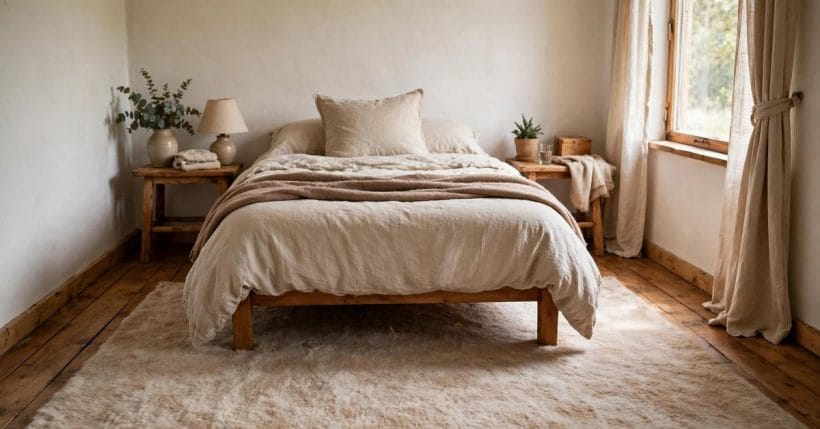
An 11×12 room sits in that in-between size where a rug can either pull the whole room together or quietly get in the way. It is big enough for a bed, bedside tables and a chair, yet small enough that every piece of furniture shares the same floor. That is why choosing a rug for this kind of room is less about finding a perfect size and more about judging how the rug will live with the furniture already in the room.
This guide looks at rug size and shape for an 11×12 room in general terms only. It covers how a rug sits under a bed, how walkways stay clear, which shapes suit which corners, and how to test a size before buying. There are no fixed measurements here, because rooms that share the same overall size still differ in door positions, window placement and furniture. The principles stay the same; the right fit is the one that works in your room, so check everything against your own floor before you commit.
It helps to think of the rug as part of the room rather than as decoration laid on top of it. A rug that anchors the bed makes the sleeping area feel settled. A rug that floats in the middle of the floor with no furniture touching it can make the same room feel unfinished. A rug that crowds a doorway or bunches against a wardrobe will annoy you every day, however good it looks in a photograph. The sections below work through each of those judgements in turn, so you can walk into a shop or browse online with a clear picture of what you are looking for.
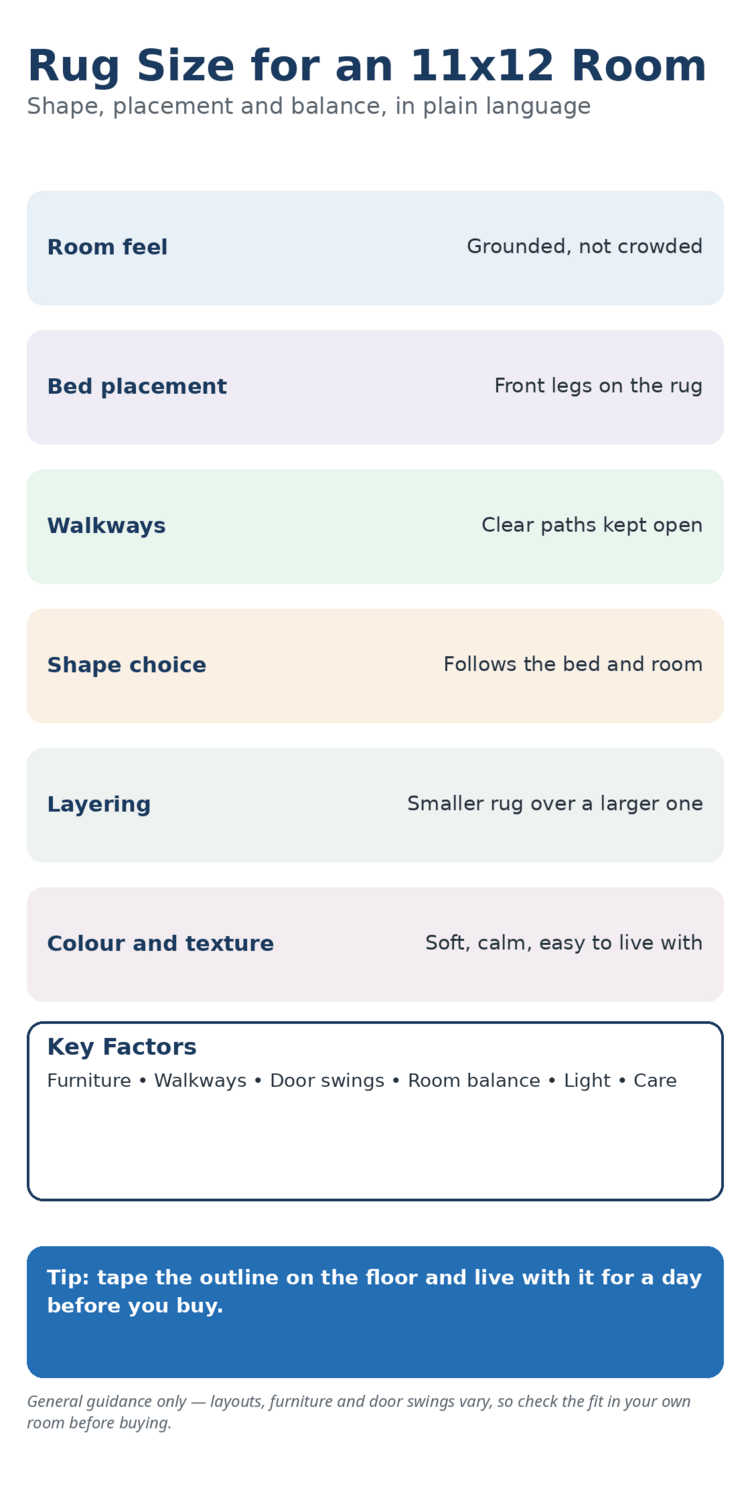
| Item | What it is |
|---|---|
| Start With the Room, Not the Rug | Before looking at rugs at all, spend a little time looking at the room itself. |
| Let the Bed Set the Shape | In most bedrooms of this size, the bed is the largest piece of furniture and the natural anchor for the rug. |
| Keep Walkways Clear and Easy | Walkways are where a rug choice succeeds or fails in daily life. |
| Rectangular Rugs and How They Sit | The rectangular rug is the natural partner for a rectangular room, and for a rectangular bed. |
| Round Rugs and Where They Work | A round rug changes the feeling of a room immediately. |
| Runners Beside the Bed | A runner — a long, narrow rug laid beside the bed — is the quiet solution for rooms where a large rug would crowd the floor. |
| Layering One Rug Over Another | Layering means placing a smaller rug over a larger, plainer one, and it is a useful trick for a room of this size. |
| Colour, Texture and the Feel of the Room | Size and shape decide how a rug fits, but colour and texture decide how it feels. |
| Doors, Furniture and Everyday Movement | A rug lives with the moving parts of a room, and those parts deserve a section of their own. |
| Try the Size Before You Buy | The most reliable test costs nothing: mark the rug shape on the floor before you buy. |
1. Start With the Room, Not the Rug
Before looking at rugs at all, spend a little time looking at the room itself. Notice where the door opens and which way it swings, where the wardrobe doors need room to move, and which paths you walk every day, from the door to the bed, from the bed to the wardrobe, and from the bed to the window. Those paths are the skeleton of the room. A rug should sit inside them comfortably, not across them.
Also notice where the light falls. A rug near a window catches daylight and becomes a natural focal point, while a rug in a darker corner can make that corner feel heavier. Colour and texture matter here too, and they are covered later, but the first decision is always placement. A rug in the wrong place will fight the room no matter how attractive its pattern is.
Finally, take stock of the furniture that will share the rug. A bed with bedside tables asks for a different arrangement than a bed standing alone against a wall. A reading chair in the corner may deserve its own smaller rug, or it may sit better on bare floor. Sketch the room roughly on paper, mark the furniture, and mark the paths you walk. That sketch, however rough, will tell you more than any catalogue photograph.
2. Let the Bed Set the Shape
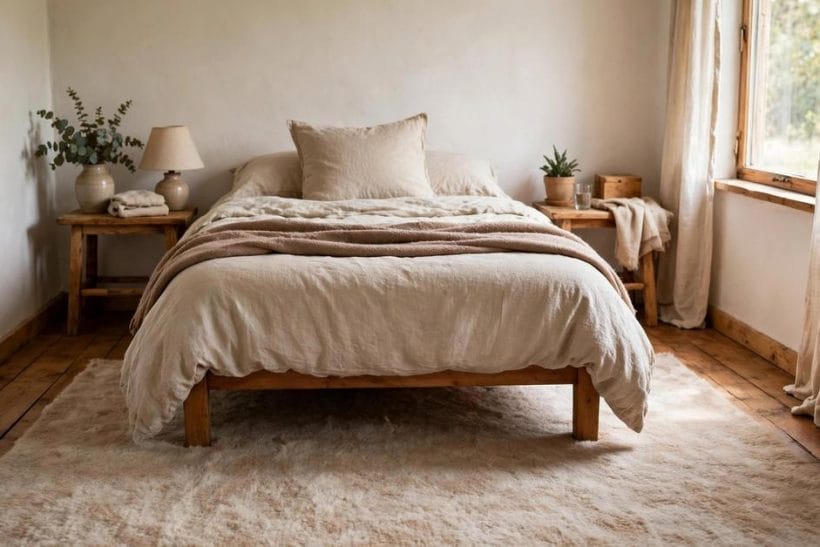
In most bedrooms of this size, the bed is the largest piece of furniture and the natural anchor for the rug. A rug that sits under the bed, with the front legs resting on it, ties the bed to the rest of the room and gives your feet a soft landing in the morning. A rug that stops short of the bed, leaving a strip of bare floor between rug and bed, can look accidental, as if the rug drifted out of place.
That does not mean the whole bed must sit on the rug. In a room of this size, a rug that reaches under the full bed and out beyond it on every side can easily crowd the walls and doorways. Letting the rug sit under the front portion of the bed, with the head end of the bed on bare floor, is a common arrangement that keeps the room feeling open while still grounding the bed. The point is connection: the rug and the bed should read as one arrangement, not as two separate objects that happen to share a room.
Bedside tables complicate the picture slightly. If the tables stand on the rug as well, the arrangement feels generous and settled. If they stand on bare floor beside the rug, the arrangement feels lighter and the rug reads as belonging to the bed alone. Either can work. What matters is that the choice looks deliberate when you stand in the doorway and take in the whole room at once.
3. Keep Walkways Clear and Easy
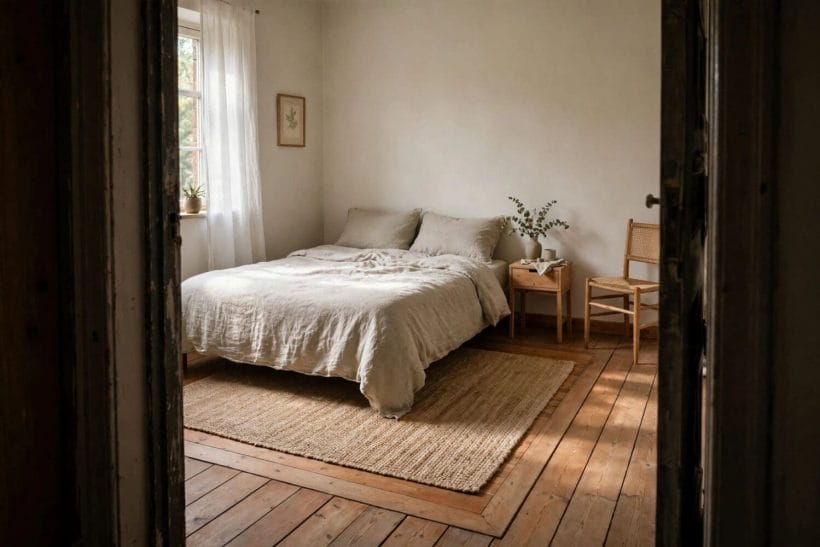
Walkways are where a rug choice succeeds or fails in daily life. You cross the room half asleep, carrying laundry, or hurrying to answer the door, and a rug edge that curls, a corner that lifts, or a rug that slides underfoot will make itself known at exactly those moments. A rug that leaves clear, comfortable paths around the bed and toward the door and wardrobe will feel right in a way that is hard to describe but easy to recognise.
Pay attention to the gap between the rug edge and the wall. A border of bare floor around the rug frames it and makes the room feel larger, because the eye can see where the floor ends and the rug begins. A rug that stretches almost wall to wall, by contrast, can make the room feel like it is wearing a carpet it did not ask for, and it leaves no breathing room around the edges. Bare floor is not wasted space; it is the frame that lets the rug do its work.
Doorways deserve special attention. A rug that runs under a door swing will catch, bunch and wear quickly, and a door that drags across a thick rug is a daily irritation. Check the swing of every door in the room, including wardrobe doors, and keep the rug clear of their path. The same applies to drawers that pull out toward the rug. A rug that respects the moving parts of a room lasts longer and causes fewer small frustrations.
4. Rectangular Rugs and How They Sit
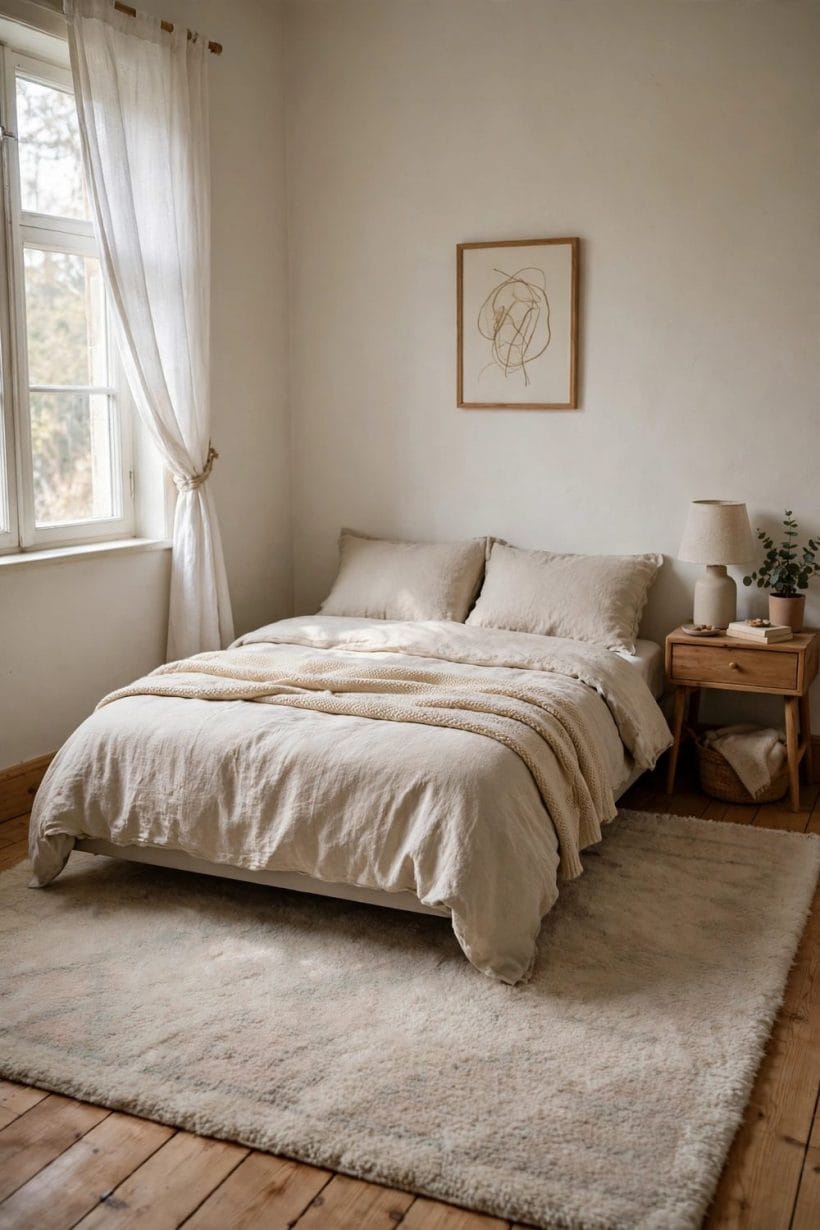
The rectangular rug is the natural partner for a rectangular room, and for a rectangular bed. Its straight edges echo the walls and the bed frame, so it tends to look settled even when the rest of the room is simply furnished. In a room of this size, a rectangular rug under the bed, extending out on the sides where you step out of bed, is the arrangement most people picture first, and it is popular for good reason: it is easy to place, easy to judge by eye, and easy to live with.
The shape also suits rooms where the bed stands against the longer wall, with space on either side. The rug can then run with the bed, giving both sides of the bed a soft landing, and the room keeps a sense of symmetry. Where the bed stands in a corner or against a shorter wall, the same shape still works, but the rug may sit mainly on the open side of the bed, with the wall side needing less coverage. Let the room tell you where the rug earns its place, rather than insisting on symmetry the room cannot support.
Rectangular rugs also make layering and pairing easier, which later sections return to. A plain rectangular rug can sit quietly under a patterned one, or a patterned rectangular rug can carry the visual interest of a plain room. Because the shape is so familiar, it rarely draws attention to itself, which is often exactly what a small room needs: a rug that supports the room without demanding to be looked at.
5. Round Rugs and Where They Work
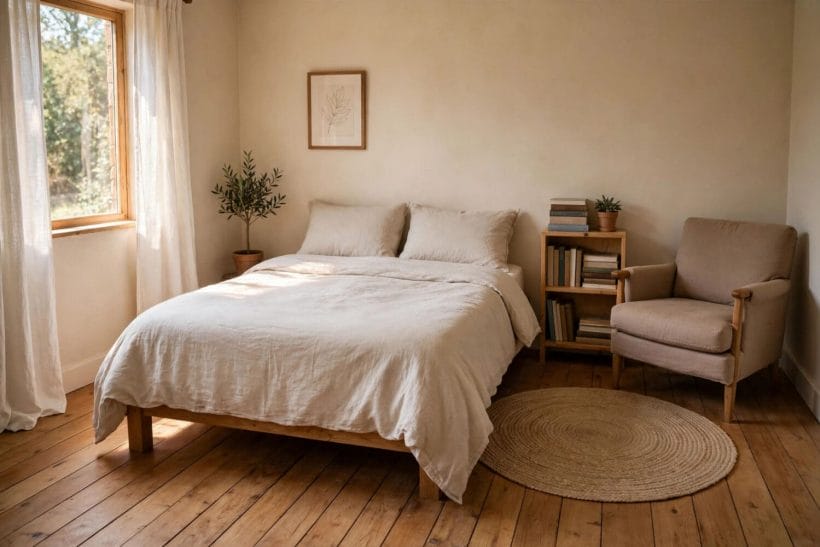
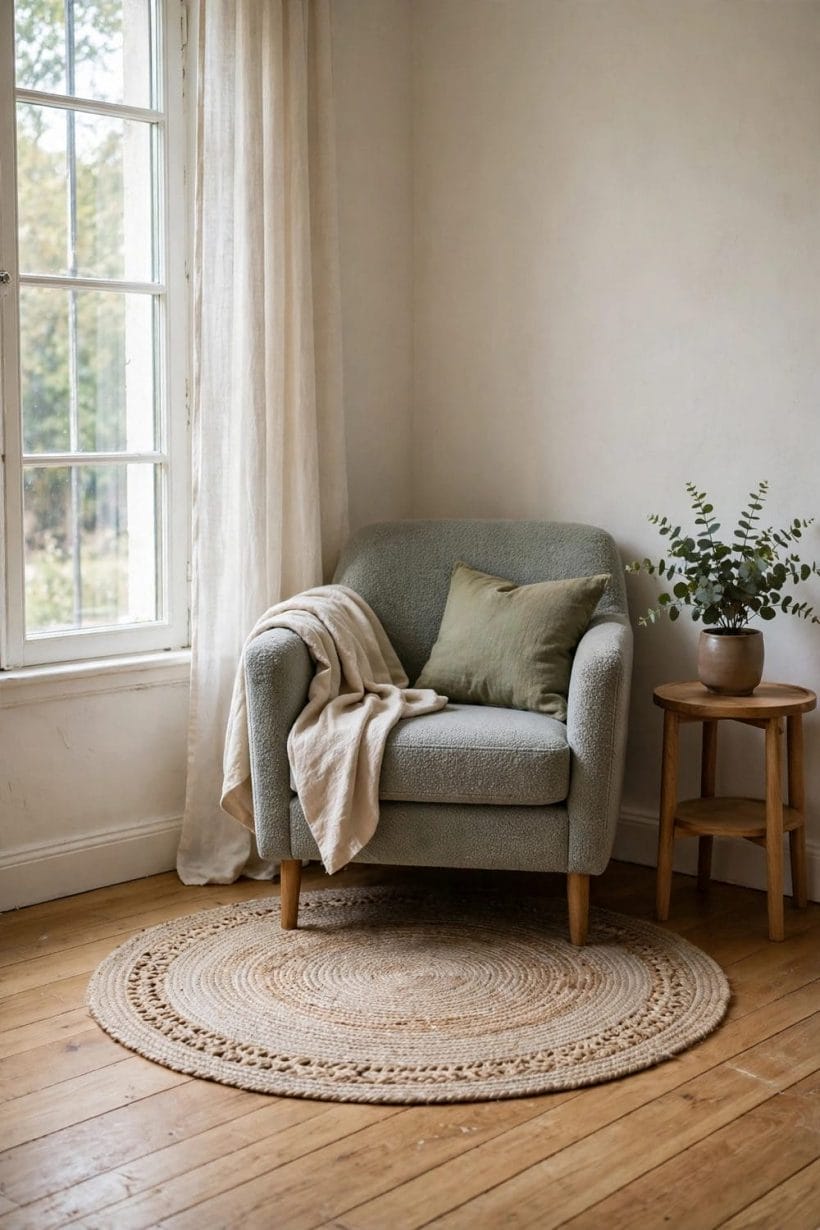
A round rug changes the feeling of a room immediately. Where a rectangular rug echoes the walls, a round rug softens them, and in a room full of straight lines — bed frame, wardrobe, door frames, window frames — that softness can be welcome. Round rugs work best where they have a clear job: under a reading chair, beside the bed as a soft landing, or in a corner that would otherwise feel empty and angular.
What a round rug does less well is anchor a bed. A bed is rectangular, and a round rug under it tends to leave awkward bare patches at the corners of the bed, where the rug curves away and the floor shows through. That can look charming in a large room with space to spare, but in a room of this size it can make the bed arrangement feel unresolved. If you love round rugs, give one a home of its own — under a chair, in a reading corner, or beside the bed — rather than asking it to do the work of a rectangular rug under the bed.
Round rugs also suit rooms where the furniture arrangement is already rounded or informal: a chair angled toward the window, a small table pulled up beside it, a plant softening the corner. In that kind of corner, a round rug completes a little scene of its own, separate from the bed, and the room gains a second focal point without feeling crowded. The key is giving the round rug its own territory, not squeezing it into a job shaped for something else.
6. Runners Beside the Bed
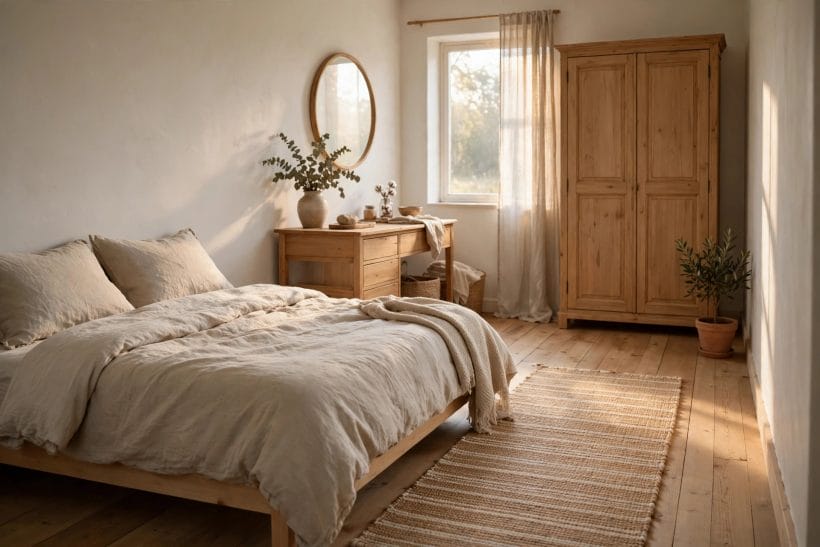
A runner — a long, narrow rug laid beside the bed — is the quiet solution for rooms where a large rug would crowd the floor. It gives you a soft place to step onto in the morning, it adds colour or pattern along the side of the bed, and it leaves the rest of the floor clear. In a room where the bed stands against a wall, a single runner on the open side can be all the rug the room needs.
Runners also work well where the room has more than one walking path to protect. A runner beside the bed and bare floor elsewhere keeps the main paths clear while still softening the spot your feet actually land. They are easy to move for cleaning, easy to swap with the seasons, and easy to replace without rethinking the whole room. For a room that already feels full, a runner adds warmth without adding visual weight.
The trade-off is that a runner does not anchor the bed the way a larger rug does. The bed and the runner read as neighbours rather than as a single arrangement, and the room can feel a little less settled as a result. If the room already feels grounded — through the bed frame, the bedding, the furniture — a runner is plenty. If the room feels bare and echoing, a larger rug may serve it better. Judge the room as a whole, not the runner in isolation.
7. Layering One Rug Over Another
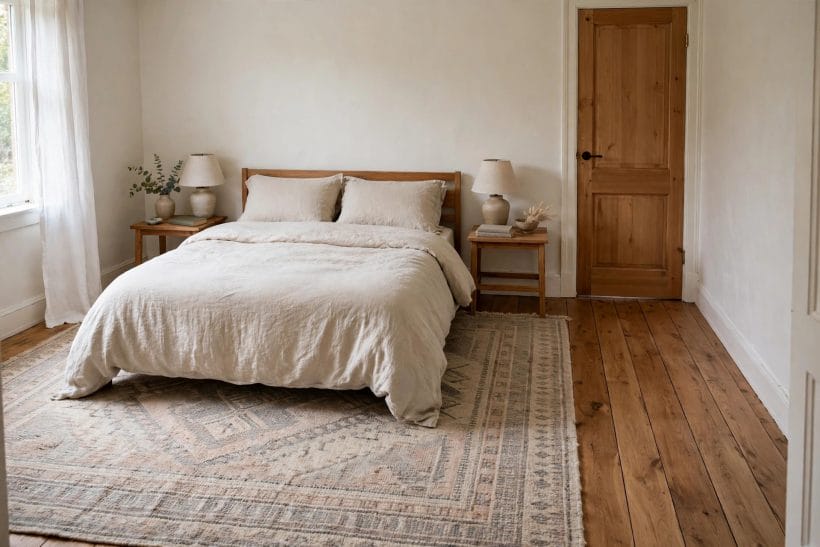
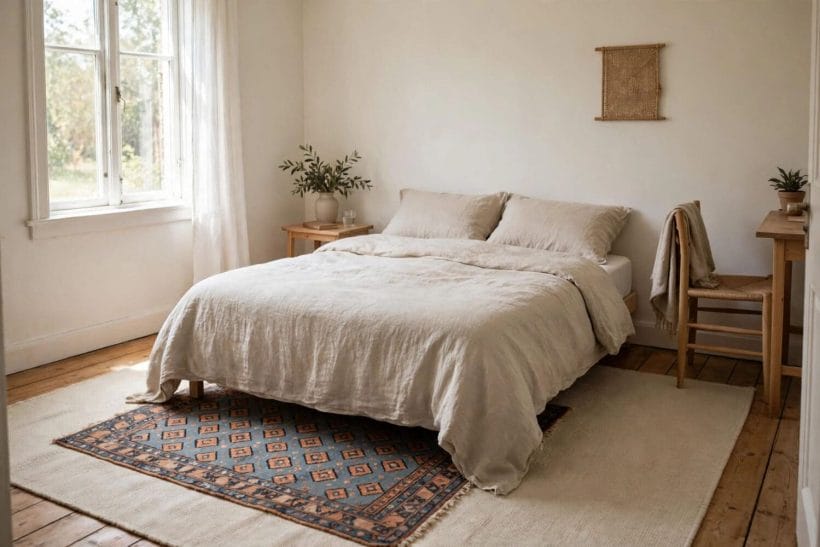
Layering means placing a smaller rug over a larger, plainer one, and it is a useful trick for a room of this size. The larger rug underneath does the grounding work — it sits under the bed, softens the floor and defines the sleeping area — while the smaller rug on top adds pattern, colour or texture exactly where you want it. Because the top rug is smaller, you can change it with the seasons or on a whim without replacing the foundation underneath.
Layering also solves a common problem: falling in love with a rug that is too small for the room on its own. On its own, a small rug under a bed can look lost, with bare floor dominating on every side. Over a larger plain rug, the same small rug looks deliberate, like a picture in a frame. The larger rug supplies the scale the smaller one lacks, and the smaller rug supplies the character the larger one may not have.
There are practical points to watch. The top rug must lie flat and stay put, or it becomes a tripping hazard, especially beside a bed where you step in the dark. A rug pad or a non-slip backing underneath the top rug helps, and the same applies between the bottom rug and the floor. Keep the edges of the top rug clear of walkways and door swings, and check that the combined thickness does not catch a door. Layered well, the arrangement looks effortless; layered carelessly, it looks like two rugs that collided.
8. Colour, Texture and the Feel of the Room
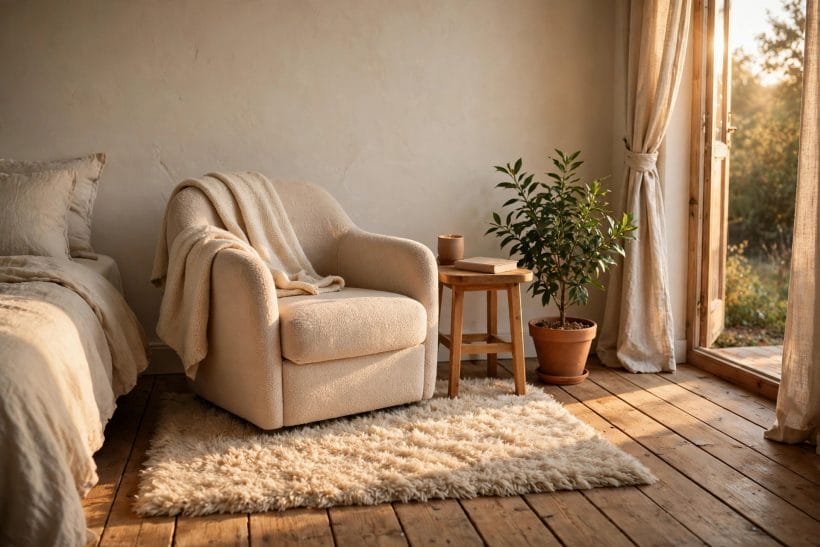
Size and shape decide how a rug fits, but colour and texture decide how it feels. A pale, soft rug makes a small room feel lighter and more open, because it reflects the daylight and does not demand attention. A dark, richly patterned rug makes the same room feel cosier and more enclosed, because it draws the eye down and anchors the space. Neither is right or wrong; the question is which feeling you want when you walk into the room.
Texture matters as much as colour. A deep, soft pile feels luxurious under bare feet in the morning, but it shows footprints and needs more care. A flat weave feels crisp and practical, and it slides more easily under doors and furniture, but it offers less cushioning. A woven texture with visible fibre adds warmth and a handmade feeling, while a smooth, dense rug feels more formal. Run your hand across samples, walk on them in bare feet if you can, and notice which texture you actually enjoy living with rather than merely looking at.
Pattern deserves a similar moment of thought. A bold pattern can carry a plain room, giving it character that the furniture alone does not supply. A quiet pattern, or none at all, lets the bedding, the curtains and the wall colour speak instead. In a small room, a very busy pattern across a large rug can dominate everything else, while a subtle pattern adds interest without competing. Stand back and picture the rug with the whole room, not just with the bed, and trust the feeling that picture gives you.
9. Doors, Furniture and Everyday Movement
A rug lives with the moving parts of a room, and those parts deserve a section of their own. Wardrobe doors swing or slide, drawers pull out, chairs push back from a dressing table, and each of those movements needs clear floor. A rug that blocks a drawer or catches a chair leg will be cursed quietly every day, and over time the rug itself will show the wear where furniture fights it.
The simplest safeguard is to walk the room before you buy, opening every door and drawer and pulling out every chair, and noting where each one travels. Then picture the rug in place and ask whether any of those movements would cross it. If a drawer would drag across the rug, the rug needs to sit elsewhere, or the drawer needs a different home. This is unglamorous work, but it is the difference between a rug that settles into the room and one that argues with it.
Furniture weight matters too. Heavy furniture on a rug can leave marks over time, and moving heavy pieces across a rug can pull it out of place or damage its backing. If you rearrange furniture often, a lighter rug that you can lift and shift easily may suit you better than a heavy one that needs two people to move. Think about how the room changes through the year — guests, seasons, rearranging for a new chair — and choose a rug that can change with it.
10. Try the Size Before You Buy
The most reliable test costs nothing: mark the rug shape on the floor before you buy. Painter’s tape, old sheets, or newspapers laid out in the shape you are considering will show you, within minutes, whether the size feels right in the actual room. Walk around it, step onto it as you would step out of bed, open the doors and drawers, and live with the outline for a while. A shape that looks right on paper can feel wrong on the floor, and the floor is where you will live with it.
This test also settles arguments between shapes. Tape a rectangle one day and a round outline the next, and the room will tell you which one it prefers. The rectangular outline will show you how much bare floor remains around the edges. The round outline will show you where it curves away from the bed and leaves bare patches. Seeing those outlines in your own room, in your own light, is worth more than any number of photographs of other people’s rooms.
When you do buy, keep the receipt and the return terms in mind, and unroll the rug fully in the room before deciding. A rug looks different rolled, folded or photographed than it does laid flat under your own furniture and light. Give it a day or two to settle and flatten, walk on it, live with it, and only then decide whether it stays. A rug that survives the tape test and the first days in the room is a rug that belongs there.
Final Considerations
Choosing a rug for an 11×12 room comes down to a handful of judgements, each of them general rather than fixed. Let the bed anchor the rug, keep the walkways clear, leave a border of bare floor so the room can breathe, respect the doors and drawers, and test the shape on your own floor before buying. Shape follows the furniture: rectangular rugs anchor beds, round rugs suit chairs and corners, runners soften the side of the bed, and layering lets a smaller rug shine over a larger plain one.
Colour and texture then decide the feeling of the room, and that feeling is personal. A pale soft rug opens a room up; a dark patterned rug makes it cosier; a flat weave is practical where a deep pile is luxurious. There is no single answer that suits every room of this size, because no two rooms of this size are truly alike. The guidance in this article is meant to sharpen your eye, not to replace it.
If you want to go further, the ideas in this guide pair naturally with broader reading on bedroom ideas for compact homes, on small bedroom layouts, and on flooring choices for small rooms. For the buying stage itself, see the checks in buying a rug online and rug buying checks, and for the room around the rug, small bedroom ideas and bedroom ideas in general. Whatever you choose, check it in your room, walk on it, live with it — and let the room itself have the final say.


0 Comments