
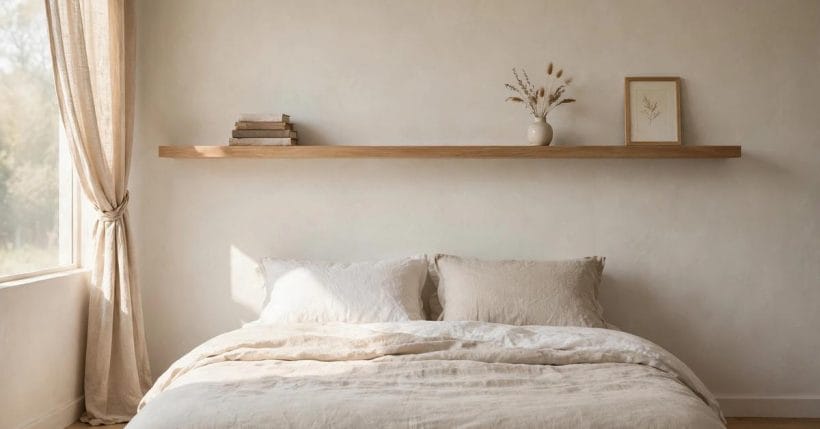
The wall above a bed is often the largest empty surface in a bedroom, and it is also the one most people hesitate to use. A headboard fills part of it, artwork fills a little more, and the rest stays blank because anything hung over a sleeping person needs to feel completely safe and settled. A floating shelf above the bed answers that hesitation well. It gives the wall a purpose without the visual weight of a cabinet, it keeps everyday favourites within reach, and it turns a plain sleeping wall into a composed part of the room.
A bedroom shelf works best when it is treated as part of the bedroom rather than as an isolated decoration. Its length should relate to the bed beneath it, its height should suit the way people sit up and lie down, and the things on it should belong in a restful room. When those relationships are right, the shelf looks as though it was always meant to be there. When they are wrong, the wall feels busy, top-heavy, or uneasy, even if every object on the shelf is beautiful on its own.
This guide looks at the bedroom floating shelf from every angle that matters in a real bedroom: layout, height, length, materials, colour, styling, lighting, small rooms, and the practical details that keep the arrangement safe and easy to live with. Every idea here is for a bedroom wall. Wall-fixing work that is structural, or that involves anything hidden inside the wall, should be left to a qualified professional, and that advice runs through the whole guide.
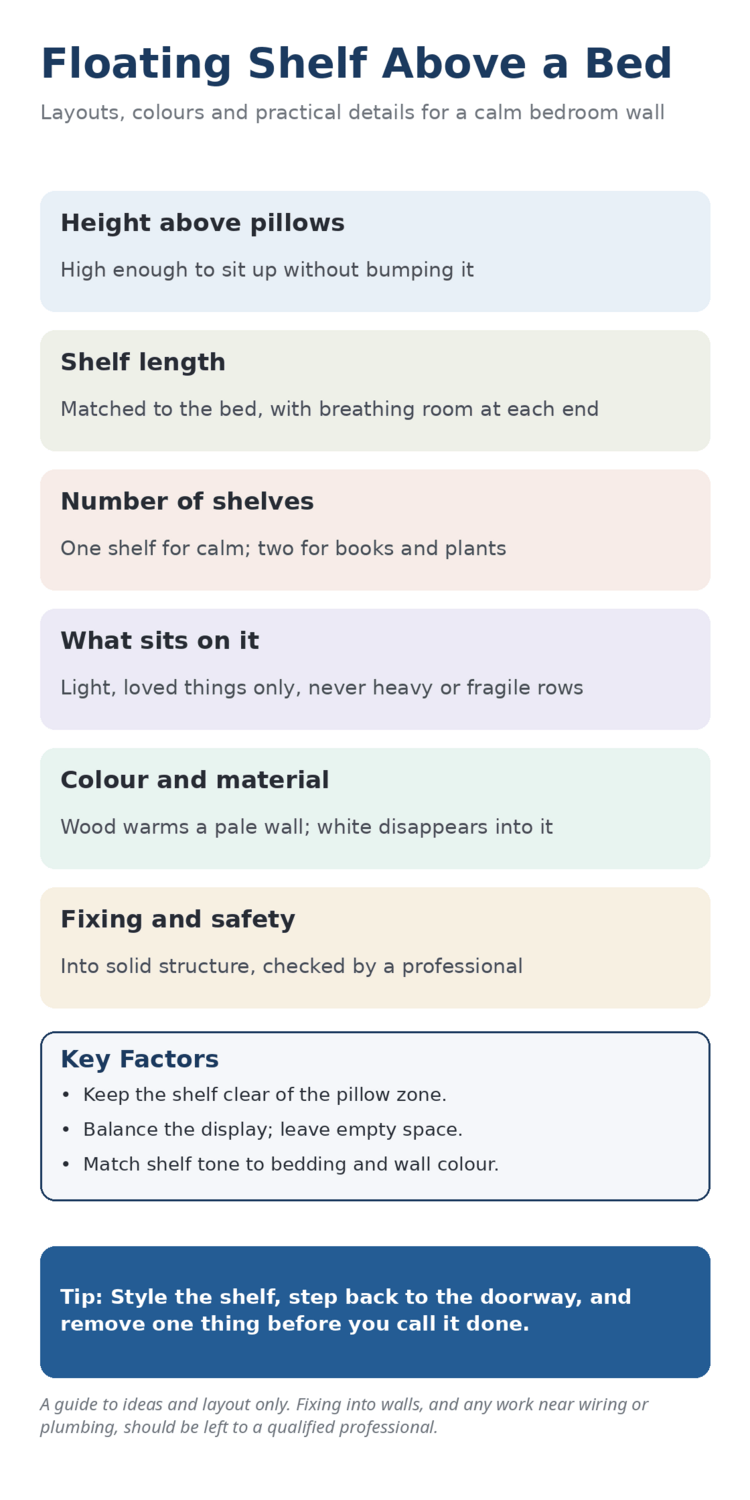
| Item | What it is |
|---|---|
| Why the Wall Above the Bed Earns a Shelf | A bedroom usually has limited floor space and plenty of wall space, so lifting storage and display onto the wall is a natural move. |
| One Shelf or Two: Choosing the Layout | The first layout decision is how many shelves the wall should carry. |
| Finding the Right Height and Length | Height is the detail that decides whether a bedroom shelf feels comfortable or threatening. |
| Materials and Colours That Suit a Bedroom | Timber is the most forgiving material for a bedroom shelf, because it brings warmth to a room that is meant to feel restful. |
| Styling the Shelf So It Stays Calm | Styling a bedroom shelf is an exercise in restraint. |
| Books, Plants and Keepsakes: What Belongs Above a Bed | Books are the most natural residents of a bedroom shelf, because the bed is where many people read. |
| Lighting the Shelf Without Waking the Room | Light transforms a bedroom shelf, but bedroom light needs to stay gentle. |
| Small Bedrooms and Tiny Houses | In a small bedroom, a shelf above the bed is not a decoration but a piece of the storage plan. |
| Guest Rooms, Kids' Rooms and Shared Bedrooms | A bedroom shelf in a guest room should be styled for a stranger, not for the owner. |
1. Why the Wall Above the Bed Earns a Shelf
A bedroom usually has limited floor space and plenty of wall space, so lifting storage and display onto the wall is a natural move. A floating shelf above the bed uses a stretch of wall that would otherwise stay empty, and it does so without taking a single step of floor. In a small bedroom that difference matters. A bedside table can hold a book and a glass of water, but a shelf can hold the books, the plant, and the photograph as well, leaving the table clear for the night.
The shelf also changes how the bed itself reads in the room. A bed without anything above it can look adrift against a large blank wall, while a shelf gives the eye a horizontal line to rest on and ties the bed to the wall behind it. The effect is similar to a headboard, but lighter and more flexible. A shelf can be restyled in minutes, while a headboard is a commitment that stays put for years.
There is a calmer reason too. Bedrooms work best when everything in them has a settled place. Loose objects pile on bedside tables, windowsills, and the top of a dresser, and the room slowly feels cluttered even when it is tidy. A shelf above the bed gives those wandering objects a home at eye level, where they can be enjoyed rather than stacked. The room feels more ordered because the shelf has drawn a clear boundary around what belongs on display.
For anyone planning a bedroom from scratch, the shelf is worth considering alongside the bed itself rather than as an afterthought. Thinking about the wall above the bed at the same time as the bedding, the wall colour, and the lighting means the shelf can be sized and finished to match, instead of being squeezed into a scheme that was finished without it. A guide to tiny bedroom ideas shows how the same thinking helps in the smallest rooms, where every wall decision carries extra weight.
2. One Shelf or Two: Choosing the Layout
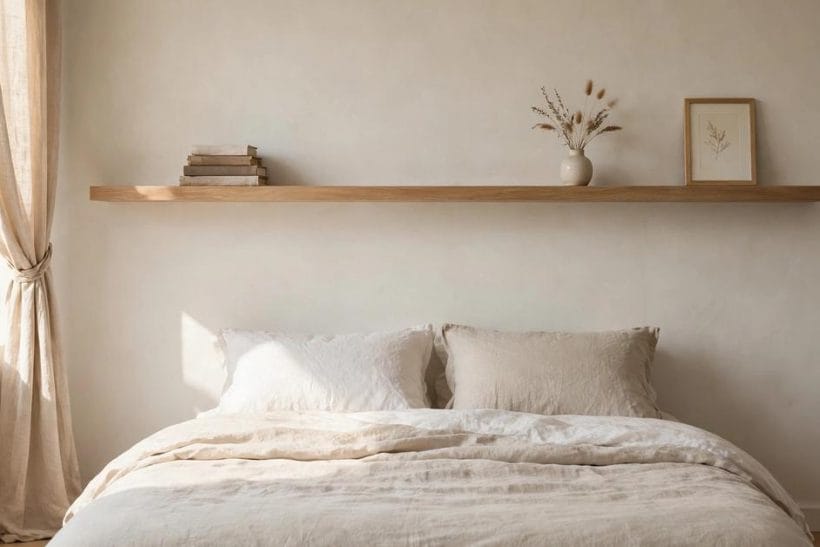
The first layout decision is how many shelves the wall should carry. A single long shelf is the calmest option and usually the best starting point. It makes one clean line above the bed, it is easy to style, and it leaves plenty of empty wall around it so the room can breathe. A single shelf suits bedrooms that already have plenty of pattern or colour elsewhere, because it adds interest without adding busyness.
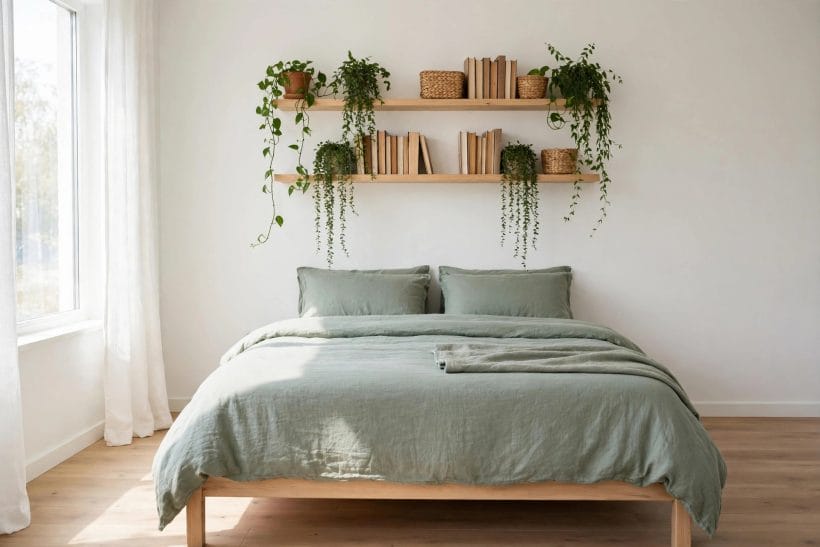
Two stacked shelves suit a bedroom where the shelf is meant to work harder. The lower shelf can hold the books and objects reached most often, while the upper shelf holds plants, baskets, and pieces that are there to be looked at rather than handled. Stacked shelves also suit a tall wall, where a single shelf would look lost halfway up. The gap between the two shelves matters as much as the shelves themselves: enough room for books to stand upright on the lower shelf, and enough air above them that the upper shelf does not press down on the display.
A pair of short shelves, one above each side of the bed, is a third layout worth considering, especially in a bedroom shared by two people. Each person gets a small display of their own, and the centre of the wall stays open for artwork or for nothing at all. This layout works best over a wide bed, where two short shelves still read as a deliberate pair rather than as two unrelated fragments.
Whatever the number, the layout should be decided before anything is fixed to the wall. Tape outlines on the wall, or paper templates cut to the shelf size, let the arrangement be judged from the doorway and from the bed itself. A layout that looks balanced on paper can feel crowded in the room, and a layout that seems sparse can turn out to be exactly right once the bedding and pillows are in place. Live with the outlines for a day or two if possible, and let the room argue its own case.
3. Finding the Right Height and Length
Height is the detail that decides whether a bedroom shelf feels comfortable or threatening. The shelf must sit high enough that a person can sit up in bed, lean back against the pillows, and turn over without any sense that something is looming overhead. At the same time it must sit low enough to feel connected to the bed rather than floating somewhere near the ceiling. The right height is found by sitting on the bed, not by standing in the doorway, because the shelf is lived with from the bed more than from anywhere else.
Pillows complicate the picture, because pillows pile higher than the mattress and change the shape of the sleeping area. A shelf judged against a bare mattress will sit lower relative to a dressed bed with plump pillows, so height should always be checked with the bed fully made. If the shelf is meant to hold books that will be reached from the bed, it should also be reachable without stretching or standing on the mattress. A shelf that can only be reached by climbing onto the bed will not be used, and its contents will gather dust.
Length follows a similar logic of relationship. A shelf that runs close to the width of the bed looks intentional and grounded, while a shelf much shorter than the bed can look like an afterthought and a shelf much longer can overwhelm the wall. Breathing room at each end of the shelf keeps the arrangement from pressing against the corners of the room, and it gives the eye somewhere to rest. In a narrow room, a slightly shorter shelf often looks better than one stretched to fill every available stretch of wall.
When the bed sits under a sloping ceiling or beside a window, the usual relationships bend a little. A sloping ceiling may push the shelf lower on one side, and a window may steal the centre of the wall entirely. In those rooms, an off-centre shelf or a shorter shelf on the clear stretch of wall usually beats forcing a symmetrical arrangement into a space that is not symmetrical. The bedroom window itself deserves its own planning, and bedroom window placement is worth reading alongside this section when a window shares the bed wall.
4. Materials and Colours That Suit a Bedroom
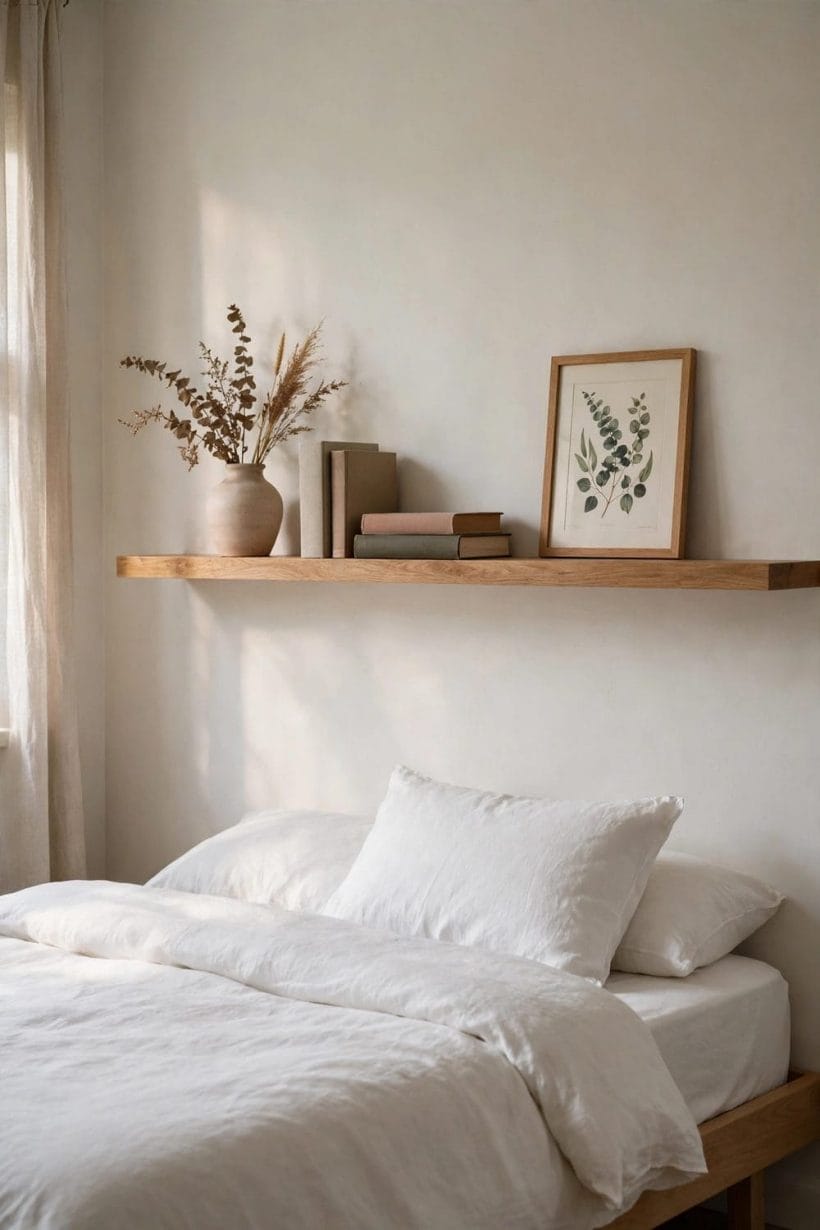
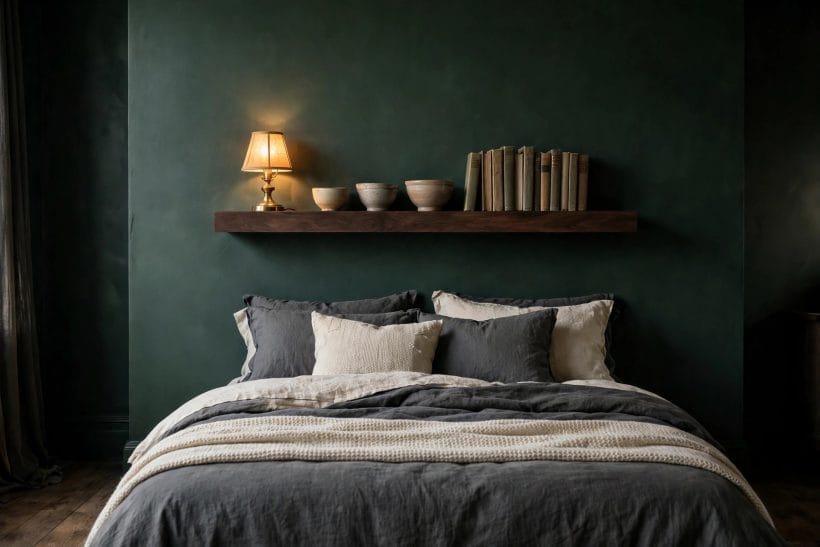
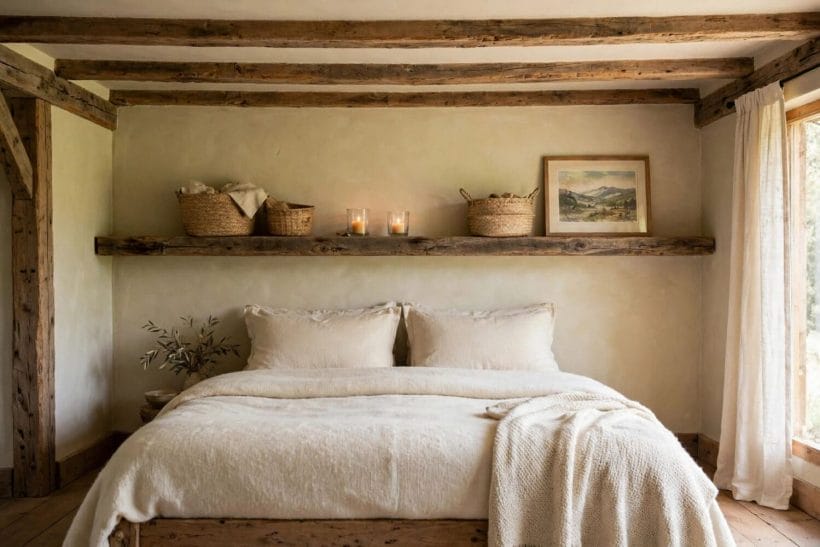
Timber is the most forgiving material for a bedroom shelf, because it brings warmth to a room that is meant to feel restful. Light oak suits pale walls and white bedding, walnut suits deeper wall colours and moody bedrooms, and reclaimed timber suits rooms with other natural textures such as linen, wool, and woven baskets. The grain of the timber does a lot of the decorative work on its own, which means the shelf can stay simple while the room still feels layered.
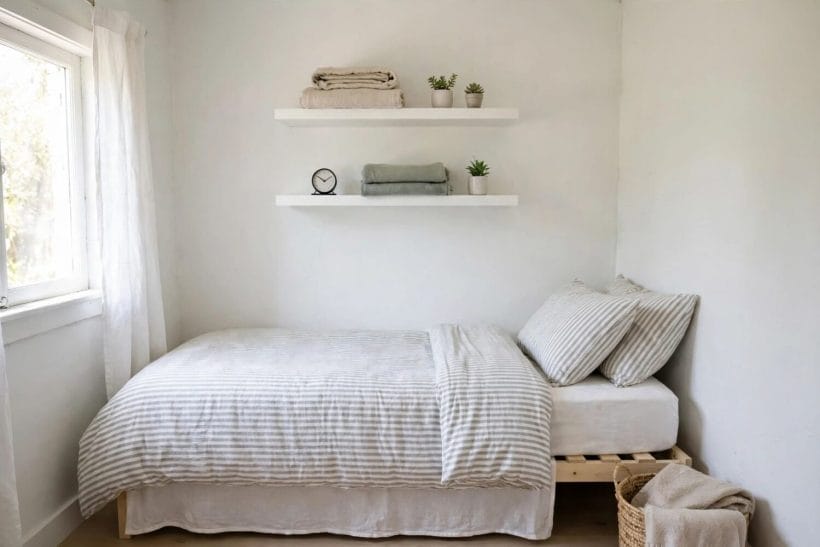
Painted shelves behave differently. A white shelf on a white wall almost disappears, leaving the objects on it to carry the display. That is an advantage in a small or busy bedroom, where a strong shelf colour would add one more competing element. A shelf painted to match the wall colour works the same way, quietly. A shelf in a contrasting colour, such as black against a pale wall, makes a deliberate statement and suits a bedroom where the shelf is meant to be a feature rather than a background.
Colour on the shelf should be judged against the bedding as much as against the wall, because the shelf and the bed are seen together every time someone enters the room. A shelf that clashes with the bedding will fight the bed for attention, while a shelf that echoes one bedding colour will pull the whole wall together. This is one reason neutral shelves are so popular above beds: they let the bedding change with the seasons without the shelf suddenly looking wrong.
Finishes matter for practical reasons as well. A bedroom shelf is handled, dusted, and leaned over, so a finish that marks easily or shows every fingerprint will age badly. Matte and satin finishes are more forgiving than high gloss, and they suit the soft light of a bedroom better. Whatever the material, the shelf itself should feel solid and well made when touched, because a shelf over a sleeping person is trusted in a way that a hallway shelf never is. A room where wall colour and shelf tone are planned together, such as a white wall grey trim bedroom, shows how quietly this relationship can work.
5. Styling the Shelf So It Stays Calm
Styling a bedroom shelf is an exercise in restraint. The shelf is above a place of rest, so it should look restful. A good rule is to leave more empty shelf than filled shelf. Empty space lets each object breathe, and it stops the display from feeling like storage that has spilled upwards. When every stretch of shelf is filled, the eye has nowhere to rest, and the wall starts to feel busy in exactly the room where calm matters most.
Grouping helps. Objects look more composed in small groups of two or three than in a long, even row, and varying the heights within a group keeps the display from looking like a line-up. A stack of books lying flat can anchor one end of a shelf, a vase can rise above it, and a small framed print leaning against the wall can soften the other end. The groups should not match each other exactly. A little asymmetry feels natural, while perfect symmetry can feel staged and rigid above a bed.
Repetition is the other quiet tool. Repeating a material, a colour, or a shape across the shelf ties the groups together without making them identical. Two ceramic pieces in different sizes, or two wooden objects with the same tone, create a thread that runs along the shelf. The thread should be subtle. If the repetition is too obvious, the shelf starts to look like a shop display rather than a personal collection.
The view from the bed matters as much as the view from the doorway. Lying down, a person sees the underside of the shelf and the lower edges of the objects on it, so objects with an interesting silhouette or a pleasing base earn their place. Anything that looks untidy from below, such as tangled cables or rough undersides, should be tidied or removed. The art of arranging small displays is covered in more detail in arranging vignettes, and its grouping ideas translate directly to the wall above a bed.
6. Books, Plants and Keepsakes: What Belongs Above a Bed
Books are the most natural residents of a bedroom shelf, because the bed is where many people read. A small row of books that are actually being read, or returned to often, belongs there more than a full library does. Heavy rows of large books are a poor choice above a sleeping person, both because of their weight and because they make the shelf look loaded. A few books, standing upright with a little room to breathe, look better and are safer than a shelf packed end to end.
Plants soften a bedroom shelf beautifully, but they need honest assessment. Trailing plants look wonderful spilling over the edge of a shelf, yet they also drop leaves onto pillows and bedding, and they need watering in a place that is awkward to reach. Small potted plants that hold their shape, or a single vase of dried stems, give the same softness with far less upkeep. Any plant above a bed should be light, secure in its pot, and easy to lift down for watering without standing on the bed.
Keepsakes and photographs belong on a bedroom shelf only when they are light, stable, and not precious enough that a fall would be a disaster. A framed photograph leaning against the wall, a small ceramic piece, or a woven basket holding soft things are all good choices. Glass objects, heavy ornaments, and anything with sharp edges are poor choices above a bed, however beautiful they are elsewhere in the house. The question to ask of every object is simple: would it matter, and would it hurt, if it fell? If the answer to either part is yes, it belongs on a lower surface.
Seasonal rotation keeps the shelf feeling alive without letting it accumulate. Changing one or two objects when the bedding changes, or when a new plant comes into the house, stops the shelf from becoming a static display that nobody looks at anymore. The shelf above a bed should feel like part of an occupied room, not like a museum exhibit, and a little change now and then is what keeps it that way.
7. Lighting the Shelf Without Waking the Room
Light transforms a bedroom shelf, but bedroom light needs to stay gentle. A small lamp on the shelf itself can cast a warm pool over the display in the evening, and it doubles as a reading light for the bed below. The lamp should be small and stable, with its cable routed neatly so nothing dangles over the pillows. A lamp that is too tall will crowd the shelf and may be knocked when the shelf is dusted or restyled.
Wall lights on either side of the bed often do a better job than light mounted on the shelf, because they wash the wall and the shelf together without adding clutter to the display. A soft, warm light flatters timber, linen, and ceramics, while a harsh white light makes the same objects look cold and clinical. Dimming matters in a bedroom more than anywhere else, because the room moves between bright mornings and dark nights, and the shelf should look good in both.
Candles appear on many styled shelves above beds, and they deserve a cautious note. A candle on a shelf above bedding is a fire risk that no styling benefit can justify, especially in a room where people sleep. If the look of candlelight is wanted, flameless candles give the glow without the flame, and they can be used freely. Real candles belong on a stable surface away from bedding, curtains, and anything that could catch, and never on a bedroom shelf.
Daylight deserves planning too. A shelf on a wall that catches strong morning sun will fade book spines and dry out plants, while a shelf in permanent shade can look dull. The shelf should be judged in the light the bedroom actually gets, at the times the room is used most. Morning light on a shelf is a pleasure; harsh midday sun on the same shelf is a slow kind of damage.
8. Small Bedrooms and Tiny Houses
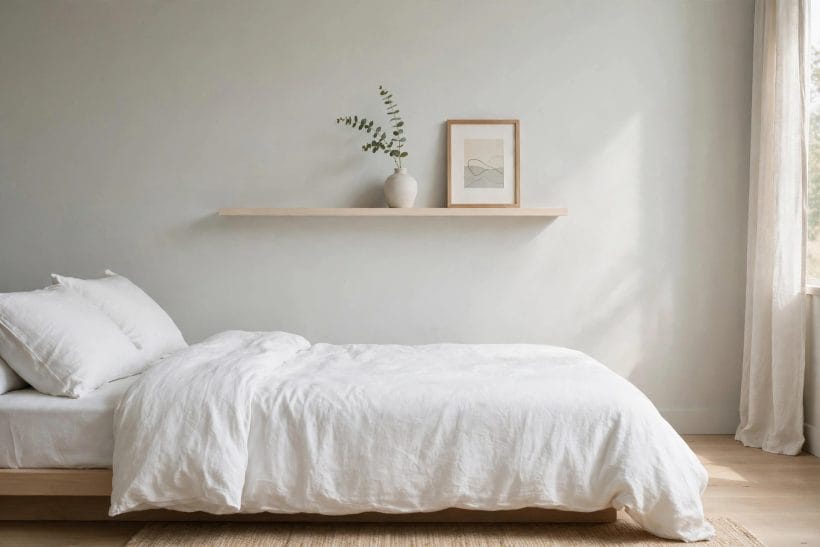
In a small bedroom, a shelf above the bed is not a decoration but a piece of the storage plan. When floor space is scarce, the wall above the bed may be the only stretch of wall free for storage at all, and the shelf earns its place by holding things that would otherwise live on the floor. The discipline matters even more here: a small room forgives a cluttered shelf less than a large room does, because the shelf is always in view.
Tiny houses sharpen every one of these decisions. The bedroom in a tiny house is often a sleeping nook rather than a separate room, and the shelf above the bed may sit close to the ceiling or under a loft edge. In that setting, a single shelf with a few light, useful objects beats a grand display, and the fixing becomes even more important, because the wall structure in a compact build may differ from that of a conventional house. Professional advice on fixing is not a formality here; it is the step that makes the shelf trustworthy.
Small rooms also benefit from shelves that match the wall colour, because a shelf that blends in does not chop the wall into pieces. A white shelf on a white wall, holding a few pale objects, can add storage without making the room feel smaller. The same room with a dark, heavy shelf can feel as though the ceiling has dropped. Colour is doing structural work in a small bedroom, not just decorative work.
For broader ideas about making compact sleeping spaces work, tiny house interiors and tiny house designs both show how wall storage, sleeping nooks, and calm colour work together. The shelf above the bed is one move inside that larger way of thinking, and it works best when the rest of the room is thinking the same way.
9. Guest Rooms, Kids’ Rooms and Shared Bedrooms
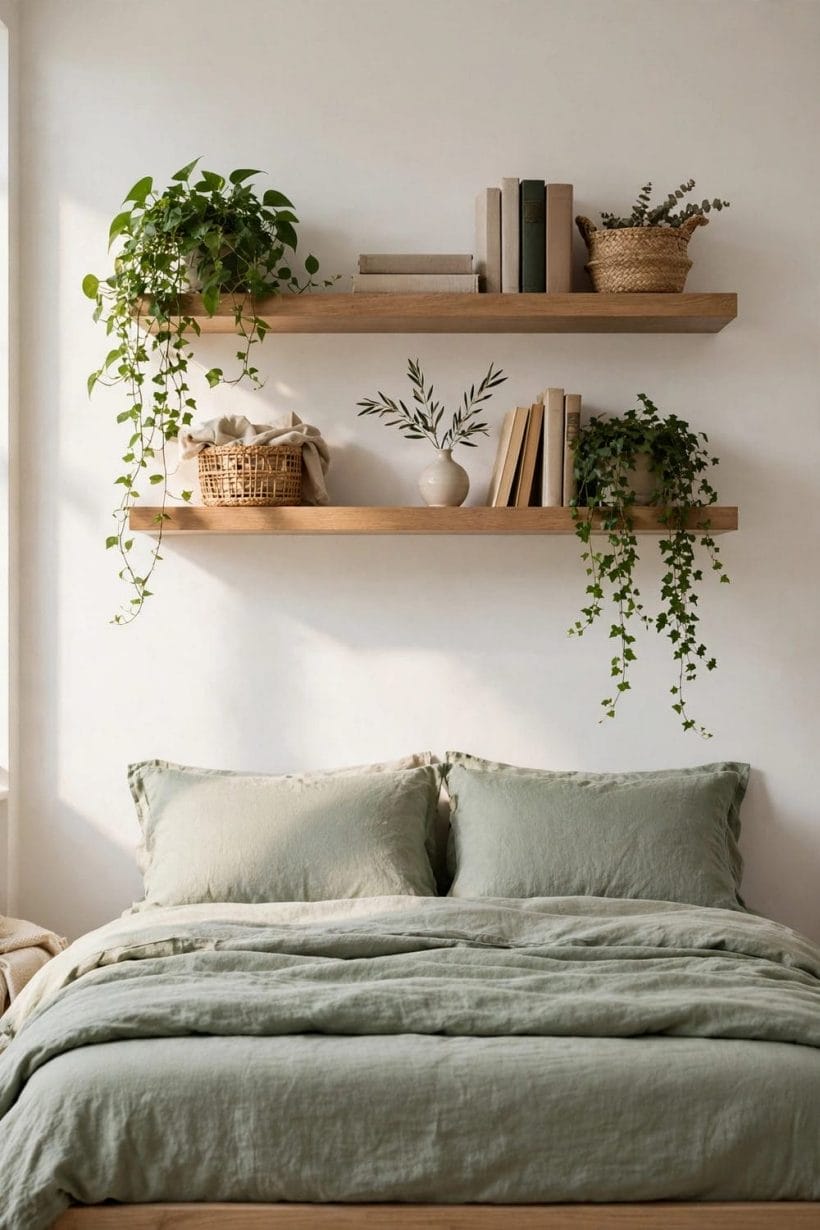
A bedroom shelf in a guest room should be styled for a stranger, not for the owner. Guests need a clear bedside surface, a place for a glass of water, and a room that feels welcoming without feeling personal. A shelf with a few neutral objects, a small plant, and one or two books suits a guest room well, because it makes the room feel finished without making the guest feel like an intruder in someone else’s collection. Anything fragile or precious should stay out of a guest room entirely.
Kids’ rooms need a stricter eye. A shelf above a child’s bed should hold only light, soft, unbreakable things, and it should be fixed with the same professional care as any shelf in the house, checked regularly as the child grows. Heavy books, glass, and anything that could fall onto a sleeping child have no place above a child’s bed. In many kids’ rooms, the better answer is a shelf on a different wall, leaving the wall above the bed for artwork or for nothing at all.
Shared bedrooms, where two people sleep in one bed, need a shelf that serves both sleepers fairly. A single long shelf can hold a mix of both people’s favourites, while a pair of short shelves gives each person their own stretch. The conversation about who gets what space is worth having before the shelf is fixed, because a shelf that feels like one person’s display in a shared room will quietly irritate the other person every night.
Rooms below ground level or converted from other uses bring their own constraints, and a shelf above the bed is no exception. Low ceilings, uneven walls, and damp-prone surfaces all change what fixing is possible and what the shelf can safely hold. A basement bedroom guide is a useful companion here, because it covers the room conditions that a shelf plan has to respect before anything is hung.
10. Mistakes to Avoid and How to Fix Them
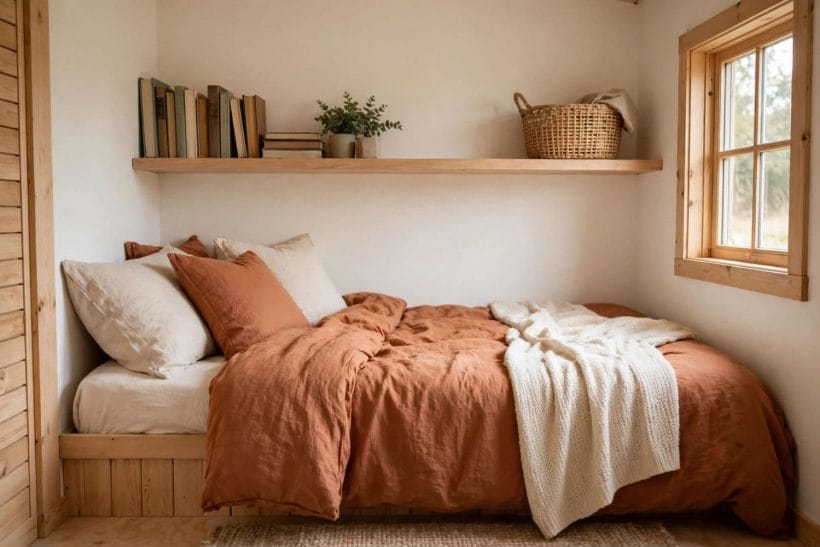
The most common mistake is overloading the shelf. A bedroom shelf that is packed from end to end looks like storage, not display, and it raises a safety question every time someone looks at it. The fix is simple and almost always improves the room: take everything off, put back only the pieces that earn their place, and leave the rest of the shelf empty. Most overloaded shelves need only half their contents removed to look composed again.
The second mistake is hanging the shelf at the wrong height, usually too low. A shelf that crowds the pillows makes the bed feel enclosed and makes sitting up an exercise in caution. The fix is to move the shelf, which is worth doing properly rather than living with a shelf that annoys its owners every day. Moving a shelf means fresh fixing work, and where the wall structure is involved, that work belongs to a professional, not to a hopeful evening with a drill.
The third mistake is choosing objects for the shelf that belong somewhere else. Heavy books, glassware, and sharp or fragile pieces migrate onto bedroom shelves because there is nowhere else for them, not because they suit the wall above a bed. The fix is to find those objects a proper home on a lower, sturdier surface, and to let the bedroom shelf hold only what suits a restful room. A shelf is not a solution to a storage shortage elsewhere in the house.
The final mistake is fixing the shelf badly, or into a wall that cannot hold it. A floating shelf hides its fixings, which is part of its beauty and part of its risk: a failed fixing is invisible until it is too late. Any doubt about the wall, the fixings, or the load should be settled by a qualified professional before the shelf goes up, and the shelf should be checked now and then afterwards, just as any fixture in a bedroom should be. A shelf that is secure is a shelf that can be enjoyed without a second thought, and that peace of mind is the whole point of the exercise.
Final Considerations
A floating shelf above a bed succeeds when it is quiet, secure, and personal in equal measure. Quiet, because a bedroom should rest the eye. Secure, because anything above a sleeping person must be beyond doubt. Personal, because the objects on the shelf should mean something to the people who sleep beneath it, not merely fill a rectangle on a wall.
Start with the layout and the height, judge them from the bed and from the doorway, and fix the shelf properly with professional help where the wall demands it. Style with restraint, leave empty space, and choose light, loved objects over heavy or fragile ones. Revisit the shelf when the seasons change, and let it evolve with the room instead of freezing into a display that nobody notices anymore.
Done well, the shelf above the bed becomes one of the most satisfying small moves in a bedroom. It takes the room no floor space, it gives wandering objects a home, and it turns the largest blank wall in the room into a composed, restful part of the house. That is a lot of work for a single board on a wall, and it is exactly why the idea has endured.




0 Comments