
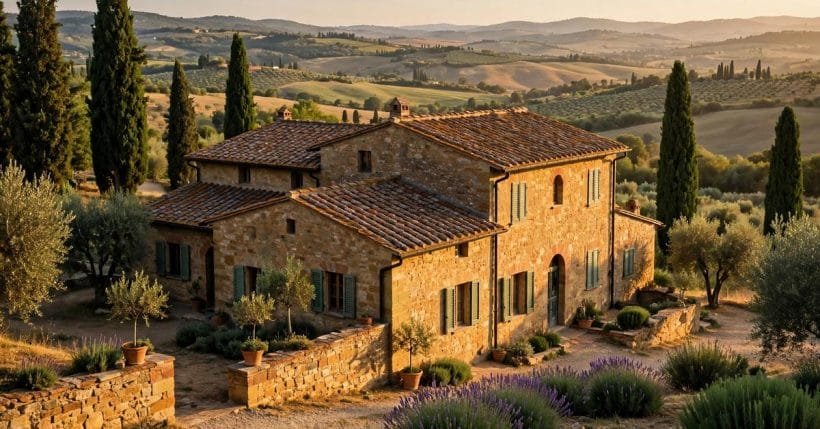
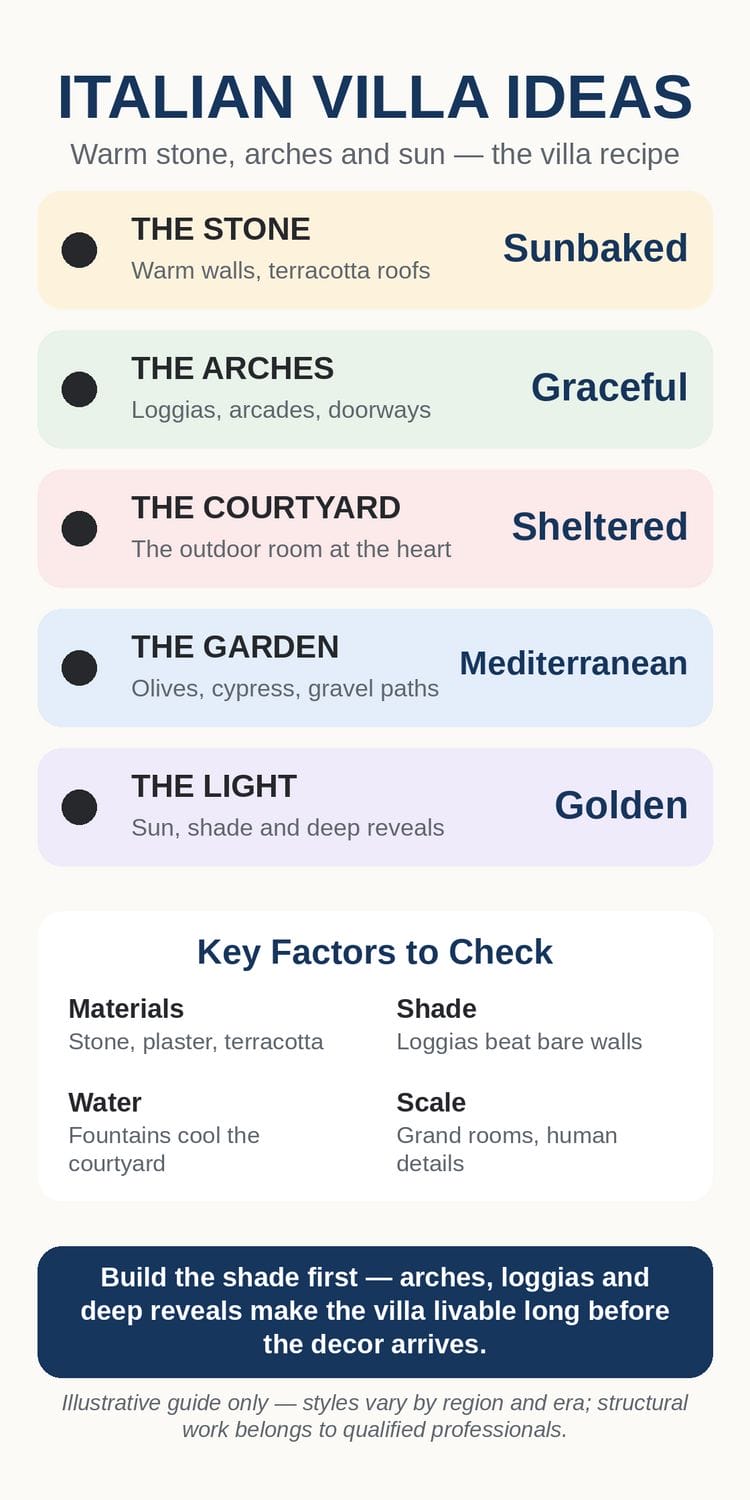
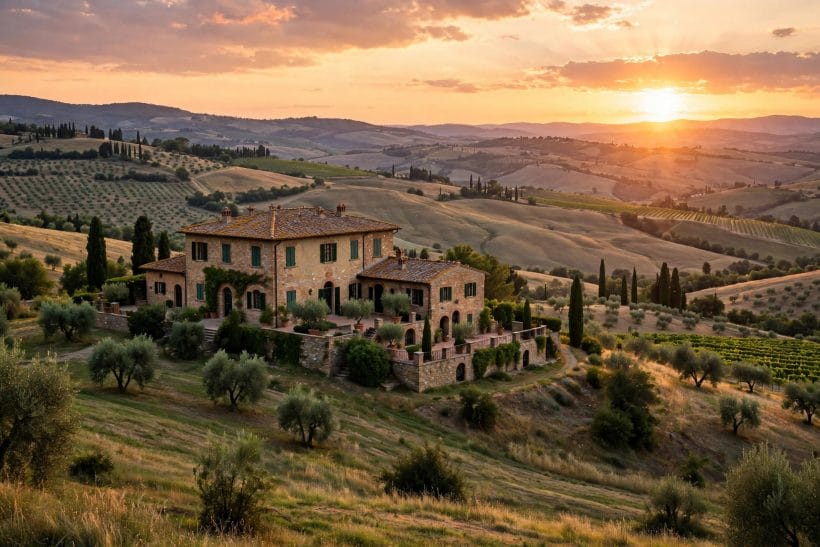
An Italian villa is not a single house but a way of building that has lasted for centuries: thick walls that keep out summer heat, arched openings that frame shade and view, a courtyard that acts as an outdoor room, and a garden that works with the climate rather than against it. From the stone farmhouses of Tuscany to the grander villas of the Veneto, the elements repeat, adapted to place and to purse, and that repetition is what makes the style so recognisable — and so borrowable.
This post surveys Italian villa home designs through those elements, rather than through any single famous house. It is about what makes a villa feel Italian, how the pieces fit together, and how the same ideas can shape a new house or a renovation far from Italy, without pretending to be something it is not.
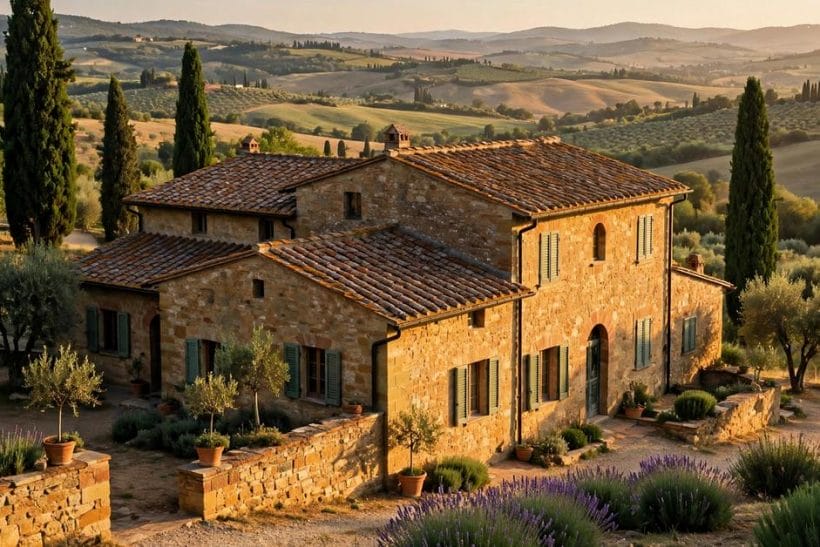
The villa’s first lesson is that it is designed from the climate outward. Walls are thick because thick walls stay cool; windows are shuttered because shutters control sun and air; courtyards are enclosed because enclosure creates shade. A villa that copies the look without the logic — thin walls, unshaded glass, no outdoor room — will look Italian in a photograph and feel wrong to live in. The style works because it answers heat, light and landscape, not because it wears a costume.
1. Stone and Plaster: Walls That Hold the Day
Villa walls are usually stone, plaster or a combination of the two, in warm tones that sit comfortably in strong sunlight. Stone gives texture and mass; plaster gives a smooth, sun-reflecting surface that can be tinted to ochre, cream or terracotta. Both age gracefully, weathering rather than wearing out, and both suit the villa’s proportions, which favour breadth over height.
For a new house borrowing the style, the wall material should suit the local climate as well as the look. In a cooler or wetter climate, the same warm tones can be achieved with renders and claddings suited to local conditions, while the proportions — long, low, grounded — carry the villa feeling more than any single material does. The wall’s job is to look settled, as though the house has always been there.
Plaster also takes colour beautifully, and villa plaster is rarely pure white: it is warmed with ochre, umber or rose, so the house glows rather than glares in strong sun. A tinted plaster that matches the local earth will always look more settled than a brilliant white that fights the landscape.
2. Terracotta Roofs: The Villa’s Signature
No element says Italian villa faster than a terracotta roof. The curved tiles, the warm colour, the low pitch and the deep eaves together give the house its silhouette, and they work hard: the tiles shed rain, the pitch suits a dry climate, and the overhang shades the walls below. A roof without overhang leaves walls exposed to sun and rain alike, and loses much of the style’s logic along with its look.
Roof pitch and tile profile vary by region, from the gentle slopes of the south to the steeper roofs of the north, and a faithful borrowing respects that range rather than picking the most dramatic profile regardless of place. Where real terracotta is impractical, concrete tiles in a matching profile and colour can carry the silhouette, provided the pitch and the eaves are kept honest.
The eaves deserve as much attention as the tiles. Deep eaves shade the walls, protect the plaster from rain streaks, and give the roofline its generous shadow, which is half the villa’s silhouette. A roof with skimpy eaves looks mean no matter how good its tiles are.
3. Arches and Loggias: Shade as Architecture
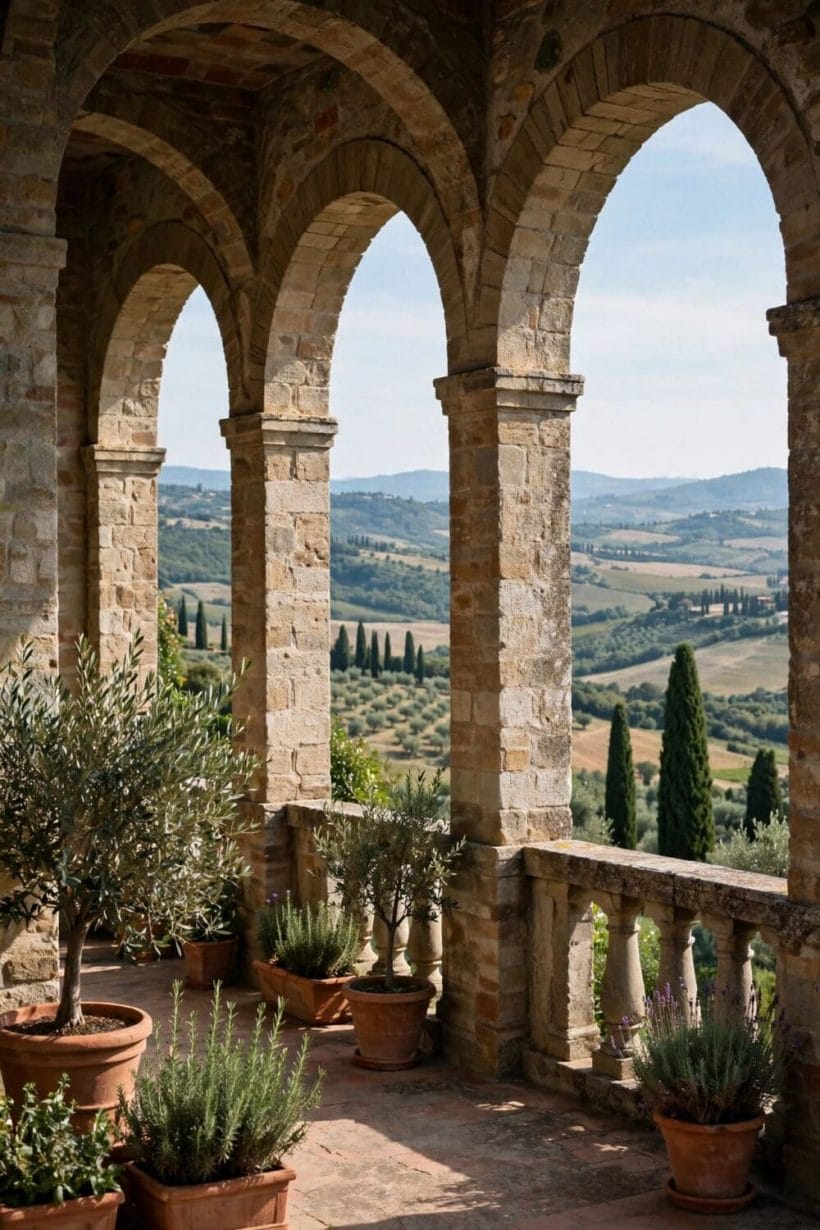
The arch is the villa’s most graceful device, and its most practical. Arched doorways, windows and loggias span openings without steel, frame views, and create shaded thresholds between inside and out. A loggia — a covered gallery open on one side — is the villa’s great gift to outdoor living: a room that is outside yet sheltered, cool at midday and usable in rain.
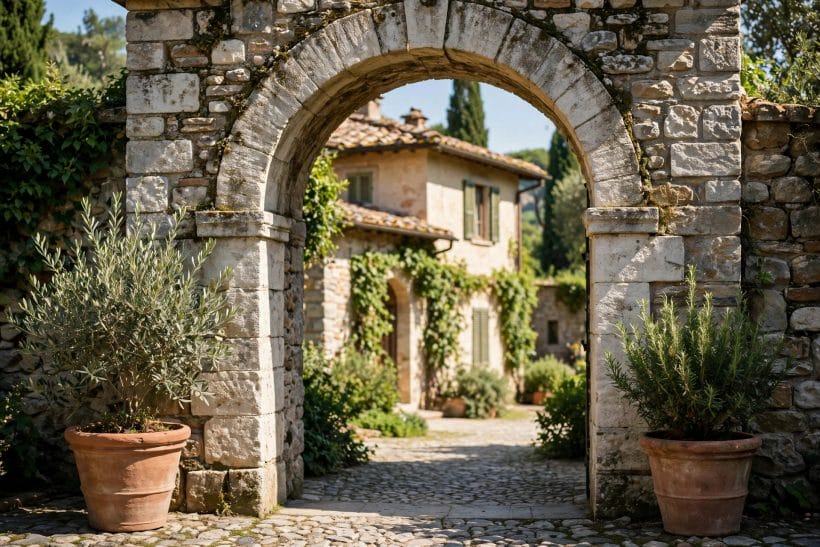
In a new design, even a single arched opening — a doorway, a garden gate, a niche — can carry the villa note without turning the house into a pastiche. A loggia need not be grand: a deep porch with an arched opening, a covered terrace along one wall, or a pergola with solid piers all give the same shaded in-between space that makes villa living work.
Arches also frame views in a way flat openings cannot: an arched doorway onto a garden turns the garden into a picture, and a row of arches along a loggia turns a walk into a gallery. The curve slows the eye, which is exactly what a view deserves.
4. The Courtyard: The Outdoor Room
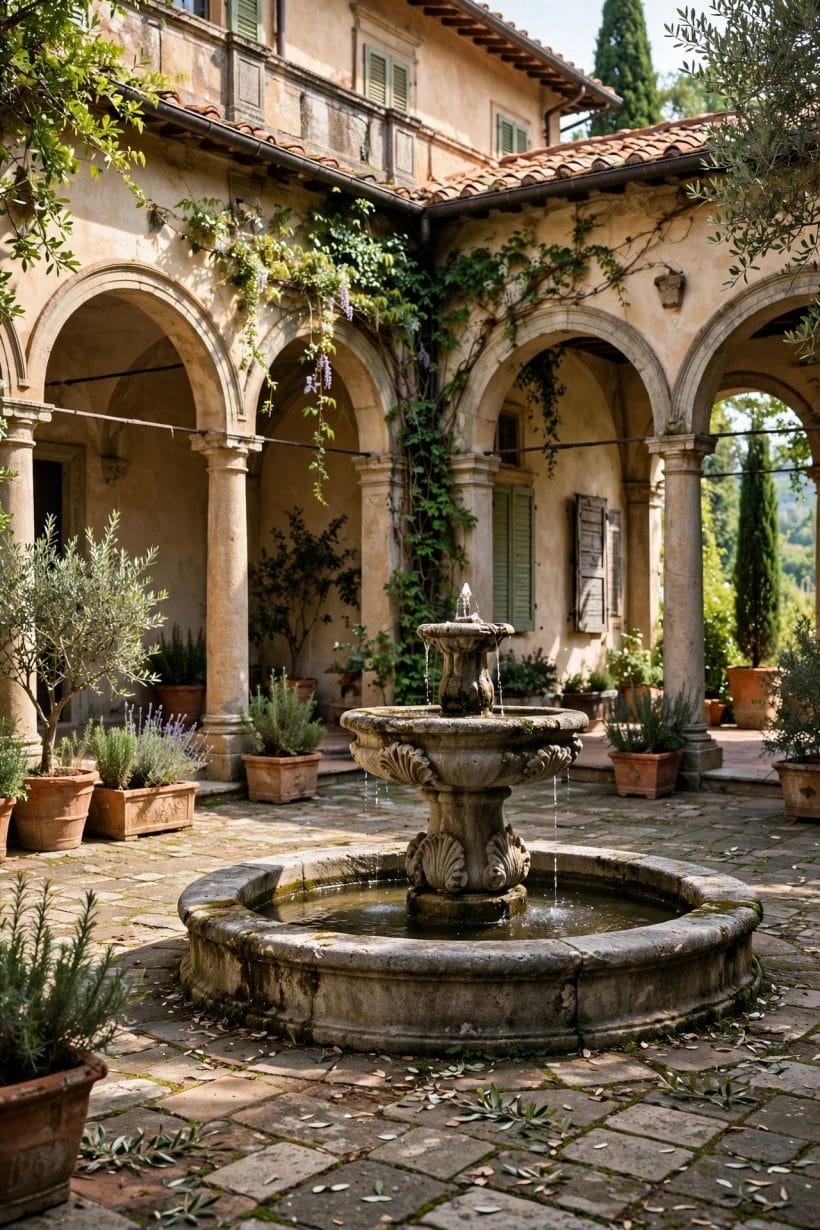
The courtyard is the villa’s heart. Enclosed on three or four sides, it is private, sheltered from wind, and shaded for much of the day, which makes it the most used outdoor space a villa has. A fountain cools the air and masks noise; potted plants soften stone; a table and chairs turn it into a dining room for half the year.
Even a small courtyard — a walled garden off a kitchen, a patio enclosed by the house’s own wings — can give a modern house the same quality. The essentials are enclosure, shade and a reason to be there: water, planting, seating, or all three. A courtyard that is merely a lightwell, with nothing to do in it, misses the point; a courtyard with a chair in the shade fulfils it.
A courtyard fountain need not be grand: a simple wall spout into a basin gives the sound of water, the cooling of evaporation, and a focal point, all without the maintenance of a large feature. Sound matters as much as sight in an enclosed space.
5. Shutters and Windows: Controlling Light and Air
Villa windows are tall, shuttered and deep-set, and each of those qualities serves the climate. Shutters close against midday sun and open to evening air; deep reveals shade the glass; tall openings draw warm air upward and out. The result is a house that manages heat without machinery, and windows that look considered rather than merely punched into a wall.
Shutters should be working, not decorative. A fixed shutter that cannot close is a costume, and it fools nobody for long. If real shutters are impractical, a deep reveal, an external blind or a shaded opening can do the same job honestly. The principle — control light and air at the window itself — matters more than the device.
Deep reveals also give a window a place for potted herbs or a candle, and they make the wall feel thick and protective even when it is not. A window set flush in a thin wall never gives that feeling, however good its shutters are.
6. The Garden: Olives, Cypress and Gravel
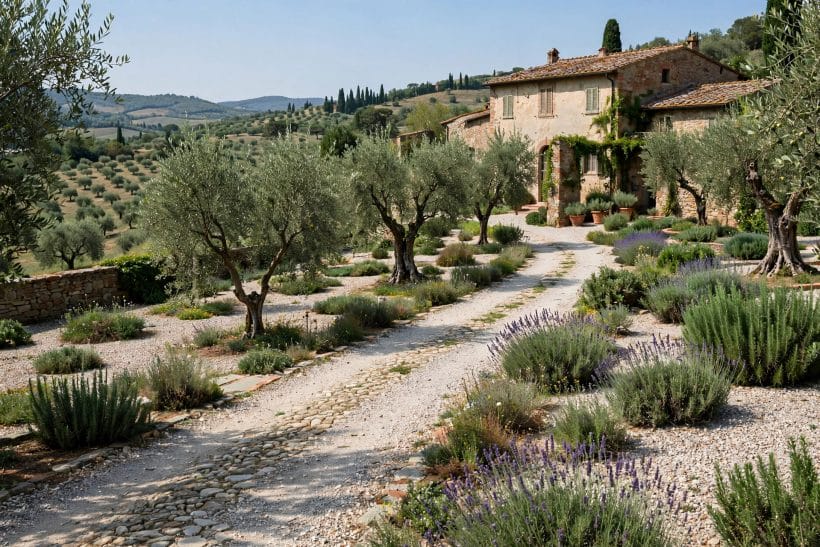
A villa garden is formal near the house and looser further away, and it uses plants that thrive in heat and poor soil: olives, cypress, lavender, rosemary, stone pine. Gravel paths crunch underfoot, drain freely and need no watering, which suits both the climate and the gardener. Lawns, where they exist, are small and close to the house, not sweeping expanses that demand constant water.
The garden’s structure matters more than its planting list. A terrace near the house, a path that leads somewhere, a tree that gives shade where it is wanted, and a boundary that encloses without imprisoning — these make a villa garden, in Italy or anywhere else. Choose plants for your own climate that give the same qualities — drought tolerance, structure, scent — rather than importing species that will struggle.
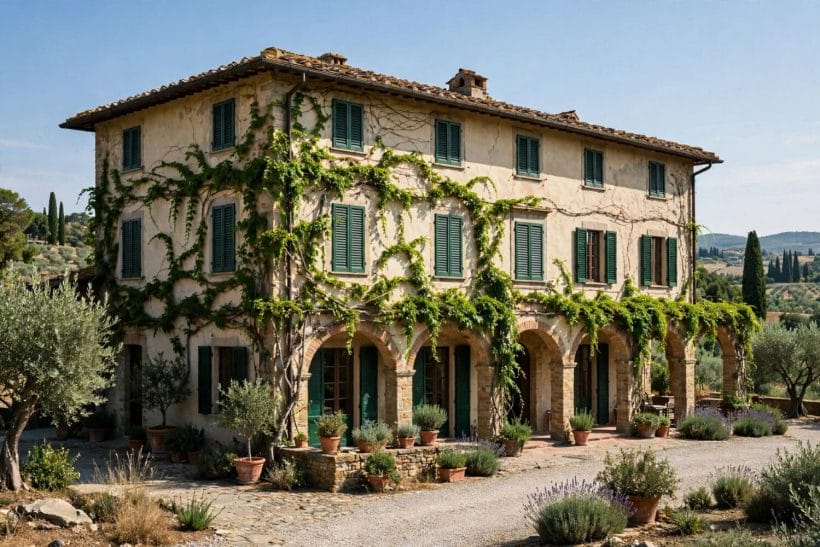
Terracing is the villa garden’s other great device: low stone walls that hold level ground on a slope, creating flat places for tables, beds and paths. A terraced garden feels intentional and old even when it is new, because it follows the land instead of fighting it.
7. Interiors: Cool, Simple and Grounded
Villa interiors follow the same logic as the outside: thick walls, tiled or stone floors that stay cool, beamed ceilings, and rooms that open to the courtyard or loggia. Colour comes from materials — terracotta, timber, plaster, stone — rather than from decoration, and furniture is solid, simple and built to last.
The interior’s generosity is in its proportions rather than its size. A room with a high ceiling, a deep window and a door to the outside feels grand at modest dimensions, while a large room with low ceilings and small windows feels mean. Borrow the proportions — height, light, connection to outside — and the interior will feel like a villa even at a smaller scale.
Beamed ceilings are the interior’s equivalent of the loggia: they give structure, shadow and warmth overhead, and they make a plain room feel crafted. Exposed beams suit the villa interior better than a flat plaster ceiling, which can feel anonymous by comparison.
8. The Terrace and the View: Living Outdoors
A villa’s terrace is where the house meets its landscape. It is usually level with the main rooms, so inside and outside flow together, and it is positioned for the view and for the evening sun rather than for the morning’s heat. A low wall, a balustrade or a row of pots gives it an edge without blocking the outlook.
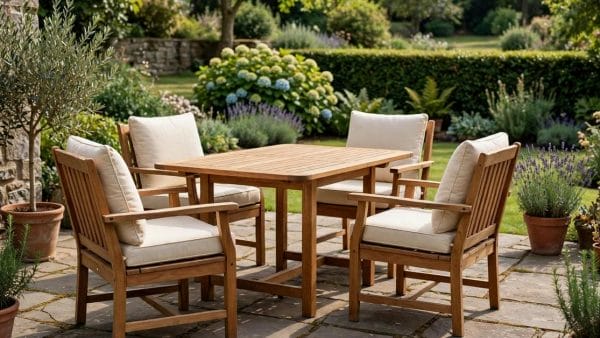
Terrace furniture should be solid and simple, suited to weather and to the house’s materials: timber, wrought iron, stone. Cushions in natural fabrics, a table large enough for a long meal, and shade — from a pergola, an umbrella or a tree — make the terrace the room the household actually lives in for half the year.
A terrace wall at seat height, rather than a full balustrade, keeps the view open while giving a sense of enclosure. Sitting with a low wall at your back and a view ahead is the villa terrace’s particular pleasure, and it is worth designing for deliberately.
9. Regional Variations: Tuscany, Veneto and Beyond
Italian villas are not one style but a family of regional ones. Tuscan villas favour stone, simple forms and farmhouse roots; Venetian villas favour symmetry, plaster and classical detail; southern villas favour whitewash, flat roofs and enclosed courtyards against fiercer sun. Each answers its own landscape, and each is worth knowing before borrowing.
The practical lesson is to borrow from the region closest to your own climate and landscape. A Tuscan stone farmhouse translates better to a dry, hilly site than a Venetian palace does, and a whitewashed southern courtyard suits a hot, bright site better than a dark stone pile. Regional honesty beats generic “Italian” styling every time.
For the Tuscan thread specifically, the Tuscan style bathroom post shows the same materials — travertine, dark wood, iron, warm colour — carried indoors, and it splits cleanly from this whole-house survey: that post is one room, this one is the house and its grounds.
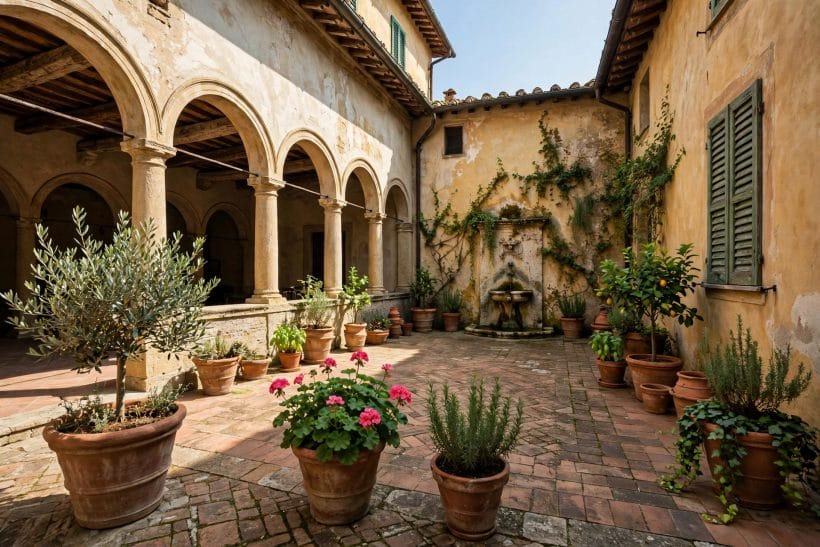
Venetian villas, with their symmetrical fronts and classical detailing, suit flatter, more formal sites, while the whitewashed courtyards of the south suit the hottest, brightest plots. Matching the regional model to the site is the difference between a borrowing that convinces and one that merely decorates.
10. Borrowing the Style Honestly
The difference between a villa-inspired house and a pastiche is honesty about what is borrowed and why. Borrow proportions, shade, materials and the courtyard idea, and adapt them to your climate, your site and your budget, and the house will feel coherent. Copy surface details — arches pasted onto a flat facade, shutters that do not shut, a tower with no purpose — and the house will feel like a stage set.
Start with the site: where is the sun, where is the wind, where is the view, where can a courtyard be enclosed? Answer those, and the villa elements will place themselves. Start with a catalogue of details, and they will fight each other. The villa tradition lasted because it answered real conditions; a borrowing that does the same will last too.
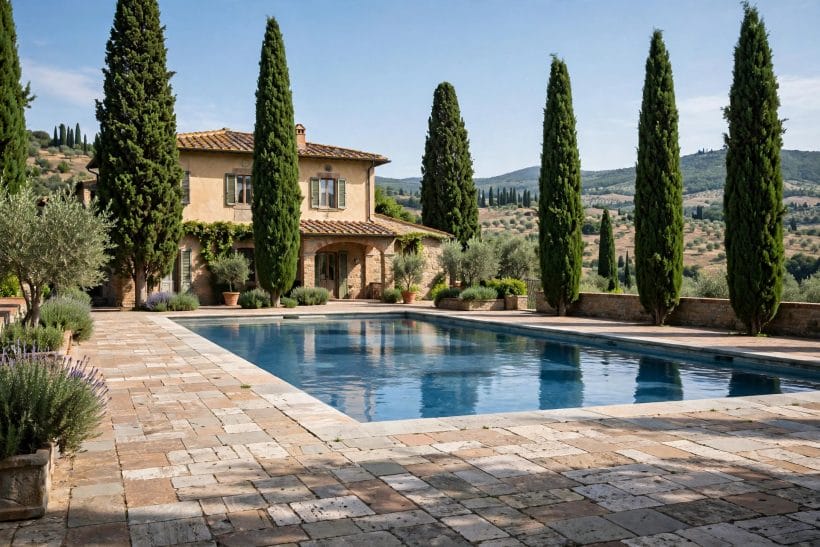
Honesty also means admitting what cannot be borrowed: a villa in a cold, wet climate will never behave like one in a dry, hot one, and its details should adapt — deeper roofs, better drainage, hardier planting — while keeping the proportions and the courtyard logic that make it a villa at all.
Final Considerations
Build from climate outward: thick walls, terracotta roofs, arches and loggias for shade, a courtyard at the heart, and a garden that suits its place. For the rooms within, Tuscan style bathrooms, brown living rooms, rustic fireplaces and fireplace walls carry the same warm materials indoors, while the dream homes survey and porch ideas show villas and their entries among other house styles. A villa is not a costume to wear but a logic to follow — and followed honestly, it works far from Italy too.

0 Comments