
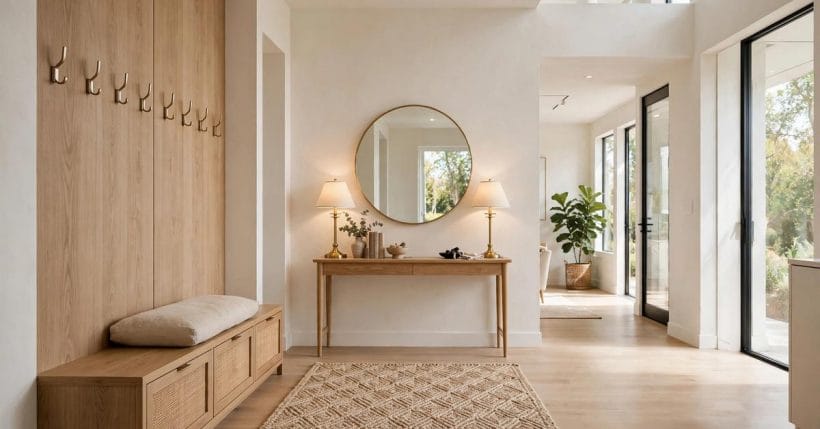
The entry hall is the hardest-working few square metres in the house: every arrival, departure, parcel, guest and muddy dog passes through it, usually at speed and usually carrying something.
These seventy-five ideas treat the hall as a room in its own right — its layout, furniture, storage, walls, light and floor — scaled for grand terraces and one-metre landings alike, with the daily pile planned for rather than apologised to.
1. Entry Hall Ideas at a Glance
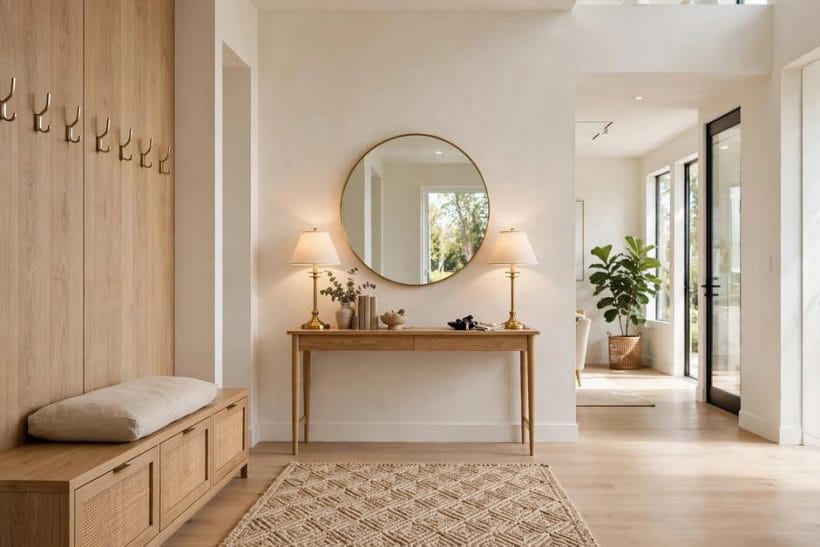
An entry hall is the interior threshold between the front door and the living rooms: part welcome, part airlock, part storage for everything the household carries.
| Question | Short answer |
|---|---|
| What is an entry hall, as opposed to an entryway? | The entryway is the whole entrance zone; the hall is the room-sized space inside it, connecting the door to the stairs and living rooms — this post treats the hall itself. |
| How wide should hall furniture be? | Shallower than living-room furniture, always chosen against the hall’s narrowest point so the passing lane stays clear. |
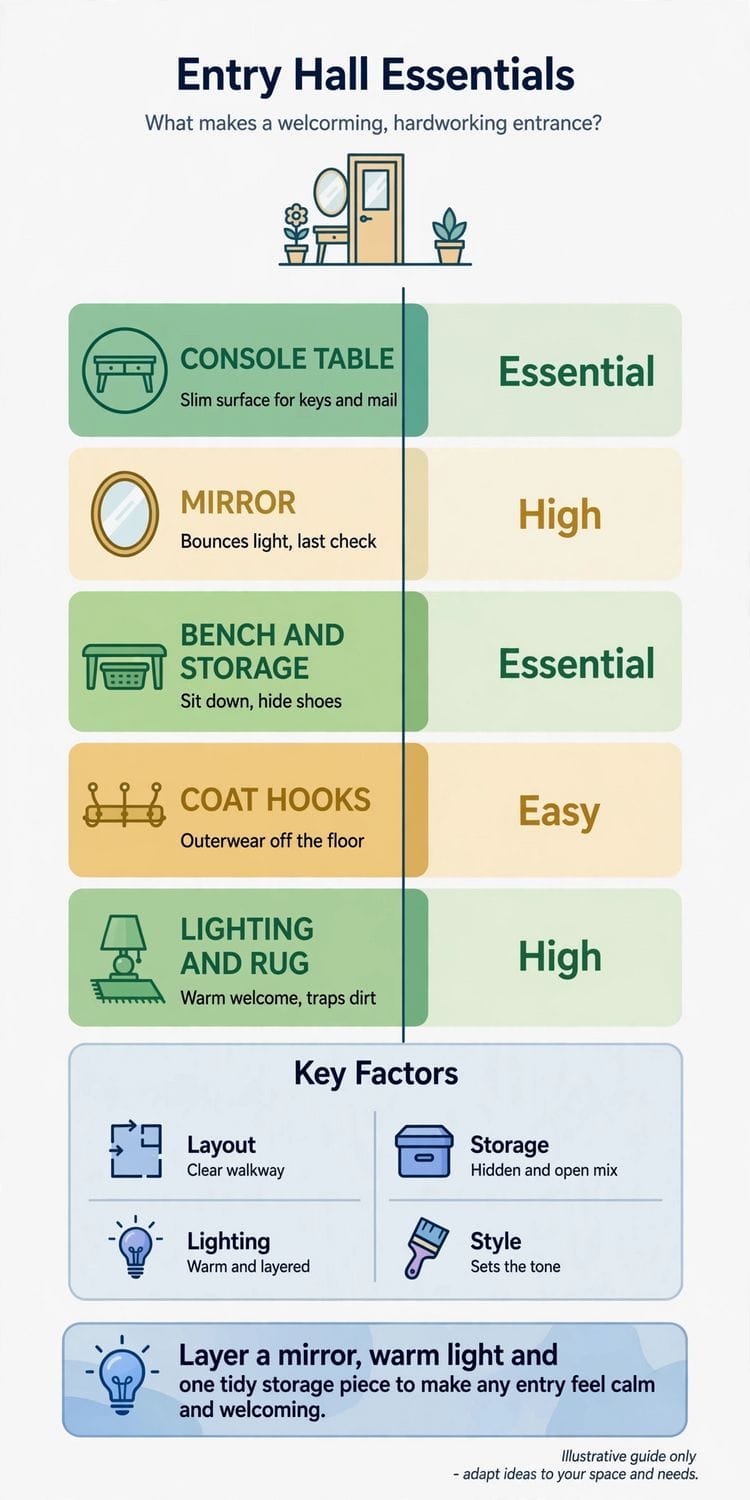
| Where does the daily pile go? | Into assigned storage: a hook, a shoe spot and a basket per person, a tray for post, and one drawer by the door for keys and kit. |
| How do you light a hall with no window? | In layers: ambient ceiling light, warmth at face height near the mirror, and one accent on art or a plant — all in one warm bulb tone. |
| What floor suits a hall best? | A forgiving, scrubbable surface in a mid tone, with a mat well of three full steps inside the door and a runner to draw the eye along. |
2. The First Five Steps: Layout and Flow
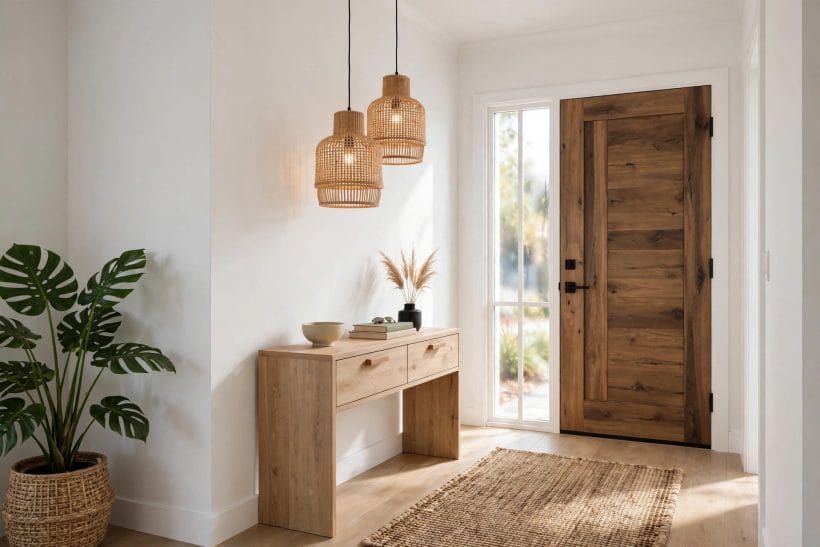
An entry hall is judged in the first five steps: door swing, a clear run to the rooms beyond, and somewhere for everything in a visitor’s hands. The wider planning in entryway ideas covers the whole entrance family; this post stays with the hall itself — the room-sized threshold that sets the house’s tone.
1. Keep the door’s swing completely clear
The front door needs its full arc free of furniture, shoes and optimism. Stand in the swing with the door open and mark the floor if you must: anything inside that arc will be hit, daily, until it moves or breaks.
2. Give the hall one straight, honest run
A hall works when the route from door to living rooms reads at a glance. Furniture that narrows the run into a slalom makes the hall feel mean even when it is wide — keep the walking line straight and let the edges hold the interest.
3. Place the first landing strip by the door
Keys, post and gloves land within two steps of the threshold or they land on the floor.
4. Let one piece of furniture anchor the long wall
A single console or bench against the longest wall gives the hall its composition. Two competing pieces make a corridor of obstacles; one confident piece, centred and lit, makes a room.
5. Keep the floor pattern running one way
Boards, tiles or a runner laid along the hall’s length pull the eye and the feet forward. Cross patterns chop a short hall shorter; lengthways lines are the cheapest spaciousness a hall can buy.
6. Decide where guests’ coats go before they arrive
A hall that improvises coat storage at every visit looks permanently mid-argument. A row of hooks, a narrow armoire or a curtained alcove — whichever the space honestly fits — decided once and kept clear.
7. Leave breathing room at the inner doorways
The hall’s junctions with kitchen, stairs and living room are its traffic lights. Keep them visually quiet and physically clear, and the whole ground floor feels calmer to move through.
8. Use the hall’s end wall as its full stop
Whatever terminates the view — a picture, a mirror, a plant on a stand — is what the hall is remembered by. Choose it deliberately; a blank end wall makes the hall feel like a corridor to somewhere better.
9. Scale everything to the narrowest point
Halls are measured by their pinch, not their average. Furniture depth, frame projection and even door handles should be chosen against the tightest stretch, or the hall will snag coats and tempers there forever.
10. Keep one clear wall for passing with arms full
Shopping, laundry baskets and sleeping children all travel the hall at width. One wall kept entirely free of furniture is the hall’s passing lane, and it earns its emptiness every single day.
11. Test the layout at the busiest hour
Judge the hall at school-run o’clock, not on a quiet Sunday. If two people with bags can pass, greet and unload without choreography, the layout works; if not, no styling will save it.
3. Consoles, Benches and Hall Furniture
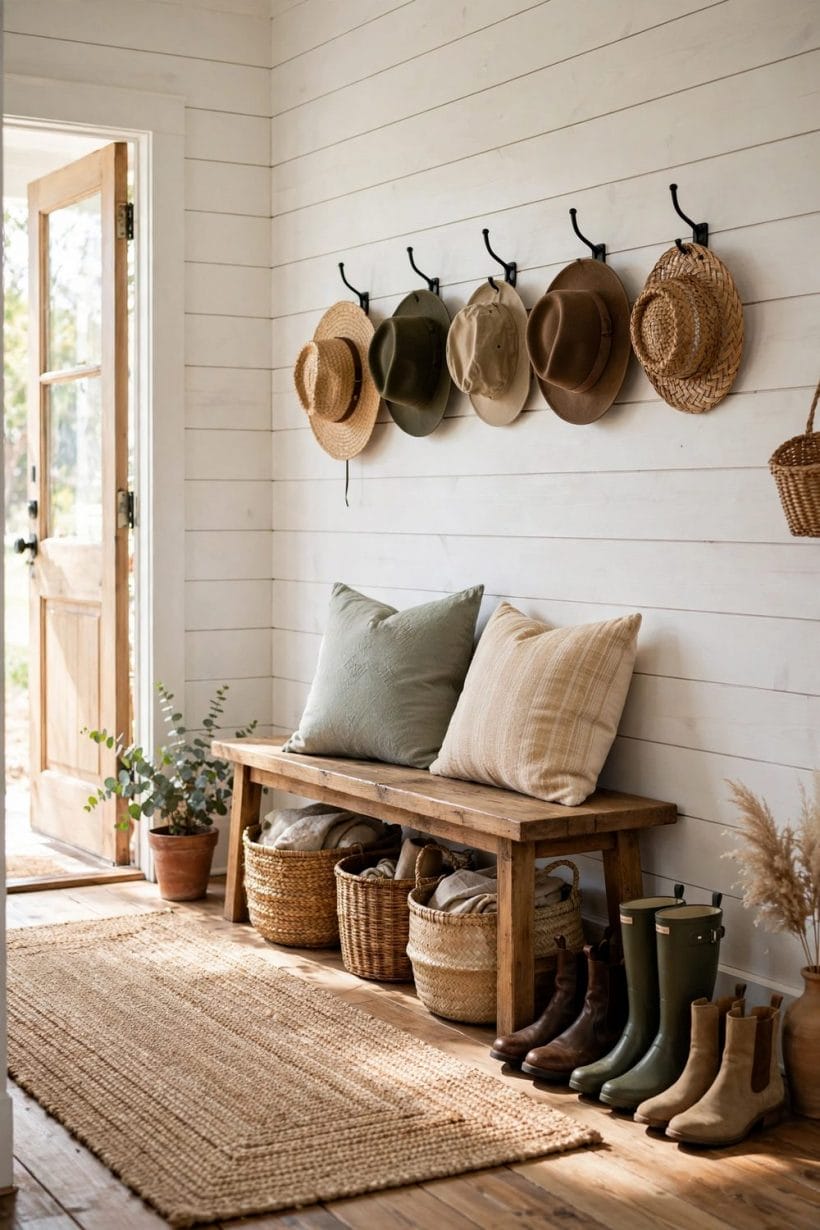
Hall furniture must earn its footprint twice — once in use, once in looks — because the hall has no slack to give.
12. Choose a console shallower than your forearm is long
A slim console holds lamps, post and a bowl while leaving the passing lane intact. Standard-depth tables jut; hall-depth consoles hug the wall. If you are adapting a piece, measure its depth against the hall’s pinch first.
13. A bench with a cushion turns waiting into sitting
The hall bench is where shoes are tied, bags are packed and phone calls are finished. A firm cushion at sitting height, over storage if the design allows, is the hardest-working seat in the house.
14. Wall-hung furniture keeps the floor reading clear
A floating shelf-console or wall-mounted bench lifts the furniture off the floor and lets the eye run under it. In a narrow hall, visible floor is perceived width — spend nothing, gain space.
15. One drawer near the door ends the key hunt
A single shallow drawer for keys, chargers, dog leads and the torch is the hall’s control centre. Everything else can live deeper in the house; the daily five belong within reach of the threshold.
16. A hall tree suits houses that live outdoors
Where boots, hats and wet coats are daily facts, a combined bench-hook-shelf unit contains the whole weather system in one footprint. It asks for a wider hall but repays it in total tidiness.
17. Mind the mirror-and-console pairing
The classic hall composition — console below, mirror above — works because it doubles light and gives a last-check moment at the door. Keep the mirror’s width inside the console’s, and the pairing reads tailored, not accidental.
18. Use a pair of stools where a bench will not fit
Two small stools tuck under a console, perch for bag-packing, and carry overflow seating to the dining room at parties. In a tight hall they beat one fixed bench that blocks the run.
19. Let a narrow bookcase turn the hall into a library
A shallow bookcase along a wide hall adds the house’s missing room: books at the threshold, changed monthly, make the hall a place to linger rather than a place to pass.
20. Choose closed storage for the visual rest
Open shelves in a hall display the household’s least beautiful objects. Doors and boxes keep the hall’s public face calm; the mess can be honest behind a cupboard front.
21. Anchor tall pieces to the wall, always
Narrow armoires and hall trees are tall, shallow and top-heavy — exactly the profile that tips. Fix them to the wall as a matter of course, especially where children climb and coats are yanked.
22. Leave one surface deliberately empty
A console styled to the last centimetre has nowhere for today’s post to land. Keep a hand’s width of clear surface as the hall’s working margin; tidiness that cannot absorb a parcel is theatre, not order.
4. Storage That Swallows the Daily Pile
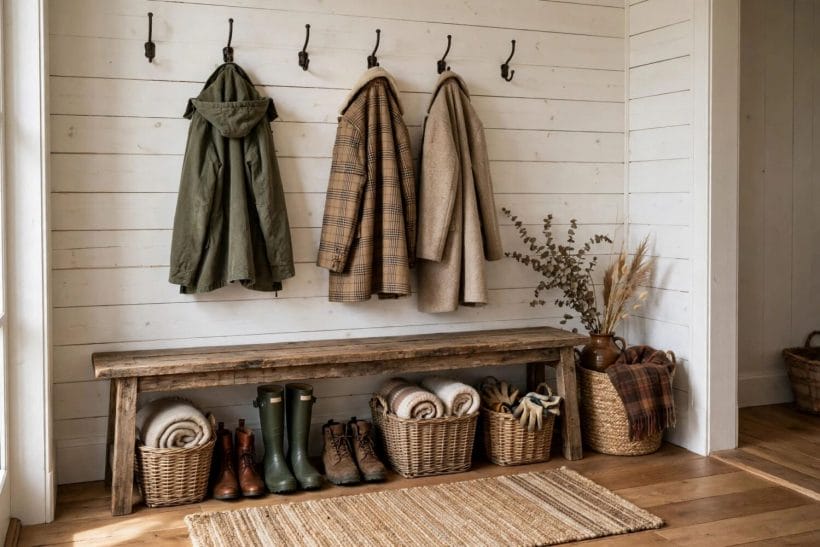
Every hall fights the same tide: shoes, bags, post, sports kit and the season’s outerwear. The contained cousin of this battle is the vestibule ideas post, where a separate lobby does the swallowing; here, the open hall must hide the pile in plain sight.
23. Give every person one hook, one spot, one basket
Hall storage fails when it is communal and succeeds when it is assigned. A hook, a shoe spot and a basket per person — named if necessary — turns tidying into a ten-second habit instead of a household inquiry.
24. Store shoes vertically where the hall is narrow
Slim tilt-out shoe cabinets and vertical racks hold the family’s footwear in a hand’s depth of wall. Flat shoe rows eat the passing lane; vertical storage is the narrow hall’s founding technology.
25. Put the basket for outbound things by the door
Library books, returns and tomorrow’s kit belong in one basket on the door side, so leaving the house collects them automatically. Outbound clutter stored deep in the hall simply becomes hall clutter.
26. Hide the dog’s kit in one lidded box
Leads, bags, towels and treats in a single box by the door keep the walk routine to one reach. Scattered dog gear is how a tidy hall quietly becomes a kennel corridor.
27. Use the under-stair slope if the hall owns it
The triangle under a hall staircase is storage the house already paid for. Drawers built into the slope, or even honest boxes on castors, swallow the seasonal pile that otherwise lives on the newel post.
28. Rotate the season’s coats, do not store them all
A hall holding twelve months of outerwear is a wardrobe with a door problem. Keep the current season at the hooks and the rest in bedroom storage; the hall breathes and the coats last longer.
29. Give post a tray and a recycling route
Unopened post is the hall’s fastest mess. A tray for the unopened, a habit of opening at the console, and a paper bin within the same room keep the pile to one day’s worth, never one month’s.
30. Keep a small shelf for the things hands carry
Sunglasses, gloves, masks, the umbrella that is always wet — a divided shelf or a row of small boxes gives the hand-carried category a home finer than the console’s surface.
31. Fit hooks at two heights for two generations
Adult hooks at adult height and a lower row for children end the coat-on-the-floor era. Children use storage that fits them with suspicious reliability; the floor pile is usually a reach problem, not a character flaw.
32. Close the storage you cannot keep beautiful
Curtains, doors or lidded baskets — the technology matters less than the honesty. If a category will never look tidy, store it behind something, and let the hall keep its public calm.
33. Audit the hall monthly and evict without mercy
Halls accumulate by stealth: one broken umbrella, one outgrown pair of boots. A monthly five-minute eviction keeps the storage sized to the life actually being lived in the house.
5. Mirrors, Art and the Welcome Wall
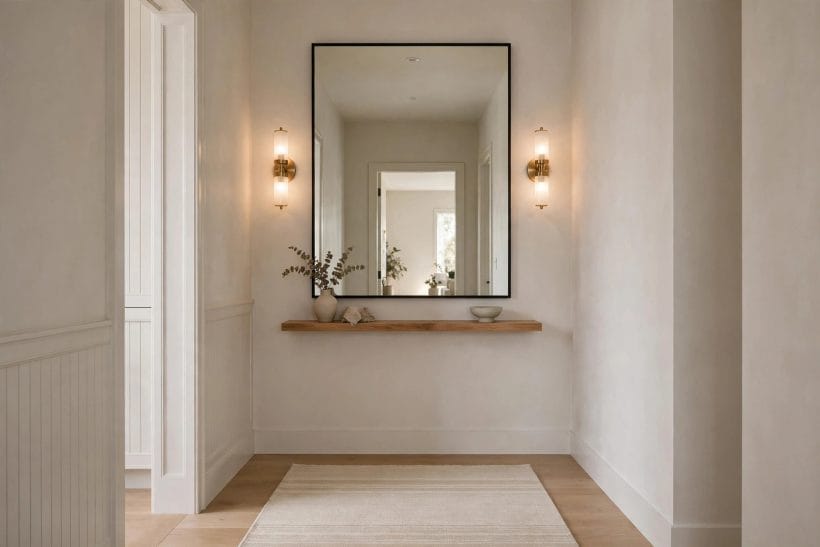
The hall is the house’s first sentence, and its walls do the talking. A mirror for light, one strong picture for character and a restrained hand everywhere else is the composition that greets without shouting.
34. Hang the mirror where it borrows light
A mirror opposite or beside a doorway or window throws borrowed light down the hall. Placed on a dark wall facing another dark wall, it reflects gloom faithfully — position is the mirror’s whole talent.
35. Size the mirror for a full last check
The hall mirror’s job is the final glance: shoes to collar in one view. A small decorative mirror is a picture with ambitions; the working mirror should show a person, whole, at standing distance.
36. Choose one large picture over a scatter of small ones
A single generous artwork gives the hall a subject. Clusters of small frames along a corridor read as a waiting room — charming in a surgery, restless in a homecoming.
37. Run a picture ledge where the art changes often
A shallow ledge lets prints, children’s work and seasonal pieces rotate without new holes. The hall becomes the house’s gallery of the moment, refreshed in minutes.
38. Keep frames in one material family
Mixed frame finishes fight each other at corridor distance. One wood tone or one metal, repeated, lets different pictures sit in the same conversation — the frames become the hall’s quiet rhythm.
39. Light the picture, not just the room
A small picture light or a well-aimed spot makes the hall’s artwork glow at evening, when the hall is most used. Lit art transforms a passage into a destination for the price of one fitting.
40. Use the wall above the wainscot line with restraint
Where the hall has panelling or a dado, the upper wall is the gallery zone. One row of frames at eye level, generously spaced, respects the architecture instead of arguing with it.
41. Let a textile soften a hard, echoing hall
A hanging rug, tapestry or framed fabric panel absorbs the hall’s clatter and adds warmth no paint can. In stone-floored or high-ceilinged halls it is decoration doing acoustic work.
42. Reflect something worth seeing
Mirrors show whatever faces them, so compose the opposite wall as deliberately as the mirror wall. A mirror facing a plant, a picture or a window is a second artwork; facing a coat pile, it is a second coat pile.
43. Keep the welcome honest and personal
Family photographs at the threshold tell visitors whose house this is before a word is spoken. A short run of the best frames beats a crowd — this is an introduction, not an archive.
44. End the hall’s view with intention
The picture or mirror at the hall’s far end is seen more than any other in the house. Give the spot the strongest piece, lit well, and every homecoming lands on something chosen.
6. Lighting a Hall That Has No Window
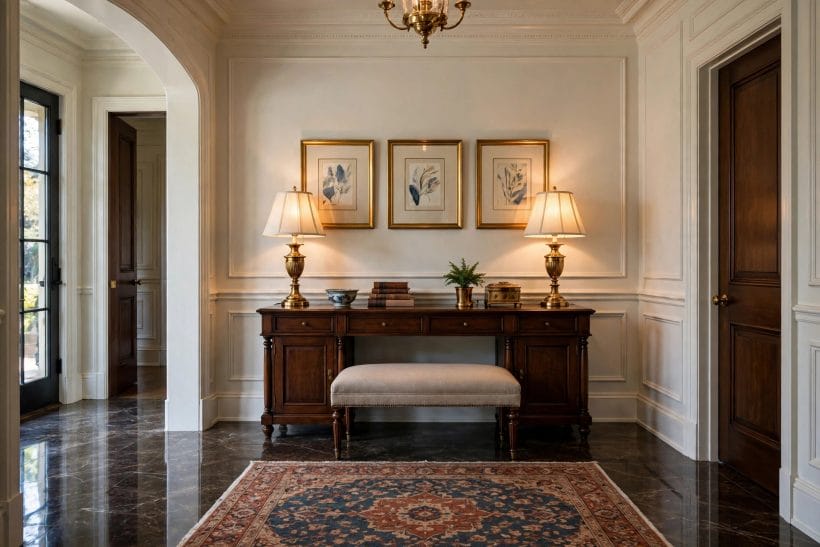
Many halls borrow all their light or have none to borrow, and lighting is where they live or die. The stair halls in staircase ideas share the problem; the answer everywhere is layers — ambient, task and accent — rather than one heroic ceiling fitting.
45. Layer three kinds of light, however small the hall
Ceiling light for general brightness, a lamp or sconces for warmth at face height, and one accent on the picture or plant.
46. Put the main light on a dimmer from the start
A hall at full brightness at midnight is a corridor in an office block. Dimming lets the same fitting serve the morning rush and the midnight return — the cheapest mood control the hall will ever get.
47. Choose warm bulbs and keep them consistent
Mixed colour temperatures make a hall feel accidentally decorated. One warm tone throughout, matched across ceiling, lamp and sconces, reads as design even when the fittings are plain.
48. Add sconces where faces need flattering
Light at face height near the mirror is the hall’s kindness to everyone leaving and arriving. Wall lights either side of the mirror — or a lit mirror itself — end the overhead-shadow grimace at the door.
49. Use motion-sensor lights for the midnight routes
A low, warm sensor light along the route to the bathroom or kitchen serves night-time journeys without waking the house. It is the hall lighting nobody notices and everybody uses.
50. Borrow light through glazed inner doors
Where a hall door leads to a bright room, a glazed or half-glazed door shares the daylight down the corridor. Frosted glass keeps the privacy and passes the glow — a structural kindness in deep-plan houses.
51. Light the stairs as part of the hall
The staircase leaves the hall, so its lighting belongs to the hall’s scheme: a pendant over the stairwell, step lights or a lit handrail zone keeps the flight safe and makes the hall feel taller.
52. Give the console lamp a real job
The hall lamp is not only decoration: it lights the key hunt, the post-opening and the bag search. Place it where hands actually work, on a timer or sensor if the switch is awkward to reach.
53. Use a pendant to give a tall hall its ceremony
Where the ceiling allows, one pendant at the hall’s centre claims the vertical space and announces arrival. In low halls, a flush fitting does the same job quietly — the point is a centre, not a chandelier.
54. Keep emergency light honest and simple
A torch in the hall drawer and a plug-in night light with a battery habit cover power cuts without drama. Halls are the house’s evacuation route; their lighting should fail gracefully.
55. Test the lighting at the hours the hall works
Judge the scheme at dawn, dusk and midnight, not at noon. A hall that welcomes at the dark hours — warm, layered, glare-free — has solved the problem most houses never notice they have.
7. Floors, Runners and the Threshold
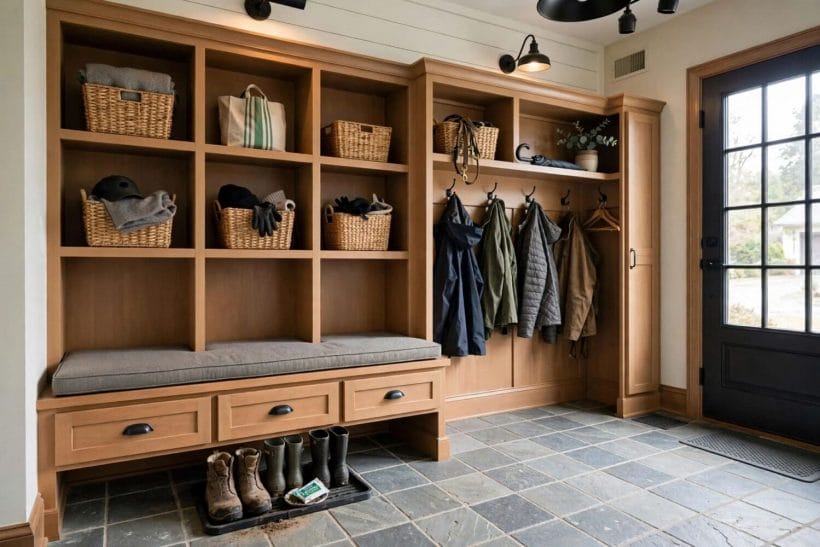
Hall floors take the house’s whole weather: grit, rain, mud and the daily migration of shoes. The front door ideas post owns the door itself; this section owns everything the feet meet after it — surfaces that forgive, and runners that guide.
56. Choose a floor that hides the day gracefully
Mid-tone, patterned or naturally varied surfaces — stone, timber with grain, tiles with movement — disguise the grit between cleans. Pale plain floors and black plain floors both publish every footprint; the hall deserves camouflage.
57. Put a real mat well inside the door
The mat’s job is three full steps of grit removal, so size it like a small carpet, not a doormat gesture. A mat well with a washable inset mat is the tidy version; either way, length is what works.
58. Let a runner draw the eye down the hall
A runner softens the acoustics, warms the floor and points the way in one gesture. Choose it long, washable and low-piled, with a grip underlay — a skating runner in a hurry is a household hazard.
59. Continue the hall floor into the rooms beyond
Where budget allows, running one floor through hall and living rooms erases the corridor feeling entirely. The hall becomes the house’s spine rather than its apology, and small ground floors feel suddenly generous.
60. Keep a hard threshold where the weather stops
A stone, tile or timber threshold strip just inside the door is where wet shoes stand and drip. Defining the wet zone protects the runner and the boards beyond it — a small border with a big job.
61. Softer underfoot matters more than grandeur
Children sit on hall floors to wrestle shoes; parcels land; dogs sprawl. A floor or runner with some give and warmth beats a magnificent cold surface every day of the year.
62. Mind the junctions between floor types
Where hall meets kitchen tile or living-room carpet, a clean threshold bar keeps the change deliberate. Ragged junctions read as unfinished; a crisp line reads as a decision, even when the decision was economy.
63. Choose finishes that forgive the mop
Hall floors are cleaned often and gently rarely. Sealed, scrubbable surfaces in the traffic line — and precious finishes nowhere near it — keep the hall’s good looks a habit rather than a project.
64. Give shoes a drying place that is not the runner
A boot tray with a lip, by the door, holds the day’s wet footwear off the textiles. Melting snow and mud belong in a tray that hoses clean in seconds, not soaked into the hall’s best rug.
65. Let the floor tell people where to go
In open-plan houses the hall can vanish entirely; a change of flooring — boards turning to tile, a runner appearing — marks the entrance zone without walls. Floors are the quietest signposts a house has.
8. Small Halls, Shared Halls and the Finishing Touches
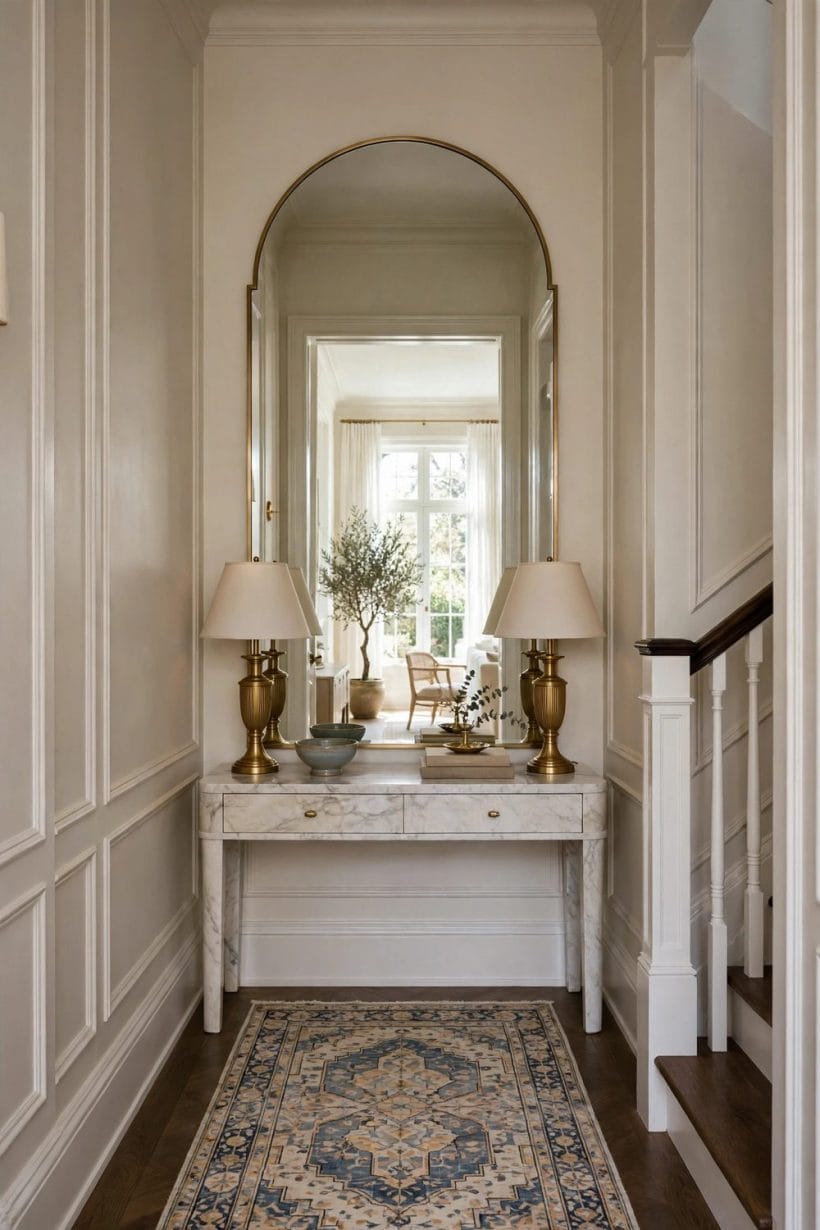
Not every home has a hall to spare: some are a square metre by the door, some are shared with stairs, bikes and the whole household’s overflow. The finishing touches matter most exactly where space is least — and the rooms beyond, starting with living room ideas, should feel like the hall’s reward.
66. In a tiny hall, hang everything
When floor space is a rumour, the walls are the furniture: hooks, a floating shelf, a wall-hung mirror and a folding stool. A tiny hall with clear floor feels deliberate; with floor clutter, it feels like a cupboard.
67. Use the back of the door as a storage wall
Door-mounted hooks and slim organisers hold the light daily kit — dog lead, tote bags, the child’s hat — in space that exists in every hall and is used in few.
68. Let one colour run wall to wall in a small hall
A single calm colour across walls, woodwork and even the ceiling wraps a small hall into one gesture and blurs its edges. Patches of contrast chop it smaller; continuity is the tiny hall’s camouflage.
69. Choose a statement light to give a small hall stature
One beautiful fitting in a modest hall announces that the house takes itself seriously from the first step. Small spaces carry bold single gestures better than several timid ones.
70. Keep a plant where the light honestly reaches
A plant at the hall’s lit end — real where light allows, unashamedly artificial where it does not — gives the threshold life.
71. Finish the hall with scent and sound
The welcome is multi-sensory: a house that smells faintly of something clean and sounds soft underfoot feels considered before it is seen. A reed diffuser on the console and the runner’s hush do this quiet work.
72. Match the hall’s ambition to the house beyond it
The hall promises; the rooms must keep the promise. Carry one thread — a colour, a wood tone, the picture frames — from hall into the living rooms so arrival feels like a beginning, not a false start. The house-wide threads are gathered in home design ideas.
73. Keep the hall ready for the unexpected guest
The test of a hall is the doorbell when the house is mid-chaos. If coats can vanish onto hooks, shoes into their cabinet and post into its tray in one minute, the hall passes — design for the minute, not the photoshoot.
74. Change one thing with the seasons
A different runner, a wreath, a bowl of pinecones or summer shells — one seasonal note keeps the hall feeling tended without redecorating. The house’s first room should notice the year turning.
75. End with the view back to the door
Stand in the living room and look back: the hall should compose as a picture — door, light, one piece of furniture, one picture. If the return view works, the arrival view will too; design them as a pair.
9. Checks and Mistakes: Before the First Purchase or the First Fitting
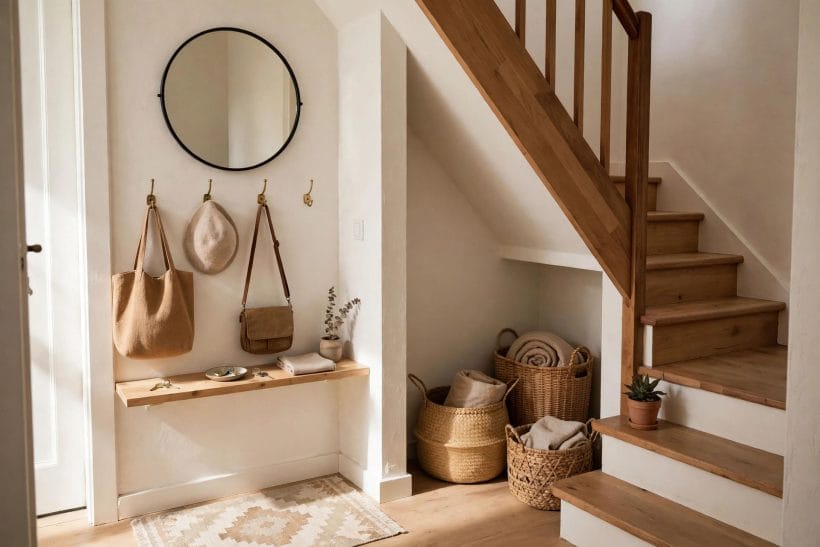
The hall’s classic mistakes are all failures of measurement: furniture bought for another room and squeezed in, a mat too small to catch the grit, storage sized for the household you wish you had.
Safety deserves its plain sentence: runners need grip underlay, tall shallow furniture needs fixing to the wall, and stairs leaving the hall need their own light.
Finally, never style a hall you have not lived through at the busiest hour. Watch the morning departure and the rainy homecoming first; the hall will tell you exactly where the hook, the tray and the bench belong.
10. Costs and Pulling It Together
Costs follow the same order as the work: storage and layout changes are mostly labour and honesty, furniture is a single considered purchase per piece, and lighting is where a modest spend transforms the room daily.
Pull it together by choosing one thread — a colour, a wood tone, a frame finish — and running it from the door mat to the far picture.
Final Considerations
An entry hall succeeds quietly: coats vanish, keys appear, guests feel expected and the house beyond gets its calm introduction.
Start with the swing of the door and the landing strip beside it, and the rest of the hall tends to fall into place behind them.

0 Comments