
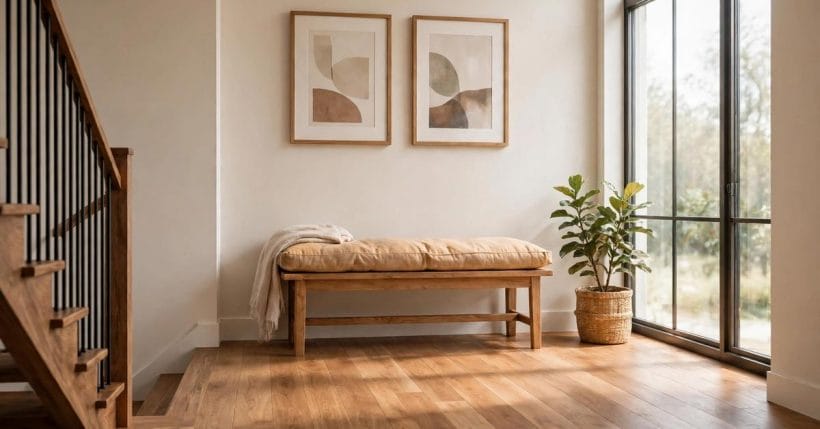
Every home with stairs has one, and almost every household walks through it a dozen times a day without really seeing it: the landing. It is the pause between flights, the place where the stairs turn, and — with a little attention — one of the most useful small spaces in the house.
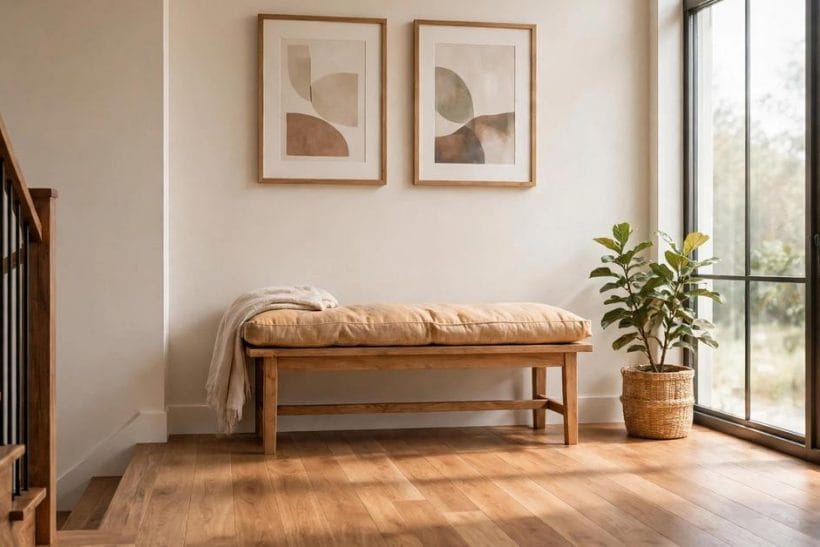
This guide treats the landing as a room in its own right: its space, its light, its storage and its styling, all in terms any household can apply without structural work.
1. The Landing at a Glance
A landing earns its keep in four ways. It gives the stairs a safe turning point, it brings daylight deeper into the house, it offers a pause — a seat, a view, a breath — and it can carry storage and display that would otherwise crowd the rooms it connects. When none of those four is working, the landing feels like leftover space. When even two are working, it feels deliberate.
| Job | What good looks like |
|---|---|
| Turning space | Clear, uncluttered, easy to step through |
| Daylight | A window, glazing or borrowed light nearby |
| A pause | Somewhere to sit, look out, or set something down |
| Storage and display | Closed storage plus one display moment |
The landing also sits inside a larger staircase story. For the staircase as a whole, the staircase ideas pillar gathers the forms and finishes, while this post stays on the landing itself. And where the landing meets the rail, modern stair railing covers the railing side in full; here, rails appear only as the landing’s edge.
2. Space: What a Landing Is For
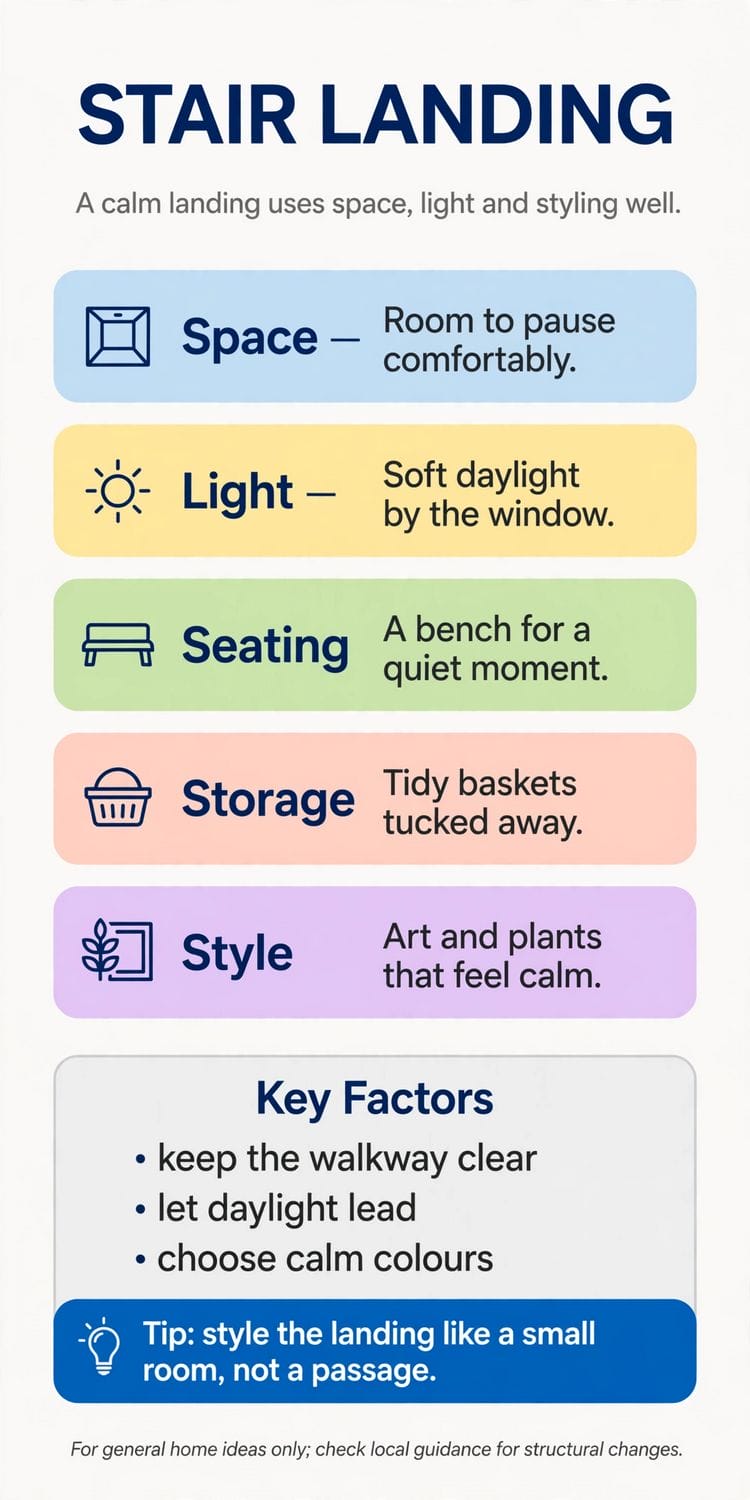
Start with the landing’s first job, which is movement. A landing must let a person turn, pass, and carry things without squeezing. That means keeping the walking line clear: no furniture jutting into the turn, no storage spilling across the path, and nothing at ankle height that a tired foot will find in the dark.
Once the walking line is protected, everything else is arranged around its edges. A shallow bench against the wall, a slim console, a row of hooks — all of these live on the perimeter, where they serve the landing without obstructing it. The test is simple: walk the landing with a laundry basket. If anything forces a sidestep, it belongs somewhere else.
Landings also differ by type, and the type shapes the styling. A half landing on a turn is a compact pause, best kept minimal. A full landing at the top of a flight can hold a bench and a bookcase. A galleried landing overlooking a hall below is a viewing platform as much as a passage, and it deserves a moment — a pendant, a picture, a plant — that rewards the person standing there.
3. Light: Windows, Glazing and Borrowed Daylight
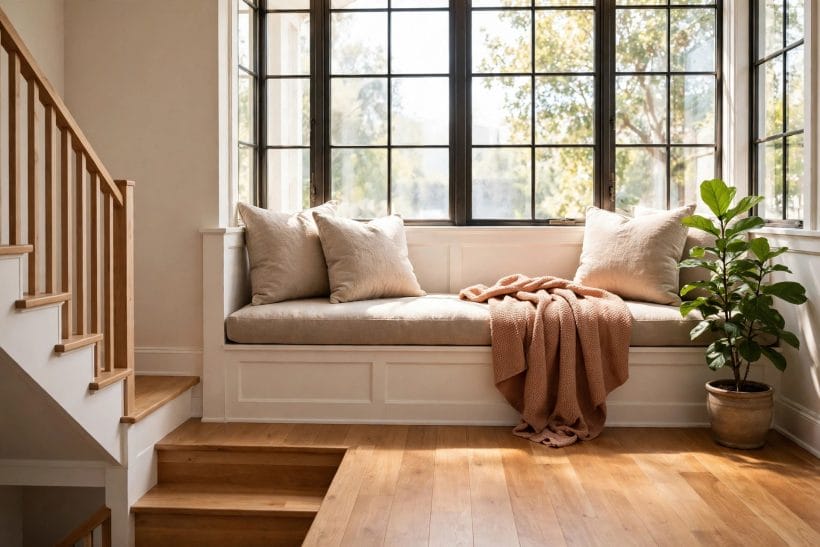
Light is the single biggest upgrade a landing can receive, and it is often already half there. A window on the stair wall, a glazed door to a bedroom, or a fanlight over a door can all pour daylight onto a landing that currently feels like a corridor.
Where no window exists, borrowed light still helps. A glazed internal door, a translucent panel beside the stair, or simply keeping the doors off the landing open during the day all move light around. Mirrors help too, but they work best opposite a real light source; a mirror facing a blank wall doubles the blankness rather than the light.
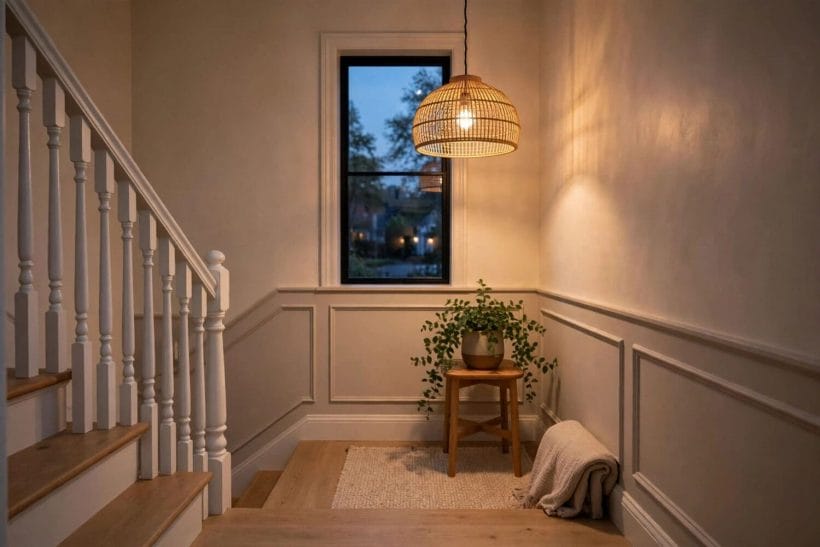
Evening light needs the same care. A landing lit only by a single harsh ceiling fitting feels institutional. A warm pendant, a wall light at picture height, or a small lamp on a console gives the space an evening identity, and a light on the landing itself — rather than borrowed from a bedroom — means nobody is walking the stairs in the dark.
Stair safety and light belong together, and the landing is where that partnership is most visible. A light switch at both the top and the bottom of the flight, a landing light that can be switched from either floor, and a low-level night light for children or older household members all make the stairs safer without any structural change. Motion-sensor lights suit landings particularly well, because they light the pause exactly when someone arrives at it, and switch off when the landing empties. Keep the sensor’s range to the landing itself, so passing traffic in the rooms below does not trigger it all evening.
4. The Bench and the Pause
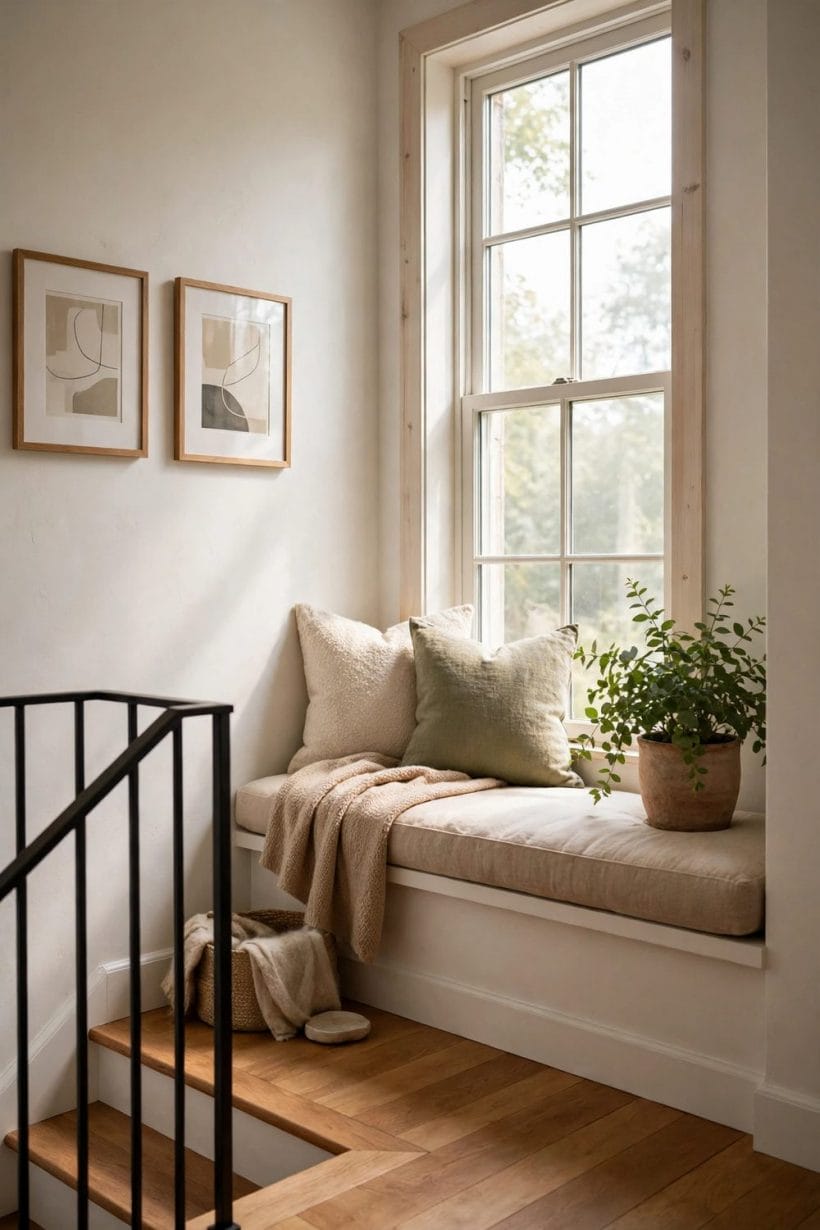
A seat transforms a landing from a passage into a place. It need not be large: a bench the depth of a seat cushion, a single chair, or a window seat built into the stair wall all give the household somewhere to pause — to put on shoes, to wait for a child, to sit with a book for five minutes.
The bench earns a second job as storage. A lift-up seat hides shoes, bags and games; a bench with baskets below does the same in the open. Either way, the landing gains storage without gaining clutter, because the storage is the furniture rather than an addition to it.
Comfort is modest but real. A cushion in a washable cover, a small side surface for a cup or a book, and a light within reach turn a bench into a nook. Without those three, a bench is a perch people pass; with them, it is a place people use.
5. Storage Without Clutter
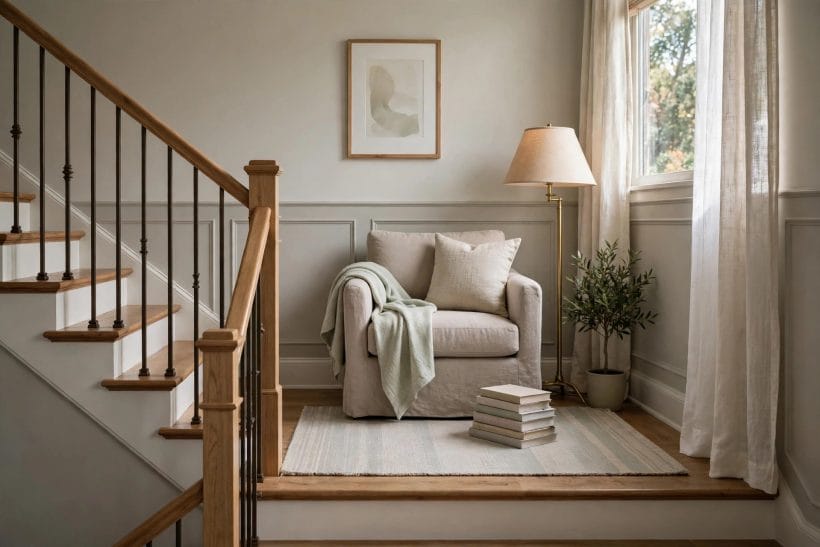
Landings attract clutter because they sit between rooms and belong to none of them. The fix is closed storage first and display second: a cupboard, a bench with a lid, or a shallow cabinet that swallows the everyday things, leaving the open surfaces for one or two chosen objects.
Hooks deserve a mention, because they are the landing’s most abused feature. A row of hooks multiplies coats, bags and hats until the wall disappears. Limit hooks to one per household member, keep them at a height children can reach, and move the overflow to a proper cupboard. A landing with five hooks and a cupboard looks calmer than a landing with fifteen hooks and no cupboard.
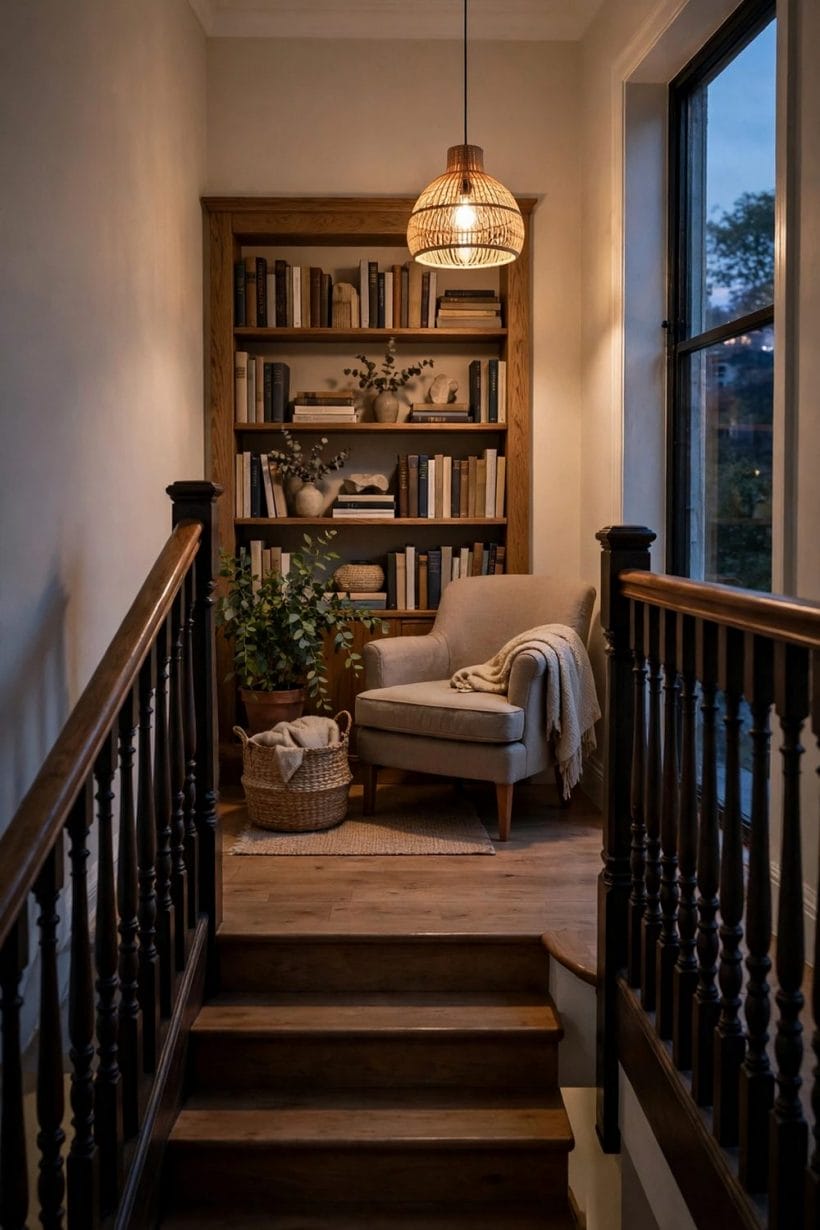
Books are the landing’s natural storage exception. A shallow bookcase on a landing wall turns dead space into a library, and books tolerate the landing’s comings and goings better than most displays. Keep the shelves shallow, the books upright, and one shelf deliberately half empty; a crammed bookcase on a landing reads as storage, while a breathing one reads as a collection.
6. Art and the Gallery Wall
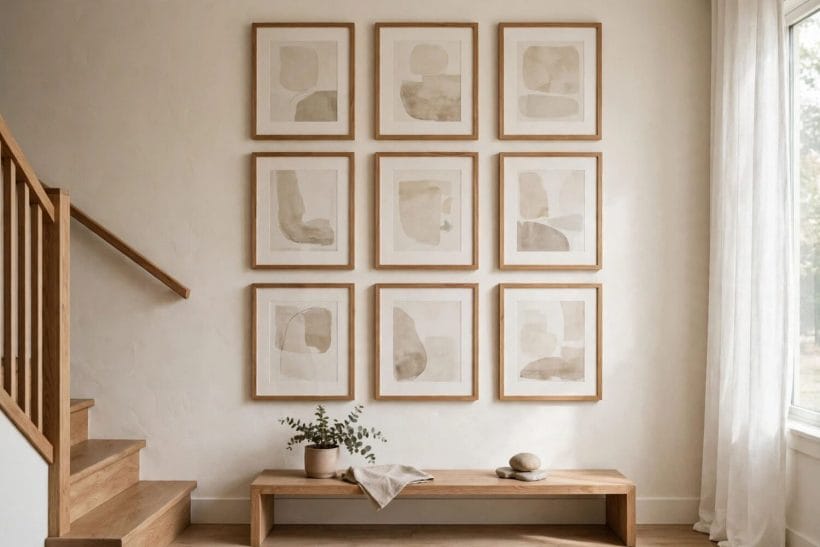
A landing wall is one of the best gallery walls in a house, because people see it slowly — on the way up, on the way down, at eye level on the turn. Family photographs, prints, children’s art and collected pieces all suit it, and the stair’s movement gives the wall a natural rhythm.
Hang with the stair in mind. On a straight stair wall, a rising diagonal of frames follows the climb beautifully. On a landing wall itself, a grid or a loose cluster at eye level works better, because the viewer stands still there. Keep the frames consistent — one frame style, varied sizes — so the wall reads as a collection rather than a jumble.
Glass and fixings matter on a stair wall, where a falling frame has further to fall. Use proper picture fixings rated for the frame’s weight, keep heavy frames low and over solid wall rather than over the stairwell void, and check the fixings when you change the pictures. A gallery wall that is secure is a gallery wall that can be enjoyed rather than worried about.
7. Runners, Rugs and Soft Landings
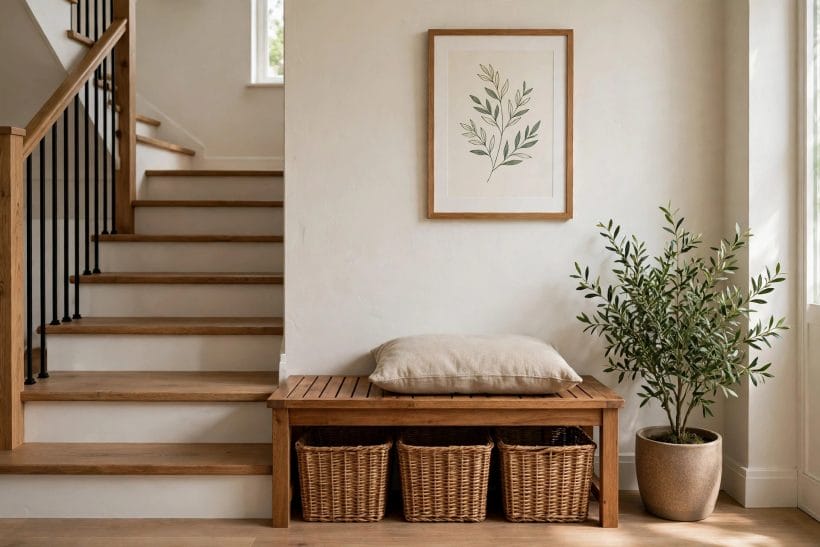
Underfoot, a landing benefits from softness and grip in equal measure. A runner on the stairs that continues across the landing ties the whole stair together, and a rug on a larger landing warms the space and quiets footfall.
Fit matters more than pattern. A runner should sit centred with an even border on each side, fixed so it cannot slip or ruckle, and a landing rug should leave a border of floor showing around it so the space still reads as a landing rather than a carpeted room. Loose rugs on a landing are a trip risk; if a rug cannot be fixed with a proper underlay or fixings, it does not belong there.
Colour and pattern on the floor can also do quiet wayfinding work. A runner in a slightly deeper tone than the stair carpet marks the turn, and a rug in a warmer tone marks the pause. Neither needs to shout; the landing is a transitional space, and its floor should feel like a transition, not a destination.
8. Plants on a Landing
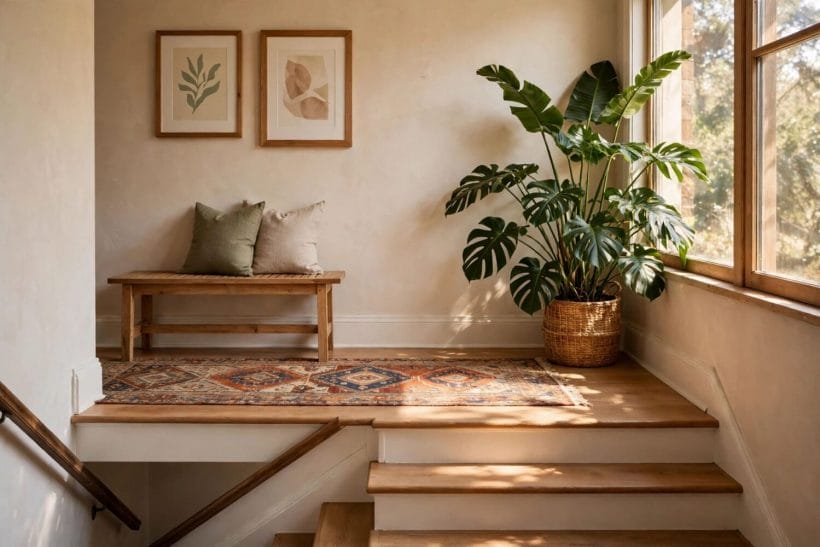
A plant is the fastest way to make a landing feel alive, and landings often suit plants well: stair windows give bright, indirect light, and the air moves. A tall plant in a corner, a trailing plant on a high shelf, or a small pot on a console each give the landing a living note.
Choose for the light you actually have, not the light you wish you had. A landing window that faces away from the sun suits shade-tolerant plants; a bright stair window suits sun lovers. And keep pots stable: a heavy pot on the floor, or a pot secured on a shelf, rather than a light pot perched where a passing elbow or a child’s hand can send it over the edge.
Watering needs a routine, because a landing plant is easy to forget. A pot with a saucer, a watering day tied to another weekly habit, and a plant that tolerates a missed week will outlast a demanding specimen every time. A healthy, ordinary plant beats a struggling exotic one on any landing.
Small homes make the landing’s plant and storage lessons doubly relevant, because every square foot must work harder. The same shallow-bench, closed-storage and single-display discipline that tidies a landing tidies a whole small home, and tiny house designs show that discipline applied at house scale, where a landing-sized space often serves two or three jobs at once. Borrow the small-home habit of asking each landing object what job it does; anything without an answer leaves.
9. Colour and Calm
Colour on a landing should calm the transition between rooms, not compete with them. A warm neutral carried from the hall, a soft tone borrowed from the rooms it connects, or a single deeper accent on one wall all work; a loud, unrelated colour turns the landing into an interruption.
Paint finish matters on stair walls, which take more scuffs than most walls. A washable, mid-sheen finish on the lower wall, or a dado-height wipeable band, keeps the landing looking fresh without repainting every year. The upper wall can stay matte, where it catches the light softly.
For a landing that also carries colour inspiration from elsewhere in the house, painted staircase ideas show how painted stairs and landings can share a palette, and bookcase ideas offer the storage side of the same small-space thinking. In both cases, the landing’s own palette should stay the quieter partner.
10. Small Landings, Big Difference
A small landing needs the same thinking at a smaller scale. One good light, one picture or mirror, one plant, and a clear walking line will do more than any amount of furniture, and a small landing with those four things feels finished rather than cramped.
The temptation with a small landing is to fill it, as though emptiness were a defect. It is not. A landing’s emptiness is its function — it is the space that lets the house breathe between floors. Keep the centre clear, put the interest on the walls and in the light, and let the landing be what it is: a pause, not a room, and all the better for it.
Finally, maintain the landing like any other room. A monthly check — fixings tight, runner fixed, light working, clutter returned to its cupboard — keeps the space safe and calm. Landings deteriorate quietly, one unreturned object at a time, and the same quiet attention restores them.
One more habit completes the picture: treat the landing as part of the cleaning route, not as an afterthought to it. Dust the frames, wipe the bench, shake the runner and water the plant on the same day the stairs themselves are cleaned, and the landing will never drift into the neglected state that makes it feel like leftover space. A landing that is cleaned with the stairs reads as part of the stairs; one that is cleaned only when noticed reads as a corridor, and the difference is entirely in the routine.
Final Considerations
A good landing asks for little: clear passage, decent light, somewhere to pause, and storage that hides rather than displays. Give it those four, add one personal touch — a picture, a plant, a book — and the most walked-through space in the house becomes one of its most pleasant.
For the staircase beyond the landing, expert home design tips gather the same practical approach across the whole home, and the landing is a fine place to start applying it: small, visible, and used every single day.


0 Comments