
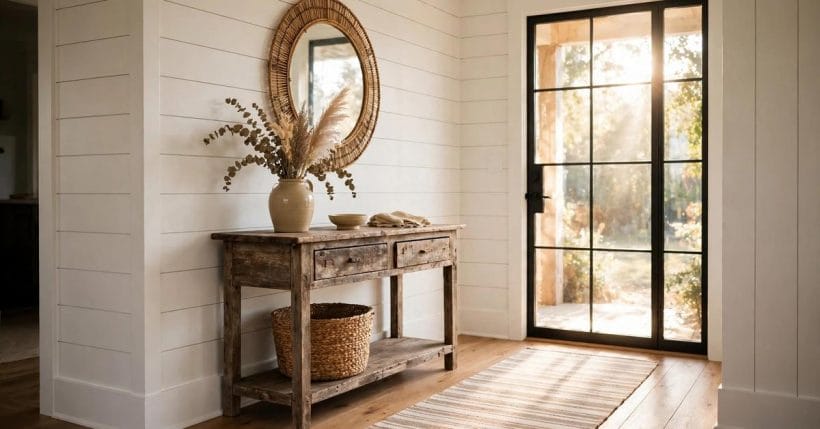
A farmhouse entry is the handshake of the house, the first room a guest steps into and the last room you pass on your way out. It should feel warm without feeling fussy, practical without looking like a storeroom, and calm even on the busiest morning. This collection gathers seventy-five ideas for that room, covering layouts, wall boards, colours, furniture, storage, floors, mirrors, lighting, seasonal touches and the practical details that decide whether an entry works.
The ideas below are written in general terms on purpose, so they can be adapted to a tiny cottage hall or a generous farmhouse entry, to a rented home or a house of your own. Take the combinations that suit your doorway, your light and your daily routine, and leave the rest. A good entry is not the one with the most objects in it, but the one where everything in it earns its place.
1. Layouts That Welcome
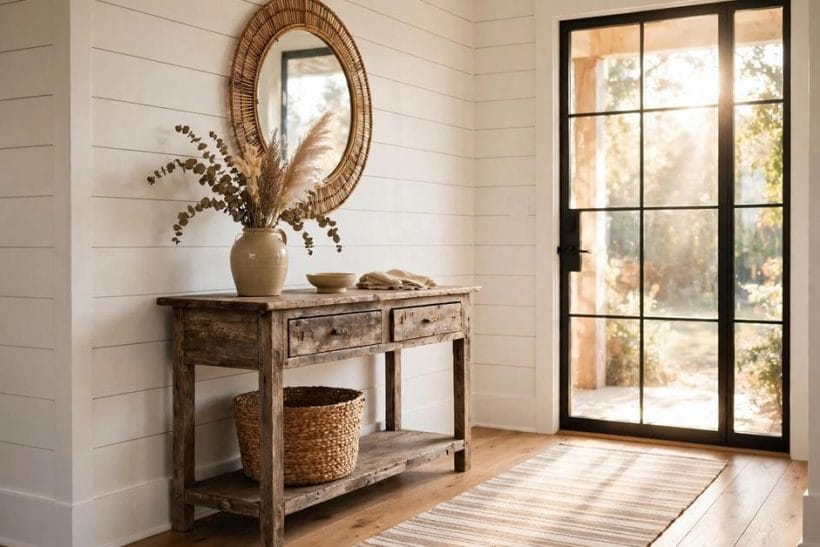
The layout is decided before a single picture is hung, because the entry must first do its practical job: let people in, give them somewhere to put things down, and lead them onward without a bottleneck. These farmhouse foyer ideas begin with that movement, and every arrangement below keeps the door swing clear, the walking line open, and the first view into the home calm rather than crowded. For a wider survey of the same family, see our guide to entryway ideas.
| Item | What it is |
|---|---|
| A Straight Run From Door to Room | Keep the path from the front door to the next room as straight as the house allows, so guests never have to sidestep furniture or squeeze past a bench. |
| A Console That Anchors One Wall | A single console against the longest wall gives the entry a centre of gravity and a place for keys, post and a lamp. |
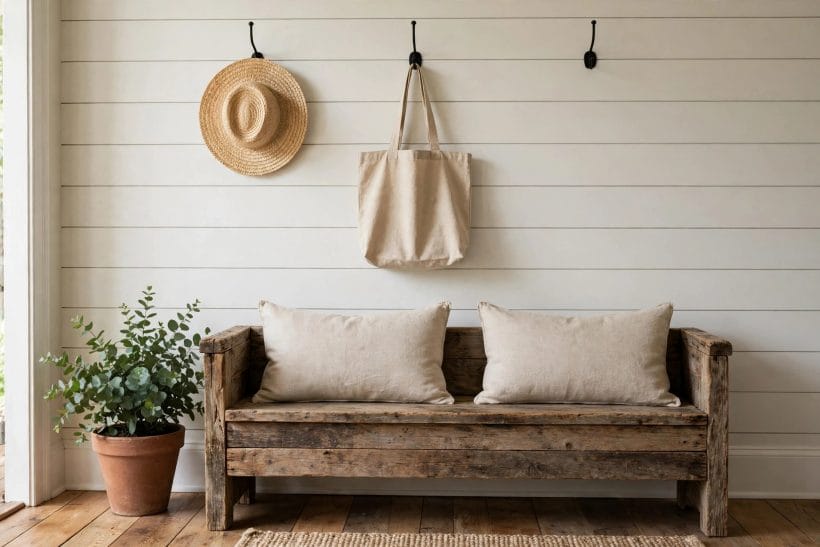
| A Bench Beside the Door | A bench beside the door turns the daily shoe routine into something easy, especially for children and older visitors who need to sit. |
| A Corner Nook That Earns Its Keep | An awkward corner near the door can become the hardest-working spot in the entry if it is given one clear job. |
| A Wide Welcome in a Narrow Hall | A narrow hall feels wider when the furniture stays shallow, the colours stay pale, and the floor runs in one unbroken direction. |
| A Split-Level Step-Up Entry | Where a step separates the entry from the main rooms, treat that step as a feature rather than an obstacle. |
| A Double-Door Welcome | Double doors suit a farmhouse entry because they open the whole width of the doorway and let light flood in. |
| An Open Flow Into the Living Room | Many farmhouse entries open straight into the living room, so the two spaces need to speak the same language. |
| Classic Horizontal Shiplap | Horizontal shiplap is the farmhouse signature, and it suits an entry because the long lines pull a narrow space wider. |
| Vertical Boards for Height | Vertical boards lift a low entry ceiling in the way horizontal boards cannot, drawing the eye upward toward the light. |
| A Shiplap Accent Wall Only | Covering a single wall in shiplap gives the entry its farmhouse identity without making the whole space feel like a themed room. |
| Beadboard Below the Chair Rail | Beadboard below a chair rail brings a cottage softness to the lower walls, exactly where bags and boots tend to scuff. |
| Board and Batten in a Grid | A grid of board and batten gives a plain entry architecture without a major rebuild, and the regular rectangles suit the orderly farmhouse mood. |
| Reclaimed Timber Planks | Reclaimed timber planks bring age and warmth that new boards cannot imitate, with knots, nail marks and varied tones telling their own story. |
| A Limewashed Brick Welcome Wall | A limewashed brick wall keeps the texture of brick while softening its colour to a pale, chalky finish that suits farmhouse style. |
| Plain Plaster With Timber Trim | Not every farmhouse entry needs boards, and plain plaster with well-chosen timber trim can feel just as authentic. |
| Warm White All Over | Warm white on every wall is the safest farmhouse entry choice, and it earns that reputation honestly. |
| Soft Sage on the Walls | Soft sage brings the garden indoors in the gentlest possible way, and it pairs beautifully with natural wood, cream linen and black ironwork. |
| Gentle Greige for Balance | Greige, the easy middle ground between grey and beige, suits entries that must connect rooms of different colours. |
| Dusty Blue for Calm | Dusty blue gives an entry a cool, collected welcome that feels especially good on a hot afternoon or in a home full of warm timber. |
| Cream With Charcoal Accents | Cream walls with charcoal accents give a farmhouse entry a crisp, tailored edge without losing its warmth. |
| Buttery Yellow in a Dark Hall | A buttery yellow can rescue a dark, windowless entry by borrowing the feeling of sunlight even when there is none. |
| A Deep Green Feature Wall | A deep green feature wall gives a farmhouse entry drama and depth, and it makes timber, brass and cream details stand out beautifully. |
| Two-Tone Walls With a Crisp Divide | Two-tone walls, darker below a chair rail and paler above, give an entry structure and hide scuffs at exactly the height where bags and boots strike. |
| A Weathered Wood Console | A weathered wood console is the farmhouse entry centrepiece, offering a surface for a lamp and a bowl for keys while its shelf or drawers swallow the clutter. |
| A Shaker Bench With Storage | A Shaker bench combines a seat, a shelf and a row of hooks in one plain, honest frame, and it suits farmhouse entries perfectly. |
| A Slim Console for Tight Walls | Where the wall beside the door is short, a slim console of shallow depth still gives the entry a landing spot without blocking the walkway. |
| A Farmhouse Hall Tree | A hall tree gathers bench, hooks and storage into a single tall unit, which makes it ideal for a family entry that must absorb a great deal. |
| A Pair of Matching Stools | A pair of matching stools beside a console gives guests somewhere to perch and gives the entry a pleasing symmetry. |
| A Vintage Dresser as a Console | An old dresser makes a wonderful entry console, because its drawers swallow gloves, scarves, torches and all the small things that otherwise pile up. |
| A Drop-Leaf Table for Tiny Halls | A drop-leaf table is the clever answer for a hall too small for a console, because it folds almost flat against the wall and opens only when needed. |
| Iron Hooks at Two Heights | Iron hooks at two heights let adults and children each hang their own coats without help, and the black metal suits farmhouse timber beautifully. |
| Wooden Peg Rails | A wooden peg rail is the simplest farmhouse storage of all, a board with turned pegs that holds coats, hats, bags and even a hanging basket. |
| Labelled Baskets on a Shelf | Labelled baskets on a high shelf keep out-of-season gloves, scarves and hats out of the way but still findable. |
| A Basket for Every Person | Giving every person in the household their own basket ends the daily hunt for shoes, scarves and sports kit, because each basket has one owner and one place. |
| A Lidded Box for the Daily Pile | A lidded box by the door swallows the daily pile of post, school papers and parcels, and the lid is the whole point, because it hides the mess in one movement. |
| A Tray for Keys and Sunglasses | A small tray on the console gives keys and sunglasses a single landing spot, and the habit of using it saves countless minutes of searching. |
| A Tall Basket for Umbrellas and Canes | A tall basket beside the door keeps umbrellas and walking sticks upright, visible and out of the walkway, which is exactly where they belong. |
| Wide Plank Wood Floors | Wide plank wood floors give a farmhouse entry warmth and a sense of age, and their broad boards suit the relaxed farmhouse mood. |
| A Washable Runner Down the Hall | A washable runner is the practical hero of a farmhouse entry hall, protecting the floor while adding colour and pattern. |
| A Round Braided Rug | A round braided rug softens a square entry and gives the space a handmade, homespun feeling that suits farmhouse style perfectly. |
| A Coir Mat at the Door | A coir mat at the door is the first defence against dirt, and its rough fibres scrape shoes clean before they reach the rug or the wood floor. |
| Patterned Tile at the Threshold | Patterned tile at the threshold creates a hard-wearing landing zone that can take wet shoes without a second thought, and its pattern gives the entry instant character. |
| A Layered Rug Look | Layering a flat woven rug over a larger natural rug adds depth and softness to a farmhouse entry, and it lets you mix pattern with plain texture. |
| A Boot Tray by the Door | A boot tray by the door contains wet and muddy footwear in one tidy rectangle, protecting the floor and keeping pairs together. |
| A Round Mirror Over the Console | A round mirror over the console is the classic farmhouse entry move, because its soft shape balances the straight lines of the furniture and its reflection opens up the space. |
| An Arched Mirror for Height | An arched mirror gives a farmhouse entry a gentle architectural lift, echoing the shape of a doorway or a window. |
| A Gallery of Botanical Prints | A gallery of botanical prints brings the garden into the entry in a quiet, timeless way, and the repeated plant forms suit farmhouse style without feeling themed. |
| A Single Large Landscape | A single large landscape over a bench or console gives the entry a calm focal point and a sense of place, whether it shows fields, coast or woodland. |
| Family Photographs in Matching Frames | Family photographs in matching frames turn the entry into a personal welcome, telling guests whose home they have entered. |
| A Chalkboard for Notes and Menus | A chalkboard in the entry holds notes, menus, reminders and a weekly greeting in one changeable spot, and its dark surface suits farmhouse timber and cream walls. |
| A Wreath That Changes With the Seasons | A wreath on the entry wall or the front door changes with the seasons and gives the welcome a fresh note four times a year, from spring blossom to autumn leaves to winter greenery. |
| A Shelf for Small Treasures | A single shelf for small treasures, a tiny vase, a found stone, a framed miniature, gives the entry a personal touch without inviting clutter. |
| A Lantern Pendant Over the Console | A lantern pendant over the console gives the entry a farmhouse centrepiece and a pool of warm light exactly where keys and post land. |
| A Pair of Wall Sconces | A pair of wall sconces flanking a mirror or a picture gives the entry balanced light that flatters faces and artwork alike. |
| A Small Table Lamp for Evenings | A small table lamp on the console is the evening heart of a farmhouse entry, casting a low, warm glow that says the house is awake and welcoming. |
| A Window That Does the Work | Where the entry has a window, let it do the work by keeping the glass clear, the frame painted pale, and nothing bulky in front of it. |
| A Dimmer for Soft Evenings | A dimmer on the entry lights is a small change with a large effect, because it lets one set of lights serve the bright morning search for shoes and the soft evening welcome. |
| Candlelight on the Console | Candlelight on the console, in a hurricane glass or a sturdy lantern, gives the entry a special-occasion glow for guests and celebrations. |
| A Motion Light for Late Arrivals | A motion light in the entry means nobody fumbles for a switch with full hands on a late return, and it welcomes guests who arrive after dark. |
| A Spring Switch of Stems and Colour | Spring in the entry can be as simple as fresh stems in the console vase, a lighter throw on the bench and a brighter cushion cover. |
| Autumn Texture Without Clutter | Autumn texture in the entry means wool, wood and woven baskets rather than piles of seasonal decoration. |
| A Winter Welcome of Wool and Wood | Winter asks the entry to work harder, with room for heavy coats, wet boots and extra layers, so give it a wool throw, a sturdy boot tray and hooks that can take real weight. |
| Summer Light and Bare Floors | Summer in the entry means lighter layers, bare floors and open doors, so roll up the heavy runner, swap wool for linen, and let the breeze through. |
| A Tiny Hall With One Hero Piece | A tiny hall needs one hero piece, a beautiful mirror, a painted bench or a striking console, and everything else kept plain around it. |
| An Under-Stair Nook | The space under the stairs beside the door can become a farmhouse entry nook with a bench, hooks and baskets fitted to the sloping ceiling. |
| A Rented Hall With No Holes in the Walls | A rented hall can still feel farmhouse with no holes in the walls, using leaning mirrors, freestanding benches, adhesive hooks rated for the load, and furniture that carries the style. |
| Second-Hand Finds That Suit Farmhouse Style | Second-hand finds suit farmhouse style better than almost any other, because age and wear are part of the look. |
| Finishes That Forgive Muddy Boots | Finishes that forgive muddy boots are essential in a working entry, so favour matte paint over gloss, sealed timber over raw timber, and washable rugs over delicate ones. |
| Keeping the Entry Tidy Week After Week | Keeping the entry tidy week after week is less about willpower than about systems, because a hall with a home for everything almost tidies itself. |
| Safety and Access at the Door | Safety and access at the door deserve the same care as style, because the entry is also an escape route and a threshold for visitors of all ages. |
1. A Straight Run From Door to Room
Keep the path from the front door to the next room as straight as the house allows, so guests never have to sidestep furniture or squeeze past a bench. A clear run makes even a small entry feel generous, and it keeps coats, bags and shoes from drifting into the walkway. Leave the centre of the floor empty and push every piece of furniture flat against a wall.
2. A Console That Anchors One Wall
A single console against the longest wall gives the entry a centre of gravity and a place for keys, post and a lamp. Choose a depth that leaves the walkway comfortable, and keep the top mostly clear so the surface stays useful rather than becoming another pile. One mirror or picture above it is enough to finish the arrangement.
3. A Bench Beside the Door
A bench beside the door turns the daily shoe routine into something easy, especially for children and older visitors who need to sit. Keep it low and sturdy, with room beneath for baskets, and place it on the side of the door that does not block the swing. A cushion makes it inviting, and a throw folded at one end softens the timber.
4. A Corner Nook That Earns Its Keep
An awkward corner near the door can become the hardest-working spot in the entry if it is given one clear job. A small bench, two hooks and a basket are often all it needs, and the corner shape itself keeps everything contained. Avoid filling it with decoration, because a corner nook earns its keep by staying usable every single day.
5. A Wide Welcome in a Narrow Hall
A narrow hall feels wider when the furniture stays shallow, the colours stay pale, and the floor runs in one unbroken direction. A slim console, a long mirror and a single runner draw the eye forward instead of letting it snag on clutter. Resist the urge to fill both walls, because one dressed wall and one clear wall is the balance that works.
6. A Split-Level Step-Up Entry
Where a step separates the entry from the main rooms, treat that step as a feature rather than an obstacle. A timber tread, a handrail that matches the other woodwork, and a mat on each level make the change of height feel deliberate. Keep the step well lit and free of baskets or shoes, so nobody has to negotiate clutter on a stair.
7. A Double-Door Welcome
Double doors suit a farmhouse entry because they open the whole width of the doorway and let light flood in. When only one leaf is used day to day, dress the working side with the mat, the bench and the hooks, and keep the fixed leaf clear. Matching hardware on both leaves keeps the pair looking like one considered design.
8. An Open Flow Into the Living Room
Many farmhouse entries open straight into the living room, so the two spaces need to speak the same language. Repeat one timber tone, one wall colour or one style of basket across the threshold, and the entry will feel like a room of its own rather than a leftover gap. A rug can mark the boundary without a wall ever being built.
2. Shiplap, Boards and Wall Character
Farmhouse character lives on the walls, and boards are the quickest way to give a plain entry a sense of place. The boards below range from crisp and painted to rough and reclaimed, and each one changes the mood of the space before any furniture arrives. Choose the board that suits the light and the size of your entry, and let the rest of the room stay quiet around it.
9. Classic Horizontal Shiplap
Horizontal shiplap is the farmhouse signature, and it suits an entry because the long lines pull a narrow space wider. Paint it warm white for a bright welcome, and keep the gaps neat and even so the shadow lines read as craftsmanship rather than clutter. One shiplap wall is usually enough, with the remaining walls painted to match.
10. Vertical Boards for Height
Vertical boards lift a low entry ceiling in the way horizontal boards cannot, drawing the eye upward toward the light. They suit halls with tall doors or a high window, and they pair well with a simple bench and a tall mirror. Keep the board width modest, because very wide vertical boards can feel heavy in a small space.
11. A Shiplap Accent Wall Only
Covering a single wall in shiplap gives the entry its farmhouse identity without making the whole space feel like a themed room. Choose the wall that faces the door, so it is the first thing guests see, and paint the other walls in a soft tone taken from the same family. The restraint is what keeps the look grown-up.
12. Beadboard Below the Chair Rail
Beadboard below a chair rail brings a cottage softness to the lower walls, exactly where bags and boots tend to scuff. The rail itself protects the plaster above, and the beaded texture hides small marks far better than flat paint. Paint beadboard and rail the same colour for a calm result, or let the rail pick up the trim colour.
13. Board and Batten in a Grid
A grid of board and batten gives a plain entry architecture without a major rebuild, and the regular rectangles suit the orderly farmhouse mood. Keep the grid spacing even and the battens slim, and stop the pattern at door frames and corners with a clean edge. Painted in one colour, the grid adds depth through shadow alone.
14. Reclaimed Timber Planks
Reclaimed timber planks bring age and warmth that new boards cannot imitate, with knots, nail marks and varied tones telling their own story. Use them on one wall only, and balance their roughness with smooth plaster elsewhere, plain linen and simple ironwork. Check that old timber is clean, dry and securely fixed before it goes up.
15. A Limewashed Brick Welcome Wall
A limewashed brick wall keeps the texture of brick while softening its colour to a pale, chalky finish that suits farmhouse style. It works beautifully behind a timber bench or a console, and it forgives dust and scuffs better than plain paint. Seal the surface lightly so it can be wiped down without losing its soft, matte character.
16. Plain Plaster With Timber Trim
Not every farmhouse entry needs boards, and plain plaster with well-chosen timber trim can feel just as authentic. A chunky skirting board, a simple architrave and one timber beam or shelf give the room its farmhouse bones. This quieter approach also lets colour, art and textiles do more of the talking.
3. Colours That Feel Like Home
Colour sets the temperature of the welcome, and farmhouse entries tend toward soft, sunlit tones that flatter timber and linen. The palettes below all sit comfortably with wood floors and woven textures, and each one can be lifted with a darker accent or calmed with cream. Test any colour on the wall itself, because entry light changes sharply between morning and evening. The same warm palette carries into the next room in our guide to farmhouse living room ideas.
17. Warm White All Over
Warm white on every wall is the safest farmhouse entry choice, and it earns that reputation honestly. It brightens a windowless hall, lets timber and baskets supply the warmth, and never fights with the rooms beyond. Choose a white with a gentle creamy undertone rather than a stark one, so the space feels soft instead of clinical.
18. Soft Sage on the Walls
Soft sage brings the garden indoors in the gentlest possible way, and it pairs beautifully with natural wood, cream linen and black ironwork. It is calm enough for a small hall and interesting enough for a large one, and it changes pleasingly through the day as the light shifts. Keep the ceiling white so the green never feels heavy.
19. Gentle Greige for Balance
Greige, the easy middle ground between grey and beige, suits entries that must connect rooms of different colours. It is warm enough for timber and cool enough for stone, and it hides dust better than pure white. Use it on the walls with cream trim, and let one darker piece of furniture anchor the scheme.
20. Dusty Blue for Calm
Dusty blue gives an entry a cool, collected welcome that feels especially good on a hot afternoon or in a home full of warm timber. It works well on a single accent wall or on beadboard below a chair rail, with cream above. Pair it with natural baskets and pale wood so the blue stays restful rather than cold.
21. Cream With Charcoal Accents
Cream walls with charcoal accents give a farmhouse entry a crisp, tailored edge without losing its warmth. The charcoal might appear on hooks, a mirror frame, a bench base or a door, and a little of it goes a long way. Keep the cream genuinely warm, because a cold cream against charcoal can feel grey and unwelcoming.
22. Buttery Yellow in a Dark Hall
A buttery yellow can rescue a dark, windowless entry by borrowing the feeling of sunlight even when there is none. Keep it soft and muted rather than bright, and pair it with white trim and pale wood so the room glows instead of shouting. One yellow wall is often enough, with the rest of the hall in cream.
23. A Deep Green Feature Wall
A deep green feature wall gives a farmhouse entry drama and depth, and it makes timber, brass and cream details stand out beautifully. Reserve it for the wall behind the console or bench, and keep the remaining walls pale so the green reads as an accent rather than a cave. Good lighting matters here, so plan a lamp or sconce nearby.
24. Two-Tone Walls With a Crisp Divide
Two-tone walls, darker below a chair rail and paler above, give an entry structure and hide scuffs at exactly the height where bags and boots strike. The divide must be level and the rail neatly finished, because a wobbly line will catch the eye every day. This classic treatment suits halls of every size and every farmhouse mood.
4. Consoles, Benches and Furniture
Entry furniture must be beautiful and hard-working at the same time, because it carries the daily load of keys, bags, shoes and post. The pieces below are all chosen for a farmhouse entry first, which means honest timber, simple joinery and storage that actually gets used. Measure the wall and the walkway before buying anything, because a piece that is even slightly too deep will be felt every day. The same discipline at a smaller scale shapes our guide to small entryway ideas.
25. A Weathered Wood Console
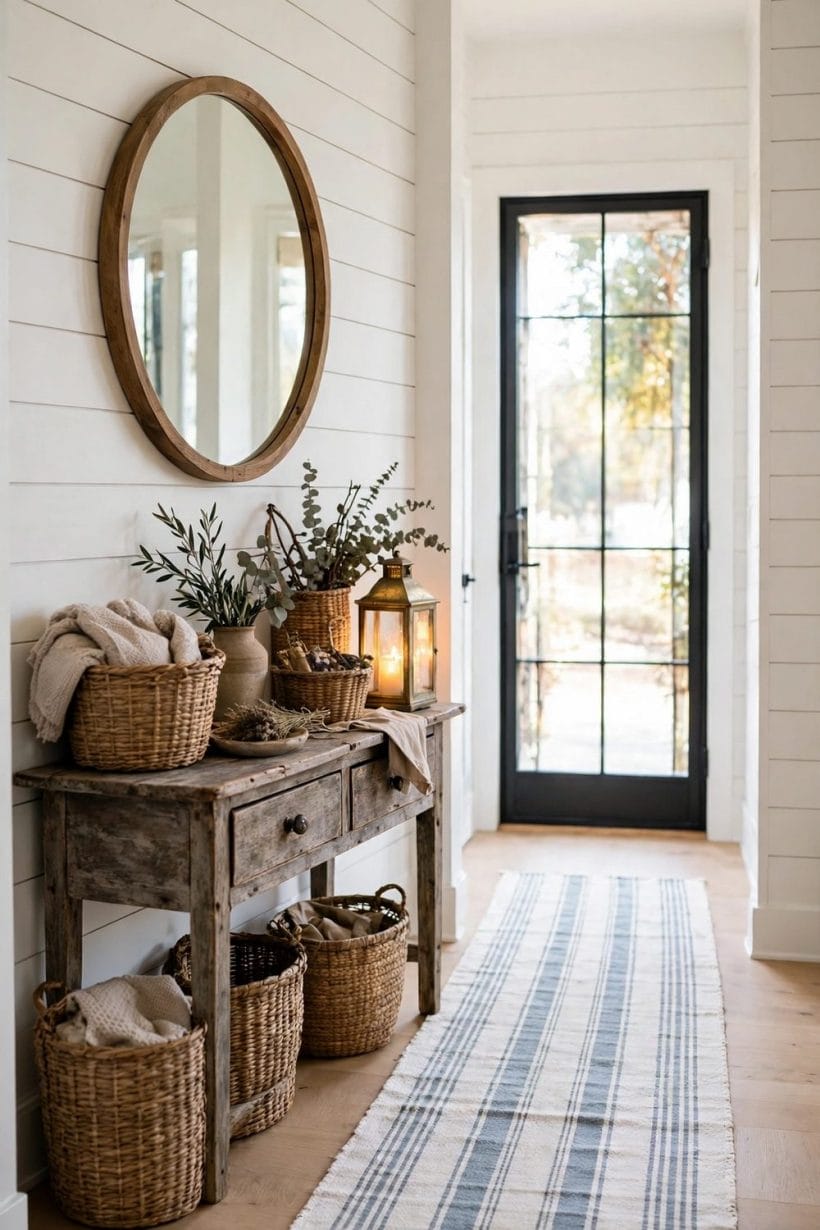
A weathered wood console is the farmhouse entry centrepiece, offering a surface for a lamp and a bowl for keys while its shelf or drawers swallow the clutter. Look for solid timber with a finish that can take a wet umbrella or a muddy parcel without complaint. Keep the top edited to three or four objects, so the console stays a working surface.
26. A Shaker Bench With Storage
A Shaker bench combines a seat, a shelf and a row of hooks in one plain, honest frame, and it suits farmhouse entries perfectly. Its straight lines never date, and its open shelf keeps baskets visible and reachable. Choose one in a painted finish for a lighter look, or in natural timber when the floors are pale.
27. A Slim Console for Tight Walls
Where the wall beside the door is short, a slim console of shallow depth still gives the entry a landing spot without blocking the walkway. It will hold keys, post and a small lamp, and a basket beneath it takes shoes or dog leads. The trick is discipline, because a slim surface fills up fast if everything is allowed to land there.
28. A Farmhouse Hall Tree
A hall tree gathers bench, hooks and storage into a single tall unit, which makes it ideal for a family entry that must absorb a great deal. Its height gives the wall presence, and its enclosed or open compartments keep each person’s things apart. Check the ceiling height first, and leave breathing room on either side.
29. A Pair of Matching Stools
A pair of matching stools beside a console gives guests somewhere to perch and gives the entry a pleasing symmetry. They tuck away neatly when not needed, and they can be pulled into the next room for extra seating. Choose stools with a woven or timber seat, and keep their height below the console top for a tidy silhouette.
30. A Vintage Dresser as a Console
An old dresser makes a wonderful entry console, because its drawers swallow gloves, scarves, torches and all the small things that otherwise pile up. Look for one with a flat top at a comfortable height and drawers that run smoothly, and paint it or leave it natural to suit the room. A mirror above completes the transformation.
31. A Drop-Leaf Table for Tiny Halls
A drop-leaf table is the clever answer for a hall too small for a console, because it folds almost flat against the wall and opens only when needed. Use it for post, keys and a small vase, and fold it away when guests need the full width of the hall. Its flexibility is exactly what a tiny farmhouse entry demands.
5. Hooks, Baskets and Everyday Storage
Storage is what separates a welcoming entry from a dumping ground, and farmhouse style has always favoured baskets, hooks and open shelves over closed cupboards. The ideas below give every daily object a named home, so tidying becomes a matter of putting things back rather than finding somewhere new. Start with the objects that actually arrive each day, and build storage around them. The hall itself is treated as a room in our guide to entry hall ideas.
32. Iron Hooks at Two Heights
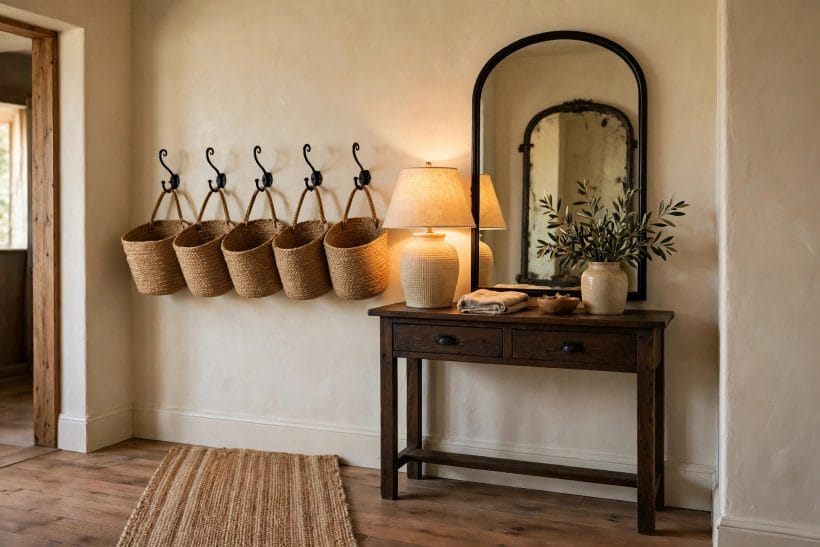
Iron hooks at two heights let adults and children each hang their own coats without help, and the black metal suits farmhouse timber beautifully. Fix them into solid timber or proper wall fixings, because a hook that pulls out will not be trusted again. Leave generous space between hooks so coats do not bunch into one heavy mass.
33. Wooden Peg Rails
A wooden peg rail is the simplest farmhouse storage of all, a board with turned pegs that holds coats, hats, bags and even a hanging basket. It costs little, fits any wall length, and can be painted to match the trim or left in natural wood. Space the pegs widely enough for a winter coat on each one.
34. Labelled Baskets on a Shelf
Labelled baskets on a high shelf keep out-of-season gloves, scarves and hats out of the way but still findable. Simple tags in a consistent hand or print keep the system honest, and matching baskets stop the shelf from looking like a jumble. Bring the baskets down only when the season changes, and the entry stays calm.
35. A Basket for Every Person
Giving every person in the household their own basket ends the daily hunt for shoes, scarves and sports kit, because each basket has one owner and one place. Choose baskets large enough for shoes and a coat, and line them up under the bench or on a low shelf. Children take pride in a basket that is truly theirs.
36. A Lidded Box for the Daily Pile
A lidded box by the door swallows the daily pile of post, school papers and parcels, and the lid is the whole point, because it hides the mess in one movement. Choose a box in timber or woven seagrass that suits the room, and empty it once a week so it never becomes a permanent archive. One box is enough.
37. A Tray for Keys and Sunglasses
A small tray on the console gives keys and sunglasses a single landing spot, and the habit of using it saves countless minutes of searching. A ceramic dish, a timber tray or a shallow basket all work, and the tray should be big enough for the whole household’s keys without overflowing. Place it where the hand naturally lands on entering.
38. A Tall Basket for Umbrellas and Canes
A tall basket beside the door keeps umbrellas and walking sticks upright, visible and out of the walkway, which is exactly where they belong. Choose a sturdy basket that will not tip when it is full, and put a small tray or mat beneath it for drips. Wet umbrellas should never be stored against painted walls.
6. Floors, Rugs and the Threshold
The entry floor takes more punishment than any other floor in the house, so it must be tough, easy to clean and still beautiful underfoot. Farmhouse entries favour wood, tile and woven textures, and the threshold itself deserves attention, because it is where outside dirt meets inside calm. Choose surfaces that forgive wet boots and sandy shoes, and dress them with rugs that can be shaken out or washed. The welcome that begins outside is covered in our guide to tiny house porch ideas.
39. Wide Plank Wood Floors
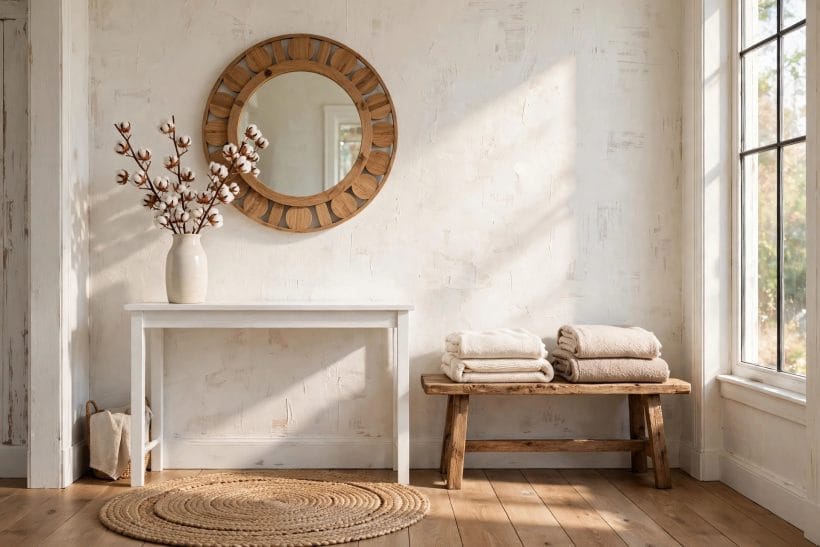
Wide plank wood floors give a farmhouse entry warmth and a sense of age, and their broad boards suit the relaxed farmhouse mood. A matte finish hides scratches better than a high gloss, and a mid-tone timber hides dust between cleans. Keep a mat at the door, because even the toughest wood floor benefits from a first line of defence.
40. A Washable Runner Down the Hall
A washable runner is the practical hero of a farmhouse entry hall, protecting the floor while adding colour and pattern. Choose a low pile that doors can swing over, and a pattern that forgives dirt between washes. A non-slip backing keeps the runner safely in place, which matters most where children and older visitors walk.
41. A Round Braided Rug
A round braided rug softens a square entry and gives the space a handmade, homespun feeling that suits farmhouse style perfectly. Its texture works with timber and linen, and its shape breaks up the straight lines of the hall. Choose a size that leaves a border of floor visible all around, so the rug reads as a deliberate layer.
42. A Coir Mat at the Door
A coir mat at the door is the first defence against dirt, and its rough fibres scrape shoes clean before they reach the rug or the wood floor. Choose a mat that fits the doorway neatly and sits flat, and shake it out or brush it regularly so it keeps working. A coir mat is a working tool first and a decoration second.
43. Patterned Tile at the Threshold
Patterned tile at the threshold creates a hard-wearing landing zone that can take wet shoes without a second thought, and its pattern gives the entry instant character. Keep the tiled area generous enough for two people to stand on, and choose a grout colour that forgives dirt. The tile also marks a clear boundary between outside and inside.
44. A Layered Rug Look
Layering a flat woven rug over a larger natural rug adds depth and softness to a farmhouse entry, and it lets you mix pattern with plain texture. Keep the layers in the same colour family so the look stays calm, and make sure the edges lie flat and the doors clear them. Layering also lets a small patterned rug shine without covering the whole floor.
45. A Boot Tray by the Door
A boot tray by the door contains wet and muddy footwear in one tidy rectangle, protecting the floor and keeping pairs together. Choose a tray with a raised edge and a surface that drains or wipes clean, and place it where it does not block the door swing. Boots in a tray look intentional, while boots scattered on the floor look like clutter.
7. Mirrors, Art and the Welcome Wall
The welcome wall is the first art gallery a guest sees, and it sets the tone for the whole house in a single glance. Farmhouse entries favour mirrors that borrow light, botanical prints, family photographs and simple shelves, all hung with restraint. One strong piece will always beat a crowded wall, and a mirror placed opposite a window doubles whatever daylight the entry receives. The formal cousin of this room is explored in our guide to foyer ideas.
46. A Round Mirror Over the Console
A round mirror over the console is the classic farmhouse entry move, because its soft shape balances the straight lines of the furniture and its reflection opens up the space. Hang it at a height where faces are reflected naturally, and keep the frame simple, in wood, iron or a pale painted finish. One mirror is enough.
47. An Arched Mirror for Height
An arched mirror gives a farmhouse entry a gentle architectural lift, echoing the shape of a doorway or a window. Its height draws the eye upward and makes a low hall feel taller, and its curve softens a room full of straight boards and benches. Lean a large arched mirror against the wall for a relaxed look, or hang it securely for a tidier one.
48. A Gallery of Botanical Prints
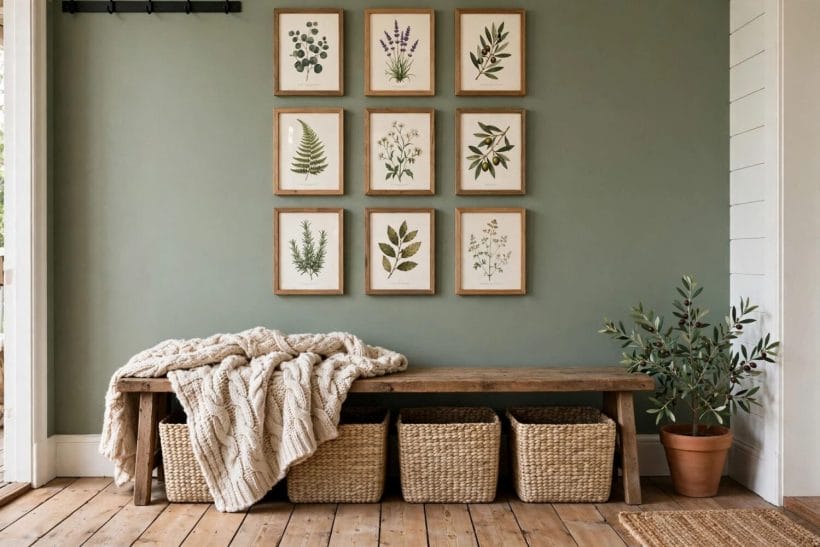
A gallery of botanical prints brings the garden into the entry in a quiet, timeless way, and the repeated plant forms suit farmhouse style without feeling themed. Use matching frames and even spacing, and keep the prints at eye level so they can be enjoyed rather than merely noticed. Pressed leaves, seed packets and simple line drawings all work.
49. A Single Large Landscape
A single large landscape over a bench or console gives the entry a calm focal point and a sense of place, whether it shows fields, coast or woodland. One large piece feels more considered than many small ones, and it leaves the rest of the wall free for hooks or a shelf. Choose colours that echo the room, not fight it.
50. Family Photographs in Matching Frames
Family photographs in matching frames turn the entry into a personal welcome, telling guests whose home they have entered. Matching frames keep a growing collection looking intentional, and a simple grid or a single row both work well. Update the photographs as children grow, so the wall stays a living record rather than a museum.
51. A Chalkboard for Notes and Menus
A chalkboard in the entry holds notes, menus, reminders and a weekly greeting in one changeable spot, and its dark surface suits farmhouse timber and cream walls. Keep the writing neat and current, because an out-of-date chalkboard quickly becomes clutter. A small shelf beneath it holds chalk and an eraser.
52. A Wreath That Changes With the Seasons
A wreath on the entry wall or the front door changes with the seasons and gives the welcome a fresh note four times a year, from spring blossom to autumn leaves to winter greenery. Choose a wreath that suits the scale of the door or wall, and store each one carefully so it lasts. The ritual of changing it marks the year beautifully.
53. A Shelf for Small Treasures
A single shelf for small treasures, a tiny vase, a found stone, a framed miniature, gives the entry a personal touch without inviting clutter. The discipline is in the number, because three or four objects look curated while ten look crowded. Dust the shelf when you dust the console, and swap one object with the seasons.
8. Lighting for Morning and Evening
Entry lighting must work twice a day in very different ways, bright and practical in the morning rush and soft and welcoming in the evening. Farmhouse entries favour lanterns, sconces and lamps with warm light, and the best schemes layer more than one source. Plan a light at face height for the mirror, a light for the walkway, and a low glow for the evening welcome.
54. A Lantern Pendant Over the Console
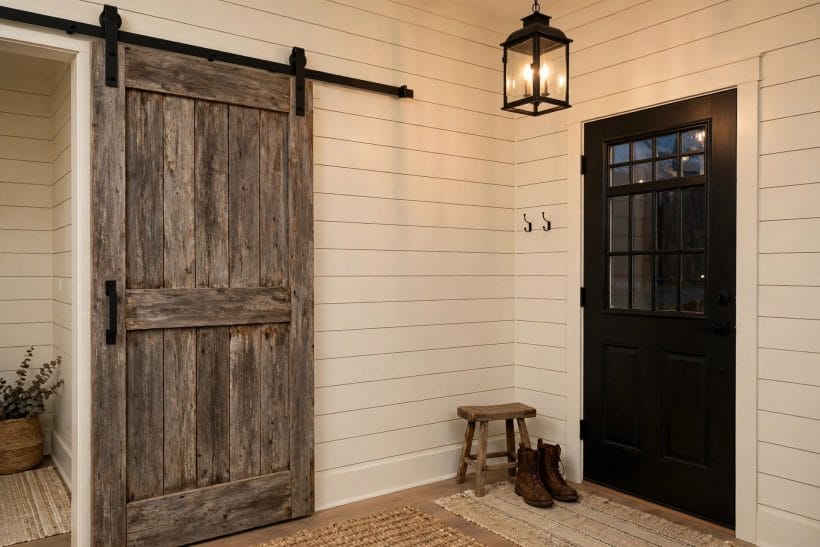
A lantern pendant over the console gives the entry a farmhouse centrepiece and a pool of warm light exactly where keys and post land. Hang it high enough to clear heads and low enough to feel intimate, and choose a lantern in black metal or aged brass with clear glass. A dimmer lets the same lantern serve morning and evening.
55. A Pair of Wall Sconces
A pair of wall sconces flanking a mirror or a picture gives the entry balanced light that flatters faces and artwork alike. Their symmetry suits the orderly farmhouse mood, and their upward and downward glow softens the walls. Keep the sconces at the same height and choose shades that warm the light rather than cool it.
56. A Small Table Lamp for Evenings
A small table lamp on the console is the evening heart of a farmhouse entry, casting a low, warm glow that says the house is awake and welcoming. Choose a ceramic or timber base with a linen shade, and keep the lamp small enough to leave room for keys and post. A lamp on a timer welcomes you home before you open the door.
57. A Window That Does the Work
Where the entry has a window, let it do the work by keeping the glass clear, the frame painted pale, and nothing bulky in front of it. Daylight is the most flattering light any entry can have, and a window beside or above the door transforms a dark hall. A simple linen panel can soften the light without blocking it.
58. A Dimmer for Soft Evenings
A dimmer on the entry lights is a small change with a large effect, because it lets one set of lights serve the bright morning search for shoes and the soft evening welcome. Fit dimmers on pendants and sconces alike, and choose bulbs that dim smoothly without flicker. Warm-toned bulbs keep the dimmed light golden rather than grey.
59. Candlelight on the Console
Candlelight on the console, in a hurricane glass or a sturdy lantern, gives the entry a special-occasion glow for guests and celebrations. Keep candles away from coats, curtains and paper, never leave them burning unattended, and use a stable holder that catches wax. Battery candles give the same flicker with none of the worry.
60. A Motion Light for Late Arrivals
A motion light in the entry means nobody fumbles for a switch with full hands on a late return, and it welcomes guests who arrive after dark. Set it to a gentle brightness rather than a harsh glare, and place the sensor so it sees the doorway without triggering from the next room. It is a small kindness that is felt every night.
9. Seasonal Touches and Small Spaces
A farmhouse entry earns its keep all year, and the best ones change a little with the seasons while staying calm and usable. Small entries need the same thinking in miniature, with one strong piece doing the work of many. The ideas below keep the entry fresh without a full redecoration, and they prove that a tiny hall can still give a full welcome. The wider principles behind these choices are set out in our guide to interior design ideas.
61. A Spring Switch of Stems and Colour
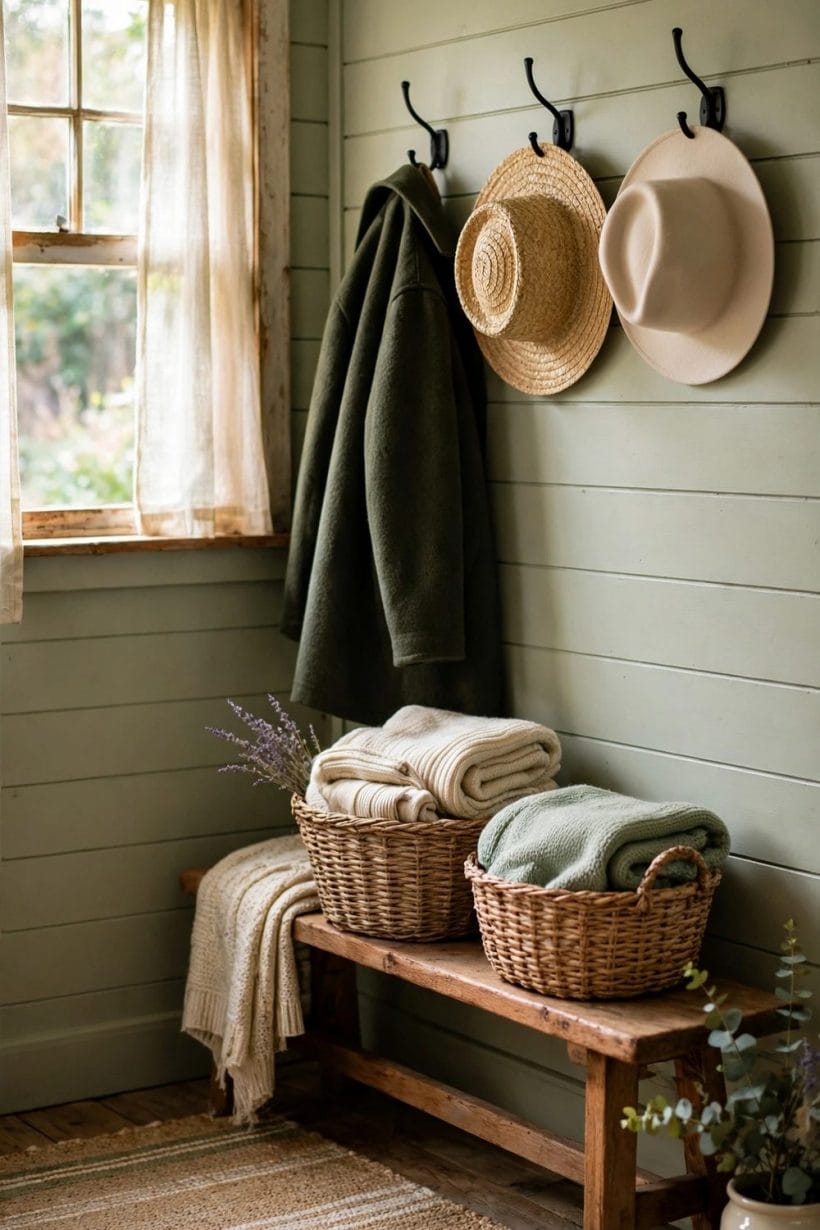
Spring in the entry can be as simple as fresh stems in the console vase, a lighter throw on the bench and a brighter cushion cover. The change costs little and lifts the whole hall, because the eye notices what is new. Keep the swap to three or four elements, so the entry feels refreshed rather than rearranged.
62. Autumn Texture Without Clutter
Autumn texture in the entry means wool, wood and woven baskets rather than piles of seasonal decoration. A chunky throw, a basket of pinecones and a warm-toned runner give the season without crowding the console. The goal is a hall that feels cosier, not a hall that has lost its working surfaces to decoration.
63. A Winter Welcome of Wool and Wood
Winter asks the entry to work harder, with room for heavy coats, wet boots and extra layers, so give it a wool throw, a sturdy boot tray and hooks that can take real weight. Warm light matters more in winter too, so add a lamp or a candle lantern to the console. A winter entry should feel like shelter from the first step inside.
64. Summer Light and Bare Floors
Summer in the entry means lighter layers, bare floors and open doors, so roll up the heavy runner, swap wool for linen, and let the breeze through. A vase of garden stems and a pale cushion are enough decoration, because summer light itself does the work. Keep the boot tray, because summer rain still happens.
65. A Tiny Hall With One Hero Piece
A tiny hall needs one hero piece, a beautiful mirror, a painted bench or a striking console, and everything else kept plain around it. The hero piece gives the eye somewhere to land, while the restraint everywhere else keeps the space usable. Resist adding a second star, because in a tiny hall two heroes become a crowd.
66. An Under-Stair Nook
The space under the stairs beside the door can become a farmhouse entry nook with a bench, hooks and baskets fitted to the sloping ceiling. Measure the lowest point carefully, because a bench that forces tall visitors to stoop will not be used. Open shelving suits the slope better than doors, which need clearance to swing.
67. A Rented Hall With No Holes in the Walls
A rented hall can still feel farmhouse with no holes in the walls, using leaning mirrors, freestanding benches, adhesive hooks rated for the load, and furniture that carries the style. A console, a rug and baskets do most of the work, and nothing needs a drill. Check the tenancy terms first, and keep every fixing removable.
10. Cost Drivers and Practical Details
The word costs in the title deserves an honest answer, and the truth is that entry projects vary enormously with materials, size and the amount of work done by professionals. The ideas below explain what drives the overall spend in general terms, where it is wise to invest, and where a farmhouse entry can be achieved for very little. No figures are quoted here, because local rates, materials and room sizes differ too widely for any single number to be useful, and a local quote for your own hall will always be more reliable than a generic estimate.
68. What Sets the Budget: Materials First
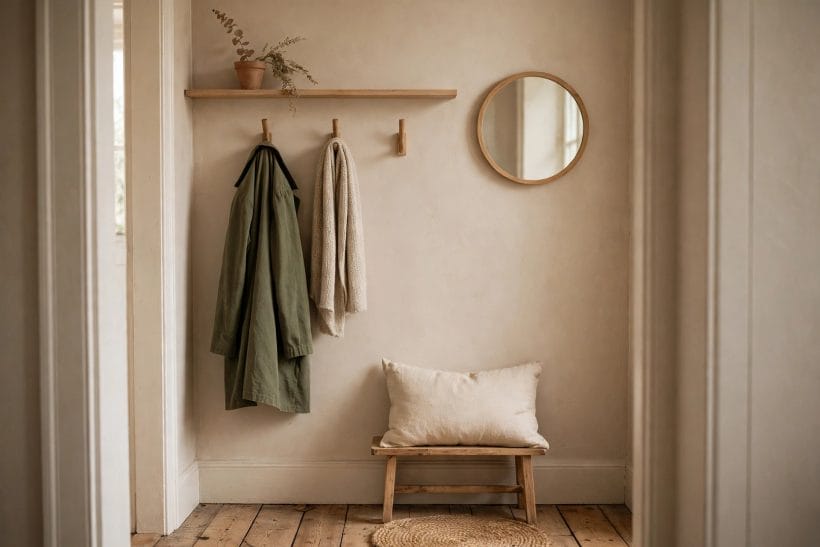
Materials are usually the first cost driver in an entry project, because solid timber, natural stone and quality tile all cost more than painted softwood or plain plaster. Boards, flooring and a good console set the tone of the spend, while baskets, hooks and textiles add relatively little. Choosing where to use the best material, and where a simpler one will do, is the key decision.
69. What Sets the Budget: Labour and Fitting
Labour and fitting are the second cost driver, because boarding a wall, tiling a threshold or fitting a bench properly takes time and skill. Work that touches wiring, plumbing or structure belongs with qualified professionals, and their time is part of the investment. A well-fitted simple design will always outlast a poorly fitted elaborate one.
70. Where to Spend and Where to Save
Spend on the pieces that take daily punishment, the floor, the bench, the hooks and the lighting, and save on the pieces that are easy to change, the cushions, the art and the baskets. This balance keeps the entry durable where it matters and flexible where tastes change. A single beautiful mirror is worth more than a wall of small decorations.
71. Second-Hand Finds That Suit Farmhouse Style
Second-hand finds suit farmhouse style better than almost any other, because age and wear are part of the look. Old benches, dressers, mirrors and baskets can be found at markets and charity shops, and a coat of paint or a new handle often transforms them. Check joints, drawers and fixings carefully, because a bargain that wobbles is no bargain.
72. Finishes That Forgive Muddy Boots
Finishes that forgive muddy boots are essential in a working entry, so favour matte paint over gloss, sealed timber over raw timber, and washable rugs over delicate ones. A finish that can be wiped, scrubbed or touched up without a trace will look better for longer than a precious one. Test any finish in a hidden spot before committing to the whole wall.
73. Keeping the Entry Tidy Week After Week
Keeping the entry tidy week after week is less about willpower than about systems, because a hall with a home for everything almost tidies itself. Empty the daily pile box weekly, return out-of-season things to their shelf, and shake out the mats on the same day each week. A five-minute reset each evening keeps the welcome intact.
74. Safety and Access at the Door
Safety and access at the door deserve the same care as style, because the entry is also an escape route and a threshold for visitors of all ages. Keep the walkway clear, the step well lit, the mat flat and the door easy to open, and avoid trailing cables or loose rugs. A welcoming entry is one that every guest can use comfortably and safely.
75. A Final Walk-Through Before Guests Arrive
A final walk-through before guests arrive is the simplest farmhouse ritual of all: step outside, come back in through the front door, and see the entry as a guest sees it. Straighten the rug, light the lamp, clear the console to its essentials, and put fresh stems in the vase. The entry is ready when the first glance feels calm, warm and unmistakably home.
Final Considerations
Before you begin, stand in your own entry at three times of day and notice where the light falls, where bags naturally land, and where the walkway narrows. Those three observations will tell you more than any catalogue, because they describe your hall rather than an ideal one. Measure the walls, the door swing and the walkway, and keep those measurements with you when you choose furniture.
Then start with the floor and the walls, add one piece of furniture that does the heavy work, and give every daily object a home before you buy a single decoration. An entry built in that order stays calm, because its beauty grows out of its usefulness rather than being pasted on top of it. And when the work is done, step outside and walk back in, because the welcome you feel on that first step is the welcome your guests will feel too.


0 Comments