

The foyer is the house’s formal handshake: the inner hall that receives a guest once the door has closed behind them, and announces — in one glance — what kind of house this is going to be. Not the place where coats are wrestled off, but the composed room beyond the threshold, where the welcome becomes architecture.
These 75 foyer ideas treat the hall as a room with its own dignity: proportion, a centre, light from above and sightlines into the house’s best face. The door-side working system — bench, hooks, shoe discipline — belongs to entryway ideas; the foyer begins where that machinery ends.
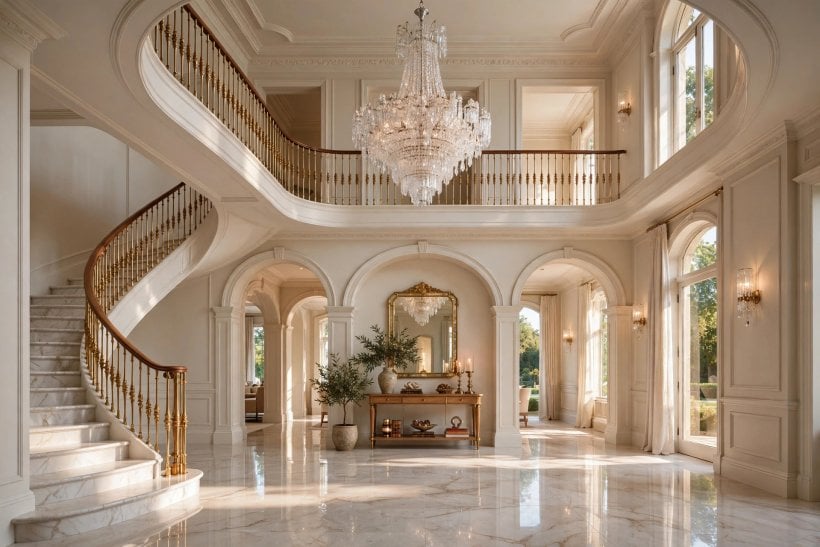
1. Foyer Ideas at a Glance
The central entity is the foyer: the formal entrance hall inside the front door, distinct from the entryway’s working threshold. Its attributes are proportion and ceiling height, a furnished centre, the staircase it often introduces, statement light, floors of consequence and curated walls. Where the entryway is judged on how completely the outdoors stops, the foyer is judged on what the indoors promises — it is the house’s opening sentence, and it should be a good one.
| What is the difference between a foyer and an entryway? | The entryway is the door-side system — bench, hooks, trays — that strips off the outdoors. The foyer is the formal hall beyond it: composed, furnished and meant to be seen. |
| What does a foyer need to feel complete? | A centre — a table, a rug, a light overhead — plus one deliberate picture or mirror. A hall with a centre reads as a room; without one it reads as a corridor with ambitions. |
| Can a small house have a foyer? | Yes. A foyer is a treatment, not a floor area: a defined rug zone, a console and a statement light can carve a formal hall out of the first few steps of an open plan. |
| What is the foyer’s most common failure? | Being used as the house’s overflow — bikes, parcels and the vacuum in the place of honour. A foyer that stores the day’s clutter has surrendered the one room whose job is ceremony. |
2. Proportion and First Sightlines
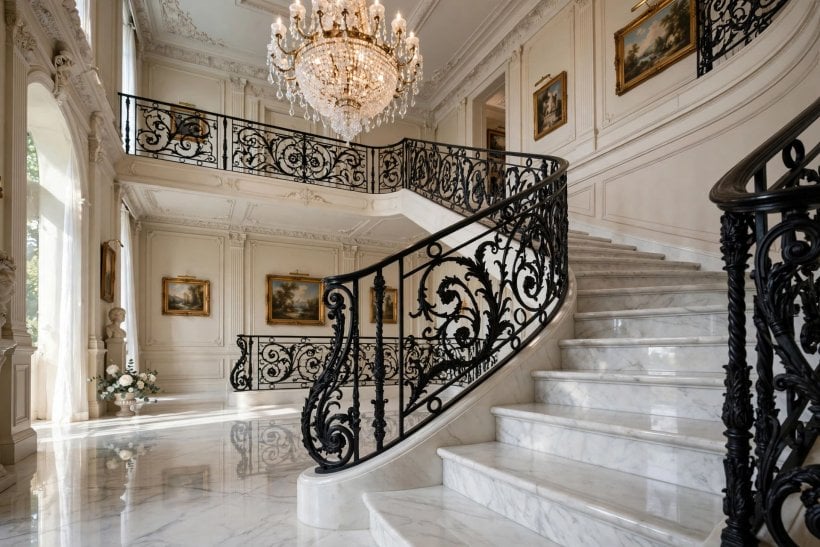
A guest reads the foyer in one sweep, before a word is exchanged. Proportion does the talking: where the eye lands first, how the ceiling height is used, and what the sightline down the hall promises. The journey to this room begins outside, at front porch ideas; this section composes the view from the moment the door opens.
1. Give the Eye a Landing Place Opposite the Door
The wall or vista facing the entrance is the foyer’s first sentence. Put the best thing there — a picture, a mirror, a doorway framed to a garden — because every arrival will read it before they read the host.
2. Centre Something: a Table, a Rug, a Light
Formal halls organise around a middle. A round table, a centred rug or a pendant on the room’s axis converts passage into place. The centre is what makes guests slow down instead of hurrying through.
3. Keep the Sightline Down the Hall Deliberate
What is visible from the door — a lit doorway, a window, a piece of art — is the house advertising itself. Audit the view from the threshold and edit it like a photograph: remove what apologises.
4. Use the Ceiling Height or Disguise Its Absence
Tall foyers take tall gestures: a long pendant, full-height curtains, art hung high. Low foyers take the opposite medicine — strong horizontals and light that spreads sideways rather than climbing.
5. Define the Foyer’s Borders With the Floor
Where the hall is carved from a larger space, a change of floor or a bordered rug draws its legal boundary. Guests understand the border instantly and treat the zone inside it as a room.
6. Let Doors Off the Foyer Stay Shut or Staged
Open doors reveal the house’s backstage. The foyer contract is that visible rooms are composed ones: keep doors to working rooms closed, and let one good doorway stand open as the invitation.
7. Scale Furniture to the Hall’s Ambition
A foyer furnished with apologetic, undersized pieces reads as a waiting area. One or two pieces at full scale — a serious console, a chair with presence — give the hall its rank.
8. Keep the Route to the Living Rooms Obvious
Formality must never confuse. A guest should sense the way to the sitting room without a guide: light, flooring direction and the open doorway should all point the same way.
9. Borrow Light From the Rooms Beyond
Glazed internal doors and open doorways pull daylight deep into the hall. A foyer lit by borrowed light feels connected to the house rather than sealed against it.
10. Treat the Foyer as the House’s Portrait Frame
Colours, wood tones and the art style declared here will be assumed to continue through the house. Choose them as the honest trailer for the film — the foyer should not promise what the rooms cannot deliver.
11. Leave Breathing Room Around Every Piece
Formal spaces are defined by what is absent. Air around the console, space around the picture: the foyer’s luxury is emptiness, curated. Crowding is the entryway’s problem to solve, not the foyer’s.
3. The Statement Console and What Stands on It
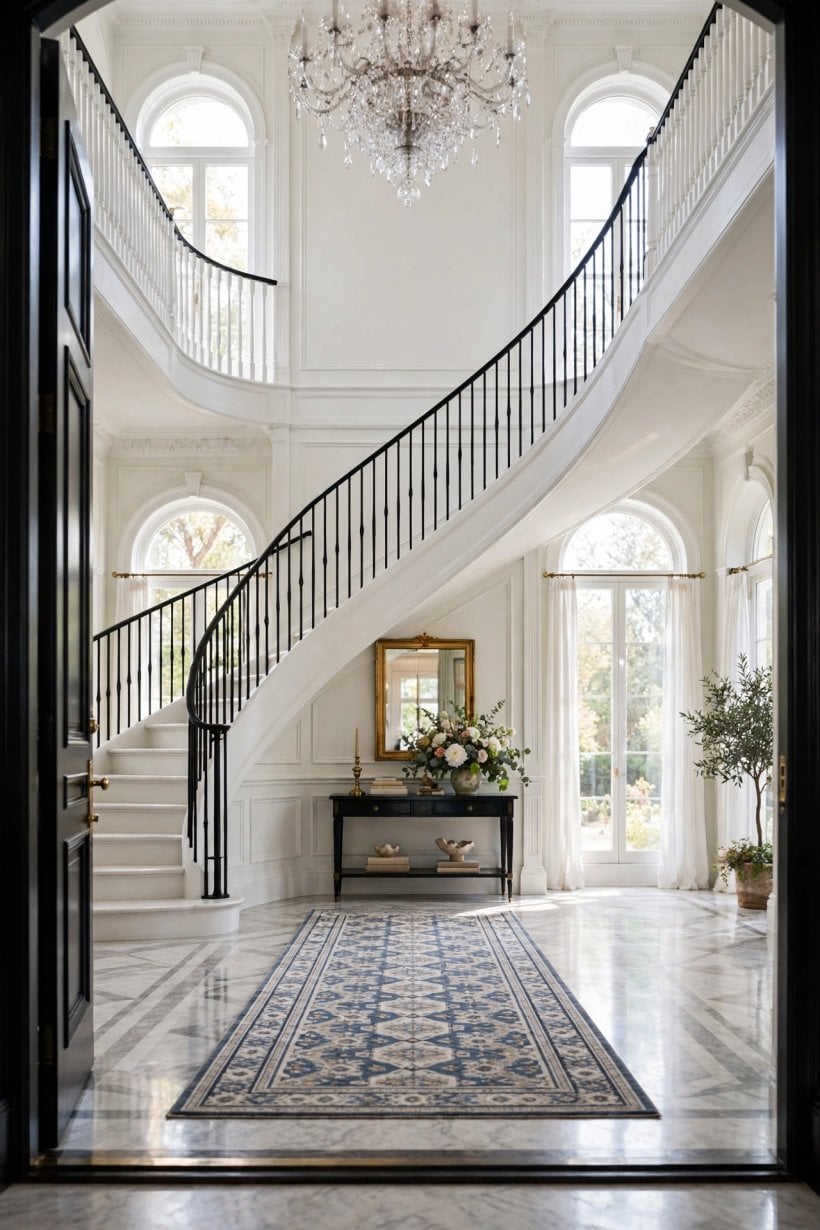
Most foyers are furnished by exactly one piece: the console table. It is the hall’s altar and its advertisement, and what stands on it — lamp, mirror, one beautiful object — composes the room’s whole personality at a glance.
12. Choose the Console as the Room’s Signature
This is the piece to spend on and to choose slowly: the console is seen by every guest, every day, at the house’s most formal moment. Timber with grain, stone with weight, or iron with line — presence is the brief.
13. Work in Threes on the Surface
A lamp, a stack of books, one object with a story: the trio is the oldest console formula because it balances height, mass and meaning. More than five objects and the altar becomes a shelf.
14. Put a Lamp on It and Use It Nightly
A lit console lamp is the foyer’s evening welcome — the light that says the house is awake and expecting you. On a timer, it performs the welcome whether anyone is home or not.
15. Hang the Mirror Above, Sized to the Table
Mirror and console are a married pair: the mirror should span most of the table’s width and hang low enough to feel connected. It doubles the lamp’s light and gives departures a final check.
16. Keep a Beautiful Bowl for the Necessary Things
Keys exist; the foyer need not scatter them. One handsome bowl or tray on the console receives the day’s small cargo with ceremony — the single licensed clutter point in the room.
17. Add Two Baskets Below for the Honest Overflow
Under-console baskets quietly hold the gloves, the dog lead and the post that awaits filing. Closed, woven and matching: storage that behaves like furniture, as the mudroom system at mudroom ideas also preaches.
18. Let One Object Carry the Season
A branch in spring, shells in summer, a bowl of pinecones in winter: rotating a single natural object keeps the foyer current without redecorating. The console becomes the house’s calendar.
19. Place a Chair Beside the Console
One good chair gives the foyer a second function — a place to sit with a guest who is only staying a moment, or to lace shoes in state. It also completes the room’s claim to be a room.
20. Keep the Console Wall’s Art Singular
Above the console, one large piece outperforms a cluster of small ones: formality prefers a statement to a conversation. Save the gallery wall for the stair turn or the landing.
21. Run a Runner to the Console, Not Past It
The rug should lead the eye to the room’s centre and stop there. A runner that continues past the console into the corridor drags the foyer back into being a passage.
22. Polish the Console’s Material, Whatever It Is
The foyer’s pieces are few, so each is examined. Wood conditioned, stone sealed, metal wiped: in a room of five objects, maintenance is visible and therefore is the decoration.
4. Stairs, Balustrades and the Hall That Rises
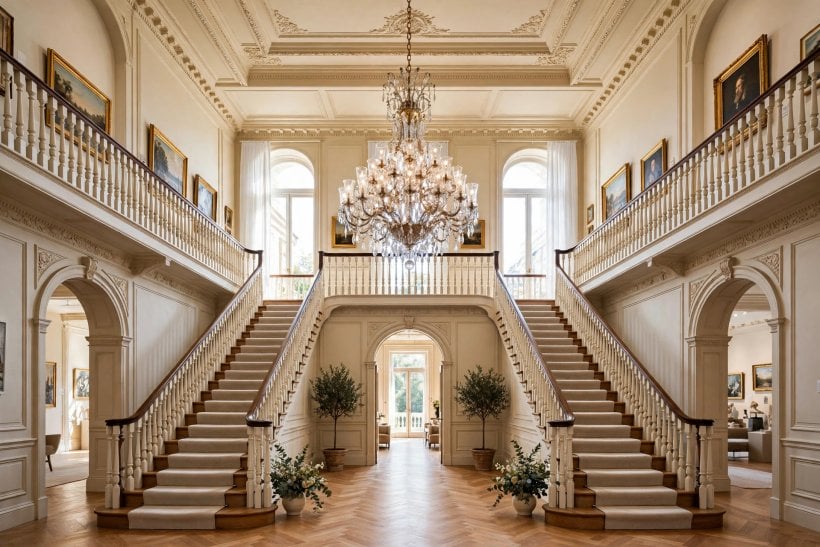
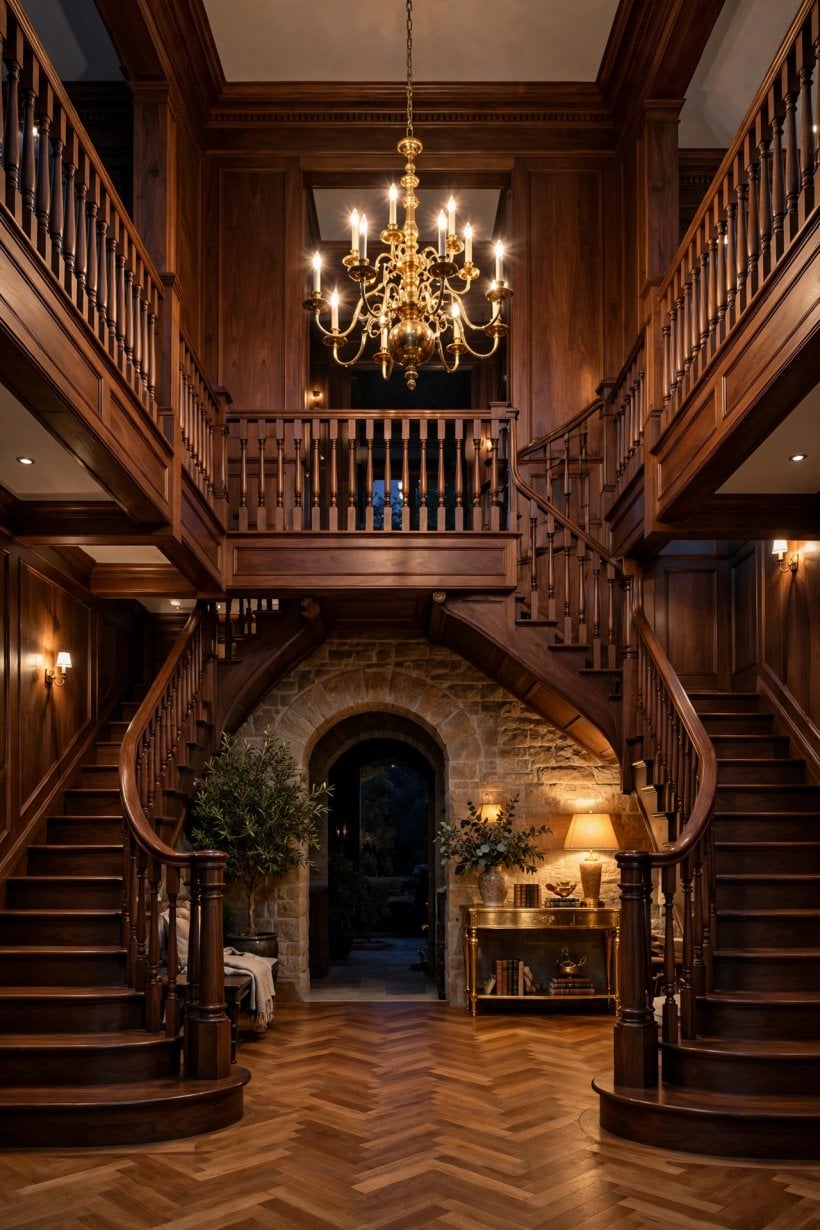
In many houses the foyer introduces the staircase, and the staircase becomes the room’s architecture — rising through the hall, offering the balustrade as sculpture and the stair wall as the house’s tallest gallery. The stair as its own subject is surveyed at staircase ideas; here it is the foyer’s grandest furnishing.
23. Treat the Balustrade as the Room’s Sculpture
Spindles, newel and handrail are the largest crafted objects most guests will touch. Their finish — painted, stained, ebonised — sets the foyer’s formality more than any furniture in it.
24. Run a Runner Up the Centre of the Stair
A stair runner softens sound, adds the hall’s richest band of pattern and signals that the house continues upward in the same taste. Border it with painted tread edges for the classic line.
25. Gallery the Stair Wall at Climbing Pace
Art on a stair wall is read slowly, one piece per few steps, at close range. Hang a series — prints, photographs, plates — that rewards the climb and can grow a frame at a time.
26. Light the Stair as Part of the Foyer
The pendant that lights the hall should spill a welcome up the first flight; a dark stair mouth beside a bright foyer reads as a warning. One light scheme, two territories.
27. Furnish the Under-Stair as the Hall’s Alcove
The triangle beneath the stairs can hold a desk, a reading chair or the console itself. Used well it is the foyer’s most charming square metre; used as a cupboard, its door should at least be beautiful.
28. Let the Newel Post Carry One Gesture
A finial, a lamp, a seasonal wreath hook: the newel is the stair’s full stop. A single deliberate detail there reads as the household’s signature, noticed by every hand that takes the rail.
29. Keep the First Step Clear as a Threshold
Shoes, bags and deliveries colonise bottom steps in every house. Defend the first tread as fiercely as the doorway: the stair’s foot is part of the foyer’s portrait, not its storage.
30. Match Stair Metals to the Hall’s Other Metals
Rail brackets, door furniture, the console lamp: one metal family through the foyer and stair keeps the architecture reading as one thought. Mixed metals belong to rooms with more distractions.
31. Paint the Stair’s Skirting to Continue the Hall
The skirting that climbs the stair should match the foyer’s exactly — same profile, same finish — so the eye reads hall and stair as one carved volume rather than two projects.
32. Use the Landing Glimpse as a Second Foyer Moment
Guests glimpse the landing when the stair turns. A small picture, a plant on the turn, a lit niche: the house’s hospitality should extend one flight up, not stop at the ground floor.
33. Keep the Hall’s Acoustics Kind to the Stair
Hard halls amplify every footstep above. The runner, the rug and one upholstered piece are acoustic furnishings as much as visual ones — a quiet stair makes a calm foyer.
5. Light: Chandeliers, Sconces and Daylight
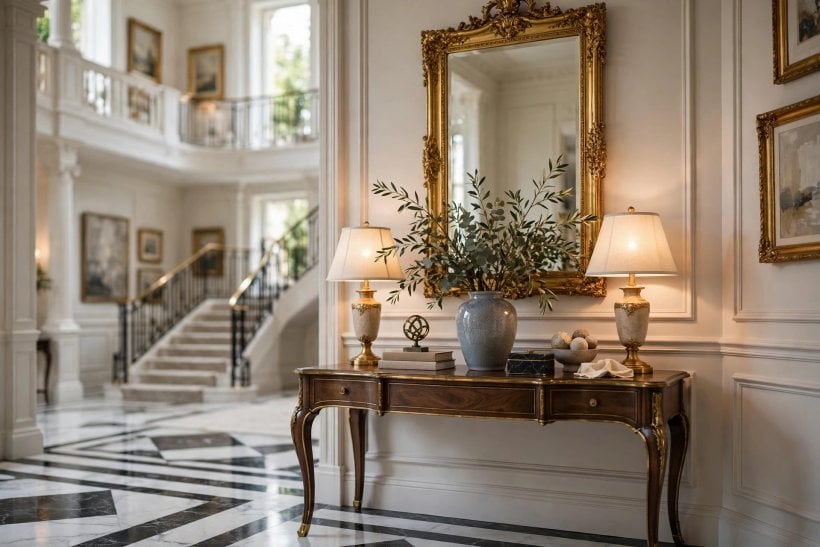
The foyer is the one room where a statement light is not vanity but duty: it is the beacon guests navigate by and the glow that makes an evening arrival feel expected. The porch’s lighting hands over at porch ideas; inside, the light takes the lead role.
34. Hang One Statement Light on the Hall’s Axis
Chandelier, lantern or pendant — one fixture, centred on the room and visible through the door’s glass if there is any. This is the foyer’s chandelier moment; spend and scale accordingly.
35. Size the Fixture to the Room’s Volume
The common failure is a timid light in a tall hall. Formal foyers take fixtures that would overwhelm a living room; the height eats scale, and the light must fill the well above the guests.
36. Layer Sconces at the Mirror and Art
Overhead light flatters nobody. Wall sconces flanking the mirror and washing the art give the foyer its evening face — warm, vertical light that makes arrivals look like the best version of themselves.
37. Put the Foyer Light on a Dimmer
Full brightness for cleaning and finding keys; a low glow for evenings and the lamp-lit welcome. The dimmer turns one fixture into the room’s whole lighting scheme, day and night.
38. Borrow Daylight Through a Glazed Door
A front door with glass — obscured for privacy, clear above eye level — floods the foyer with the day’s weather. The hall becomes a sundial, and artificial light retires until dusk.
39. Keep a Lamp Burning as the House’s Signal
The console lamp on a timer is an old hospitality technology: the house looks inhabited, expected guests feel awaited, and the family comes home to a room that has kept the light on for them.
40. Match Bulb Warmth Across Every Foyer Fitting
One cool bulb among warm ones reads as a maintenance error in a formal room. Standardise the warmth across pendant, sconces and lamp — the consistency is invisible, which is the point.
41. Wash One Wall to Fake a Larger Hall
A sconce pair washing a pale wall with light makes a narrow foyer read wider at night. Light is the cheapest volume a small hall can buy, and it rents by the watt.
42. Let the Stairwell Share the Pendant’s Glow
In tall foyers a long-drop fixture lights hall and stair together — one gesture, two rooms. Choose the drop so the fixture hangs in the stairwell’s view as well as the door’s.
43. Add a Picture Light Over the Signature Piece
The foyer’s one painting deserves its own light: a slim picture light lifts it out of the room’s general glow and confirms its rank. Guests will stop in front of it. That is the idea.
44. Plan the Night View From the Street
Stand outside after dark and read the house as guests will: the lit foyer behind glass is the home’s kindest advertisement. Adjust the layers until the view in is the welcome intended.
6. Floors Worthy of a Formal Hall
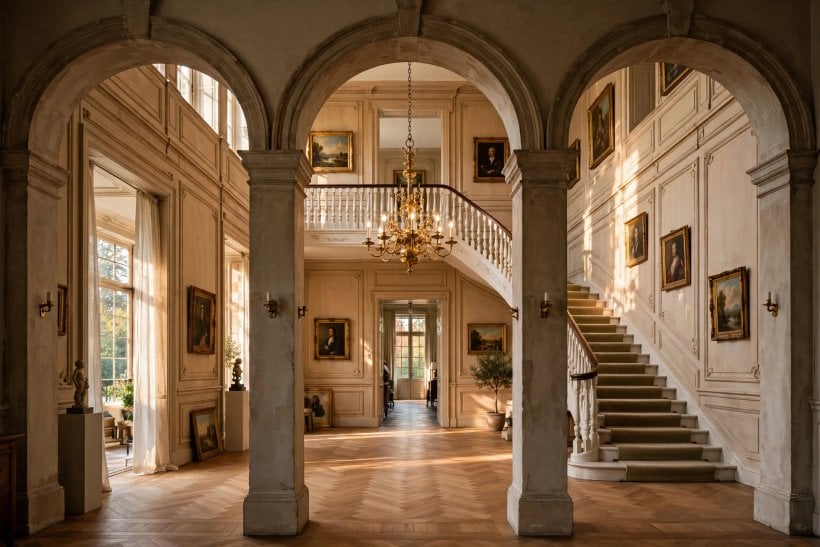
Foyers take the house’s hardest floor traffic in its most formal room — the contradiction this section resolves. The answer of grand houses is a floor of consequence that improves with wear: stone, chequerboard, honest timber, and a rug that behaves like upholstery rather than apology.
45. Lay a Floor That Ages in Public Gracefully
Stone, brick and timber all record traffic as patina; pale carpet records it as damage. The foyer’s floor is walked on by every visitor the house will ever have — choose the material that tells that story well.
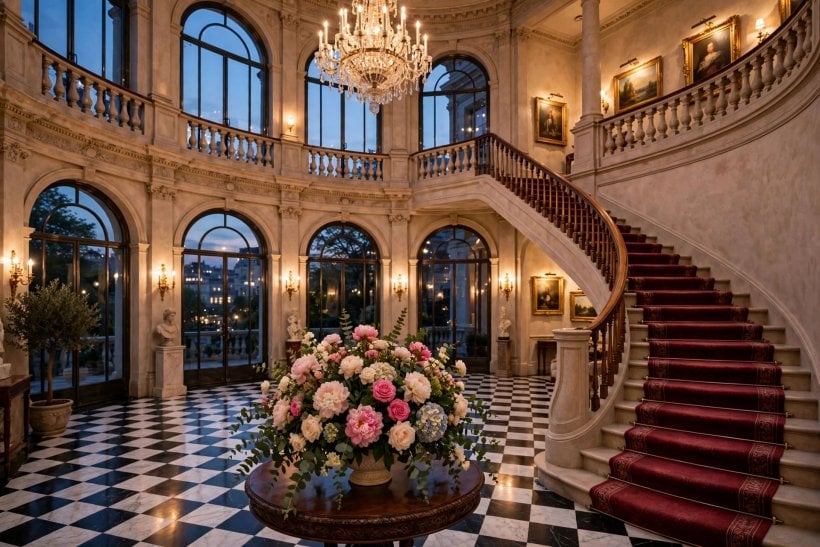
46. Consider the Black-and-White Chequerboard
The classic hall floor — stone or tile in chequer — is formality itself and hides the day’s evidence in its pattern. It suits narrow halls especially: the grid organises the eye and widens the read.
47. Run Timber Boards Toward the Light
Boards laid along the hall’s length and toward its brightest opening lengthen the room and lead the guest in. Across-laid boards chop a short foyer into slices.
48. Set a Stone or Tile Apron Inside the Door
Even in a timber-floored hall, a hard apron at the threshold takes the weather’s first blow — the formal echo of the entryway’s dirt line, executed in the foyer’s materials.
49. Choose a Rug With a Border and a Centre
The foyer rug is a carpet in the ceremonial sense: bordered, centred under the light, large enough for the console and a standing guest. A small rug reads as a mat that wandered in from the door.
50. Anchor the Rug So It Never Travels
A sliding rug in the house’s most formal room is slapstick waiting for an audience. A proper underlay, sized to the rug, is invisible infrastructure — buy it with the rug, not after the first incident.
51. Let the Floor Set the Hall’s Palette
Stone greys, timber warmth, chequer contrast: the floor is the foyer’s largest colour statement, and walls and textiles should be chosen in its company rather than against its evidence.
52. Keep a Boot Tray Beautiful or Banished
Wet weather will demand a tray. Choose one in zinc, stone or leather that can stand in the foyer without apology — or route wet boots to the mudroom and keep the hall ceremonial. Half-measures look like neither.
53. Heat the Floor if the Renovation Allows
Underfloor warmth in the hall dries the day’s wet footprints, welcomes bare morning feet and makes stone feel kind. In a foyer renovation it is the luxury guests feel without ever noticing.
54. Polish the Threshold Line Between Hall and Rooms
Where foyer floor meets living-room floor, the junction should be a deliberate line — a threshold strip, a border change — not a fade. Formal rooms end; the guest should feel the border as a small ceremony.
55. Keep One Rug in Reserve for the Mud Season
A darker, tougher runner that serves in the wet months lets the good rug rest and the foyer stay formal year-round. Seasonal rotation is how real houses keep beautiful things.
7. Mirrors, Art and the Curated Wall
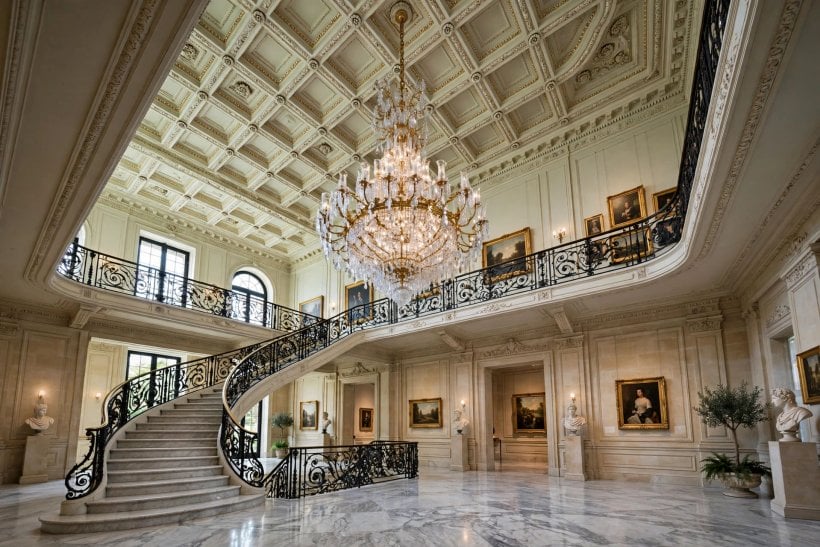
The foyer’s walls are few and closely read — guests stand still here, waiting, looking. That captive attention is the room’s gift to art and mirrors, and it should be spent on pieces that reward a stationary viewer. The reflective discipline is shared with the genkan tradition at Japanese genkan entryways — stillness, one beautiful thing, nothing spare.
56. Hang One Mirror Large Enough to Matter
A foyer’s mirror checks coats, doubles light and reflects the room back at itself. Scale is its virtue: a mirror that spans the console or fills a chimney breast works; a timid one merely reflects doubt.
57. Give the Signature Painting the Door’s First View
The picture opposite the entrance is the house’s chosen self-portrait. Let it be the best piece the household owns, lit properly, hung at standing eye height — the foyer exists to introduce it.
58. Use a Pair to Make Symmetry Speak
Two prints, two sconces, two chairs: the foyer’s formality loves pairs. Symmetry is the fastest route to the composed feeling that separates a foyer from a hall with furniture in it.
59. Keep Family Photographs for the Stair Wall
The foyer is the house’s public face; the stair wall is its private gallery. Photographs read best at climbing pace and close range, and the foyer keeps its formality for art and architecture.
60. Frame Consistently Within the Room
One frame family — timber, black, gilt — across the foyer’s pieces makes different artworks read as one collection. Mixed frames belong to eclectic rooms; the foyer is a classical one.
61. Add a Sculptural Object Where a Wall Is Short
A tall vase, a branch arrangement, a piece of pottery on a plinth: where wall space is broken by doors, a three-dimensional object carries the room’s art duty in the round.
62. Let Wall Colour Serve the Art, Not Compete
Formal halls traditionally run deep or neutral behind pictures. Choose the wall as the frame’s outer frame — a tone that throws the art forward and disappears behind it in photographs.
63. Include One Living Thing
A plant, cut branches, a bowl of lemons: something alive or once-alive keeps the formal room from reading as a showroom. The foyer should smell faintly of a garden or a kitchen, never of polish alone.
64. Hang at Standing Eye Height, Not Seated
Foyers are stood in. Art centred for a standing viewer — higher than living-room convention — meets the guest’s eye correctly. Seated-height hanging in a hall makes every arrival stoop to look.
65. Rotate One Piece With the Seasons
A single changing picture or textile keeps the foyer alive for the family who pass it hourly. The room’s permanent pieces provide the continuity; the rotating one provides the news.
8. Foyers in Small Houses and Tiny Homes
Small houses rarely have a hall to spare — but the foyer is a set of gestures, not a room count. This section carves formality out of doorways, corners and the first steps of an open plan, borrowing the machinery discipline from drop zone planning while keeping the ceremony.
66. Declare a Foyer With a Rug and a Light
In an open plan, a bordered rug inside the door plus a pendant above it declares a foyer in two objects. The zone will be treated as a room by everyone who enters — borders are behaviour.
67. Use a Screen or Bookcase as the Hall Wall
A low bookcase or an open screen a step inside the door creates the foyer’s essential fiction: a space between outside and living. It also hides the sofa’s back, which is doing the same job in reverse.
68. Take the Console Slim and Wall-Hung
A floating shelf-console with a mirror above delivers the foyer’s whole furnishing formula in fifteen centimetres of depth. In a tiny hall, that difference is the corridor’s width.
69. Let the Door Itself Carry the Welcome
Where there is no room for furniture, the door becomes the foyer: painted in the house’s signature colour, dressed with good hardware and a wreath hook, it performs the ceremony solo.
70. Steal a Coat Cupboard From the Next Room
A shallow cupboard built into the wall between hall and living room keeps the small foyer’s machinery invisible. The formal room survives because its clutter has a legal home behind a door.
71. Brighten a Windowless Hall With Mirror and Sheen
Tiny internal halls have no daylight to borrow. A large mirror opposite the one lit doorway, plus a gentle sheen on the paint, manufactures brightness the architecture declined to provide.
72. Keep the Small Foyer to Three Objects
Console or shelf, mirror, one beautiful thing: in a small hall, subtraction is the whole art. Every additional object taxes the room’s claim to formality at compound interest.
73. Run the Hall Colour Into the Living Room
Where foyer and living space are one volume, a continuous wall colour unifies them; the foyer’s identity comes from its rug, light and console rather than a paint border that would shrink both.
74. Use the Stair Foot as the Tiny Foyer’s Centre
Many small houses open straight onto the stair. Treat its foot as the foyer: a runner rising from the door mat, a picture on the turn, a lamp on the newel — ceremony in a metre of floor.
75. Borrow the Garden Through a Glazed Door
A glazed door or sidelight that frames the garden gives a tiny foyer the grandest possible first view. Where the outlook is good, the smallest hall in the house can have the largest picture.
9. Checks and Mistakes: Before the Console Is Bought
The foyer’s failures are failures of nerve: the hall furnished with leftovers because “it’s only a hall”; the statement light bought too small; the overflow of the whole house quietly annexing the one room meant for ceremony. And the subtlest mistake — confusing the foyer with the entryway, and loading the formal hall with hooks, trays and shoe racks until neither room works. Run the checks from the door. Is there a centre? A landing place for the eye? One light worth looking at? Nothing stored that apologises? A foyer that passes those four questions will make every arrival — guest or family, first or five-thousandth — feel like the house meant it.
10. Costs and Pulling It Together
The foyer’s money concentrates where eyes do: the light fixture, the console, the mirror and the rug. Floors are the big-ticket item when they change, but the formal hall is one of the few rooms where a floor earns a generation’s keep. Everything else — paint, a picture light, baskets — is modest. Pull it together in the room’s own order: fix the centre, land the eye, light the axis, floor it with consequence, then curate the walls. The foyer is small, formal and finished early in any decorating plan — the house’s promise, kept in a single room, introducing all the others.
Final Considerations
A foyer asks little: a centre, a light, a clear floor and nothing that apologises. In return it gives the house a beginning — the composed moment in which arrivals become guests and the family, coming home, is received by its own best manners. Whatever the size of the hall, that exchange is available. It only has to be furnished like it matters, because it is the room that tells everyone it does.

0 Comments