
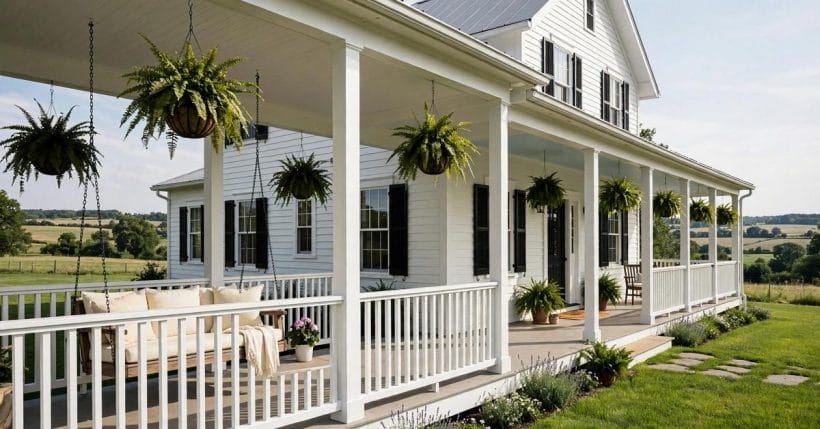
A farmhouse porch is not an entrance. It is the house’s handshake, its waiting room, its evening parlour and its front-row seat — the place where the day is started with coffee and ended with the light going down.
These seventy-five farmhouse porch ideas build that room properly: bones, furniture, swings, light, welcome and planting, in the farmhouse’s own order. Its nearest relative on the site is the craftsman porch ideas post — the same deep shade, a different joinery accent.
1. Farmhouse Porch Ideas at a Glance
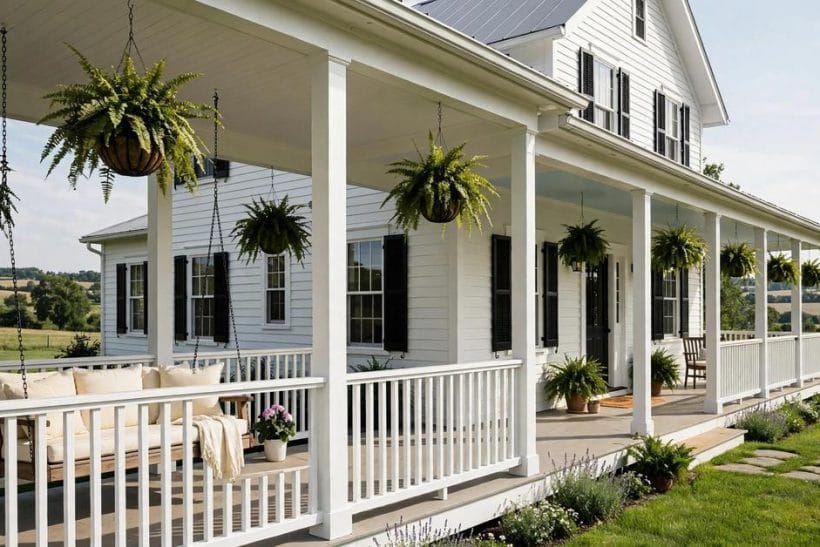
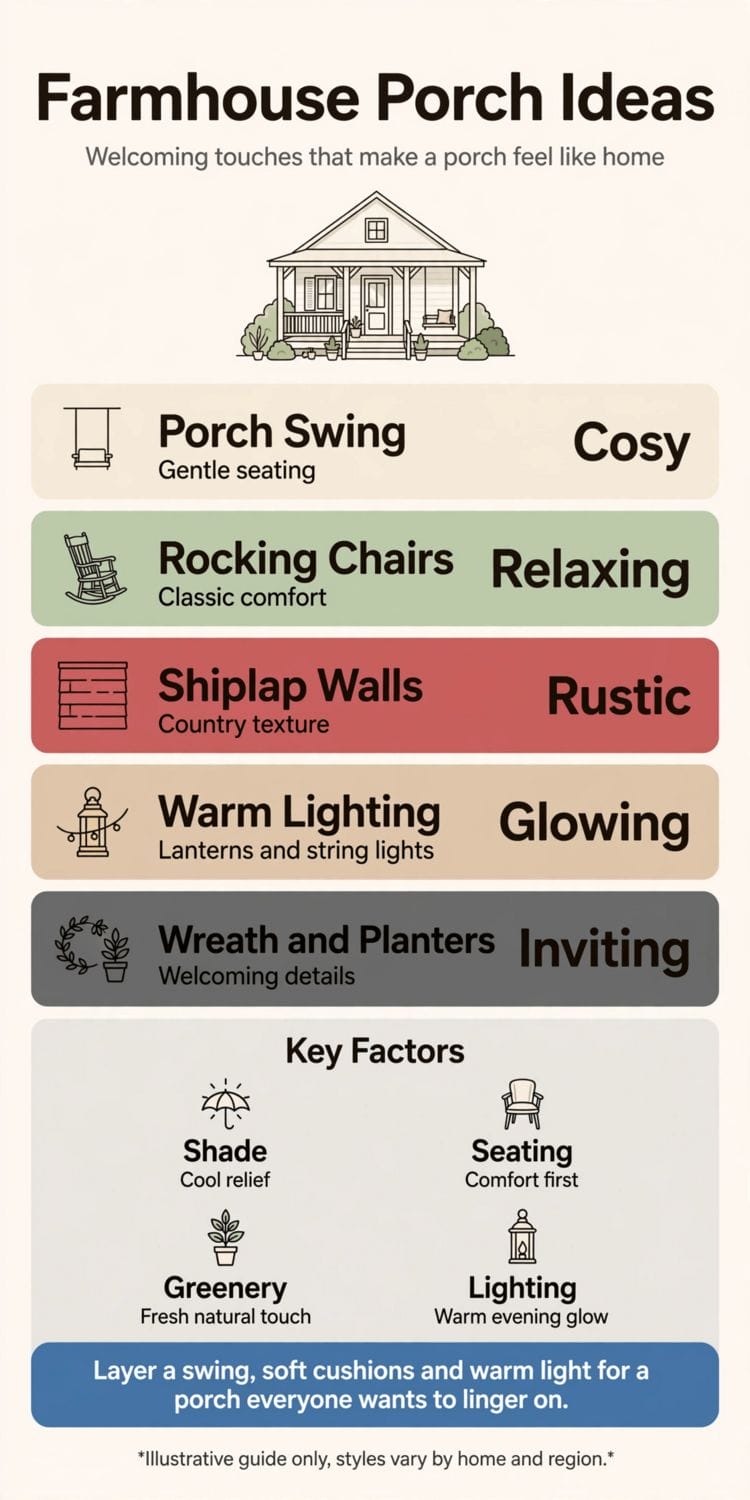
A farmhouse porch is a roofed outdoor room attached to a farmhouse or farmhouse-styled home, deep enough for furniture and daily life rather than mere arrival. Its defining pieces are a swing or rockers, a long table, posts and rails with some substance, a painted ceiling and planting that ties it to the garden. More than any other porch style it is a working room — part parlour, part pantry, part observation post — and its comfort comes from depth, shade and furniture that is used every single day.
| Question | Short answer |
|---|---|
| How deep should a farmhouse porch be? | Deep enough for a swing’s swing and a table’s company — shade is the point |
| What is the essential furniture? | Rockers and a swing first, then a long table and benches |
| Why is the ceiling painted blue? | A southern tradition — pale blue-green, said to discourage wasps and lift the shade |
| What makes it feel welcoming? | A strong door colour, readable numbers, lanterns lit and the threshold swept |
| Can a small porch be a farmhouse porch? | Yes — one rocker, a pot of herbs and a wreath carry the whole idea at small scale |
2. Porch Bones: Floors, Ceilings, Posts and Rails
A farmhouse porch is a room the house wears outdoors, and like any room it stands or falls on its bones: a floor that sheds water and takes boots, a ceiling that shelters the furniture, posts that carry the roof with a little dignity, and rails that guard without caging. Get the bones right and every later pleasure — swing, table, lantern light — has somewhere sound to live. The posts themselves, turned, chunky or plain, are the family’s own study over at porch columns; here the whole structure is the subject.
1. A floor of boards, brick or stone that drains
Porch floors live wet: rain blows in, plants drip, boots arrive muddy. Boards with a whisper of fall away from the house, or brick and stone that shrug off water entirely, are the farmhouse answers — sealed, sloped and never precious.
2. Paint the ceiling haint blue or keep it timber
The pale blue-green ceiling of southern porches is the farmhouse’s prettiest tradition, said to keep both wasps and worries away; natural timber is its northern cousin. Either beats white, which shows every fly and season.
3. Posts with presence
Farmhouse posts are chunkier than the structure strictly needs: square timber, turned wood or stone-based piers that make the roof look carried rather than balanced. Skinny posts make a porch look like it is apologising.
4. Rails low, wide and sittable
Where rails are needed, a wide top rail doubles as a shelf for coffee cups, plant pots and elbows. The classic farmhouse rail is furniture as much as fence.
5. Steps that invite
Wide, shallow steps — ideally with a landing deep enough for a pair of boots and a basket — turn arrival into a small ceremony. Steep, narrow porch steps are a farmhouse failing everyone feels and nobody names.
6. A roof deep enough to matter
The porch roof must throw real shade and shed real rain beyond the furniture’s edge. A token awning is not a porch roof; depth is the whole difference between a porch and a doorstep with ambitions.
7. Screen the sleeping end, if the climate asks
In midge and mosquito country a screened section keeps the porch usable at dusk, when it is best. Screen one end and keep the other open to the garden, and the porch serves both weathers.
8. Beadboard and board-and-batten walls
The wall behind the porch furniture wants texture: beadboard, vertical boards or the house’s own siding left honest. Flat render makes a porch feel borrowed from indoors.
9. Hang the door with confidence
The front door seen from a farmhouse porch should be the porch’s picture: painted deep, glazed above, with a handle that feels like something. It is the view from every rocker on the porch.
10. Stone or brick at the base
A skirt of stone or brick where the porch meets the ground grounds the whole structure, hides the under-porch world and gives planters and boots a hard edge to live against.
11. Leave room for the porch to be a passage
A farmhouse porch is also a corridor — to the garden, the woodpile, the back field. Keep a walking line along it clear of furniture, or every journey becomes an obstacle course with chairs.
3. Furniture: Rockers, Benches and Long Tables
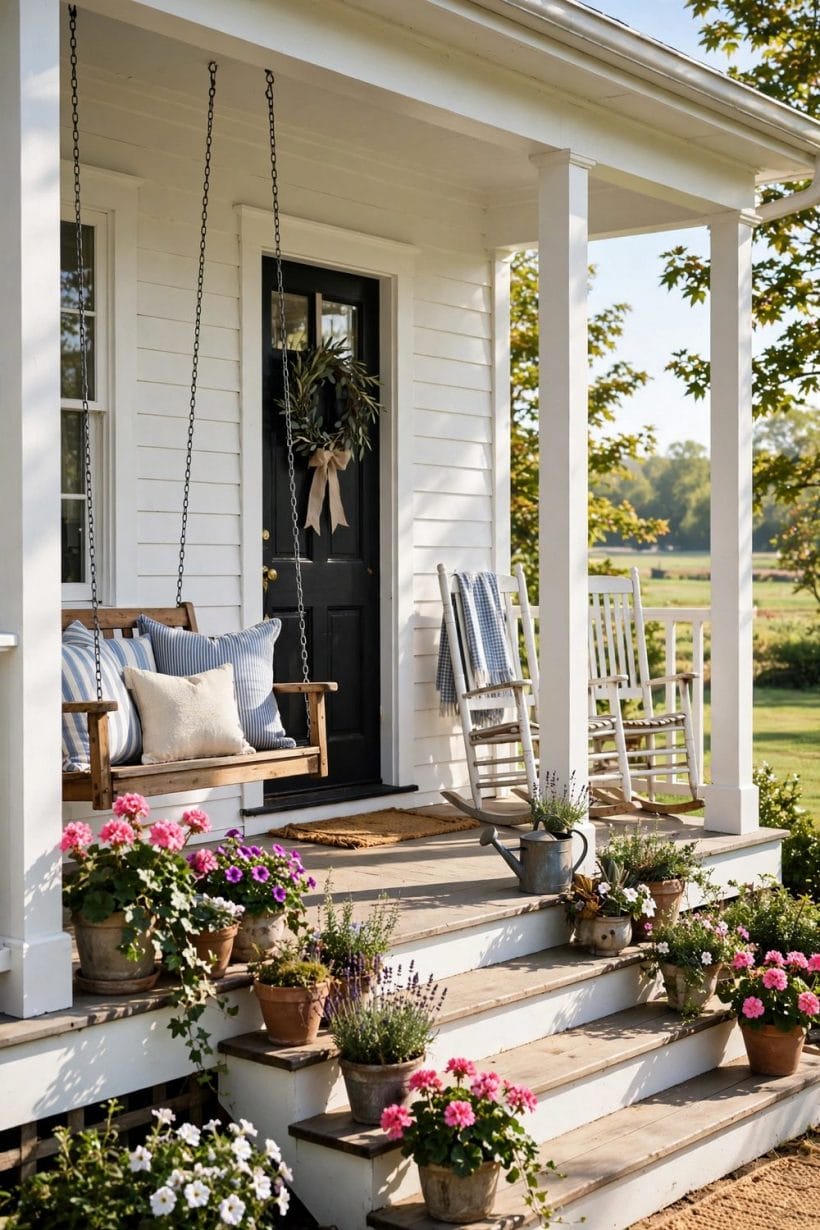
Farmhouse porch furniture is working furniture in its Sunday clothes: rockers built for hours, benches that seat a harvest crew, tables long enough for supper and the preserving pan at once. It is chosen for weather, weight and company, in that order — and it ages in public, which is rather the point.
12. Rockers in a row, facing the view
The rocking chair is the porch’s throne and its metronome. A row of rockers facing the garden or the lane turns the porch into the house’s theatre, with the world supplying the show.
13. A swing-sofa’s cousin: the long bench
Where a swing will not hang, a long bench against the wall seats the same crowd, holds cushions in a pile and takes a tray at each end. Benches are the porch’s most flexible citizens.
14. A farmhouse table for outdoor eating
A plain long table — scrubbed top, sturdy legs — makes the porch the summer dining room: breakfast in dressing gowns, supper as the light goes, preserving and flower-arranging in between.
15. Adirondack and ladder-back chairs
Deep, sloped chairs for the lawn end of the porch and upright ladder-backs for the table mix the porch’s two moods: collapse and conversation. Paint them the house’s trim colour or leave the wood to silver.
16. A daybed for the afternoon collapse
A single daybed or porch bed along the wall, heaped with washable cushions, is the farmhouse porch’s open secret: the best nap in the house is outdoors, in company, in shade.
17. Side tables that are really stools and crates
Every seat needs a table within reach, and the farmhouse porch supplies them from stools, crates and upturned buckets — pieces that move as the company moves and store against the wall in winter.
18. Cushions in washable, faded fabrics
Porch textiles live hard: sun, rain drift, cat. Choose washable covers in stripes, checks and faded florals that look better slightly sun-bleached — because they will be.
19. A porch rug that can be hosed
A flat-weave outdoor rug under the rockers defines the room and softens the boards. It should be the kind that dries by lunch after a hosing, in colours borrowed from the garden.
20. The tiny-house translation
On the porches of tiny house porch ideas, the same furniture shrinks gracefully: one rocker, a folding bench, a table for two — the farmhouse formula at half scale, losing nothing but seats.
21. Storage bench for the porch’s own kit
Cushions, throws, the lantern’s oil and the croquet set all need a home on the porch itself. A storage bench along the wall swallows the kit and seats two more at supper.
22. Furniture arranged for talk, not display
Turn the rockers slightly toward each other, pull the bench out of its line, angle the table to the view. Porches are for conversation; furniture in a showroom row silences it.
4. Swings and Hanging Seats
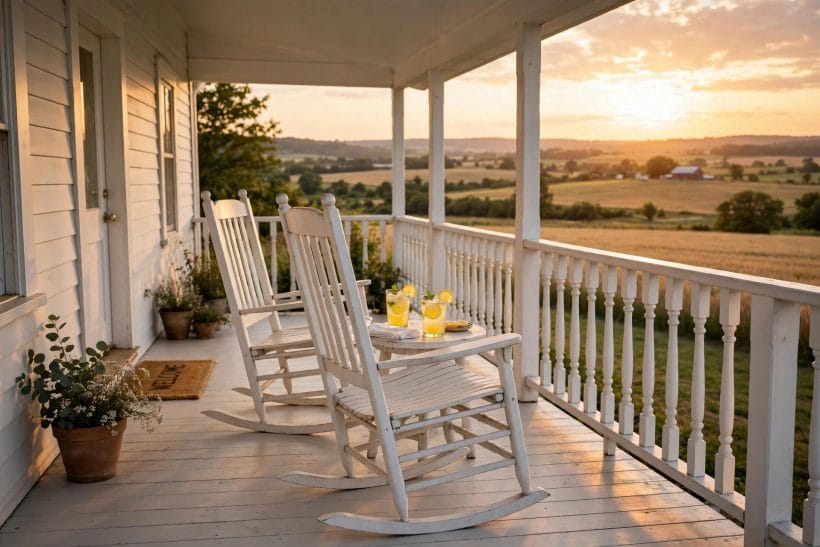
If the rocker is the porch’s throne, the swing is its cradle — the seat everyone photographs, everyone fights for and everyone falls asleep in. A farmhouse porch swing is part furniture, part weather instrument, hung where the breeze and the view agree.
23. The classic bed swing
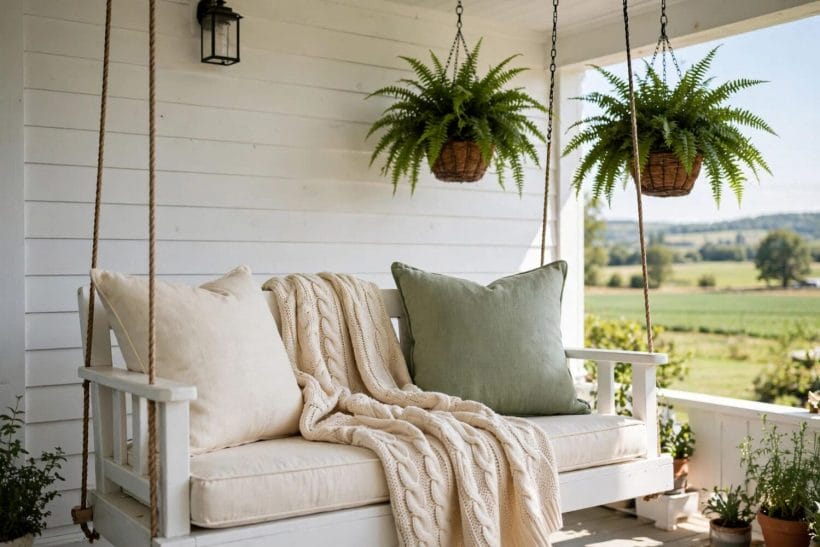
A swing built like a single bed — deep enough for cushions, a throw and a fully reclined swinger — is the modern farmhouse porch’s defining luxury. Hang it at the porch’s quiet end, facing the garden.
24. Chains, honest and visible
Chain-hung swings wear the farmhouse look best: galvanised or black chain, heavy enough to trust, long enough to tune the seat’s height and tilt. Rope suits the coastal porch; chain suits the farm.
25. Rope swings for the shaded end
Thick natural rope softens a swing’s voice and suits a porch among trees. It asks for dry storage in winter and rewards it with the gentlest ride on the porch.
26. Hang from structure, never from trim
A swing’s fixings belong in the porch’s beams, found with certainty and fitted with proper eye bolts. The rule is absolute: if you cannot name the timber the swing hangs from, do not hang the swing.
27. Leave the swing’s arc empty
A swing needs its travelling space — clear floor and air behind and before, no planters in the flight path, no table at shin height. Mark the arc with the rug’s edge and keep it sacred.
28. A pair of hanging chairs
Where one long swing will not fit, two hanging chairs flank the door like punctuation — each swinger with a private arc, the conversation swinging gently out of time.
29. Cushions and throws for the swing
Dress the swing as a bed: mattress cushion, pillows at the back, a throw over the arm. A bare swing is a bench with ambitions; a dressed one is a destination.
30. The swing as the children’s headquarters
Children colonise the swing by right of discovery: it is boat, fort and reading nook in one. Choose washable covers and let them — the porch’s memories are being made there.
31. A glider where hanging is impossible
Where the structure will not carry a swing, a glider bench gives the same motion on its own frame. It is the honest substitute, chosen openly rather than a swing hung on hope.
32. Tune the height for feet and talk
A swing hung so feet rest flat or dangle just clear of the floor serves both sitters and swingers. Too high is a climbing frame; too low scrapes the boards and the mood.
33. Winter the swing kindly
Cushions indoors, chains checked, timber fed with oil: ten minutes of autumn care buys a swing that opens the porch season already perfect in spring.
5. Lighting and Ceiling Fans: Porch Evenings
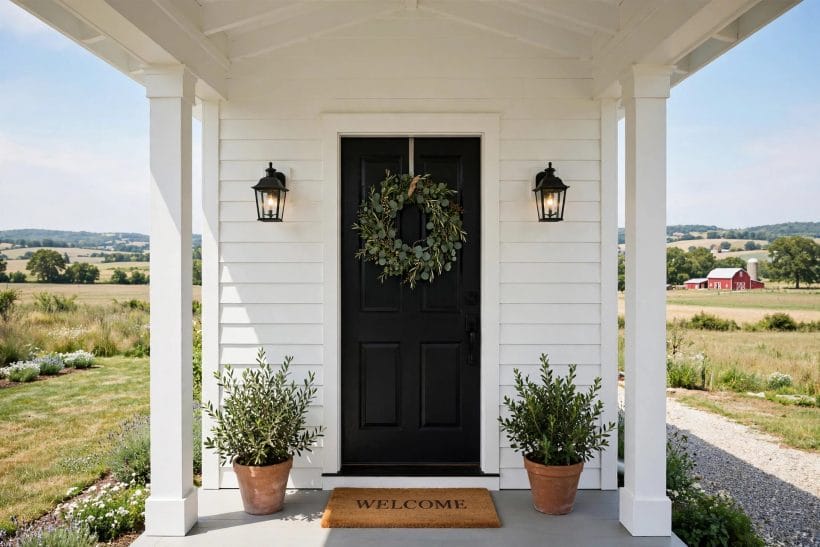
A farmhouse porch earns its keep twice a day, and the second shift — dusk to bedtime — belongs to light and moving air. Lanterns low, a fan turning slowly overhead, the garden going dark beyond the rails: the porch evening is the farmhouse day’s reward, and it is designed, not accidental.
34. Lanterns at sitting height
Light belongs where the people are: lanterns on side tables, a hurricane lamp on the supper table, candle jars along the rail. Low light flatters faces, draws no glare and lets the garden keep its dark.
35. One good pendant over the table
A single pendant or enamel shade over the dining table pools light where plates and faces are, leaving the porch’s edges in friendly shadow. It is the porch’s chandelier, and one is plenty.
36. Wall lanterns flanking the door
A lantern each side of the front door is the porch’s welcome written in light: it frames the door’s picture, lights the step and tells the lane the house is home.
37. String lights, used with restraint
A single run of warm festoon lights along the porch’s beam can be lovely; three runs is a beer garden. The farmhouse rule is one strand, warm white, and off when the porch is empty.
38. Ceiling fans sized to the porch
A fan over the seating keeps the evening air moving, discourages the biting insects and stirs the lantern light gently. Choose an outdoor-rated fan with plain blades, sized to the porch’s width, turning slow.
39. Solar path lights at the steps
The garden side of the porch wants its own small lights: a solar lantern at the steps and one at the path’s turn, so arrivals see the way without the porch’s mood being flooded.
40. Candles in jars against the breeze
Real flame behind glass survives the porch’s draughts and doubles the lantern effect cheaply. Keep them on trays, away from cushion fabric, and count them in at night like livestock.
41. Dark-sky manners
Porch light should fall on the porch, not the neighbourhood: shaded fittings, warm bulbs, nothing glaring outward. The stars are part of the porch’s ceiling; do not compete with them.
42. Switches where the evening ends
A switch by the door into the house, and the porch’s lights die as naturally as they lit. Fumbling for a switch in the dark is how porch evenings end early.
43. Fireflies over fixtures
Where fireflies, moths and night birds visit, keep the porch’s light low and warm and the garden dark. The best porch lighting design leaves something for the dark to show you.
44. The covered neighbour
A roofed porch and a covered deck solve the same evening from two sides; covered deck ideas work the deck’s version of lantern light and shelter, and the two make fine cross-reading for anyone planning both.
6. Welcoming Details: Doors, Numbers, Mats and Wreaths
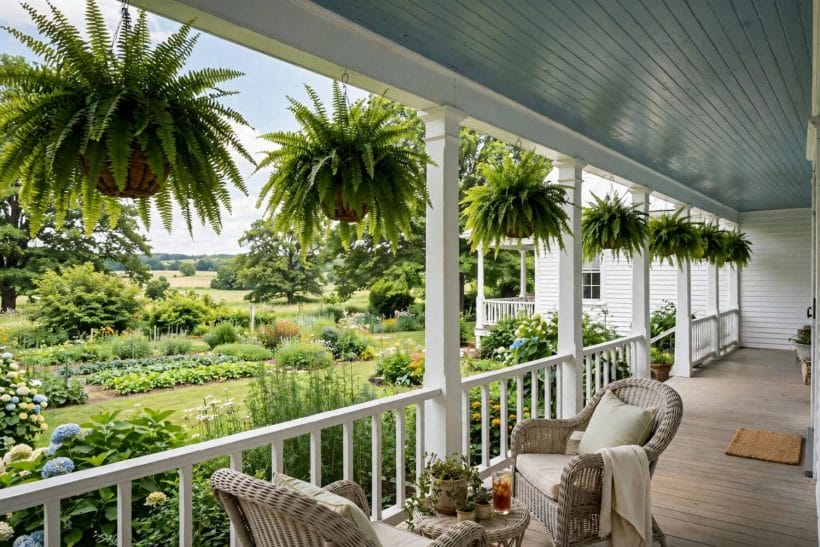
A farmhouse porch is judged in the first ten seconds, and the judgement is made by small things: the door’s colour, the number legible from the lane, a mat that means it, something green or wreath-shaped hanging where a hand would knock. The details are cheap; the welcome is priceless.
45. Paint the door a colour with a spine
Deep green, barn red, indigo, black: the farmhouse door states itself. Against pale siding and a grey porch floor, a strong door is the whole scheme’s exclamation mark.
46. House numbers a stranger can read
Large, plain numbers in black or brass, lit by the door lantern, mounted where the lane’s eye lands. Decorative scripts that defeat delivery drivers are hospitality failing at its first test.
47. A coir mat that scrubs boots
A thick coir mat at the door and a boot scraper beside the steps are the farmhouse porch’s handshake with muddy reality. The welcome begins with somewhere honest for the dirt.
48. A wreath for every season
The door wreath is the porch’s calendar: greenery at winter, blossom in spring, herbs and seed heads in autumn. One good wreath form, redressed through the year, beats a cupboard of novelties.
49. A bench by the door for parcels and boots
Deliveries, muddy boots, the sitting-down to lace them: a small bench beside the door serves all three and gives the porch’s arrival zone its piece of furniture.
50. Pots flanking the steps
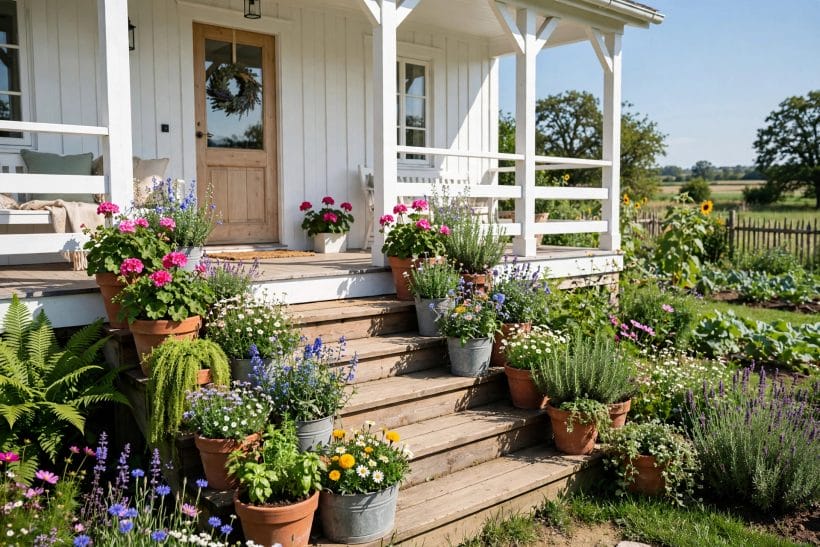
A pair of planted pots at the steps — herbs, geraniums, small shrubs — frames the climb and softens the porch’s edge. Odd numbers inside the porch; pairs guard the threshold.
51. A bell, a knocker, a honest chime
Let visitors announce themselves with something that sounds like the house: an iron knocker, a brass bell, a chime with a low note. The sound is the first sentence of the welcome.
52. The porch sign, kept wordless or nearly
If a sign hangs, let it be a number, a farm name or nothing at all. The farmhouse porch does not need its welcome spelled in script; the rockers already said it.
53. Hooks by the door for the day’s gear
Hats, dog leads, a market basket, the umbrella: a row of hooks inside the porch by the door keeps the day’s equipment out of the hall and in the porch’s working zone.
54. A water bowl and a boot tray in summer and winter
Small kindnesses compound: water for dogs in summer, a tray for wet boots in winter, a spare pair of porch slippers for the gardener. Guests remember these longer than the furniture.
55. Keep the threshold swept
The cheapest welcoming detail is a broom kept on the porch and used: leaves off the steps, webs off the lantern, the mat shaken. A swept porch says the house is loved daily.
7. Planting and Seasonal Dressing
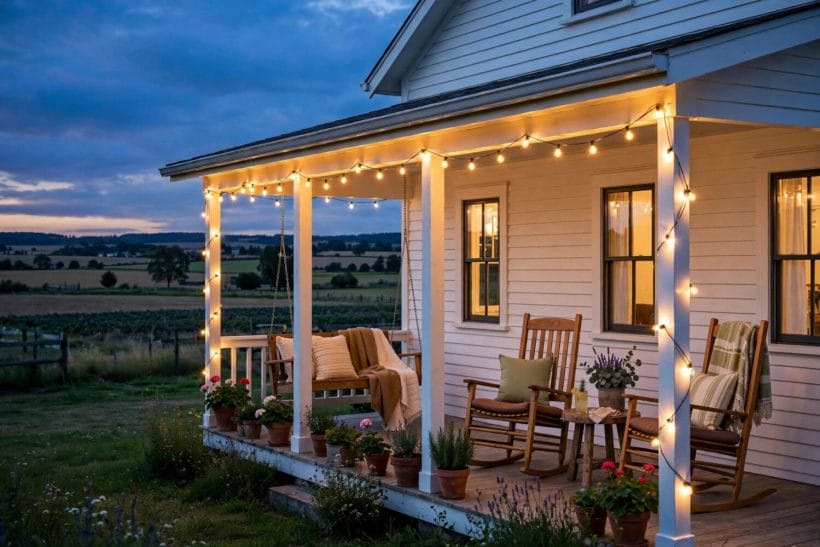
The farmhouse porch is where the house meets the garden, and planting is the treaty between them: pots on the boards, climbers on the posts, herbs within reach of the kitchen door. Dressed through the seasons, the porch never has a month when it is not saying something.
56. Climbers trained up the posts
A rose, jasmine or honeysuckle taught to climb one porch post perfumes the whole seating area and knits the porch to the garden. Train them on wires, keep them off the paintwork, prune without mercy.
57. Herbs in pots by the kitchen door
Basil, mint in its own pot, rosemary as a small shrub: herbs on the porch are decoration that gets eaten, placed where the cook’s hand falls on the way to the table.
58. Ferns in the shaded corners
The porch’s gloomy corners, where sun never lands, are fern country. A stand of green ferns cools the porch visually and thrives exactly where flowering plants sulk.
59. Window boxes on the porch rail
Boxes along the rail at sitting height put flowers in the rockers’ foreground — the view from the swing framed in geraniums. Water them from the porch, daily in summer, without ceremony.
60. Spring: bulbs and blossom
Pots of bulbs forced along the steps, a branch of blossom in a tall jar by the door: the porch announces spring a fortnight before the garden commits to it.
61. Summer: abundance, watered
Summer dressing is generosity — full pots, hanging baskets at the porch’s edge, the swing among leaves. The price is water, daily; the porch pays it gladly for the jungle shade it buys.
62. Autumn: the harvest porch
Pumpkins on the steps, seed heads in jars, a plaid throw on the swing: autumn is the farmhouse porch’s harvest festival, and it dresses itself if the garden is allowed to help.
63. Winter: evergreen and lantern light
Evergreen in the pots, a wreath on the door, lanterns lit at four: the winter porch is spare, green and glowing, the house’s lit window on the dark lane.
64. A small tree in a big pot
One substantial potted tree — olive, bay, a small maple — gives the porch a piece of architecture that grows. It anchors a corner better than any ornament and outlives every cushion.
65. Share the deck’s planting lessons
Small porches and small decks solve planting the same way — pots in threes, climbers on structure, herbs by the door — and small deck ideas work the same arithmetic at ground level for anyone dressing both.
8. Farmhouse Porch Styles: Classic, Modern Farmhouse, Southern and More
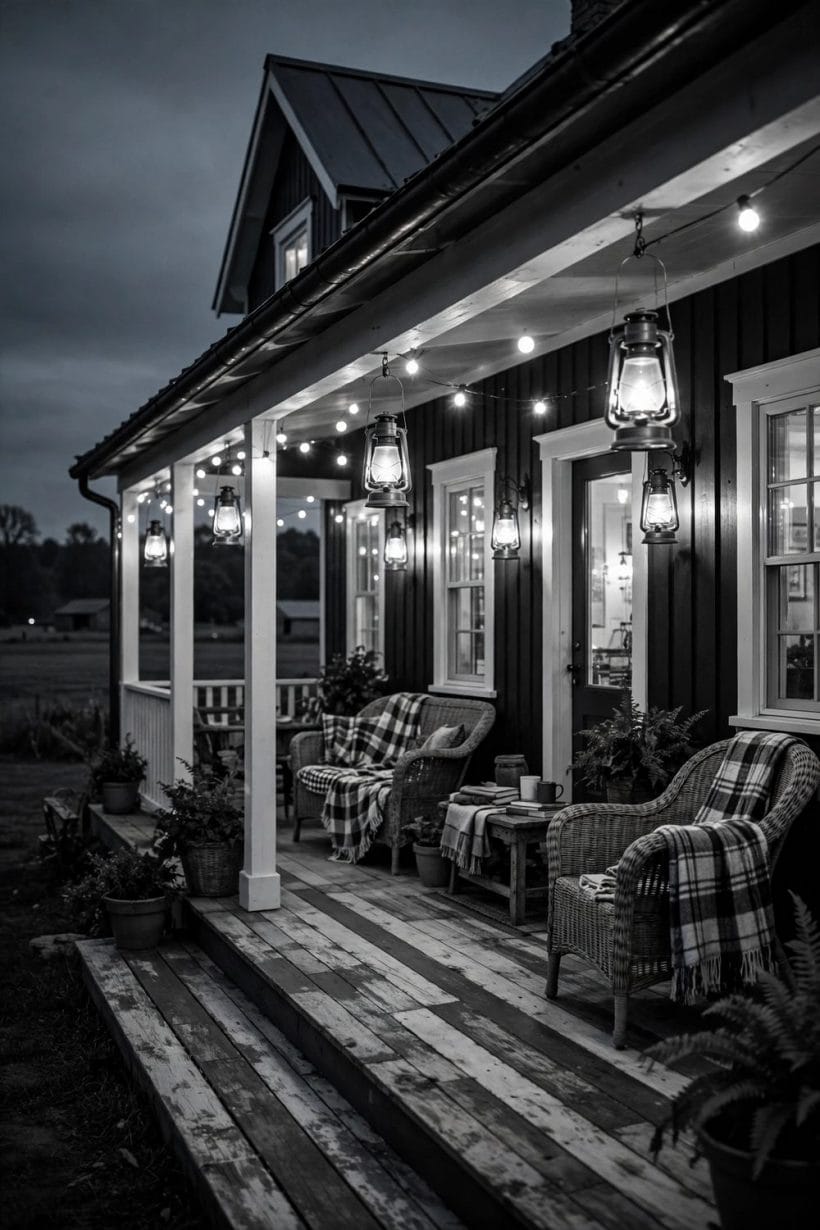
The farmhouse porch wears several regional and period faces, and choosing among them is mostly a matter of listening to the house. The bones stay constant; the dress changes — a column’s profile, a ceiling’s colour, a swing’s cushion — and the porch becomes colonial, southern, Scandinavian or new-country with the same rockers throughout.
66. The classic country porch
Turned posts, a railing with spindles, rockers in a row and a flag if the household flies one: the classic is the porch of memory, and it asks only for maintenance and company.
67. Modern farmhouse: black, white and clean lines
The modern farmhouse porch strips the ornament: black door and lanterns, white siding, square posts, furniture in black and natural wood. Its full house treatment lives in farmhouse home design ideas; the porch is that scheme’s frontispiece.
68. The southern wraparound
Deep on two sides, ceiling blue, swings plural and ferns in hanging baskets: the southern porch is a way of life with a roof on, built for heat, talk and time taken slowly.
69. Colonial symmetry
Pairs everywhere — posts, pots, lanterns, rockers — and the door centred like a full stop: the colonial porch is the formal cousin, welcoming with perfect manners.
70. The prairie porch: low and wide
A low roof, wide piers of stone or brick and a long horizontal welcome suit the prairie house and its landscape. Furniture stays low and long to match the horizon.
71. Scandinavian farm porch: pale and sparse
White boards, untreated wood silvering, one sheepskin and pots of white flowers: the northern farm porch is the classic with the colour turned down and the light turned up.
72. The cottage porch, half garden
Where the porch shrinks to a stoop with pretensions, plant it like a garden room: climbers overhead, pots crowding kindly, one chair. The cottage porch is a bower with a door in it.
73. The back porch: working dress
Not every farmhouse porch is for show: the back porch in boots-and-baskets dress — sink, hooks, crates, the woodpile — is the style’s engine room, and it deserves the same care, differently aimed.
74. Porch into room: the furnished compromise
Glazed or screened ends, a rug, lamps and the daybed make the porch a three-season room — the direction the whole family’s indoor style takes at farmhouse living room ideas, where the farmhouse moves indoors for winter.
75. Choose by the house, not the photograph
The right style is the one the house’s age, region and bones keep suggesting. A porch that agrees with its house looks inevitable; one copied from a photograph always looks like it is waiting to be believed.
9. Checks and Mistakes: Before the First Purchase or the First Fitting
Check the swing’s structure before the swing: beams, bolts and the honest naming of what carries the load. A porch’s pleasures are heavy and move; its fixings must be boringly sound.
Mind the water: porch floors, cushions and timber all live with blown rain. Choose materials that dry, store the soft things under cover, and let nothing precious live where the weather visits.
Beware porch creep — the slow arrival of bikes, boxes and the broken chair awaiting repair. A farmhouse porch stays a room only while its working line stays clear and its clutter stays in the barn.
10. Costs and Pulling It Together
A farmhouse porch’s money divides by permanence: structure first — roof, floor, posts — because it shelters everything after; the swing and rockers second, bought once and well; tables and benches third, plainly made; and the whole dressing layer last, since wreaths, pots and cushions are the porch’s small change and can arrive season by season.
Pull the design together by choosing the porch’s hour — dawn coffee, long suppers, dusk on the swing — and letting that hour decide the furniture’s arrangement, the lights’ positions and the planting’s shade.
Final Considerations
The farmhouse porch is the house at its most hospitable and least formal: a room that belongs to everyone who climbs its steps, furnished by use and decorated by seasons.
Start with shade and a seat that moves, hang the lantern, plant the pot by the door — and then simply be there, daily, which is the porch’s only real requirement.



0 Comments