
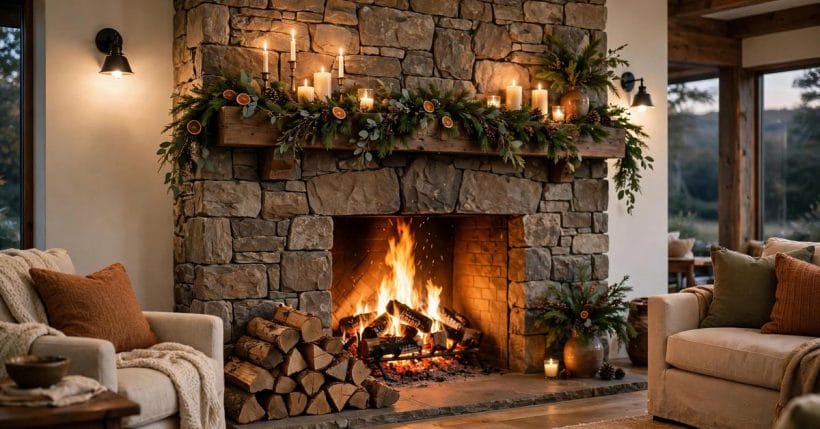
The hearth is the fireplace’s front step — the flat, fireproof apron at the fire’s feet where sparks land, boots dry, and the whole room learns how close it may comfortably come.
These seventy-five fireplace hearth ideas cover levels and shapes, stone, tile, brick and slate, the surround and mantel above, raised hearths you can sit on, fireside styling, and the safety, care and cost drivers that keep the fireside honest.
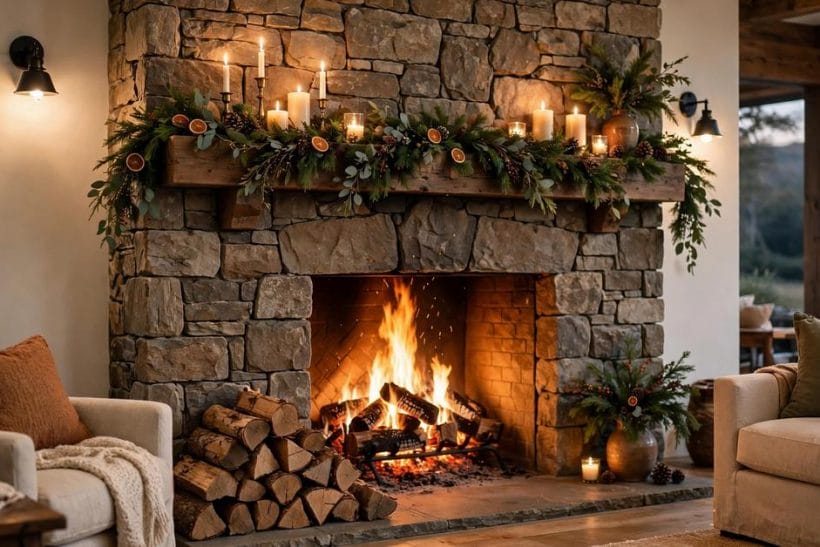
1. Fireplace Hearth Ideas at a Glance
A hearth is the non-combustible floor area directly in front of a fireplace opening, built to catch sparks and embers, protect the floor, and give the fire a visual base. This post stays with the hearth alone. The wider fireside family has its own surveys — all fireplaces in living rooms covers the fireplace as a whole, and fireplace mantel ideas takes the shelf above — so here, everything is at the fire’s feet, where it belongs.
| Question | Short answer |
|---|---|
| What is a hearth? | The fireproof apron of stone, tile, brick or similar material at the base of the fireplace, inside the firebox and out across the floor |
| Flush or raised? | Flush suits modern rooms and easy floors; a raised hearth adds seating, presence and a clearer safety edge |
| Which materials work? | Stone, slate, tile, brick and concrete are the classic family — chosen for heat tolerance, looks and how they clean |
| What matters most for safety? | Non-combustible materials, correct sizing and clearances for your fireplace type, and local rules — checked, never guessed |
| Can a hearth be updated alone? | Often yes — re-tiling, re-facing or extending a sound hearth is one of the most effective small fireplace refreshes |
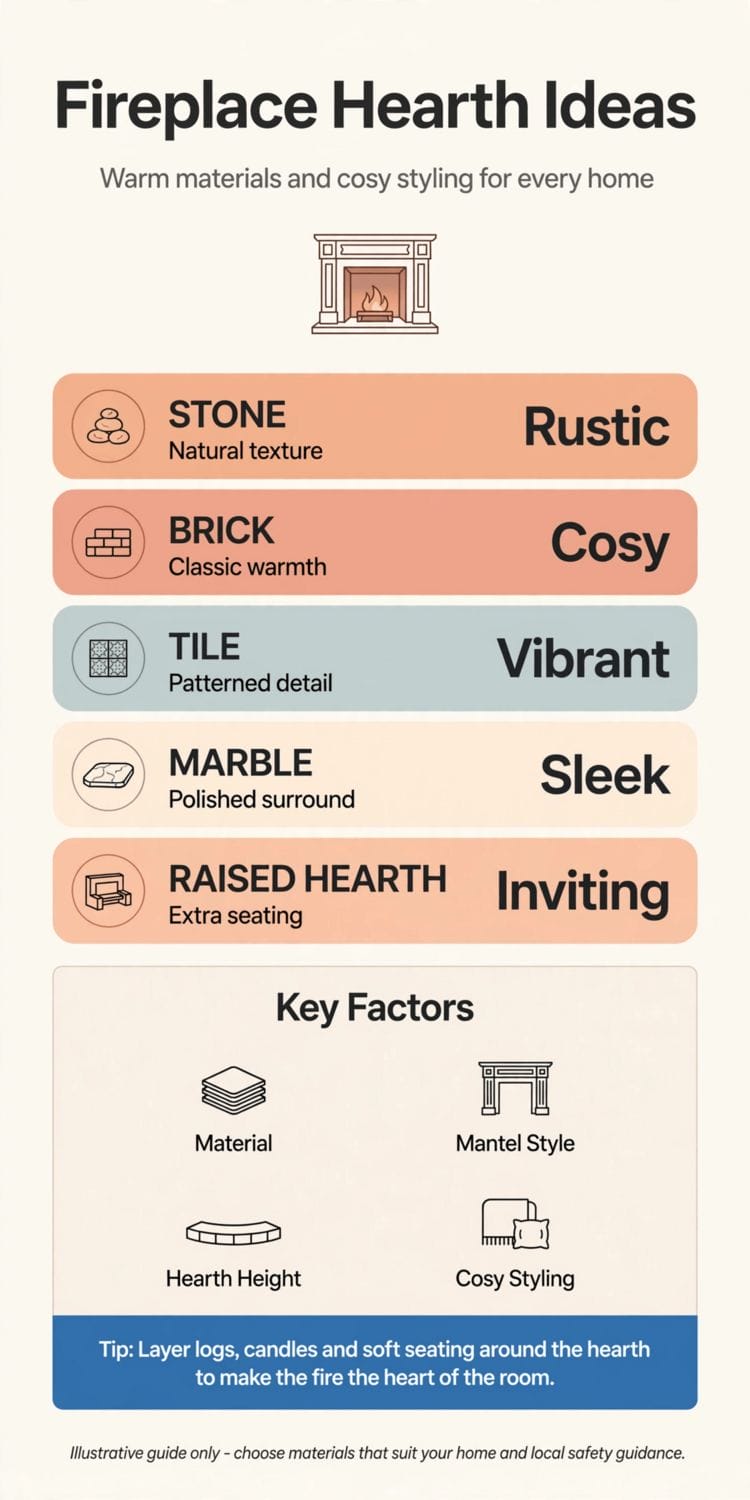
2. Levels and Shapes: The Hearth’s Foundation Decisions
Every hearth design starts with two decisions — how high it sits against the floor, and how far it reaches. Get those right and the material almost chooses itself.
1. A flush hearth, level with the floor
The modern default: hearth stone set level with the surrounding boards or tiles, so the fire sits in the floor plane itself. It keeps sightlines clean, floors easy to sweep, and works beautifully where the fireplace is a calm rectangle in a calm wall.
2. A slightly raised hearth on a low plinth
One modest step up gives the fireplace presence and the fire a stage, while staying low enough to step over without thinking. The raised edge also draws a clear line small children and guests instinctively respect.
3. A deep hearth that reaches into the room
Extend the hearth well beyond the minimum and it becomes the fireside’s floor — room for log baskets, boots, a kettle, a dog. Deep hearths suit country rooms and big fireplaces where the fire is the household’s real hearth in every sense.
4. A hearth that wraps the fireplace’s sides
Carrying the hearth material up and around the opening’s sides — a full apron — frames the fire completely. It suits traditional fireplaces and stoves alike, and it hides the awkward junction where firebox meets wall.
5. A corner hearth for a corner fireplace
A fireplace set across a corner wants a hearth shaped to its angle — a fan, a chamfered corner or a neat diagonal — so no sharp stone corner juts into the room’s walking lines.
6. A curved hearth edge
A gentle curve softens the fireplace’s footprint and suits rooms with rounded furniture or arched details. Curves ask more of the cutter, so they belong on hearths built by someone who enjoys the geometry.
7. A hearth flush inside, raised outside
Combine a level inner hearth — practical for sweeping ash — with a raised outer kerb that marks the boundary and catches the eye. Many traditional hearths were built exactly this way, and the logic has not dated.
8. A full-width hearth under a wide fireplace wall
Run the hearth the full width of a chimney breast or fireplace wall and the whole elevation gains a base line. It grounds wide modern fireplaces and gives long, low fires the apron their scale demands.
9. A minimal hearth for a wall-hung fire
Raised and wall-hung fires still deserve a defined, non-combustible zone beneath them, marked in stone or tile at floor level. The material line does the visual work the fire’s height has given up.
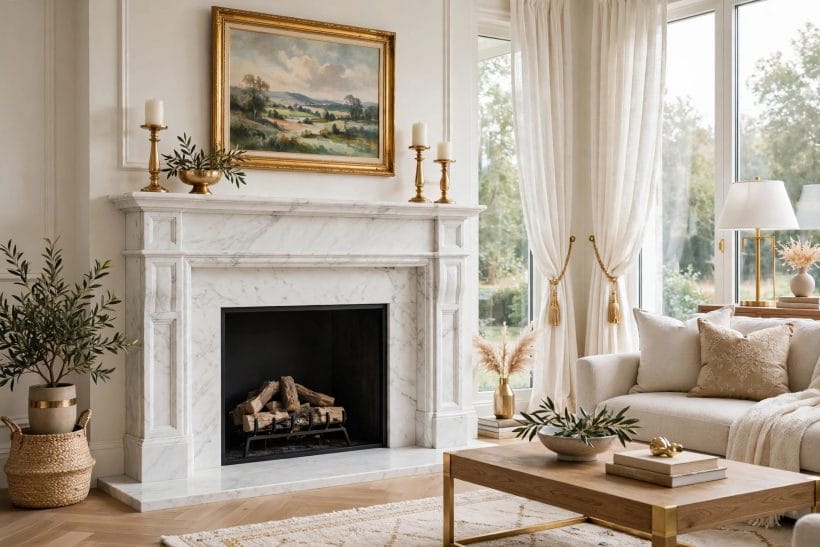
3. Stone Hearths: The Classic Apron
Stone is the hearth’s ancestral material — cool underfoot in summer, unbothered by sparks. Its outdoor cousins are surveyed in stacked stone fire pit building; indoors, the stone is cut flatter and finished finer.
10. A single slab of honed stone
One unbroken slab — slate-grey, pale limestone-look or soft granite tones — is the quiet luxury version: no grout lines, no pattern, just weight and calm. Edges matter most; a softened arris keeps the slab kind to shins.
11. Large stone tiles with fine joints
Where a slab is impractical, oversized stone tiles with tight, well-matched joints approach the same calm at a friendlier build. Lay them on the room’s main axis so the joints compose, rather than fight, the fireplace’s lines.
12. Rustic riven stone for country fires
A split-face, naturally textured stone suits inglenooks, farmhouse rooms and wood stoves with muddy boots beside them. Its unevenness forgives ash, scuffs and decades — the hearth that improves with use rather than merely surviving it.
13. Polished stone for a formal fireplace
A polished finish reflects firelight in a way honed stone never will, doubling the flames’ presence in a formal room. It shows dust and ash more readily, so it belongs to households who enjoy the ritual of the fireside kept smart.
14. Stone that matches the surround
Hearth and surround in one material make the fireplace a single carved gesture, grand in traditional rooms and monolithic in modern ones. Book-matching or careful tone-matching across the pieces keeps the unity deliberate.
15. Stone that deliberately contrasts
A dark hearth under a pale surround — or the reverse — draws a horizon line at the fire’s base and lets each material flatter the other. Contrast is also practical: ash shows less on mid-toned, varied stone.
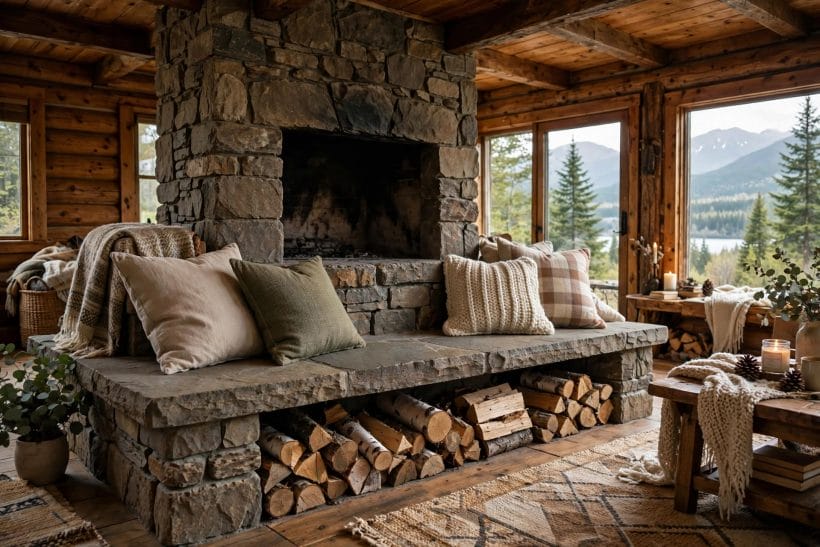
16. A stone hearth extended into a bench
Where the hearth stone continues sideways as a low bench, the fireplace gains seating, a wood store’s lid and a display shelf in one build. It is the stone version of the raised-hearth seat taken up in section eight.
17. Reclaimed stone with a past
Old flagstones and kerbs carry wear no new stone can fake, and a hearth is exactly where such character belongs. Check reclaimed pieces for soundness and clean them thoroughly — a hearth’s history should be charm, not soot.
18. Stone-look porcelain for easy care
Modern porcelain that convincingly imitates stone gives the look with simpler upkeep and consistent thickness for flush fitting. Choose a matte, textured finish — glossy imitations announce themselves under firelight.
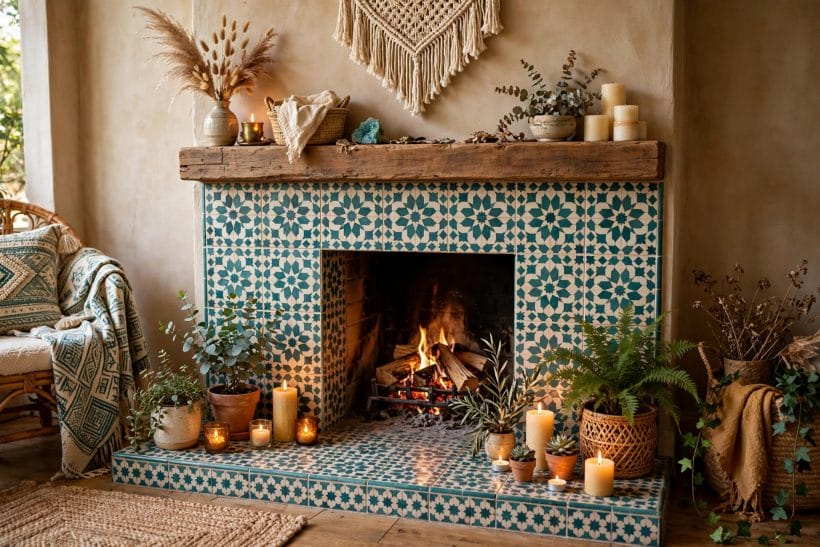
4. Tile Hearths: Pattern at the Fire’s Feet
Tile is the hearth’s pattern-maker: colour, geometry and glaze where a fireplace can carry decoration without competing with the flames. Heat-suitable tiles and proper setting materials are the ground rules, checked with your supplier.
19. Classic square tiles in a deep glaze
Small squares in bottle green, ink blue or oxblood are the Victorian hearth’s signature, and they still flatter period fireplaces better than almost anything. The glaze’s depth changes with firelight — the tiles perform twice nightly.
20. Hexagon tiles for a gentle pattern
Hexagons give pattern without direction, softening the fireplace’s geometry in rooms that lean modern-traditional. A mid-tone grout keeps the honeycomb calm; contrast grout turns the volume up considerably.
21. Herringbone at the hearth
A herringbone lay brings movement to a plain fireplace and suits long, low hearths especially well. Centre the pattern on the firebox so the chevrons meet symmetrically at the fire’s own axis.
22. Handmade-look tiles with soft edges
Tiles with wavy edges and varied glaze read crafted rather than manufactured, suiting cottages and relaxed rooms. Their irregularity hides ash specks kindly and asks for a tiler comfortable with honest imperfection.
23. A tiled hearth that climbs the surround
Carry the hearth tiles up the surround’s face and the fireplace becomes one tiled composition, hearth to mantel. It is the boldest tile move, and the one that most rewards a restrained palette.
24. Checkerboard tiles, the farmhouse way
Black-and-cream checkerboard under a simple surround is farmhouse shorthand — cheerful, traditional, and forgiving of soot in a way plain cream never is. Scale the checks to the hearth: small hearth, small checks.
25. Terracotta tiles for warmth underfoot
Unglazed warmth at the fire’s feet suits Mediterranean and country rooms, and terracotta’s earthiness flatters wood fires particularly. Sealing per the maker’s guidance keeps ash and spills from writing on it permanently.
26. A plain tile field with a patterned border
Keep the hearth’s centre calm and run the pattern as a border — the tiled equivalent of a picture frame. It suits busy rooms, where the fireplace should anchor rather than add another voice.
27. Slim brick-format tiles
Brick-shaped tiles give the tile hearth a masonry accent without brick’s thickness — useful for flush hearths over existing floors. Laid in a stack bond they read modern; in running bond, traditional.
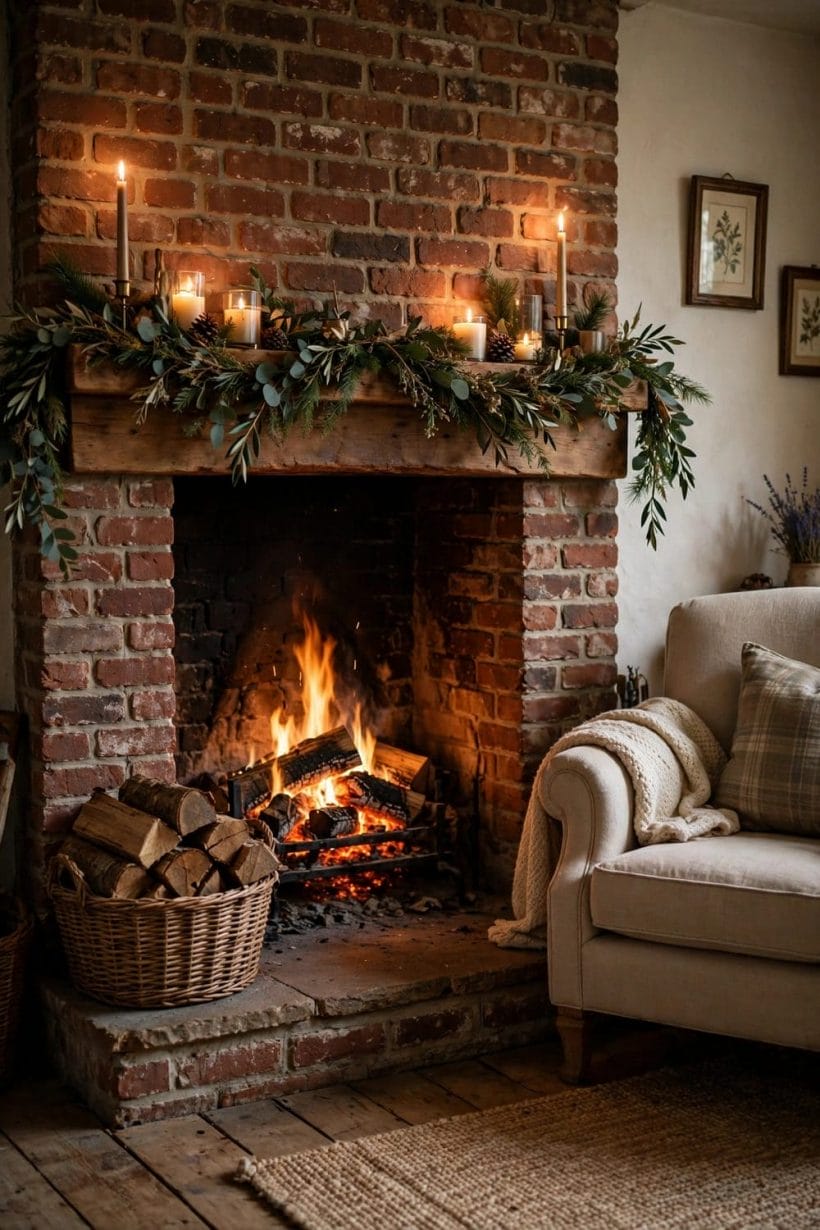
5. Brick Hearths: Honest Masonry
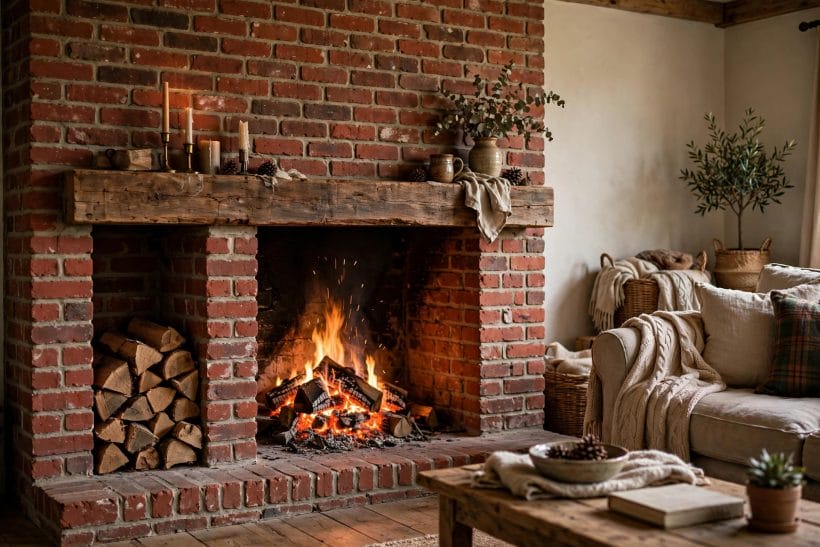
Brick is the working hearth — the material of farmhouses, workshops and a thousand cottage fires — and this site’s brick fireplace survey in brick fireplace living room ideas covers the whole elevation. Here the focus stays at floor level, where brick’s toughness is used hardest.
28. A brick hearth laid flat, stretcher bond
Bricks laid flat in a simple running bond make a hearth of real substance that shrugs off dropped logs and iron tools. The texture reads from across the room: this fireplace works for a living.
29. A herringbone brick hearth
Brick herringbone brings the cottage hearth its full ceremony — pattern, texture and history in one lay. It asks for level, patient bricklaying, and repays it every time firelight rakes across the pattern.
30. Brick soldier course as the hearth’s edge
A row of bricks standing on edge along the hearth’s front gives a crisp, raised lip that finishes the apron and marks its boundary underfoot. It is a small detail that makes flat brickwork look built, not spilled.
31. Painted brick for a softer room
Where red brick overwhelms a scheme, a breathable paint or limewash in a pale tone keeps the texture and calms the colour. Many traditional hearths were limewashed yearly — the look is as historic as the bare brick.
32. A brick hearth with a stone centre slab
Set one smooth stone slab directly before the firebox, brick around it: the slab takes the ash-sweeping and the hottest work, the brick gives the character. A marriage of the two oldest hearth materials, each doing its best job.
33. Reclaimed brick with lime mortar
Weathered bricks and pale lime mortar give a hearth instant age and a soft, chalky joint that modern cement never matches. Source sound bricks — a hearth is no place for spalling, frost-damaged stock.
34. A raised brick platform under a stove
Wood stoves classically stand on a brick platform that lifts them to a kind working height and spreads their presence across the floor. The platform’s size and construction follow the stove maker’s instructions and local rules, always.
35. Brick hearth meets timber floor
The junction between brick and boards wants a deliberate detail — a timber threshold strip, a metal trim, a clean shadow gap — because the two materials move differently and meet thousands of footsteps a year.
36. A whitewashed brick inglenook floor
Inside a deep inglenook, whitewashed brick flooring bounces firelight around the alcove and keeps the nook feeling like a room rather than a cave. It is the inglenook’s oldest finish, and still its friendliest.
6. Slate, Concrete and the Modern Hearth
The modern hearth strips the apron to essentials — one material, exact lines, nothing it cannot justify. Slate and concrete lead this family, with metal and glass appearing only where makers and local rules genuinely allow.
37. A honed black slate slab
Slate’s layered, matte darkness is the modern fireplace’s best friend: sparks vanish against it, ash brushes off, and its natural cleft texture keeps it from ever reading as flat. One slab, well edged, is a complete design.
38. Slate tiles in a large format
Where a slab won’t travel, large slate tiles keep the palette and most of the calm. Align joints with the room’s geometry and seal as the supplier advises — slate rewards the small effort permanently.
39. A polished concrete hearth
Cast or tiled concrete gives the hearth an architectural, gallery calm that suits minimalist rooms and pairs naturally with pale walls and black steel. Its finish should be specified for heat and soot, in the maker’s terms, before it is poured.
40. A concrete hearth cast as one with a bench
Concrete’s gift is continuity: hearth, bench and wood store poured as a single sculptural run. It is the modern room’s strongest fireside gesture and, being permanent, deserves the longest thought before it is cast.
41. Micro-cement over a sound existing hearth
Where a hearth is sound but dated, a suitable micro-cement finish can give it the modern look without demolition — subject always to the product’s stated heat suitability and a professional’s judgement on the base.
42. A steel plate hearth, where makers specify it
Some stoves stand on a slim metal plate hearth, industrial and exact. This is a maker’s-specification item, never an improvisation: thickness, size and placement follow the stove’s instructions and local rules to the letter.
43. Dark hearth, pale room: the contrast plinth
A near-black hearth slab in a pale, minimal room works like a plinth under sculpture — the fire becomes the exhibited object. Keep everything else quiet and let the contrast do the single, confident thing.
44. A hearth in the floor’s own material, marked by a border
Where regulations and the fireplace type allow a visually continuous floor, a border of metal trim or contrasting tile can mark the hearth zone within the room’s own flooring. The definition, not the material change, carries the design — and the safety requirements still rule every dimension.
45. The near-invisible hearth for ribbon fires
Long, low gas and electric ribbon fires often sit above a slim stone or metal shelf-hearth that exists mostly as a line. Its precision is the point: measured, level and finished like cabinetry, not masonry.
7. The Surround and Mantel Above the Hearth
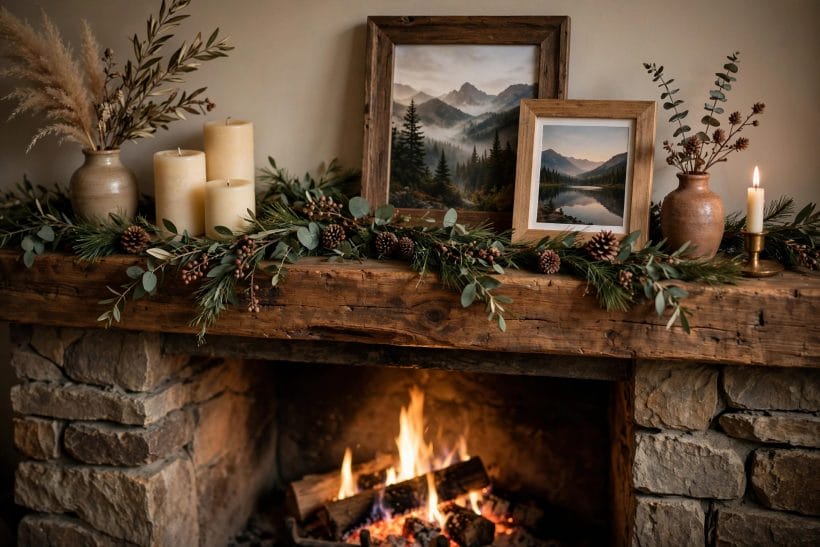
A hearth never reads alone — the eye takes hearth, surround and mantel as one composition. This section covers only the handshake between the apron and everything directly above it.
46. Hearth and surround in matching material
One material from floor to mantel makes the fireplace monolithic and calm. It suits stone especially, and it asks for careful templating, because every joint in the elevation shows against the unity.
47. A timber mantel shelf over a stone hearth
The classic country pairing: warm wood above, cool stone below, each flattering the other. The shelf’s clearance from the fire and its fixing follow the fireplace maker’s and local guidance — timber near fire is placed by rules, not by eye.
48. A painted surround with a contrasting hearth
Paint the surround into the wall’s colour family and let a contrasting hearth carry the fireplace’s definition at floor level. The fire seems to float in the wall, grounded by its apron — a very modern kind of traditional.
49. A tiled surround echoing the hearth tiles
Echo — don’t necessarily match — the hearth’s tile on the surround’s face or legs, and the fireplace gains a tailored, designed coherence. One shared colour or shape between the two is usually enough.
50. A mantel-less modern surround
Where there is no shelf, the hearth’s role grows: it becomes the fireplace’s only horizontal, its stage and its furniture line. Give it the depth and finish quality the missing mantel would have had.
51. An antique surround married to a new hearth
A reclaimed surround above a fresh, well-cut hearth is a partnership of eras that suits period houses being gently modernised. The new hearth should be quiet — the surround is the soloist, the apron the accompaniment.
52. Plinth blocks where the surround lands
Traditional surrounds stand on plinth blocks that meet the hearth. Aligning those meetings — a block centred on a tile, a joint or a slab’s edge — is the invisible tailoring that separates a fitted fireplace from an assembled one.
53. A deep mantel shelf styled as a room divider
In open plans a fireplace between zones earns a deep, display-worthy shelf, and the hearth below it widens to match, grounding the divider at floor level. The pair together mark the boundary far better than furniture alone.
8. Raised Hearths and Hearth Seating
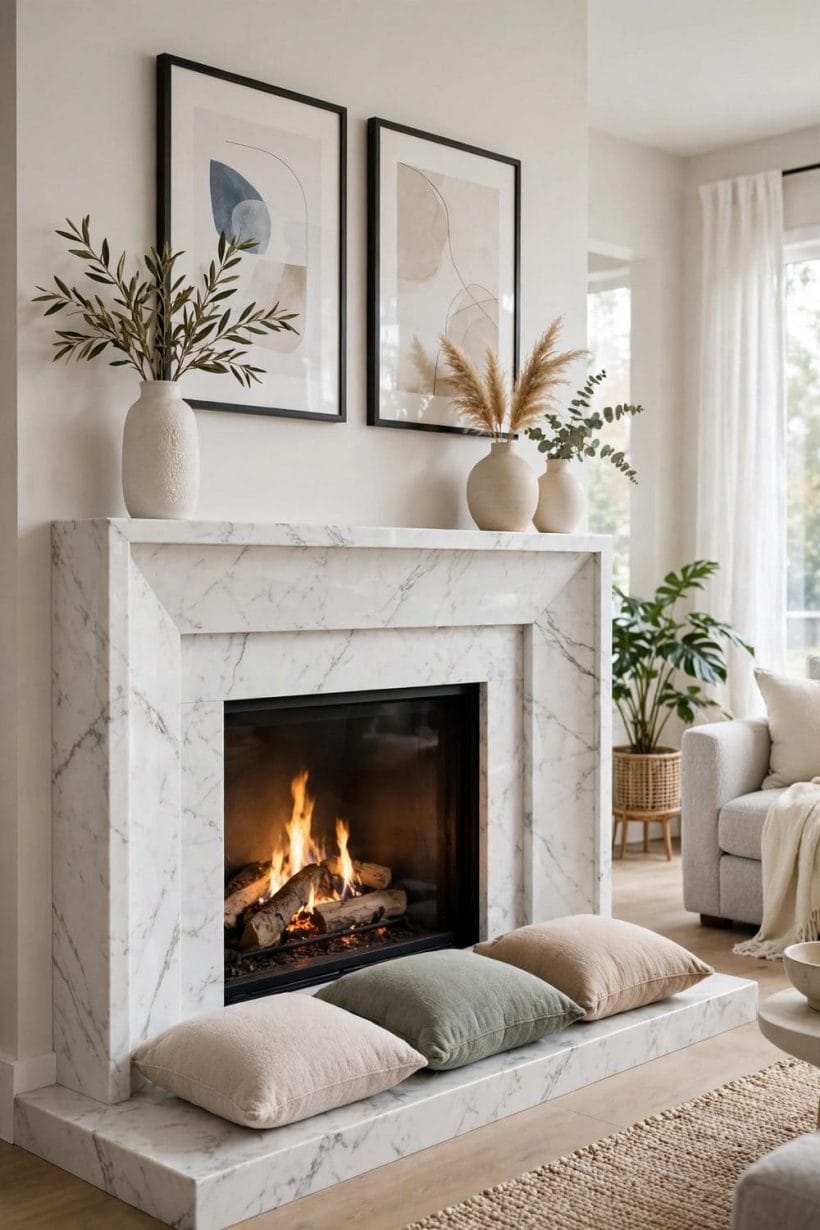
Lift the hearth and it stops being only an apron: it becomes a bench, a shelf, a wood store’s lid and the room’s favourite seat — close to the fire, low to the ground, and occupied from the first cold evening. The ideas that follow sit on that raised edge.
54. A wraparound hearth seat
Carry the raised hearth around the fireplace’s sides and the seating doubles, turning a corner fire into a fireside nook. It suits family rooms where the fire competes with every other seat — and usually wins.
55. Cushions and throws kept for the hearth seat
A seat this close to the fire earns its own textiles: a fitted cushion, a folded throw, kept there permanently. Keep them at a sensible distance from the opening, in natural fibres, as part of the seat’s design rather than its storage.
56. A raised hearth with a log store beneath
Build the seat hollow, with an open front bay, and the raised hearth stores the evening’s logs in the warmest, driest spot in the house. The bay should be sized to the household’s real fires, not a magazine’s.
57. A hearth seat with books and a lamp beside it
Place a reading light and a small stack of books at one end of the hearth seat and you have built the house’s most contested chair. It is the fireside version of a window seat — and it works in every season.
58. Stone-topped, masonry-bodied: the warm seat
A masonry raised hearth with a stone top slowly takes the fire’s warmth into itself and returns it to sitters — the principle of the old stove benches. It is comfort of a kind no cushion alone provides.
59. A low hearth step for a tall fireplace
Where a firebox sits high, a single hearth step at a kind height makes tending the fire comfortable and safe to reach. Steps should be generous, grippy underfoot and lit by the room’s light, not only the fire’s.
60. Children, pets and the raised hearth’s edge
A raised hearth’s edge is also a guard line: it keeps toys, paws and small feet at a defined remove from the fire. Where households need more, a well-chosen fireguard designed for the fireplace is the honest addition — fitted, stable, and never improvised.
9. Styling the Hearth: Fireside Dressing
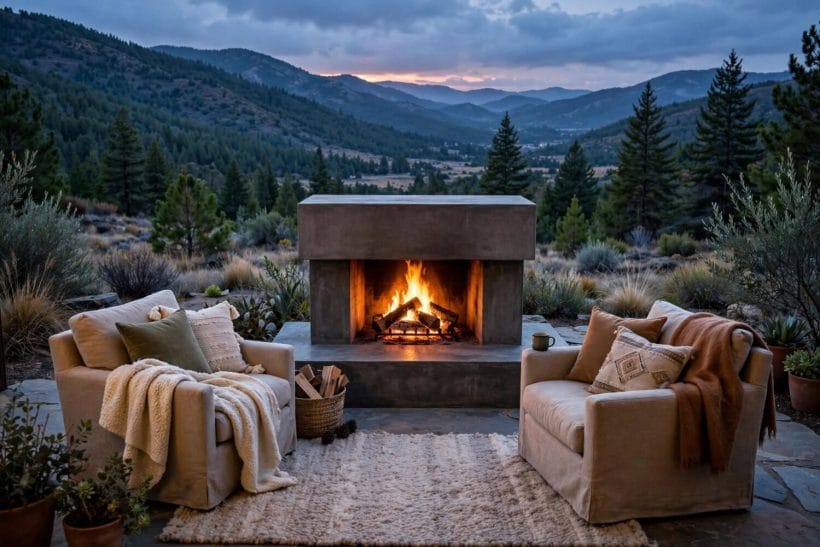
The dressed hearth is a small still life that changes with the seasons. The outdoor fire family gets its dressing elsewhere, in fire pit ideas; indoors, the palette is calmer and the rules are mostly about restraint. Small rooms borrow the same discipline as small living room ideas: fewer things, placed exactly.
61. The log basket, sized to the hearth
A generous woven or leather basket of logs is the hearth’s classic ornament and its fuel store in one. Size it to the apron it stands on — a basket that crowds the opening helps nobody tend the fire.
62. A companion set that earns its place
Poker, brush, shovel and tongs on a stand are tools first and decoration second. Choose a set with real weight and comfortable handles; it will be handled nightly and judged, fairly, as furniture.
63. Candles on the hearth in summer
When the fire is out for the season, a cluster of candles or lanterns on the hearth keeps the fireplace’s glow in the room’s life. Set them inside the opening or safely on the apron, and the fireplace never becomes a black hole in summer.
64. A green plant in the empty firebox
A robust fern or trailing plant in the clean, swept firebox is summer’s other answer — green where the flames were. It belongs only in a fireplace genuinely out of use, swept and cool, and it leaves before the first fire is lit.
65. Seasonal garlands kept clear of the opening
A garland belongs on the mantel and surround, at a safe distance from heat and flame — never draped across the hearth or opening. Dress the architecture, respect the fire’s territory, and the two never argue.
66. A fireguard chosen as furniture
Where a guard is needed, choose it like furniture: the right size for the opening, a finish that suits the room’s metals, and a stable fit. A guard that suits the room stops looking like equipment.
67. The empty, swept hearth as a style
The most confident styling is none: a beautiful hearth, swept clean, its material and the fire itself the whole picture. Where the stone or tile is fine, dressing can retire — the apron was always the ornament.
10. Safety, Care and Costs
The last section is the ledger: a hearth is a safety device that happens to be beautiful. Clearances, materials and sizes follow the fireplace maker’s instructions and the rules where you live — the points here are general, never figures.
68. Non-combustible, correctly sized, properly fitted
The hearth’s three safety foundations, in general terms: materials that do not burn, dimensions that suit the fireplace and its fuel, and fitting that leaves no gaps at the firebox junction. Each is specified by makers and local rules; a hearth is not a place for approximation.
69. Keep the hearth’s working zone clear
Flammable life — rugs, paper, furniture, drying clothes — belongs outside the hearth’s zone, at the distances the fireplace’s guidance requires. The apron’s edge is the household’s visible reminder; design the room so the reminder is easy to keep.
70. Ash care: cool, contained, regular
Ash is swept when cold, stored in a metal container away from anything that burns, and never left to build into the firebox’s throat. A hearth kept swept also shows its material at its best — care and looks are the same habit here.
71. Cleaning by material
Stone and slate ask for sweeping and a damp cloth, with anything stronger checked against the stone’s nature first. Tiles forgive more; brick keeps its dignity with a brush. Abrasive enthusiasm ruins more hearths than fire ever does.
72. Repointing and small repairs
Joints between bricks, tiles and slabs loosen over years of heat cycles. Repointing with suitable material, and re-fixing a rocking slab promptly, keeps a hearth safe and smart; cracked firebacks and damaged flue parts are professional territory, always.
73. Chimney and flue care belong to the same routine
A hearth’s safety is completed above it: chimneys and flues need regular professional sweeping and inspection for the fuel in use. The most beautiful apron in the world is only the visible end of a system that must be sound throughout.
74. Cost drivers, stated plainly
A hearth’s cost is driven by its material and size, whether it is a single slab or many pieces, the cutting and fitting skill involved, the state of what lies beneath, and any associated surround or flue work. Itemised local quotes, from fireplace specialists, are the only honest figures.
75. Refresh or replace: the honest test
Refresh — re-tile, re-face, extend, repoint — when the hearth is sound, correctly sized and safe. Replace when it is not, or when the fireplace itself changes. The test is never the photograph; it is the tape measure, the maker’s booklet and the rules where you live.
Final Considerations
Choose the hearth as you would choose a threshold: level and material settled first, sized to the fire it serves, built from things that do not burn, and finished to be swept, sat on and lived with. Honour the maker’s instructions and your local rules on every dimension that matters, and the fireplace’s front step will do its quiet double duty — safety below, welcome above.


0 Comments