
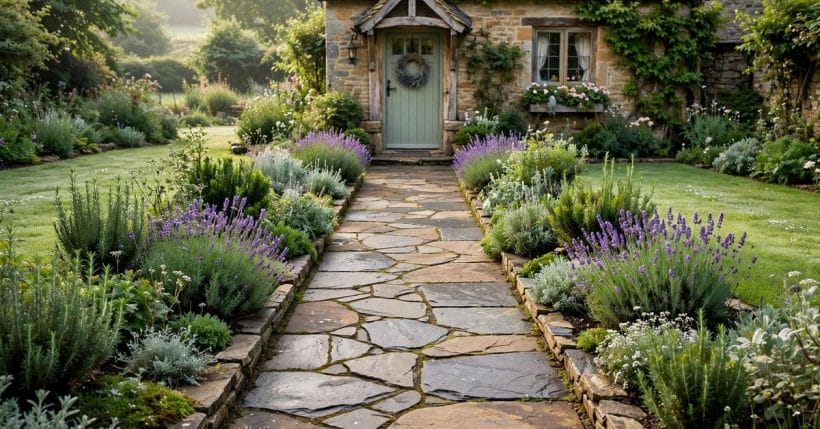
Some paths are laid; a flagstone walkway looks grown. Big, irregular slabs of real stone, each one different, settle into a garden the way stepping stones settle into a stream — as if the route had always been there and the house arrived later.
These seventy-five flagstone walkway ideas cover the whole craft: front approaches and cottage-garden routes, stepping-stone crossings, the joints between the slabs, the colours of the stone itself, and the laying and care that keep a path level, drained and handsome for decades.
1. Flagstone Walkway Ideas at a Glance
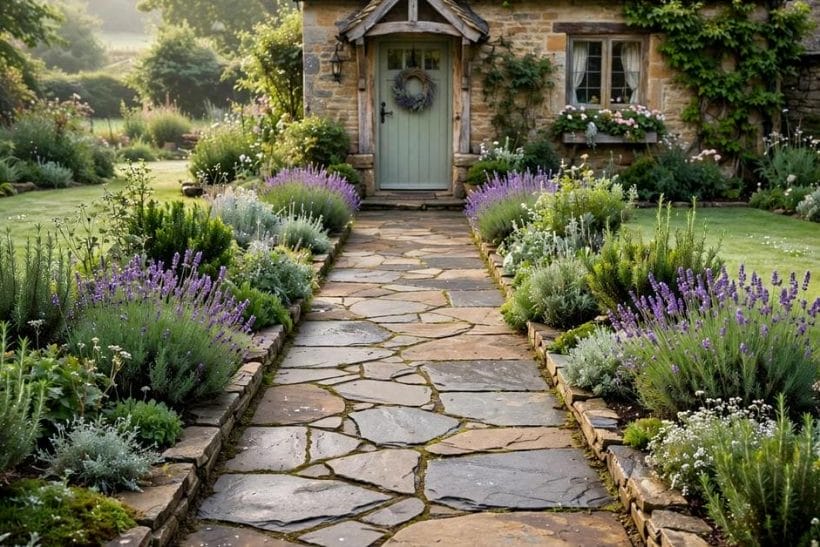
The central entity is the flagstone walkway: a path paved with large, flat, irregular pieces of natural stone — sandstone, slate, limestone and their kin — laid as fitted slabs or stepping stones. It is a chapter of the wider walkway ideas pillar, and a natural-stone sibling to the looser gravel path with rock borders approach. Everything here is the stone itself: how it is routed, jointed, edged and kept. Installation is described in general terms throughout — ground conditions vary, and a local landscaper’s reading of your soil and levels outranks any general guidance.
| Question | Short answer |
|---|---|
| What is flagstone? | Large flat slabs of natural stone with irregular edges |
| Where does it suit best? | Front paths, cottage gardens, lawns and informal routes |
| What fills the joints? | Mortar, sand, fine gravel or low groundcover plants |
| What decides success? | A prepared base, correct falls for drainage and level slabs |
2. Front Approaches: The Walk to the Door
The front path is the handshake of the house, and flagstone shakes hands warmly. These nine approaches run from gate to door — past the privacy fence line and the modern gate — with the width and welcome a daily entrance deserves. Width and welcome are the twin briefs here: wide enough for two abreast, welcoming enough that the door feels expected from the gate.
1. The straight cottage approach
Large fitted slabs in a straight run to the door, lavender or low planting softening both edges. It is the picture-postcard layout — and genuinely practical, because a straight path is the easiest to lay level and keep swept.
2. The wide-slab main entry
Oversized slabs at a generous width make the main entrance feel established and calm. Two people can walk it side by side, prams and deliveries roll kindly, and the stone’s scale does the decorating.
3. The offset-slab entrance
Staggering the slabs slightly off a centre line gives a designed informality that suits houses without cottage pretensions. The route stays direct; only the geometry relaxes, and planting fills the offsets.
4. Flagstone with a brick edge
A soldier course of brick along both sides neatens flagstone’s irregular edge into a tailored line. The pairing suits brick houses especially: the edge borrows the wall’s material and the path belongs to the house.
5. The porch-to-gate axis
Aligning the path with the door and gate on one axis gives even a small front garden ceremony. Keep the planting low near the axis so the sightline — and the welcome — stays open.
6. A landing slab at the door
One extra-large slab as the doorstep landing grounds the entrance and gives callers a settled place to stand. It is also the slab that takes the most weather and wear; choose the soundest stone for it.
7. The curved front approach
A gentle curve to the door softens a deep front garden and lets planting beds take the corners. Curve the path where the garden earns it — a bend without a reason reads as an error, not a feature.
8. Flagstone through a front lawn
Slabs set as a fitted path across grass keep the lawn the garden’s main event while giving feet a dry route. Mow strips beside the slabs keep the edge tidy without fuss.
9. The lit entrance path
Low lights washing the slabs’ edges make the evening arrival safe and quietly theatrical — stone texture loves low light. Fittings and wiring belong to the electrician; the design point is that the path is planned for night as well as day.
3. Layout and Line: Fitting the Slabs
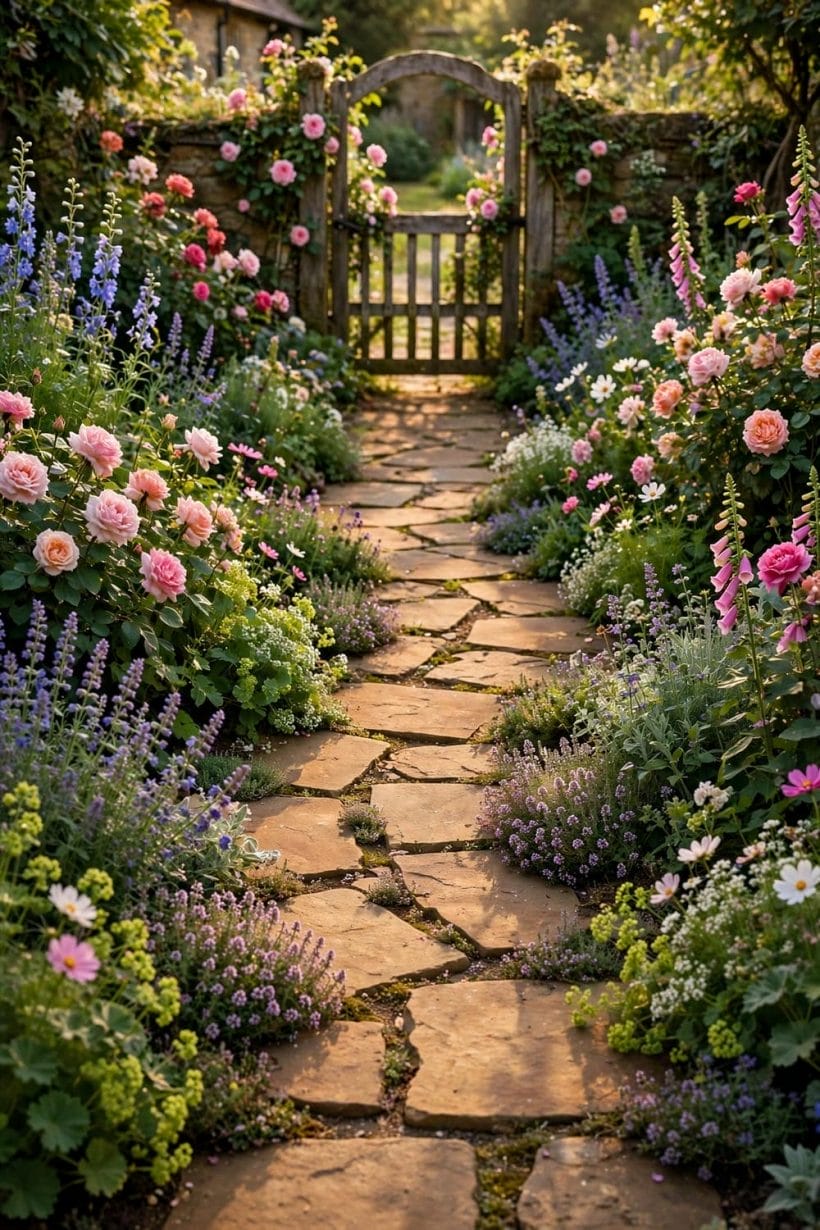
Flagstone’s art is in the fitting: slabs chosen and turned so their irregular edges converse rather than collide. Nine layout decisions that separate a path that looks grown from one that looks spilled. Allow real time for the fitting of a family-sized path; the turning and trying of slabs is slow work that cannot be hurried into looking right.
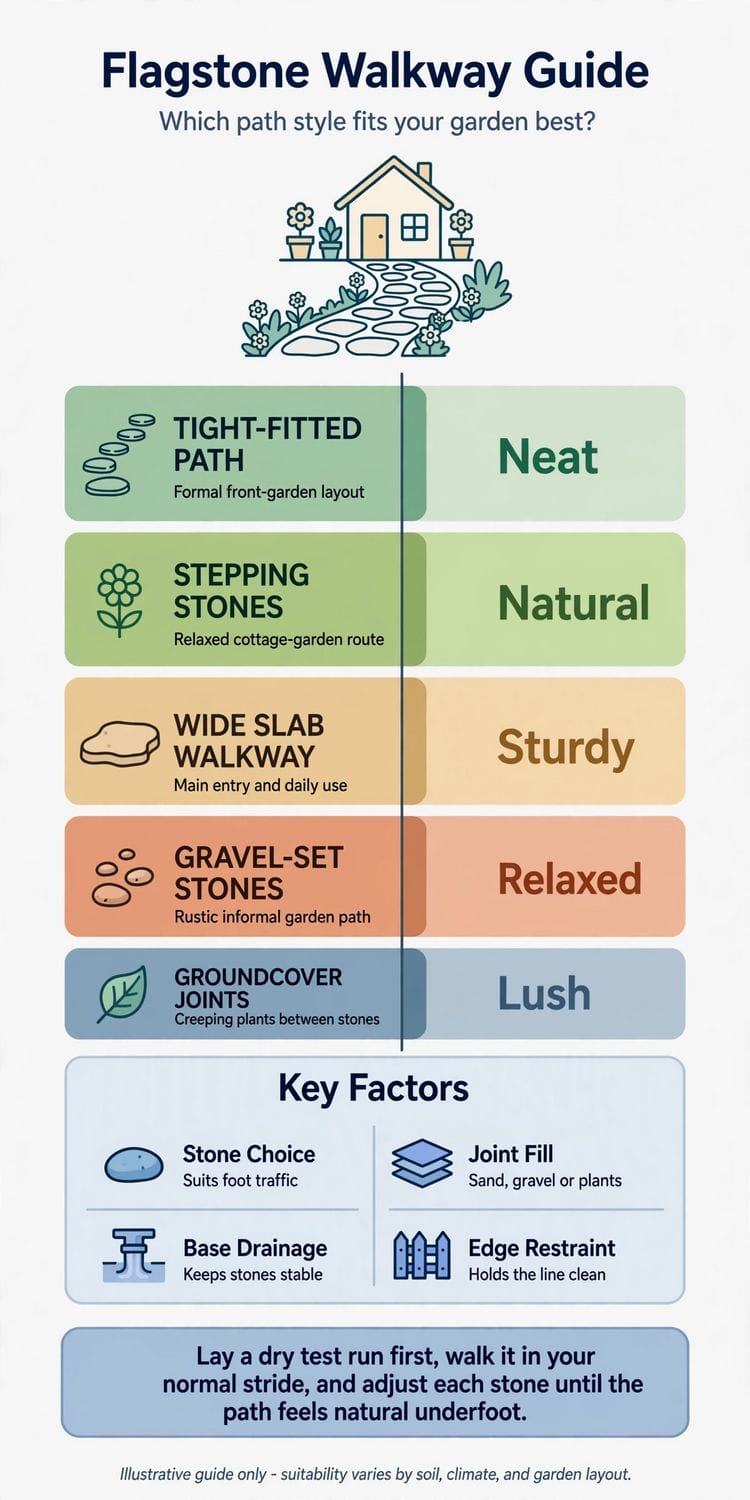
10. Tight-fitted joints for a formal read
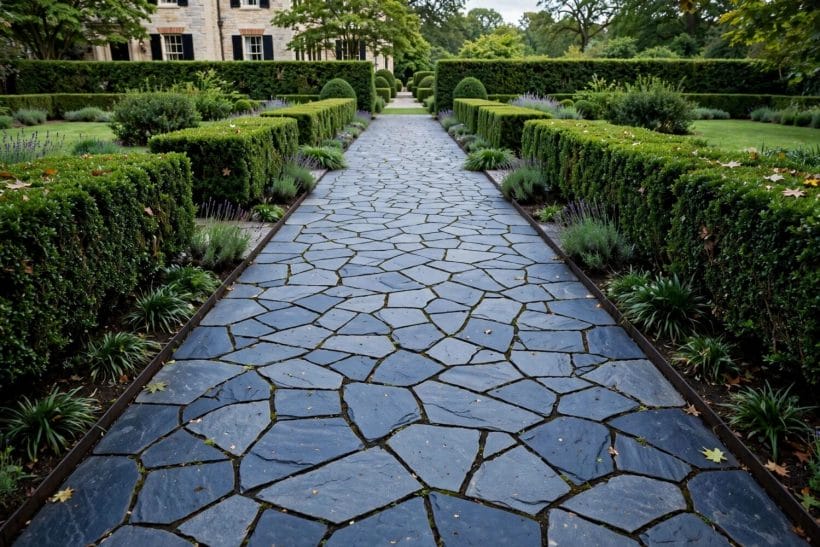
Slabs selected and trimmed to fit closely give a near-paved surface with natural variation — the formal end of flagstone. It takes the most selection time at laying and returns the neatest, most sweepable path.
11. Generous joints for the cottage read
Wider gaps filled with green or gravel give the relaxed cottage character the stone is loved for. The joints become part of the planting plan, and the path breathes with the garden around it.
12. The crazy-paving revival
Smaller broken pieces fitted as a mosaic — the mid-century staple — is back in favour for its thrift and texture. It uses offcuts beautifully and suits secondary paths where its busyness charms rather than tires.
13. Running the grain one way
Where slabs show a natural grain or riven direction, aligning it along the path’s length gives the route a quiet current that leads the eye to the door. It is a subtle discipline visitors feel without naming.
14. Big slabs at the centre, small at the edges
Placing the largest, flattest pieces in the walking line and smaller pieces toward the borders puts the best stone underfoot where it matters. The edges can absorb the awkward shapes no path can avoid.
15. A dry test run before bedding
Lay the whole path loose first and walk it in your normal stride, turning slabs until every step lands flat and natural. The dry run is where flagstone paths are actually designed; bedding merely makes it permanent.
16. Stepping rhythm for fitted paths too
Even a fitted path has a stride hidden in its joints. Spacing visual breaks — a wider joint, a change of tone — at a walking rhythm makes the route feel paced rather than endless.
17. Squaring the start and finish
Letting the path begin and end with a deliberately squared slab or a neat landing frames the irregular middle. Journeys like punctuation; a path with a clear start and finish reads as architecture.
18. Mixing two stones in one path
Two kindred stones — a buff sandstone with a grey — alternated loosely give a path gentle variation without chaos. Keep the proportions uneven, one stone clearly hosting and the other visiting, or the mix turns muddle.
4. Garden Routes and Cottage Paths
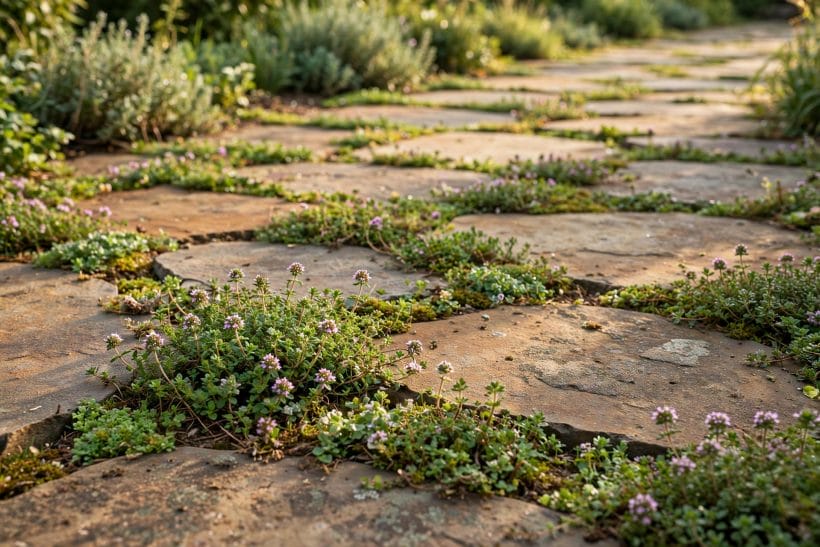
Inside the garden, the flagstone path is part route, part planting partner. These nine ideas weave stone through borders and beds — including the working paths between raised garden beds, where hard-wearing routes earn their keep daily. A garden path is walked a thousand times a year, in boots and in bare feet, in drought and in frost — design it for the thousand walks, not the photograph.
19. The lavender-edged cottage path
Lavender or catmint spilling over both edges is the classic cottage frame: scent underfoot, bees at work, stone warmed by sun. Keep the spill in check so the walking line stays honest.
20. The S-curve through deep borders
A lazy S through deep planting lets the path reveal the garden in episodes rather than all at once. Each bend is a place to pause a feature — a bench, a birdbath, a favourite shrub.
21. The vegetable-garden work path
Flagstone between beds gives the kitchen garden a mud-free, wheelbarrow-kind route that lasts as long as the beds do. Set slabs slightly proud of the soil so a broom can keep them clean.
22. A path to the garden room
Summerhouse, studio or shed: a flagstone route gives the garden’s second building its own address. A landing slab at its door and a widening of the path there mark the arrival.
23. The woodland walk
Under trees, irregular slabs among ferns and shade planting look entirely native. Choose stone with a grippy, riven finish for the damp shade, and let fallen leaves be part of the picture between sweeps.
24. Herb garden stepping rounds
Round or near-round slabs as steps among herbs make a path you browse rather than walk, brushing thyme and mint as you pass. The route’s purpose is the plants; the stone merely keeps shoes dry.
25. The rose-walk path
A straight fitted path under rose arches is the formal garden’s romance. Flagstone’s cool neutrality flatters the roses and gives heels a kinder surface than gravel on the way to the bench.
26. A path that ends at a view
Routing the walk to a seat, a gate in a hedge or a glimpse of countryside gives the whole garden a destination. The flagstones are the sentence; the view is its full stop.
27. The side-return utility path
Down the house’s side, where bins and bikes travel, flagstone on a firm base outlasts every cheaper surface and washes down clean. Plain, tight-fitted and unpretentious — the path as good infrastructure.
5. Stepping Stones and Crossings
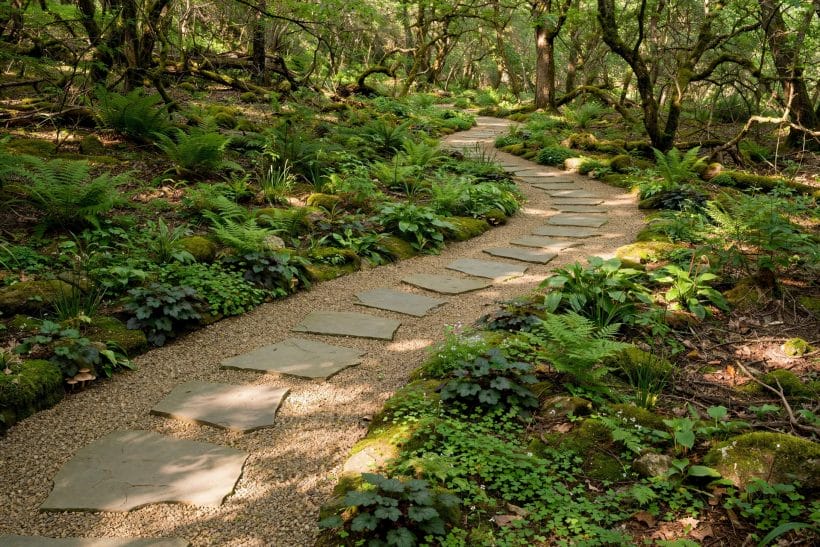
Not every route needs a paved path. Where traffic is occasional — across a lawn, to a deck like those in the covered deck ideas collection, or over a damp corner — stepping stones give dry feet with the least stone and the most garden. Nine crossings. The stepping-stone route is also the reversible route: a stone can be lifted, re-bedded or removed without a trace, which makes crossings the safest place to experiment with a line.
28. The classic lawn crossing
Single slabs at a comfortable stride across the grass: the lightest intervention a lawn can take. Set each stone’s top just at mowing height and the mower passes over the whole arrangement kindly.
29. Paired stones for a social stride
Two smaller slabs side by side at each step let two people cross together and give the crossing a deliberate, designed beat. It doubles the stone and more than doubles the charm.
30. Stepping stones through a gravel sea
Large flags rising just above a gravel bed make a dry-shod causeway with a Japanese calm. The contrast — still stone, raked gravel — is the whole decoration, and it needs no plants at all.
31. The pond-edge crossing
Sturdy slabs edging or bridging a pond’s shallow margin let you garden and feed fish without mud. Water work is a professional conversation where depths and liners are involved; the stones’ job is the dry approach.
32. Stones across a damp hollow
Where a garden dips and stays wet, a short run of raised stepping stones keeps the route open all year. Address the drainage too if you can — the stones are the bridge, not the cure.
33. The children’s garden route
Closely spaced, smaller slabs make a hop-along route children adopt as their own road through the garden. Play value aside, it keeps small feet off the beds more reliably than any instruction.
34. Stepping stones to the compost corner
The working corners — compost, log store, cold frames — deserve dry access too. Utility crossings in offcut stone are the thrifty, satisfying use of a path project’s leftovers.
35. A crossing that becomes a path
Where a stepping route proves popular, infilling between its stones with smaller pieces graduates it to a fitted path on exactly the line feet chose. Let traffic design the route; then pave its decision.
36. Winter-proofing the crossing
Stepping stones earn their keep in the wet season, when lawns turn to sponge. A route that is a summer nicety becomes winter infrastructure — one more reason to bed each stone level and firm from the start.
6. Joints: Mortar, Sand, Gravel and Green
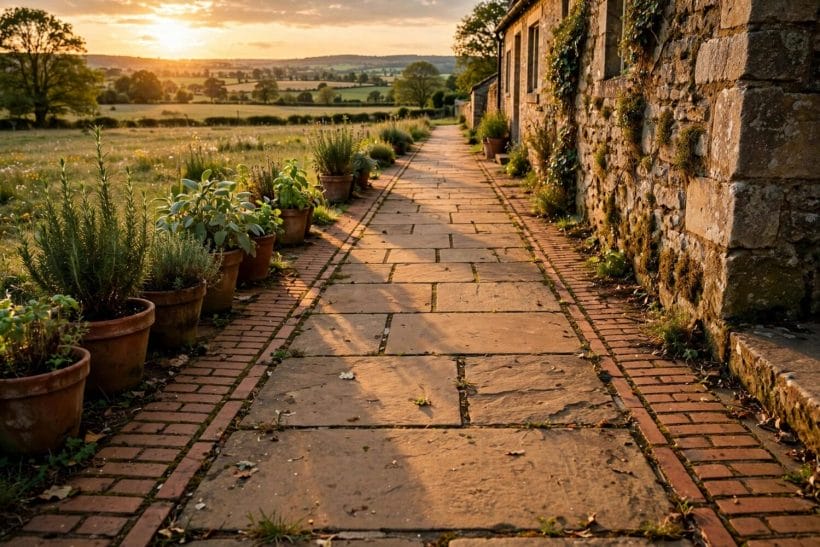
Between the slabs lies the path’s personality. The joint decides whether the walkway reads formal or wild, how it drains, how it weeds, and how it feels under bare feet. Nine joint treatments. Choose the joint before the stone is ordered, not after it is laid — the fill, the width and the planting all belong in the same decision, and each constrains the others.
37. Mortared joints for the formal path
Full mortar joints give the firmest, neatest finish — the choice for main entrances and heavy traffic. Mortar work belongs to sound bases and honest mixes; failed mortar is almost always failed preparation underneath.
38. Sand-swept joints
Kiln-dried sand brushed into the gaps is the forgiving, traditional finish for dry-laid paths: easy to top up, kind to drainage, and simple to rework when a slab needs lifting. Expect it to need replenishing after hard weather.
39. Fine gravel joints
Small angular gravel knits into joints more stubbornly than sand and crunches satisfyingly underfoot. It suits the informal path and suppresses weeds by keeping the joint hostile and drained.
40. Creeping thyme in the joints
Thyme planted in wide joints scents every footstep and flowers along the path’s seams. It asks for sun, drainage and patience while it knits — and repays all three every summer evening.
41. Low grass joints, honestly kept
Letting lawn grass colonise the joints is the softest, oldest finish — provided it is trimmed and the slabs stay visible. Unkept, it swallows the path; kept, it is the prettiest joint of all.
42. Moss joints in shade
In damp shade, moss does voluntarily what gardeners plant elsewhere. Welcoming it in the joints of a woodland path gives a green velvet seam that no planting plan matches for naturalness.
43. Chamomile and creeping jenny
Lawn chamomile and creeping jenny are the other reliable joint plants: low, spreading, tolerant of feet. Mix them along one path for varied texture — green tapestry between the stones.
44. The soil joint, planted deliberately
Filling joints with soil and sowing or planting them on purpose — rather than letting weeds volunteer — is the difference between a green path and an abandoned one. Choose the plants; do not inherit them.
45. Joint width as a design lever
Decide joint width as consciously as stone choice: narrow reads built, wide reads grown. Consistency matters more than the dimension itself — a path whose joints wander in width looks accidental whatever fills them.
7. Colour and Stone: Reading the Slabs
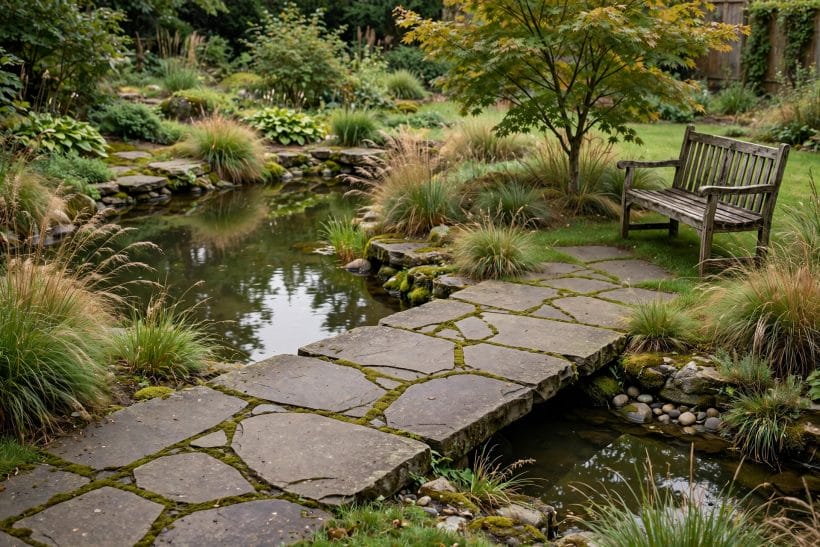
Flagstone is a family of stones, not one stone, and its colours run from honey to slate-blue. Eight tone decisions — made with the house’s walls and the garden’s light in view, never from a merchant’s photograph alone. Order a handful of candidate slabs and live with them in the garden, wet and dry, before committing the whole path to one of them.
46. Buff and honey sandstone
Warm buff slabs are the cottage default: sunny even in January, forgiving of soil marks, and kind to brick and render alike. In small gardens their lightness keeps the path from swallowing the space.
47. Blue-grey slate tones
Blue-grey stone gives the path a cool, architectural register that suits contemporary houses and shaded gardens. It darkens handsomely when wet — the path’s colour has a weather forecast built in.
48. Rustic riven finishes
A riven, naturally split surface carries texture and grip, and its shadow-play hides a multitude of garden soil. Riven stone asks for careful levelling; its character lives in a surface that is never perfectly flat.
49. Sawn, smooth slabs for modern gardens
Sawn edges and honed faces make flagstone behave like large-format paving with natural colour — the modern garden’s way to keep stone and lose the rusticity. Joints go tight and minimal to match.
50. Mixing warm and cool slabs
Many natural stones carry both warm and cool tones in one slab. Leaning the path’s overall mix toward the house’s palette — warm walls, warmer path — is the quiet trick of harmonious hard landscaping.
51. Stone that echoes the house
Where the house is stone-built, a path in a kindred stone continues the building into the garden. Aim for cousin, not clone: an exact match that misses slightly looks like a repair, not a design.
52. Wet-look colour, planned for
All natural stone deepens when rained on; judge samples wet as well as dry before ordering. The colour you must love is the November one, and it is always the darker of the two.
53. Patina as a feature
Flagstone ages gracefully — edges soften, lichens freckle, tones mellow. Choosing natural stone is choosing a path that improves with weather instead of expiring by it; plan to enjoy the patina rather than fight it.
8. Slopes, Steps and Drainage
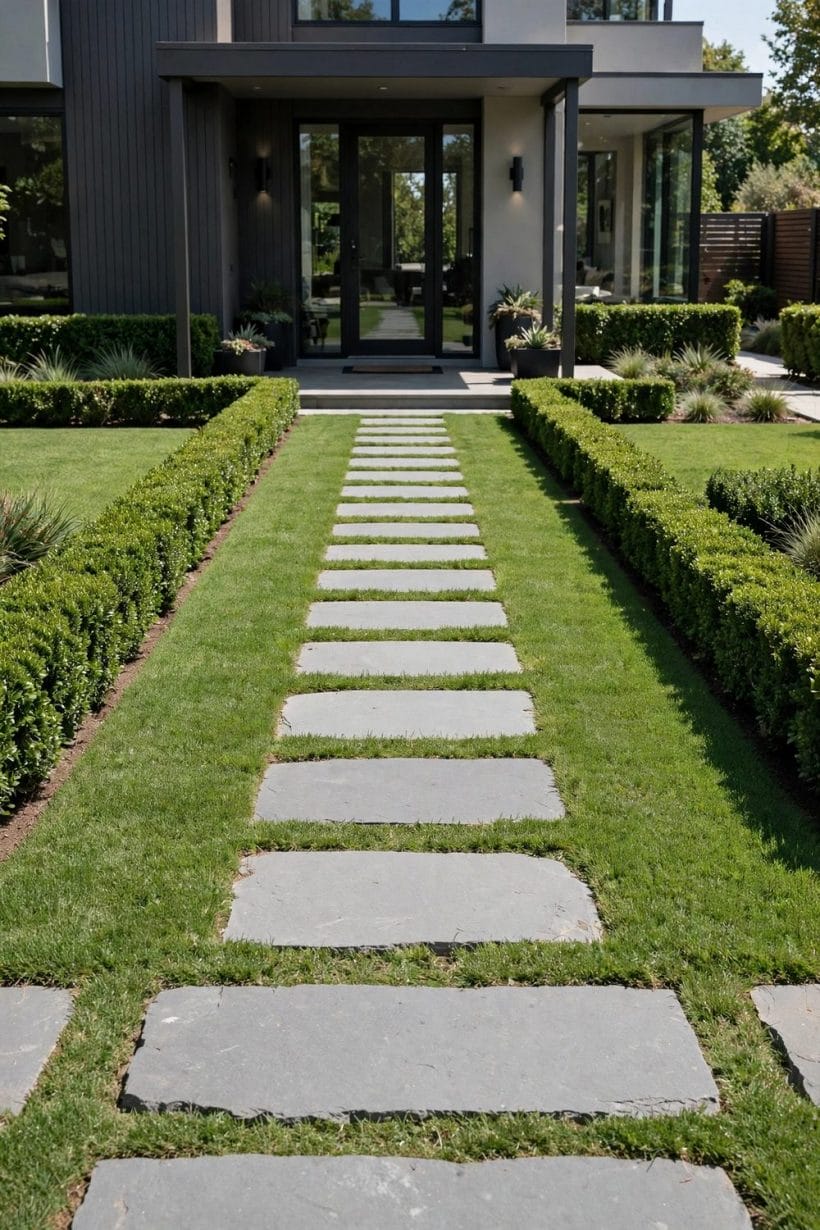
The unphotogenic section that decides whether the path is still level in ten years. Eight points on ground that moves, water that gathers, and levels that change — stated generally, because every garden’s ground is its own case. Get these points right and nobody will ever notice them, which is precisely the praise that groundworks aims for.
54. A gentle fall away from the house
Paths should shed water away from walls and toward planting or drainage, never ponding against the house. The fall is set at laying with levels and string lines; it cannot be added later with optimism.
55. Flagstone steps on a slope
Where the route climbs, wide slabs as shallow steps keep the stone language unbroken. Steps are structural work — treads firm, rises even, edges unmistakable — and worth a professional’s hand on anything beyond the gentlest bank.
56. Terracing a steeper route
On a real slope, short flat runs of path between single steps read as terraces and walk comfortably. The rhythm of walk-step-walk is the hillside garden’s natural gait, and flagstone takes to it kindly.
57. Crossing a drainage line
Where water naturally crosses the route, the path should meet it deliberately — a drained channel, a raised causeway of slabs — rather than become the channel. Ignored water re-routes itself through your joints.
58. The prepared base, honestly built
Every lasting flagstone path stands on excavation, a compacted sub-base and a true bedding layer, whatever the local method. Stone laid on soil alone is a temporary arrangement, and the soil always collects its debt.
59. Frost and heave, planned for
In cold climates, ground movement lifts casually bedded slabs. A properly built base and flexible joints absorb what rigid mortar cannot — another reason the joint choice belongs to the climate as much as the eye.
60. Edge restraint that holds the line
Paths spread without restraint at the edges. Buried edging, a stone kerb or a planted bank keeps the outer slabs honest; the restraint is invisible in the finished garden and obvious in its absence.
61. Settling and re-levelling
A dry-laid path can be lifted, re-bedded and relaid slab by slab as the ground settles — one of its great practical graces over rigid paving. Mortared paths trade that forgiveness for firmness; choose knowingly.
9. Edges, Borders and Planting Partners
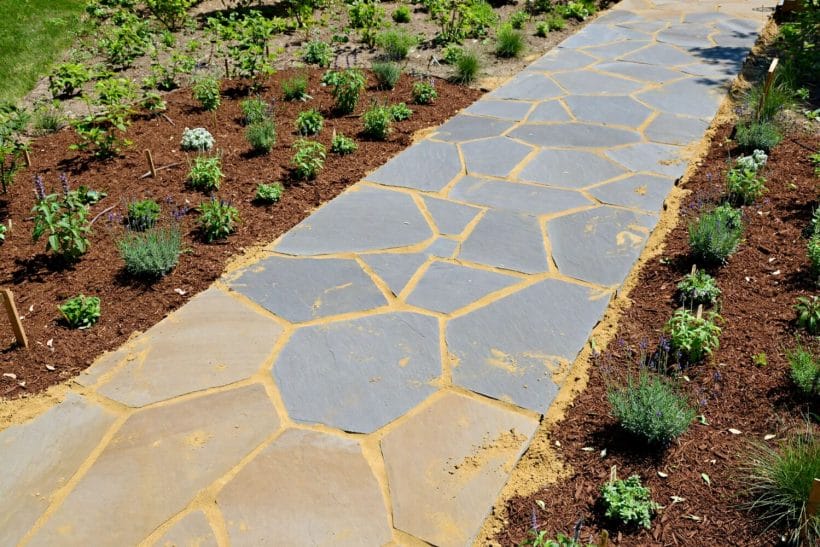
A flagstone path is finished by what grows and sits beside it. Seven edge treatments that turn a route into a garden feature. The edge is also where the path declares its manners — crisp against a lawn, loose against a border, silent against a wall.
62. The low stone kerb
A kerb of setts or small boulders along the path gives the slabs a contained, deliberate frame and keeps mulch and soil on the beds. It is the edge that suits stone houses and traditional gardens best.
63. Planted edges that spill
Geraniums, alchemilla and their sprawling kin soften the path’s outline by growing over it slightly. The spill is the cottage garden’s signature — keep it mannerly so the walking line survives the romance.
64. A gravel margin
A band of gravel between slab edge and bed catches drips from the eaves line, suppresses weeds and gives the path a crisp border to read against. It also makes edge trimming of lawns unnecessary on that side.
65. Box and lavender formality
Clipped low hedges or lavender rows along a flagstone path make the formality-with-nature tension that formal gardens run on: wild stone, disciplined green. The maintenance is real and so is the effect.
66. Ferns and shade planting
Along a shaded path, ferns and hostas lean in with the right green weight. The stone stays cool, the planting stays lush, and the route feels like a woodland clearing’s floor.
67. Pots along the path
Terracotta pots stationed at bends and landings punctuate the route and let tender plants join the display seasonally. Keep them off the walking line; punctuation belongs in the margins.
68. The bench at the path’s elbow
A bench where the path turns gives the route a reason and the garden a seat. Flagstone landing, wooden bench, planting behind — the simplest garden room there is, built from a path’s spare corner.
10. Laying, Care and Honest Alternatives
The final seven ideas cover the path’s working life — and the honest cases where a different material serves better, such as the stamped concrete patio approach for large, hard-working surfaces. None of the care that follows is glamorous, and all of it is cheaper done in this order than in any other.
69. Laying order: base, bed, stone, joints
The sequence never changes: excavate and compact, bed the slabs true, then fill and finish the joints. Skipping stages does not save money; it defers the cost to the relaying, with interest.
70. Keeping slabs level over years
Walk the path each spring and note any slab that rocks or sits proud. Early re-bedding of one slab is an hour’s work; a neglected path of rocking slabs is a weekend and a reputation.
71. Cleaning stone without harming it
A stiff brush and water handle nearly everything a flagstone path collects. Aggressive chemicals and careless pressure-washing damage both stone faces and joint plantings — gentle methods keep the path’s patina and its plants.
72. Weeds in the joints, managed early
Joint weeds are easiest pulled young and after rain, roots and all. A path whose joints are planted, graveled or mortared by design has few vacancies for weeds to apply for.
73. Slippery seasons and honest grip
Algae film on shaded stone is the flagstone path’s one real hazard. Brushing, light management and keeping drainage honest control most of it; in persistently damp shade, choose riven textures that grip.
74. When concrete or gravel serves better
For vehicle loads, very large areas or the tightest budgets, other surfaces win honestly. Flagstone’s kingdom is the walked garden route; knowing its borders keeps it excellent within them.
75. The path that outlives the planting
Gardens change around a flagstone path for decades — beds move, shrubs grow, fashions turn — and the stone route remains, asking only to be walked and occasionally re-levelled. Lay it once, lay it properly, and it will carry every version of the garden to come.
Final Considerations
A flagstone walkway is the garden’s oldest technology still in daily use: flat stones, a prepared bed, and a route worth walking. Its virtues are patience’s virtues — it suits the garden better with every year, forgives repair slab by slab, and never looks like it was trying too hard.
Choose stone for your light and your house, fit it on a dry run until your feet approve, and give the joints as much thought as the slabs. The result is not just a path but the garden’s spine — seventy-five ideas long, and good for a lifetime of walks.

0 Comments