
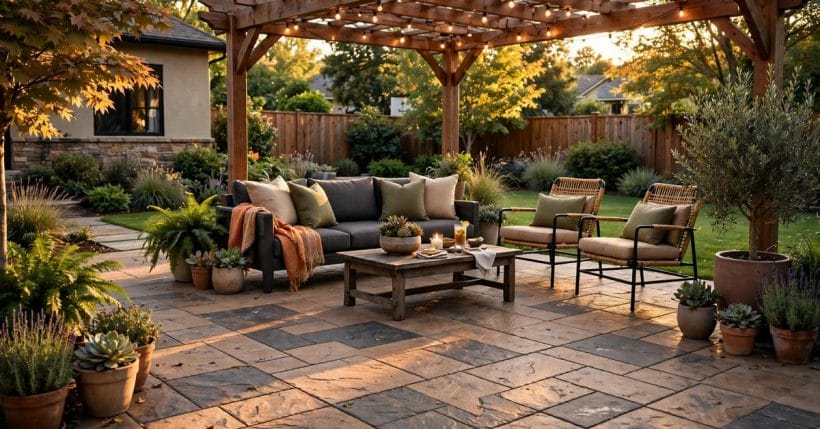
One pour of concrete, pressed with patterned moulds while it is still fresh — and the terrace under your table is suddenly slate, cobble or weathered plank.
These seventy-five stamped concrete patio ideas cover the patterns, colours and layouts that make the impersonation convincing. The outdoor family begins with patio ideas, where the whole ground is planned before any of it is poured.
1. Stamped Concrete Patio Ideas at a Glance
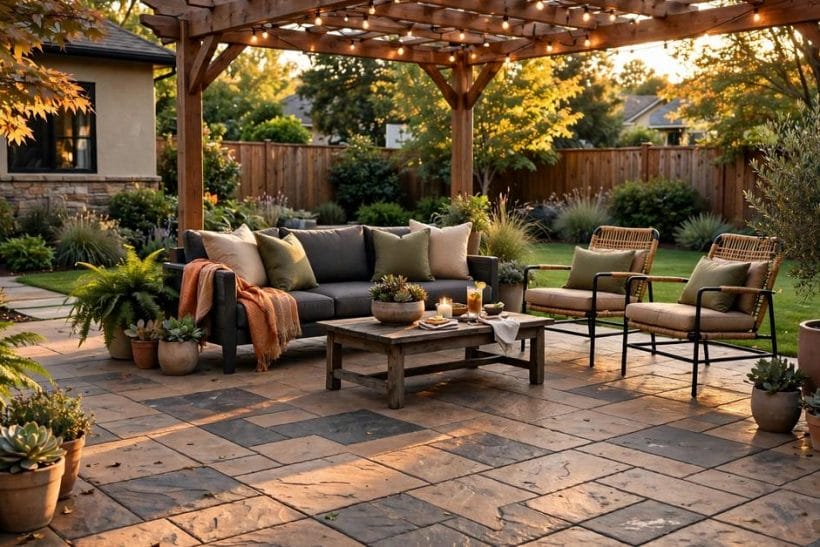
A stamped concrete patio is a poured concrete slab whose surface is imprinted with patterned moulds and coloured — integrally, with surface hardeners and antiquing washes — to imitate stone, brick, tile or timber. Its defining bargain is permanence with disguise: one monolithic floor that drains, endures and needs no weeding between joints, wearing the face of a material that would cost more and move more. Stamped patios range from a small entry court to a full pool surround, and their quality lives in the base preparation, the colour work and the installer’s timing.
| Question | Short answer |
|---|---|
| What is a stamped concrete patio? | A poured slab imprinted and coloured to imitate stone, brick or timber |
| Does it need joints like paving? | Its control joints are hidden inside the pattern’s own lines |
| What decides whether it convinces? | Colour variation and antiquing more than the pattern itself |
| Is it slippery when wet? | Textured patterns and matte sealers keep it kind to wet feet |
| What maintenance does it ask? | Resealing as regular care, and washing like any stone floor |
2. Patterns: Stone, Brick, Timber and Tile Looks
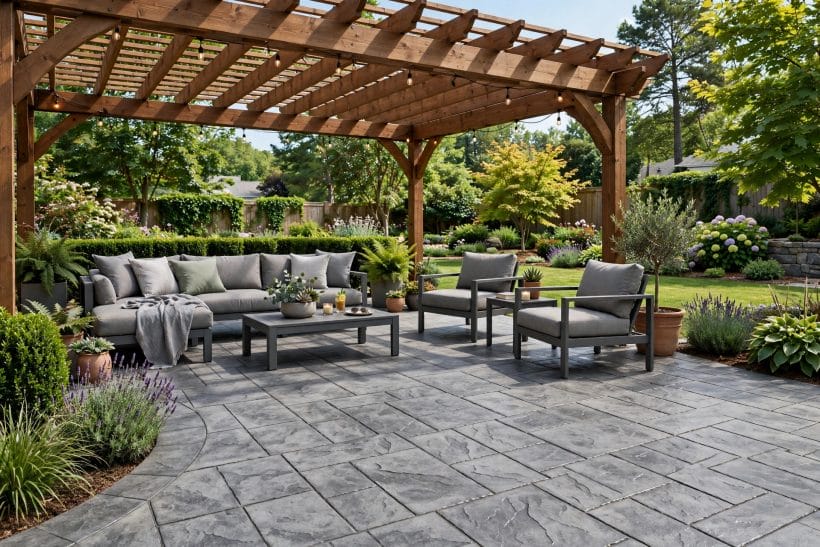
The stamp is the whole idea: fresh concrete pressed with patterned moulds until it wears the face of another material. The family’s ground rules are set out in patio ideas; here the subject narrows to the pattern itself — the eleven looks below are the ones that survive fashion because each imitates its material honestly.
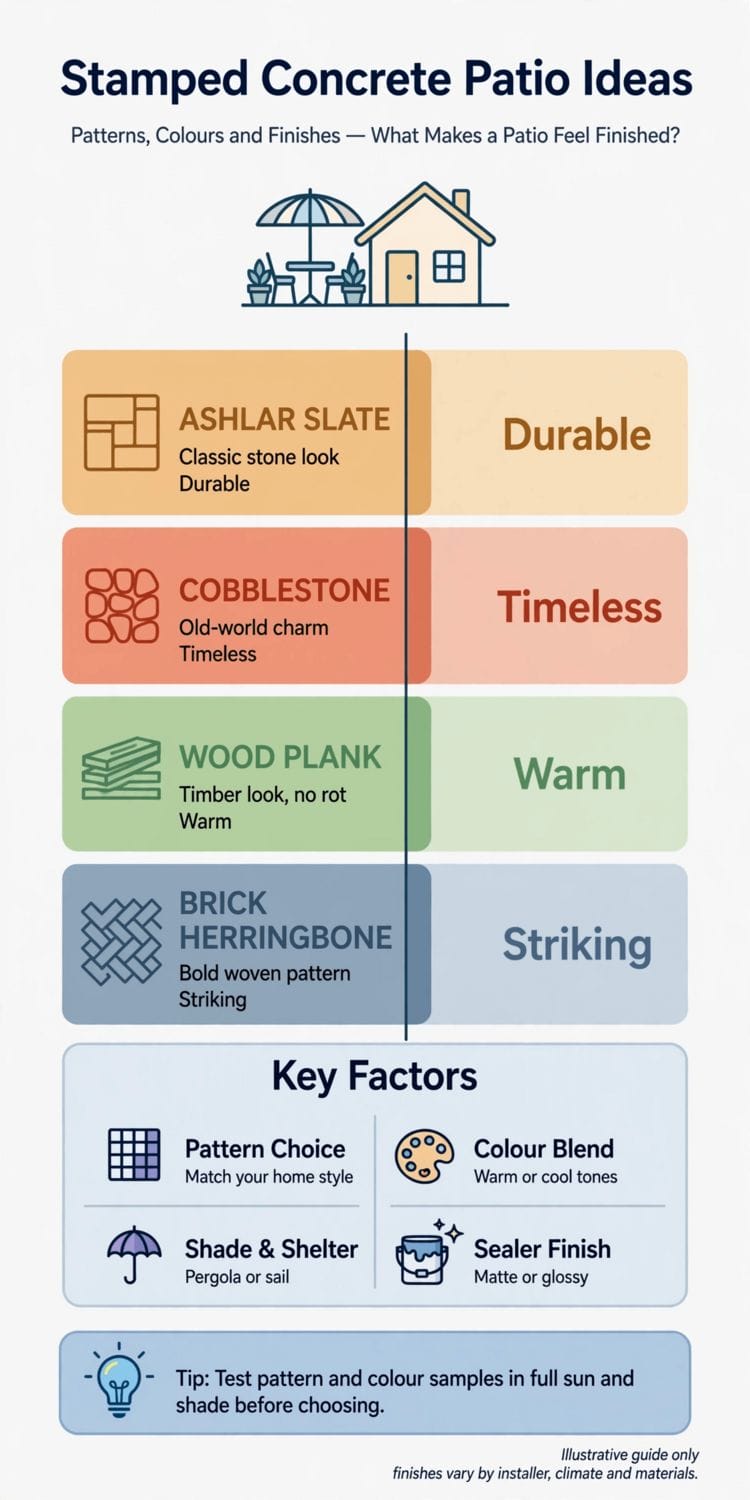
1. Ashlar slate: the classic stone grid
Rectangular slate pieces in a running ashlar bond, each stone’s face lightly textured: the most chosen stamped pattern in the world, because it suits almost any house and hides its concrete nature completely at a glance.
2. Cobblestone for old-world charm
Rounded cobbles in close ranks give a courtyard its centuries: the pattern of European lanes and farmyard aprons. Cobblestone stamping suits cottages, country houses and any garden that leans toward the planted and informal.
3. Wood plank: timber’s face without timber’s troubles
Planks stamped with grain, knots and saw marks, coloured in warm browns: the look of a boardwalk or a barn floor in a material that never rots, splinters or asks for oil. Convincing at conversational distance, honest underfoot.
4. Brick herringbone for a woven field
Bricks laid at angles in the classic herringbone weave: a pattern with built-in movement that flatters long patios and paths. Herringbone reads traditional in red tones and quietly modern in greys.
5. Running bond brick for quiet order
The stretcher-bond brick pattern of garden walls and city pavements: orderly, familiar and easy on the eye over large areas. Running bond is the pattern that never argues with the house.
6. Random flagstone for a natural floor
Large irregular flags with wide joints, each stone shaped as if split rather than cut: the pattern for gardens that want the patio to feel found rather than built. Colour it in mixed earth tones.
7. European fan for a formal flourish
Overlapping arcs fanning across the floor like scallops: the most decorative of the classic patterns, and the one that suits a formal terrace or a Mediterranean courtyard best. Fans reward precise laying-out.
8. Seamless texture skins for a stone wash
No pattern joints at all — just a continuous stone texture across the whole slab, the joints cut or left minimal. Seamless skins give the calmest floor and suit modern houses that want texture without geometry.
9. Large-format tile looks for clean lines
Big square tiles with fine, straight joints: stamped concrete pretending to be the expensive porcelain or stone tile of contemporary terraces. The illusion depends on disciplined joints and a restrained colour.
10. Basketweave brick for small areas
Pairs of bricks alternating direction in a woven square: a busy, charming pattern that works best in smaller fields — a dining terrace, a porch floor, an entry court — where its scale can be appreciated.
11. A mixed field: two patterns in one patio
A calm main pattern with a second pattern in the dining zone or along the path: zoning by stamp rather than by furniture. Mixed fields want a shared colour family so the floor reads as one design.
3. Colour and Finish: Integral Colour, Accents and Sealers
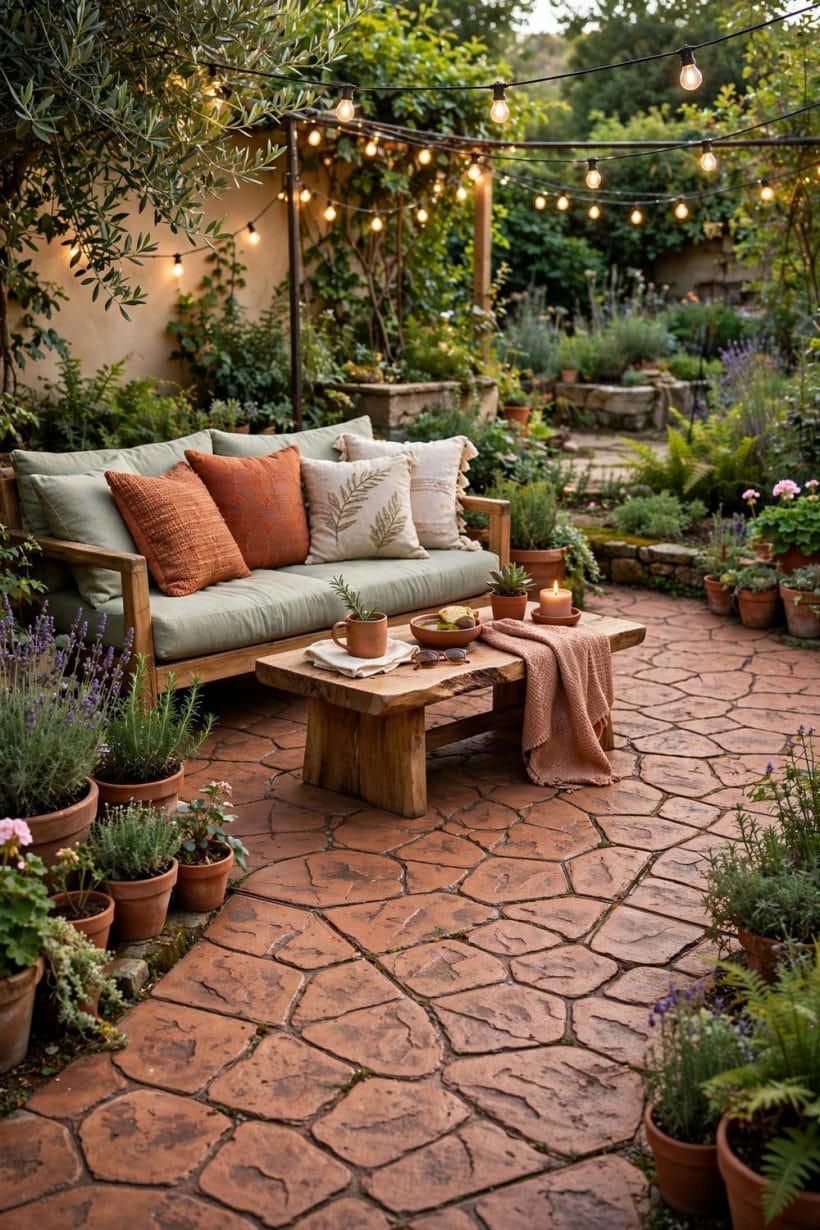
Pattern is only half the illusion; colour sells it. The choices below run from the pigment mixed through the slab to the wash rubbed into its joints and the sealer that finishes the surface — and they matter more to the result than the stamp itself.
12. Integral colour through the whole slab
Pigment mixed into the concrete before pouring, so the colour runs through the material rather than sitting on it. Chips and wear show the same tone beneath, which is why integral colour is the durable foundation of every good stamped floor.
13. A surface colour hardener for depth
Dry pigment broadcast and worked into the fresh surface deepens and hardens the wearing face: richer colour where feet and weather strike, and a tougher skin than plain concrete ever grows.
14. Antiquing release for the aged look
A darker powder or liquid release, washed so it lodges in the joints and low spots: instant age. Antiquing is what separates a stamped patio that looks printed from one that looks quarried.
15. Two-tone colouring stone by stone
Neighbouring stones tinted in slightly different tones, as real quarried stone varies: the extra labour is invisible in the invoice and unmistakable in the result. Uniform colour is the first tell of a fake floor.
16. Warm sandstone and buff tones
The forgiving family: buffs, sands and pale browns that sit comfortably with lawns, timber and brick houses, and show dust kindly. Warm tones are the safe inheritance of most gardens.
17. Cool greys for modern houses
Slate greys and blue-greys pair with render, steel and glass: the contemporary stamped palette. Cool floors stay visually cool underfoot in hot gardens, and they flatter green planting enormously.
18. Terracotta and brick reds
The Mediterranean register: reds and earthy oranges that glow at evening and suit terracotta roofs, warm brick and sun-baked planting. Reds ask for confidence and reward it.
19. Charcoal and near-black drama
A dark floor grounds pale furniture and makes planting look theatrical. Charcoal shows dust and pollen honestly and drinks the sun’s heat — choose it for looks and shade, not for bare feet at noon.
20. A matte sealer for a natural face
Sealer without shine: the floor keeps the matte, stony face of the material it imitates. Matte sealers suit stone and timber patterns, where gloss would break the illusion instantly.
21. A wet-look sealer for depth of colour
Gloss sealer deepens every tone, as rain does on real stone: colours saturate, patterns sharpen. Wet-look finishes can be slippery when actually wet — texture and common sense both belong in this choice.
22. Coloured joints that draw the pattern
Grout lines tinted darker or lighter than the stones steer the eye: dark joints make each stone read separately and traditionally; pale joints calm the floor into a single field. The joints are a design decision, not a leftover.
4. Layouts: Where the Stamped Patio Sits and How It Flows
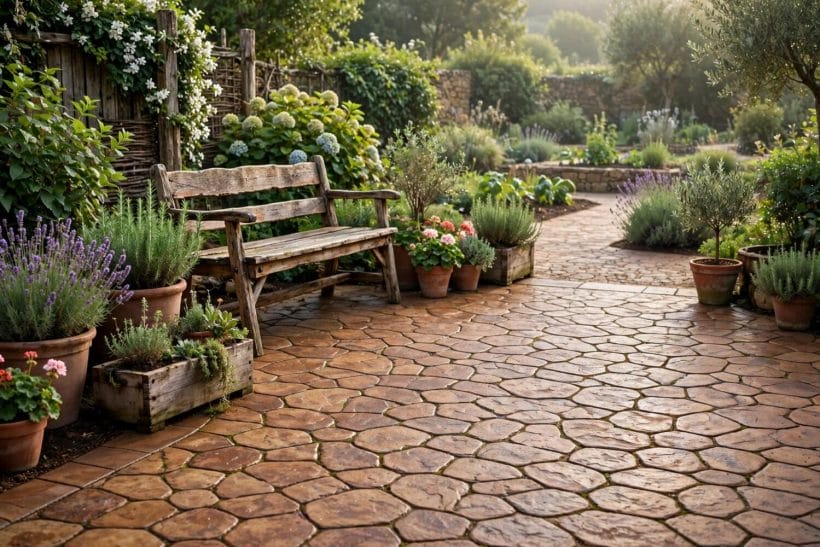
A stamped slab is poured once and lived with for decades, so its layout deserves the same care as its pattern. The ground-level alternative in loose stone is compared in gravel patio ideas; the layouts below are the poured kind, shaped around doors, sun and the garden’s own lines.
23. A terrace straight off the living room
The classic position: doors opening onto a stamped terrace at the house’s garden face, dining close to the kitchen and lounging at the far end. One pour, one pattern, and the house gains its largest room.
24. A patio that wraps the corner
Where the house turns, the slab can turn with it: sun on one face in the morning, shade on the other by evening, and a walking route around the house that never touches mud.
25. A courtyard enclosed by walls
Stamped concrete is the courtyard’s natural floor: one patterned field wall to wall, a fountain or a tree at its centre, and the pattern chosen formal to match the enclosure’s ceremony.
26. A dining terrace sized to the table
Pour the terrace the table’s size plus its chairs pulled back and a serving path: no more. Right-sized slabs look intentional, cost less to stamp well, and leave the garden its greenery.
27. A two-zone patio: dining and lounging fields
One slab, two pattern fields with a border band between: dining near the door, lounging at the sunny end. The stamp itself does the zoning that rugs and furniture do indoors.
28. A path-and-patio single pour
The garden path and the patio poured together in matching pattern and colour: the eye reads one designed ground from gate to terrace, and the pour is cheaper as a single visit.
29. A patio at the garden’s sunny end
Where the house shades its own terrace, move the patio down the garden to the sun: a stamped destination with its own furniture, joined to the house by a matching stamped path.
30. A small entry court in stamped concrete
The front-door apron as a design moment: a fan or basketweave field, a border, and the house’s welcome stated in pattern. Entry courts are small pours with outsized effect.
31. A patio shaped to a curved garden
Stamped concrete takes curves gracefully: a crescent or kidney terrace that follows the lawn’s sweep, its pattern joints radiating or running with the curve. Curved slabs suit informal gardens best.
32. A stepped patio for a sloping plot
Two or three stamped levels joined by broad steps, each level its own room: dining above, firepit below. Steps in the same stamp and colour keep the terrace reading as one design.
33. A narrow side-yard patio
The shaded strip beside the house, stamped and furnished with a bench and pots: a cool retreat at noon in hot gardens, and proof that no strip of ground is too small to design.
5. Borders, Bands and Medallions: The Details That Sell the Illusion
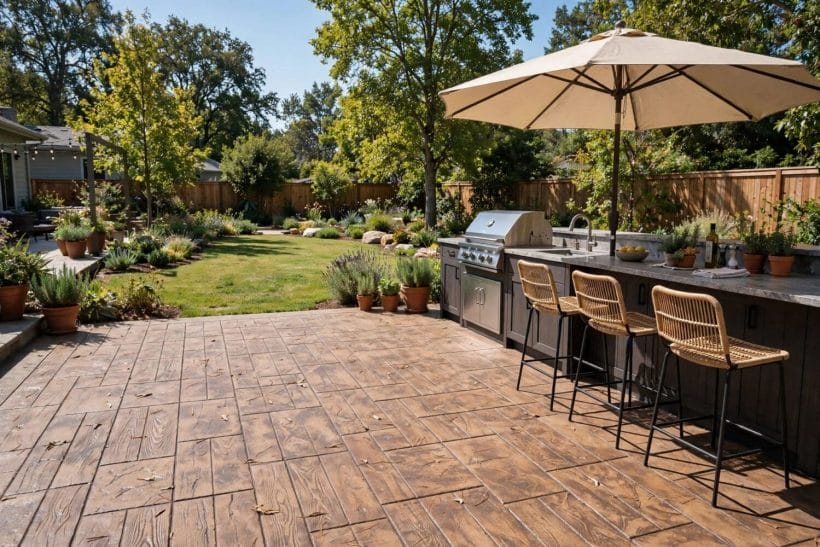
Real stone floors are finished at their edges, and stamped floors are believed at theirs. The roofed neighbour in this family — boards under a proper cover — is planned in covered deck ideas; the details below are what lift a stamped patio from a coloured slab to a floor with manners.
34. A soldier-course border around the field
A band of upright ‘soldier’ bricks stamped around the main pattern: the classic frame. Borders contain busy patterns, finish the slab’s edge and give the eye a full stop at the lawn.
35. A contrasting band in a second pattern
A strip of herringbone around an ashlar field, or cobbles around flags: two stamps in conversation. Keep the colour family shared and the contrast in the pattern, and the floor reads designed rather than decorated.
36. A medallion or compass rose at the centre
A stamped medallion at the terrace’s centre — under the table, or alone as the design’s heart. Medallions suit formal layouts and courtyards, where the floor is seen from above as a whole composition.
37. Saw-cut joints that follow the pattern
Control joints placed where the pattern’s own lines run, so the necessary cuts hide inside the design: the difference between a floor whose joints argue with its stones and one whose joints are its stones.
38. A plain margin where the slab meets the house
A strip of smooth, unstamped concrete along the wall gives the pattern breathing room and the wall a clean junction: the frame within the frame, and a kindness to future repairs.
39. Stepping stones stamped into a lawn crossing
Individual stamped pads — stone-faced, generously sized — carrying the route across the lawn to the patio: the pattern family extended into the garden without a full path’s cost or weight.
40. A threshold strip at the door
A band of contrasting stamp where the patio meets the door: the doormat of the design, marking the crossing from house to garden and taking the heaviest wear in a replaceable-looking panel.
41. Rounded corners that soften the slab
Curved corners on the pour echo the garden’s own shapes and spare shins and mower wheels alike. Rounded corners suit flagstone and cobble patterns, whose materials never had sharp corners either.
42. A darker edge stain for definition
The border band stained a tone deeper than the field: definition without a second pattern, and the cheapest of all the framing devices. Dark edges also hide the slab’s dirtiest zone gracefully.
43. Pattern turned at the dining zone
The same stamp rotated or re-laid at the dining area, as a rug turns in a room: a subtle sign that this part of the floor is a place, not a passage.
44. A matching stamped step and hearth
Steps, a firepit hearth and a low wall cap all stamped or coloured to match the floor: the terrace reads as one built object rather than a slab with guests.
6. Around Pools, Paths and Outdoor Kitchens
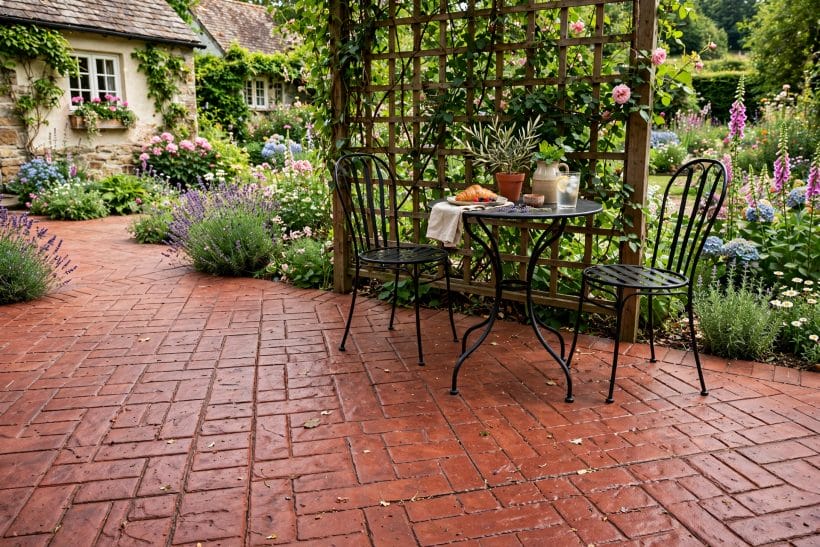
Stamped concrete earns its keep where other floors struggle: wet zones, heavy traffic and the working end of the garden. The grill-centred version of this ground is designed in outdoor grill area ideas; here the stamp serves the pool, the path and the cooking line.
45. A pool surround in a textured stamp
Around water the stamp must grip: choose textured patterns — seamless stone skins, coarse flagstone — and a matte sealer, and the surround stays kind to wet feet. Pale colours keep the coping cool at noon.
46. A cool-toned deck for hot climates
Light buffs and pale greys around the pool reflect the sun and spare bare feet: in hot gardens the pool surround’s colour is a comfort decision before it is a style one.
47. A stamped path that never turns to mud
The main garden route poured and stamped once, dry and clean in every season after: paths are where stamped concrete’s permanence pays fastest, because paths are used in the worst weather.
48. An outdoor kitchen floor that shrugs off spills
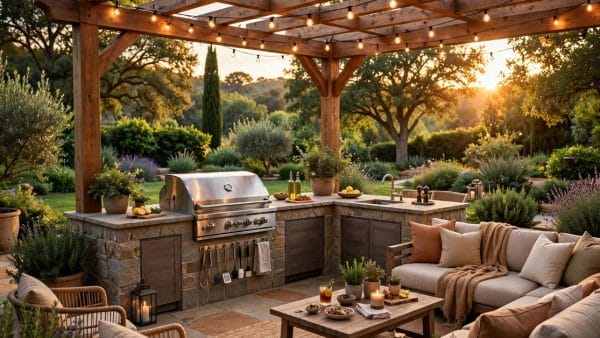
Beneath the grill and counters, a sealed stamped floor hoses clean and shows no grout to stain: the working kitchen’s floor, in the pattern of the terrace it serves.
49. A firepit terrace in a heat-proof circle
A stamped circle around the firepit — cobbles or flags — gives the fire its room and the chairs their ring. Keep the pattern’s joints clear of the fire’s centre and the floor will outlast the fashion.
50. A hot tub pad with privacy planting
A small stamped apron at the tub, screened by planting in raised beds of the same colour family: the spa corner as a designed place rather than an appliance on a slab.
51. A garden room floor for a summerhouse
The summerhouse or studio apron stamped as its doorstep room: a fan or basketweave field that gives a small building a formal arrival and a dry threshold in winter.
52. A driveway apron that matches the terrace
The same stamp at the drive’s edge and the front path ties the house’s public face together: one pattern family from street to door, and the front garden reads intentional.
53. A utility corner made decent
Bins, bikes and the potting bench on a small stamped pad behind a screen: the garden’s working corner given the same finished ground as its leisure corner, and tidier for it.
54. A stamped base for a pergola or gazebo
The structure’s floor poured and patterned before the posts rise: the pergola gains a finished room beneath it, and the stamp’s pattern can centre itself on the structure’s own geometry.
55. Drainage falls designed into the pour
Every outdoor slab is a roof for the ground beneath: falls set at the pour lead water to a drain or a garden bed, never to the house wall or a pooled corner. Design the falls before the pattern.
7. Furniture, Shade and Styling on Stamped Concrete
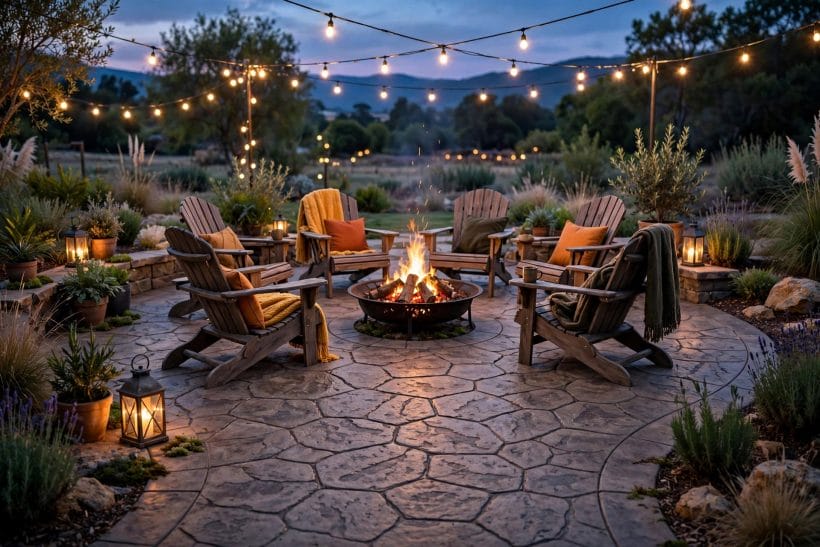
A stamped floor is a stage: hard, patterned and permanent, it asks its furniture to be movable, soft-edged and lighter than itself. The shade structures that stand on such floors are gathered in patio with a gazebo ideas; what follows is the furnishing of the floor itself.
56. An outdoor rug to soften the field
A rug under the dining set or the loungers breaks the pattern’s expanse, warms the floor for bare feet and names the room within the floor. Choose rugs whose tones argue gently with the stamp, not echo it.
57. Furniture feet that respect the sealer
Chairs and tables with broad, smooth feet — or caps fitted — so the sealer is not scratched through in the first season: the floor’s finish is its face, and furniture is its weather.
58. A pergola centred on the pattern
Where a pergola stands on the slab, centre its posts on the pattern’s geometry and the floor and structure compose together: pattern medallions and pergola centres were made for each other.
59. Pots in families along the edges
Planters grouped in twos and threes along the slab’s edge soften its geometry and green its borders: one big pot family beats a scatter of singles on a patterned floor.
60. A fire table as the evening centre
A fire table on the stamped terrace gathers the evening around itself: the floor beneath is unburnable, the pattern glows in the firelight, and the terrace’s season stretches at both ends.
61. Loungers on the sunny field
The lounging zone placed where the pattern is calmest and the sun longest: seamless fields suit reclined days, and a side table or two completes the spa-hotel arrangement.
62. A dining set that echoes the pattern’s era
Herringbone brick under a farmhouse table; ashlar slate under iron and teak: furniture chosen in the pattern’s own period makes the illusion complete, and the terrace reads as a place with a history.
63. String lights over a patterned floor
Festoons above a stamped terrace double the pattern’s pleasure after dark: light pools in the joints’ shadows and the floor performs twice — once by day, once by lamplight.
64. A bench wall along the low edge
A low wall at the terrace’s edge, capped smooth, seats the overflow and holds the pots: on a stamped patio the built seat keeps chairs — and their feet — off most of the floor.
65. Seasonal styling: textiles over texture
Cushions, throws and a table runner are the stamped floor’s soft furnishings: changed with the season, they let one permanent pattern host a dozen different terraces a year.
8. Styles: From Old-World Courtyard to Clean Modern Slab
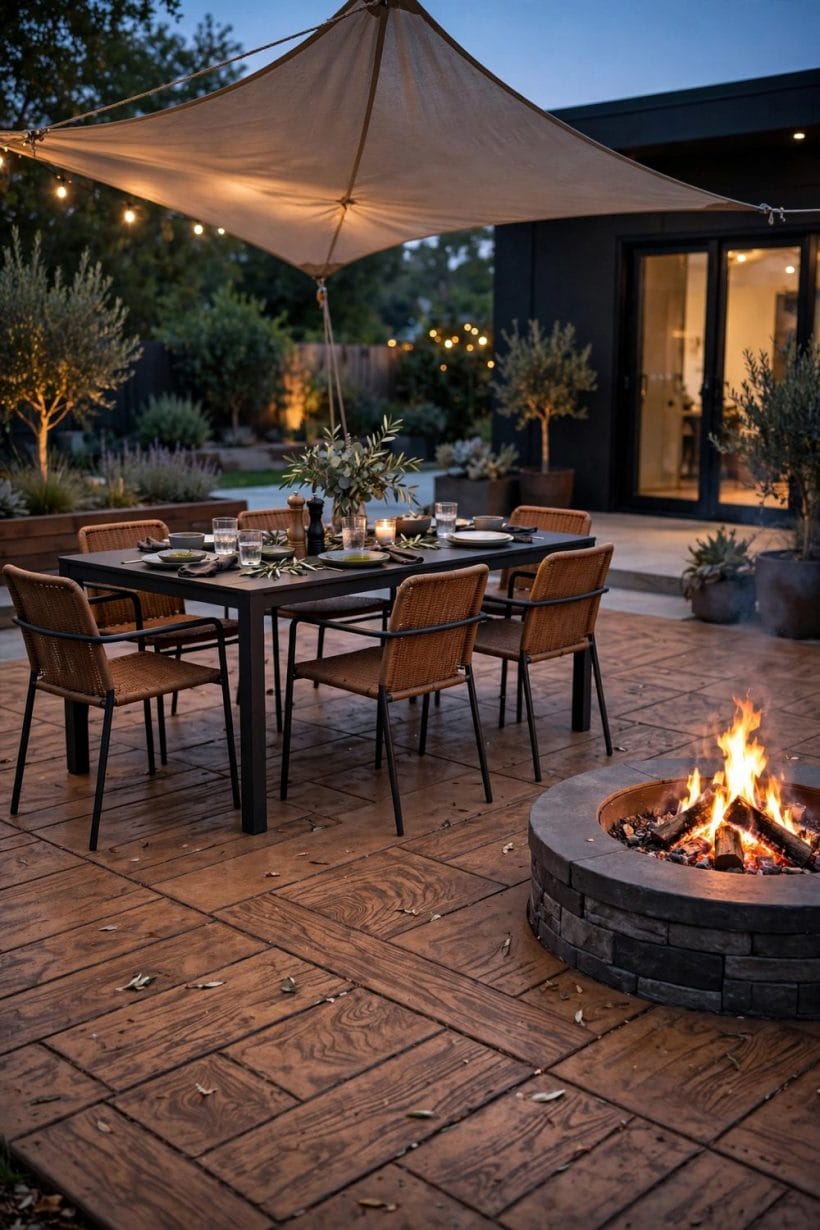
The stamp is a chameleon, but each patio must pick one voice and keep it. The standalone cooking zones that pair with several of these styles live in bbq area ideas; the styles below are the floor’s own characters, from the oldest courtyard to the newest slab.
66. Old-world courtyard in cobble and fan
Cobblestones, a fan medallion, terracotta pots and iron furniture: the courtyard of the old continent, built in an afternoon’s pour and a century’s imagination.
67. English garden terrace in running bond brick
Brick underfoot, roses at the edges, a scrubbed timber table: the stamped brick terrace is the English garden room’s floor, formal in pattern and soft in planting.
68. Mediterranean warmth in terracotta tones
Warm reds and buffs, a seamless or fan pattern, shade from a vine: the Mediterranean terrace glows at evening and asks for long lunches in its contract.
69. Farmhouse yard in wood-plank stamp
Plank-stamped concrete around a farmhouse table, galvanised planters and a bench or two: the working yard remembered fondly, in a floor that never needs the yard’s maintenance.
70. Coastal pale: bleached stone tones
Pale seamless stone in sand tones, white furniture and rope-and-linen textiles: the coastal terrace stays cool, bright and forgiving of sandy feet.
71. Modern slab: large tiles, cool grey, no fuss
Big-format tile stamps in cool grey under sculptural furniture: the contemporary terrace, where the floor is calm and the objects are the ornament.
72. Rustic lodge in random flagstone
Big flags, deep joints, heavy timber furniture and a firepit: the mountain-lodge floor, happiest with pine shade and a woodpile in view.
73. Desert modern in warm seamless texture
Warm sand-toned seamless skins, gravel margins, sculptural planting and shade sails: the desert terrace treats the stamped floor as one plane in a dry composition.
74. French courtyard in basketweave and gravel
A basketweave field edged with loose gravel and boxwood: the provincial courtyard’s formality, softened by green geometry and the crunch underfoot at its border.
75. Eclectic terrace: pattern as the personality
A mixed field — fans at the centre, flags at the edge — under the household’s gathered furniture: the eclectic terrace lets the floor itself be the collector, and every other rule relaxes.
9. Checks and Mistakes: Before the First Purchase or the First Fitting
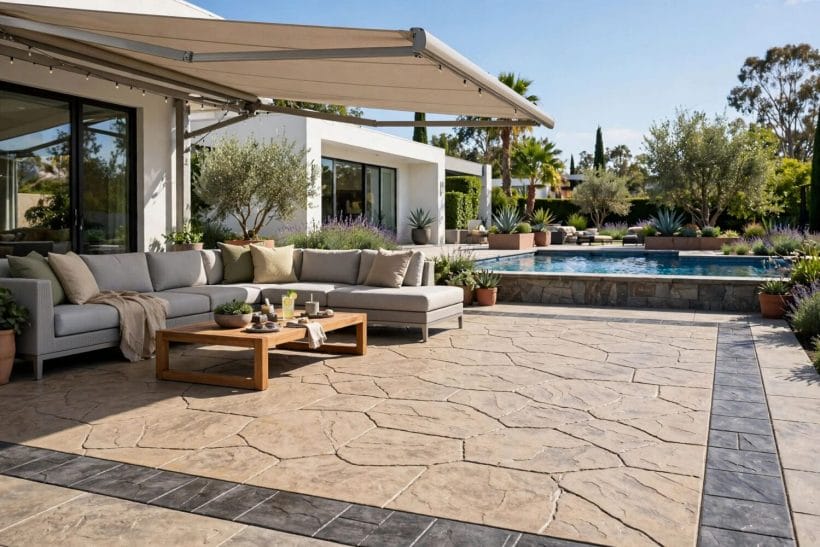
Begin with the pour’s practicalities, because stamped concrete is unforgiving of haste: the pattern must be pressed while the concrete is at exactly the right stage, which makes the installer’s experience the single largest quality decision. Ask to see finished work of a similar age, not fresh photographs.
Check the ground the slab will cover. A stamped patio is only as stable as its base: poor preparation shows as cracks and settlement that no pattern can hide, and the falls for drainage are set at the same stage — water must always be led away from the house, to a drain or a planted soakaway.
Mind the slipperiness honestly. Smooth patterns and glossy sealers can be treacherous when wet, above all around pools and on slopes; textured stamps, matte sealers and anti-slip additives worked into the finish are the standing answers, and they belong in the conversation before the pour.
The commonest disappointment is colour: a stamped patio’s tones shift with light, weather and age, and the sample board is a promise made in one afternoon’s sun. View samples at several hours of the day, expect the antiquing to soften, and plan on resealing as the surface’s regular maintenance rather than its rescue.
10. Costs and Pulling It Together
Costs follow area, ground preparation and pattern complexity, in that order. A single-pattern terrace on prepared ground is the modest end; multiple pattern fields, medallions, two-tone colouring and stepped levels are the expensive end, with the installer’s skill priced into every square of it.
The drivers in order: the base and the pour first, then the pattern and colour work, then borders and details, then sealing — and, across the years, resealing and care as the floor’s running cost.
Pull the design together by choosing the pattern from the house’s own materials, the colour from the garden’s light, and the layout from the hours the terrace will actually be used.
Final Considerations
A stamped concrete patio is the garden’s great impersonation: stone, brick or timber at a glance, one honest pour underneath — and decades of service from a single week’s work.
Choose the pattern your house would have chosen for itself, colour it in daylight rather than lamplight, and let these seventy-five ideas argue their cases under your feet.

0 Comments