
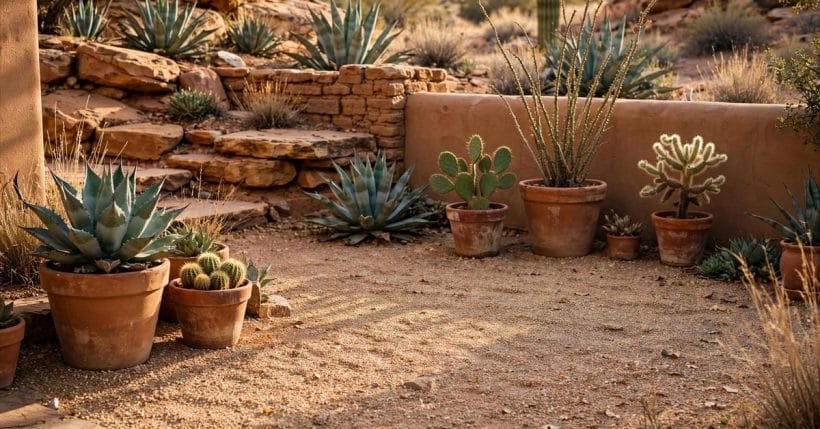
A southwestern garden is not a collection of cacti. It is a way of gardening that starts from the desert’s own terms — fierce sun, thin soil, precious water — and finds the beauty inside them: sculptural plants, warm stone, gravel that glows at evening.
These 75 southwestern landscaping ideas work through the style in order: the shapes, the plants, the ground itself, walls and shade and water, and the honest question of how far the style travels beyond its home climate.
1. Southwestern Landscaping at a Glance
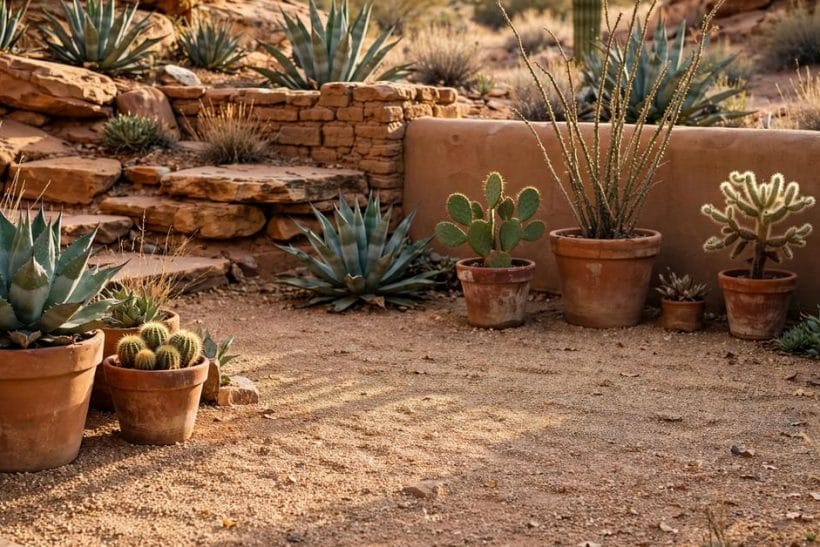
The central entity is southwestern landscaping: a regional garden style built for arid country, where planting is sparse and sculptural, surfaces are mineral rather than green, and every plant earns its water. Its plant palette overlaps the one catalogued in our desert southwest plants guide, but this post is about the designed landscape as a whole — shape, ground, wall and shade — in the style’s home territory and, carefully, beyond it.
| Aspect | What to know | In a word |
|---|---|---|
| The Shape | Curves, clusters, open gravel | Relaxed |
| The Plants | Agave, cactus and desert bloom | Sculpted |
| The Ground | Gravel, granite, flagstone | Grounded |
| The Walls | Adobe, stone and rusted metal | Warm |
| The Shade | Pergolas, sails, desert trees | Cooled |
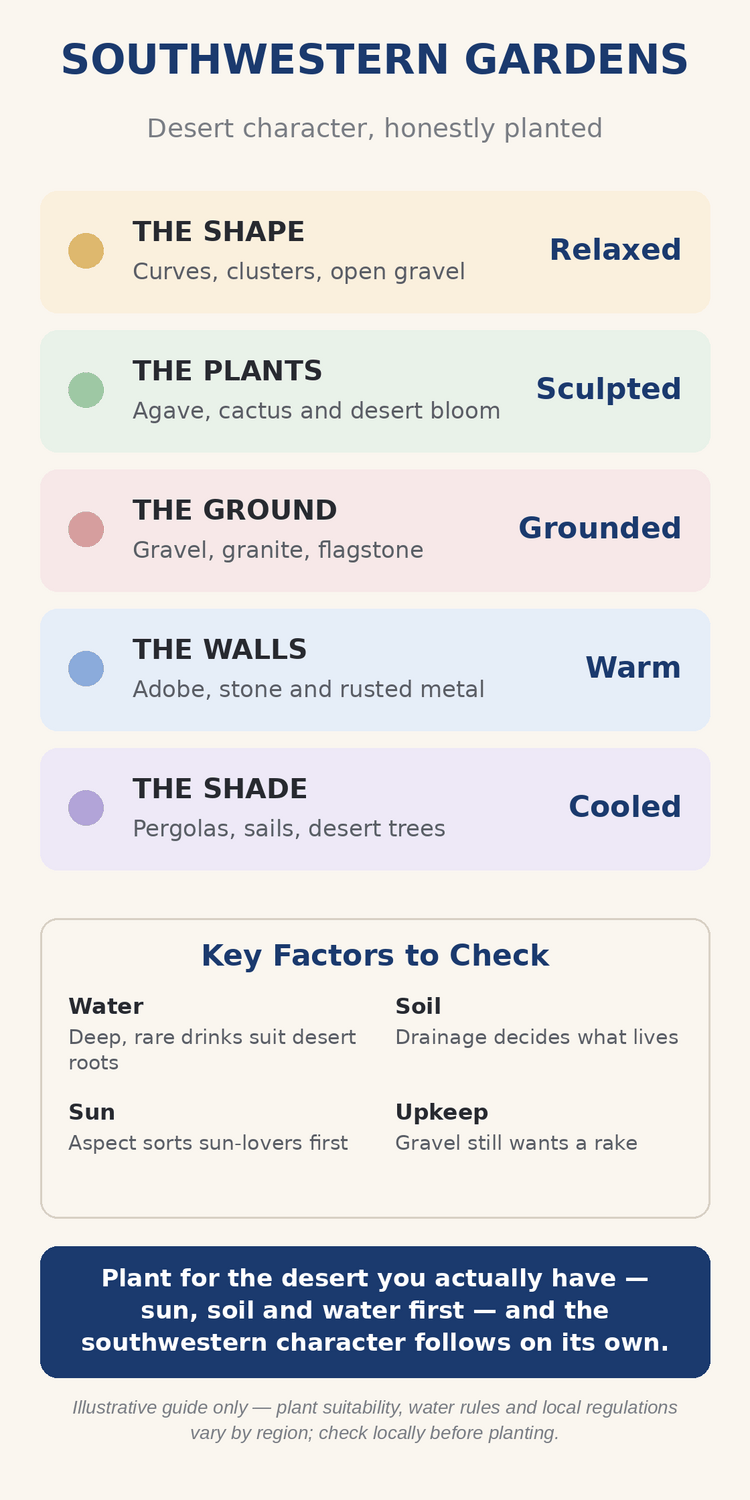
Plant for the desert you actually have — sun, soil and water first — and the southwestern character follows on its own. Four checks sit behind the table: water, because deep and rare drinks suit desert roots better than little and often; soil, since drainage decides what lives before any planting plan does; sun, with aspect sorting the sun-lovers first; and upkeep, because even gravel still wants a rake.
Most readers arrive here from southwestern landscape photographs taken in high desert light, where every garden looks sculptural. The style is genuinely forgiving — but it is a climate’s style, and the ideas below keep that honesty in view: what the desert plants want, what the surfaces do, and where the look can be borrowed and where it should be admired from a distance.
2. Shapes and Layouts
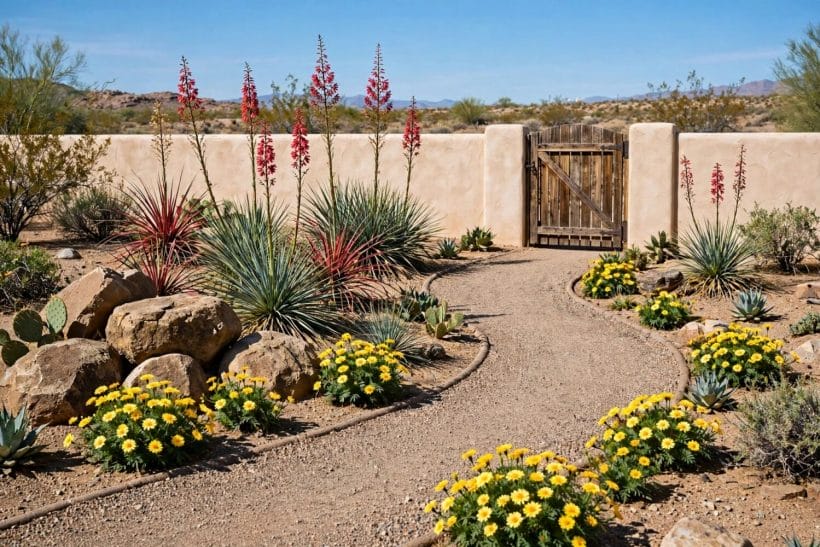
A curving gravel path, boulders in loose clusters, flower drifts against a stucco wall — the layout in this photograph is the style in miniature. Southwestern shapes are borrowed from dry country itself: washes, drifts and scattered stone.
1. The Curving Gravel Path
Paths in this style wander like dry washes, curving between planting clusters rather than ruling straight lines to the door. The curve slows the walk, opens changing views, and lets the garden feel larger than its fence.
2. Planting in Clusters, Not Rows
Desert plants grow where water gathers, in loose companies — and the garden copies it: a boulder, three agaves, a drift of flowers, then open gravel. Clusters separated by breathing space read as landscape; rows read as a nursery.
3. Boulders as Anchors
One large stone, half-buried and unstudied, anchors a planting group the way it does on a hillside. Choose local stone where possible, set it deep, and let plants gather at its shaded side as they would in the wild.
4. Open Gravel Between the Groups
The empty ground is not unfinished — it is the style’s equivalent of lawn, the calm field the planting performs against. Resist filling it; southwestern gardens are edited by subtraction.
5. A Courtyard at the Centre
Where the plot allows, the garden organises around a walled courtyard — the outdoor room the house opens to. It concentrates the best planting, the shade and the sitting where they are used daily, in the spirit of our patio ideas.
6. The Front Garden as Landscape
In desert towns the front garden is the landscape — no lawn, no apology, the full style facing the street. Handled with the drift-and-boulder layout of our front yard landscaping ideas, it is often the most admired garden on the road.
7. Terraces on a Slope
Sloping desert plots terrace beautifully in stone, each level a gravel shelf with its own cluster. Terracing also slows the rare heavy rain, giving water time to sink where the plants can use it.
8. One Tree, Placed Like a Sculpture
A single desert tree — a palo verde, a mesquite — planted alone in open gravel becomes the garden’s monument. The style uses trees sparingly and means it: one great shape outvalues five ordinary ones.
9. Edges That Melt Into the Land
Where a garden meets open country, let the planting thin out gradually — clusters loosening, gravel giving way to native ground. A hard fence-line ending looks imported; a melting edge looks inevitable.
3. The Sculptural Plants
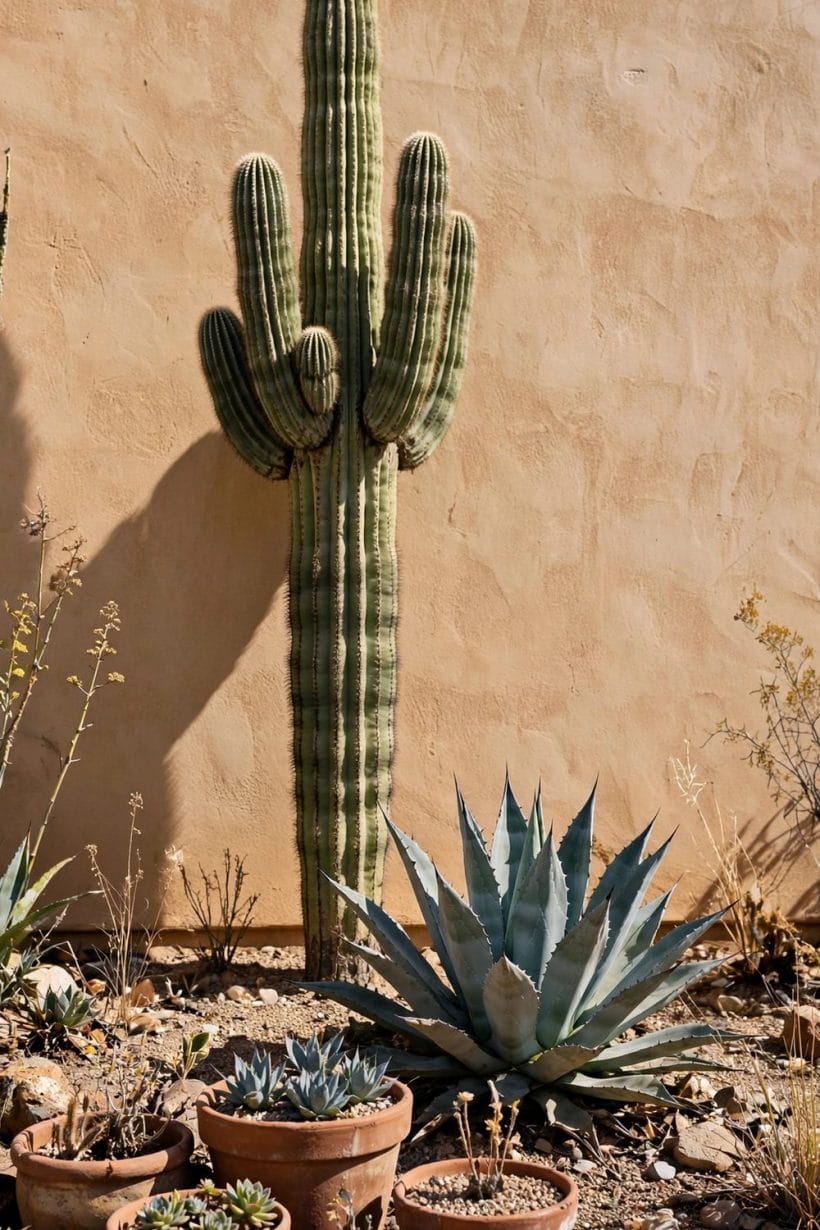
A saguaro and a blue agave against a warm wall: the style’s planting is architecture first and foliage second. These are plants chosen for silhouette, grown slowly, and given the space their shapes demand.
10. The Saguaro, Where Winters Allow
The giant columnar cactus is the style’s emblem, and a genuinely slow, climate-bound plant — at home only where frosts are light and drainage is perfect. Where it cannot grow, its role passes to other columns rather than to plastic imitation.
11. Blue Agave as the Anchor Plant
A mature blue agave is a fountain of geometry, blue-grey against warm gravel. Plant it with its adult spread in mind, away from path edges — its leaf points are as serious as its looks.
12. Prickly Pear Pads and Fruit
Prickly pears give the garden its flat green sculpture and, in season, flowers and fruit of unlikely brilliance. They root easily and spread politely where happy — give them a corner they can own.
13. Golden Barrels in Threes
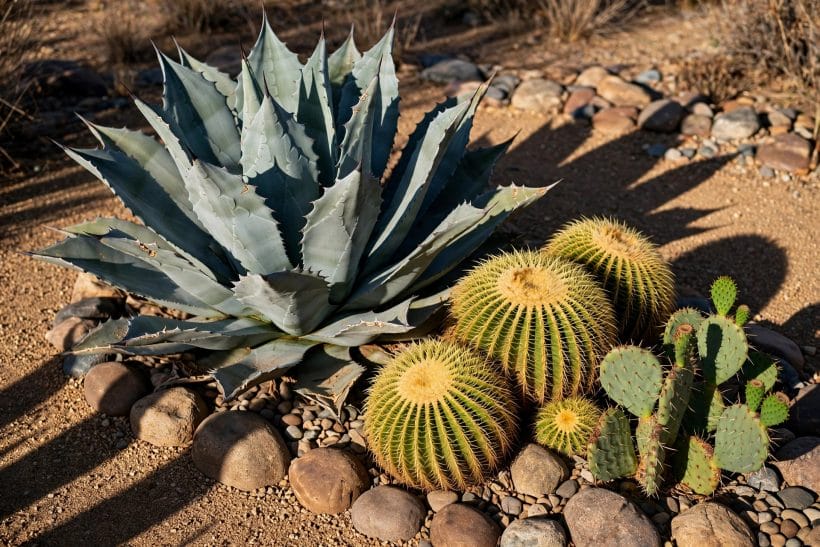
Barrel cacti read best in odd-numbered groups, their ribs catching low light like lanterns. Clustered among river stones they make the smallest complete garden picture in this post.
14. Ocotillo for Height and Spring Colour
Long whiplike canes, leafing after rain and tipping with red bloom — ocotillo gives height without bulk, and a living record of the weather. It wants the sharpest drainage in the garden.
15. Red Yucca’s Flowering Wands
Not a yucca but a soft fountain of grey-green leaves with tall pink-red flower wands through the warm months. It is among the most obliging plants in this list for gardens at the style’s cooler edge.
16. Desert Marigold Drifts
Yellow daisies over silvery foliage, flowering whenever warmth allows — desert marigold is the drift flower of the gravel beds, sown or planted in sweeps rather than dots.
17. Brittlebush and Silver Foliage
Silver-leaved shrubs cool the palette and glow at dusk. Brittlebush, lavender cotton and their kin give the garden its moonlit register and ask only sun and drainage in return.
18. One Plant, One Plinth of Gravel
Give specimen plants a clear apron of gravel or stone around their base — it shows the shape, keeps crowns dry, and turns each plant into an exhibit. The plinth is the style’s smallest design move and its most reliable.
4. Cacti, Succulents and Desert Bloom
Agave, barrels and prickly pear share one bed here, stones between them, every plant with air around it. This section is about combining the desert palette so the planting reads as one landscape rather than a collection of pots outdoors.
19. Group by Water Need, Not by Looks
The invisible rule of desert planting: plants that want the same watering regime live together, whatever the picture suggests. A thirsty flower drift beside a dry cactus bed means one of them is being gardened wrong.
20. Flowers in Seasonal Waves
Desert bloom comes in pulses — spring annuals, summer perennials, autumn sages. Plan the waves and the garden changes costume through the year instead of peaking once and retiring.
21. Penstemon Spikes for Spring
Penstemons send up wands of tubular flowers in reds and pinks that hummingbirds work methodically. Short-lived but generous with seed, they are the spring drift of the better-drained beds.
22. Desert Willow for Summer Shade-Flowers
A small tree with orchid-like blooms through the hot months, desert willow flowers exactly when the garden is hardest to enjoy — and gives light, movable shade while doing it.
23. Lantana and the Long Season
Where winters are kind, lantana flowers almost without pause and feeds butterflies through the heat. Where frosts bite, it is treated as a summer annual — the style adapts, the colour remains.
24. Sages That Scent the Air
Texas sage and its relations perfume the air after rain and flower in lavender waves. Plant them where paths pass close; they are shrubs to brush against, not just to look at.
25. Aloe and the Small Succulents
Aloes, echeverias and small clustering succulents fill the foreground — the gravel’s edge, the pot, the rock crevice — with rosettes and winter flowers where the climate allows them outdoors.
26. Night-Blooming Drama
Some desert flowers open at dusk for moths and bats, pale and perfumed. One night-blooming plant near the evening sitting place gives the garden a second, secret shift of beauty.
5. Gravel, Stone and Ground Surfaces
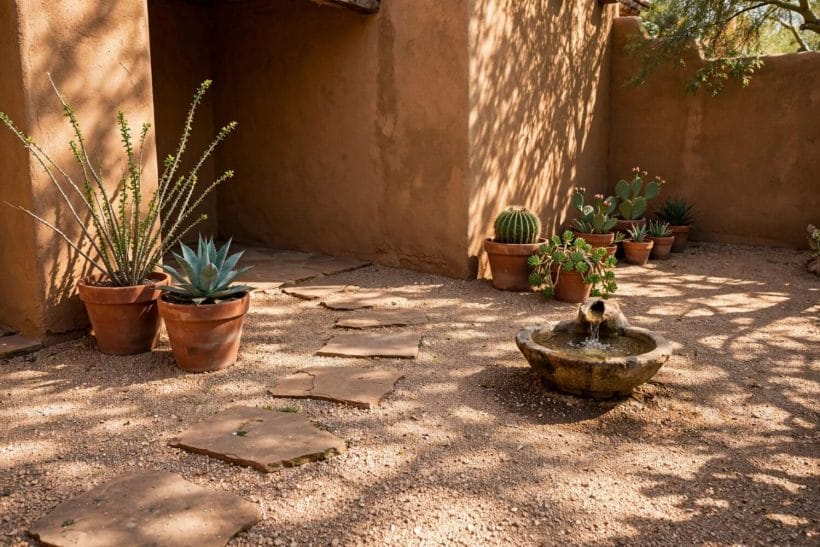
Decomposed granite underfoot, flagstone steps, a small fountain bowl — the ground plane does more work in this style than in any other. Choose it as carefully as the planting.
27. Decomposed Granite, the House Surface
Crushed granite packs firm, drains freely and comes in the warm tones the style is built on. It is the default ground of courtyards and paths, renewed by raking and the occasional fresh layer.
28. Gravel Colours From the Local Stone
The convincing gravels are the colour of the region’s own rock — rose, gold, rust, pale grey. Matched to local stone and the house’s walls, the ground disappears into the landscape; imported colours always look delivered.
29. Flagstone Stepping Paths
Large flat stones set into gravel mark the walked lines through planting — kinder to feet than gravel alone, and a rhythm of pale shapes the eye enjoys. Set them level and generous; mean little stones trip.
30. River Stone Washes
A dry wash of rounded river stone, curving through the garden, suggests the water that shaped the land. It also works: in heavy rain the wash carries runoff where the gardener chooses, as the stone layouts in our stone landscaping ideas demonstrate.
31. Boulder Groupings, Half-Buried
Stones sit naturally when a third of them is underground. Grouped in twos and threes with gravel lapping their bases, half-buried boulders look geological; perched on the surface, the same stones look like deliveries.
32. Edges in Steel or Stone
Gravel needs a kept edge where it meets paths and beds — a line of stone, a buried steel strip, a row of pavers. The edge is one of the few straight lines the style allows, and it earns its place.
33. Stepping Stones Through Planting
Where a path crosses a planted drift, big single steppers keep feet off crowns and soil uncompacted. They also slow the walker at the garden’s best views, which is half their purpose.
34. A Gravel Terrace for Sitting
The sitting ground of the desert garden is gravel underfoot — warm by day, quick-draining, informal. Furniture sits steadier on packed granite than on loose gravel, so the terrace wants the firmest rolling of all.
35. Mulch Where Plants Are Young
Even desert gardens mulch their newest planting — a light gravel mulch rather than bark, keeping crowns dry while roots establish. Bark and compost belong to other climates’ gardens; here they invite the damp the plants dislike.
6. Walls, Gates and Adobe Colour
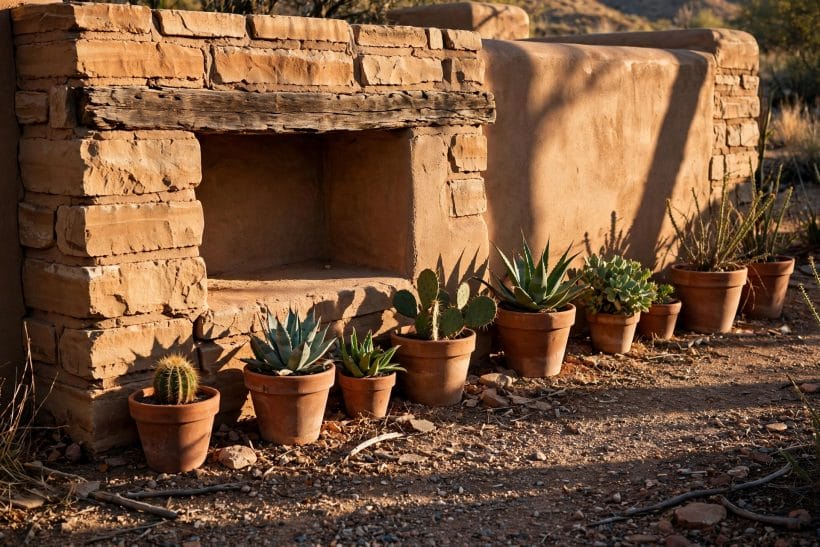
Sandstone blocks, an adobe wall, a timber lintel over a niche — walls in this style are scenery, shelter and colour at once. They hold the day’s heat and give it back to the evening garden.
36. Adobe and Stucco in Earth Tones
The wall colour of the Southwest is the land itself — sand, clay, terracotta, the pale pink of evening stone. Stucco in these tones makes the perfect backdrop: warm behind green, never competing.
37. A Niche in the Wall
A shallow recessed niche, holding one pot or a small shrine-like arrangement of stones, gives a long wall its punctuation. It is an old device of courtyard gardens and costs only the decision to build it.
38. Timber Gates and Lintels
Weathered timber — rough planks, big beams — is the style’s dark accent against pale walls. A simple plank gate in a stucco wall, iron-ringed and heavy, is the garden’s handshake.
39. Rusted Metal Accents
Weathering steel, left to rust to its deep orange-brown, echoes desert varnish on rock. Used for edging, planters and gates, it bridges the garden’s mineral and metal notes — the same material family used more formally in our farmhouse landscaping ideas.
40. Stone Retaining on a Slope
Dry-laid or mortared local stone holds terraces with a face that planting can colonise — small succulents in the joints, trailers over the top. The wall becomes a vertical garden in miniature.
41. The Wall as a Heat Bank
A sun-facing masonry wall stores the day’s warmth and shelters tender planting at its base through cool nights. In borderline climates this microclimate is the difference between a plant’s surviving and thriving — never guaranteed, always worth using.
42. Painted Colour, Used Once
One door or gate in the region’s famous turquoise or deep red, against all that earth, is the style’s signature exclamation. Once is the rule — the second painted feature halves the effect of the first.
43. Low Walls That Seat
A garden wall at sitting height works twice — boundary and bench. Cap it wide and smooth, place it where the evening sun lands, and the wall becomes the garden’s favourite chair.
7. Shade and Outdoor Rooms
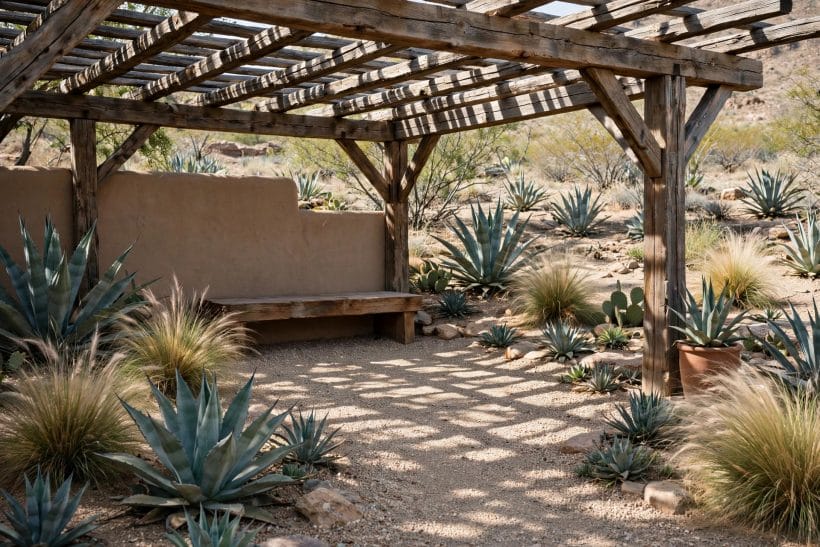
Under a rustic pergola, benches wait in patterned shadow. Shade is the desert garden’s true luxury — the thing that makes it a place to live in, not just to look at.
44. The Timber Pergola
Big rough timbers overhead, casting striped shade that moves with the day — the pergola is the style’s roof. Build it where the sitting is, orient it against the afternoon sun, and plant its feet with climbers where the climate is kind.
45. Ramada Shade, Solid-Roofed
The traditional ramada — posts and a fuller roof — gives the deeper shade that midday demands. It suits the cooking and dining end of the garden, where people gather longest.
46. Shade Sails for Modern Gardens
A taut sail in sand or terracotta tones gives clean, removable shade in contemporary plots. It is the pergola’s modern cousin — lighter, seasonal, and honest about being temporary.
47. Desert Trees as Living Shade
Palo verde and mesquite cast the famous lace shade — light enough for planting beneath, kind enough for sitting. Their shade is the garden’s most elegant, and the slowest to arrive; plant trees first, always.
48. A Bench in the Wall’s Shadow
The simplest shade seat: a bench placed where a wall’s shadow falls in the late afternoon. No structure, no cost — just observation of where the shade already goes, applied to furniture.
49. The Outdoor Room’s Floor and Rug
Define the sitting room with a change of ground — flagstone under the pergola where gravel surrounds it — and, for softness, an outdoor rug in earth patterns. Rooms outdoors are made by floors and ceilings; the walls are optional.
50. Evening Fire, Carefully Placed
A small fire bowl or outdoor fireplace extends the garden’s evenings — sited with local fire rules checked first, away from planting, on mineral ground. Fire in a dry garden is a pleasure governed by rules, and the rules come first.
51. Lighting Low and Warm
Path lights low to the ground, a lantern by the gate, uplight in one tree — desert gardens light their shapes, not their surfaces. Keep it warm and sparse; the desert sky provides the rest.
52. A Hammock Between Posts
Two stout posts and a woven hammock make the siesta official. It is the outdoor room’s most honest furniture — nobody pretends to work in a hammock — and it folds away when the season turns.
8. Water Used Sparingly
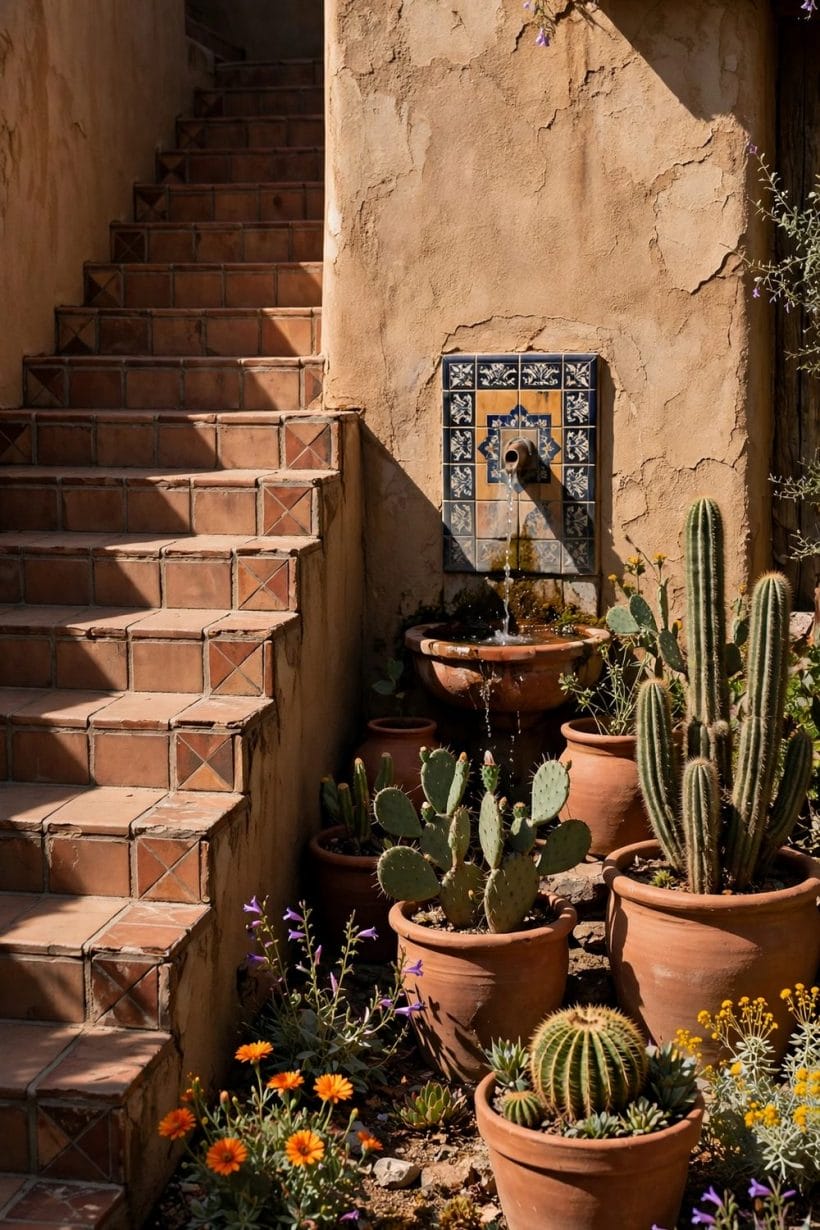
Tiled steps, pots of cacti and one small wall fountain: this courtyard spends its water where it is heard and seen, not spread thin. In the desert style, water is an accent, never a carpet.
53. The Small Wall Fountain
A modest fountain — a spout, a basin, a recirculating pump — gives the courtyard the sound of water for very little of it. The sound cools a garden psychologically before it cools it any other way.
54. A Basin for Birds
One shallow basin, refreshed often, brings the desert’s birds — finches, doves, the occasional roadrunner — into daily view. Wildlife is the water feature that repays its water most visibly.
55. Drip Lines, Hidden and Honest
Where irrigation exists, drip lines under gravel deliver water to roots without wetting crowns or sky. Run them thoughtfully, group plants by need per idea 19, and let the surface stay dry and clean.
56. Watering Deep and Rare
Established desert planting generally prefers a deep soak at long intervals to a daily sprinkle — roots follow water down and learn drought. New planting is the exception, watered attentively until its roots are down; nothing here is a promise any plant will thrive.
57. Rain Caught Where It Falls
Swales, washes and low basins slow the rare storm and sink its water in the garden rather than losing it to the street. Shaping ground for rain is unglamorous, invisible most of the year, and the making of desert gardens in wet weeks.
58. Pots as the Watered Jewels
Container planting concentrates water where it shows most — by the door, the gate, the sitting place. Terracotta pots with drought plants, watered by hand, are the desert garden’s permitted extravagance.
59. No Lawn, or the Smallest One
The style’s default answer to grass is none — gravel and planting instead. Where a household insists, a small patch for children or dogs, honestly sized, is better than a thin green acre of guilt.
60. Grey Days and Local Rules
Water rules, hose restrictions and planting ordinances vary across the desert towns themselves, and gardeners elsewhere face their own. Check what your locality asks before designing the water — the style respects limits as a design material, as it does in the water-wise thinking of our coastal landscaping ideas.
9. Evening in the Desert Garden
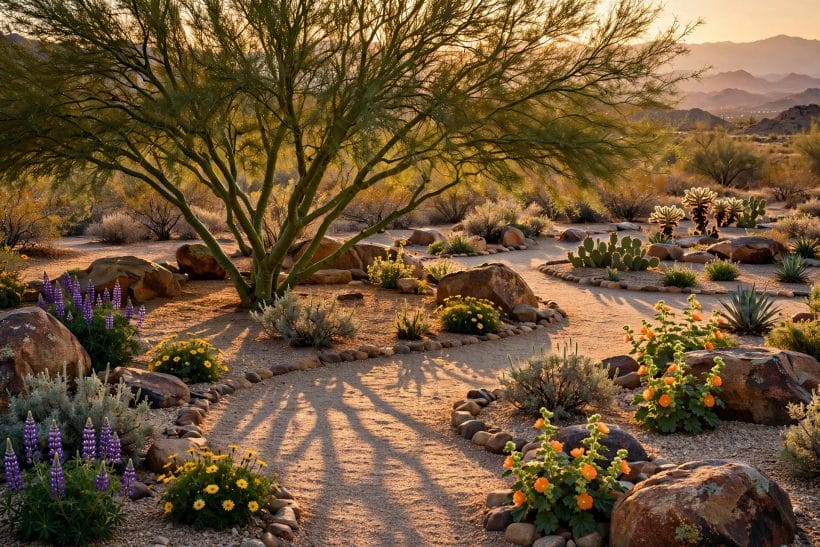
Golden hour is this garden’s finest performance: gravel glowing, the palo verde’s shade lace on warm ground, flowers at their most saturated. Plan for the evening and the garden works all day.
61. West-Facing Colour
Plant the sunset-facing beds with the flowers and silver foliage that backlight best — sages, grasses, pale blooms. A garden composed for the light it actually receives at sitting hour always outperforms one composed for noon.
62. Lanterns Along the Path
A line of low lanterns — solar, wired or candle — turns the evening path into a procession. Keep them at ankle height, marking the way rather than flooding it, and let the dark do the decorating.
63. The Fire Bowl Hour
Where local rules allow and conditions are calm, a fire bowl at dusk gathers the garden’s people as nothing else does. Mineral ground, clear space, water to hand — the courtesies of fire in dry country, observed without exception.
64. Pale Stone That Holds the Light
Light-coloured gravel and pale flagstone go on glowing after the sun leaves them, lending the garden a long twilight. It is one reason the style’s grounds run pale beneath dark planting silhouettes.
65. Silhouettes Against the Sky
At dusk the garden’s shapes read as cut-outs — saguaro, agave, the tree’s lace. Compose a skyline somewhere: a view corridor where the sculptural plants stand against open sky rather than against a wall.
66. Scented Planting by the Seats
Evening releases the sages’ and night flowers’ perfume. Put the scented planting where the evening seats are, downwind of nothing and close to everything — scent is the garden’s least visible luxury.
67. Uplighting One Great Shape
One light, placed low, raking up the trunk of the tree or the arms of the great cactus, makes the night garden’s single portrait. One is theatre; five is a car park.
68. Cool Stone to Sit On
Stone benches and wall caps, hot at noon, are pleasantly warm at dusk and cool by full dark — the desert garden’s seating keeps the day’s diary. Cushions live in a box by the door for the hours between.
10. Beyond the Desert and What It Costs
The style travels — honestly, within limits. Dry-summer climates take it nearly whole; wetter and colder gardens borrow its bones (gravel, stone, walls, sculptural planting) and plant them with hardier relations, accepting that the true cacti become pot plants that winter under cover. What never travels is the guarantee: no plant in this post is promised to thrive anywhere, and local advice beats regional romance every time, as the gardeners in our modern landscaping survey would confirm.
69. Borrowing the Bones
Gravel grounds, warm walls, clustered planting and one great specimen — the structure of the style suits any dry, sunny garden, whatever its planting palette. Bones first, plants second, and the borrowings look designed rather than themed.
70. The Pot-and-Shelter Compromise
In cold-wet climates, tender cacti and agaves live in pots — out for the summer, under glass or eaves for the winter. It is more work and less landscape, honestly admitted, and the pots by the door still carry the style’s flag.
71. Hardy Relations Standing In
Hardy yuccas, prickly pears of the cold-tolerant kinds, sedums and ornamental grasses can suggest the desert palette where the true plants cannot overwinter outdoors. Suggestions, chosen with local nursery advice, are the honest limit of the style abroad.
72. Ground and Stone Are the First Costs
In general terms, this style spends its money on the ground plane — gravel by the load, stone, edging, walling — before it spends on plants. Budget the mineral skeleton first; planting can grow into it over seasons.
73. Plants: Small Money, Slow Returns
Desert plants are often bought small and grow slowly, so plant costs ladder gently over years. The expensive shortcut is the mature specimen — magnificent, immediate, and priced like the decade it took to grow.
74. Water Systems and Professional Work
Irrigation, lighting and any electrical or structural walling work are quoted and fitted professionally, and in dry country the water system is the garden’s long-term economics. Done once and done properly, it is the spend the garden repays longest.
75. Upkeep, the Standing Cost
The style’s running costs are mostly time: raking gravel, sweeping washes, pruning after storms, watching young plants through their first summers. It is among the lighter gardening regimes — but it is a regime, and the gardens that fail are usually the ones told they needed none.
Final Considerations
Southwestern landscaping is a discipline disguised as a look: shape the ground like dry country, plant sculpturally and sparsely, spend water like it matters, and let walls, stone and evening light do the decorating. Work the 75 ideas in their order — layout, plants, ground, walls, shade, water — check your local rules and your plants’ real hardiness with people who garden where you live, and the garden that results will have the one quality no photograph can fake: it will belong where it stands.


0 Comments