

Building a tiny house out of pallets is the most romantic idea in the whole movement — a home from wood the world was throwing away. It is genuinely possible, and people have done it beautifully. It is also surrounded by more nonsense than any other tiny topic, so this guide takes the honest route: pallets are a wonderful material with real limits, a safety question you must answer before any other, and a structural role that is smaller than the dream suggests.
Read the first two sections before you collect a single pallet. They decide whether your project is a cabin built wisely around reclaimed timber, or a problem you stacked yourself. Everything after them is practical: sourcing, preparation, where pallet wood earns its keep in a build, the paper problems nobody mentions, and what the project really costs in the currency that matters — your time.
1. The Honest Answer First: What Pallets Can and Cannot Do
Pallets are built to carry loads across a warehouse floor, not to hold up a roof over your bed. Their boards are thin, their timber is often low-grade and fast-grown, and their history — what they carried, what spilled on them, how long they sat in the weather — is usually unknown. A tiny house built naively from whole pallets stacked as structure is asking a fork-lift component to do an engineer’s job, and no guide worth reading will pretend otherwise.
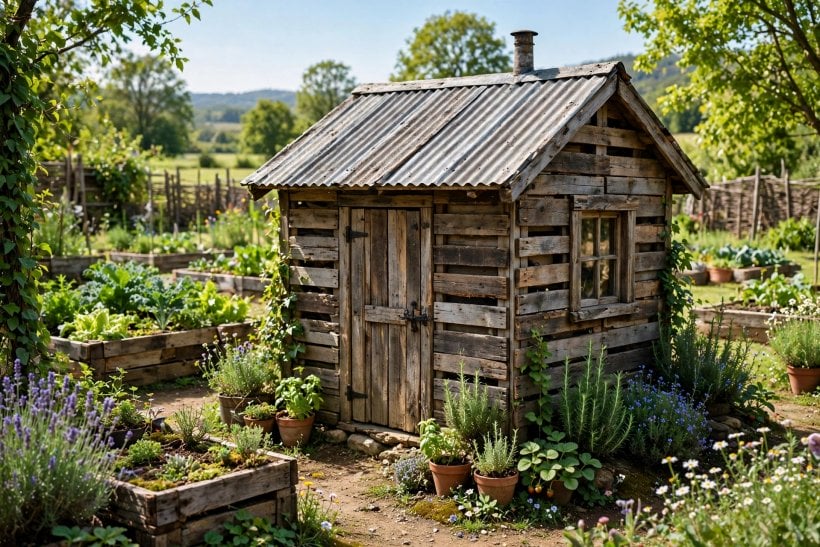
What pallets genuinely can do is supply reclaimed boards: cladding, interior lining, floors in low-duty areas, furniture, fittings and a hundred details — over and inside a frame that is designed and built to carry the house properly. That is the build this guide describes, and it is not a consolation prize: the pallet wood is the visible soul of such a house, the part everyone photographs. The frame is a morning’s conversation with standard materials and, where the house will be lived in, a professional’s eye. Our broader guide to how to make a tiny house shows the standard sequence this build follows.
2. Know Your Pallets: Stamps, Treatments and What to Reject
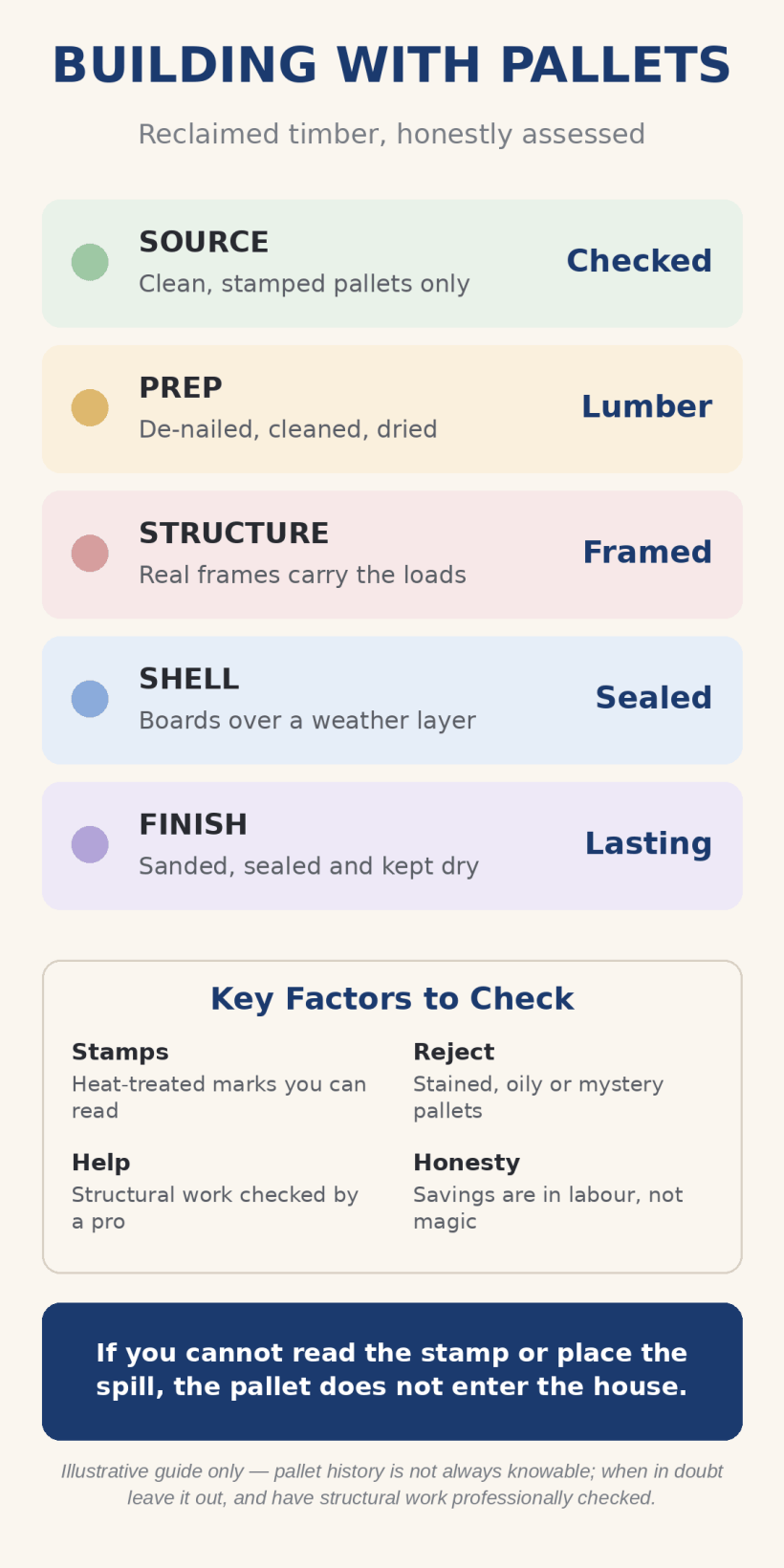
Safety starts with the stamp. Pallets that travel internationally are treated against pests, and the treatment mark is branded or stencilled on the wood. The marks you want indicate heat treatment — the wood was heated to kill pests, a physical process that leaves nothing chemical behind. Marks indicating chemical fumigation exist too, historically involving methyl bromide, and a pallet carrying one does not enter a home build. Learn to recognise the stamp styles before you source, from the pallet industry’s own published guides.
Then apply the harder rule: a pallet whose history you cannot read is a pallet you reject. Oil-soaked wood, chemical staining, a smell you cannot identify, spills from unknown cargo — any of these ends the conversation, however free the pallet. Unmarked pallets are not automatically dangerous, but for the parts of a house you will breathe beside for years, “probably fine” is not a standard. When in doubt, leave it out: the supply of clean, stamped, boring pallets from known light-duty goods is large enough that no project needs a questionable one.
3. Sourcing Without Regrets
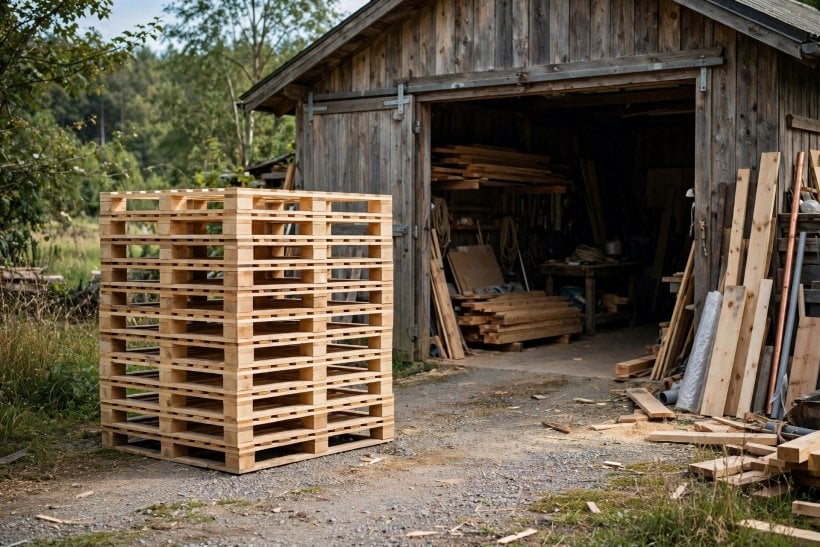
The best sources are businesses with clean, consistent goods: warehouses, garden centres, tile and appliance shops — places whose pallets carried dry, harmless freight and were stacked neatly out of the weather. Always ask. Pallets have owners, deposits and return schemes attached to them more often than the internet admits, and the asking is also how you learn what the pallet carried — the single most valuable fact about it.
Collect gradually and be picky from the first day; a uniform stock of sound boards in one or two sizes is worth far more than a mountain of mixed salvage. Expect a meaningful share of everything you gather to be rejected at sorting — cracked stringers, twisted boards, the mystery stain you spot in daylight. That rejection rate is not waste; it is the quality control that makes the finished house trustworthy, and planning for it is why experienced pallet builders always gather more than the drawings say.
4. The Prep Work: Turning Pallets Into Lumber
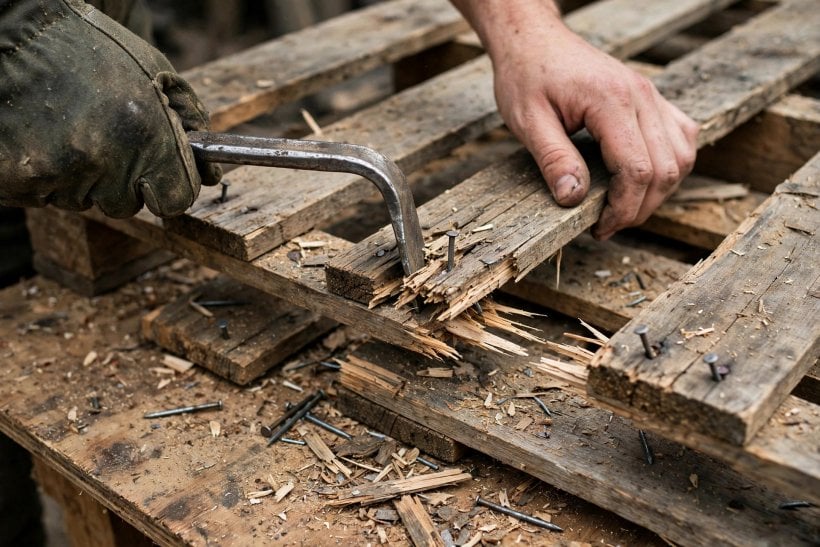
Preparation is where pallet building spends its hours. Each pallet must be broken down or cleaned up, every board de-nailed — the spiral nails pallets use are famously stubborn — then sorted by soundness, cleaned, and dried. Boards for interior use get sanded and checked for splinters and hidden metal; a missed nail fragment is a ruined saw blade or a worse accident later. Work with gloves and eye protection throughout: pallet yards and old pallets alike are full of staples, splinters and tetanus-friendly rust.
Expect the workbench stages to teach you your real rejection standard. The first pallet you dismantle, every board looks usable; by the twentieth, your eye rejects twist, shake and hidden splits on sight. That educated eye is the project’s true foundation, and it is why the advice to start with furniture — a bench, a planter, a porch deck — before touching the house itself is so often given: it trains the sorting instinct on objects whose failure costs nothing.
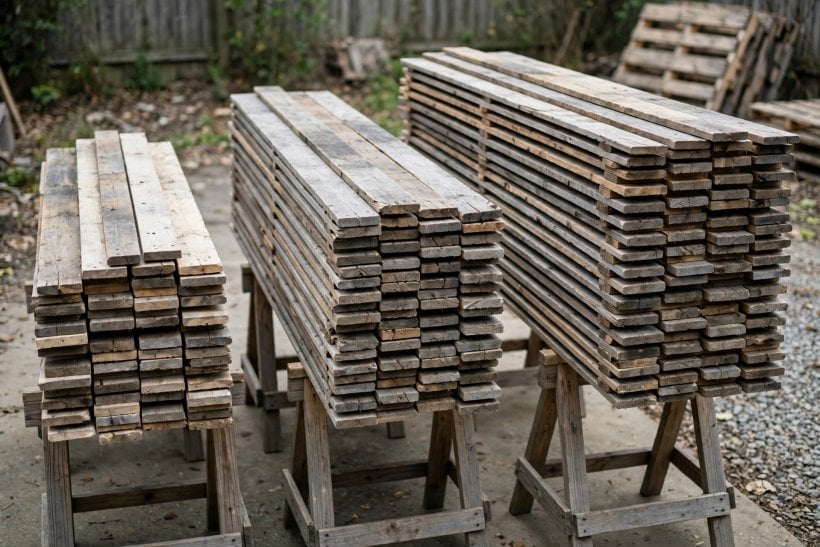
None of this is skilled work, but all of it is slow, and honesty about that slowness belongs in your plan: the lumber is nearly free because the labour is entirely yours. Stack prepared boards stickered and under cover so air can move through them while they dry to indoor moisture levels; building with damp reclaimed wood invites the movement, gaps and mould that give pallet houses a bad name they do not deserve.
5. Structure: The Frame Is Not Made of Pallets
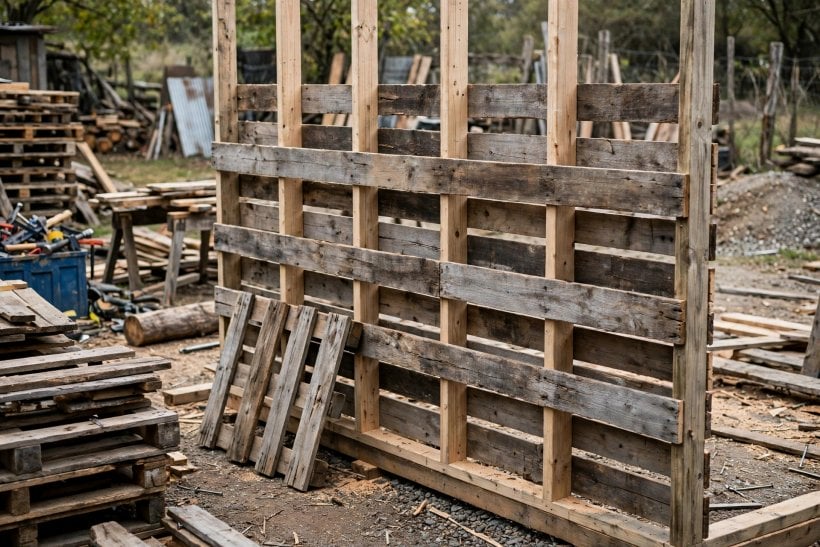
This is the section the dream resists, so it gets its own heading: the load-bearing frame of a house people sleep in should be proper structural material, designed for the loads — new or graded reclaimed timber of known section, on a sound base, following your plan. That is not snobbery about pallets; it is the same rule this site applies to every build, and the reason is simple: a frame’s failures are hidden, delayed and occasionally catastrophic, and pallet boards bring unknown grade, unknown history and nail-torn fibres to exactly the job that tolerates none of those.
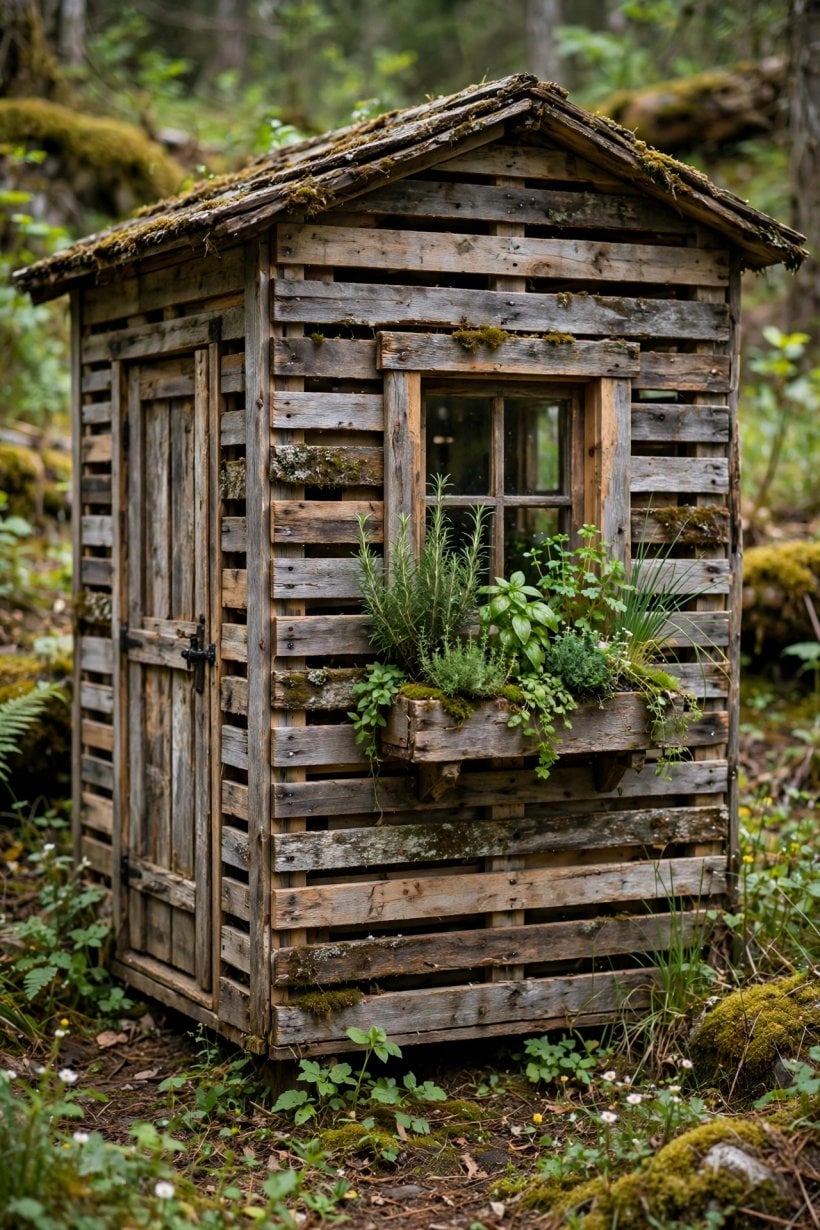
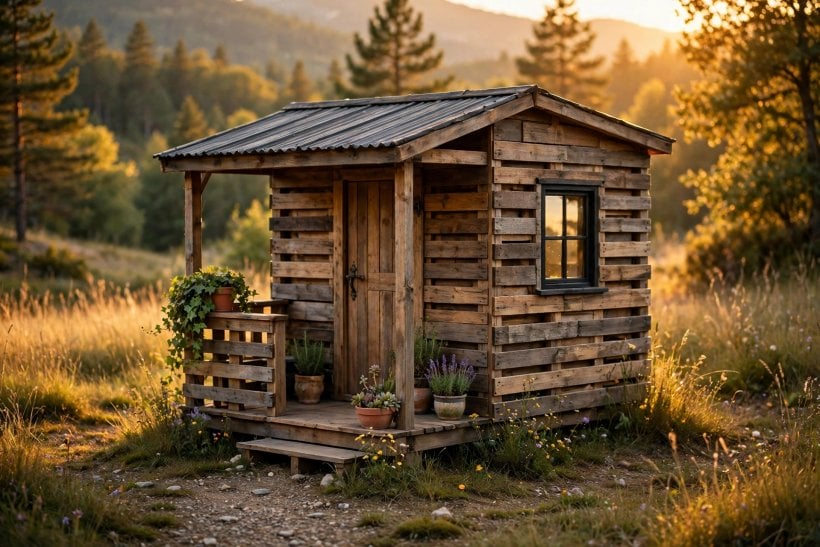
Within that rule, your pallet wood still does heroic work: it can sheath and clad the frame, line every interior wall, floor the loft, and build the furniture, the kitchen and the porch. If your project is a garden studio, a playhouse or an outbuilding rather than a dwelling, the structural stakes fall — but permits and common sense still apply, and anything people sleep under deserves the professional check. Whether you can take on the wider build is the question our guide to building your own tiny house answers honestly, and our step-by-step on how to build a tiny house shows the standard construction your frame should follow; plans drawn for standard materials — including the DIY-friendly tiny house plans and the wider tiny house floor plans library — adapt to a pallet finish far better than pallet improvisation adapts to a plan.
6. Shell and Weather: Boards Over a Proper Layer
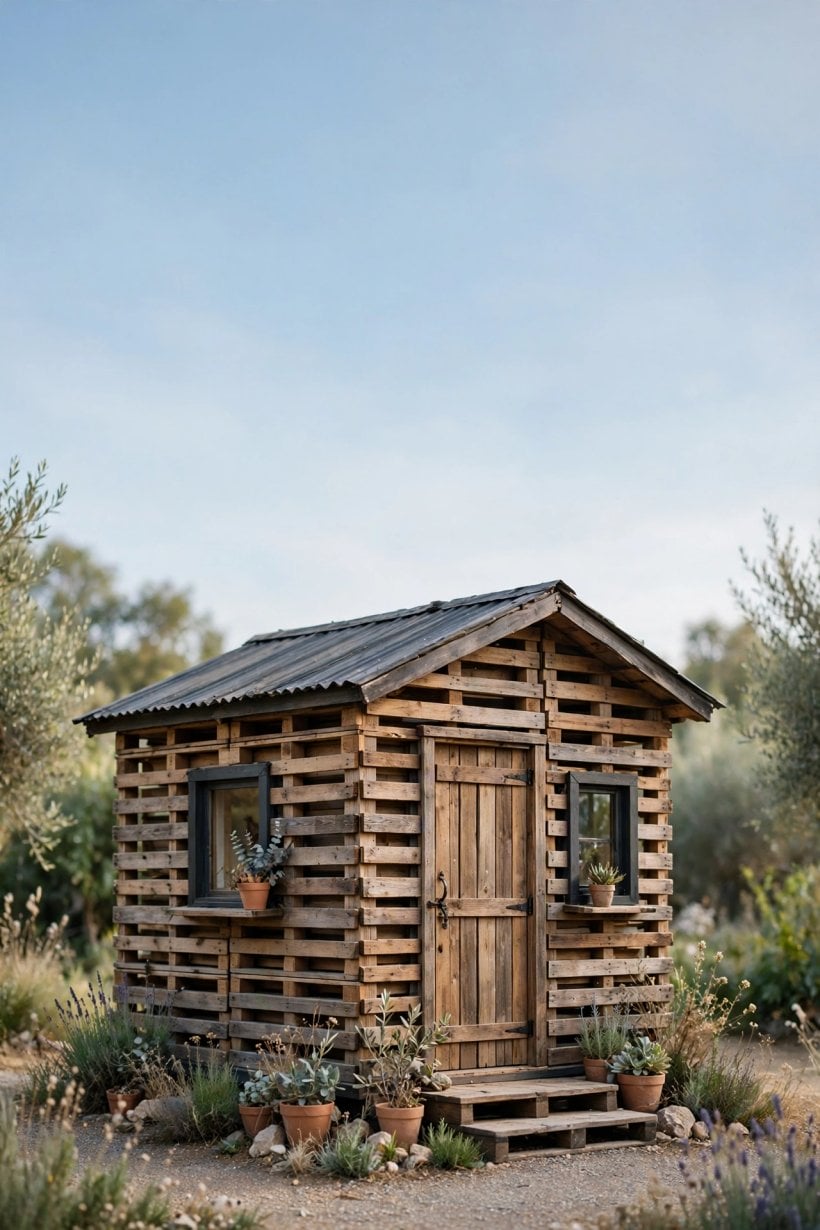
Pallet boards as exterior cladding have one charming flaw: they are slatted, gappy and uneven, which is to say they are not a weather layer. Rain will pass them, wind will whistle through them, and that is fine — provided the real weather defence, the wrapped and sealed shell behind them, was built as carefully as on any other house. Treat pallet cladding as the visible rain screen and character of the house, never as its waterproofing.
The same honesty applies to insulation and draught-proofing: those live in the wall build-up behind the boards, done with ordinary materials in the ordinary way. Get the shell right and the pallet exterior becomes pure pleasure — replaceable board by board, ageing gracefully, and repairable with material that costs nothing but the prep. Get it wrong, and no quantity of reclaimed charm will keep the wall dry.
7. The Interior: Where Pallet Wood Shines
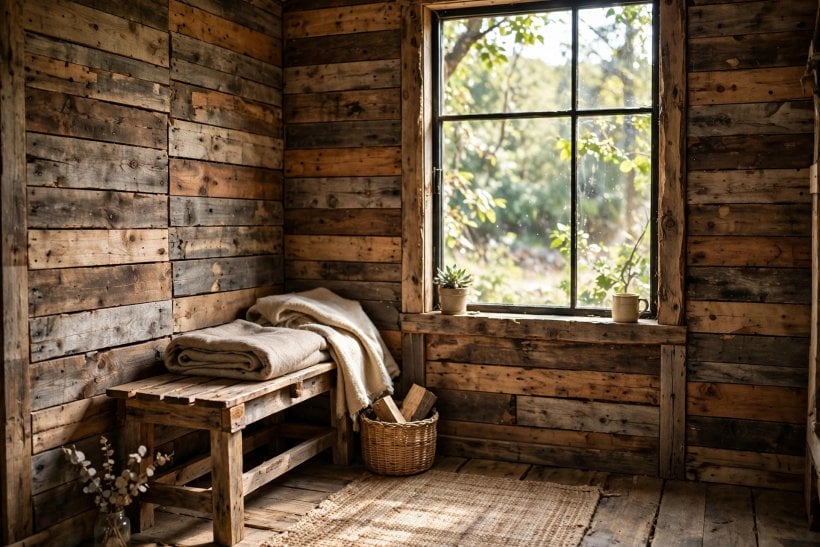
Inside, the case for pallets needs no caveats. Lined walls of sanded, sealed reclaimed boards give a tiny house a warmth no bought panel matches, and every board’s stamps, scars and grain are the decoration. Kitchen carcasses, shelving, bed bases, stairs treads, doors and the porch deck are all fair work for sound pallet timber, chosen board by board for the duty each piece will do.
Keep a small reserve of your best spare boards after the build, stored dry with the house’s papers. Reclaimed stock is unrepeatable — the exact tone and stamp of your walls will never be on sale again — and a board-for-board match is what lets a future repair disappear instead of announcing itself. It is the cheapest insurance the project offers, and it costs one dry corner of storage.
Finish interior wood properly: sanded smooth, sealed against the steam and splashes of tiny living, and fixed so individual boards can be replaced. Choose your sealant for a lived-in interior and let it cure fully before you move in. This is also where the budget quietly wins — the interior is the most visible and most expensive-feeling part of a tiny house, and yours is built from the material everyone else threw away.
8. Permission, Insurance and the Paper Problem
Here is the pitfall nobody puts in the videos: a house substantially built from reclaimed materials can be hard to permit, certify, insure and sell, because every official question — what grade is this timber, what standard does this wall meet — meets a shrug. Dwellings in most places must satisfy building rules that assume graded materials, and an inspector cannot grade your wall’s history by looking at it. A pallet-clad, pallet-lined house over a standard, inspected frame keeps the paper world calm; a structurally-pallet house invites it to say no.
Ask early. Talk to your local building office about the project in its real form before the build, and to an insurer before you need one. Some contexts — rural outbuildings, non-dwelling cabins, places with lighter rules for small structures — are far friendlier than others, and discovering yours in advance is the difference between a charming build and an uninsurable one. The comparison of routes in our guide to prefab versus DIY costs is a useful cold shower at this stage too.
9. What It Really Costs: The Money and the Hours
The pallet house’s famous cheapness is real but lopsided. The boards cost almost nothing — and the trailer or foundation, roof, windows, insulation, systems, fixings, finishes and fees cost exactly what they cost on any other tiny house, because they are the same products. This guide prints no total, because yours depends on how much of the house is pallet and how much is catalogue; but expect the saving to live in the cladding, lining and furniture lines of the budget, not in the whole of it.
The true currency is time: sourcing, sorting, de-nailing, sanding and fitting reclaimed boards takes multiples of the hours that bought boards take, and the build calendar stretches to match. Price your own hours honestly — even at zero, they are a finite resource the project will spend freely if you let it. Builders who finish pallet houses are the ones who planned for the prep like a second job, because it is one.
10. Frequently Asked Questions
How do you build a tiny house out of pallets?
Build the house the standard way — base, proper frame, sealed shell, certified systems — and let pallet wood do the work it is good at: cladding, lining, floors in light-duty areas, furniture and fittings. Source only clean, heat-treated stamped pallets, prepare the boards thoroughly, and have any structure people sleep under properly designed and checked.
Are pallets safe to build with?
The right pallets are: those marked as heat-treated, clean, dry and from known harmless freight. Reject chemically-treated marks, oil or chemical staining, and anything whose history you cannot establish. For wood that will line the rooms you breathe in, that caution is the whole answer — when in doubt, leave it out.
How many pallets do I need for a tiny house?
There is no standard count — it depends on the house size, how much of it is pallet-finished, and your rejection rate at sorting. Work it out from a material list for the areas you are cladding and lining, then gather generously beyond it; a meaningful share of collected boards will not make the grade, and running short mid-wall is worse than a spare stack.
Can a pallet tiny house be permitted?
It depends on the build’s form and your local rules. A standard, inspectable frame with pallet cladding and lining is a far easier conversation than a structurally pallet house, because officials need graded, knowable materials where loads are carried. Ask your building office about your actual design before you build, not after.
How much does a pallet tiny house cost?
Less in boards, the same in almost everything else: base, roof, windows, systems and fees are ordinary products at ordinary prices. The real spend is your time in sourcing and preparation. Budget the non-pallet parts at full price, count the pallet parts as your labour, and the total will surprise you less.
Where can I get free pallets?
Ask at warehouses, garden centres and shops receiving clean, dry goods — and always ask, both for permission and to learn what the pallets carried. Favour sources with consistent, tidy stock over random giveaways; a known history is worth more than a shorter drive.
Do I need special tools for pallet lumber?
Mostly the standard kit plus the de-nailing armoury: a pry bar suited to pallets, a punch for driving out the stubborn spiral nails, and the patience to use both. Add a metal check before any board meets a powered blade — reclaimed wood hides fragments that destroy edges and can injure.
Final Considerations
Build with pallets for the right reasons — the look, the thrift, the satisfaction of rescue — and the project can be the most characterful tiny house on the road. Build with them under the honest rules — stamped and clean or rejected, a real frame carrying the loads, professionals and paperwork respected — and it can also be a sound one. The romance survives the honesty easily; it is only the shortcuts that do not. This guide is general information only, not building or legal advice.


0 Comments