

In a tiny house, decorating is never just decoration. With so little room to spare, the layout is the decor and every object has to earn its place — a cushion is also a colour decision, a shelf is also storage, and a mirror is also a window’s worth of borrowed light. This guide shows how to make every one of those choices deliberately.
Tiny House Interior Design Ideas: At a Glance
In the tiny house, design and decorating are one discipline: the structure you build and the layer you style cannot be separated, because every object is both. This guide works through the whole craft in the order a home comes together — the principles first, then walls and shelves, textiles and surfaces, the sleeping, bathing and cooking corners, seasonal change, handmade and vintage pieces, and finally the plants, books and small rituals that make a small space feel collected rather than cramped. The thread running through all of it is curation: fewer objects, better chosen, each one telling part of your story.
| Topic | What It Covers | Key Fact or Figure |
|---|---|---|
| 1. One Discipline | Why design and decorating merge in a tiny house | Every object is design — nothing is only decoration |
| 2. Walls and Gallery Walls | Art, mirrors and the composed grouping | Hang the group’s centre at 57 inches |
| 3. Shelf Styling | Groups of three, varied heights, breathing room | The styled shelf is functional art |
| 4. Textile Decorating | Cushions, throws, rugs and curtains | Textiles are the fastest refresh there is |
| 5. Entryway and Surfaces | The welcome, and styled tables that still work | Keep 30% of every styled surface clear |
| 6. Bedroom and Loft | Layered bedding, calm art and warm light | The bedroom decorates for rest |
| 7. Bathroom and Kitchen | Small luxuries and functional beauty | Decor that works for its place |
| 8. Seasonal and Weekend Refresh | Swaps, natural finds and the two-day reset | A full refresh costs $0–$100 |
| 9. DIY and Vintage | Handmade pieces and secondhand character | Patina is the story new pieces lack |
| 10. The Collected Home | Plants, books, scent and the rules that hold | 10–15 meaningful objects beat 50 knickknacks |
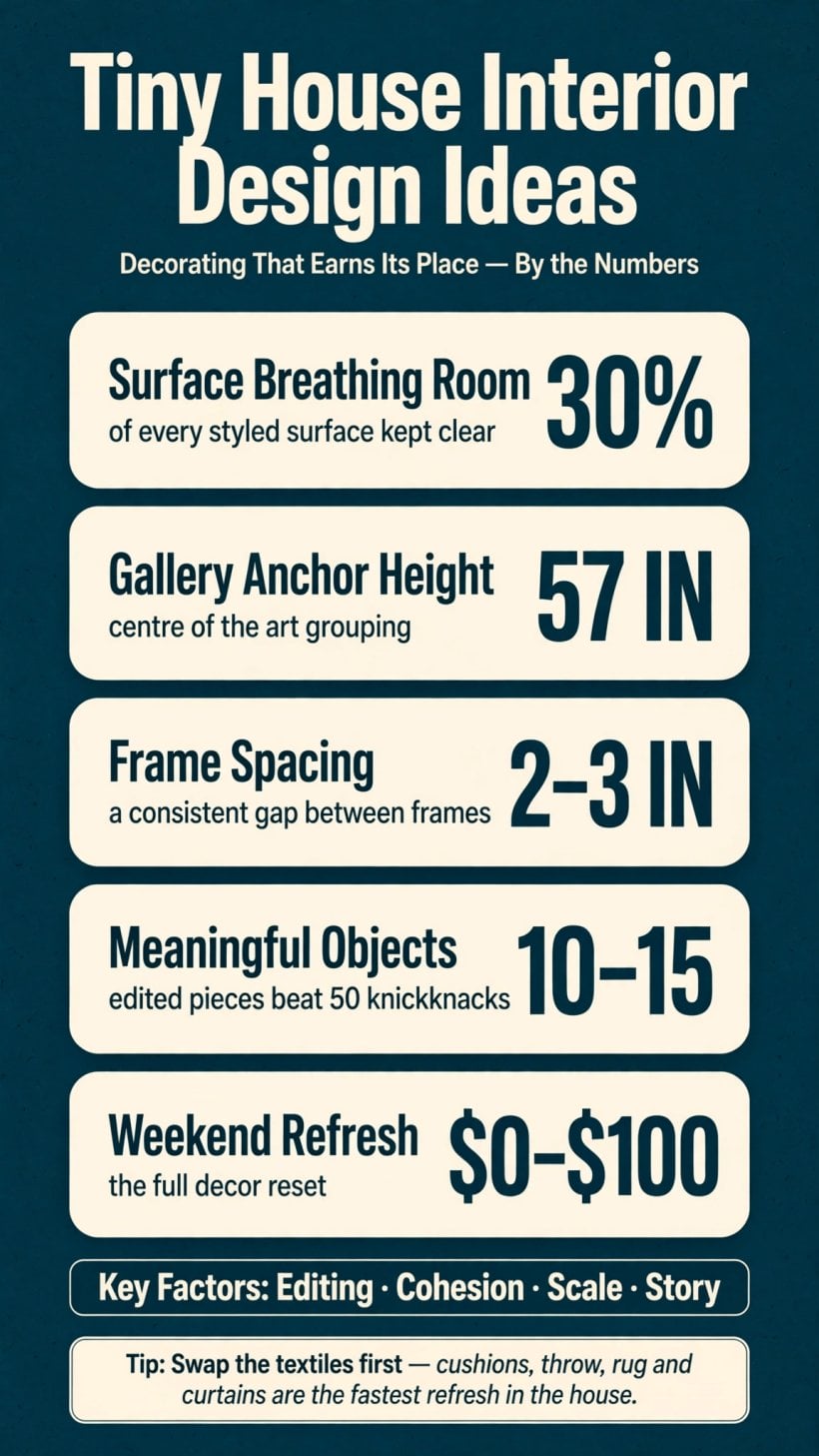
Decorating by the numbers: keep 30% of every styled surface clear, hang a gallery group’s centre at 57 inches with 2–3 inches between frames, edit down to 10–15 meaningful objects — and refresh the whole home for $0–$100.
1. Design vs. Decorating: One Discipline in a Tiny House
In a conventional house, design and decorating are separate trades. The design is the structure — the layout, the built-ins, the palette fixed to walls and floors. The decorating is the layer applied afterwards — the objects, the textiles, the art. A tiny house collapses the two into one discipline, because there is no spare volume in which a purely decorative object can hide. The sofa is the room’s largest colour block. The shelf is both storage and display. The rug is both softness underfoot and the line that zones the living area from the kitchen.
That merger is why the best tiny house interior design ideas begin with five principles rather than a shopping list. Less, but better: an edited few quality pieces instead of many ordinary ones. Cohesion: one palette and one story told through the whole home, so the eye travels without jolts. Honest scale: pieces sized to the space, neither dollhouse-small nor apartment-large. Function: the beautiful that also works, doubling wherever it can. And personality: the objects that carry your story, because a tiny house decorated from a catalogue page belongs to nobody. The pull toward editing is explored further in our guide to minimal interior design ideas for tiny houses, where the same principles are stripped to their essentials.
2. Wall Decor and the Gallery Wall
Walls are the largest free surface a tiny house offers, and they should tell the story. There are four honest ways to dress them. A curated gallery of personal pieces — art, photographs, objects — collected over time. One statement piece, a single focal work that anchors the room. A mirror, which expands the space and throws light into corners it would never otherwise reach. And open shelves, where the display is the storage, styled rather than stacked.

The gallery wall deserves its own method, because it is the tiny home’s museum and the easiest thing to get wrong. Plan it on paper first: cut templates the size of each frame, tape them to the wall, and live with the arrangement before a single nail goes in. Mix art, photos and small objects rather than matching prints in a row. Decide whether the frames will be cohesive — one finish, one material — or deliberately eclectic, and then commit. Keep the spacing consistent at 2–3 inches between frames, and hang the grouping so its centre sits at 57 inches, the eye-level anchor that makes a wall feel composed rather than scattered. Choose the art itself personally first — the pieces you love, scaled honestly (not too small), beat five fillers every time. One statement beats a crowd; a collected wall beats a bought set.
3. Shelf Styling: Functional Art
The styled shelf is the tiny house’s signature piece of furniture — storage that is also the art. The method is simple and strict. Group in threes: a tall piece, a medium piece and a low piece read as a composed still life where a row of equals reads as inventory. Vary the heights so the eye moves in rhythm rather than scanning a shelf of sameness. Then edit for breathing room — the empty space between groups is not wasted, it is what makes the objects visible at all.
Keep the personal in front: the meaningful object, the travelled souvenir, the inherited piece, because a shelf of anonymous decor is a shelf that says nothing. This applies doubly to open kitchen shelves, where the styled and the stored are literally the same objects — jars, bowls and boards arranged with the same rule of three. A styled shelf is never finished once; it is re-edited as pieces arrive and leave, one in and one out, so the display stays a portrait of the household rather than a backlog of it.
4. Textile Decorating: The Fastest Refresh
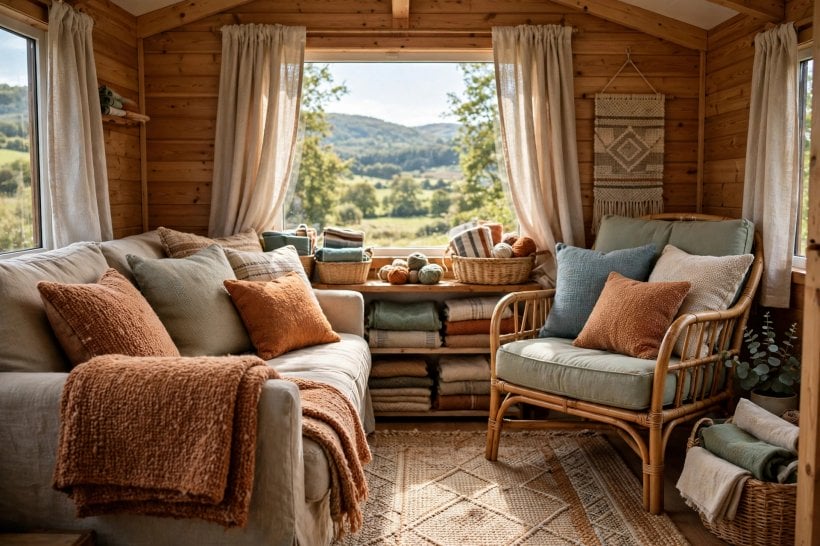
When a tiny house feels tired, the answer is almost never new furniture — it is fabric. Textiles are the fastest, cheapest and most reversible decorating layer there is. Cushions change the palette of a seating area in minutes and swap with the seasons. A throw adds texture and the suggestion of cosiness wherever it is draped. A rug anchors a zone, drawing the boundary of the living area on an open floor more clearly than any partition. Curtains soften the hard lines of a small room and frame its light.
Because the layer is changeable, it is also where colour courage belongs. A palette that would overwhelm on walls — deep rust, forest green, ochre — can live happily in cushions and a throw for a season and leave without a trace. Coordinate the textiles with each other and with the fixed palette, and the whole home reads as pulled together; let them fight, and even a well-built room feels restless. In the kitchen, the same trick works at smaller scale: coordinated towels and a runner carry the scheme into the room where hard surfaces rule. Store the off-season set, rotate it back in, and the house feels newly decorated twice a year for the price of storage space alone.
5. The Entryway and the Styled Surface
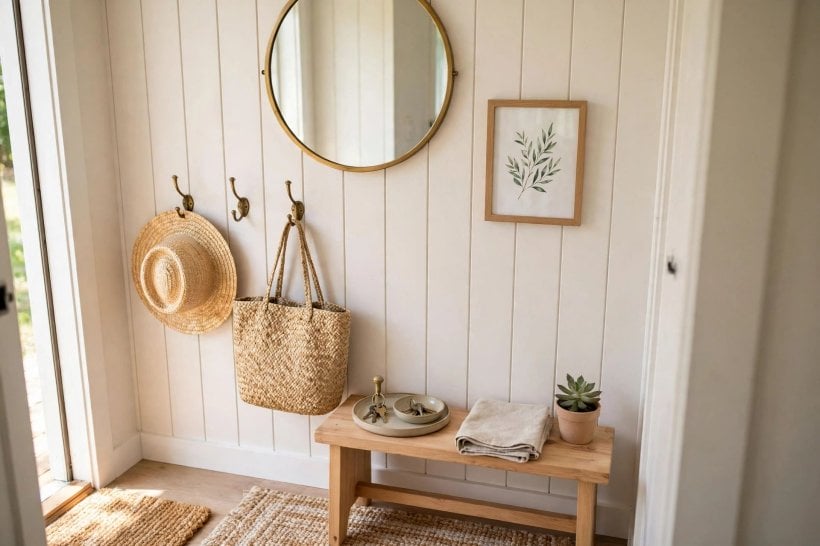
The entryway is the first impression, and in a tiny house it may be no more than a wall beside the door — which makes every centimetre of it count. Four pieces do the whole job: a mirror, for the last check on the way out and the light it lends the corner; beautiful hooks, functional first and decorative by the same gesture; a tray, the catch-all that keeps keys and post organised instead of scattered; and one piece of art, the welcome that tells a guest whose home this is.
Surfaces throughout the home follow the same edited logic as the entryway. A coffee table styles well with four elements: a tray to corral the small things, a stack of loved books, one sculptural object, and something green and alive. The rule that keeps it honest is the 30% rule: at least 30% of every styled surface stays clear, because a surface that cannot hold a cup of tea is not styled, it is occupied. The same applies to the work corner — the desk that earns its footprint by day and reads as part of the room by night, as in our home office design ideas for tiny houses. And the wider living space these surfaces sit in gets the full treatment in our living room interior design ideas for tiny houses.
6. Bedroom and Loft Decor: Decorating for Calm
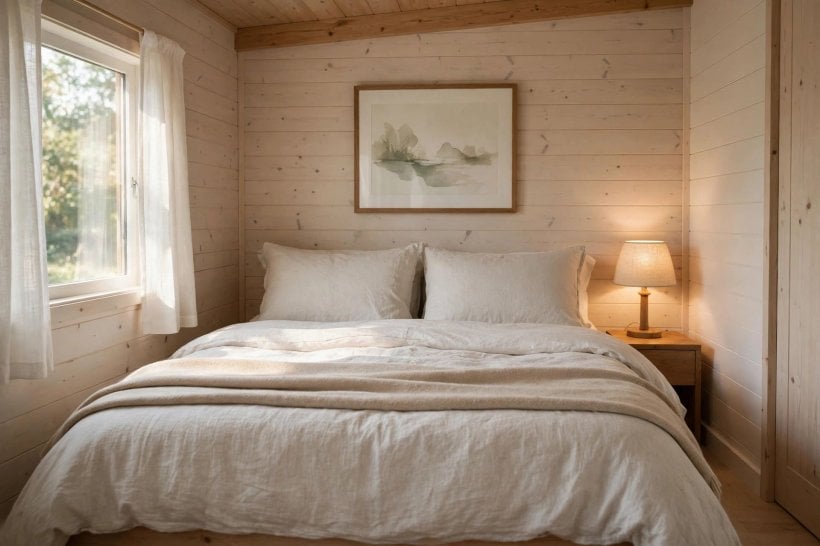
The bedroom’s job is rest, so its decor decorates calm. The bedding is the room: layered, inviting, the largest textile statement in the home, built from the palette rather than despite it. Above the bed, one focal piece of art — the wall everyone sees first and last. At the bedside, warm light, low and soft, because overhead glare is the enemy of the wind-down. And beneath it all, the edit: a serene room is an emptied one, with the day’s clutter given somewhere else to live.
The sleeping loft follows the same rules with one twist: it is visible from below, so it decorates in public. The bedding becomes the focal point of the whole home’s view, the art goes small and angled to be read from underneath, and string lights give the loft its cosy glow without fixtures the low ceiling cannot take. Treat the loft as a designed room seen through a frame, not a bunk, and it stops being the home’s apology and becomes its postcard. For a room-by-room deep dive into the sleeping space, see our guide to tiny house bedroom decor and styling ideas.
7. Bathroom and Kitchen: The Small Luxury, the Working Beauty
The bathroom decorates with small luxuries, daily ones. Coordinated towels turn the room spa-like for the price of a matching set. A humidity-loving plant thrives where other rooms’ plants sulk, and brings the alive note into the smallest room in the house. One small, unexpected piece of art — bathrooms are the most under-decorated room in most homes, which is exactly why a framed print lands there with such charm. And storage that is beautiful as well as functional, because in a tiny bathroom the storage is always on show. The layouts and fittings underneath the decor are covered in our tiny house bathroom designs.
The kitchen decorates functional: beauty that works. Open shelves styled and curated, with the everyday dishes as the display. A bowl of fruit — the alive centrepiece that restocks itself. One small piece of art for charm among the hard surfaces. Textiles coordinated with the home’s palette so the room reads as part of the whole. Nothing in a tiny kitchen can afford to be only pretty, so the decorating succeeds when the prettiest things in it are also the most used. Our dedicated kitchen design ideas for tiny houses and small spaces take the room from layout to finishing touches.
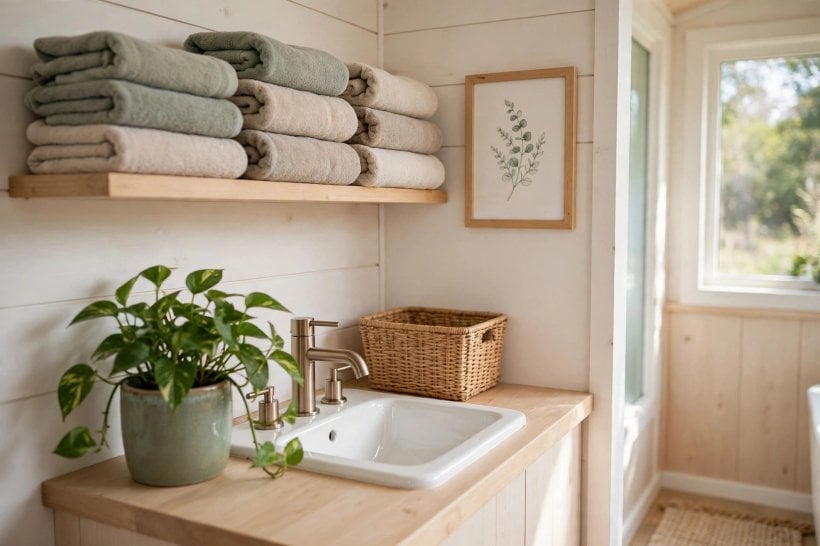
8. Seasonal Decorating and the Weekend Refresh
A tiny house that never changes starts to feel like a showroom; the seasons are the excuse to keep it alive. The seasonal swap works through the textile layer first — cushions, throw, rug, curtains — then the natural layer: branches, pine, whatever the season drops for free. In winter, light does the decorating, candles standing in for the sun. The discipline is restraint and storage: the tiny house edits its seasons rather than accumulating them, and the stored box of off-season pieces is the whole footprint the habit is allowed.
When the whole home needs the reset at once, the original weekend method still works beautifully. Saturday morning is the edit — things come out, and the brave version removes 10 things. Saturday afternoon is the rearrange, the $0 transformation, furniture and objects finding better places. Sunday morning is the textile swap, the one paid step, around $100 for the full set. Sunday afternoon is the styling — shelves recomposed, surfaces cleared to their 30%, art re-hung. The total cost runs $0–$100, and by Sunday evening the result is the new house feeling, achieved without buying a single piece of furniture. The fastest refresh of all remains the textile swap alone: one afternoon, the layers changed, the home reborn.
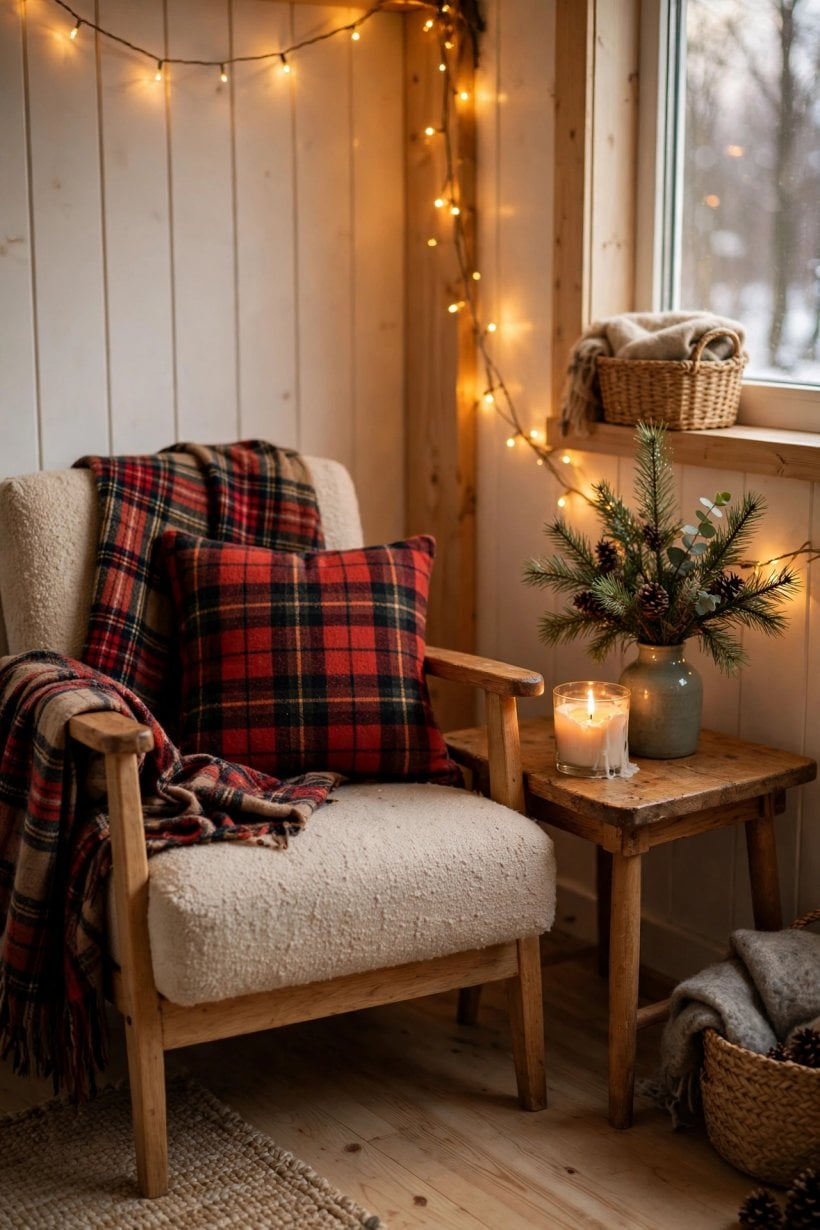
9. DIY and Vintage: The Personal Layers
Handmade decor decorates deepest, because it carries the maker’s story in a way nothing bought can. The projects scale to tiny houses naturally: handmade art sized exactly for the wall it will hang on; frames built to fit the awkward dimensions stock frames never match; textiles sewn to coordinate precisely with the palette; shelves installed where the space actually is, not where a flat-pack expects it to be. A home furnished partly by its owner’s hands is a home that could belong to no one else.
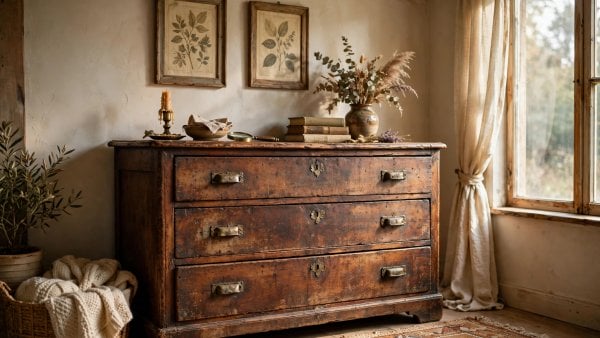
Vintage and secondhand pieces do the same work from the other direction — their story predates you. The hunt turns up quality at prices new pieces cannot touch, and the patina on a genuinely old object is character that no distressing technique fakes convincingly. The mix is the method: old with new, the collected look, eras layered the way a life layers them. Budget decorating leans on both layers at once — the secondhand hunt, the DIY project, the natural find, the rearrange — and discovers what the original guide insisted: the constraint creates the style, and the budget home usually ends up the most personal one in the street.
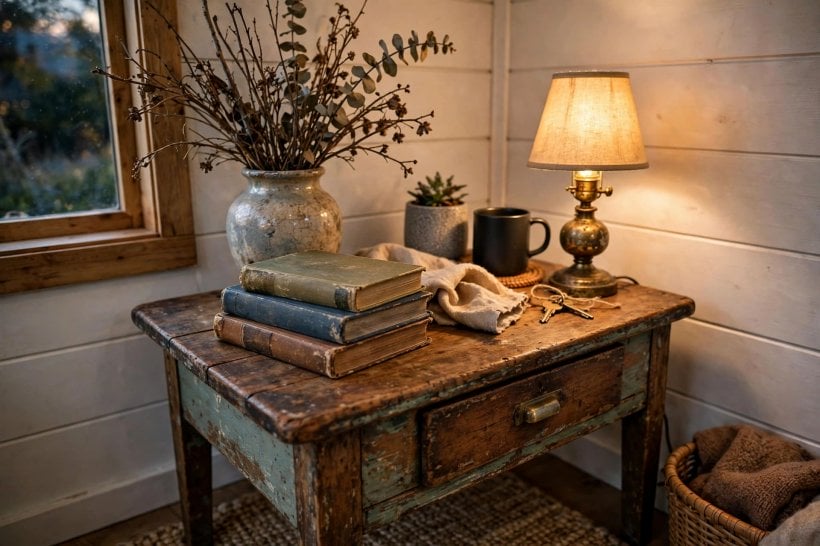
10. Plants, the Collected Home, and the Rules That Hold
Plants are the living decor, and styled properly they behave like it: grouped in composed clusters rather than scattered singly, in coordinated pots that keep the palette intact, at varied heights for rhythm, and placed by the light they need to survive rather than the corner that happens to be empty. Books and objects work the same way — the loved ones displayed, rotated seasonally to stay fresh, telling any guest exactly who reads and lives here. And decorating is multisensory: the scent of a candle or diffuser and the sound of music in the room are the invisible layer, often the most powerful one, because they are felt rather than seen.
Over years, this is how the collected home assembles itself — travel souvenirs, heirlooms honoured rather than stored, eras mixed — until the home decorates itself and the owner’s job is only editing. The mistakes to avoid are the mirror image of the method: too much, and the calm is lost to clutter; too small, and pieces turn dinky and disappear; too matchy, and the home becomes a showroom; too trendy, and it dates at speed; too impersonal, and it could be a catalogue photograph. The ten commandments compress the whole guide: every object earns its place; cohesion over collection; scale honestly; function first, beauty always; edit ruthlessly; personal over perfect; textiles refresh fastest; walls tell the story; less is the luxury; and live with it — the rule from which the other nine follow. Professional eyes, when you want them, apply the same framework, as our tiny house interior designer guide explains.
Final Considerations
The best tiny house interior design ideas are not really about objects at all — they are about intention. Every piece chosen, every surface considered, every corner telling the story of the people who live there: curate rather than accumulate, keep the edited 10–15 meaningful pieces over the 50 knickknacks, refresh with textiles and seasons instead of shopping, and let the home gather itself over time. Less, better, personal — a tiny house decorated that way is not a compromise on a bigger home. It is the most personal home of all.


0 Comments