

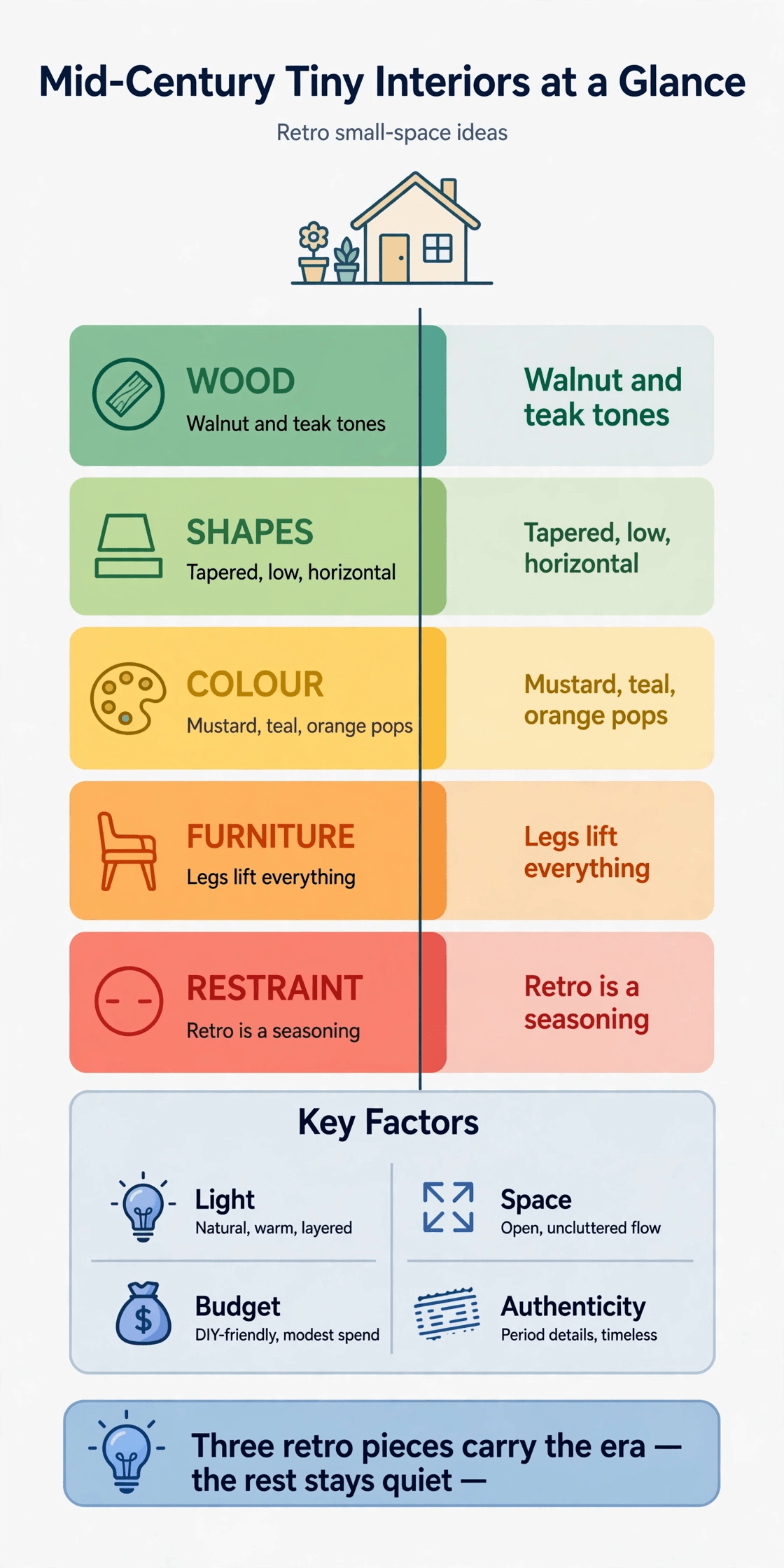
A mid century tiny house interior takes the design language of the post-war decades — warm walnut and teak tones, low horizontal furniture on tapered legs, and confident pops of mustard, teal, and orange — and discovers that it was almost designed for small spaces. Mid-century furniture was made for modest new homes and apartments, so its scale, its raised legs, and its unfussy storage suit a tiny footprint better than most styles that came after. The low lines leave the upper half of a small room empty, which is exactly where a tiny home keeps its sense of air.
This guide gathers eighteen ways to use that language without turning your home into a film set. It works in the order the style itself is built: wood tones first, then silhouette, then the famous accent colours, furniture and storage, the kitchen, lighting, the bathroom and bedroom, and finally the discipline that keeps retro as seasoning rather than costume. Everything here is about proportion and repetition, not about hunting original period pieces — the look survives perfectly well on honest modern furniture that borrows the shapes, which is just as well, because a tiny house has no room for fragile antiques.
Mid Century Tiny House Interior Summary: The 18 Ideas at a Glance
| # | Idea | What It Does |
|---|---|---|
| 1 | Walnut and teak tones lead | Sets the warm mid-century base |
| 2 | Wood grain as the pattern | Decoration without extra objects |
| 3 | Low, horizontal lines | Keeps the upper room empty and calm |
| 4 | Tapered legs everywhere | Lifts furniture and shows the floor |
| 5 | Mustard as the warm pop | Sunshine in small, moveable doses |
| 6 | Teal as the cool pop | Depth against the warm wood |
| 7 | Burnt orange, used sparingly | The strongest accent, the smallest dose |
| 8 | Legged, raised furniture | More visible floor, easier cleaning |
| 9 | Credenza-style low storage | A wall of storage that reads as furniture |
| 10 | Two-tone kitchen cabinetry | Wood below, light above |
| 11 | Retro-look appliances, modern inside | The silhouette without the inefficiency |
| 12 | Globe and starburst lighting | Sculpture that earns its ceiling space |
| 13 | One statement clock or mirror | A single piece of wall theatre |
| 14 | Retro pattern in the bathroom tile | Period character in the smallest room |
| 15 | A low platform bed | Sleeping space that keeps the line |
| 16 | Wide windows, sheer curtains | Daylight the way the era intended |
| 17 | Low dividers instead of walls | Zones without losing the open plan |
| 18 | Retro as seasoning, not a theme | The discipline that keeps it liveable |
1. Mid-Century Tiny House Wood Tones: Walnut and Teak First
Idea 1: Let Walnut and Teak Tones Lead
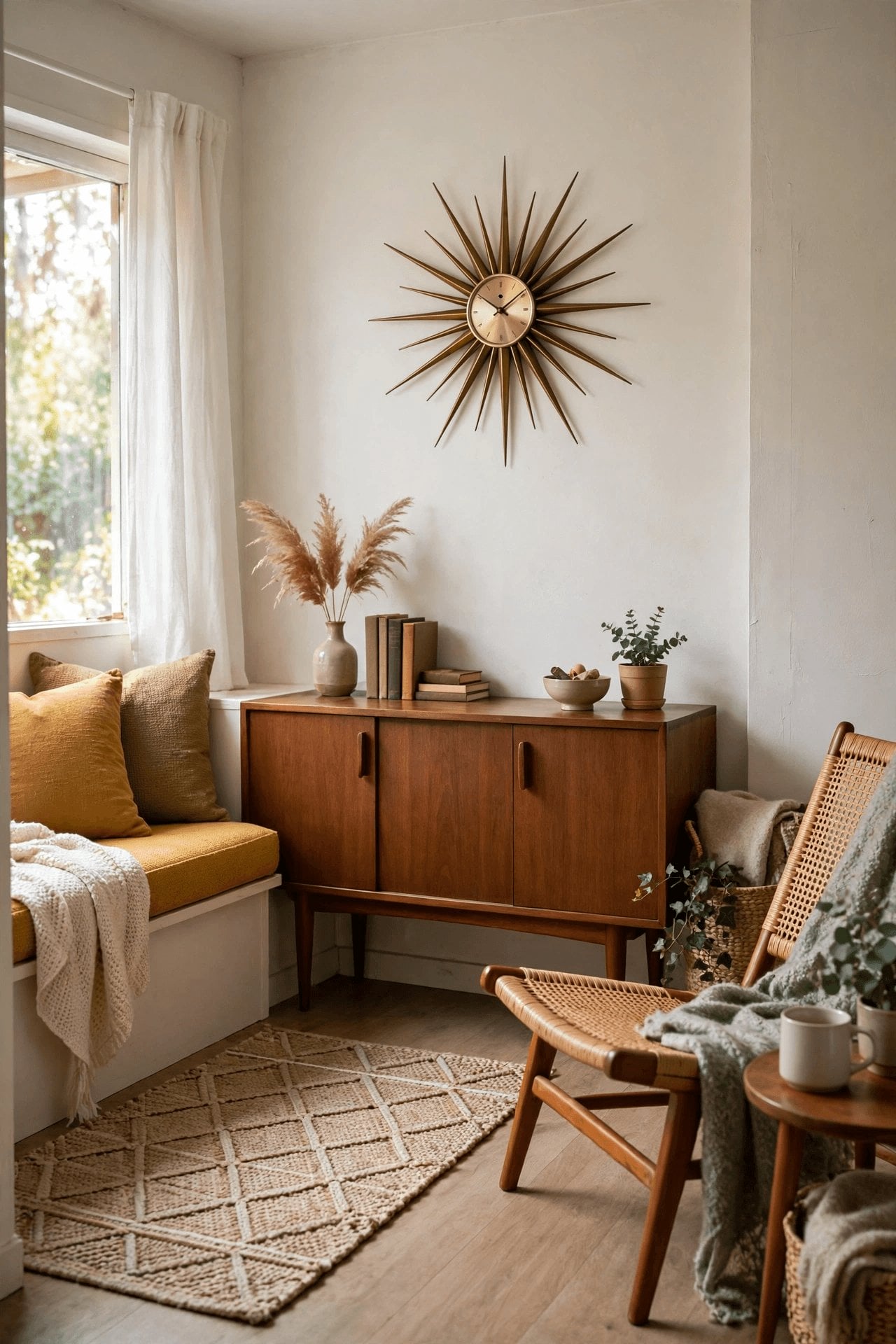
Mid-century warmth starts with wood, specifically the mid-brown, grain-rich tones of walnut and teak. In a tiny house, let those tones cover the biggest furniture surfaces — the storage wall, the table, cabinet fronts — so the room’s base reads warm before a single accent colour arrives. You do not need the genuine vintage timbers; modern veneers and well-chosen finishes in the same tone family deliver the look at a fraction of the weight and cost, which matters in a small build. Keep the tone consistent rather than mixing pale, mid, and dark woods, because a tiny room shows every mismatch at a glance.
Idea 2: Treat Wood Grain as the Room’s Pattern
A small room cannot carry much applied pattern — printed cushions, busy curtains, and feature wallpaper all compete in a space that is always fully in view. Mid-century design solves this elegantly by letting the wood grain be the pattern: long, calm, horizontal grain on cabinet fronts and table tops provides all the visual texture the room needs. Choose pieces where the grain runs consistently, ideally in the same direction along a run of cabinetry, and keep other surfaces plain. The result is a room that feels decorated without a single decorative object, which is precisely the economy a tiny house requires.
2. Mid-Century Tiny House Silhouette: Low Lines and Tapered Legs
Idea 3: Keep Lines Low and Horizontal
The mid-century silhouette is a long, low line: sofas, storage, and tables that stretch horizontally and stay below the room’s midpoint. In a tiny house this is structural good sense, because keeping mass low leaves the upper volume free for light and air, and the room feels wider than its footprint. Build the effect with a low sofa, a long low storage unit, and a table that sits lower than modern standard. The trick works even better paired with vertical volume, as these tiny house plans with high ceilings show — low furniture under a high ceiling is the classic mid-century section drawing, at tiny scale.
Idea 4: Put Tapered Legs on Everything
The tapered, splayed leg is the style’s signature detail, and in a small room it is also a practical device: raising furniture on slim legs reveals the floor beneath, and visible floor is what convinces the eye a room is larger than it is. Choose sofas, chairs, tables, and storage that all stand on legs — ideally in matching wood tones, angled slightly outward in the period manner. A useful side effect is cleaning: a brush or robot vacuum passes under legged furniture, while dust gathers undisturbed under anything that sits on the floor. If a piece must be plinth-based, let it be the only one.
3. Mid-Century Tiny House Colour: Mustard, Teal, and Orange Pops
Idea 5: Use Mustard as the Warm Pop
Mustard is the friendliest of the mid-century accents: warm, sunlit, and forgiving against walnut tones. Use it where colour can be changed cheaply — cushions, a throw, one upholstered chair, curtains — rather than on fixed surfaces. In a tiny room, two or three mustard pieces placed apart from each other read as a deliberate scheme; a single piece reads as an accident. Because the wood base is already warm, mustard needs restraint to avoid a room that feels like late afternoon all day. Pair it with plenty of the pale neutrals in idea 16’s window treatments, and the colour stays cheerful instead of heavy.
Idea 6: Use Teal as the Cool Counterweight
Every warm scheme needs a cool note, and teal is mid-century’s answer: deep enough to hold its own against dark wood, green enough to feel alive next to plants. A teal sofa is the classic move and works in a tiny living area if the rest of the scheme stays quiet; smaller doses — an armchair, cabinet paint inside a niche, bedding — suit more cautious rooms. Teal and mustard together are the era’s signature pairing, but in a small space use them in unequal amounts, roughly two parts of one to one of the other, so they read as a hierarchy rather than a tie.
Idea 7: Dose Burnt Orange the Most Carefully
Burnt orange is the strongest of the three pops and the easiest to overdo; in a tiny room, a little goes a very long way. Think of it as the punctuation mark: one cushion, a single ceramic piece, the inside of a lampshade, a stripe in a rug. Placed once, it makes the mustard and teal around it look intentional. Placed everywhere, it heats the room visually until the wood tones and the orange merge into one loud note. If you love the colour, let it appear in something seasonal that can rotate out — a throw or a table runner — rather than in paint or upholstery you must live with daily.
4. Mid-Century Tiny House Furniture: Raised, Low, and Storing Everything
Idea 8: Choose Legged Furniture That Keeps the Floor Visible
Beyond the tapered-leg detail, the broader principle is furniture that floats. A sofa on legs, a media unit on legs, a bed frame on legs — each one returns a strip of floor to the room and lets light travel underneath, softening shadows at skirting level where small rooms often look cramped. When you shop, photograph pieces from a low angle; if you cannot see under them, they will sit heavily in your small room too. Keep legs consistent in tone across pieces, because at this scale the furniture reads as one family, and a mix of black metal, chrome, and wood legs quickly looks like a jumble sale.
Idea 9: Run a Credenza Along the Longest Wall
The low, long sideboard — the credenza — is mid-century’s great storage invention, and a tiny house can put a wall-length version to serious work: media, linens, tableware, paperwork, and the household’s overflow, all behind sliding or hinged doors at sitting height. Because it is low, its top becomes display and landing space without blocking light or sightlines. Building storage into the base of such units follows the same logic as these tiny house plans with hidden storage: the storage is the furniture. Match its wood tone to idea 1’s palette and it will read as architecture, not furniture at all.
5. Mid-Century Tiny House Kitchen: Two Tones and Gentle Retro
Idea 10: Split the Kitchen Cabinets Into Two Tones
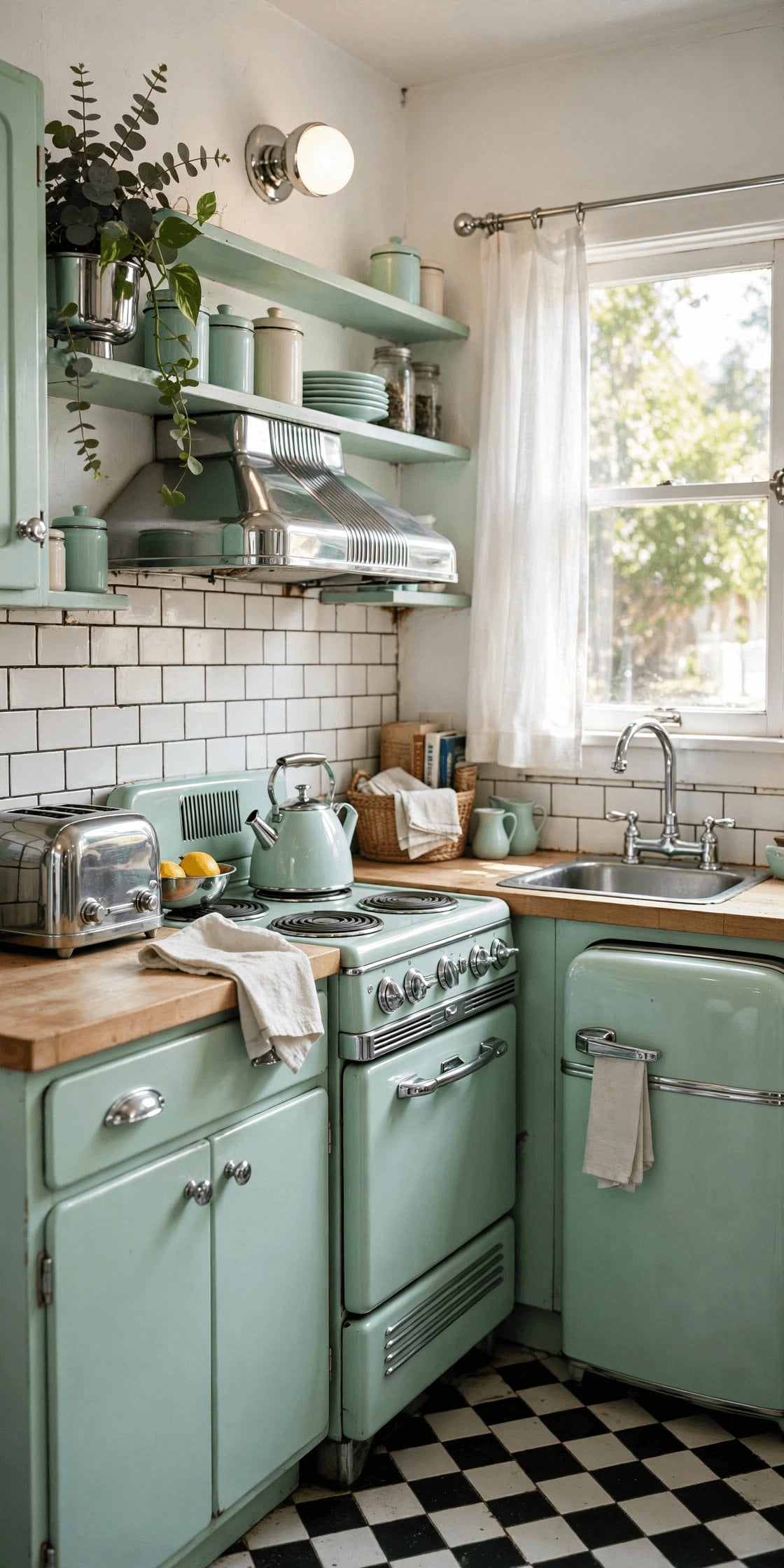
Two-tone cabinetry is a period habit that happens to be perfect for small kitchens: wood-tone or colour below the counter, pale and light above it. The darker, warmer base grounds the room and hides scuffs where feet and bags land, while pale uppers bounce light and stop a full-height run of units from looming over a narrow galley. Carry the splashback in a simple, light finish — plain tiles or a smooth panel from the options surveyed in these lightweight interior wall finishes for tiny houses — and let one accent colour from section 3 appear in a kettle, a stool, or a single open shelf of ceramics.
Idea 11: Choose Retro-Look Appliances With Modern Inners
Rounded corners, pastel or cream enamel, and chrome trim make period-style appliances the fastest kitchen shortcut to the era — and modern versions hide current, efficient engineering behind the silhouette, which is the version a tiny house should buy. A small home runs on limited power and water, so performance matters more than authenticity. Keep the cast small: a fridge and a cooker or hob in the retro style is plenty, with everything else plain and modern, otherwise the kitchen tips from character into theme café. Buy the sizes the kitchen actually fits, and be honest that a statement fridge earns its footprint only if it is also the right capacity.
6. Mid-Century Tiny House Lighting: Globes, Starbursts, and One Statement
Idea 12: Light With Globes and Starbursts
Mid-century lighting is sculpture that happens to glow: opal glass globes, sputnik and starburst pendants, and cone shades on angled arms. A tiny room needs only one sculptural piece — usually the pendant over the table or the room’s centre — supported by plain, warm light elsewhere. Globes are the forgiving choice in small spaces because they spread soft, shadowless light that flatters wood and skin, while starbursts make a stronger, spikier statement and need ceiling height to land properly. Fit dimmers where you can; the same pendant that lights dinner prep should be able to drop to a glow for the evening.
Idea 13: Hang One Statement Clock or Sunburst Mirror
The sunburst clock and the starburst mirror are the era’s wall signatures, and the rule in a tiny house is one — one wall, one statement, nothing competing beside it. A mirror version earns its place doubly in a small room because it returns light and view. Hang it where it reflects a window or the room’s best angle, not a doorway or the kitchen’s working clutter. Everything else on the walls should stay quiet: a couple of framed prints in thin wood frames, or nothing. The discipline sounds strict, but it is what gives the single piece its theatre; three starbursts in one small room is a gift shop.
7. Mid-Century Tiny House Bathroom and Bedroom: Small Rooms, Period Details
Idea 14: Put the Retro Pattern in the Bathroom Tile
If one room can carry pattern, it is the bathroom, because it is small, separate, and visited in short bursts. A geometric period-style tile — on the floor, or one wall of the shower — gives the whole home a mid-century credential without affecting the calm of the living space. Keep the sanitaryware plain and white, the fittings simple, and the wood tone present in a stool or shelf so the room joins the rest of the scheme. These tiny house bathroom layouts show how compact a full bathroom can be, which is exactly why one patterned surface is enough to define it.
Idea 15: Sleep on a Low Platform Bed
The bedroom — or the sleeping end of an open plan — keeps the low horizontal line with a platform bed: a simple timber frame, legs short or recessed, the mattress sitting close to the floor. It preserves headroom in lofts and under sloped ceilings, and its long low profile matches the living area’s furniture, so moving through the house feels like one continuous design. Dress it in plain bedding with one accent cushion from section 3’s palette rather than patterned sets. Storage drawers under a platform are tempting; if you add them, keep the frame’s face plain and the handles minimal so the line stays clean.
8. Mid-Century Tiny House Windows: Wide Glass and Sheer Light
Idea 16: Favour Wide Windows and Sheer Curtains
Mid-century houses were built around glass — wide, horizontal windows that treated the view as the largest picture in the room. A tiny house cannot always choose its window sizes, but it can dress what it has in the period manner: sheer, lightweight curtains that filter light without blocking it, hung wide so the glass reads bigger, and nothing heavy or swagged at the sides. Where windows sit high, the effect strengthens further; these clerestory window tiny house layouts show high glass feeding light deep into a small plan. Keep windowsills clear — in this style, the view is the ornament, and plants belong on the credenza, not lined up against the light.
9. Mid-Century Tiny House Layout: Zones Without Walls
Idea 17: Divide the Open Plan With Low Furniture, Not Partitions
The era’s great spatial idea was the open plan with implied rooms: a low credenza backing the sofa, a rug defining the seating, a change of pendant marking the table. A tiny house, which cannot afford partitions anyway, can zone itself the same way — storage and furniture doing the dividing while light and sightlines pass over the top. It is the same zoning logic used in these modern Scandinavian tiny house floor plans, which share mid-century’s open-plan DNA. Keep dividers below seated eye level where possible, so the whole home still reads as one room from any seat — that continuity is the real luxury in a small footprint.
10. Mid-Century Tiny House Discipline: Retro as Seasoning
Idea 18: Use Retro as Seasoning, Not as a Theme
The final idea governs all the others. A tiny house styled entirely in period pieces — every object vintage, every detail a reference — becomes a set you live inside, and sets are tiring. Seasoning works better: perhaps seventy percent calm, contemporary base — plain walls, modern comfort, current appliances — and thirty percent unmistakably mid-century, concentrated in the silhouette, the wood, and one or two accents per room. New purchases must pass a simple test: would this earn its place if it were not retro? Households should agree the ratio together, as these tiny house layouts for couples assume shared decisions about shared space. Taste differs; the test settles arguments kindly.
Final Considerations
Mid-century style suits tiny houses unusually well because it was designed for small homes in the first place — but hold the trade-offs in view. Dark walnut tones and saturated accents ask more of your windows and lighting than pale schemes do, so check the scheme against your actual daylight before committing to paint and upholstery. Genuine period furniture is now collectible, often fragile, and usually the wrong size; borrowing the shapes in modern pieces is the practical route, and nothing in this guide depends on owning antiques. Keep the lines low, the legs tapered, the accents dosed, and the retro as seasoning, and a small home gains sixty years of design thinking in one coherent scheme.


0 Comments