

A stand mixer is one of the most useful appliances in a small kitchen, and one of the most awkward to store. It is heavy, tall and just bulky enough to dominate a worktop or strain your back every time you drag it out of a cupboard.
A kitchenaid mixer cabinet lift with drawer promises a neat answer: the mixer lives inside a base cabinet, rises to worktop height when you need it, then drops away again. This guide weighs the pros and cons honestly, and lists what to check before you buy or build one.
1. Mixer Cabinet Lifts at a Glance
Before the detail, here is the short version. A cabinet lift is a hinged or scissor-style platform fitted inside a base cabinet. You pull it up and out, it locks level with the worktop, and your mixer sits on it ready to use. Push it back down and the cabinet door closes as normal. The questions below are the ones readers ask most often, answered in plain terms.
| Question | Short answer |
|---|---|
| What is a mixer cabinet lift? | A platform inside a base cabinet that raises a stand mixer to worktop height and lowers it back for storage. |
| Who suits one best? | Frequent bakers with limited worktop space, and anyone who finds lifting a heavy mixer difficult. |
| What is the main benefit? | The mixer is always plugged in, level and ready, yet hidden when the door closes. |
| What is the main drawback? | You give up a whole cabinet, and the mechanism plus fitting cost more than simple storage. |
| Can it include a drawer? | Yes, some designs pair the lift with a shallow drawer for attachments, but space is tight and must be planned. |
| Is it a DIY job? | Possible for a confident DIYer with a square, sturdy cabinet; many people prefer a professional fit. |
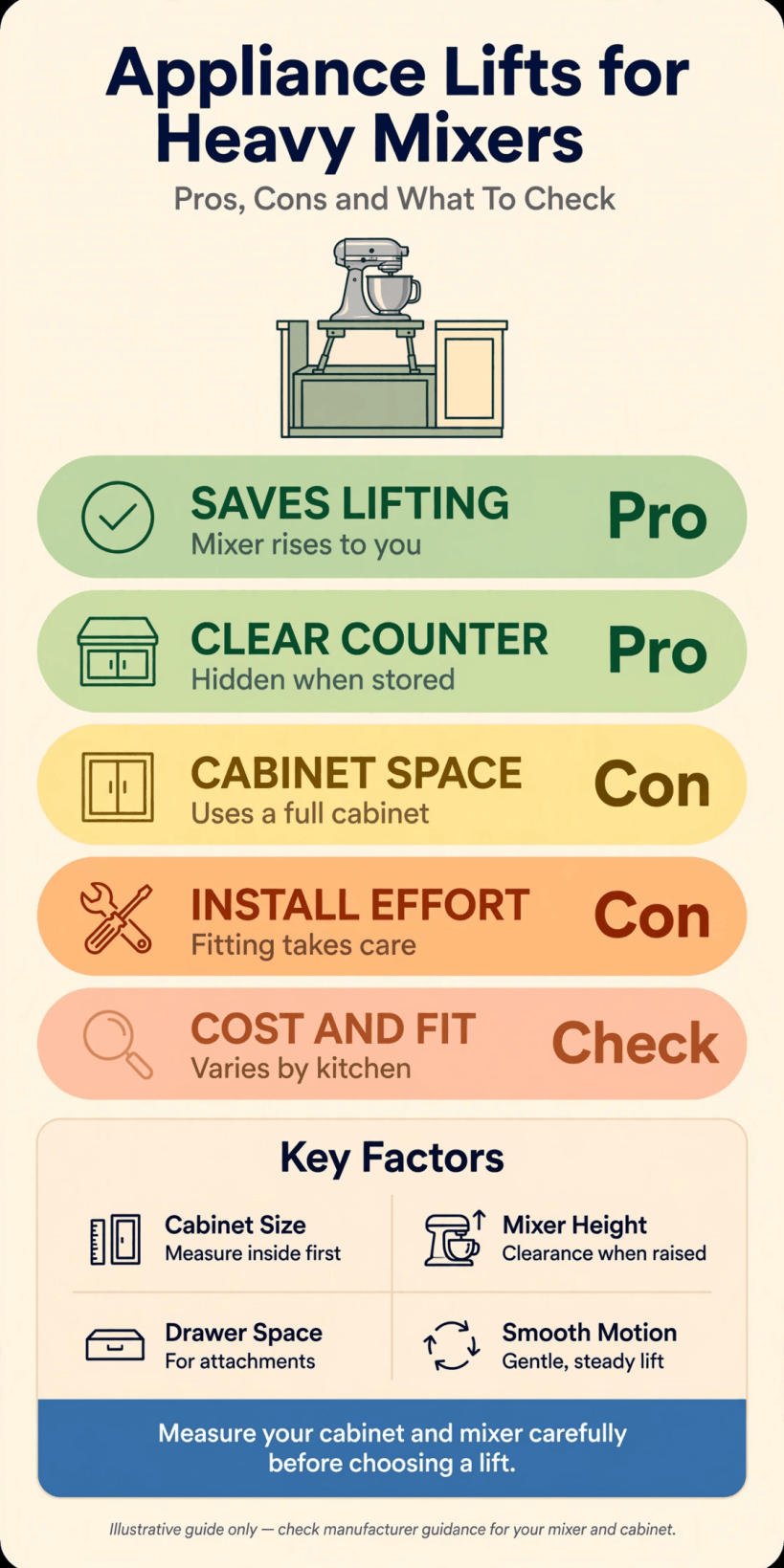
The essentials at a glance: how a cabinet lift works, what it gives you, and what it asks in return.
The honest summary is that a lift is a comfort and convenience upgrade, not a necessity. If you bake weekly, keep the mixer permanently set up, or share your kitchen with other cooks and appliances competing for the same stretch of worktop, the case is strong. If the mixer comes out twice a year, a lift is an expensive way to store it, and the money is better spent elsewhere in the kitchen.
2. What a Cabinet Lift Actually Does
Most lifts work on the same simple idea. A platform is mounted on strong hinged arms or a scissor frame inside the cabinet. Springs or gas struts help carry the weight, so raising the mixer feels far lighter than lifting it by hand. At the top of the travel the platform locks level with, or just below, the worktop, giving you a stable extra surface at the height you already work at.
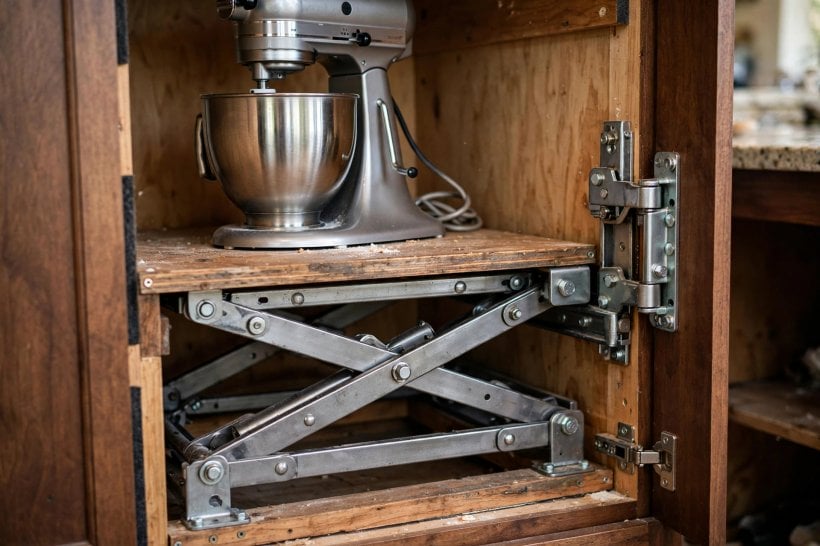
When you finish, you release the lock and guide the platform down. The mixer travels back into the cabinet on its shelf, the door closes, and the kitchen looks exactly as it did before. Good mechanisms move smoothly in both directions without jerking, because a sudden drop is hard on both the machine and your fingers. The best designs also keep the mixer upright through the whole arc, so bowls, attachments and the machine itself never tip or slide.
Think of the lift as a piece of kitchen furniture rather than a gadget. It becomes part of the cabinet, it is used every time you bake, and it has to feel solid for years. That is why the quality of the hinges, the platform and the locking action matters far more than any clever extra feature. A lift that wobbles at full height will annoy you every single time you use it, however tidy the closed cabinet looks.
3. The Biggest Pros: Counter Space and Easier Lifting
The first pro is obvious to anyone with a small kitchen: your worktop comes back. A stand mixer left out permanently takes up a surprising amount of the most valuable real estate in the room, right where you roll pastry, rest hot trays and plate up meals. In a compact home every clear stretch counts, the same way smart layouts matter in tiny house living room ideas where furniture has to earn its place.
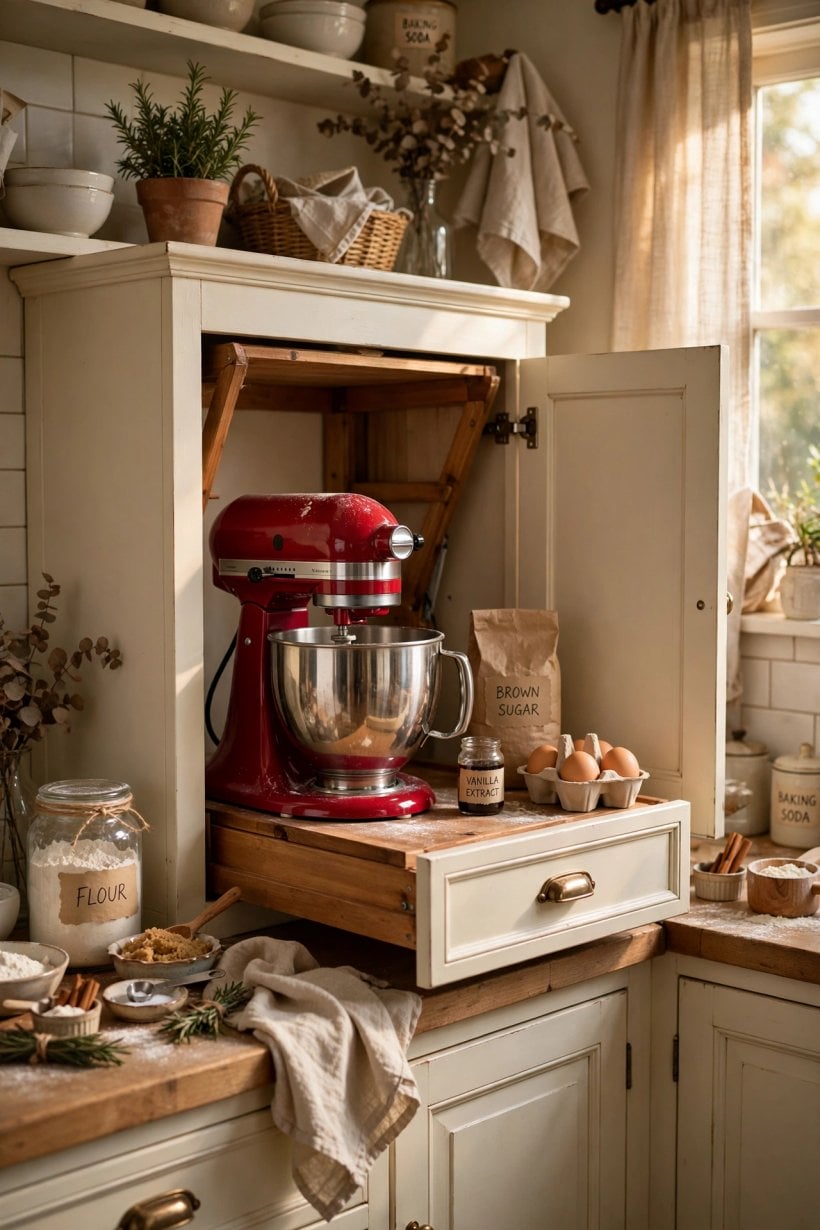
The second pro is physical. A stand mixer is a dense, top-heavy object, and lifting one from a low cupboard, or down from a wall cabinet, is exactly the kind of awkward lift that strains wrists, shoulders and backs. With a lift, the mechanism does the heavy work and the springs do most of the rest. You guide rather than heave. For older cooks, anyone with limited mobility, or households where several people use the mixer, that difference is not a luxury. It is often the whole reason for buying one.
Together, those two benefits change habits. When the mixer is thirty seconds away instead of a wrestling match, you use it more: bread dough on a weekday, whipped cream without a second thought, attachments that otherwise stay in their boxes. Appliances earn their cost when they are used, and a lift removes the friction that keeps a good machine idle.
4. More Pros: Safer Handling and a Tidier Kitchen
Safety is the quieter pro. Carrying a heavy mixer across a kitchen, sometimes with a bowl fitted and a lead trailing, is when accidents happen: a slip, a knocked pan, a machine set down too close to an edge. On a lift, the mixer never leaves its platform. It travels a short, fixed path, and it is used exactly where it stands, so there is no carrying, no balancing and no hunting for a safe place to put it down mid-recipe.
Then there is the tidiness factor. Closed doors hide the machine, its lead and its attachments, so the kitchen looks calm even in a small open-plan space. That matters more in compact homes than large ones, because the kitchen is usually visible from where you sit and relax. The thinking is the same as in tiny barn house interior planning, where storage is designed in from the start rather than added as an afterthought.
A lift also keeps the mixer cleaner. Inside a cabinet it gathers far less of the grease and dust that settle on appliances left out near a hob. And because the machine stays plugged in where it is used, there is no repeated plugging, unplugging and lead-wrangling, which is a small daily irritation that disappears completely once a lift is fitted.
5. The Cons: Cost, Complexity and Lost Storage
Now the honest downsides, starting with cost. A quality lift mechanism is a piece of engineered hardware, and it is priced like one. On top of the mechanism you may pay for cabinet alterations, a new door arrangement, and professional fitting if you do not do the work yourself. Compared with the price of simply keeping the mixer in a cupboard, the total is significant, and it buys convenience rather than any improvement in how the mixer itself performs.

Complexity is the second con. A lift has moving parts, and moving parts can loosen, squeak or wear. Cheap mechanisms are the worst offenders: thin platforms flex, locks feel vague, and the whole thing develops a wobble that makes you nervous at full height. This is not a purchase where the budget option is a smart saving. If the numbers only work with the cheapest hardware you can find, the project is probably better postponed.
The third con is lost storage. A lift claims most of one base cabinet for a single appliance. In a big kitchen that is a fair trade; in a small one it may mean losing your main pan or bakeware storage. Before committing, empty the cabinet you have in mind and find a real home for everything in it. If nothing sensible presents itself, the same problem-solving mindset behind how to build your own tiny house applies: every cubic inch has to be accounted for on paper first.
6. Cabinet Fit: Width, Depth, Height and Swing Clearance
Most lift projects succeed or fail on measurements, so measure the cabinet, not the brochure. Start with internal width: the platform and its arms need room on both sides, and the mixer itself must pass through the opening without catching the frame or hinges. Then check internal depth. The mixer has to sit fully on the platform with the door able to close, and deep machines on shallow cabinets are a common reason lifts get returned.
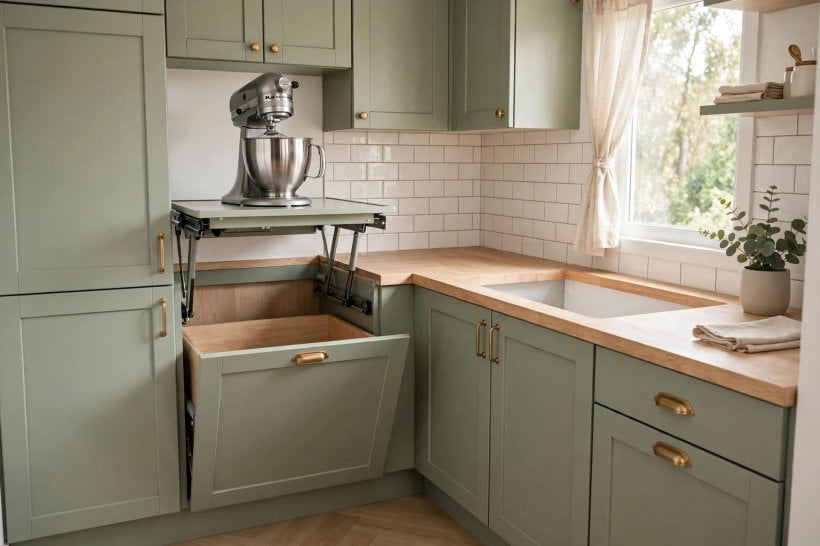
Height matters twice. Inside the cabinet, the closed space must swallow the mixer standing on its lowered platform, with the head in its normal position. At the top of the lift’s travel, the platform must arrive level enough with the worktop that sliding a full bowl across is easy. Also picture the swing: as the platform rises it arcs outward, so check that nothing on the worktop above, and no drawer or door nearby, sits in that path.
Finally, look at the cabinet itself with fresh eyes. The carcass needs to be square, rigid and well fixed, because the lift’s arms concentrate force into their mounting points every time the platform moves. A flimsy or damaged cabinet is a poor foundation. Doors matter too: hinged doors that open wide are easiest, while anything that restricts the opening will fight the platform. Write every measurement down and compare them with the lift maker’s stated requirements before ordering anything.
7. Weight, Stability and Why Ratings Matter
Every lift is rated for a maximum load, and that rating deserves respect rather than optimism. The load is not just the mixer. It includes the bowl, the ingredients inside it, and any attachment fitted at the time, and dough in particular adds real weight while the machine is working. Rather than chasing exact figures, follow a simple rule: choose a lift whose stated capacity sits comfortably above everything you will ever put on it, with headroom to spare.
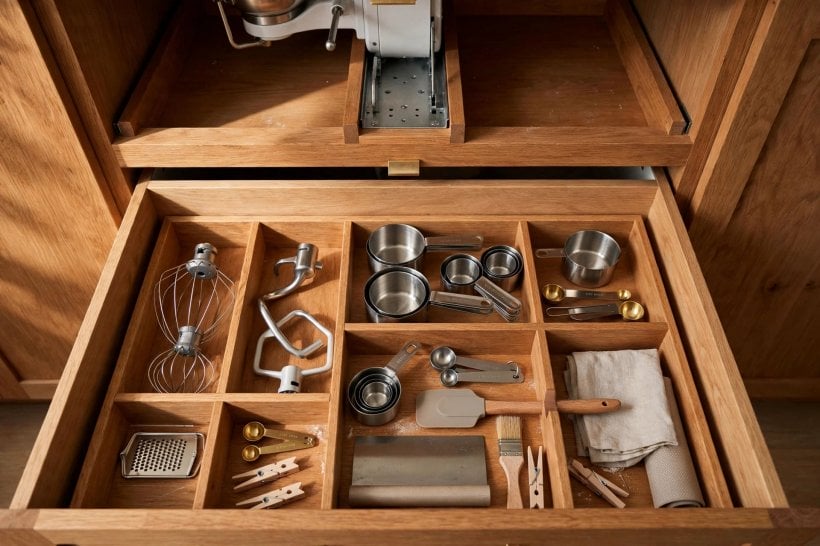
Stability is the partner check. Raise the platform, fit the mixer, and imagine it kneading a heavy dough: the machine will rock gently as it works, and the platform must absorb that without creeping, dipping or rattling against the cabinet. Strong springs or struts matched to the load are what make the movement feel controlled. A lift that is under-sprung feels alarmingly heavy to raise; one that is over-sprung can jump up faster than you expect.
If you are comparing models, read how each maker describes capacity and testing, and be wary of vague claims with no stated rating at all. Reputable hardware tells you plainly what it can carry. And whatever the figures say, the final test is physical: once fitted, load the platform gradually, check the lock at full height, and only then trust it with your best mixing bowl.
8. The Drawer Question: Storage Above, Below or Beside
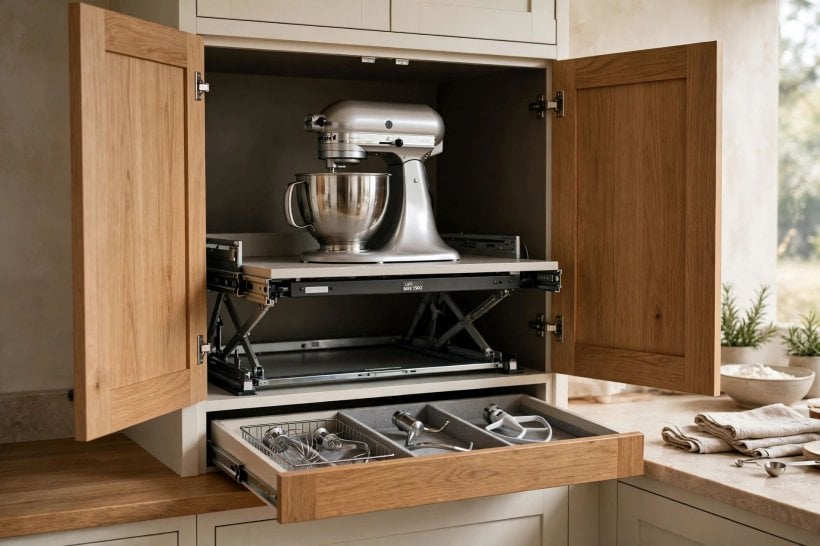
The most requested variation is right there in the phrase kitchenaid mixer cabinet lift with drawer: can the cabinet keep a drawer as well as the lift? Sometimes, yes. A shallow drawer above the lift space can hold beaters, dough hooks and measuring tools exactly where you need them. But that drawer steals height from the mixer’s closed space, so the combination only works when the cabinet is tall enough for both, measured honestly.
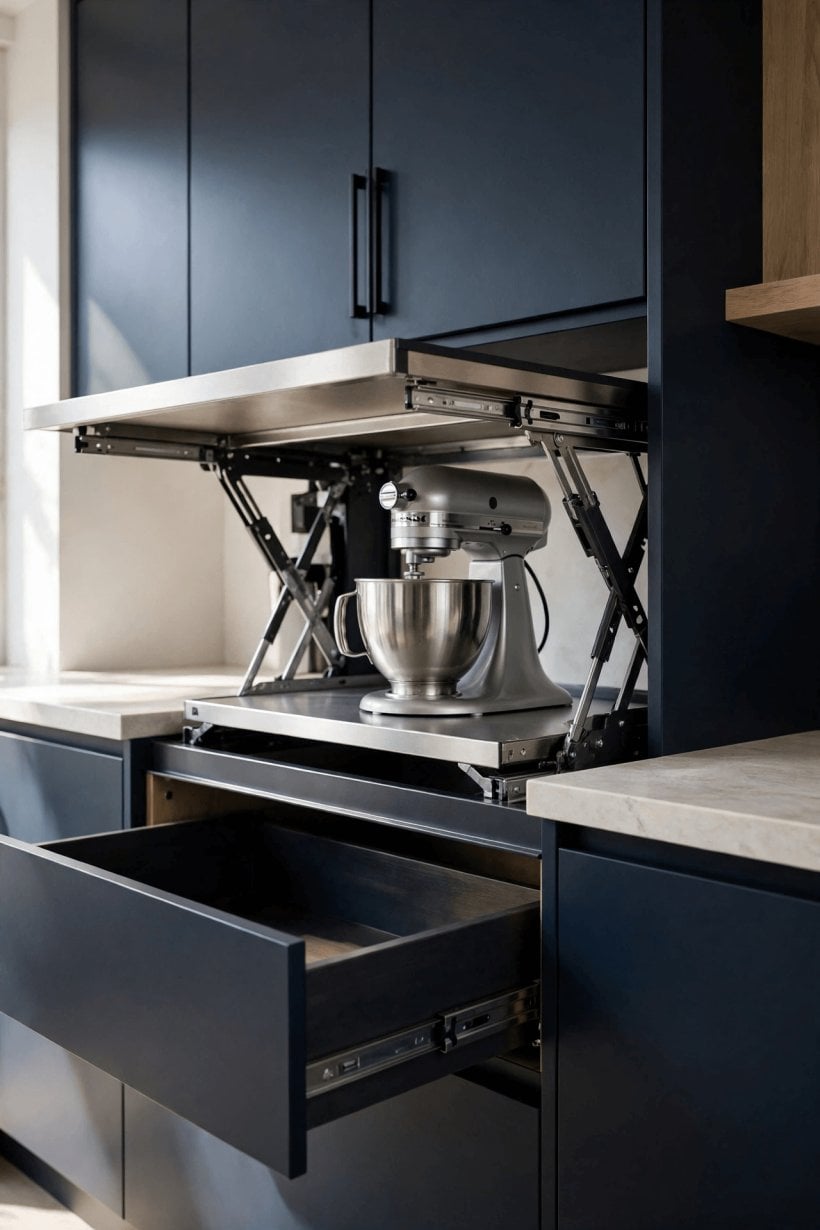
There are three realistic layouts. A shallow drawer above the lift keeps attachments together but demands the most internal height. A drawer below is rarely possible, because the lowered platform and mechanism need that space. Storage beside the lift, in the neighbouring cabinet or a nearby drawer, is the simplest answer and the one most kitchens end up with: the mixer gets its cabinet, and its tools live one step away.
Whichever you choose, plan it before fitting, not after. Attachment storage sounds like a detail until you are holding a dough hook with floury hands. Small kitchens reward this kind of joined-up thinking everywhere, from mixer cabinets to the sleeping space in tiny house bedroom ideas, where the storage is always designed around the thing it serves. If a drawer forces compromises on the lift itself, keep the lift and drop the drawer: smooth, solid lifting is the point of the project.
9. Installation: DIY or Professional Help
Fitting a lift is within reach of a confident DIYer, but it is not a forgiving job. The cabinet must be emptied, the mechanism fixed squarely and securely into the carcass, and the platform adjusted so it travels freely and locks level. Small errors show up as rubbing, uneven movement or a platform that will not sit flush, and correcting them usually means taking the mechanism out and starting that stage again.
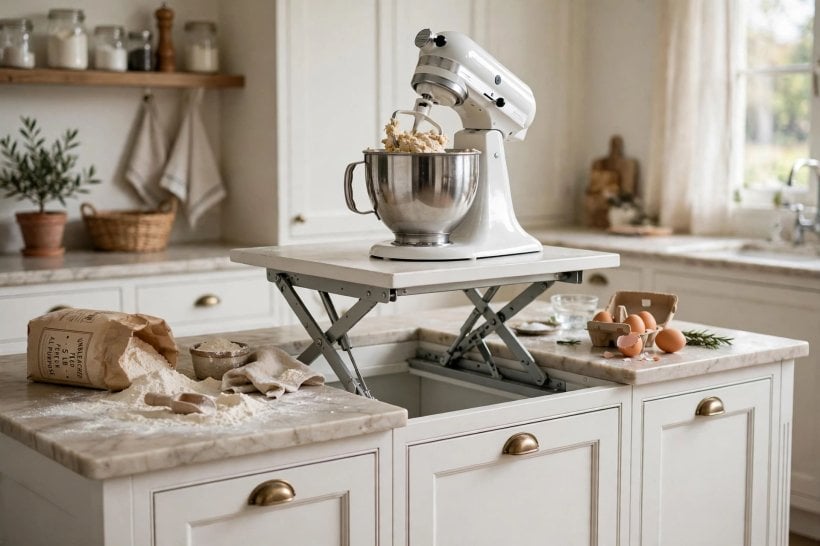
Professional fitting costs more and buys certainty. A kitchen fitter or joiner has done the measuring dance before, will spot a cabinet that is not square, and can adjust doors and alignment so the finished result looks original rather than retrofitted. If your kitchen units are new, expensive or still under a maker’s guarantee, professional fitting also protects you: altering cabinets yourself can affect guarantees, so check before you drill.
Either way, build in testing time. Fit the mechanism, run it empty, then with the mixer aboard, then with a bowl of something heavy, checking clearances and the lock at every stage. Sort the power supply too: the mixer needs a socket it can stay plugged into, with the lead routed so it cannot snag on the moving platform. A trailing lead caught in a hinge is the one installation mistake that can damage both machine and mechanism, so route it carefully and check the full travel twice.
10. Care, Cleaning and Everyday Checks
A lift asks for very little upkeep, but the little it asks for matters. Every few months, check the fixing screws on the arms and platform and tighten any that have worked loose; the repeated movement of a heavy load will find a slack screw eventually. Keep the mechanism clean and dry, and wipe flour and splashes off the platform before lowering it, so debris is not carried down into the cabinet.
Follow the maker’s guidance on lubrication rather than improvising: some mechanisms are designed to run dry, and the wrong product only attracts dust. Watch how the lift behaves as you use it. New squeaks, a platform that drifts down from its lock, or movement that suddenly feels heavier are all early warnings that something needs attention, and they are far easier to fix when caught early.
Everyday habits help too. Lower the mixer gently instead of letting the springs do all the work, keep attachments stored so they cannot rattle against the machine in transit, and never use the raised platform as a general shelf for heavy pans. Treat it as part of the kitchen’s furniture, in the same spirit as the considered storage in tiny house bathroom ideas, and it will repay you with years of quiet, boring reliability, which is exactly what you want from hardware.
Final Considerations
A mixer cabinet lift is a simple idea done well or badly, with very little middle ground. The pros are real: a clear worktop, no more heaving a heavy machine around, safer handling and a calmer-looking kitchen. The cons are equally real: meaningful cost, a cabinet given over entirely to one appliance, and hardware that must be chosen carefully and fitted square. Neither list wins on its own; the answer depends on how often you bake and how tight your kitchen is.
So measure the cabinet honestly, respect the load rating, plan where the attachments will live, and decide the drawer question before you order. Get those four things right and the lift fades into the background of your kitchen, which is the highest compliment storage can earn. If you are still weighing up the layout of a compact kitchen as a whole, the ideas in colorful tiny house interior design show how good storage and strong colour can happily share a small space.




0 Comments