

The grill exiled to the far fence makes its cook a stranger at their own party, ferrying plates through the dark while the conversation happens somewhere else.
These seventy-five ideas bring the grill into the patio itself — placed, sheltered, lit and surrounded by the people it feeds. They build on the groundwork of patio ideas, where the terrace itself is planned first.
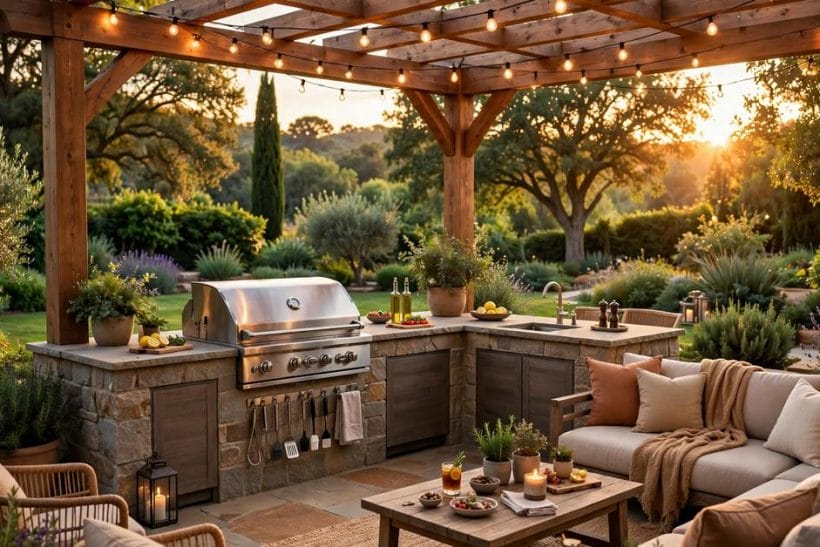
1. Outdoor Grill Area Ideas at a Glance
An outdoor grill area is the part of a patio arranged for cooking: the grill, working counters, storage, light and seating planned together on the terrace.
| Question | Short answer |
|---|---|
| What is an outdoor grill area? | The part of a patio arranged for cooking — grill, counters, seating and shelter together |
| How is it different from a barbecue area? | A barbecue area stands alone; a grill area is built into the patio’s life |
| Does the grill need to be built in? | No — portable grills on a proper pad work just as well |
| What matters most in placement? | Smoke carried away from the seats and a short path to the kitchen |
| What surface suits the cooking patch? | Firm, level, heat-safe paving that cleans easily |
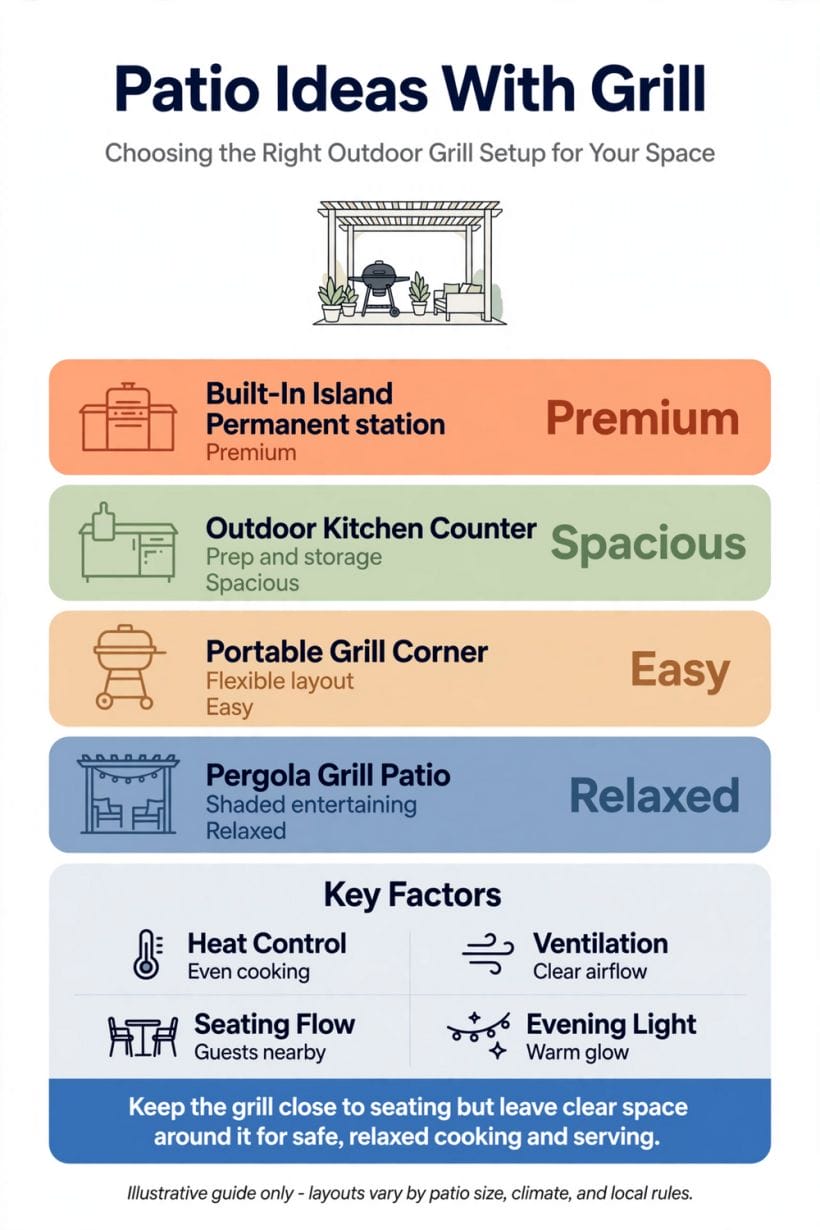
2. Grill Placement Within the Patio: Zones and Clearances
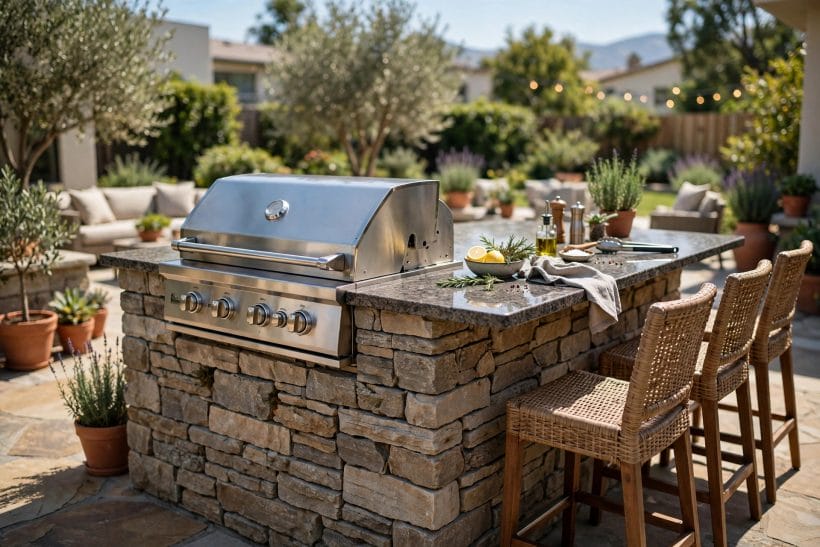
This post keeps the grill where the brief for this corner of the garden says it belongs: inside the patio’s life, not exiled from it. A standalone cooking zone on its own ground is a different design problem, planned in bbq area ideas; here, every placement assumes the paving, the table and the house door are already neighbours, and the grill must earn its place among them.
1. The grill set into the patio’s edge, facing in
The classic patio arrangement: the grill built or parked along the patio’s edge, its back to the garden and its cook facing the table.
2. A cooking zone at the patio’s far end
On a long patio, give the far end to cooking: grill, a counter and the bins together, with the dining set between the zone and the house.
3. The grill beside the kitchen door
The shortest carry wins more evenings than any other factor: a grill placed a few steps from the kitchen door, on the same level, with a surface beside it for trays.
4. A corner grill station on a wide patio
A wide patio’s corner is the grill’s natural home: two walls of working surface can meet there, the cook stands in the angle with everything in reach, and the corner’s shelter keeps the flame steadier.
5. Downwind placement that keeps smoke off the seats
Smoke follows the breeze, and every garden has a usual one on summer evenings. Set the grill so that breeze carries smoke away from the table, not across it — a small decision, made once, that guests will thank you for at every meal without ever knowing why.
6. A paved pad that extends the patio for the grill
Where the patio itself is small, extend a firm paved pad from its edge purely for the grill and the cook’s standing room.
7. The grill under a covered section’s open edge
A grill can sit under the very edge of a patio cover — sheltered enough that rain does not end the cooking, open enough that smoke escapes sideways and up without gathering.
8. A grill zone separated by a low planter
A low planter or a run of pots between the grill and the seating marks the cooking zone without fencing it: herbs in the pots put seasoning within reach, and the green line tells wandering guests and children exactly where the hot country begins.
9. Space behind the cook kept clear
The metre behind the grill is working land: trays land there, the cook steps back there, lids are parked there. Keep it clear of chairs, toys and through-traffic, and the cooking stays calm whatever the patio’s front is doing.
10. A small patio’s single grill wall
On the smallest patios, give one short wall entirely to cooking: grill, a fold-down shelf and hooks for tools in a single run.
11. A firm, level, heat-safe surface under the grill
Whatever the placement, the ground rules come first: the grill stands level and firm, on a surface that tolerates heat and fat, with clear space around it that paving, not planting, covers.
3. Grill Stations and Counters Within the Patio
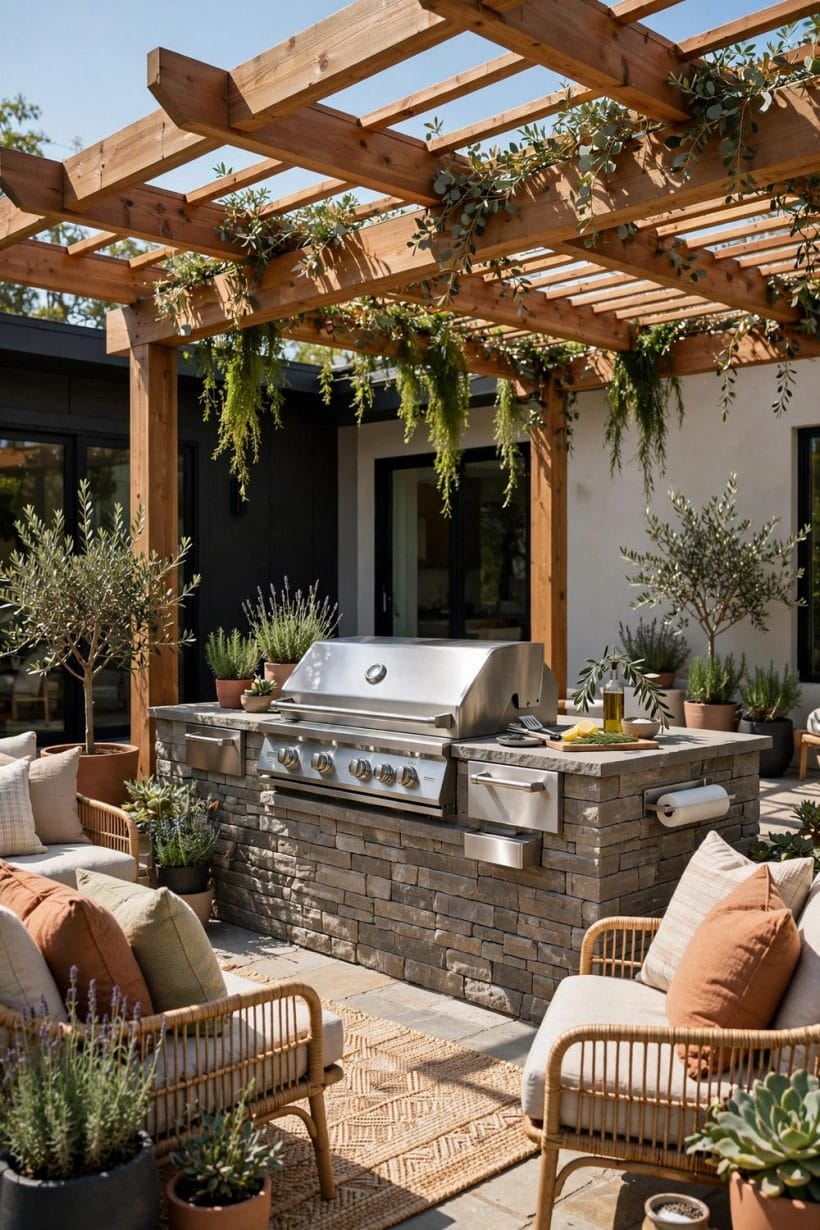
A grill alone is an appliance; a grill with counters is a kitchen. The counters need not be grand — a ledge each side at working height transforms the cooking — but they should belong to the patio’s own materials and lines, so the station reads as part of the terrace rather than an island that landed on it.
12. Counters on both sides of the grill
The single most useful arrangement: a counter to the left for raw food arriving, a counter to the right for cooked food leaving, and the grill between them like a sentence between commas.
13. A prep counter that doubles as a serving ledge
Where space allows one counter only, make it wide and dual-purpose: prep at cooking time, serving at eating time, with the dining side kept clear for plates and glasses.
14. Heat-tolerant surfaces beside the grill
The counters touching the grill take heat, fat and weather together: stone, concrete, tile and stainless surfaces shrug off all three. Timber looks warm and works well a little further away, where hot pans land on trivets rather than directly on the grain.
15. A simple cold-water point where the patio allows
A tap or a standpipe within the cooking zone — for rinsing hands, filling a pot, damping a flare of fat — is a small luxury that changes the cooking more than another burner would.
16. Cabinet storage under the counter
Closed storage beneath the counter keeps tools, trays, fuel and the brush where the cook’s hand expects them, dry and out of sight.
17. A trolley that extends the counter when cooking
The flexible counter: a sturdy trolley that rolls out to extend the station on cooking days and parks against the wall the rest of the week.
18. A raised ledge behind the grill for guests
A counter raised behind the grill, with stools on the far side, puts guests in conversation with the cook and out of the working lane at once.
19. A tiled or stone splashback behind the grill
The wall or fence behind a grill takes the fat and the heat; a splashback of tile, stone or metal sheeting takes it instead, wiping clean and protecting timber fencing from scorch and stain.
20. A cover that keeps the station clean between cooks
A fitted cover over the grill and a clear counter at nightfall keep the station ready: no leaf litter in the burners, no bird gifts on the prep surface.
21. A freestanding station that stays put
Not every station is built: a freestanding grill unit with side shelves, parked in its place and chocked steady, serves small patios and renters honestly.
22. Lighting built into the station itself
A small light fixed at the station — under a shelf, on the splashback, in the cover’s edge — lights the food rather than the patio, and food is where the cook’s eyes need to be after dark.
4. Portable Grills, Carts and Flexible Setups
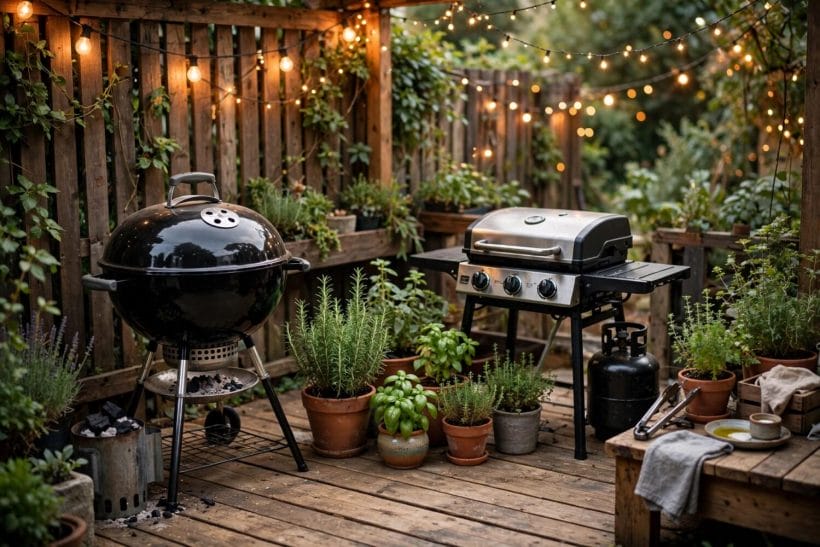
Most patio grilling in real gardens is portable, and there is no apology in that: a wheeled grill on a proper pad, with a table and a parking place, answers the brief as well as any built station.
23. A kettle grill on a small paved pad
The kettle on its pad is the small patio’s classic: charcoal flavour, a lid that roasts as well as grills, and a footprint no bigger than a chair.
24. A grill cart that parks against the wall
A cart-style grill lives against the house wall under its cover and rolls out to its cooking mark when needed. The wall gives it shelter and a backdrop; the patio keeps its floor.
25. A folding side table as the only extra
The minimalist’s station: the portable grill plus one folding table that holds the tray, the tools and the cook’s drink.
26. A wheeled gas grill for weeknight ease
For households that grill on Tuesdays, the wheeled gas grill’s instant start is the feature that matters; park it near the door, keep its cover tidy, and let its side shelves be the counters.
27. A charcoal grill kept at the patio’s open side
Charcoal asks for the patio’s most open edge: sparks and ash travel, and the open side keeps both away from covers, cushions and the house wall.
28. A tabletop grill for the tiniest patios
Where the patio is a balcony’s cousin, a tabletop grill on a sturdy, heat-proof table brings grilling home at the smallest scale.
29. A flat-top griddle plate for breakfasts outside
A griddle plate — over the grill or as its own unit — opens the patio to breakfasts, pancakes, vegetables and the smash-burger arts that bars cannot do.
30. Storing the grill under a weather cover
A portable grill lives outdoors and should dress for it: a sound cover, kept on between cooks, doubles its good-looking life.
31. A dedicated parking spot defined by the paving
Give the portable grill a marked home: a square of different paving, a stone slab, a painted corner.
32. One grill, two homes: patio and garden spots
A portable grill can serve two stations: the patio pad for family suppers and a garden spot — near the herb bed, under the tree — for slow weekend cooking.
33. A shared courtyard grill corner
In small shared courtyards and groups of tiny homes, one good grill in a defined corner, booked by custom and cleaned by honour, serves households that could never each fit one.
5. Surfaces, Shelter and Weather Protection
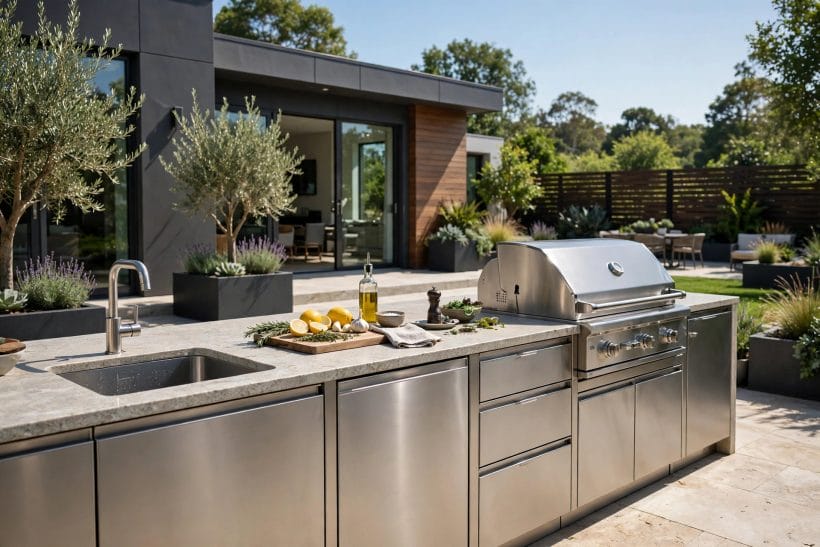
The patio’s fabric decides how the grilling feels: paving that forgives grease, shelter that shields the cook without trapping the smoke, and drainage that keeps the cooking patch dry. The ground-level lessons of gravel patio ideas apply at the pad especially, where a firm, drained base matters more than a pretty one.
34. Paving that shrugs off grease spots
Fat finds the floor at every grill session, so choose the cooking patch’s paving for forgiveness: textured stone, brick and concrete pavers hide and release grease better than pale polished slabs.
35. Shelter that shields the cook, not the smoke
Shelter over a grill is a balance: a pergola edge or an awning’s corner can keep rain off the cook while the smoke still rises clear beyond it.
36. A wall that breaks the wind behind the grill
Wind is the grill’s oldest enemy — it steals heat, bends flame and blows ash. A wall, fence or dense hedge behind the station steadies the cooking more than any lid.
37. An awning over the serving side only
Put the retractable awning over the serving ledge and the guests’ stools, and leave the grill itself in the open: food stays dry on its way to plates, people stay dry while they watch, and the smoke keeps its sky.
38. A firm gravel bed at the grill pad
A compacted gravel pad is the budget grill station’s best friend: level when raked and rolled, drained after every shower, and indifferent to sparks and fat.
39. A canopy for one rainy evening
A pop-up canopy, kept folded in the store, rescues the planned grill evening that the forecast betrays: ten minutes to raise, the table and the guests dry beneath it, the grill just outside its edge.
40. Drainage that keeps the cooking patch dry
The cook stands in one place for an hour; that place should not be the patio’s puddle. Falls should lead water away from the station, and a channel drain at the patio’s low edge keeps the whole floor honest.
41. Shade for the afternoon cook
The cook is the one person who cannot move into the shade, so give it to them: the grill placed where a tree, a sail or the house’s own shadow falls at cooking time.
42. A heat-safe mat under a portable grill
Where a portable grill must stand on decking or a surface that marks, a heat-safe mat beneath it takes the sparks, the drips and the radiant heat.
43. Soft furnishings kept upwind and away
Cushions, throws and the outdoor rug belong on the patio’s far side from the grill: smoke perfumes them, fat spots them, and sparks are their natural predator.
44. Fuel stored dry, apart and out of reach
Charcoal, gas bottles and lighting materials live dry, ventilated and separate from the cooking flame’s casual reach — in a store box or cabinet away from the grill, never beneath it.
6. Dining and Seating Around the Grill
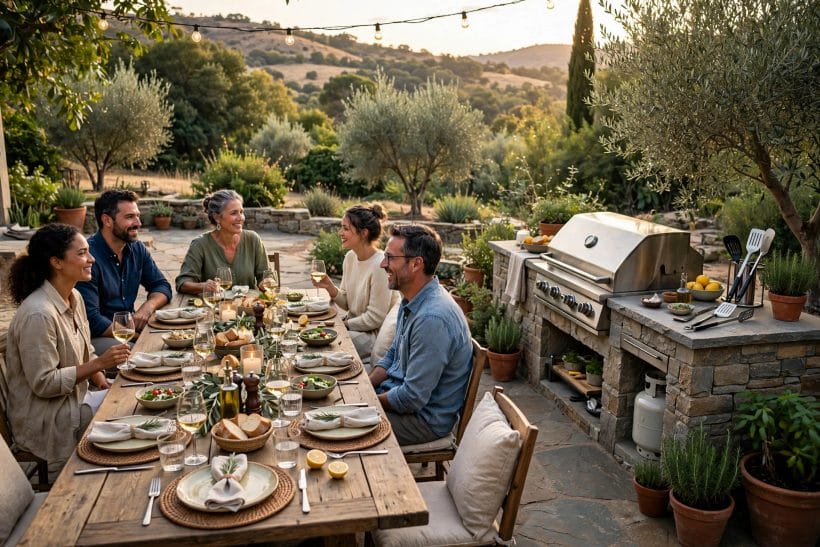
A patio grill area succeeds at the table, not at the grate: the seating should keep guests close enough for conversation, far enough for comfort, and arranged so the cook remains part of the company. A gazebo over the dining side — the arrangement in patio with a gazebo ideas — is one classic way to shelter the eaters while the grill keeps the open sky.
45. The table within talking distance of the grill
The golden distance: near enough that the cook and the seated can hold one conversation without raising voices, far enough that no one’s chair back is warmed by the grill.
46. A bench along the wall for extra guests
A wall bench seats the overflow without storing extra chairs: built in, cushioned in season, and happy to hold trays and bags when the crowd is small. Benches also settle children at the table’s end, within reach of everything and everyone.
47. Stools at the counter’s far side
Where the station has a raised ledge, stools on its far side make the patio’s best seats: front-row to the cooking, drink in hand, out of the working lane. Two stools serve most households; four make a party that never needs the table at all.
48. A separate lounge corner away from the heat
After the eating, the gathering wants soft seats away from the grill’s residual heat and smell: a lounge corner at the patio’s other end, with low chairs and a side table, catches the evening’s second half.
49. Folding chairs brought out for a crowd
The honest answer to the occasional crowd: good folding chairs, stored flat in the store or the garage, brought out for birthdays and forgiven their slight mismatch. A patio furnished permanently for twelve serves two badly every ordinary day of the year.
50. A picnic table that seats the whole family
The picnic table is the grill patio’s folk classic: benches attached, everything at one level, children sliding in at the ends.
51. Cushions stored in the bench by the door
Seat cushions live in a bench or box by the house door, close to the seats and far from the grill: out in a minute when guests arrive, away before the dew.
52. A serving shelf between grill and table
A narrow shelf or ledge on the route between grill and table — for the resting meat, the sauces, the finished platters — breaks the carry into safe stages.
53. Small side tables for drinks
A small table beside every second seat ends the patio’s oldest problem: the drink with nowhere to live.
54. A high table for standing gatherings
For drinks-party evenings, a high table near — not at — the station lets guests stand, graze and circulate while the grill produces its procession of small things. Standing gatherings are the grill’s natural festival, and the high table is their altar and their anchor.
55. The cook’s own stool by the grill
The forgotten seat: one for the cook, beside the station, at the height for watching the food and joining the talk in the pauses.
7. Lighting, Storage and the Working Flow
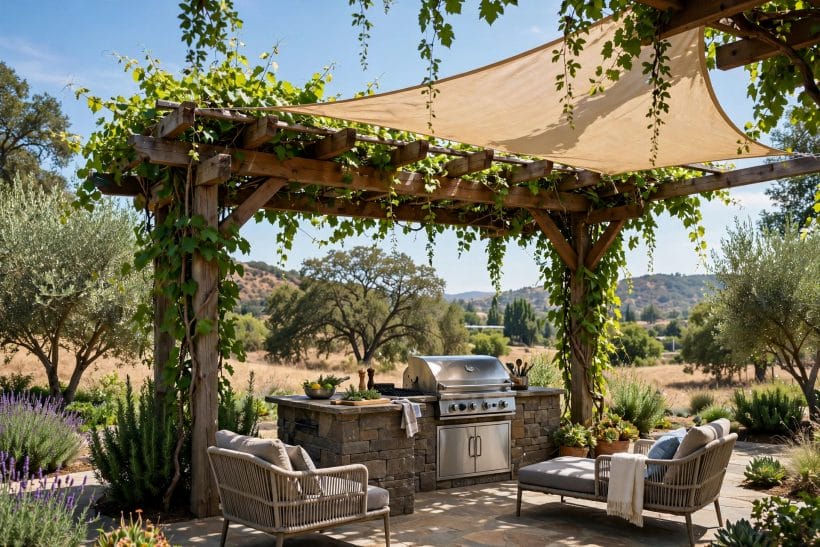
Evening is the grill patio’s high season, and evening runs on light and order: light where the food is, storage where the hand expects it, and a flow from door to grill to table that nobody has to think about. The planting side of the flow — herbs at arm’s reach — is grown in raised garden bed ideas, a short walk from most patios.
56. Task light over the grill surface
The most important light on the patio hangs over the food: a fixed fitting, a clip light or a lamp on the station that shows the cook the colour of what is cooking.
57. String lights over the dining side
Festoons over the table and the seats give the dining side its evening ceiling: warm, low and flattering. Keep them off the grill’s own airspace — heat and smoke rise there — and let the two lighting moods, task and festival, each keep their territory.
58. A lantern shelf by the station
A shelf at the station for lanterns and the cook’s torch keeps portable light where the dark corners are: inside the storage cabinet, under the counter, behind the splashback. Light that must be fetched from the house is light that will not be fetched.
59. Tool hooks on the wall beside the grill
Tongs, brush, fork and thermometer on hooks in their order, at the cook’s working side: the station’s tools should hang like a workshop’s, each with its place and silhouette. Hooks end the hunted-for tong, the balanced-on-the-edge tray and the dropped-in-the-dark brush.
60. A closed store for charcoal and lighting kit
Charcoal, firelighters and the gas key live in one closed, dry store — a cabinet, a box, a bin with a lid — positioned with the fuel rule in mind: dry, ventilated, apart from the flame and out of children’s casual reach.
61. Trays that carry everything in one trip
The one-trip rule: a tray big enough for the raw food, the tools and the seasoning goes out full and returns with the cooked.
62. A bin placed where the cook actually stands
Rubbish happens at the station, so the bin belongs at the station: a lidded bin within a step of the grill for packaging, trimmings and ash-adjacent waste. A bin across the patio is a bin that fills the counter’s corner instead, every single time.
63. Plate and glass storage in the counter
Outdoor plates, glasses and cutlery stored in the station’s cabinets end the kitchen shuttle for tableware and keep the good indoor things out of harm’s way. Melamine and enamel earn their place here — light, unbreakable and unbothered by paving.
64. A herb pot rail within arm’s reach
A rail or shelf of herb pots at the station’s end — rosemary for the grill bars, thyme and parsley for the finishing — puts the garden in the cooking.
65. A torch kept with the tools
A small torch lives with the grill tools for the evening’s last checks: the corner of the counter, the inside of the store, the ash before it is binned.
8. Styles: Courtyard Patios, Decks and Tiny Gardens
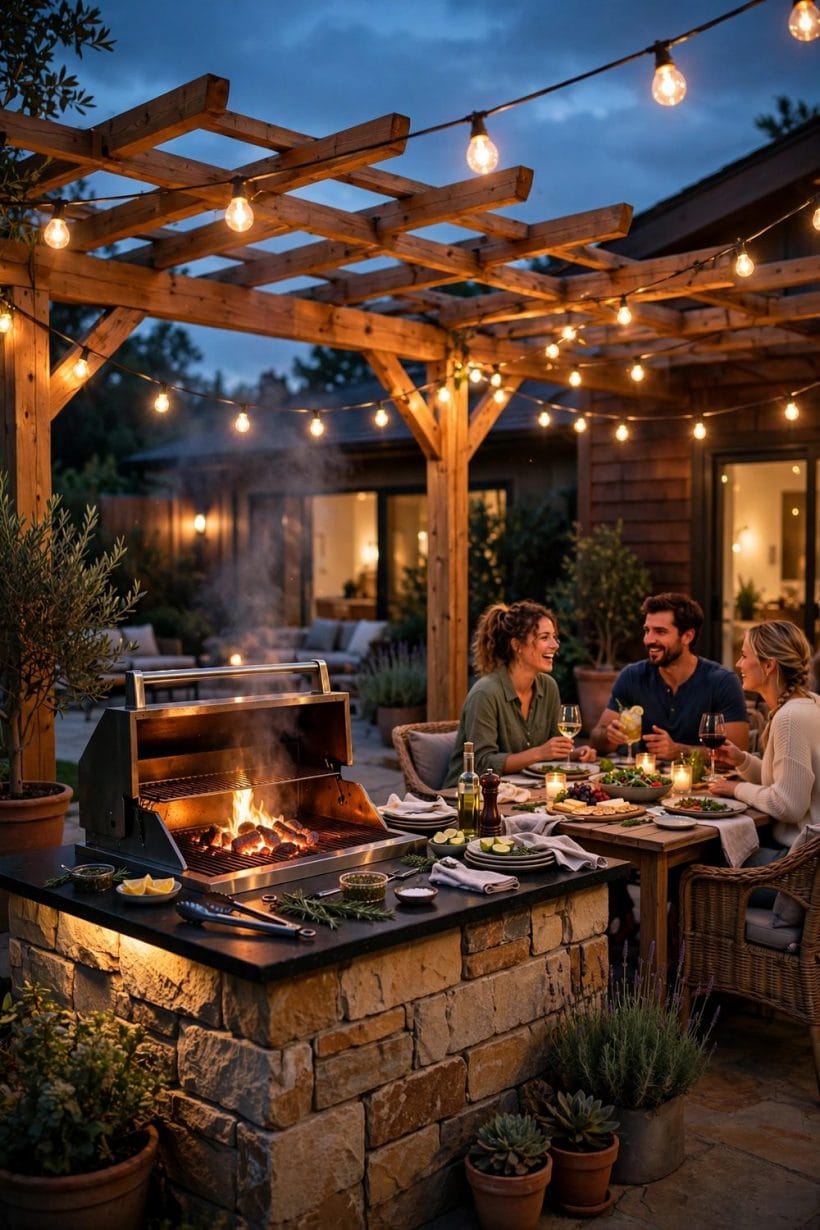
The grill area wears the patio’s style, whatever that is — and the enclosed end of the family, the walled patio, is planned in courtyard ideas. Ten styles follow, from courtyard formality to tiny-garden ingenuity; each keeps the same working rules and changes only the clothes.
66. A Mediterranean courtyard grill corner
Terracotta pots, a tiled splashback, the grill in a masonry niche and herbs in every sunny crack: the Mediterranean corner cooks the way its climate taught it to. Shade is dappled, water is near, and lunch is the day’s main event by design.
67. A modern patio with a single steel station
One clean-lined station in dark steel against plain paving, the grill’s form doing all the talking: modern patios suit built simplicity and punish clutter. Keep the palette to metal, stone and green, and let the fire be the decoration.
68. A cottage patio with a brick grill niche
A brick niche built into the cottage patio’s wall, with an iron grill and a timber shelf: permanent, charming and exactly as technical as it needs to be. Cottage style forgives soot, loves climbers and expects the cook to sit down often.
69. A rustic timber counter and stone pad
Heavy timber counters, a stone pad underfoot and the grill between them: the rustic station suits woodland gardens and big appetites. Its materials age into the landscape, and its maintenance is an oiling, a brushing and an occasional honest repair.
70. A coastal patio in pale paving and rope light
Pale paving, weathered timber and festoon lights strung like a harbour’s: the coastal grill patio cooks fish beautifully and forgives sand everywhere. Choose finishes that salt air cannot embarrass, and keep the palette to the shore’s own — white, rope, driftwood grey.
71. A tiny-garden grill pad with folding furniture
The smallest stage: one pad, one portable grill, furniture that folds to the fence. Tiny gardens grill wonderfully when every piece earns its footprint and the storage is ruthless — the pad is a stage, and the play is the cooking.
72. A family patio built around one long table
The grill serves the table, and the table seats the tribe: this style puts its money in length — a long table, a long bench, a station sized to feed them both.
73. A minimalist grill wall in rendered block
A single rendered wall carries everything: grill recessed, counter cantilevered, tools vanished into a cupboard. Minimalism at the grill is a discipline of hiding — the cooking is theatre, the equipment is backstage, and the wall is the curtain.
74. A festival patio of festoon lights and long benches
Built for gatherings: festoon lights overhead, benches in rows, the grill producing at one end like a street stall. Festival style suits households whose ordinary Saturday is other people’s occasion, and it stores its benches stacked without complaint.
75. A quiet breakfast patio with a small grill for two
The gentle end: a small grill or griddle by a two-person table, morning sun, coffee within reach of the kitchen door.
9. Checks and Mistakes: Before the First Purchase or the First Fitting
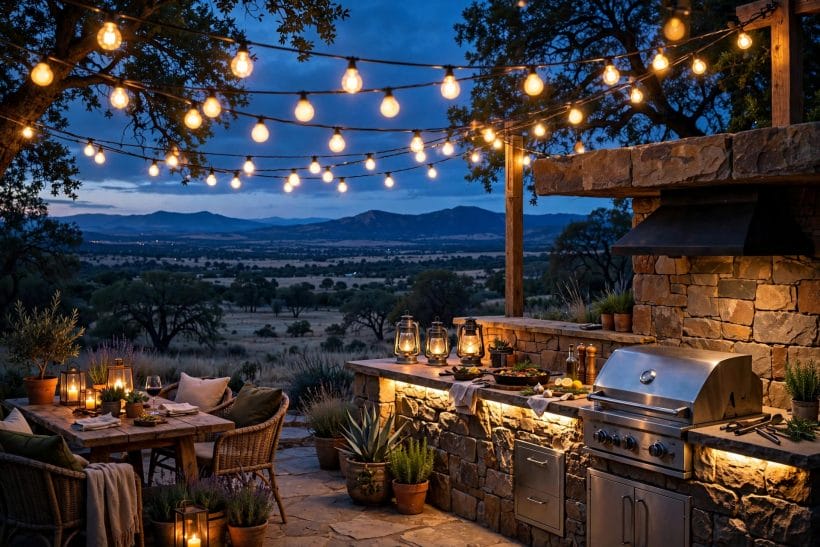
Clearances are the first check and the one that cannot be styled away: a grill needs honest space from walls, fences, eaves, covers and anything that burns, and the maker’s guidance for the individual grill is the word to follow — take it over any photograph.
Smoke and neighbours are the second check. A patio grill area that perfumes the neighbours’ washing weekly will make enemies of friends; placement that uses the usual breeze, cooking that avoids needless flare and fat smoke, and a word in advance before the big party are the whole diplomacy.
The common mistakes are domestic, not technical: a grill placed for the photograph instead of the carry; counters that exist but at the wrong height or on the wrong side; storage in the house for tools that live at the grill; and lighting everywhere except over the food.
Finally, plan the cleaning before the cooking: a brush that lives at the hooks, a bin at the station, a cover that fits, and surfaces that forgive.
10. Costs and Pulling It Together
Costs follow how much of the station is built. A portable grill, a paved pad and a folding table are the modest end — the price of the grill itself plus a weekend of groundwork.
The drivers in order: the grill and its installation first, then counters and storage, then groundworks and drainage, then shelter and lighting, then the seating that makes the area a room.
Pull it together by fixing the placement with the breeze and the carry, choosing built or portable by the household’s real week, and dressing the result in the patio’s own style.
Final Considerations
A grill belongs where the people are, and on most plots the people are on the patio.
Start with the firm pad and the honest clearances, add counters and light as the seasons teach you, and let the seventy-five ideas here argue for their versions.

0 Comments