

A pantry works hard and is opened many times a day, yet its door is usually an afterthought. It does not have to be. The right pantry door can save floor space, bring in light, hide storage completely or give a plain kitchen its one memorable feature.
This guide covers the unusual options honestly: how each type opens, what it costs in effort and upkeep, and the practical checks to make before you fall for a photograph.
1. At a Glance: Choosing a Door by How It Opens
| Door type | Best for | Watch out for |
|---|---|---|
| Sliding or barn style | Tight kitchens where a swing would block walkways | Wall space beside the opening and a less complete seal |
| Pocket door | A clean look with no door visible when open | Work inside the wall and access for future repairs |
| Bookcase or hidden door | Blending the pantry into a run of units or a dining room | Weight, hinges and keeping the disguise convincing |
| Glazed or French doors | Borrowing light and showing styled shelves | Visible clutter and regular glass cleaning |
| Bifold or concertina | Wide openings in a small footprint | Tracks, alignment and a busier appearance |
| No door at all | Walk-in pantries used constantly | Dust, smells and the need for tidy shelves |
Start with the opening itself, not the door. Measure the width and height, note which way foot traffic flows past it, and look at what stands opposite: an island, a fridge or a dining table can all collide with a careless door swing. Then decide how open you want the pantry to feel. A door that disappears suits a busy family kitchen; a door that performs suits a room that needs character. Neither is better. The wrong choice is the one that fights the room’s daily routine.
Also think about what the door is hiding. A working pantry full of bulk bags and appliances asks for privacy. A styled pantry with jars, baskets and matching shelves can afford glass. Be honest about which pantry you actually keep, because the door will advertise the answer every day.
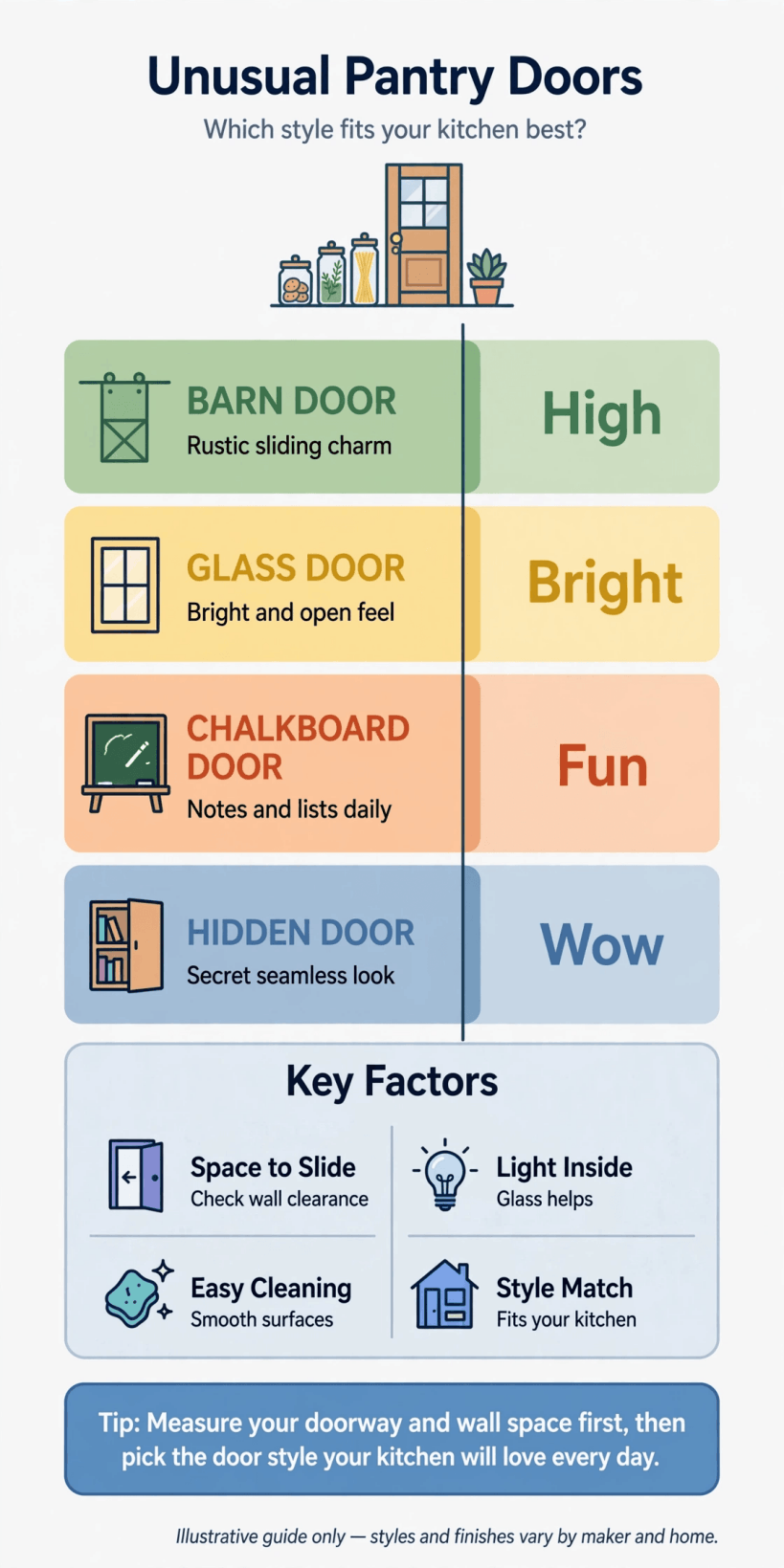
The main door types compared: how they open, where they suit and what to check first.
2. Start With the Swing: Sliding, Pocket and Bifold Options
The most unusual door is sometimes simply the one that opens differently. A standard hinged door needs a clear arc of floor, and in a small kitchen that arc is valuable. Sliding doors travel along the wall instead, which frees the floor but claims the wall: check that sockets, switches, shelves and artwork are not sitting where the door needs to slide. Pocket doors go further and vanish into the wall, giving the cleanest result of all, but they ask for work inside the wall cavity and make later repairs to the mechanism a bigger job, so choose hardware you can reach and service.
Bifold doors fold back against themselves and suit wider openings where a single slab would be heavy and clumsy. They keep most of the opening accessible and take up little swing space, though the tracks and pivots need to be good quality and kept aligned. Concertina and accordion styles push this idea further for very tight spots, trading a solid feel for compactness. In compact homes, the space-saving logic is the same one that drives tiny house living room ideas: every door, like every piece of furniture, has to earn the floor it stands on.
Whichever way the door moves, test the feel. A door you open with an armful of tins should glide, not judder, and it should stay where you leave it rather than drifting shut on your elbow.
3. Hidden Doors and Bookcase Doors That Disappear
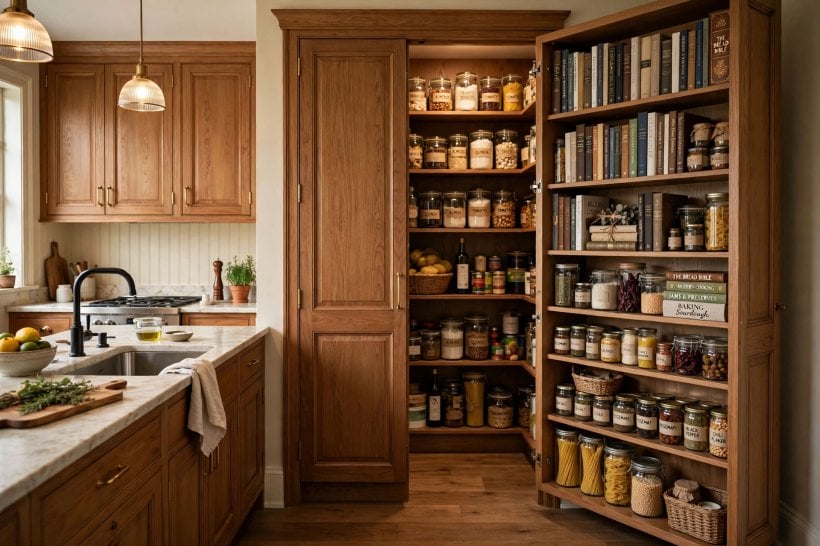
A hidden door is the pantry’s party trick: a panel finished to match the wall or the kitchen units, with no obvious handle, that swings open to reveal shelves. Done well, it calms a room, because a run of doors breaks up a wall and draws the eye. Done badly, with gaps that wander and a finish that almost matches, it looks like a secret everyone can see. The craft is in the alignment: hinges need to carry the panel without sagging, edges must sit flush, and the opening mechanism, whether a push latch or a disguised handle, must work every time without a struggle.
Bookcase doors take the idea further, with a shelved unit as the door itself. They suit a pantry next to a dining space, where the shelves hold cookbooks, glassware or crockery, much like the built-in storage in tiny barn house interiors. Remember that a loaded bookcase door is heavy. The frame, hinges and floor beneath all need to be up to the job, and the contents should be the kind that will not rattle or topple as the door moves.
Plan the inside as carefully as the disguise. If the trick door is awkward to open, people will leave it ajar and the illusion dies. A hidden pantry should be as easy to use as an honest one, just quieter about it.
4. Glazed, French and Frosted Doors That Borrow Light
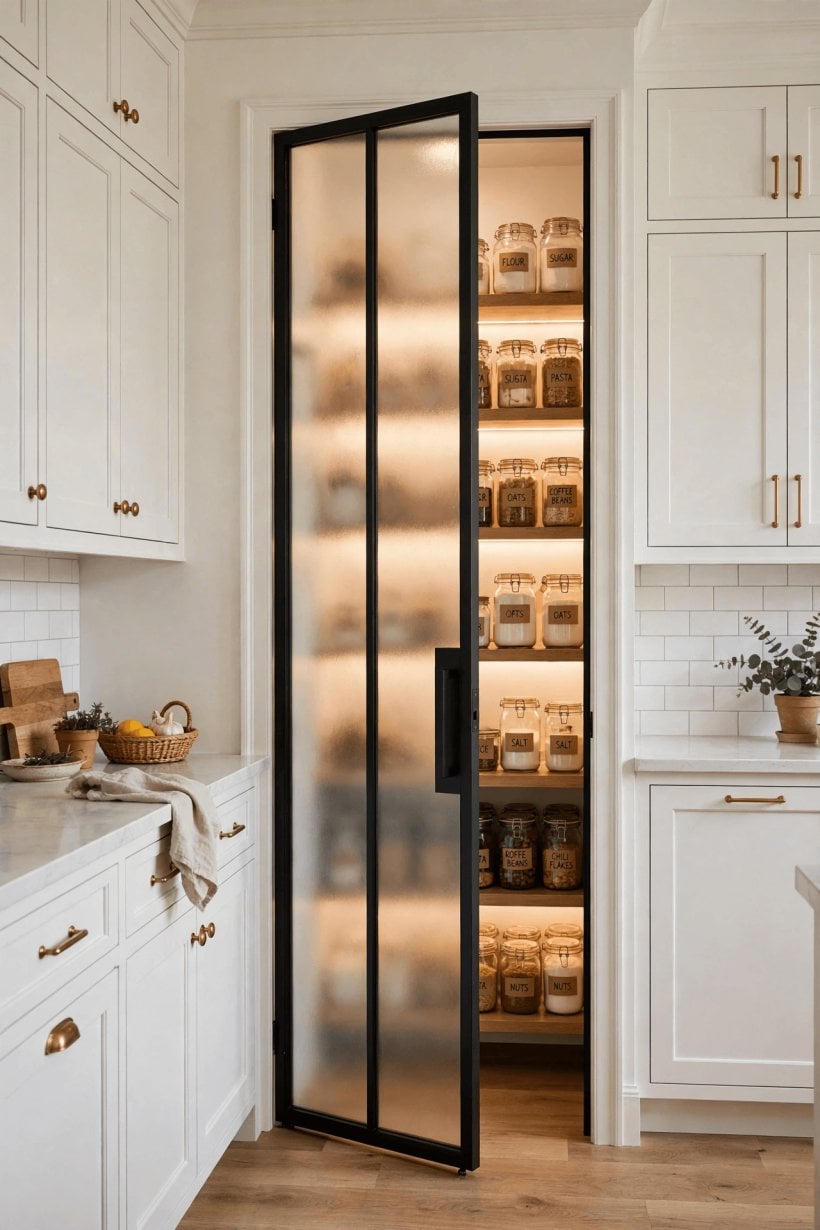
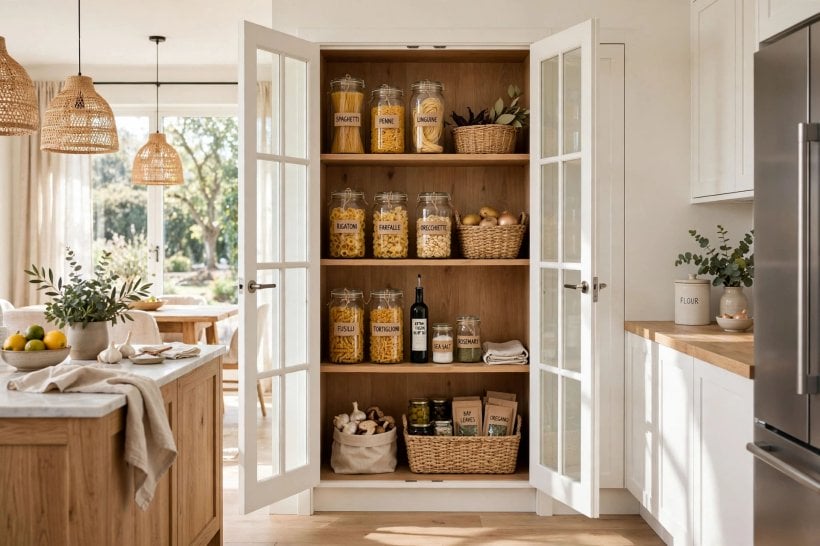
Glass changes a pantry’s mood completely. A glazed door, a pair of narrow French doors or a steel-style frame with divided panes lets light travel between the kitchen and the pantry, which helps when the pantry has no window of its own. It also turns storage into display, so this option rewards households who decant into jars, line shelves neatly and enjoy looking at their provisions. If that does not sound like your household, choose frosted, fluted or seeded glass, which borrows the light while blurring the detail behind it.
Consider the frame as well as the glass. Slim dark frames give a tailored, modern look against pale units; timber frames soften the effect and suit the relaxed schemes found in colourful tiny house interiors, where one strong feature is balanced by quieter surroundings. Match the door’s metalwork, handles and hinges, to the rest of the kitchen so the door reads as part of the design rather than an addition.
Practical notes matter here too. Glass near a working kitchen needs regular wiping, and large panes in a door should be the appropriate safety type for the job, which your supplier or installer can confirm. Ask about the glazing specification rather than assuming, and think about low sun: a pantry that glows at breakfast can also glare by evening.
5. Barn Doors, Tracks and Hardware That Becomes the Feature
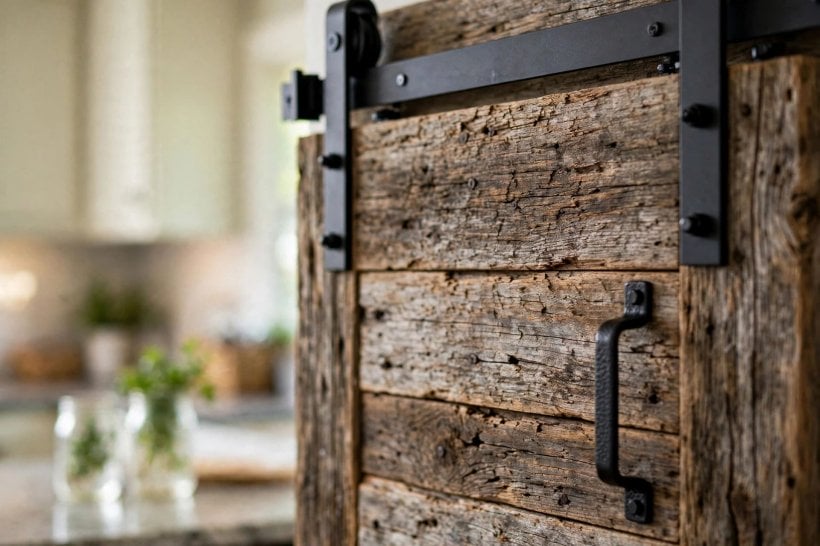
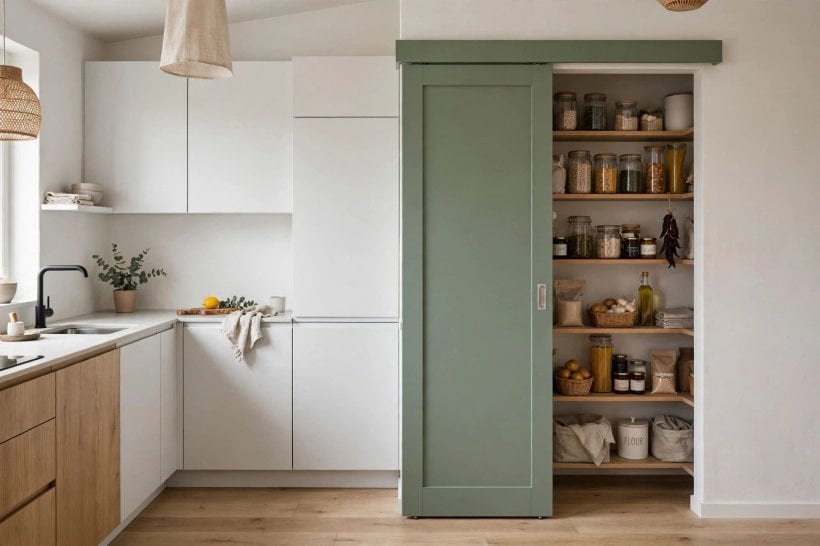
The barn-style door, a slab hung from a visible rail above the opening, is the most recognised of the unusual options. The hardware is the decoration: a blackened steel track, exposed wheels and a chunky handle give a pantry an agricultural honesty that suits wood worktops and open shelving. Because the door hangs in front of the wall, fitting is usually simpler than building a pocket into a wall, and the door can be a single striking piece of timber, new or reclaimed.
Know its habits before you choose it. A barn door sits slightly away from the frame, so it does not seal like a hinged door; sounds and cooking smells travel more freely, and small children or pets may treat the gap as an invitation. The door also needs clear wall to one side, at least its own width, and the track must be fixed into a structure that can carry the door’s weight safely. Your installer can advise on fixings for your wall type; do not rely on the rail finding something solid by luck.
Choose the slab with the room in mind. Vertical boards feel taller, a framed and braced design feels traditional, and a smooth slab in a painted finish reads modern. Whatever the style, give the door a handle you can pull with floury hands, and a stop that prevents it travelling too far and striking the wall.
6. Colour and Finish: The Door as the Kitchen’s One Bold Note
Sometimes the unusual choice is not the mechanism but the colour. It is a single, contained surface, which makes it the safest place in a kitchen to be brave. A deep green, a warm red or a near-black door against pale units gives the room a focal point without committing every cabinet to the same drama. Because the area is small, repainting later is a weekend job rather than a renovation, which makes boldness low-risk.
Finish matters as much as shade. A satin or eggshell finish forgives fingerprints better than a flat matt and wipes clean more easily than gloss, which shows every mark in raking light. If the door is timber, a stain that shows the grain suits a rustic scheme, while a painted finish suits a crisper one. Carry a sample home and look at it against your units in morning and evening light, the same advice that works for any strong colour choice, and check how it sits with the floor, because doors meet floors visually whether you plan it or not.
Handles finish the statement. An oversized pull, a leather tab or a simple knob in a contrasting metal can make a plain door feel designed. Keep the metal consistent with taps and hinges, and the door will look intentional. The same eye for one feature balanced by calm surroundings runs through bedroom interior design for tiny houses, where a single confident element carries a small room.
7. Reclaimed, Vintage and Character Doors With a Past
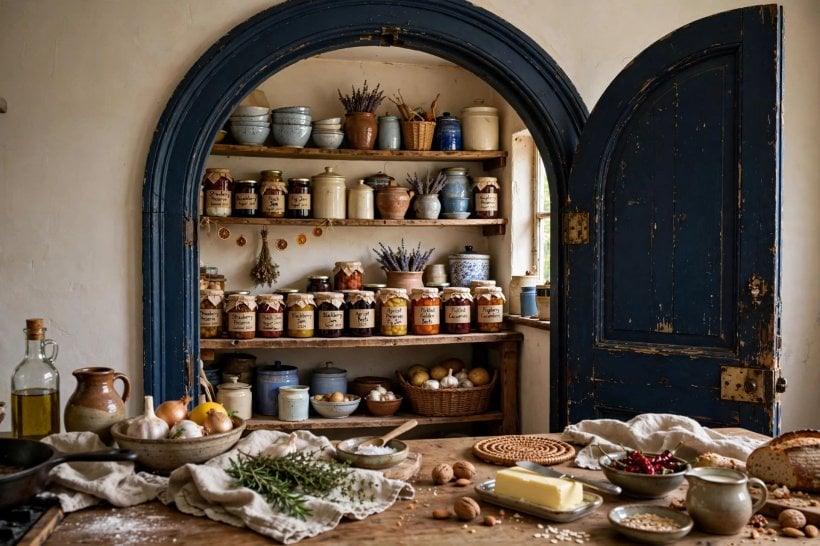
An old door gives a new kitchen something money cannot quite buy: evidence of a previous life. Salvaged ledged doors, old school or chapel doors with narrow panes, and vintage shop doors all turn up in architectural salvage, and a pantry is a forgiving place to use one because the opening is small and the door can be trimmed, within reason, to fit. Check any reclaimed door carefully before you buy: sight along it for twist, look for woodworm and rot at the bottom edge, and confirm it is thick enough to take hinges and a handle where you need them.
Old paint deserves respect and a question. Doors with a long history may carry finishes you would rather identify before sanding, so ask the seller what is known about the door and take appropriate advice before stripping it. Hardware is part of the charm: an original rim latch or iron handle can be cleaned and kept, though you may need modern hinges to carry the door truly.
Expect a little imperfection and enjoy it. A character door will not sit with machine-made precision, and the pantry behind it, with its baskets and jars, is the right home for that looseness. In a house being built or adapted by its owners, the resourceful spirit of how to build your own tiny house applies: reuse what is sound, adapt it carefully, and let its history show.
8. Working Doors: Chalkboard, Pinboard and Message Centres
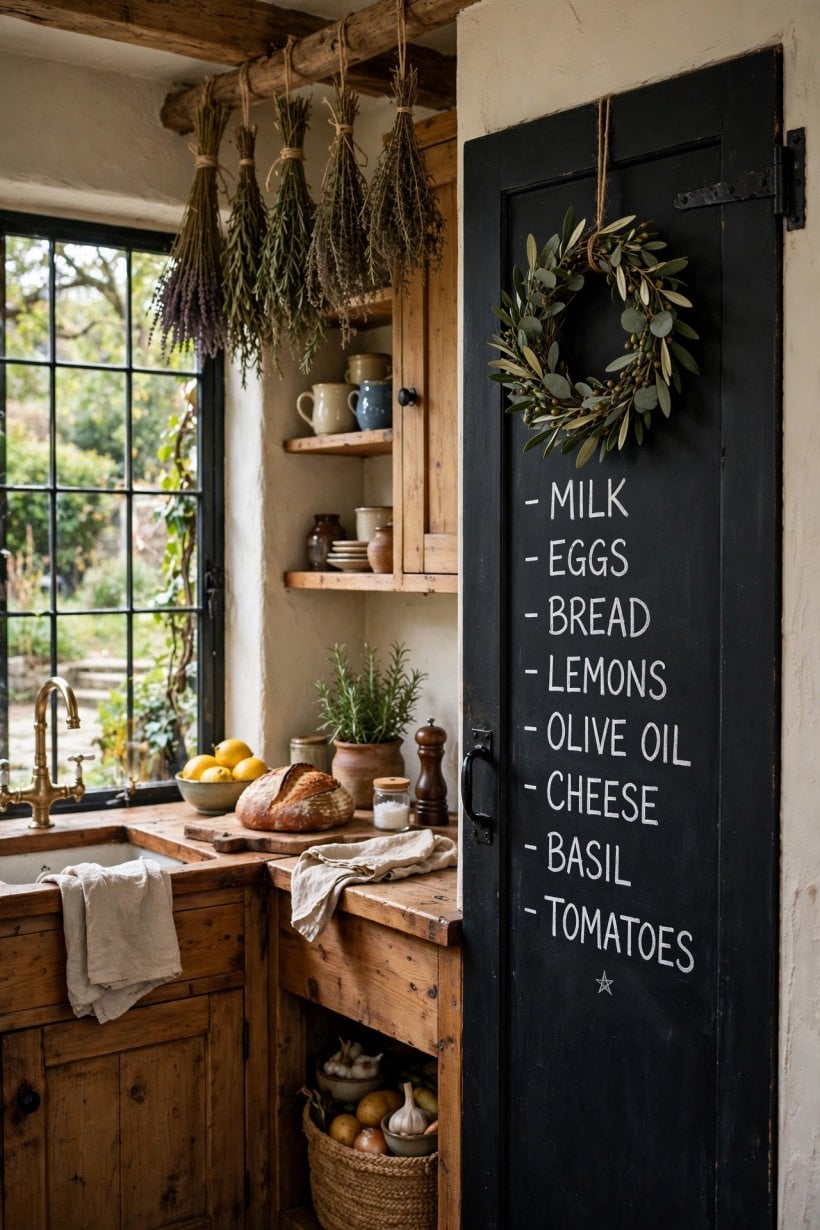
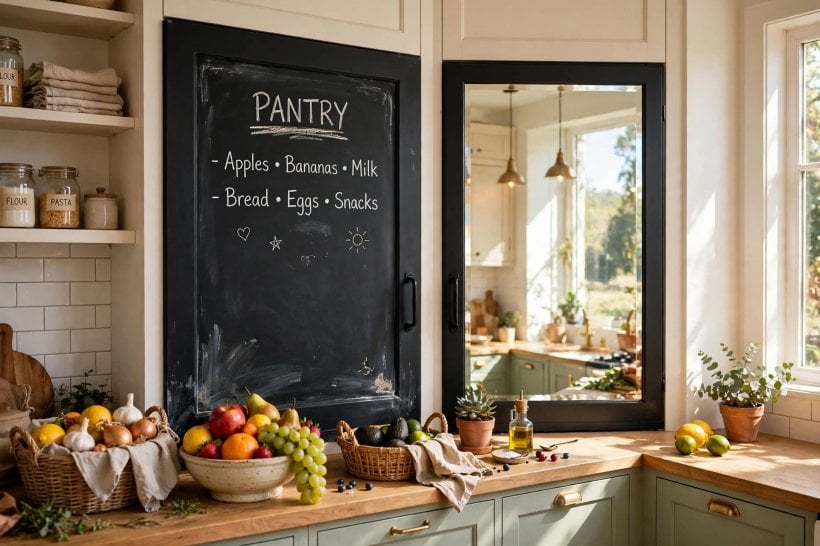
It can also earn its keep. A chalkboard finish on the outer face turns it into the kitchen’s notebook: shopping lists, menus, reminders and the running total of what has run out. Chalkboard paint on a smooth door gives a tidy result, while a framed board hung on the door lets you change your mind later. Liquid chalk pens keep the dust down and write more crisply, which matters if the board will hold a week’s meal plan in small writing.
Variations on the idea suit different households. A pinboard or fabric-covered panel holds invitations, certificates and photographs. A magnetic surface takes timers, spice tins with magnetic bases and the children’s artwork. A slim shelf or a row of hooks on the door’s face can hold aprons and the calendar, though anything projecting needs clearance from the swing and from people passing with hot dishes.
Keep the working door working. A board that is never wiped becomes wallpaper, so place it where the cook actually stands, keep the chalks or pens in a pot fixed beside it, and agree as a household what the board is for. Kitchens organised around a clear daily routine, like the ordered small spaces in tiny house bathroom ideas where every item has a place, stay calmer than kitchens that rely on memory.
9. Small Pantries, Corner Pantries and the No-Door Option
In a small kitchen, the most unusual answer may be no door at all. A cased opening, an arch or a simple square-edged gap into a walk-in pantry keeps traffic flowing, removes the swing problem entirely and makes the pantry feel like part of the kitchen rather than a cupboard. The trade is honesty: shelves are on view, so baskets, matching jars and a little discipline do the work a door used to do. A curtain on a track or rod is the halfway house, softening the view, stopping some dust and opening with a sweep of the hand, at a fraction of a door’s cost and fitting effort.
Corner pantries, built into the angle of a kitchen, often come with angled or double doors, and these can be rethought too. Twin narrow doors meet more gracefully than one wide one, bifolds open the corner fully, and in some layouts a curved or faceted front turns an awkward angle into the room’s feature. Look at the corner from the cook’s position: you want to reach shelves without sidling, and to see what you have without a torch.
Under-stairs and alcove pantries raise the same questions in miniature. A door cut to follow a slope, or a pair of short doors under a stair, uses space that would otherwise be wasted, much as the planting around a small home in tiny house landscaping ideas makes every awkward edge work. Measure these openings twice; nothing about them is standard, and that is exactly their charm.
10. Costs, Fitting and the Checks Before You Commit
Costs for an unusual door are driven less by the door itself than by everything around it. A painted slab on a surface track is mostly the price of the door and hardware plus fitting time. A pocket door adds work inside the wall. A hidden or bookcase door adds joinery, heavy-duty hinges and careful finishing. Reclaimed doors can be cheap to buy and dear to make good, or the reverse. Because prices vary so much by region, materials and the state of your walls, gather itemised quotes from local joiners and installers, and ask each one what is included: hardware, finishing, making good, and disposal of the old door.
Before anyone starts, agree the practical details in writing. Which way does the door travel, what handle is fitted, who supplies the hardware, and what happens if the opening turns out not to be square, as openings in older houses often are not? Photograph the wall before a pocket or track is fitted, so you know where cables and pipes run, and keep the hardware instructions for the day something needs adjusting.
If your home is rented, or the kitchen is listed or in a managed building, check with the landlord or the relevant authority before altering doors and walls, because rules differ and it is far easier to ask first. It is a small project with a large daily effect, and an hour of checking at the start protects every part of it.
Final Considerations
Choose the door that suits how you live, not just how you would like your kitchen to photograph. Start with the opening and the swing, decide how much you want to hide, then let colour, glass, timber or trickery do the rest. It is opened more often than almost any other door in the house, so when it moves smoothly, fits the room and raises a small smile, it has done an unusual job unusually well.

0 Comments