

A leather sofa is a long-term piece of furniture, and the label alone tells you very little. Two sofas can look alike in a showroom and age in completely different ways, depending on the hide, the frame and the care they get. This leather sofa buying guide walks through the checks that matter, in the order to make them, so you can ask better questions before you pay.
There are no brand verdicts here. Instead, you will find what each term usually means, what to look and feel for in person, and which answers to get in writing before delivery day.
1. At a Glance: Quick Questions and Short Answers
| Question | Short answer |
|---|---|
| What should I check first? | Whether the size fits your room, your doorways and your life, before anything about the leather itself. |
| Which leather lasts best? | Ask what part of the hide is used, how it is finished, and get the answer in writing; descriptions vary between sellers. |
| How can I judge comfort? | Sit the way you actually sit at home, for several minutes, and check support at your back, knees and neck. |
| What makes one sofa cost more? | Hide quality and coverage, frame materials, suspension, cushion fillings, workmanship and warranty terms. |
| What should I confirm before buying? | Delivery access, the returns position, care requirements and exactly which parts are covered in leather. |
Read the table as a promise to yourself: do not fall for a finish before you have answered the practical questions. A beautiful sofa that cannot get through the hall, dwarfs the room or cannot cope with your household is the wrong sofa however good the hide is. Work through the checks in this guide in order, size and access first, materials second, comfort throughout, and paperwork last. By the end you should be able to say what the sofa is made of, where the leather is and is not used, how it will be delivered, and what happens if it arrives damaged or simply feels wrong at home.
Take notes as you shop. Photograph labels, keep swatches with the seller’s name written on the back, and write down every promise. Memory is generous in a showroom and hazy a month later, and the notes you make before buying are the ones that settle questions afterwards.
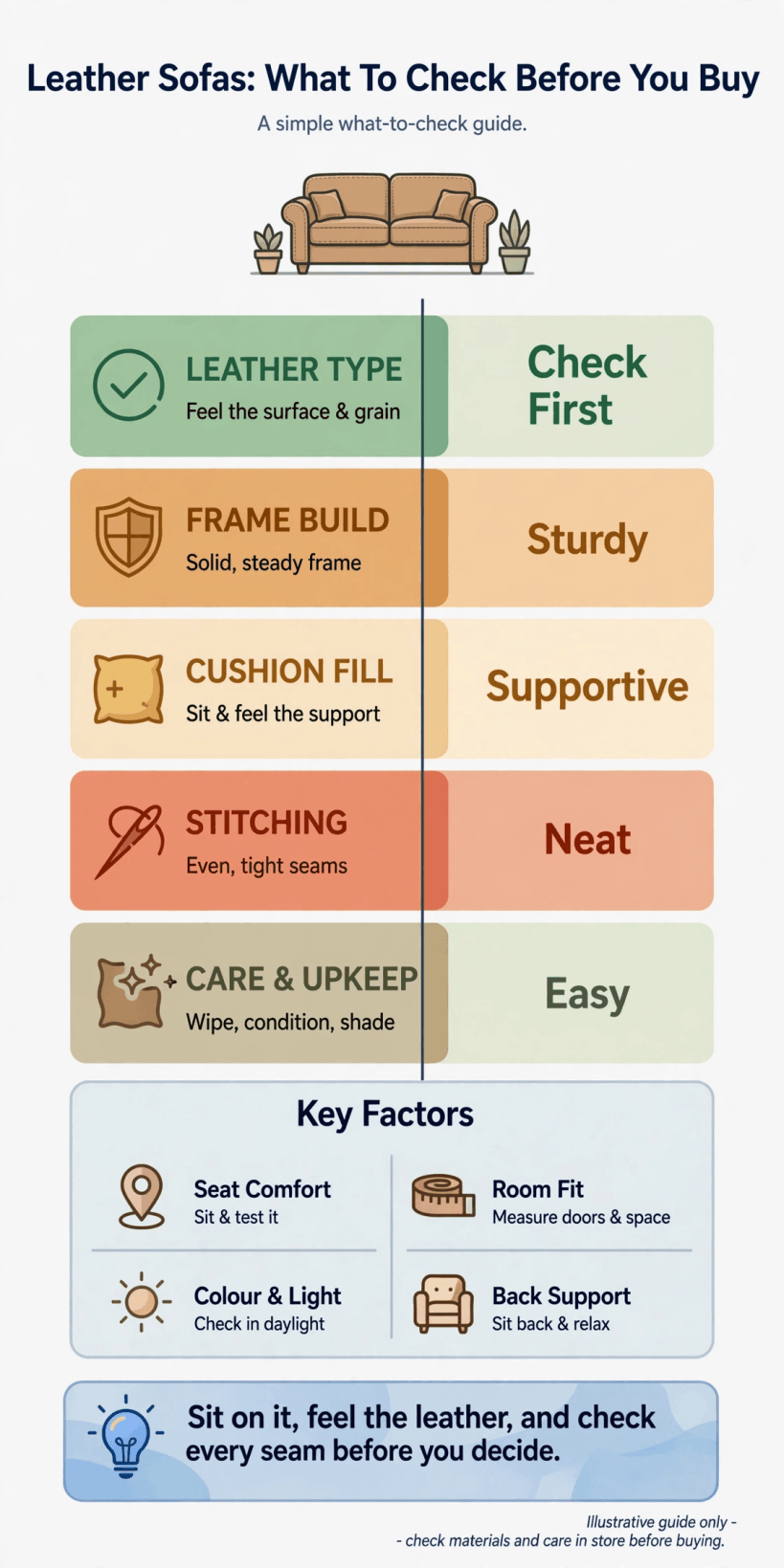
The buying checks in this guide at a glance, from fit and hide to frame, comfort and paperwork.
2. Understand the Leather: Types, Finishes and Honest Descriptions
Sellers use a handful of terms for leather, and it helps to know what each one usually describes. Full-grain generally means the surface of the hide is left largely as it was, with the natural grain visible. Top-grain usually means the surface has been lightly sanded or corrected and finished for a more even look. Corrected leather has been more heavily treated and embossed. Split leather comes from the lower layers of the hide, and bonded material is made from leather fibres. None of these words alone is a guarantee, so ask what the term means for that specific sofa and which panels it applies to.
Finishes matter as much as the hide. Some leathers are dyed through with a light protective surface and will show marks and patina over time. Others carry a heavier pigment coating that gives even colour and more resistance to spills, with a less natural feel. Neither approach is automatically better; the question is whether it suits your household. Homes with children, pets or food near the sofa usually need the more forgiving finish, while a quieter room can enjoy the kind that ages visibly.
In the shop, look closely and touch. Natural grain varies; a perfectly repeating pattern can suggest heavy embossing. Ask for a swatch to take home, then view it in daylight and in your evening light, because colour and texture both change. Press, scratch very gently with a fingernail where the seller allows, and ask how marks should be treated.
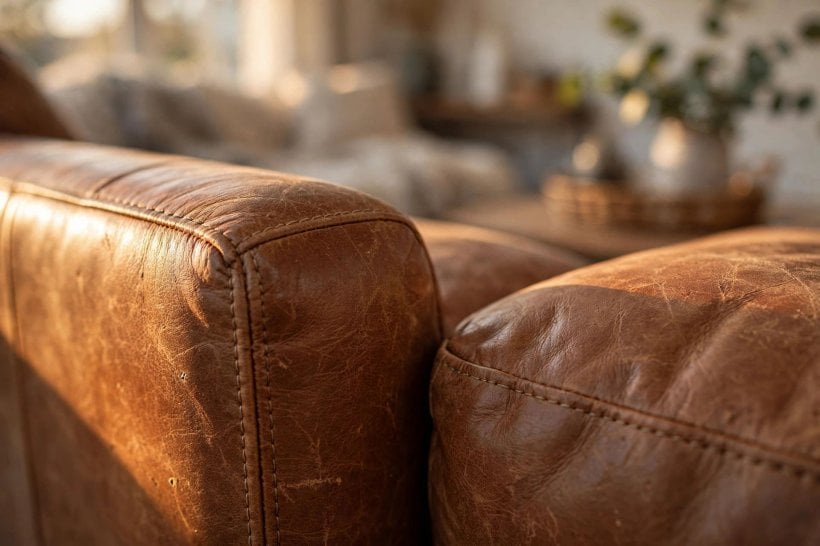
3. Where the Leather Is, and Where It Is Not
One of the most useful questions you can ask is also the simplest: which parts of this sofa are leather? Some sofas use leather on the seats, backs and arms, the areas you touch, and a matching material on the sides and back. That can be a sensible way to control cost, and it is common practice, but you should know before you buy, especially if the sofa will stand in the middle of a room where its back is on show, as many layouts in tiny house living room ideas require.
Check the description carefully for phrases that distinguish the contact areas from the rest, and ask the seller to point to each material on the floor model. Run your hand over the sides and back and compare the feel and grain with the seat. If different materials are used, ask how each should be cleaned and whether they are expected to age at the same rate, because a mismatch that is invisible when new can show after a year of light.
Also ask about the pieces you cannot see. What is under the cushions, how are the inside backs and the platform finished, and is the material consistent in the sample and the delivered item? Get the answers on the order paperwork. A sofa described clearly, panel by panel, is a sofa you can buy with your eyes open.
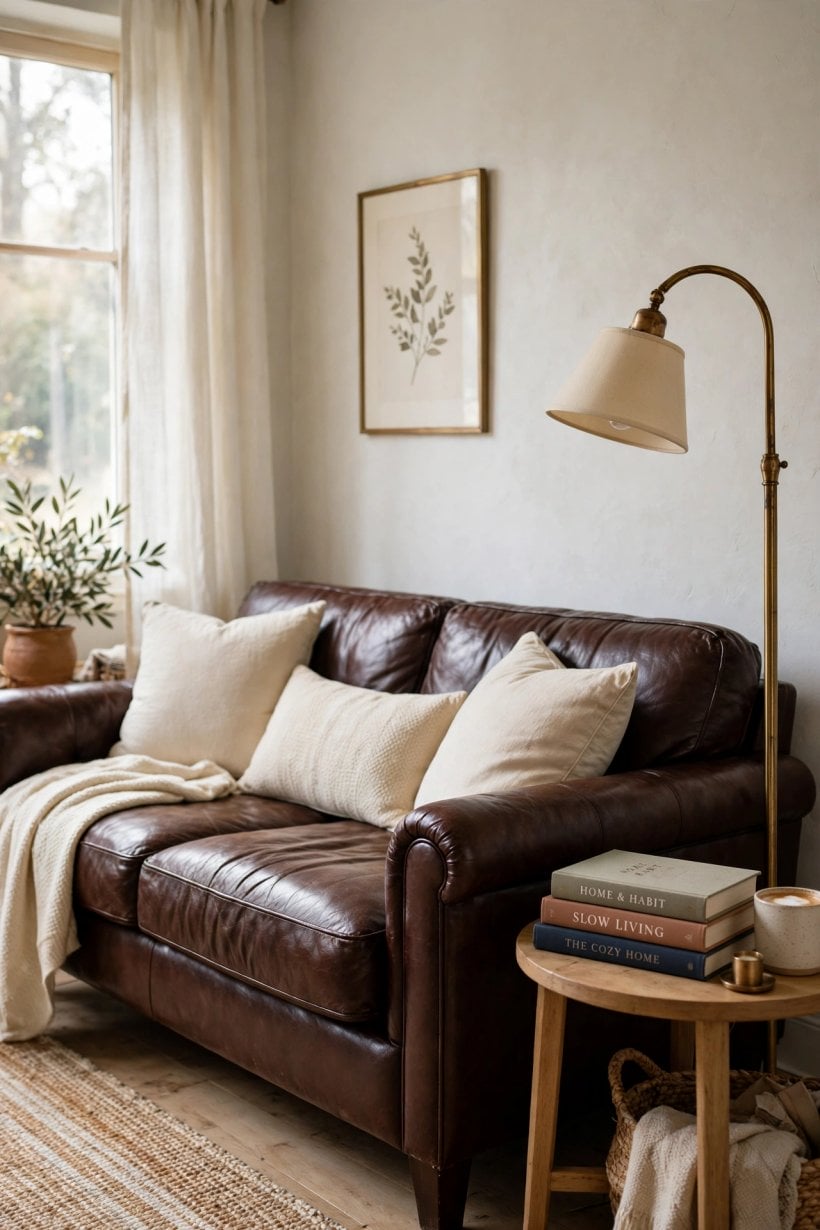
4. Size, Proportion and Getting It Through the Door
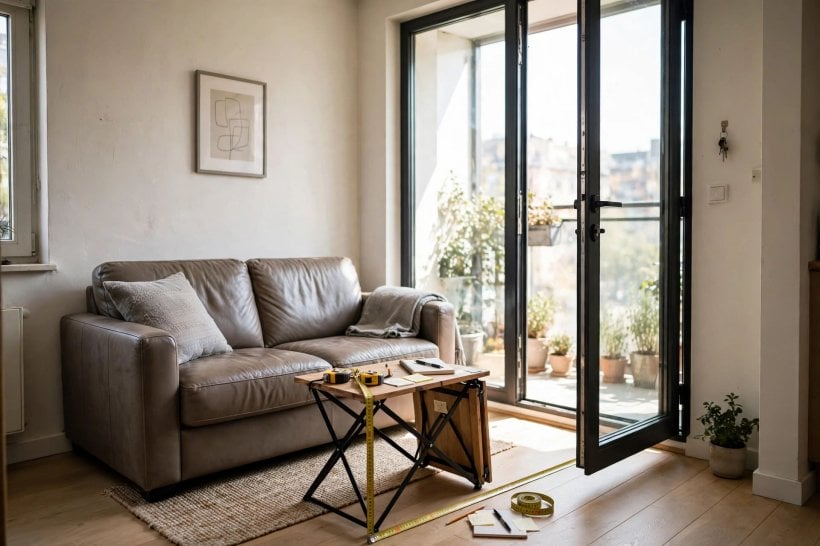
Measure three things before you look at styles: the space the sofa will occupy, the route it must travel, and the people who will use it. In the room, mark the footprint on the floor with tape and live with it for a day. Check that doors, drawers and walkways still work, that other furniture does not crowd, and that the sofa does not block heat sources or light. The planning mindset behind small living room layouts that work applies in any size of home: circulation space is as much a part of comfort as the seat itself.
Then measure the route. Doorways, hall turns, stairwells and lifts decide whether a sofa arrives intact or goes back on the van. Note the narrowest point, the height of ceilings on stairs, and any corners where a long frame must turn. Ask whether the sofa comes apart, whether arms or feet remove, and whether the delivery team has handled your type of access before. A sketch with measurements settles most arguments in the shop.
Finally, proportion. Seat depth suits taller people and loungers; shorter sitters often prefer a shallower seat with back cushions that support rather than swallow. Arm height changes how a sofa sits beside tables. Sit down, stand up, and repeat: if rising feels like hard work in the showroom, it will not improve at home.
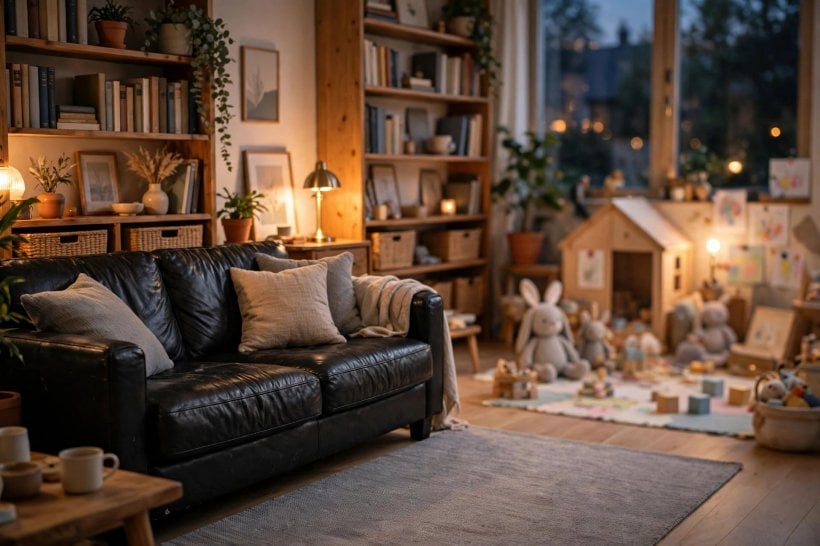
5. Frame, Suspension and the Parts You Cannot See
The frame decides how long a sofa keeps its shape, so ask what it is made from and how the joints are held. Sellers typically describe frames in terms of hardwoods, softwoods, engineered boards or metal, and joints that are glued, screwed, dowelled or stapled. You cannot dismantle a showroom sofa, but you can ask direct questions, read the specification, and test what you can feel. Lift one front corner slightly if the seller allows: a frame that twists and creaks easily is telling you something.
Suspension is what the cushions rest on, and it shapes both comfort and wear. Ask what system is used, whether it runs across the whole seat or in sections, and whether it can be repaired or replaced later. Sit in each seat in turn, including the middle, and notice any dip, roll or hard edge. Shuffle, slump and sit upright. A sofa that only feels right in one careful position will not suit a real household.
Look underneath if you can, and at the back. Neat finishing in unseen places is a fair sign of care in the making. Ask about the warranty for frame and suspension specifically, how long it runs and what it excludes, and keep that answer with your order documents.
6. Cushions and Comfort: Test Them Like You Mean It
Cushion filling changes the whole character of a sofa. Foam generally gives a firmer, neater seat that springs back. Fibre and feather-style fillings feel softer and more relaxed, and usually need plumping to keep their shape. Many sofas combine materials, a supportive core with a softer wrap. Ask what is inside each cushion, seat and back separately, whether covers unzip, and whether fillings can be replaced or topped up in years to come. Replaceable insides extend the life of good leather considerably.
Then do the only test that really counts: sit properly. Spend several minutes on the sofa. Sit as you would to read, to watch a film, to talk. Check that your feet can rest sensibly, that your lower back is supported without a cushion doing rescue work, and that the seat is not so deep or soft that you perch or sink. If two of you will share it, sit together, because width on paper and width between two sets of arms feel different.
Remember that showroom comfort is a first impression, not a promise. New cushions usually soften with use, so ask how the display model compares in age to a new one, and whether the filling is expected to settle. Choose the feel you will still like when it is slightly softer than it is today.
7. Colour, Finish and Living With Light
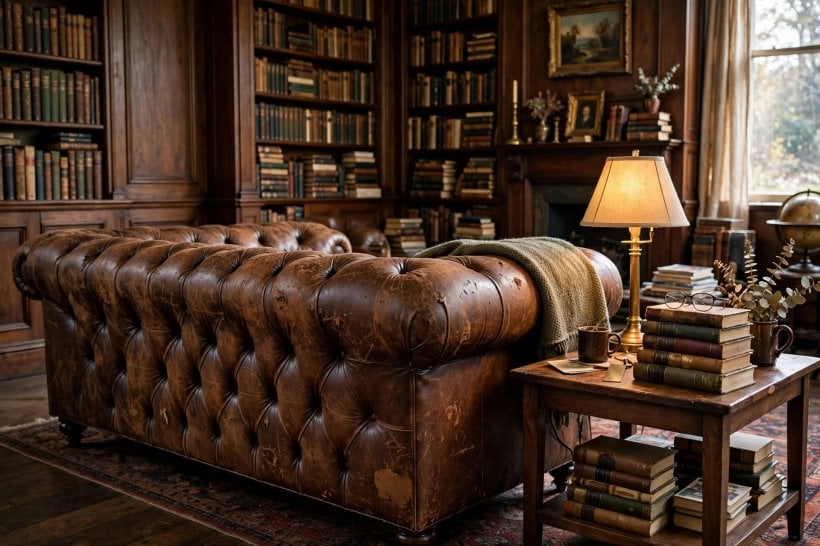
Colour choice is where buyers most often rely on showroom light and regret it at home. Leather can look warmer, darker or glossier under shop lighting than it will by your window. Take swatches home, look at them morning and evening, and place them against your floor, walls and other furniture. If your room scheme is still evolving, the way colourful tiny house interiors balance one strong piece against quieter surroundings is a helpful model: a sofa can be the confident note, or the calm background, but decide which job it is doing.
Think, too, about how finish and light interact over time. Sunlight can change the appearance of many materials, leather included, so ask the seller how the finish you have chosen should be positioned and whether window light needs managing with blinds or a throw. Darker colours can show dust and pale crumbs; paler colours can show dye transfer from clothing and throws. There is no carefree colour, only the one whose habits suit your household.
Order swatches of your final choice and keep one with your paperwork. If the delivered colour looks different from the swatch in the same light, you have evidence for the conversation. Without it, you have only a memory, and memories of colour are notoriously unreliable witnesses.

8. Seams, Feet, Details and the Quality You Can Check
Small details reveal how carefully a sofa has been made, and they are all checkable in the shop. Run your eyes along the seams: stitching should be even, with no skipped or wandering lines, and seams should sit where the design intends rather than drifting. Look at corners and joins where panels meet, check that patterns and grain changes look deliberate, and open and close any zips on cushions to see that they move freely.
Check the feet and the base. Feet should be firmly attached, even in height and finished underneath so they do not scratch floors; ask what they are made of and whether replacements are available. Feel inside arm tops and along the front rail for lumps or hollows that suggest uneven padding. Sit and listen: occasional soft sounds from leather are normal, but persistent squeaks from the frame deserve a question before, not after, delivery.
Details like these are also where comparisons between sofas at different prices become honest. Two sofas may share a similar description, yet differ in the tidiness of hidden work. The layered, built-to-last thinking in tiny barn house interiors, where structure and finish are both on show, is a good standard to hold any large purchase to.
9. Care, Cleaning and Life With Pets, Children and Sunlight
Ask, before you buy, exactly how the leather should be cared for, and be honest with yourself about whether you will do it. Some finishes need only dusting and a damp cloth; others are sold with recommended cleaners or conditioners and a routine. Get the care instructions in writing, note any products the seller says to avoid, and ask what common accidents, such as ink, dye from clothing or pet claws, would mean for your chosen finish. A finish that needs more care than your household will give is the wrong finish, however beautiful.
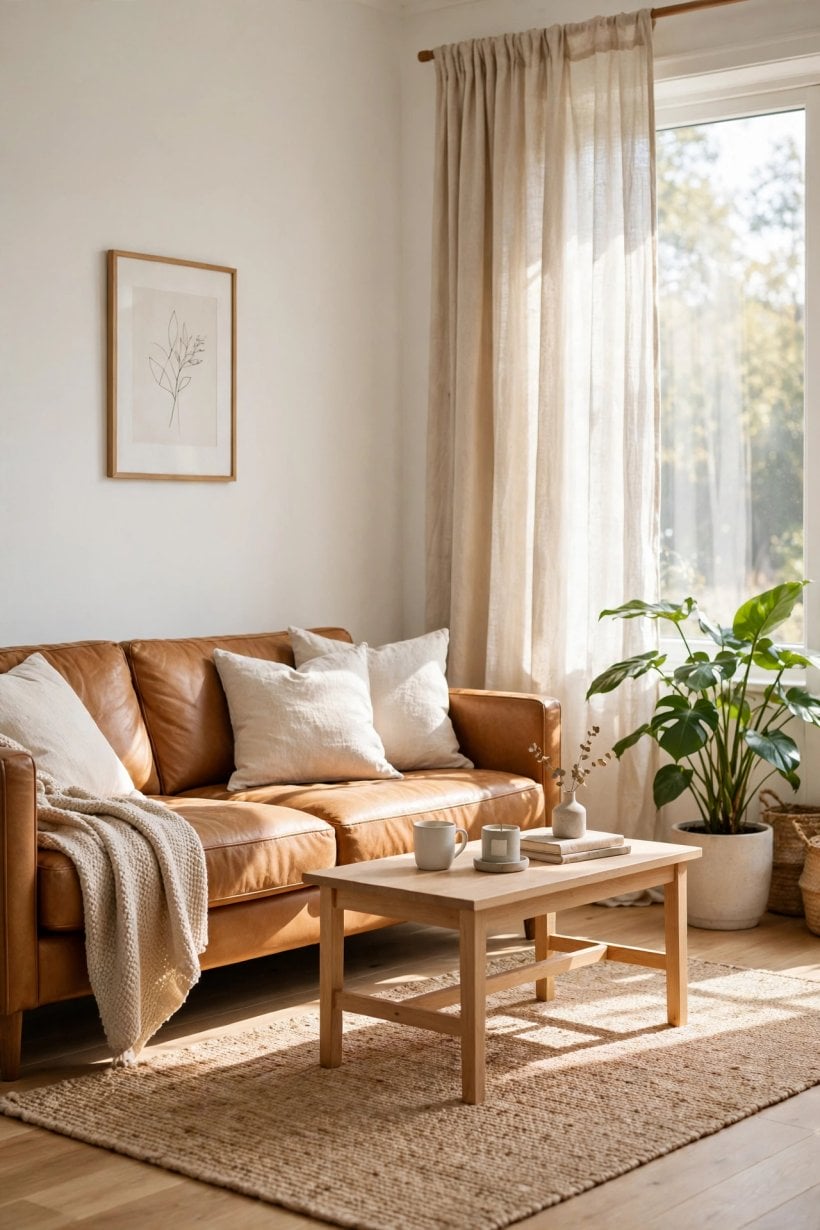
Plan where the sofa will live. Keep it out of harsh, direct sun where you can, and away from heat sources that can dry surfaces over time. Use throws and cushions as working protection in the busiest seats, vacuum crevices with a soft brush, and deal with spills promptly in the way the instructions describe rather than with whichever spray is under the sink. The calm, ordered approach that makes bedroom interiors in tiny houses feel restful applies here too: small, regular care beats occasional rescue missions.
If your household includes animals, say so in the shop and ask which finishes the seller would steer you towards and why. Their answer tells you as much about the seller as the sofa. Practical honesty at this stage is worth more than any guarantee offered in vague terms.
10. Price, Warranty, Delivery and the Questions To Get in Writing
Price makes sense only when you know what it includes. Ask what drives the price of the model you are considering: the hide and where it is used, the frame, the fillings, the size and any features such as recliners or a sofa-bed mechanism. Then ask what is added on top: delivery, installation, removal of packaging or an old sofa, and any care products or protection plans being offered. Read optional extras carefully and decide in your own time; a protection plan is a separate purchase with its own terms, not a standard part of buying a sofa.
Warranties repay close reading. Frame, suspension, cushions, leather and mechanisms may each have different terms, exclusions and claim processes. Ask what counts as normal change in leather, because natural materials are usually expected to soften and show character, and make sure you understand the returns position if the sofa simply does not suit the room. Note the cooling-off and cancellation position for your type of purchase, and who pays for collection if it goes back.
Finally, delivery. Confirm the date process, who contacts you, what access the team needs, and what you should check before signing on the day: panels, feet, cushions, mechanisms and the colour against your swatch. If anything is wrong, note it on the delivery record there and then and photograph it. Careful paperwork, from the guidance in how to build your own tiny house on keeping project documents together, applies to a purchase like this as well: the file you keep is the purchase you can prove.
Final Considerations
Buy the sofa you have checked, not the one you have imagined. Confirm the fit, name the leather and where it is used, test the frame and cushions by sitting properly, choose a colour in your own light, and get the care, warranty and delivery details in writing. A leather sofa bought that way is not a gamble on a showroom impression; it is a considered piece of furniture that should earn its place in your home for years.



0 Comments