

Removing a dated textured ceiling can make a room feel taller, cleaner and far easier to repaint, yet quotes for the same ceiling often differ wildly. Understanding popcorn ceiling removal cost starts with a simple truth: you are rarely paying just to scrape texture off. You are paying for preparation, containment, testing, finishing and cleanup, and each of those stages can move the price.
This guide walks through the real drivers behind a quote, so you can compare estimates fairly, spot what is missing, and decide where careful spending genuinely protects the finished result.
1. At a Glance: The Main Cost Drivers
| Cost driver | What changes | Why it matters |
|---|---|---|
| Ceiling area and height | Square footage, ceiling height and number of rooms | More area means more labour, more material and more waste to handle |
| Painted or unpainted texture | Whether the texture was ever painted over | Paint can seal the surface and make removal slower and messier |
| Age and testing | When the ceiling was installed and whether it is tested first | Older ceilings should be checked before disturbance, which adds a step |
| Finish after removal | Skim coating, sanding and the paint finish you choose | A smooth, paint-ready ceiling takes far more work than a rough one |
| Access and occupancy | Furniture, stairs, tight hallways and whether you stay in the home | Protection, moving and staged work all add time |
| Hidden repairs | Cracks, stains, tape joints and water damage underneath | Repairs are usually priced once the texture is off and damage is visible |
| Containment and disposal | Plastic sheeting, sealing vents and bagging debris | Proper containment keeps dust out of the rest of the home |
| Region and timing | Local labour rates, demand and season | Busy crews and higher-cost areas quote higher for identical work |
Read any quote against this table before you compare totals. A low figure that leaves out skim coating, priming or disposal is not really cheaper; it is simply incomplete, and the missing items tend to reappear later as extras. A higher figure that includes testing, containment, a smooth finish and full cleanup may be the more honest price for the same finished ceiling. Ask each contractor to price the same scope, in writing, item by item.
It also helps to decide your finish before anyone quotes. There is a big difference between a ceiling that is merely scraped and one that is scraped, repaired, skimmed, sanded, primed and painted to a standard you would accept in bright daylight. Most disappointment with this project comes from mismatched expectations about that final surface, not from the scraping itself.
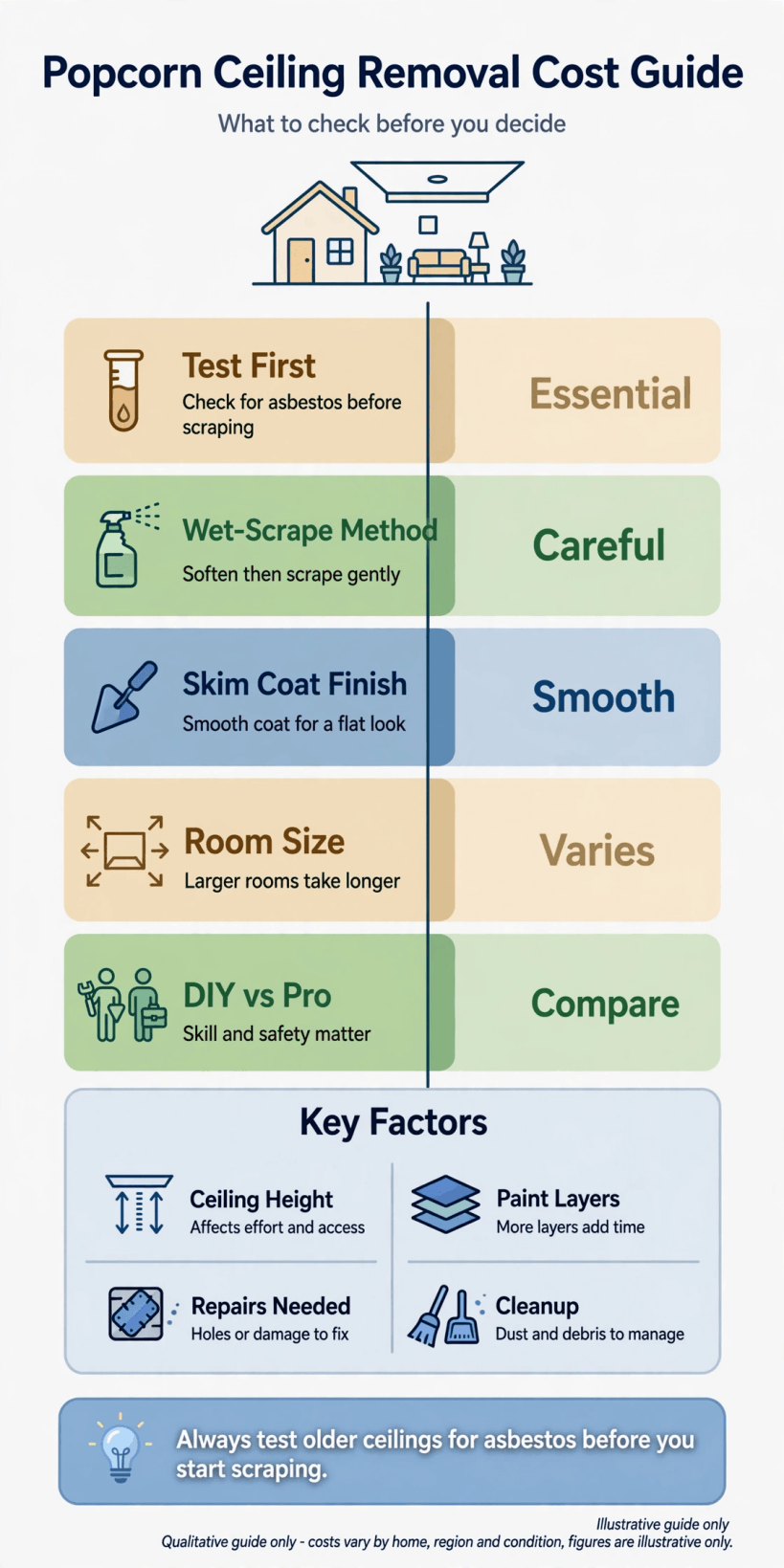
The main drivers behind a removal quote, from ceiling size and testing to the finish you choose afterwards.
2. Ceiling Size, Height and Room Shape
The most basic driver is simply how much ceiling there is. Contractors usually think in square footage, so a large open-plan room costs more than a small box room even when the texture behaves perfectly. Ceiling height matters just as much: a standard-height ceiling can be reached from a step platform, while a tall or vaulted ceiling needs scaffolding, longer setup time and slower, more careful work overhead. Sloped sections, beams, coving and awkward angles all add edges where scraping and skimming take longer.

Room shape changes the maths too. Several small rooms can cost more per square foot than one large room, because each space needs its own masking, protection and cleanup. If you are planning the room below at the same time, browsing tiny house living room ideas can help you decide whether flooring, lighting or layout changes should happen while the ceiling is already stripped and the room is empty. Bundling decisions early rarely makes the ceiling itself cheaper, but it avoids paying twice to empty, protect and repaint the same space.
When you request quotes, give every contractor the same measurements, ceiling heights and room list. Vague descriptions produce vague prices, and a quote based on a guessed area will almost always be revised upwards once the crew arrives and measures properly.
3. Painted, Sealed or Never-Painted Texture
Unpainted texture is usually the friendliest version of this job. It can often be softened with water, then scraped away in sheets, which keeps labour time and mess under control. Once a popcorn ceiling has been painted, especially with several coats or a glossy or stain-blocking paint, water cannot soak in as easily. The crew may need to score the surface, work in smaller sections, use more aggressive methods or remove a thin layer of the board face itself, and all of that adds hours.

This is one reason a neighbour’s price is a poor guide for your own. Two ceilings that look identical from the floor can behave completely differently once work starts, depending on their paint history. Tell contractors honestly if you know the ceiling was painted, and when. If nobody knows, a small test patch in a discreet corner can reveal how the surface responds before a fixed price is agreed.
Paint history also affects the finish you can expect. Heavily painted texture that has to be worked hard can leave a rougher surface that needs more skim coating to look smooth. That extra finishing belongs in the quote from the start, not as a surprise midway through the job, in the same way that anyone planning bedroom interior design for tiny houses learns to cost the preparation behind a scheme, not just the visible decoration.
4. Age of the Ceiling and Testing Before Work Starts
Age matters for one important reason: some older textured coatings and joint compounds were made with asbestos, and the only sensible approach with a ceiling of unknown age is to check before anyone disturbs it. Having a sample tested before work begins is standard safety framing for older homes, not a scare tactic. It is a small, planned step that tells the contractor whether ordinary removal methods are appropriate or whether the job needs a licensed specialist route instead.
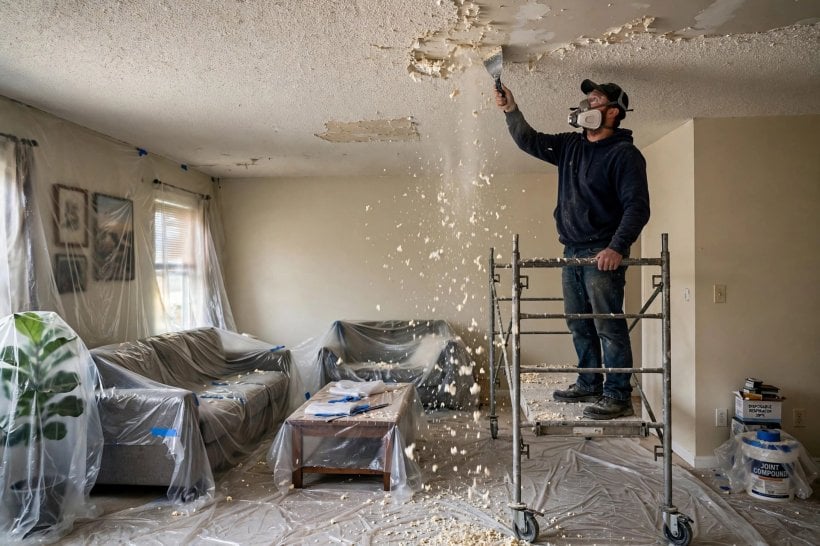
Testing adds a modest cost and a little time at the front of the project, but it protects everyone in the house and prevents a far more expensive problem: starting work, becoming suspicious and having to stop, seal the room and re-plan. If a quote for an older ceiling does not mention testing at all, ask why. A careful contractor will either include it, arrange it or ask you to arrange it before a start date is set.
Do not let anyone talk you into skipping this step to save money, and do not scrape a suspect ceiling yourself to see what happens. Checking first, then choosing the right method for what the ceiling actually contains, is simply how this job is done properly on older properties.
5. What Finish You Want Afterwards
Scraping is only the halfway point. Underneath the texture there is usually a ceiling that was never meant to be seen: uneven joints, screw heads, trowel marks and patches. Turning that into a smooth, modern ceiling takes skim coating, drying time, sanding and often a second skim before priming and painting. The smoother and more flawless you want the result, especially under raking light from windows or downlights, the more finishing labour you are buying.

Some households choose a lighter route, such as a subtle texture, boarding over the existing ceiling or installing panels, and those choices change the price in different ways rather than simply lowering it. Talk through the options with the finished room in mind. A ceiling in a softly lit bedroom can forgive more than one in a bright kitchen. If the room is a sleeper, the calm schemes in tiny house bedroom ideas show how much a plain, smooth ceiling contributes to a restful feel, while the practical layouts in tiny house bathroom ideas are a reminder that moisture-resistant finishes matter more in steamy rooms.
Whatever you choose, get the finish described in words in the quote: how many skim coats, whether priming is included, how many paint coats and what sheen. Those lines are where cheap and careful quotes quietly diverge.
6. Access, Furniture and Working Around an Occupied Home
A ceiling does not exist on its own. Below it there may be heavy furniture, fitted wardrobes, a stairwell, delicate flooring or a home office that someone needs every day. Moving furniture out, protecting what stays, sheeting floors and stairs and working around an occupied home all take time, and time is what you are paying for. An empty rental between tenants is simply cheaper to work in than a lived-in family home where a crew must re-sheet and tidy every evening.

You can reduce this part of the bill with preparation of your own. Clear small items, lamps, curtains and ornaments before the crew arrives, decide where furniture will go, and agree access routes, parking and working hours in advance. In a compact property the discipline is familiar: anyone who has studied tiny barn house interior layouts knows that in a small footprint every staging decision matters, because there is nowhere spare to put things.
Be realistic about living through the work too. Even with good containment, this is a dusty, disruptive job, and rooms being worked on are out of use. If a contractor needs you to vacate a room for longer than expected, that inconvenience is part of the true cost, even though it never appears on the invoice.
7. Damage Hiding Underneath the Texture
Texture is an excellent hiding place. Beneath it there may be hairline cracks, old water stains, loose tape, sagging sections or previous repairs that were covered rather than fixed. None of that is visible until the ceiling is stripped, which is why careful quotes either include an allowance for minor repairs or state clearly that repairs found underneath will be priced once they can be seen. Either approach is reasonable; what matters is that it is agreed before work starts.

Water damage deserves particular attention. A stain is a symptom, not the problem itself, and skimming over a ceiling while a slow leak continues above it wastes every penny of the finishing work. If staining appears, find and fix the source first, let everything dry properly, and only then finish the surface. Contractors who insist on that sequence are protecting your money, not padding the job.
Structural concerns are rarer, but sagging or cracked boards that move under pressure may need re-fixing or replacing rather than coating. Again, this is scope that legitimately changes the price, and a good contractor will show you the problem area and explain the options before going ahead.
8. Containment, Cleanup and Disposal
Wet scraping keeps dust down, but this is still one of the messiest jobs in a home. Proper containment means sealing the room with plastic, covering floors and any remaining furniture, protecting vents and fittings, bagging debris as it comes down and cleaning thoroughly at the end. All of that material and labour is a real part of the job, and quotes that include it properly will look higher than quotes that quietly assume a broom and a bin bag.

Disposal matters too. Bagged ceiling debris is bulky, and it needs to leave your property somehow, whether that is a skip, a licensed waste service or trips arranged by the contractor. Confirm who is responsible for it and where it goes. Debris left in bags by the back door has not been disposed of, whatever the quote implied.
Ask, too, how the crew will protect the rest of the house: hallway sheeting, dust control at doorways and a final clean that includes sills, skirting and floors. The colourful finished rooms in colourful tiny house interior features only look that fresh because someone did the unglamorous cleaning properly before the furniture went back. Cleanup is not an optional extra on this project; it is part of a finished job.
9. Labour, Timing and Where You Live
Most of what you pay for is skilled time, so local labour rates shape the quote more than any material. The same ceiling will cost more in a high-cost city than in a small town, and more when good crews are booked out for weeks than in a quiet season. None of that reflects the quality of your ceiling; it reflects the market the contractor works in. Getting quotes from genuinely comparable local firms tells you far more than any national average.

Timing can be used sensibly. If your project is flexible, asking when a contractor has a gap between larger jobs may produce a keener price than demanding a start next week. What rarely works is pressuring a crew to rush the finishing stages. Skim coats need drying time, and sanding or painting too early leads to a surface that has to be redone, which is the most expensive outcome of all.
Finally, remember that availability cuts both ways. A contractor who can start tomorrow in a busy market may simply be quiet for a reason. Check recent reviews, ask to see a finished ceiling if you can, and treat a sensible wait for a trusted crew as part of buying a good result.
10. Getting Comparable Quotes and Avoiding False Bargains
The safest way to judge the final popcorn ceiling removal cost for your home is to make every contractor price exactly the same job. Write a short scope: rooms and measurements, testing where the ceiling is older, whether the texture is painted, the finish you expect, who moves furniture, who disposes of debris and whether priming and painting are included. Give that same scope to each firm and insist on itemised written quotes rather than a single round number.
Then read for what is missing, not just what is present. Does the quote mention containment? Testing? Skim coats by number? Repairs, and how they will be charged if damage appears? A vague low quote transfers all of that risk to you, because every omission becomes a negotiation in the middle of a dusty job, when you have the least bargaining power. Anyone who has followed a self-build route, such as the readers of how to build your own tiny house, will recognise the pattern: unspecified work is never free work.
Check the basics as well: insurance, a real business address, recent references and a payment schedule tied to stages rather than a large sum upfront. Keep a small contingency for the repairs that only reveal themselves once the texture is off. That is not pessimism; it is how experienced homeowners budget for a job whose full scope literally cannot be seen at the start.
Final Considerations
A textured ceiling is not removed in an afternoon of scraping, whatever the simplest quotes suggest. The price reflects area, height, paint history, sensible testing on older ceilings, the finish you choose, access, hidden repairs, containment, disposal and the local cost of skilled labour. When each of those is named and priced openly, the total usually makes sense, and the differences between quotes become easy to explain.
Choose the contractor whose quote describes the finished ceiling you actually want, in the home you actually live in, with the cleanup included. That is the quote most likely to still look like good value when the sheeting comes down, the light hits the ceiling and the room feels new again.




0 Comments