
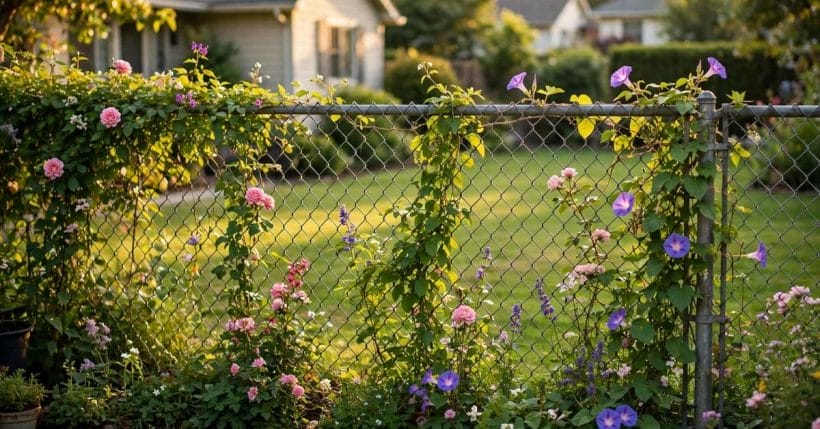
Chain link is the honest fence: affordable, durable, nearly invisible from a distance and famously plain up close. The good news is that plain is a starting point, not a verdict.
These seventy-five ideas take a chain link fence you already have — or are considering — and make it beautiful: paint and colour first, then slats, screens and panels, then the vines and planting that do most of the work, and finally gates, front-garden kerb appeal, pet and pool boundaries, and the care that keeps it all looking meant.
1. Pretty Chain Link Fence Ideas at a Glance
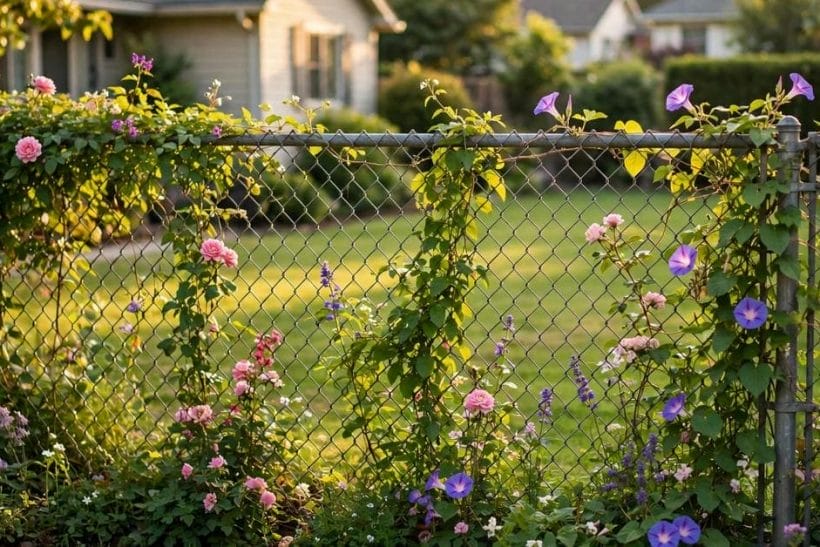
A chain link fence has three layers to work with: the mesh itself, which takes colour and woven strips; the line it stands on, which takes screens, panels and planting; and the frame — posts, rails and gates — which takes paint and finish.
Splits within the fence family, stated plainly: this post is chain link made prettier. For mesh of a different kind, our hog wire fence post covers panel-and-mesh fencing for gardens and livestock edges, and for the privacy function itself — fences whose job is to block views — the privacy fence ideas post is the specialist. Gates across the family live with the gate ideas pillar. Here, the mesh stays and the beauty is added.
| Question | Short answer |
|---|---|
| What is the fastest transformation? | Paint the mesh and frame black or dark green — the fence visually recedes and the garden comes forward |
| What gives real privacy? | Woven slats, mesh privacy screens or dense planting against the line; vines alone give dappled, seasonal cover |
| What do the plants need? | A narrow bed at the fence foot, support the mesh already provides, and patience — climbers take seasons, not weeks |
| Before I start? | Confirm the fence is yours to alter, check local rules on height and appearance, and repair or straighten first — decoration emphasises a lean |

2. Paint and Colour: The One-Day Transformation

Colour is the cheapest revolution a chain link fence can have. These ideas turn the mesh from the subject of the view into its background.
1. Black mesh disappears best
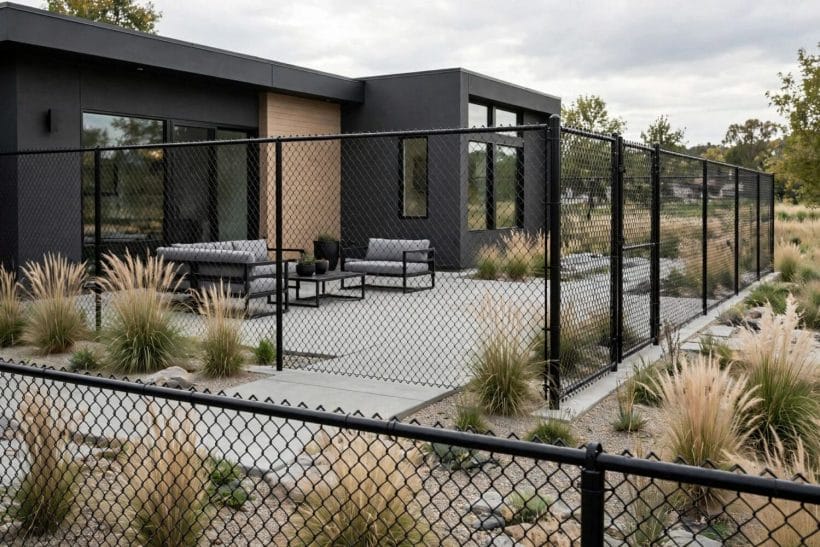
Dark colours recede: a black-painted or black-coated chain link fence reads as shadow and lets planting carry the eye. Against lawns, hedges and flower beds it is the closest thing to an invisible fence, which is why modern houses choose it almost by default.
2. Dark green for the garden boundary
Where black feels architectural, deep green is the garden’s own camouflage. Green mesh against a hedge or tree line vanishes in summer and stays quiet in winter, and it flatters cottage planting and country boundaries alike.
3. Paint posts, rails and mesh as one
A coloured mesh on galvanised posts looks half-done. Whatever finish you choose — painted, powder-coated or vinyl-coated from the start — carry it across posts, top rail, tension bars and gate frames so the fence reads as one object in one colour.
4. White for the cottage picket effect
White chain link is rarer and braver: against flowering planting it gives a picket-fence brightness with none of the picket maintenance. It suits front gardens and cottage plots where the fence is meant to be seen and enjoyed rather than hidden.
5. Match the house trim
If the house wears a strong trim colour — charcoal window frames, a deep door — repeating it on the fence ties boundary to building. The fence becomes part of the architecture’s palette instead of an afterthought that happened to be silver.
6. Two-tone: dark frame, lighter infill tricks
A dark frame with the mesh left lighter can work in reverse compositions — pale planting against it, for instance — but it is the advanced move. When in doubt, one colour everywhere is the disciplined default; two tones want a deliberate reason.
7. Refresh tired galvanising honestly
Weathered mesh with rust spots should be cleaned, treated and recoated with products a local supplier recommends for galvanised metal — preparation stated generally because products vary. Paint over active rust and the fence will freckle through by the second season.
8. The gate in the fence’s colour
Gates are where fences announce themselves, so the gate frame and mesh take the fence’s finish exactly, with black hardware. A gate that matches disappears into the run; a gate that contrasts becomes the garden’s front door — choose deliberately, as the gate section develops.
3. Privacy Slats and Woven Strips
Slats weave vertically through the mesh and turn a see-through fence into a striped wall. These ideas use them where they shine and avoid them where they sag.
9. Slats on the neighbour’s side only
Privacy is usually needed on one or two boundaries, not all four. Slatting the overlooked runs and leaving the garden-facing runs open keeps the plot feeling spacious and spends the slat budget where eyes actually pass.
10. Slat colour that matches the planting plan
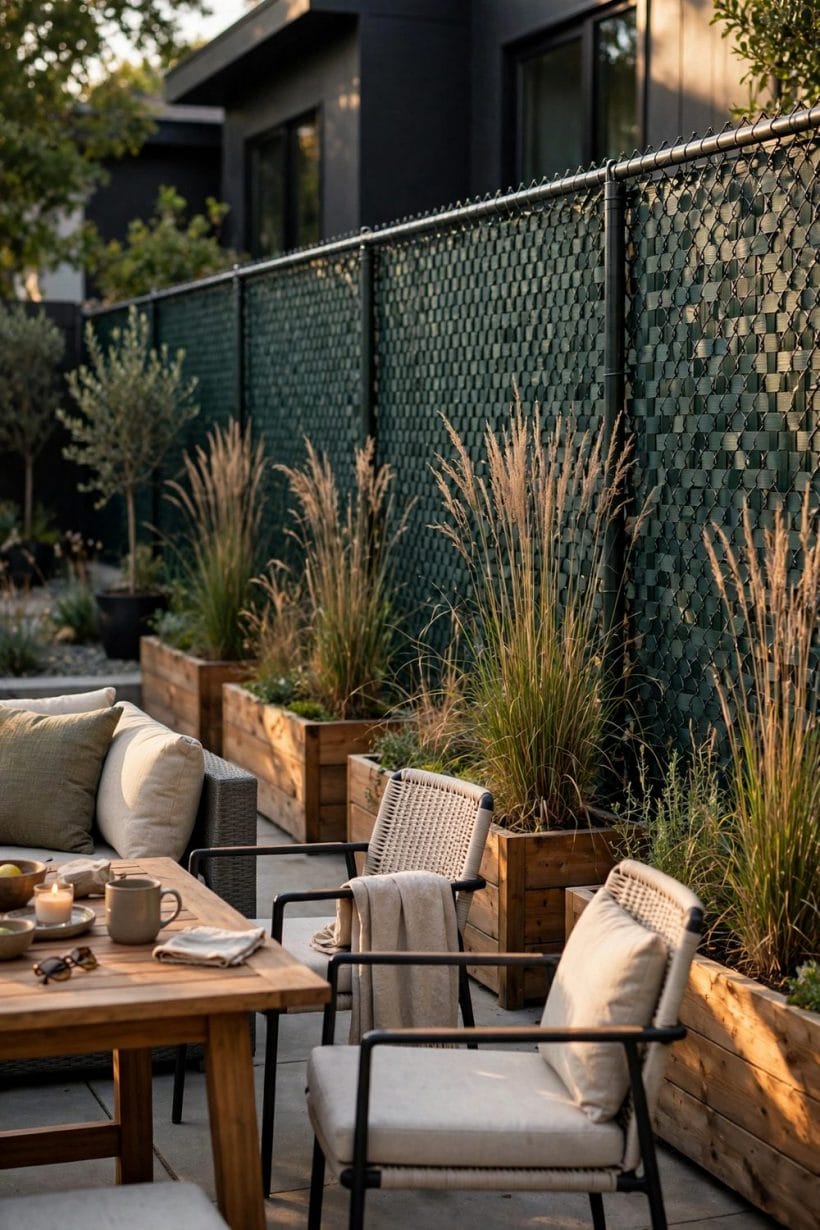
Slats come in colours; choose against the garden’s scheme, not the fence’s. Green slats behind shrubs double the greenery, brown reads as timber at a glance, and pale slats brighten a shaded boundary where plants struggle.
11. The woven-strip alternative
Flexible strips woven horizontally through the mesh give a softer, fabric-like finish than rigid slats and follow slight fence irregularities kindly. They suit rental-friendly and reversible makeovers — everything woven can be unwoven when tastes or tenancies change.
12. Partial slatting for light and air
Slats need not run the full height. A slatted lower band with open mesh above gives seated privacy in a garden while standing views and breezes pass over — a compromise that keeps small gardens from feeling boxed by their own boundaries.
13. Slats plus climbers, the belt-and-braces
Where privacy must be total, slats give it instantly and climbers soften them over the following seasons. The combination is the professional’s answer for overlooked urban gardens: structure now, beauty compounding yearly.
14. Keep the wind in mind
A slatted fence catches wind like a sail where open mesh let it through.
15. Slat the gate too, or frame it
An open gate in a slatted run is a hole in the wall. Weave the gate’s mesh to match, or accept the contrast deliberately and frame the gate as the boundary’s designed feature, with the planting of the later sections gathered around it.
16. Rental-friendly reversibility
Slats and woven strips share a virtue owners overlook: they remove cleanly. For rented homes and future re-sales, they are the privacy upgrade that leaves no evidence — worth stating in a make-over plan so the fence’s next chapter stays open.
4. Screens, Panels and Covers
Where slats work within the mesh, screens work in front of it: a second skin hung on the fence’s frame. These are the fastest covers of all.
17. Bamboo and reed screening
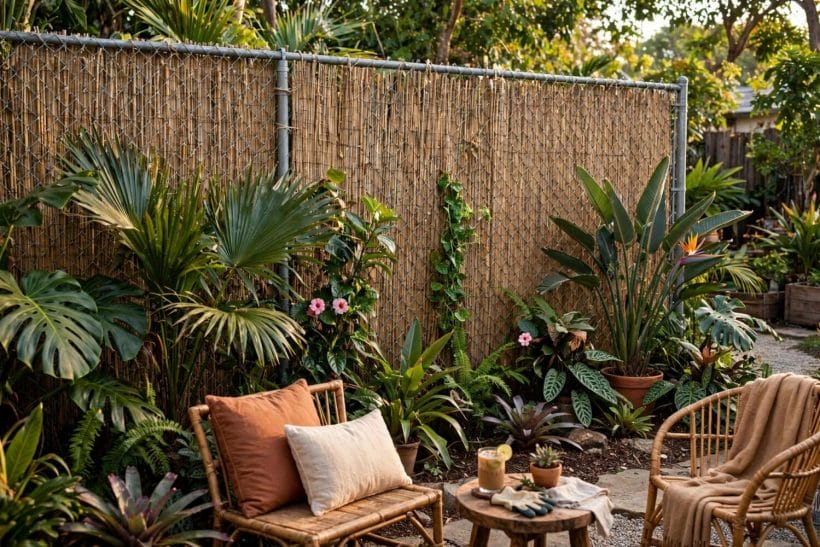
Rolled bamboo or reed fixed to the mesh gives instant texture and a holiday-garden warmth. It weathers to grey over the seasons, which suits naturalistic planting; treat it as a medium-term cover to renew rather than a permanent wall.
18. Brushwood and willow hurdles
Woven hurdles cable-tied or wired to the fence line bring the countryside’s own fencing language over the metal. Against cottage planting they look entirely intentional, and individual panels replace as they age without disturbing the fence behind.
19. Mesh privacy fabric
Woven privacy mesh — the knitted fabric sold for fences and scaffolds — stretches taut, comes in greens, blacks and sands, and filters views while letting air pass. Fixed evenly with tidy ties, it reads as a deliberate screen; fixed loosely, it reads as laundry.
20. Timber panels inside the line
A run of timber panels or horizontal boards fixed inside the chain link gives a fully architectural boundary while the mesh quietly does security duty behind it. It is the most expensive cover and the most complete: the chain link all but vanishes from the garden’s side.
21. A trellis skin for climbers
Timber or metal trellis panels mounted on the fence give climbers a handsome ladder and the eye a pattern while the plants establish. Even bare in winter, trellis reads as garden structure rather than covered fence — the cover that needs no apology out of season.
22. Shade cloth for the working areas
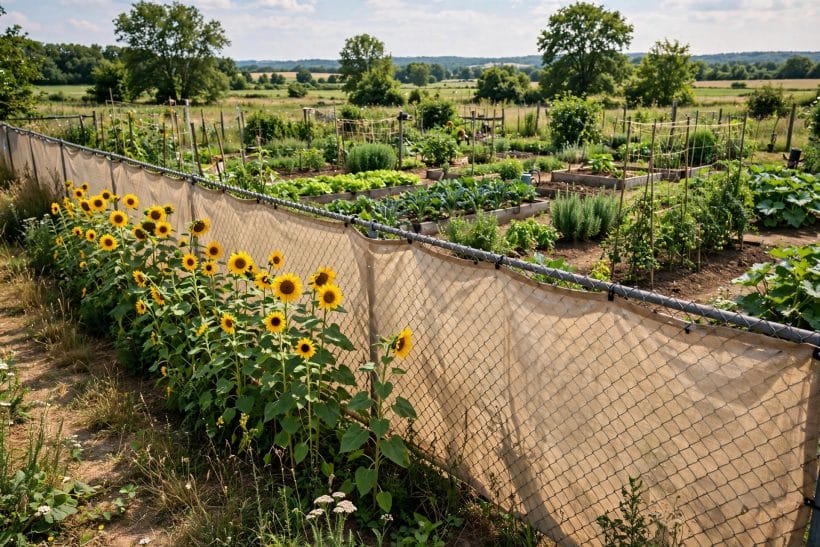
Vegetable plots, dog runs and utility corners ask for function over finery: shade cloth or mesh fabric cools, screens and tidies in one move, and its plainness suits the working end of the garden where the pretty sections would be wasted.
23. Patterned metal panels as the feature bay
One or two decorative metal panels set into the run — at the gate, opposite the kitchen window — turn coverage into composition. The fence becomes a gallery wall with a feature bay, and the plain mesh between reads as its quiet hanging space.
24. Layer screens with planting pockets
Screens need not be flat: leave planting pockets and offsets where a shrub or a pot group stands in front, breaking the screen’s line. A boundary that steps in and out around planting feels designed; a dead-flat screen, however pretty its material, always confesses.
5. Climbing Plants and Green Cover
Plants are the chain link fence’s destiny — the mesh is a climbing frame that never needs building. These ideas grow a boundary instead of merely covering one.
25. The mixed climber hedge
Two or three climbers with different seasons — spring flowers, summer green, autumn colour — woven through one run give a fence that changes monthly. Mixed planting also insures: if one plant fails or rests, the others hold the cover.
26. Evergreen backbone first
For year-round privacy, plant the evergreen climbers and let the flowering ones decorate them. A fence that is beautiful in July and bare wire in January solves only the summer’s problem; the backbone planting is what makes green cover a boundary rather than a display.
27. Roses along the sunny run
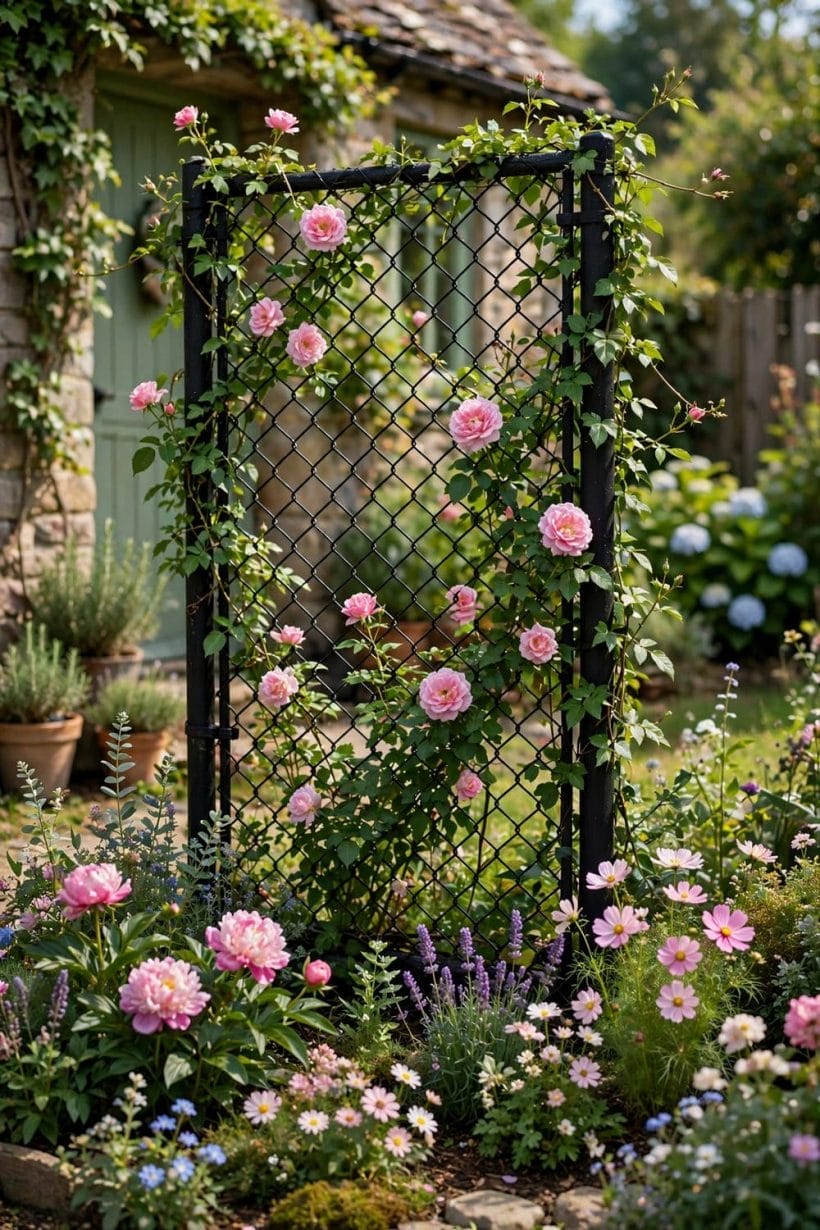
Climbing and rambling roses were made for mesh: the ties are the fence itself. Along a sunny boundary they give the classic cottage photograph — the one on this post’s cover — and their thorns politely discourage climbing of the human kind.
28. Fast cover for the impatient season
Annual climbers — sweet peas, morning glory, nasturtiums — cover a fence in a single summer while the permanent plants establish. Sow them at the fence foot in the permanent plants’ gaps and the boundary never has a bare year.
29. Ivy, used with judgement
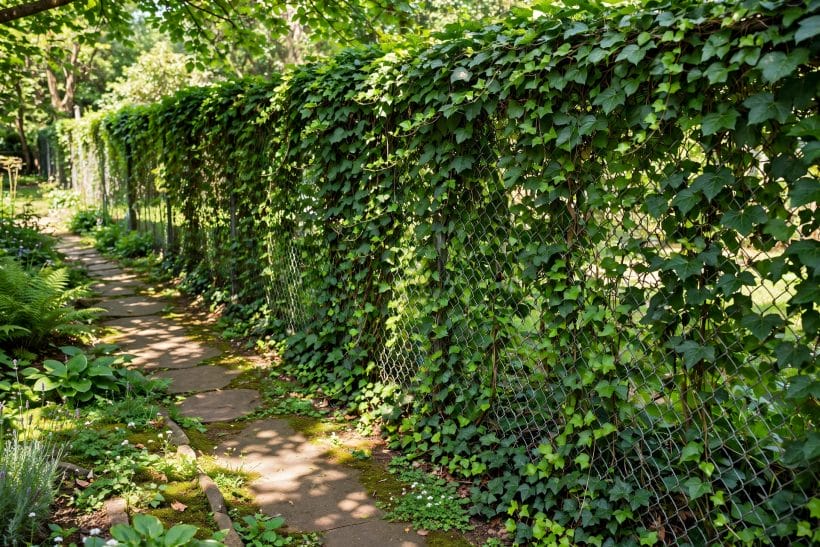
Ivy covers completely and evergreenly, and it also holds moisture against the mesh and can shorten a tired fence’s life.
30. Espalier and trained shrubs
Fruit trees and flowering shrubs trained flat against the mesh give a boundary that is both wall and harvest. The fence supplies the support grid; the pruning, done seasonally, supplies the pattern. It is the most gardenerly of all the covers and the most rewarding.
31. Herbs and scent at the gate
Where hands brush the fence daily — the gate, the path to the door — plant for scent: jasmine, honeysuckle, a rose by the latch. The boundary becomes a moment in the day’s route rather than a piece of infrastructure nobody notices.
32. Keep climbers off the moving parts
Gates must swing and latches must work in every season. Plant climbers a respectful distance from hinges and gate posts, train them away from the swing, and prune the gate bay hardest. Beauty that jams the gate in June gets cut back by July, roughly.
6. Planting Beds Along the Line
Even without climbers, a planted foot transforms a fence. These ideas build the border that makes any chain link run look gardened.
33. The narrow bed that changes everything
A bed even a spade’s width deep along the fence foot, mulched and planted, converts the boundary into a border. The mesh rises out of flowers instead of out of weeds and gravel, which is most of the difference between a yard and a garden.
34. Shrubs in front, mesh forgotten
A staggered row of medium shrubs a pace inside the line hides the fence at seated eye level while the mesh quietly continues above and behind. From the house, the boundary reads as planting; the fence has retired from view without retiring from duty.
35. Ornamental grasses for the modern line
Grasses against black mesh — as in one of this post’s photographs — give movement, autumn colour and a designed spareness that suits contemporary houses. They also forgive the fence’s straightness by never holding a straight line themselves.
36. The sunflower and vegetable screen
Sunflowers, sweetcorn, beans on the mesh and tall annuals make the productive garden’s fence a seasonal wall of green industry. It is the allotment tradition, and it works in any garden that grows food against its sunny boundary.
37. Repeat one plant for rhythm
A single plant repeated along the run — lavender, a rose, one grass — gives a long fence the rhythm that makes it look designed. Mixed planting suits short runs; repetition is what long boundaries are asking for.
38. Mulch and edge the bed properly
A defined edge and a clean mulch line signal intention more loudly than the plants themselves. The fence foot is where gardens look neglected first; a crisp edge there makes even a young, sparse planting read as a plan in progress.
39. Pots against the problem stretches
Where digging is impossible — paving, roots, services — group large pots along the line instead. Pots bring the green to the fence’s foot on hard ground and can be rearranged as the seasons and the household change their minds.
40. Shade planting for the dark boundary
North-facing and overshadowed runs want ferns, hostas and shade-tolerant shrubs rather than sun-loving climbers sulking at the wire. Plant the boundary you have; a green shade border against dark mesh is one of the calmest sights a garden can offer.
41. Leave the mower a strip
Grass grown hard against the mesh is a weekly wrestling match. A mowing strip — paving, gravel or the bed’s edge set a mower’s width out — keeps the line tidy without the strimmer’s war on the fence’s bottom rail and the plants’ ankles.
7. Gates, Posts and the Finishing Hardware
Fences are judged at their details. These finishes lift a chain link boundary from adequate to deliberate.
42. Post caps that finish the line
Plain dome or ball caps on every post close the fence’s silhouette and keep water out of the tubes. Missing caps are the chain link equivalent of a missing button — small, and somehow the only thing anyone sees.
43. A top rail that runs true
The top rail is the fence’s horizon; a sagging or bent rail makes the whole run look tired. Straightening or replacing a tired rail — a fencing contractor’s short job — refreshes the boundary more honestly than any decoration hung on it.
44. The gate as the garden’s front door
Give the main gate the design budget: a timber infill panel, an arched top, or simply the fence’s colour with handsome black hardware and a planted pair of pots. Guests read the whole garden from its gate, as they read the modern gate design post’s entries — make the reading kind.
45. Timber posts at the feature bay
Substituting or cladding the posts at one feature bay — the gate, the seating corner — with timber warms the whole run disproportionately. The eye visits the feature and forgives the mesh; composition again, not coverage.
46. Numbers, signs and the small ceremonies
A house number on the gate, a small sign, a lantern by the latch: the ceremonies of arrival belong on fences too. They cost little, they photograph beautifully, and they announce that this boundary is somebody’s home edge, not a lot line.
47. Lighting along the line
Solar or wired lights on posts — modest, warm and downward — turn the evening boundary into a lit garden edge and make the gate findable after dark. Keep it gentle: the fence should glow at its posts, not glare like a perimeter.
48. Latches and hinges that work silently
Oil, alignment and sound hardware are invisible beauty. A gate that swings true and latches with a click makes the whole fence feel well-kept in a way visitors register without naming — the finishing touch that is actually maintenance, as the final section argues.
49. Chain link at the corner, handled gracefully
Corners concentrate a fence’s awkwardness. A corner post planted round with a shrub, a climber given the corner to own, or the bed sweeping the turn in a curve rather than a right angle — any of these stops the eye tripping where the runs meet.
8. Front Gardens and Kerb Appeal
The front fence is the house’s public face, and chain link there draws the most prejudice. These ideas give it manners.
50. Low and open at the front
Front boundaries usually want to stay low and reasonably open — for light, for neighbourliness and often by local rule. A low chain link run, painted dark and planted inside, keeps the openness while losing the municipal look entirely.
51. The front hedge inside the fence
A hedge planted just inside the front fence gives the street a green boundary and the house a secure one, each doing what it does best. In a few seasons the mesh is a rumour behind foliage, and the kerb sees only the hedge.
52. A flower border facing the street
Plant the showiest border against the front fence where the street enjoys it. Cottage annuals and roses against dark mesh photograph like a village lane; generosity with flowers is the oldest kerb-appeal trick there is.
53. Match the fence to the front door
Colour again, at civic scale: the front fence painted to echo the door or the window frames makes house and boundary one composition from the pavement. Passers-by read intention, and intention is most of what kerb appeal means.
54. The path and gate alignment
A gate set squarely on the path’s axis, with the path edged and the planting mirrored loosely on both sides, gives even a plain fence a formal welcome. Symmetry at the entry forgives simplicity everywhere else.
55. Hide the bins behind the pretty part
Every front garden has a working corner. Screen the bins and meters behind the boundary’s best bay — slatted, planted or panelled — so the fence’s public face is flowers and gate, and its chores are invisible from the street.
56. Window boxes and rail planters echoing the fence
Planting that repeats between the house’s window boxes and the fence’s foot ties the composition together across the front garden. The fence stops being the plot’s edge and becomes part of the house’s own gardening.
57. Keep the front run ruthlessly tidy
At the front, maintenance is decoration: mesh tensioned, the line straight, weeds at the foot banished, the gate oiled. A plain fence in perfect order beats a decorated fence in disrepair from every pavement in the world.
9. Boundaries for Pets, Pools and Play
58. The dog run that does not look like one
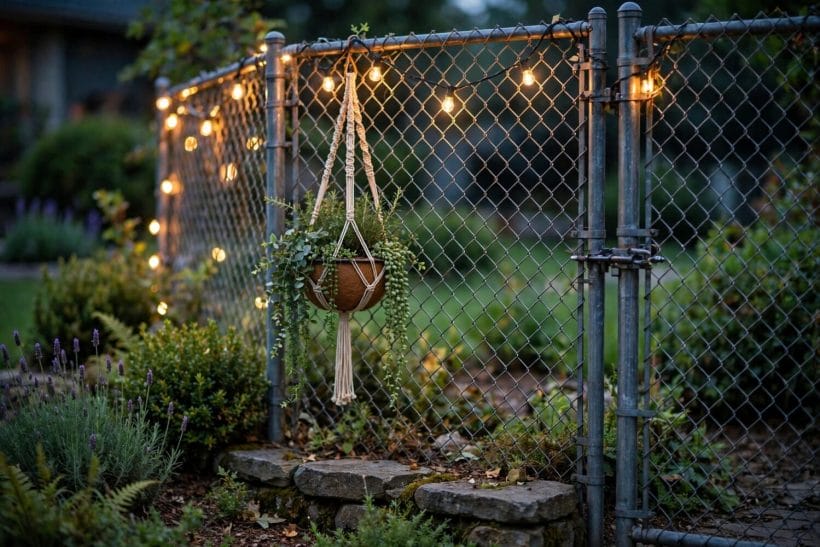
A fenced dog area planted round with shrubs outside and given shade, water and a digging corner inside serves the dog without exiling design. The mesh is the right material — visible, climb-resistant, washable — and the planting keeps the household’s view green.
59. Digging and jumping, answered plainly
Determined dogs test the fence’s foot and its top. A buried or pinned mesh skirt at the base answers the digging, and a height chosen for the actual dog — with a top rail that offers no easy launch — answers the jumping, described generally because dogs, like rules, vary; a local fencing contractor will size the specifics to your animal and plot.
60. Pool fencing that passes the rules
Pool barriers are regulated almost everywhere — heights, gate latches and climb resistance are matters for your local code, not for a design post.
61. Play areas within sight
Chain link’s see-through virtue suits play boundaries: children contained, adults able to see, the garden still one garden. Plant the outside of the play fence and let the inside stay open, soft-edged and safe underfoot.
62. Vegetable gardens fenced from wildlife
Where deer, rabbits or the household’s own dog raid the beds, a chain link run with a fine-mesh lower band keeps the harvest yours. The sunflower photograph in this post is the look to aim for: productive, flowery and entirely unembarrassed about its fence.
63. Chickens and small livestock edges
For poultry and small animals the mesh is the classic material; the prettiness comes from the run’s planting, a decent gate and a shelter that matches the garden’s materials. The hog wire fence post covers the heavier livestock variations in the same spirit.
64. Tennis-court green for sports corners
A practice wall, a small court or a trampoline zone fenced in dark green mesh disappears against planting and reads as a garden room for sport. The colour does the diplomacy: silver mesh would announce an institution; green announces a garden that plays.
65. Temporary runs that store flat
Puppyhoods, parties and building projects need temporary boundaries. Chain link panels that clamp and store flat answer them all, and keeping a few for the purpose saves the permanent fence from improvisations that outstay their welcome.
66. The utility corner, screened once for all
Compost, oil tanks, tool stores and the working clutter of a garden deserve one screened corner: the fence’s plainest bay, covered hardest. Every garden reads better when its machinery has an address and the address is not the view from the kitchen.
10. Care, Repair and Knowing When to Replace
67. The annual walk of the line
Once a year, walk the fence with gloves and oil: tension, leaning posts, rust spots, gate swing, climbers invading hardware. An hour’s attention on a dry day prevents the slow decline that no amount of planting can disguise.
68. Straighten before you decorate
A leaning post pulls every cover crooked and every photograph with it. Re-setting one post is a modest job for a fencing contractor and transforms the run’s posture; do it before slats, screens or paint, never after.
69. Rust treated early stays small
Wire-brush, treat and touch up rust at the spots stage, with products a local supplier matches to galvanised mesh. Caught early it is cosmetics; left alone it becomes structure, and the repair bill changes its nature entirely.
70. Tension is the fence’s posture
Sagging mesh reads as neglect from fifty paces. Re-tensioning a run — stretcher, come-along, a contractor’s hour — restores the crisp diamond grid that makes chain link look deliberate, and it is the cheapest posture correction in the garden.
71. Prune the cover, spare the fence
Climbers and hedges against mesh need their seasonal trim kept off gates, latches and the top rail. A cover that swallows the fence’s working parts becomes a burden the fence carries; a cover in discipline is the partnership working as designed.
72. Replace sections, not the whole story
Chain link repairs in sections: a damaged bay re-meshed, a post re-set, a gate re-hung. The piecemeal repair is the material’s economy — a boundary can be maintained for decades without ever facing a whole-fence bill.
73. Know when the fence itself should change
If the line is wrong — badly placed, too low for its job, or the garden has outgrown it — decoration is the wrong spend.
74. The neighbour conversation
Boundaries have two sides. A word with the neighbour before slatting, painting or planting a shared line — and an offer to keep their side tidy — turns a potential grievance into a shared improvement, and keeps your pretty fence a source of goodwill.
75. Pretty is a system, not a product
The fences in these photographs are not special fences; they are ordinary mesh with colour, cover, planting and care working together. That is the whole lesson of this post, and it pairs with the path that leads to the gate — our flagstone walkway ideas and the walkway ideas pillar treat the ground’s half of the same welcome.
Final Considerations
A chain link fence becomes pretty the way a garden becomes beautiful: in layers, over seasons, with the structure kept honest underneath.
Check your local rules on boundary height, appearance and pool safety before altering any fence, confirm which side of the line is yours to change, and bring in a local fencing contractor for posts, tension and anything structural.


0 Comments