
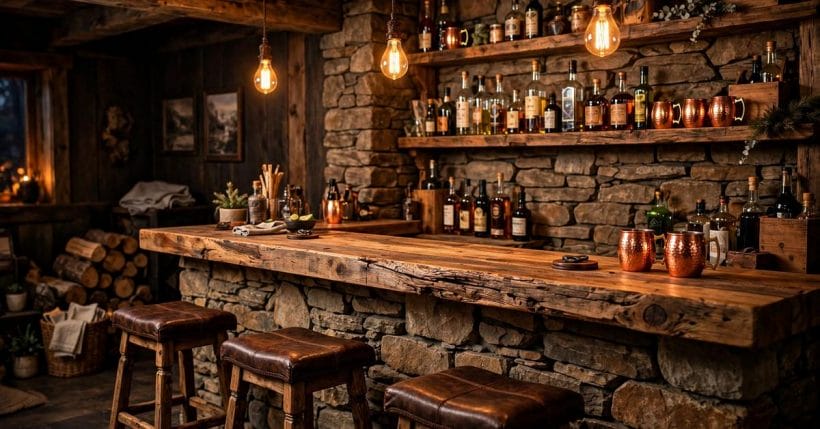
A rustic home bar is the warmest corner a house can grow: rough timber, stacked stone, leather and lamplight, arranged around the simple ceremony of pouring a drink for people you like. It asks for patina rather than polish — wood that has lived, metal that deepens with touch, and shelves that show the bottles instead of hiding them. Rustic is also forgiving: it welcomes the reclaimed, the hand-made and the slightly irregular, which makes it the most achievable of all the bar styles to build honestly.
These seventy-five ideas keep strictly to the rustic style: the materials, layouts, colours and practical details that make a bar feel carved out of a cabin, a barn or a farmhouse kitchen. Plumbing, electrical work and anything structural are described in general terms only — those belong to qualified local trades — and nothing here prices a project: costs in rustic building live and die by what you reclaim and what you buy new.
Related Guide: 10 Outdoor Bar Ideas: Layouts, Colours, Costs and Practical Details
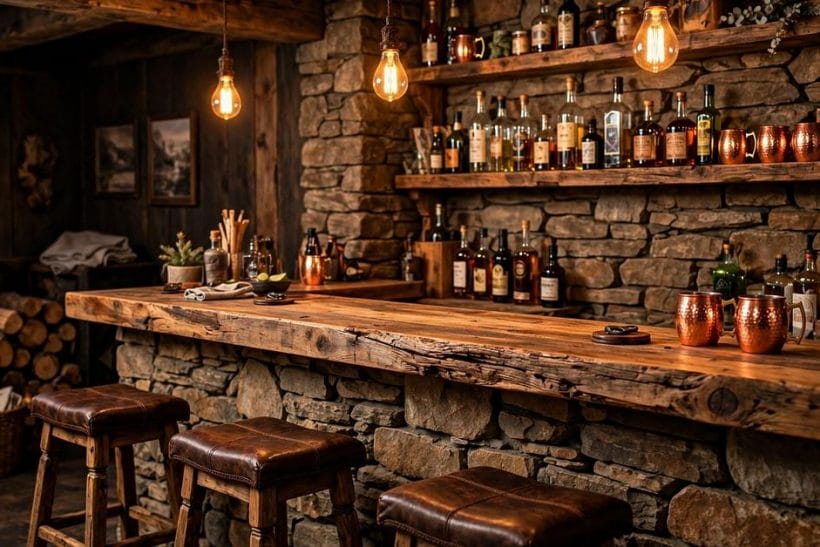
1. Rustic Home Bar Ideas at a Glance
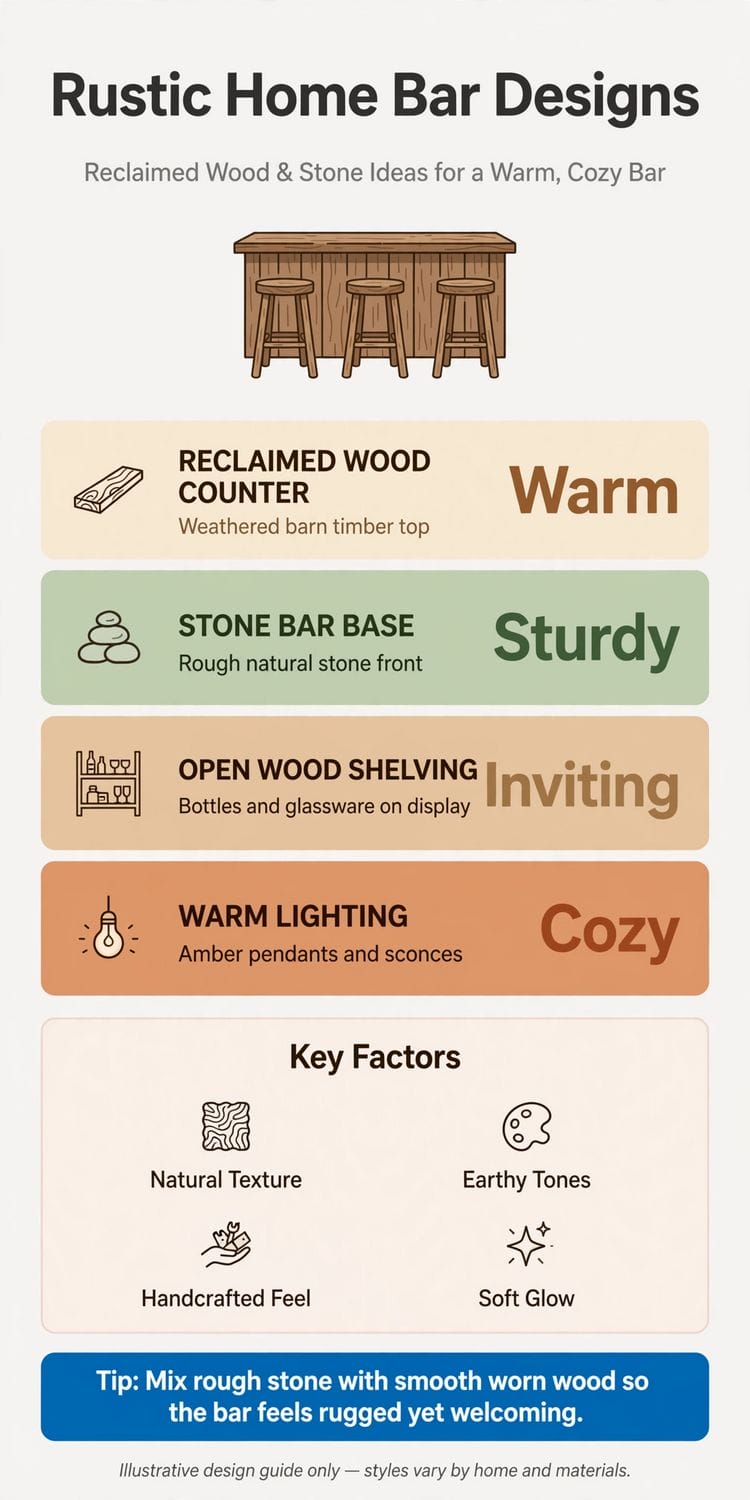
Rustic bar design rests on four material truths: timber with its grain and history showing, stone or brick with weight at the base, metal in blackened or hammered finishes, and light kept warm and low. Get those four right and the style holds at any scale — a full cellar bar, a kitchen corner, a cart against a wall. Miss them, usually by mixing in gloss and chrome, and the room becomes a theme rather than a place.
The family split, stated plainly: this post owns the rustic style only. The general survey lives at the home bar ideas pillar, the compact version in our small home bar ideas post, the no-plumbing version in dry bar ideas, the shelving-led version in home bar with floating shelves ideas, and the dark colour-led counterpart in black home bar ideas. Each owns its angle; this one owns timber, stone and firelight.
| Question | Short answer |
|---|---|
| What makes a bar read as rustic? | Reclaimed or rough-sawn timber, stone or brick, blackened metal, leather and warm low light — texture over shine, always |
| Where does rustic work best? | Basements, cabin and farmhouse interiors, dens and garden rooms — anywhere timber and masonry already speak the language |
| What is the cheapest rustic move? | A live-edge or slab timber counter on a simple base, open shelves, and Edison-style warm bulbs — the style in one weekend |
| What ruins it fastest? | Gloss finishes, chrome, novelty signage overload and plastic “distressed” imitations — rustic is materials, not props |
2. The Bar Counter: Timber With a Past
1. The live-edge slab top
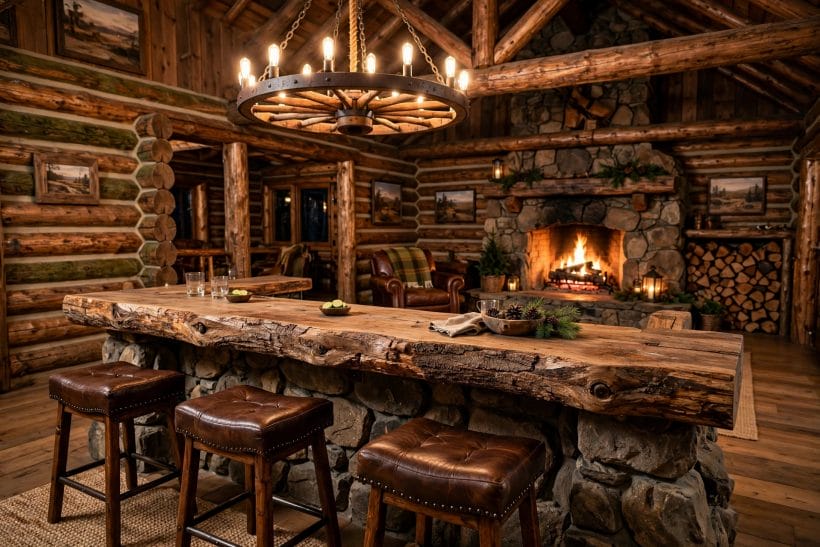
A single slab with its bark-line edge left wavy is the rustic counter’s signature: no two exist, and the edge invites hands. Sealed against rings and spills with a finish a timber supplier recommends, it becomes the room’s whole argument in one piece of wood.
2. Reclaimed barn boards as the top
Boards with nail holes, saw marks and a century of weather carry the style effortlessly. Joined, flattened and sealed, they make a counter that new timber spends decades trying to become. Ask the reclamation yard about the boards’ history — the story is part of the furniture.
3. A butcher-block of mixed timbers
Where a slab is out of reach, thick mixed-timber block — offcuts and old joists laminated — gives the same weight and variegation at a friendlier scale. The patchwork is the point: rustic counters are quilts, not mirrors.
4. The stone-fronted base
A counter front of stacked stone, real or veneer, grounds the bar like a chimney breast. It shrugs off boot scuffs and stool kicks that would scar timber, and its cool mass against the warm top is the style’s central contrast.
5. A brick base, limewashed or bare
Brick under the counter suits farmhouse and industrial-rustic rooms alike — bare for the full earthy read, limewashed where the room wants the texture without the colour weight. Either way it is honest masonry doing honest work.
6. Timber-panelled fronts with battens
Vertical boards with battens — the barn-door pattern — make a counter front from plain timber and a day’s joinery. It is the most buildable of the fronts and the easiest to repair: one damaged board swaps, the rest keep their patina.
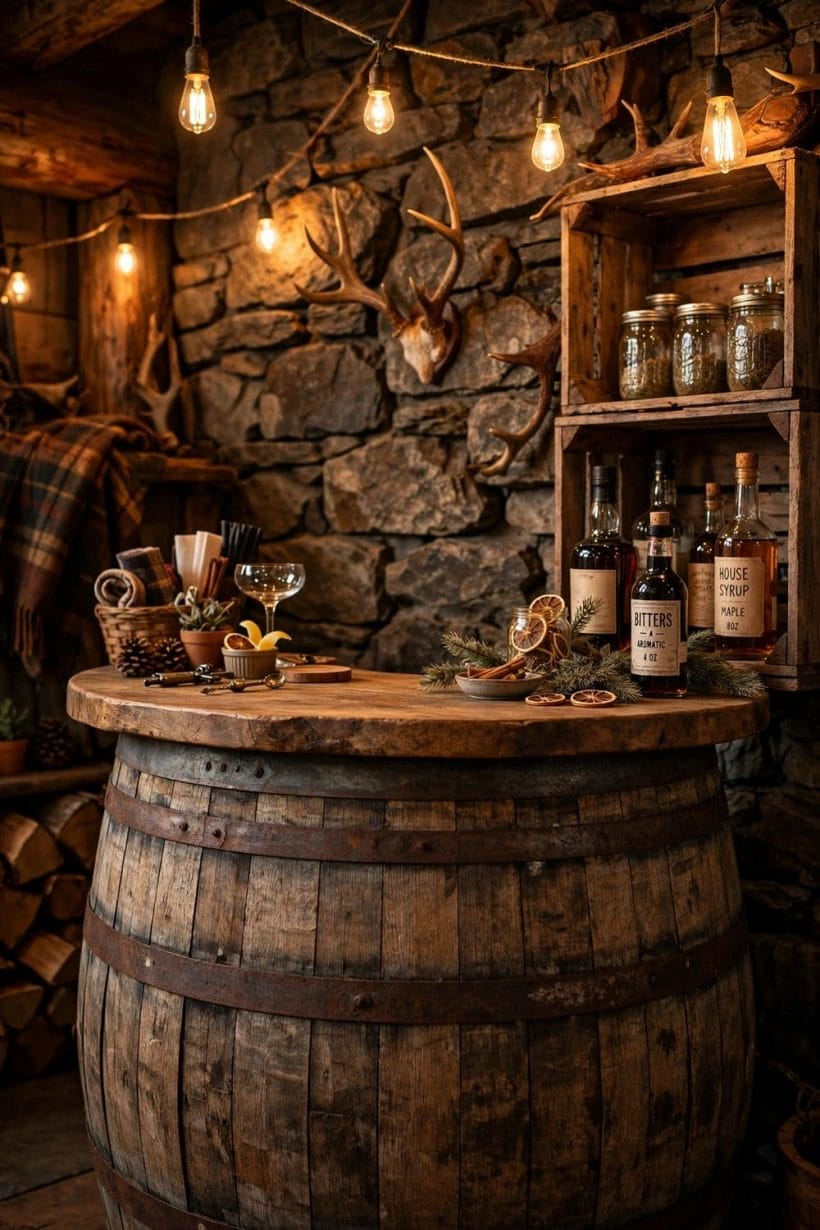
7. The barrel-base bar
Whole or halved barrels as the counter’s supports bring the cooper’s craft into the room. They suit wine-keeping households and cellar corners, and their curve softens a room of straight lines pleasantly.
8. An overhang honest for knees
Whatever the top is made of, it must overhang the base enough for stools and knees — the comfort dimension that photographs never show and evenings always reveal. Mock it up with the actual stools before the top is fixed; rustic is no excuse for bruised shins.
3. Layouts: Where the Rustic Bar Sits
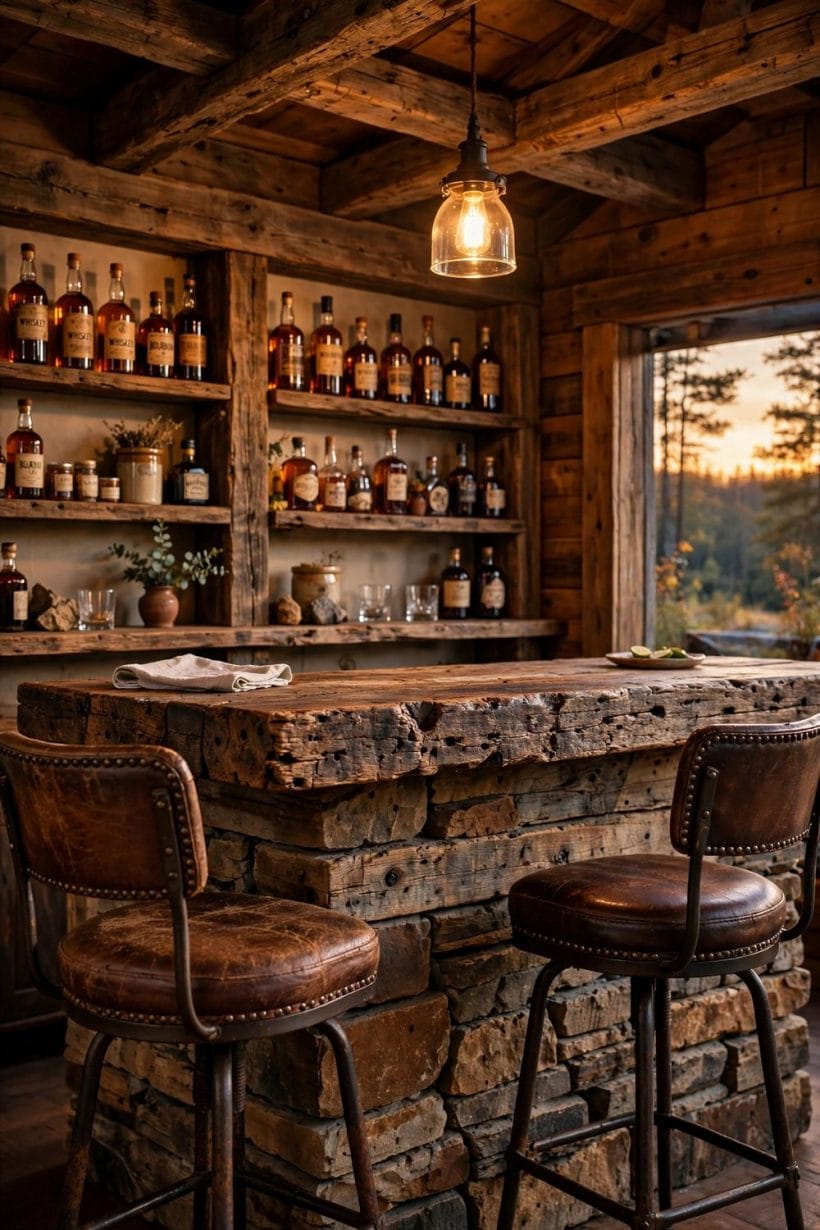
9. The cellar corner
Basements and lower-ground rooms suit rustic bars naturally: cool, dim and masonry-walled already. A counter along the wall with back shelves uses the room’s character instead of fighting it, and the temperature flatters stored bottles.
10. The cabin wall run
In a cabin or lodge-style room, a straight run against the log or boarded wall — counter, shelves above, stools in a row — is the classic arrangement, leaving the room’s centre for the fire and the chairs that face it.
11. The L that makes a bartender’s pocket
An L-shaped counter creates the working pocket behind it: sink or fridge at the short leg, serving along the long one. In rustic rooms the L often forms around a stove or a structural post, which the style absorbs as character.
12. The freestanding island bar
Where the room is generous, a freestanding bar — stone or timber base, stools on the guest side, working aisle behind — becomes the room’s hearth-substitute, the thing gatherings orbit. It wants the biggest timber you can bring through the door.
13. The dry rustic bar
No plumbing is no obstacle: the dry arrangement — counter or cabinet, shelves, a fridge or ice bucket — carries the whole style, as the wider treatment in our dry bar ideas post shows. Rustic suits dry bars especially; taverna bars were dry for centuries.
14. The kitchen-end bar
A farmhouse kitchen with a bar end — counter continuing the worktop line, shelves where the dresser stood — hosts the household’s daily version of the ritual. It is the easiest rustic bar to live with because the plumbing, power and traffic already exist.
15. The garden-room and outdoor bar
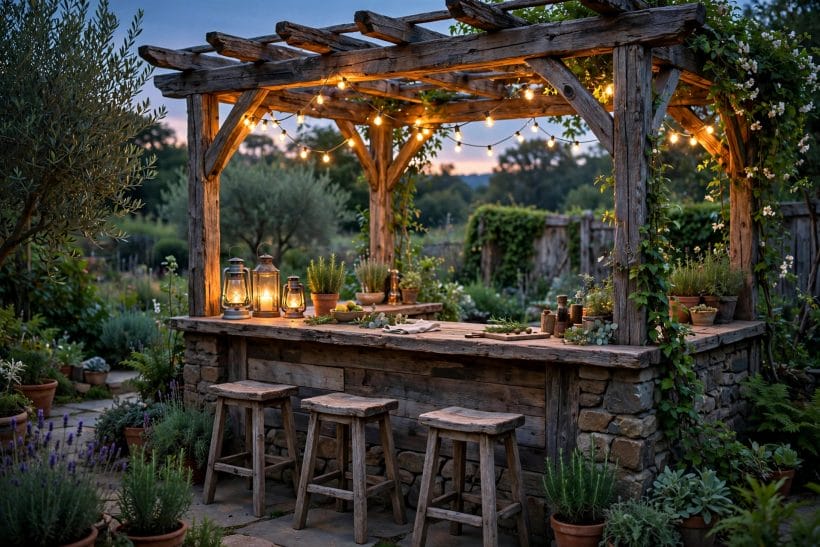
A pergola or garden-room bar in stone and weathered timber extends the style outdoors, as one of this post’s photographs shows. Outdoor versions choose materials for the weather first and the look second — the rustic palette happens to forgive both.
16. The cart and cabinet minimum
At the smallest scale the rustic bar is a sturdy timber cabinet or a barrel-top trolley with shelves above — the arrangement our small home bar ideas post develops. Two square metres of wall, honestly timbered, beat a room of good intentions.
4. Back Bars, Shelves and Bottle Display
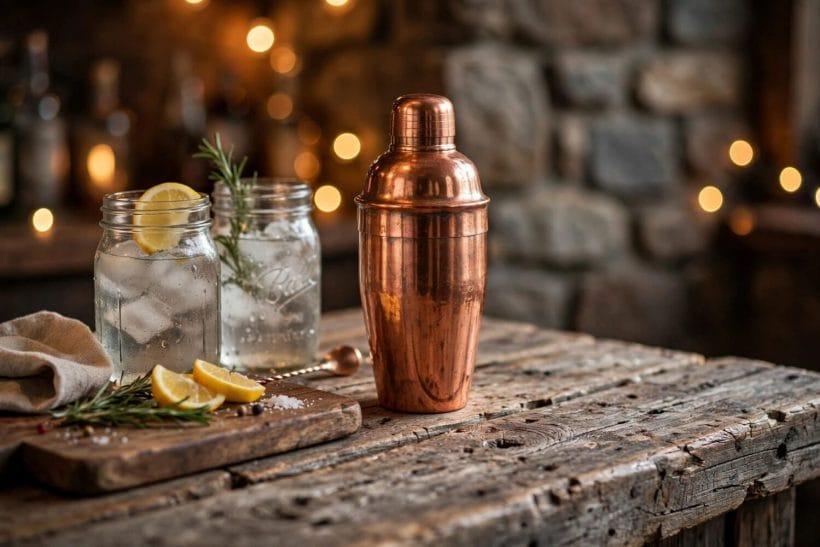
17. Open shelves on rough brackets
Thick boards on blackened iron brackets are the rustic back bar’s default: bottles and glasses on show, everything reachable. Keep the boards deep enough for bottles to stand safely and the brackets honest enough to carry glass by the shelf-load.
18. The ladder of shelves to the ceiling
In tall rooms, shelves climbing to the ceiling — with the top rows given to the rarely used and the decorative — use the wall’s whole height and give the bar its tavern grandeur. A library ladder is theatre; a sturdy step stool is practice.
19. A mirrored panel, antiqued or none
Traditional back bars mirror behind the bottles to multiply light. In rustic rooms the mirror wants to be antiqued, foxed or small — a bright modern mirror fights the timber. Many rustic bars skip it and let bottle glass and lamplight do the glittering.
20. Hanging glass racks under a shelf
Glasses hung by their feet beneath a shelf keep them dust-free, reachable and glittering in the lamplight. In timber, the rack can be as simple as slotted battens — a detail guests always notice and always approve.
21. The hutch and dresser back bar
A farmhouse dresser or hutch against the wall is a back bar that arrives ready-made: shelves, cupboards and a serving surface in one piece of furniture. For renters and the commitment-shy it is the rustic solution with no joinery at all.
22. Crates, boxes and the honest jumble
Wooden crates — stacked, wall-mounted or shelf-standing — store bottles and glasses with the style’s favourite shrug. The discipline is grouping: crates for glassware, crates for bottles, so the jumble reads as a system rather than a storage accident.
23. A rail for mugs, jugs and copper
Copper mugs, stoneware jugs and enamel cups on hooks along a rail bring the working-farmhouse note and free the shelves for bottles. Metal that is used develops the patina money cannot buy — hang the pieces you actually pour from.
24. Labels, chalk and the menu board
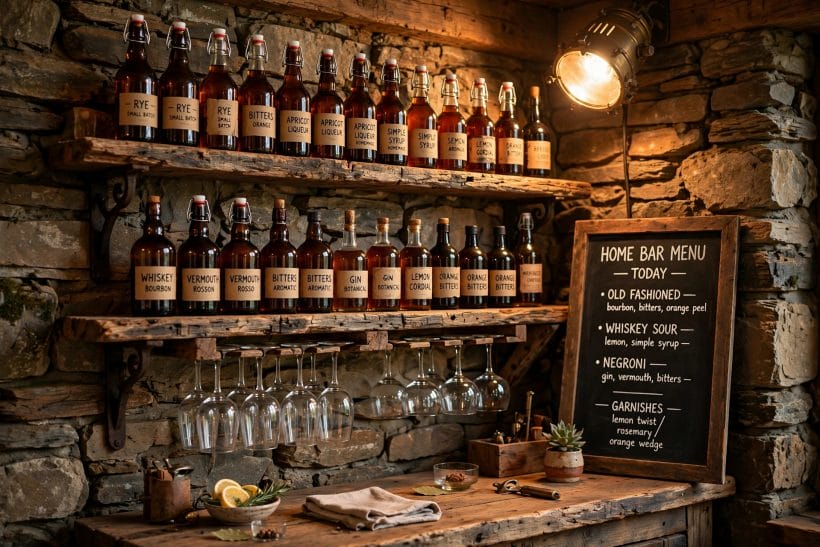
A chalkboard for the evening’s offerings and small labels on decanters suit rustic bars because they are changeable and hand-made by nature. Keep the handwriting handsome and the jokes rationed; the board is a menu, not a comedy wall.
5. Stools, Seating and the Guest Side
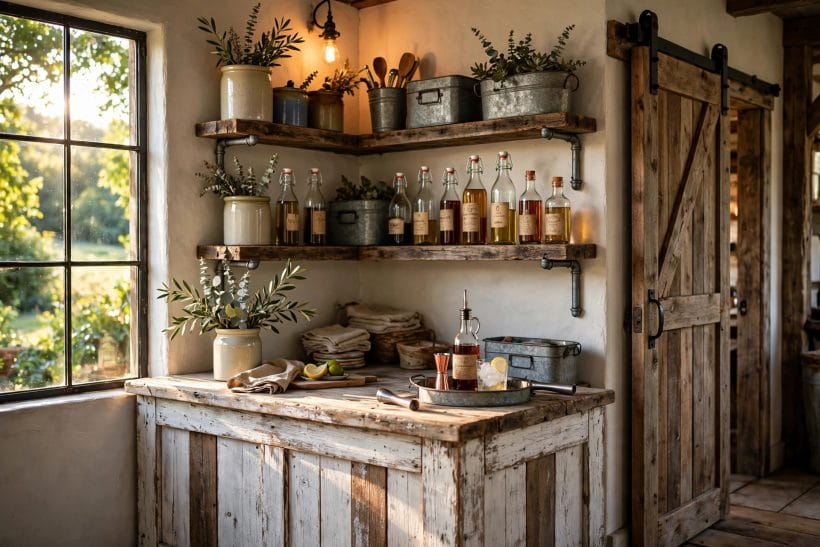
25. Leather-topped timber stools
The rustic stool of record: a square or round timber frame with a worn leather seat. Leather deepens with every year of elbows and evenings, forgives spills with a wipe, and is the texture that marries stone and wood together.
26. Backless stools that tuck away
Backless stools slide fully under the overhang, clearing the room when the bar is closed. In small rustic bars that tuck-away geometry is the difference between a bar corner and a furniture obstacle course.
27. A bench along the bar
Where the guest side faces a wall or a fire, a long bench seats more people, more sociably, than a row of stools — the tavern arrangement. With cushions in wool and hide it becomes the room’s second sofa.
28. Two armchairs and a low table
Not every drink is taken at the counter. A pair of deep chairs — leather club chairs are the rustic dream — with a barrel or crate table beside the bar gives the room its whisky-and-conversation corner.
29. Stools of mixed ages
A matching set is the showroom’s idea; rustic rooms take stools collected over time — same height family, different histories. The mix reads as a place that grew, which is the style’s whole fiction and, done honestly, its truth.
30. Foot rails in blackened iron
A rail at the counter’s base gives perched guests somewhere for their feet and the bar front a finished line. Blackened pipe or bar, solidly fixed, is a comfort detail every sitter registers and nobody photographs.
31. Seat height matched to the counter
Counter and stool heights are a pair; the pairing should be tested with real bodies before either is finalised. Rustic tolerances are generous in looks only — an awkward perch empties a beautiful bar faster than any other flaw.
32. A rug under the guest side
A hard-wearing rug — flat weave, dark pattern — under the stools warms the stone or boards, quiets the room and defines the bar’s territory in an open space. It will take spills; choose the pattern that forgives them.
6. Lighting: Amber, Low and Layered
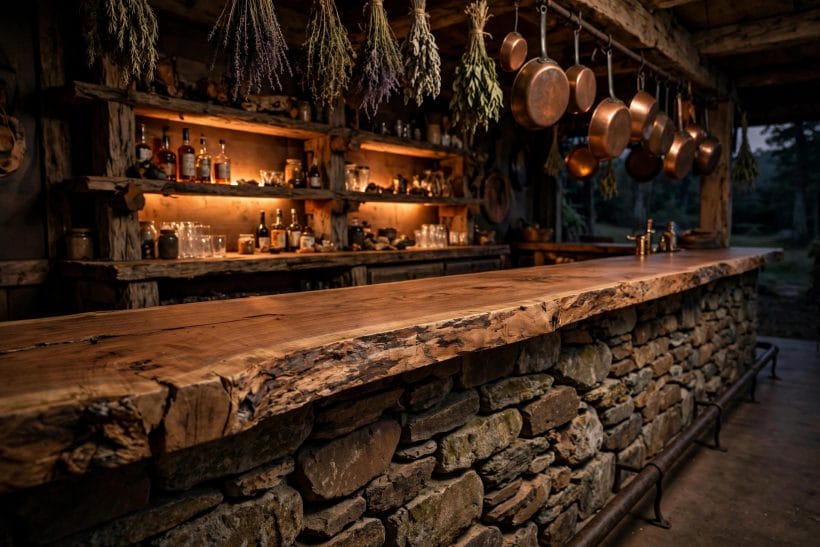
33. Pendants over the counter
A row of pendants — enamel shades, seeded glass, hammered metal — pools light on the timber and leaves the room’s edges in dusk. Over a rustic counter they are the ceiling’s whole contribution; keep them low, warm and dimmable.
34. Edison-style bulbs, used knowingly
Exposed filament bulbs are the style’s shorthand for warmth. Used inside shades or cages they flatter everything; used bare in rows they can glare like a fairground. Warmth is a colour and a level, not just a bulb shape.
35. Shelf and bottle lighting
A discreet strip or small downlights washing the back shelves make bottles glow like a tavern window. It is the single most atmospheric upgrade a home bar can take, and it belongs on its own dimmer from the room’s main lights.
36. Lanterns and candlelight
Real or battery lanterns on the counter and tables give the flicker no fitting reproduces. Rustic rooms were lit by flame for centuries; a little of it, safely placed away from spirits and sleeves, completes the illusion honestly.
37. A fire, where the room allows
A stove or fireplace near the bar — as in this post’s cabin photograph — is the rustic room’s beating heart. Where a real fire is impossible, the warm end of the lighting plan and a leather chair angled to the room do the emotional work instead.
38. Dimmers on everything
Daylight chores, evening drinks and late-night clearing-up are three different rooms wearing one bar. Dimmers on each layer let the same space play all three. Any electrical work belongs to a qualified electrician — stated once here for every idea in this section.
39. Task light where drinks are made
Behind the counter, the working surface needs honest light: under-shelf lighting over the mixing area keeps garnish-cutting and glass-washing safe without raising the room’s mood lighting. The bartender’s bench is a workplace; light it like one.
40. Windows dressed down
Daylight in a rustic bar wants filtering, not flooding: timber shutters, linen curtains or woven blinds keep the cave-like calm the style loves and protect bottles and leather from the sun’s slow bleaching.
41. Black metal, never chrome
Every fitting, hinge and handle in the room should agree: blackened, oiled or hammered metal, with copper and brass as the warm accents. One chrome intrusion reads like a typo in the style’s language — consistency is what makes rustic feel real.
7. Storage, Sinks and the Working Back
42. A sink, if plumbing honestly allows
A small sink behind the counter — for rinsing glasses, ice and spills — is the wet bar’s great convenience, and a deep, plain, hard-wearing one suits the style. Its feasibility is a plumber’s call on your house, never a plan drawn in hope.
43. The ice strategy
Ice makes the bar: a freezer drawer, a serious insulated bucket or a lidded chest in livery of timber cladding. Decide where ice lives before the counter is built; carrying it through the party is the host’s oldest marathon.
44. A fridge in rustic clothing
An under-counter fridge keeps mixers, wine and garnishes cold; panelled with timber to match the bar front, it disappears. Ventilation for appliances is a maker’s specification to follow exactly — enclosed fridges still breathe, or they fail.
45. Drawers for the small army
Openers, pourers, knives, towels, coasters, cocktail picks: a bar runs on small tools. Shallow drawers under the counter, divided simply, keep them at the bartender’s hand instead of in the kitchen’s third drawer.
46. Glass storage that forgives
Glasses stored mouth-up on shelves, mouth-down on racks, spares in a crate below: the system matters less than its honesty about breakage. Rustic bars choose sturdy glassware with weight in the hand — it survives the room’s stone and timber.
47. Bottle storage lying and standing
Wine rests lying down, spirits stand: the back bar should offer both — a timber lattice or diamond bins for the lying bottles, shelf room for the standing. Cellar-cool positions suit both; radiators and sunny glass suit neither.
48. The bin and the bottle bank
Caps, corks, empties and the evening’s debris need a planned home: a bin within the bartender’s reach and a crate for empties somewhere discreet. Bars without them accumulate their archaeology on the counter by midnight.
49. A worktop behind the worktop
Where depth allows, a low back counter or shelf behind the bartender holds the preparation — citrus, shakers, the second ice — so the show counter stays clear. Professional bars are two surfaces deep; home bars benefit from the same modesty.
8. Walls, Floors and the Room Around the Bar
50. Stone or brick behind the shelves
The back wall carries the bar’s portrait: stacked stone, exposed brick or limewashed masonry behind the bottle shelves gives the depth the photographs trade on. Where real masonry is impossible, a well-laid veneer keeps its dignity by keeping its joints honest.
51. Boarded walls, vertical or horizontal
Timber boarding — reclaimed, rough-sawn or simply matte-painted — wraps a room in the style’s material. Vertical boards lift low cellar ceilings; horizontal boards lengthen a short room. One boarded wall is usually enough theatre.
52. Beams and the heavy ceiling
Exposed joists, a beamed ceiling or a dark-stained boarded one press the room’s height into intimacy. In new rooms, false beams in real timber earn their place by also carrying the pendant lights and the occasional hanging pan.
53. Floors that forgive: stone, brick, wide boards
Bar floors take spills, drips and stool feet. Stone flags, brick pavers, sealed concrete or wide timber boards all serve, each with its own care; what fails is anything precious. A floor the host does not worry about is a host who enjoys the evening.
54. A hearth rug or hide at the centre
Between bar and chairs, a rug or hide gathers the room’s furniture into an encampment and warms the masonry underfoot. In rustic rooms the rug wants pattern, age and a tolerance for the occasional splash — indoor-outdoor weaves in earthy tones are the modern answer.
55. Limewash and clay-toned walls
Where walls are plain plaster, limewash or matte paint in clay, ochre, smoke and bone keeps the palette dug from the ground. Gloss and brilliant white belong to other styles; rustic walls should look as if they could have been mixed on site.
56. Antlers, art and the edited wall
Landscape prints in timber frames, a set of antlers, an old map, tools as sculpture: rustic walls enjoy objects with former lives. The editing is the skill — a few strong pieces, generously spaced, never a jumble sale of signage.
57. Green notes: herbs and a plant or two
A pot of herbs on the counter for garnishes, a fern in the cool corner, dried hops or grasses along a beam: living and once-living green keeps the timber-and-stone palette from heaviness and scents the room faintly of the countryside.
9. Details, Rituals and Keeping It Rustic
58. Serveware in wood, stone and metal
Boards for citrus and cheese, stoneware bowls for nuts and olives, metal jiggers and shakers: the tools of service are the bar’s tableware and should be as material-true as the room. Plastic measures and novelty straws break the spell at the last inch.
59. Decanters and the unlabelled shelf
Decanting the everyday spirits into plain glass, with small tags or chalk labels, tidies a mixed collection into the room’s palette and starts the evening’s conversation. Keep the special bottles in their own dress; both shelves are honest.
60. A coffee and tea answer
Not every guest drinks, and every evening ends somewhere. A kettle’s worth of provision — good coffee, tea, sparkling water in handsome bottles — hosted as generously as the spirits is what makes a home bar a hospitality station rather than a shrine.
61. Music with sleeves, not screens
Records, a radio, an instrument in the corner: rustic rooms take their music analogue where they can. A television can live in a rustic bar, but it wants a cabinet or a dark wall to retire into, not the place of honour over the bottles.
62. The guest book and the wall of evenings
A house-bar tradition worth starting: a guest book on the counter, or a cork board of the evenings’ photographs. Rustic style is nostalgia engineered; giving the room its own memory to accumulate is the deepest version of the look.
63. Seasonal dressing
Greenery at midwinter, flowers from the garden in summer, a bowl of orchard fruit in autumn: the bar that changes with the year never looks staged. The timber and stone stay; the dressing rotates, and regular guests read the seasons off the counter.
64. Scent: wood, citrus and beeswax
A rustic bar should smell faintly of its materials — timber, a cut lemon, a beeswax candle — and never of last night’s spills. A wiped counter and an aired room are the whole secret; scented products are the admission of defeat.
65. Restraint with signage
One vintage sign with a real history can charm; a dozen repro plaques make a gift shop. The style’s authority comes from materials doing the talking. When in doubt, take a sign down and put a plant, a lamp or nothing in its place.
66. The host’s stool and the working triangle
Behind the counter, arrange ice, glass and sink (or bucket) within a turn of each other, and keep one stool for the host inside the working side. A bar the host enjoys working is a bar guests get hosted from, all evening, without expeditions.
10. Building It and Keeping It Honest
67. Start with the counter and shelves
The minimum viable rustic bar is a counter and one run of shelves, both well made. Add the back bar, the lighting layers and the seating across seasons as budget and finds allow — the style tolerates, even prefers, a bar that grew.
68. Source reclaimed with your eyes open
Reclaimed timber should be checked for what it carries: nails, treatment chemicals, rot and woodworm are a supplier conversation to have before purchase, and old painted wood deserves particular caution. Honest yards welcome the questions; the patina is worth the diligence.
69. Know which jobs are trades’ jobs
Plumbing a sink, wiring pendants and dimmers, gas or stove work, and anything structural belong to qualified local professionals — the same framing this whole series uses, from the home bar ideas pillar down. The joinery, shelving and finishing are the home project’s honest territory.
70. Weight is a structural question
Stone counters, masonry veneers and a stocked back bar weigh more than furniture usually does. Floors — especially upper floors and old joists — should be assessed by someone qualified before the stone arrives, not after the ceiling below complains.
71. Seal timber where liquid lives
Counter tops and shelves near ice and sinks need finishes chosen for wet work, advised by the timber or finish supplier, and renewed on the schedule they name. Unsealed rustic charm near a sink becomes grey watermarked regret within a season.
72. Fire sense in a room of timber and spirits
Candles, stoves and high-proof bottles share rustic bars with open flame traditions; keep the disciplines — lanterns enclosed, flames away from the spirit shelf, an extinguisher in a known place. Atmosphere is a guest; carelessness is not.
73. Clean as you go, close the bar nightly
The rustic bar’s upkeep is a ritual, not a chore list: bottles wiped, counter cleared and oiled when it asks, glasses washed before the house sleeps. Five minutes at closing keeps the room’s welcome intact for the next opening.
74. Let it age, do not distress it
The difference between rustic and costume is time. Build with real materials, use the bar properly, and let the wear arrive honestly — ring by ring, polish by elbow. Artificially distressed finishes fool no one who has ever sat at a real one.
75. The bar as the house’s warm heart
Done honestly, a rustic bar becomes more than a style: it is the room where the house is most itself — timber, stone, firelight and welcome, in the proportions this post has laid out. For the colour-led alternative, the black home bar ideas post shows the same room after dark; for the rustic interior that surrounds it, our rustic cabin interior ideas complete the world.
Final Considerations
A rustic home bar is not bought; it is assembled — from timber with a past, stone with weight, metal with a future patina and light kept low and warm. The seventy-five ideas here stay inside that discipline on purpose, because the style’s whole promise is authenticity: guests can feel the difference between a room that was built and a room that was decorated, and they stay longer in the built one.
Begin where the pillar begins, with the home bar ideas survey for the family’s full map, then give your bar its rustic bones — counter, shelves, light — and let the years do the finishing. Trades for plumbing, power and structure; patience for everything else.


0 Comments