
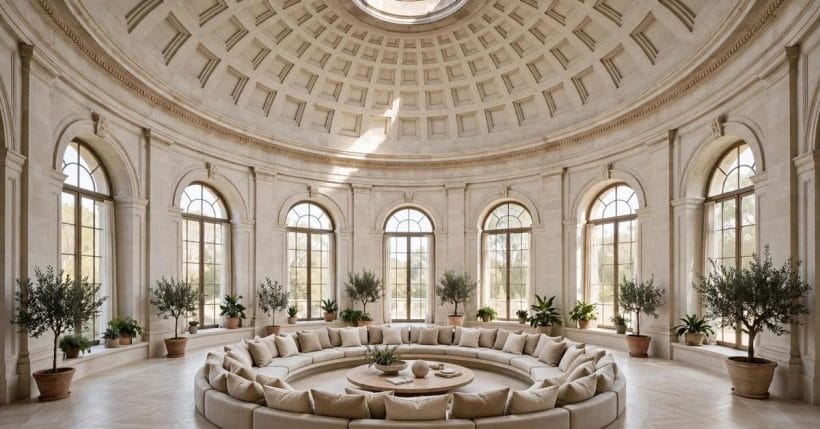
A rotunda is one of the most recognisable shapes in architecture, and also one of the simplest to describe. It is a room that is round in plan, usually crowned by a dome, and arranged so that the eye is drawn gently upward and around rather than toward a single flat wall. This rotunda definition covers the whole idea in a single image: a circular space, a curved ceiling overhead, and a sense of calm completeness that a rectangular room rarely achieves. You may have stood in such a room without knowing its name, in a grand hall, a quiet library, a garden pavilion, or the entrance of a large house, and felt at once that the room was holding you in the middle of something.
What makes a rotunda different from any other round room is the combination of its parts. The circle alone is not enough, and neither is a dome alone. It is the pairing of the two, together with the way light, columns and openings are arranged around the curve, that gives the rotunda its character. The room feels centred, balanced and open, even when it is modest in scale, because every point on the wall stands at a similar distance from the middle. This guide explains the rotunda in general terms only: its form, its light, its layout, where it appears in homes and in public buildings, and what it feels like to live with a round room.
1. The Simple Definition in Plain Words
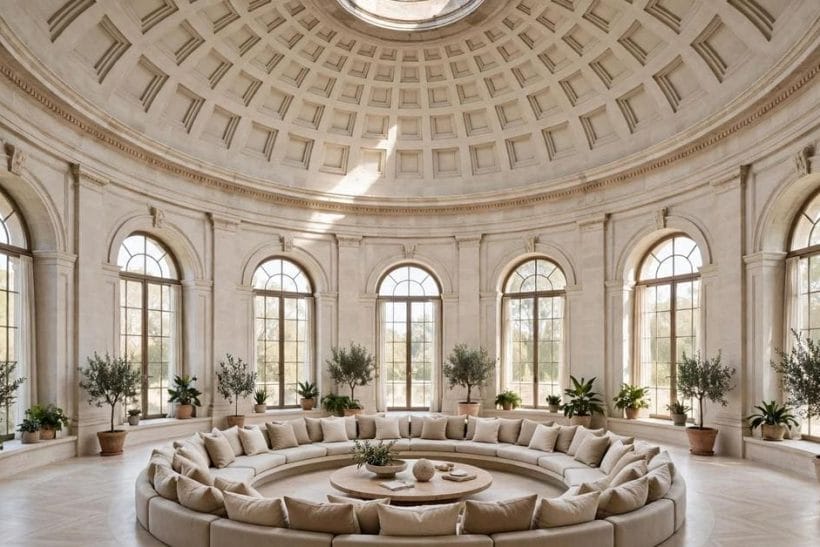
At its simplest, a rotunda is a round room with a domed roof. The walls run in a circle, the ceiling rises and curves inward to a point or a small opening at the top, and the floor follows the same round shape below. Nothing about the definition depends on size, luxury or a particular style. A small garden rotunda and a large public hall share the same basic geometry, and both are recognised by the same qualities: a circular plan, a curved overhead, and a centre that the whole room seems to gather around.
The word itself points to that roundness. A rotunda is round by nature, and the room is best understood by walking around its edge in the mind rather than by looking at a single view. From any doorway, the curve leads the eye sideways, then around, then back to where it began. That continuous movement is part of the pleasure of the form. There are no corners to stop the eye, no dead ends in the wall, and no single direction that dominates the rest. The room feels whole in a way that a room with corners does not.
It helps to separate the rotunda from its near neighbours. A dome is a roof shape, and it can crown a square room as well as a round one. A circular room without a dome is simply a round room, pleasant in its own right but missing the upward lift that a dome provides. A rotunda brings the two together, and the pairing is what matters. When the circular plan and the domed ceiling meet, the room gains a vertical dimension that matches its horizontal roundness, and the result is a space that feels complete in every direction.
2. The Round Plan and Why It Feels Different
A round plan changes how a room is entered, crossed and furnished. In a rectangular room, furniture naturally lines up against straight walls, and movement tends to follow straight paths from door to door. In a rotunda, there is no straight wall to line up against, so furniture gathers toward the middle or follows the curve in a loose ring. Movement, too, becomes circular rather than linear. A person entering a rotunda tends to pause, take in the whole room at a glance, and then move around its edge or toward its centre, rather than hurrying straight through.
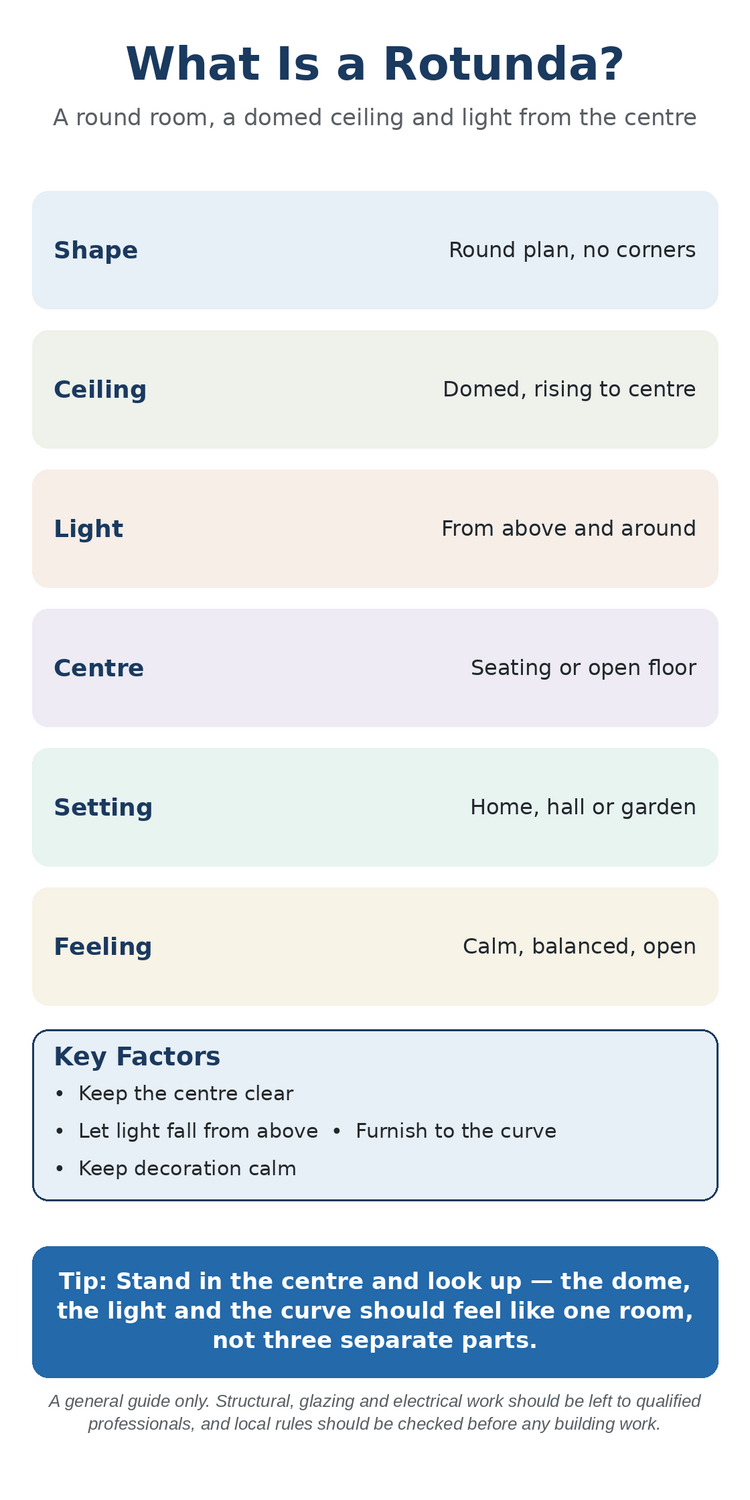
That centred feeling is the rotunda’s greatest gift and its greatest demand. Because the middle of the room draws attention, it asks for something worthy of the centre: a table, a seating group, a pool of light, or simply an empty floor that lets the shape speak for itself. Leave the centre empty and the room can feel grand and calm. Fill it thoughtlessly and the room can feel crowded, because every piece in a round room is visible from every other point. The plan rewards restraint, and a few well-chosen pieces will always serve a rotunda better than a crowd of them.
The round plan also changes how the room connects to the rest of a building. Doors and openings in a rotunda rarely sit opposite each other in the strict way they do in a rectangular hall. Instead, they open off the curve at points that suit the rooms beyond, so the rotunda acts as a gentle hub rather than a corridor. Coming from one room into a rotunda feels like arriving somewhere, not passing through, and leaving it feels like setting out again. That hub quality is why rotundas are so often placed at the heart of a plan, where several rooms meet.
3. The Dome Overhead
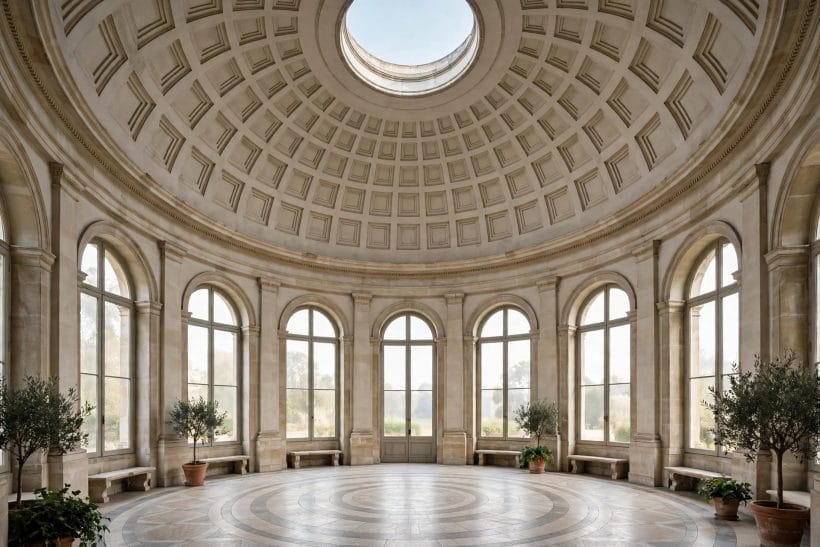
The dome is the rotunda’s crown, and it does more than simply cover the room. A flat ceiling closes a room off at a single height, but a dome lifts the eye upward in a smooth curve, so the room feels taller than its walls alone would suggest. The curve gathers the whole ceiling into a single gesture, and the highest point, at the centre, becomes a natural focus. Standing beneath a dome, a person feels sheltered and uplifted at once, as if the room were both enclosing and opening.
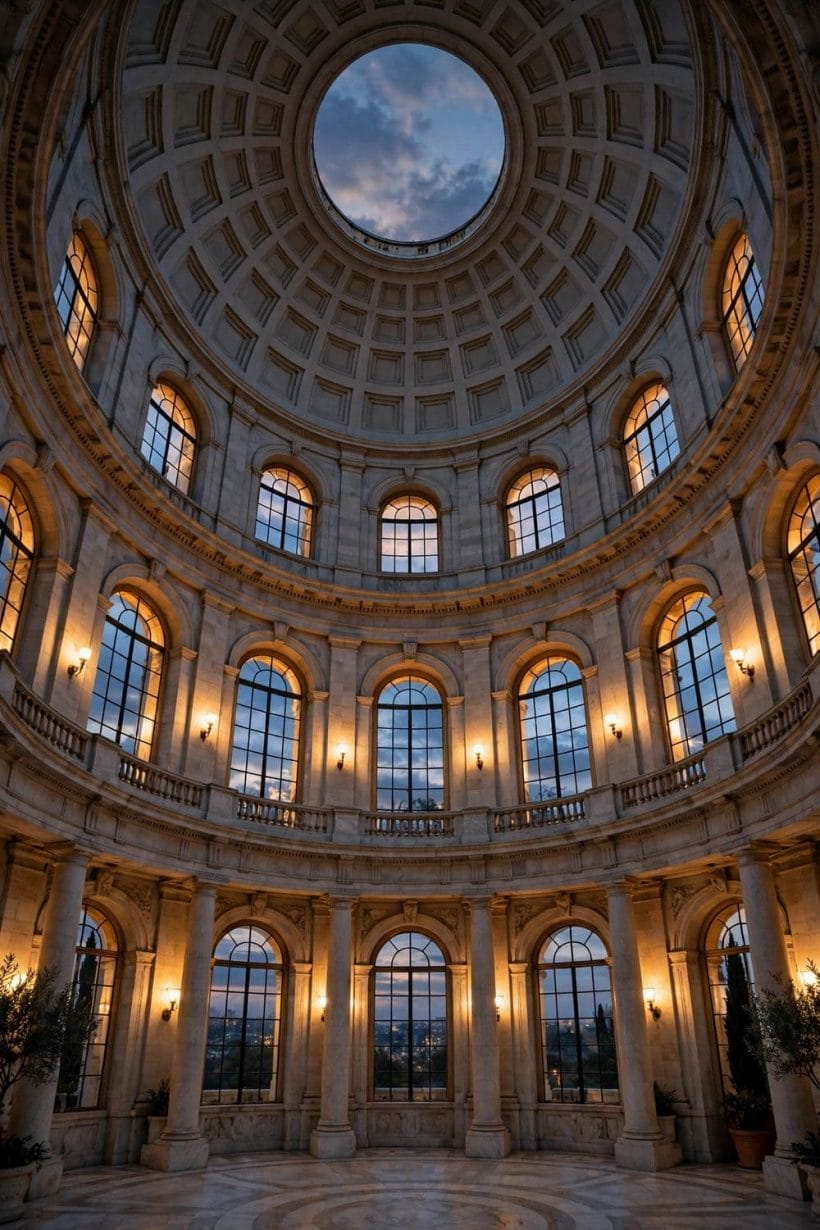
Domes take many forms, and the differences matter to the feeling of the room. A shallow dome gives a gentle lift, keeping the room intimate and calm. A taller dome gives a stronger sense of height and ceremony, suited to a grand hall or a formal entrance. Some domes are smooth and plain, letting light and shadow play across an unbroken curve. Others are divided into panels or ribs that draw the eye upward in lines, like the spokes of a wheel. In every case, the dome’s job is the same: to complete the circle in the vertical direction, just as the walls complete it in the horizontal one.
At the very top of many domes sits a small opening, sometimes glazed, sometimes left as a lantern that rises above the dome itself. That opening is both practical and poetic. It lets daylight fall straight down into the centre of the room, and it gives the dome a finishing point, a place where the curve resolves. Even when a dome is closed at the top, the centre remains the natural focus, and a hanging light or a painted detail there will draw the eye in the same way. The dome, in short, is what turns a round room into a rotunda.
4. Light From Above and Around
Light behaves beautifully in a rotunda, and it is one of the main reasons the form has endured. Daylight entering from above falls into the centre of the room and spreads evenly in every direction, because there are no corners for shadows to gather in. The curved walls catch that light softly, so the room glows rather than glares. On a bright day, a rotunda can feel luminous without any single window dominating the scene, and on a dull day it still feels evenly lit, because the light comes from the room’s own centre rather than from one side.
Windows around the curve add a second kind of light. Tall openings set into the circular wall bring in views and breezes from every direction, so the room feels connected to the world outside on all sides rather than facing a single outlook. The changing light through the day moves around the room in a slow circle, warming one side in the morning and another in the afternoon, and the room’s character shifts gently with it. That slow movement of light is part of the rotunda’s quiet drama, and it rewards a room that is used through the day rather than visited for a moment.
Artificial light follows the same centred logic. A single hanging light at the dome’s centre can serve the whole room, because its glow spreads evenly to the curved walls. Smaller lights set around the wall can then add warmth at seating height, without fighting the central glow. The related survey of ceiling design ideas shows how overhead forms shape the light of a room, and the same lesson applies here: in a rotunda, the ceiling and the light are one design, not two separate decisions, and they should be planned together from the start.
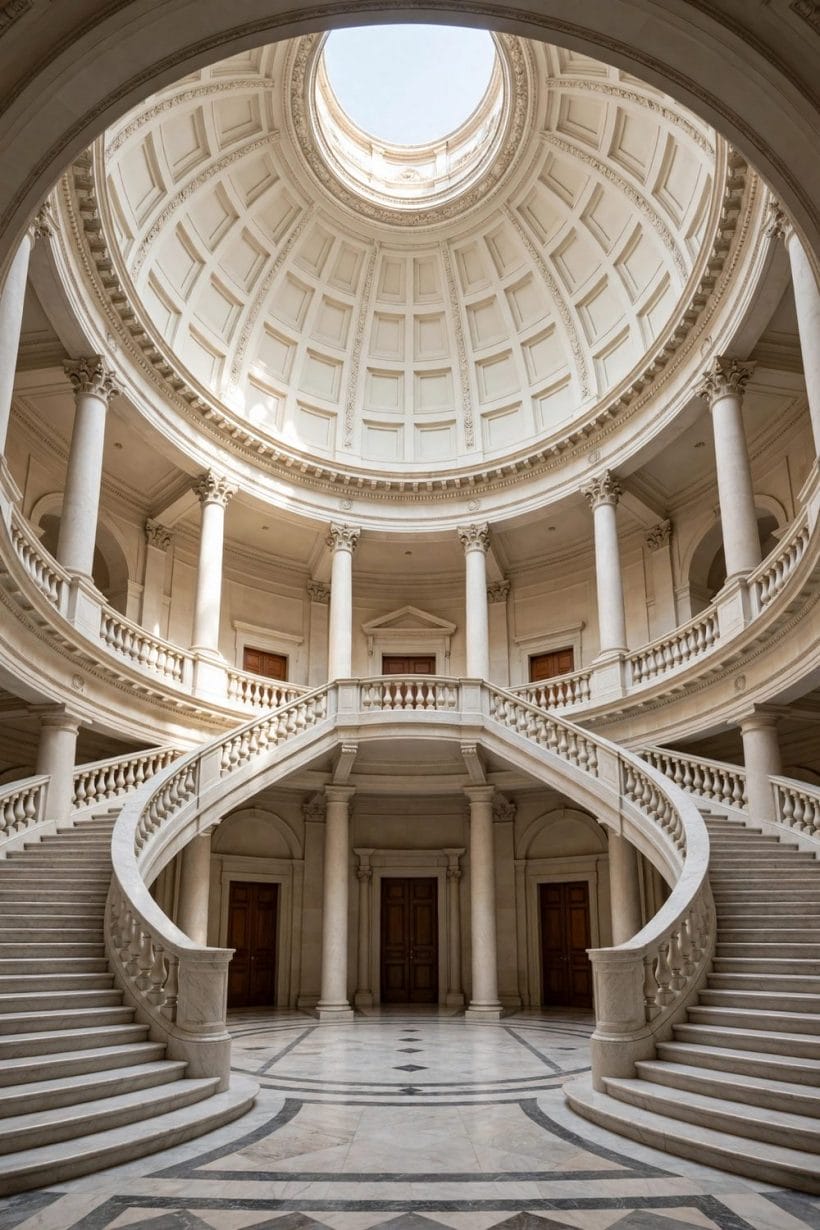
5. Columns, Arches and the Circular Wall
Columns are frequent companions of the rotunda, and they serve the form in several ways. A ring of columns inside the circular wall can carry the weight of the dome, divide the room into a central space and a surrounding walkway, and give the eye a rhythm to follow around the curve. That rhythm is part of the rotunda’s music: column after column, evenly spaced, leading the eye around and around. Even when columns are purely decorative, standing proud of the wall rather than carrying anything, they add that same sense of measured repetition.
Arches belong to the same family. An arched opening in a rotunda’s wall echoes the curve of the room itself, so doorways and niches feel like part of the whole rather than holes cut into it. A row of arches around the wall can create a covered walkway, a gallery, or simply a series of framed views into neighbouring rooms. The arch, like the dome, is a curve, and curves laid upon curves are what give a rotunda its harmony. Straight, sharp-edged openings can work in a rotunda, but they need careful handling, or they will feel like interruptions in an otherwise flowing wall.
The circular wall itself deserves attention, because it is harder to build and to furnish than a straight wall. Curved joinery, fitted shelving and artwork all need to follow the bend, and a picture hung on a curved wall will always sit at a slight angle to its neighbours. These are practical matters, not reasons to avoid the form, but they explain why rotundas are usually kept relatively plain in their wall treatment. A calm, continuous wall lets the shape itself carry the room, and the most successful rotundas are often the least decorated, trusting the circle and the dome to do the work.
6. Rotundas in the Home
In a home, a rotunda most often appears as an entrance hall, a living room, or a garden room. As an entrance, it gives arrival a sense of occasion: a guest steps from outside into a round, light-filled space, pauses, and then chooses a direction, rather than being funnelled straight down a hallway. That pause is the point. A home with a rotunda entrance feels generous even when it is not large, because the entrance itself is a room to enjoy rather than a passage to hurry through. The companion survey of foyer ideas explores that welcoming quality, and a rotunda is one of the grandest ways to achieve it.
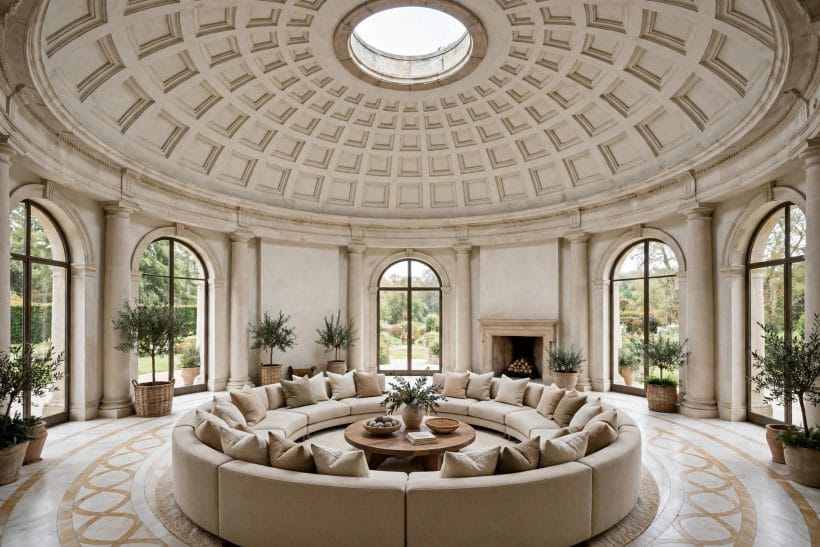
As a living room, a rotunda suits gathering. Seating arranged in a circle or a loose ring lets everyone face each other, which suits conversation far better than rows of chairs facing a single wall. A central table, a fireplace set into the curve, or simply an open floor for children to play on all suit the plan. The room’s even light flatters people and furnishings alike, and its lack of corners means there is no awkward dead space where furniture goes to be forgotten. A rotunda living room feels sociable by its very shape.
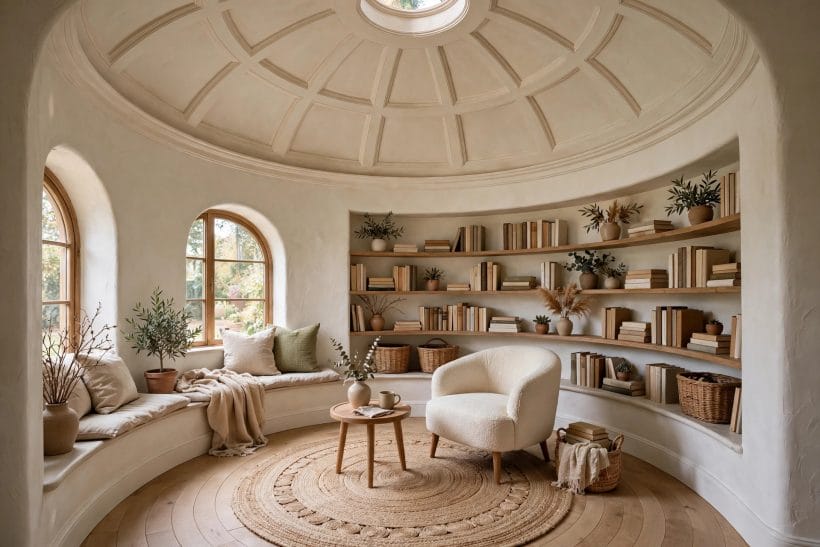
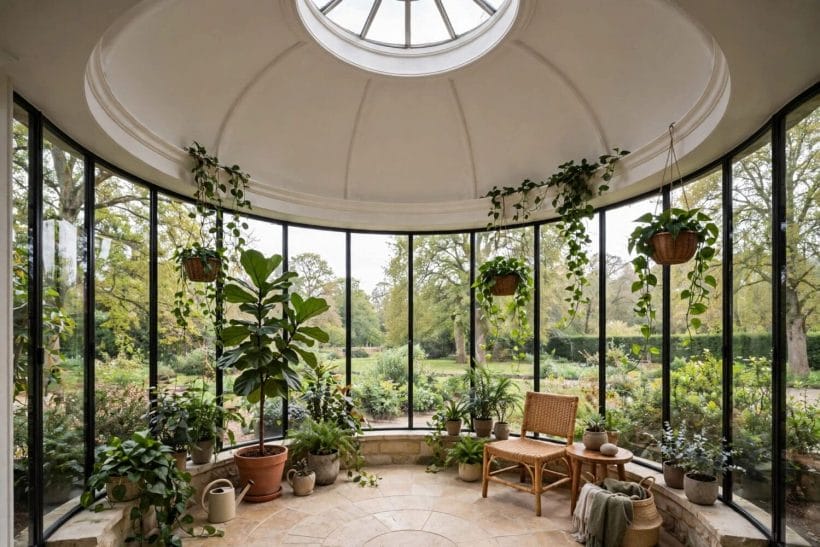
Smaller domestic rotundas appear as dining rooms, libraries, studios and garden rooms. A round dining room makes every seat at the table feel equal, which suits long, leisurely meals. A round library, with shelves following the curve, feels enclosed and calm, like a room built for reading. A garden room in rotunda form brings the garden in on every side, so planting surrounds the sitter rather than facing them from one direction. In each case, the rotunda’s gift is the same: a room that gathers its occupants together and turns its face outward in every direction at once.
7. Rotundas in Public Buildings
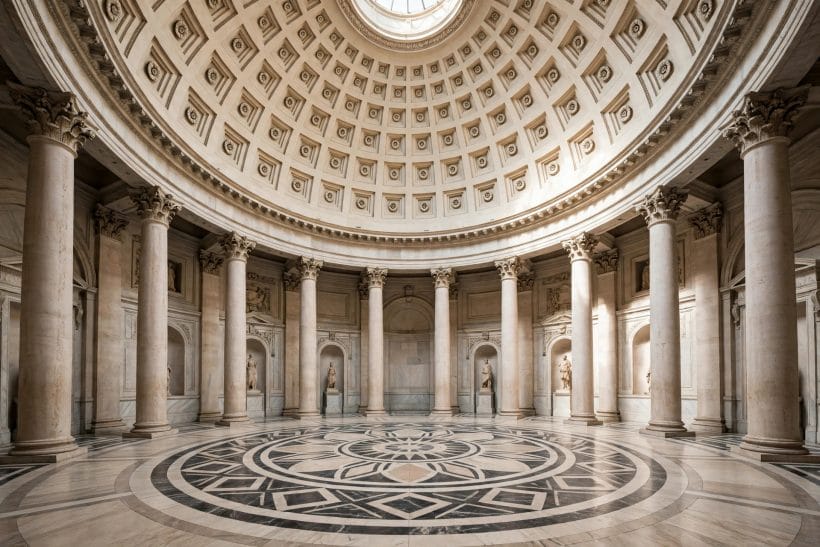
Public buildings have long used the rotunda for rooms that are meant to impress and to gather. A hall, a library, a museum gallery or a place of assembly gains dignity from a round, domed space, because the form itself suggests completeness and shared purpose. Visitors entering such a room understand at once that they are in a place of some importance, without needing any sign to tell them. The rotunda’s calm, centred geometry does that work quietly, through shape and light alone, and it does so for every visitor equally, since no seat or standing place in a round room is obviously better than another.
That equality of place is part of the rotunda’s public appeal. In a long, rectangular hall, the front rows matter more than the back, and the centre matters more than the edges. In a rotunda, the centre is shared, and the edges are all equivalent, so a crowd can gather without a strict hierarchy of position. Exhibits, displays or speakers placed at the centre can be seen and heard from every side, and visitors can move around them freely. The form suits any gathering where the whole group, rather than a single performer or exhibit, is the point.
Public rotundas also serve as landmarks within larger buildings. A visitor who has passed through a rotunda remembers it, and can find their way back to it, because its shape stands out from the rectangular rooms around it. That memorability makes the rotunda a natural meeting point, a place to pause, to orient oneself, and to decide where to go next. The related survey of great room ideas describes a similar gathering quality in tall, open rooms, and a rotunda carries that quality to its fullest expression, adding roundness and a dome to height and openness.
8. Rotundas Outdoors and in Gardens
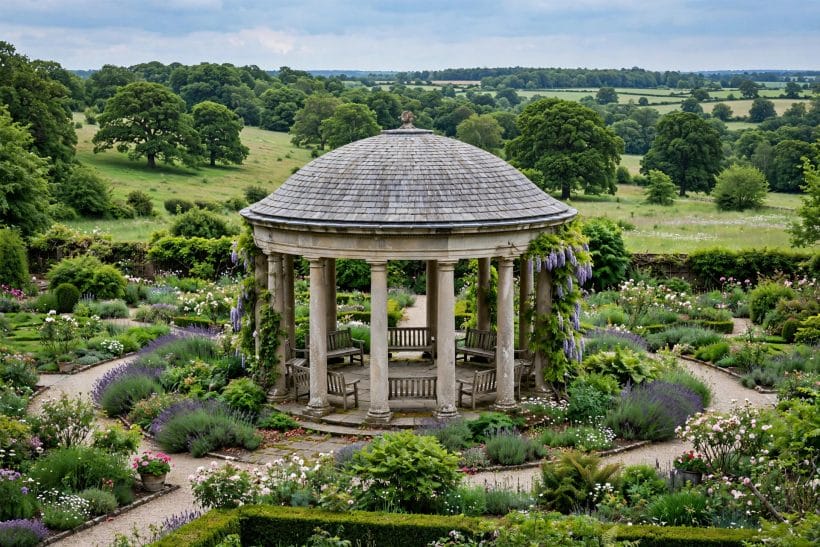
Outdoors, the rotunda takes a lighter form. A garden rotunda is often an open pavilion: a ring of columns carrying a domed roof, with no walls at all, or with low walls that leave the space open to breezes and views. Such a pavilion gives a garden a destination, a shaded place to sit, to eat, or simply to look out from, and it does so without closing off the garden around it. The dome overhead provides shelter and a sense of enclosure, while the open sides keep the garden present on every side.
A garden rotunda also works as a focal point in a landscape. Placed at the end of a path, on a rise, or beside water, it draws the eye and invites a walk toward it, and once reached, it frames views in every direction rather than a single framed vista. Planting can be allowed to climb its columns or to gather around its base, softening its geometry without hiding it. In a larger garden, a rotunda can anchor a whole area, giving paths and beds a centre to relate to, much as a rotunda indoors anchors the rooms around it.
The outdoor rotunda shares its indoor cousin’s love of light, but in a more open way. Sunlight filters through the columns and under the dome, casting moving patterns on the floor through the day, and the open sides let the garden’s sounds and scents in freely. A rotunda in a garden is therefore less a room than a sheltered outlook, a place that is both in the garden and slightly apart from it. The companion survey of sunroom ideas explores a similar in-between space, and a garden rotunda carries that in-between quality outdoors, where the boundary between building and landscape is at its most gentle.
9. Living With a Round Room Day to Day
Living with a rotunda day to day is a pleasure with a few practical lessons. Furniture should be chosen for the curve, not against it. A round or oval table suits the centre better than a long rectangular one, and seating that curves gently, or that is arranged in a ring, will feel at home in a way that a straight sofa pushed against a curved wall never quite will. Rugs, too, suit the round plan: a circular rug echoes the room’s shape and anchors the seating group, while a rectangular rug can fight the curve and make the room feel uneasy.
Storage needs thought in a round room, because there are no straight walls for long runs of shelving or cupboards. Low, freestanding pieces work better than tall fitted runs, and a few well-placed niches in the wall can hold books, plants or display pieces without breaking the curve. The room rewards a lighter touch with belongings: fewer, better pieces, each given room to breathe, rather than a full complement of furniture borrowed from a rectangular room. That discipline is not a drawback; it is part of what keeps a rotunda calm.
Movement around a rotunda quickly becomes second nature. Household members learn the room’s circular flow, children enjoy its lack of corners, and guests find it easy to navigate, because every direction is visible from the centre. The room’s acoustics deserve a mention too: sound in a round, domed room can linger and travel around the curve, so soft furnishings, rugs and curtains help keep conversation comfortable. With those soft layers in place, a rotunda is as easy to live in as any other room, and considerably more delightful to spend time in. The survey of entryway ideas covers the practical welcome a home needs at its threshold, and a rotunda entrance combines that practicality with ceremony in a single round space.
10. Small Rotundas and Compact Homes
A rotunda need not be grand to be worthwhile, and compact homes can borrow its lessons at a smaller scale. A modest round bay, a circular reading corner, or a small domed garden pavilion can bring the rotunda’s calm and centred feeling into a home that has no room for a grand hall. The key is proportion: a small rotunda should be kept simple, with a gentle dome, plain walls and a few pieces of furniture, so the shape itself remains the star. Over-decorating a small round room will crowd it quickly, while restraint will let it feel larger than it is.
Compact homes also benefit from the rotunda’s hub quality. A small round space where two or three rooms meet can replace a cramped hallway, giving each neighbouring room a gracious threshold and the household a place to pause. Light from above is especially valuable in a compact plan, where windows may be limited, and a small skylight at the centre of a modest dome can transform a dark corner into the brightest spot in the house. The related survey of vaulted ceiling ideas shows how height and light can open up even a modest room, and a small rotunda applies that lesson in round form.
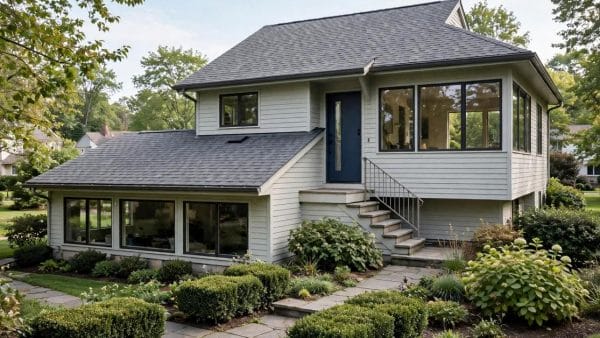
For tiny houses in particular, the rotunda is best treated as an idea to borrow rather than a form to copy literally. A curved wall segment, a round window, a circular seating nook, or a domed skylight can all bring a hint of rotunda character into a compact footprint, without demanding a full circular room. The survey of staircase ideas shows how a single strong form, like a stair, can organise a compact home, and a rotunda detail can do similar work on a smaller scale: one round gesture, placed with care, that gives an otherwise rectangular home a moment of calm, centred grace.
Final Considerations
A rotunda, then, is a round room with a domed ceiling, a centre that gathers the room around it, and a quality of light and movement that no rectangular room quite matches. It appears in grand public halls and in modest garden pavilions, in formal entrances and in quiet reading corners, and in every case it offers the same gifts: even light, balanced proportions, a sense of arrival, and a room that feels complete. Its demands are modest in return: restraint in furnishing, care with curved walls and storage, and an acceptance that a round room is best kept calm rather than crowded.
Before planning a rotunda, or borrowing its ideas for a smaller home, spend time in one if you can, noticing how the light moves, how sound behaves, and how your own movement slows and circles rather than hurrying straight ahead. Think about what the centre of the room should hold, how the dome will be lit, and how the room will connect to its neighbours, since those decisions shape the rotunda more than any decoration. With those questions settled, a rotunda becomes not merely an architectural curiosity, but a genuinely pleasant place to be: a round, domed room that gathers people, light and quiet ceremony into a single, satisfying whole.

0 Comments