
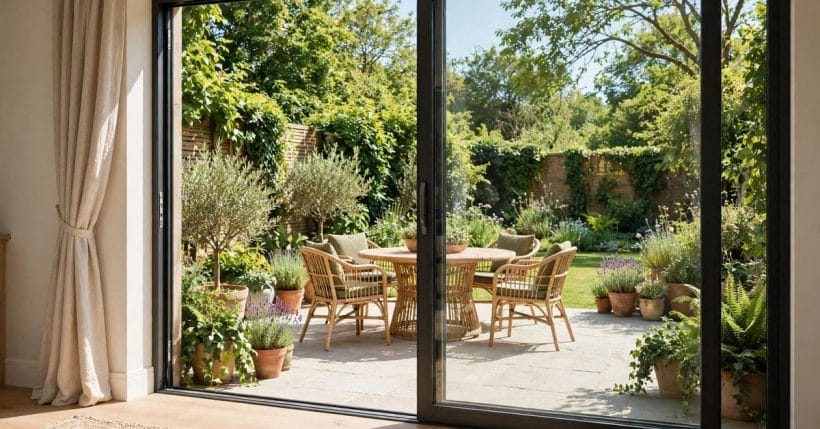
A sliding patio door is the most-used moving part in many homes: it opens the house to the garden, carries daily traffic, and must glide, seal, lock and keep weather out, all in one frame. Choosing one well means checking the things that decide its daily life — the glide, the seal, the lock, the glass and the track — before any brand or model enters the conversation. This guide works through those checks in the order that prevents the commonest regrets.
Nothing here names a maker or a model, and nothing judges one. Makers, models, prices and availability change constantly, and any verdict tied to them would age before the door is even fitted. What does not change is the door itself: how it moves, how it seals, how it locks, and how it is fitted. Check those, and the door you choose will serve whichever maker built it.
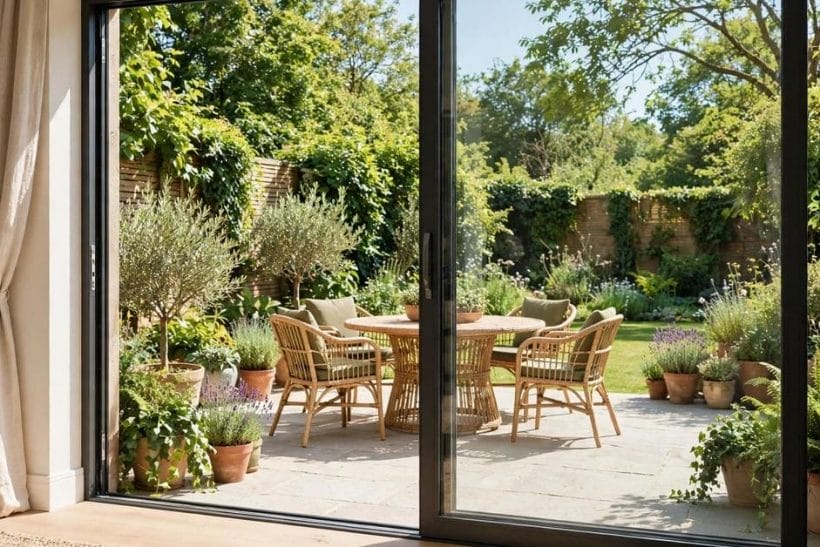
1. The Glide: Smooth on One Hand
The glide is the first thing to test and the first thing to fail. A good sliding door moves with one hand, smoothly, without juddering, sticking or lifting off its track. Test it in the showroom the way you will use it at home: open it fully, close it fully, stop it halfway and move it again. A door that needs force, or that grinds at any point, will only get worse with daily use.
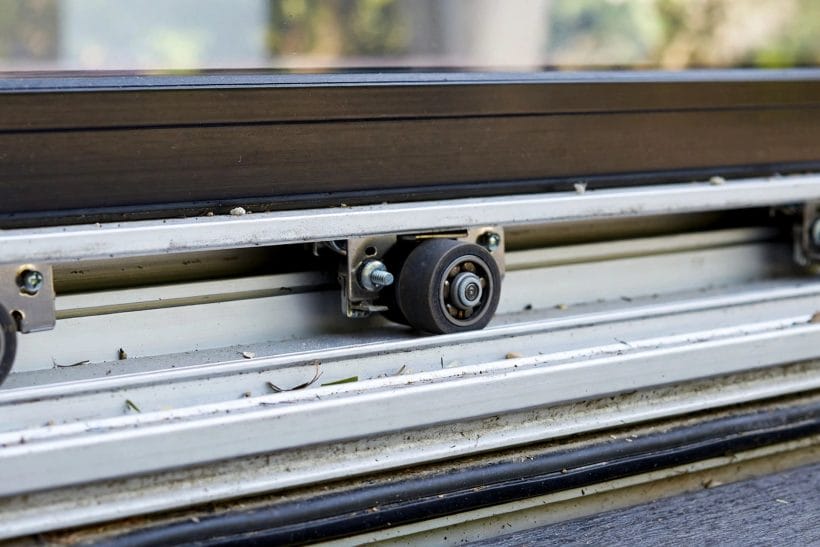
The glide depends on rollers, track and alignment together. Rollers carry the weight; the track guides them; alignment keeps the door square in its frame. A door that drags on one side is usually misaligned rather than broken, but misalignment that cannot be adjusted out is a fault, not a quirk. Ask how the rollers adjust and whether they can be replaced without removing the whole door.
2. The Seal: Draught-Free When Closed
A closed sliding door should seal. Stand beside a closed display door and feel for draughts at the meeting stiles, the top and the bottom; look for daylight through the seals. A door that leaks air leaks heat in winter and cool air in summer, and it lets in dust and noise along with the draught.
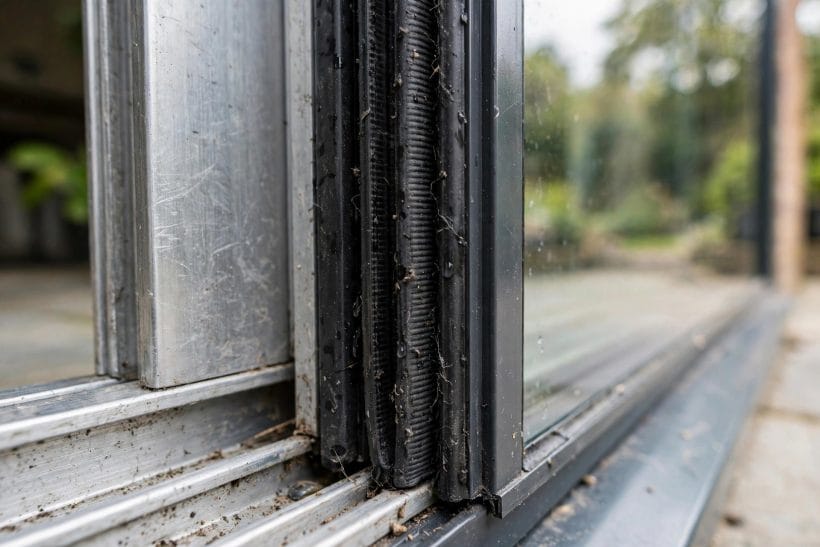
Seals wear, so ask how they are replaced. A door whose weatherstripping pulls out and pushes back in without tools is a door that can be kept sealed for years; a door whose seals are glued or buried is a door whose draughts become permanent. Check the bottom seal particularly — it meets dirt, grit and feet, and it fails first.
3. The Lock: Solid and Multi-Point
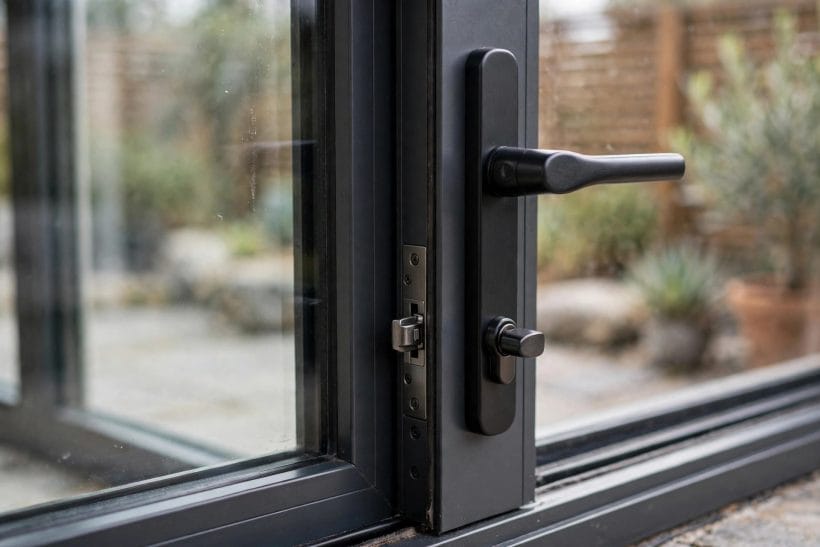
A sliding door’s lock must do more than latch. Look for a lock that engages solidly, with a handle that turns cleanly and a bolt that seats fully, and consider multi-point locking, where the door locks at several points along its edge rather than one. A single latch on a long sliding panel is a weak point; several points spread the load and resist forcing.
Test the lock from both sides and with the door slightly open as well as closed — a lock that only works when the door is perfectly aligned will fail as the house settles and the door shifts. Secondary security, such as a security bar or an auxiliary lock, is worth considering for doors that face secluded gardens, but it should complement a good primary lock, not excuse a poor one.
4. The Glass: Safe, Quiet and Comfortable
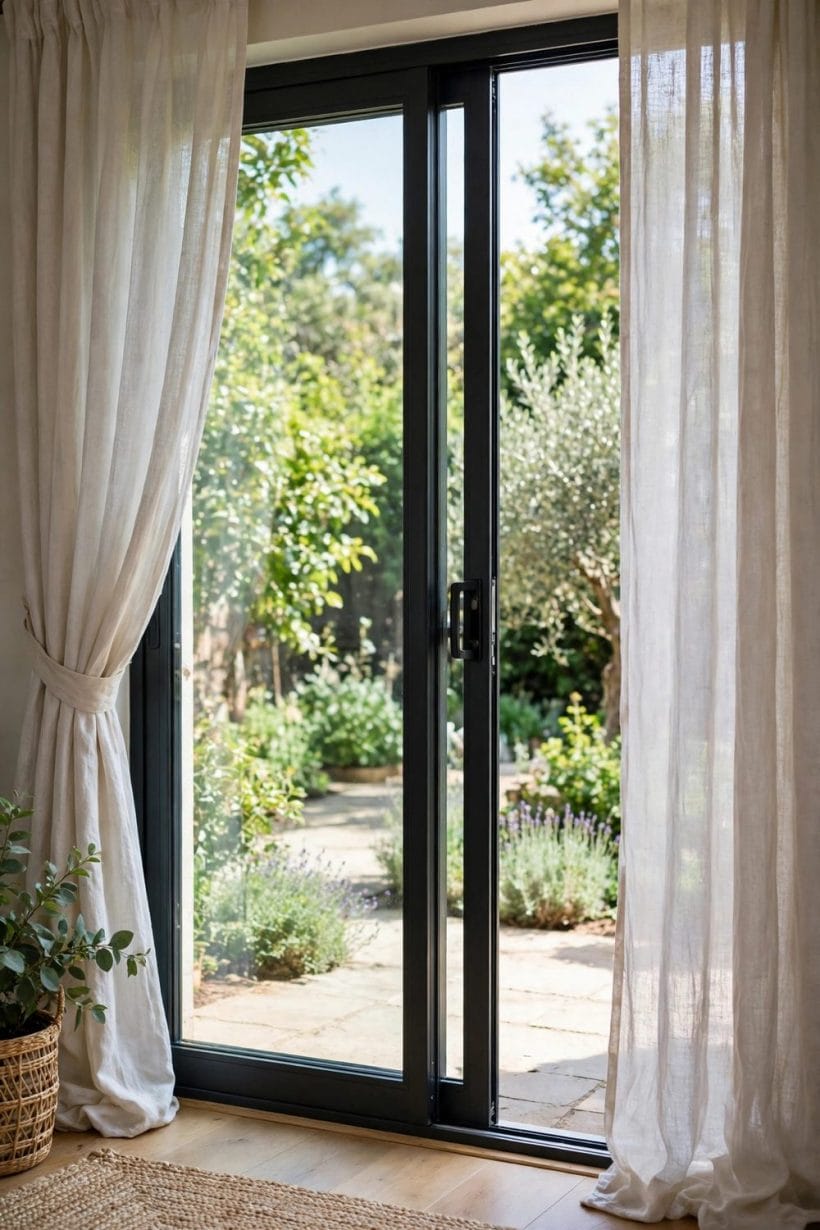
The glass is most of a sliding door, so it decides most of its comfort. Safety glass is the baseline — it breaks safely rather than in dangerous shards — and it should be standard, not an upgrade to be talked into. Beyond safety, consider insulation and sound: a door with good glazing keeps heat in and street noise out, while a thinly glazed door turns the room cold and loud.
Think about sun as well. A south-facing sliding door can overheat a room in summer, and the glass specification shapes that as much as curtains do. Ask about the glass in general terms — its insulation, its solar behaviour, its safety rating — and judge the answers against your room’s orientation rather than against any single number.
Privacy and tint deserve their own consideration, since a sliding door is also a window. Clear glass gives the best garden view and the least privacy; tinted or obscured glass reverses the balance. Between-glass blinds split the difference, offering privacy on demand without curtains, while curtains and external shades offer it with more flexibility. The right choice depends on how overlooked the garden is and how much you value an unobstructed view — a secluded garden can stay clear-glazed, while an overlooked one benefits from privacy built into the door rather than added afterwards.
5. The Track: Clean, Level and Protected
The track is the door’s foundation, and it lives in dirt. Leaves, grit and pet hair collect in it, and a track that cannot be cleaned will eventually defeat the glide no matter how good the rollers are. Look for a track that can be vacuumed and wiped easily, with a profile that does not trap debris in unreachable corners.
Check the track’s level and its drainage. An outdoor track must shed rain rather than pool it, and a track that sits proud of the floor becomes a trip edge. A flush or low-threshold track suits step-free access, but it must still drain — a threshold that floods in rain is worse than one that steps up slightly. The track’s height, drainage and cleanability should be judged together.
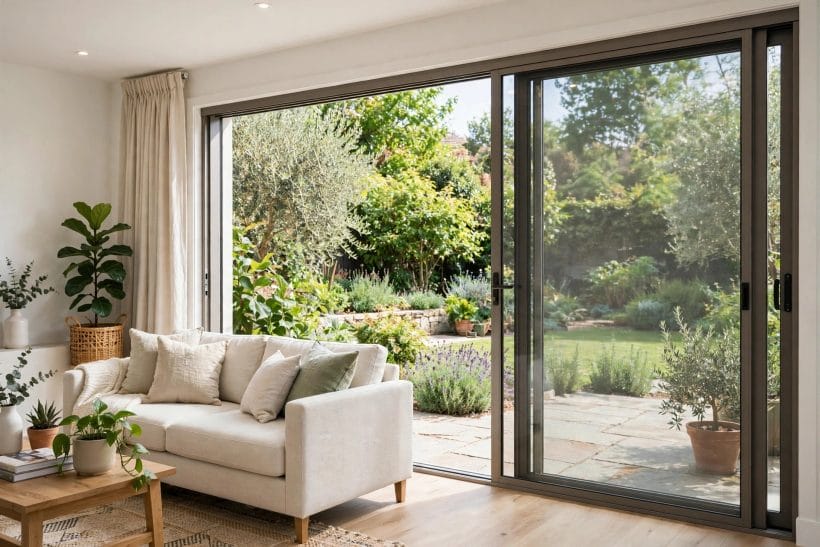
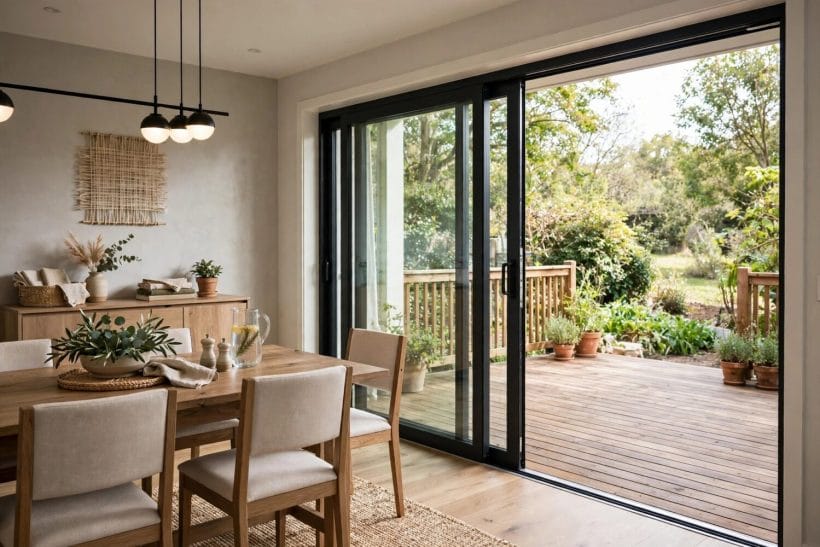
Panel configuration also affects how the door feels in use, and it deserves thought before ordering. A two-panel door gives one sliding and one fixed panel — simple, reliable, and easy to seal. A three- or four-panel door opens wider but adds tracks, meeting stiles and seals, each of which must glide, seal and lock as well as the first. For most households, the simpler configuration serves better: fewer moving parts mean fewer faults, and a single sliding panel that works perfectly beats two that work adequately. Let the opening and the garden decide the configuration, and resist the temptation to maximise opening width at the cost of daily reliability.
6. Fit and Size: The Opening Decides
A sliding door must fit its opening, and the opening must suit a slider. Measure the opening, the wall depth and the space each panel needs to slide into — a slider needs a clear run beside it, and a panel that slides into a wall pocket needs the pocket built for it. A door ordered to the wrong opening size is a door that never glides or seals properly.
Consider the number of panels. Two panels suit most openings; more panels suit wider ones but add meeting stiles, tracks and seals — each a place where draughts and faults can enter. Let the opening’s width and the room’s use decide, not the showroom’s largest display.
Fitting belongs to qualified professionals. A sliding door is heavy, its alignment is precise, and a badly fitted door fails at glide, seal and lock simultaneously. The maker’s fitting guidance should be followed, and the fit should be tested — glide, seal, lock — before the fitters leave.
Handles and hardware deserve the same testing as the door itself, because they are what hands meet every day. A handle should sit naturally in the hand, turn or pull without strain, and feel solid rather than hollow. Cheap hardware on a good door undermines the whole experience — a handle that flexes, a lock that grates, a pull that loosens within months. Test the hardware on the actual door, repeatedly, and ask whether it can be replaced separately if it wears. Hardware that can be renewed without replacing the door extends the door’s life by years, and it is worth choosing a door whose hardware is standard rather than proprietary.
7. Screens, Blinds and Daily Life
Screens and blinds decide how the door lives day to day. A screen door that slides as smoothly as the main door keeps insects out without a daily struggle; one that judders or jumps its track will be left open and useless. Test the screen with the same care as the main door.
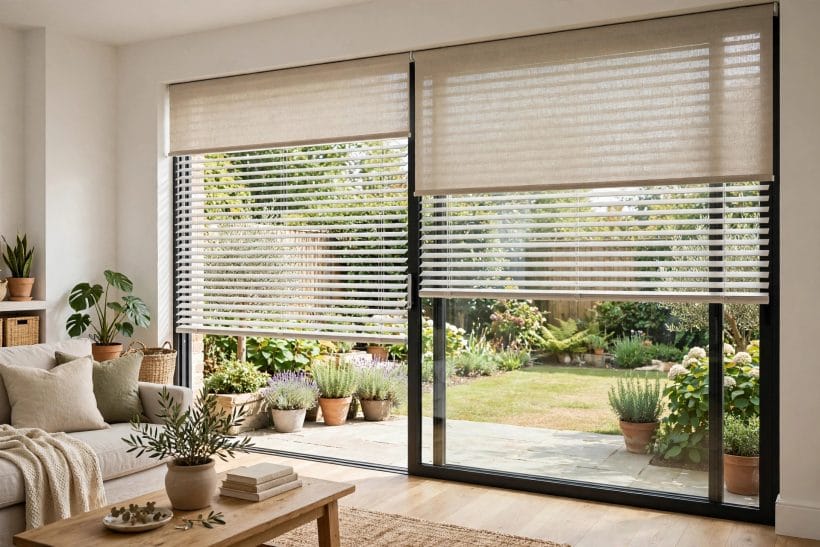
Blinds or shades between glass, on the glass or beside it each suit different households. Between-glass blinds never need dusting but cannot be replaced separately; surface blinds can be changed but need cleaning. Choose for your household’s real habits — pets, children, dust — rather than for the showroom’s styling.
8. Safety, Especially With Children
Sliding doors deserve a safety check, especially where children live or visit. Fingers trap in sliding panels, and a heavy glass panel that slides freely can injure a small hand. Look for finger-safe details where offered, and consider how the door’s weight and glide feel to a child — a door a child cannot control is a door that needs a restrictor or a different handle position.
Glass visibility matters too: a clean glass door is nearly invisible, and children, visitors and pets walk into it. Decals or manifestations at eye level — for both adults and children — prevent the commonest glass-door accident. They need not be ugly; a simple frosted band or a decorative decal serves the same purpose.
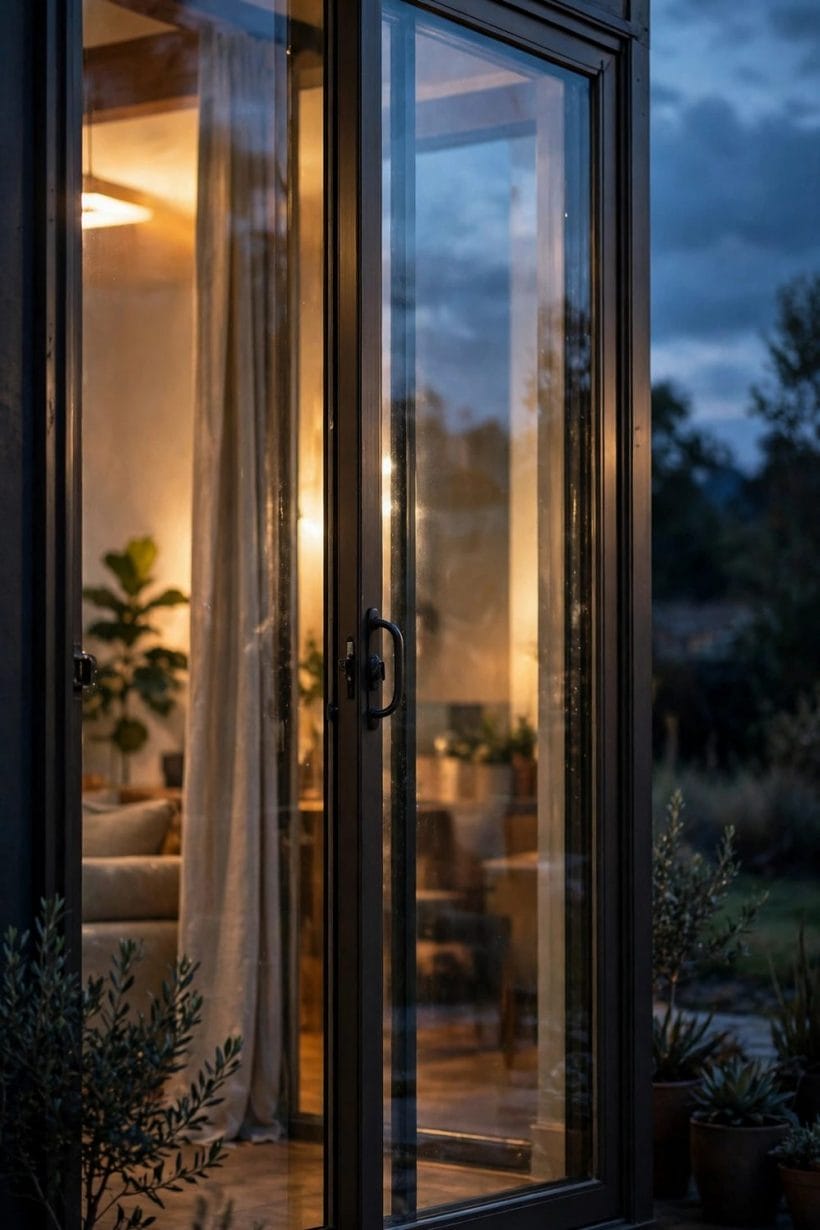
Thresholds deserve a safety check of their own. A raised threshold can trip, especially for older visitors, children and anyone carrying something through the door, while a flush threshold needs proper drainage to avoid flooding. The balance between step-free access and weather protection should be decided for the household that uses the door daily, not for the showroom visitor. A threshold that is clearly visible — through a colour or material change — is safer than one that blends invisibly into the floor, whatever its height.
9. Weather, Noise and the Room Beyond
A sliding door is also a wall, and it must behave like one. In wind, it should not rattle; in rain, it should not leak at the track or the meeting stiles; in cold, it should not stream with condensation. Condensation on the glass signals humidity and temperature differences rather than a fault in itself, but persistent condensation at the frame or track deserves attention.
Noise follows the same logic as draughts: a door that seals air seals sound. If the garden faces a road, the door’s sealing and glazing matter more than its appearance. Stand beside a display door, close it, and listen — the difference between a well-sealed door and a poor one is audible immediately.
Coastal and exposed locations add their own demands. Salt air, driving rain and strong winds test seals, tracks and finishes harder than sheltered inland conditions do, and a door that performs well inland may struggle on an exposed coast. Ask how the door’s seals, rollers and finishes cope with exposure in general terms, and favour designs whose drainage and sealing were made for weather rather than for calm showrooms. A door chosen for its real location, not its display location, is a door that will still glide and seal when the weather turns.
10. Before You Buy: The Final Checks
Before committing, run the whole checklist on the actual door you will buy, not a display model: glide it, seal-test it, lock it, look at its track, and ask about roller replacement, seal replacement, glass specification and fitting. Ask what the warranty covers in general terms and what it excludes, and read the maker’s guidance for the model you choose — the guidance, not a forum verdict, is the authority on your door.
Do not let urgency decide. A door bought in haste because an opening is empty is a door that will be lived with for years; a few days spent checking glide, seal, lock and fit are repaid every day the door is used. The right door is the one that passes the checks, from whichever maker it comes, fitted by qualified professionals and tested before they leave.
Maintenance, finally, is the habit that keeps a good door good. Vacuum the track regularly, wipe the seals, lubricate the rollers as the maker directs, and check the lock’s alignment as the house settles through the seasons. These are small tasks, but they are the difference between a door that glides for decades and one that grinds within a few years. A sliding door asks little — a clean track, a wiped seal, an occasional adjustment — and it repays that little with daily ease. Build the habit when the door is new, while everything still works perfectly, and the door will stay that way.
Final Considerations
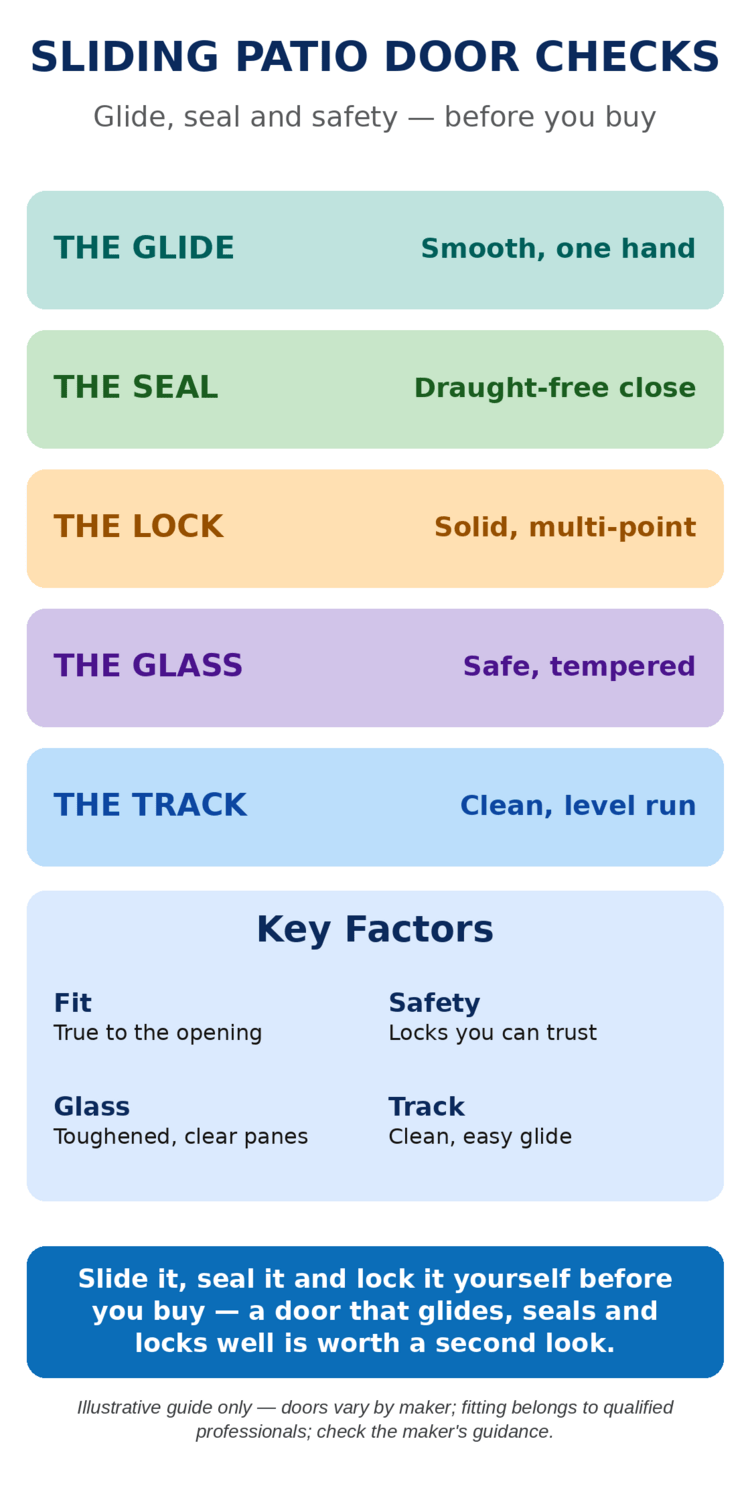
A sliding patio door is judged by five checks: a glide that moves on one hand, a seal that holds air out, a lock that engages solidly at several points, glass that is safe and comfortable, and a track that stays clean, level and drained. Fit binds them all — a badly fitted door fails every check at once.
Make those checks on the door itself, ignore the urgency of the moment and the name on the frame, and the door you choose will open and close as it should for years. For the openings around it, our exterior entryway, fence gates, garage door opener checks, patio furniture checks, interior design ideas, tiny house designs and kitchen ideas follow the same check-first discipline.



0 Comments