

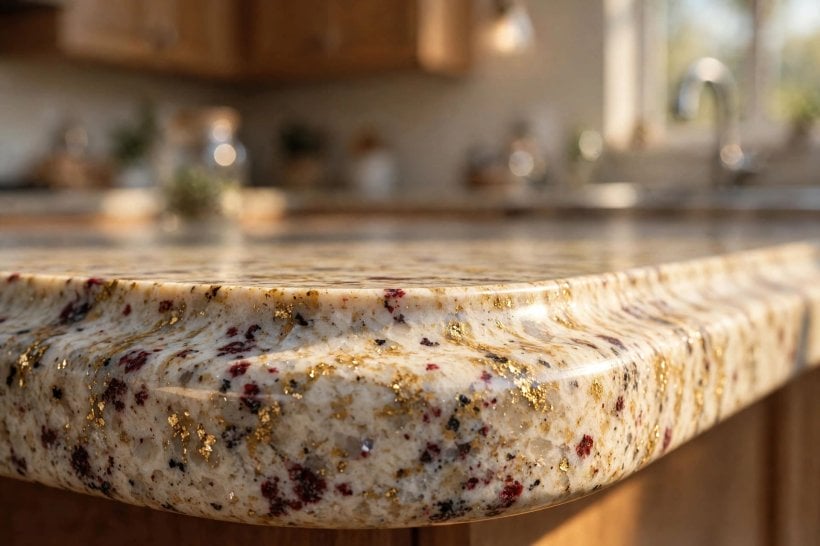
Warm, speckled and forgiving of everyday life, St Cecilia granite has been a kitchen favourite for years — and it still earns its place. This guide explores layouts, colours, cost drivers and practical details for a santa cecilia granite kitchen, so you can plan the stone, the cabinets and the finishing touches as one scheme.
Expect honest guidance on pairing, edges, care and budgeting, without the sales talk.
1. At-a-Glance: St Cecilia Granite in Brief
| Question | Practical answer |
|---|---|
| What does it look like? | A warm, creamy-to-golden granite flecked with burgundy, brown, gold and dark grey mineral deposits; every slab is naturally unique. |
| Which cabinets suit it? | Warm whites, cream, natural wood and deeper stained cabinetry all work; cool blue-greys need careful testing against its warmth. |
| Is it good in small kitchens? | Yes. Its busy pattern hides crumbs and marks, but pair it with plain cabinets and walls so the room does not feel crowded. |
| Does granite need sealing? | Granite is usually sealed on installation and periodically afterwards, following the fabricator’s advice for your slab. |
| What drives the cost? | Slab choice, thickness, edge profile, cut-outs, templating, delivery distance and installation complexity — not just the stone itself. |
| Is each slab the same? | No. View and reserve the actual slab you will live with whenever you can. |
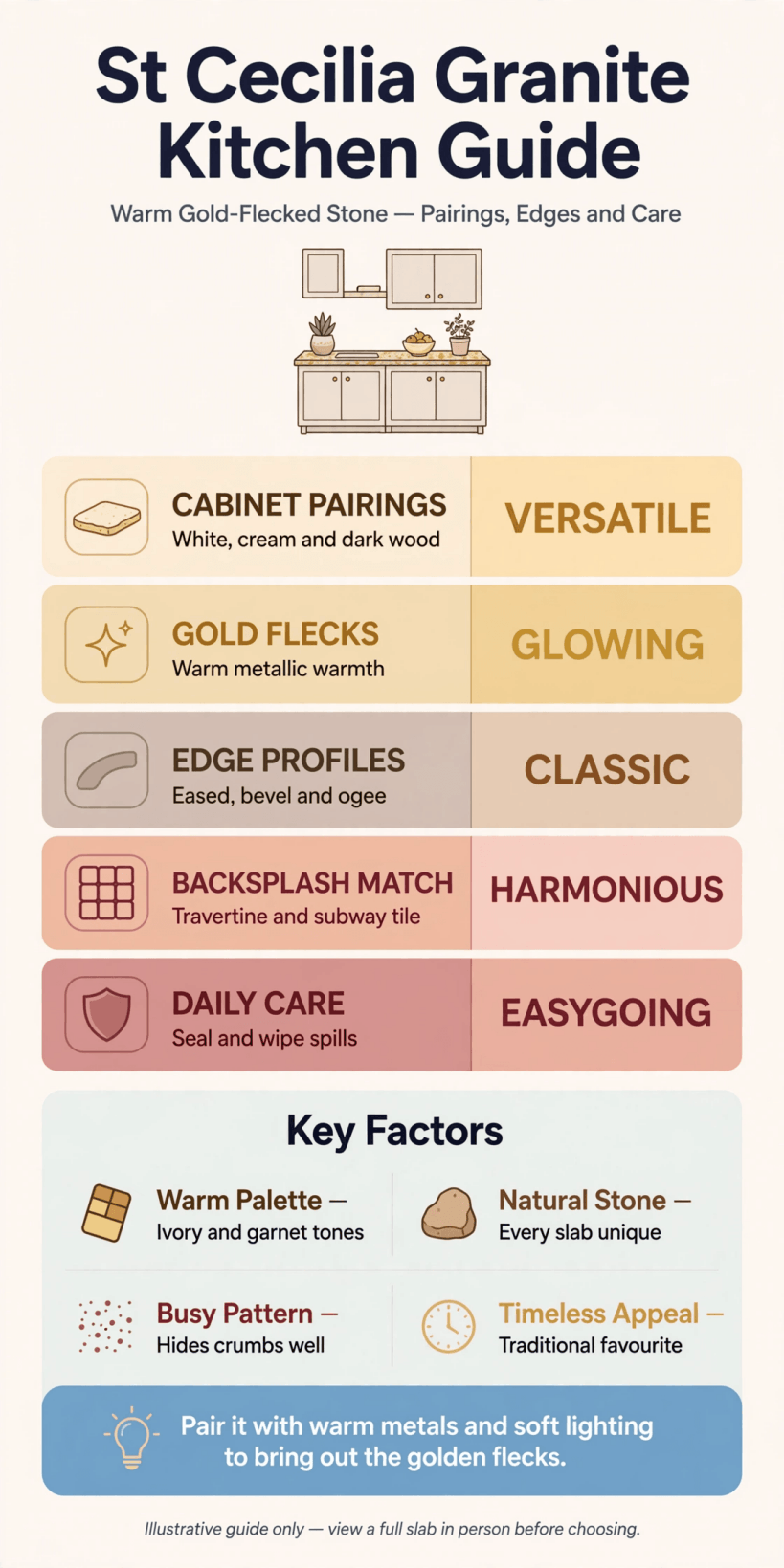
A quick visual summary of St Cecilia granite — its colour mix, best pairings and the practical points to check before you order.
St Cecilia — often sold as Santa Cecilia — is best understood as a warm neutral with movement. From a distance it reads as a soft, golden cream; up close, the mineral flecks give it depth that plain worktops cannot match. That dual nature is its strength in a family kitchen: the overall effect is calm, but the detail disguises the evidence of breakfast, baking and homework. It is also why samples can mislead. A palm-sized sample shows the fleck pattern but not the flow of a full slab, where larger patches of colour drift across the surface. Whenever possible, choose from full slabs or large showroom pieces, and take cabinet, floor and paint samples with you to judge the combination in the same light.
Because the stone carries several colours at once — cream, honey, chestnut, wine-dark flecks and charcoal — it offers unusual freedom with the rest of the room. You can pull any one of those tones forward: a burgundy accent, warm brass hardware, a charcoal cooker or soft cream walls will each produce a different kitchen from the same worktop. The sections that follow work through those choices in order, from layout to styling.
2. Layouts That Let the Stone Breathe
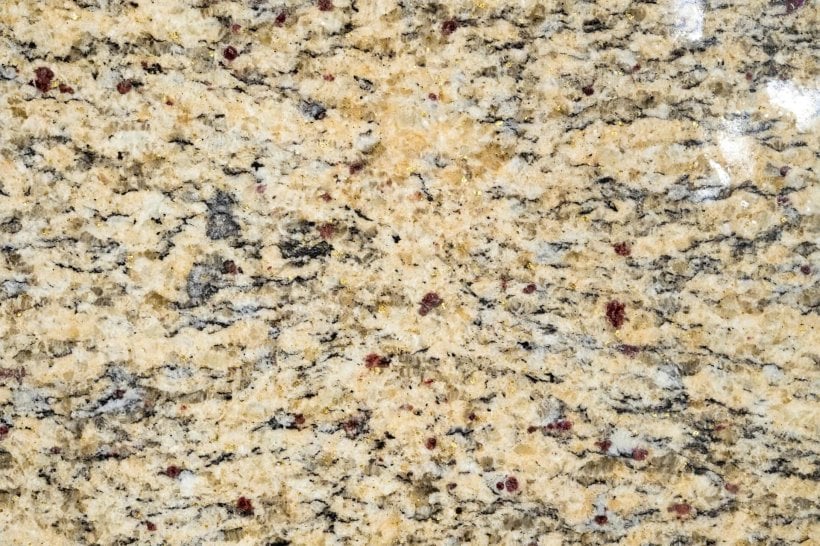
Layout comes before stone selection, because the shape of the run decides how much granite you see and where the joins fall. In a galley kitchen, long unbroken runs show the slab’s movement beautifully and need few seams; keep the pattern running in the same direction on both sides for a calmer effect. In an L-shaped layout, think about the corner early — whether the stone turns the corner in one piece or meets in a join affects both appearance and price, and your fabricator will template it precisely either way. U-shaped kitchens wrap the stone around you, which is practical and generous, but three runs of a busy granite around a small room can overwhelm it; consider a plainer material on one short run, such as a wooden breakfast ledge, to rest the eye.
Islands deserve special thought. A St Cecilia island becomes the room’s centrepiece, so give it breathing space: plain cabinet fronts below, a simple edge profile, and pendant lights that do not fight the pattern. Waterfall ends, where the stone continues down the side of the island, look dramatic but use a great deal of material and suit larger rooms; in compact kitchens a standard end panel keeps the island lighter. If your cooking space is genuinely small, the layout principles in our tiny house living room ideas guide — one strong feature per room, everything else quiet — translate perfectly: let the granite be the feature and keep the layout simple.
Whatever the shape, plan the practicalities alongside the beauty: landing space beside the hob and fridge, a run long enough for food preparation, and sockets positioned so they do not chop into the splashback at awkward points.
3. The Colour Story: Warmth, Flecks and Light
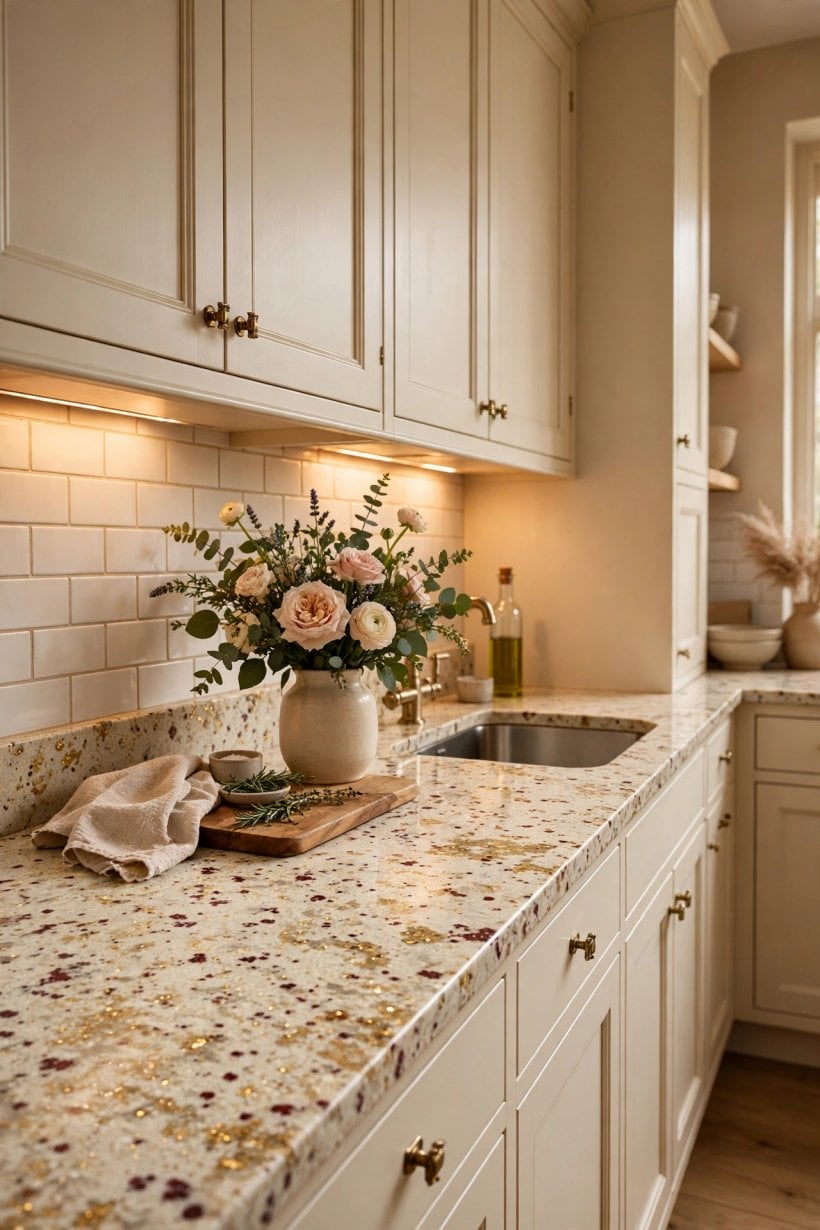
The defining trait of this granite is warmth. Its background moves between ivory, cream and pale gold, and the flecks scatter burgundy, amber, coffee and near-black across it. In a bright, sunlit room the gold tones come forward and the whole surface glows; in a north-facing kitchen the greyer minerals show more and the stone reads moodier and more sophisticated. Neither is better — but they ask different things of the rest of the scheme. Warm, glowing slabs partner happily with cream cabinets and brass; moodier slabs look superb with deep green or navy units and darker bronze hardware.
Lighting changes everything, so test before you commit. Prop a slab sample at worktop height, look at it in daylight and under your evening lighting, and check it against your floor. Warm-white bulbs flatter the stone; very cool bulbs can make the cream background look slightly grey and the burgundy flecks dull. If you are replanning lighting anyway, layered light — ceiling spots for work, softer pendants for evening — gives you both faces of the stone in one room.
Colour confidence matters elsewhere in the home too. If you love how a multi-toned natural material lets you build a palette from its own flecks, our colourful tiny house interior ideas show the same trick working with textiles and paint in small spaces: pick two or three tones from the material you already have, repeat them quietly, and stop there.
4. Pairing Cabinets, Doors and Hardware
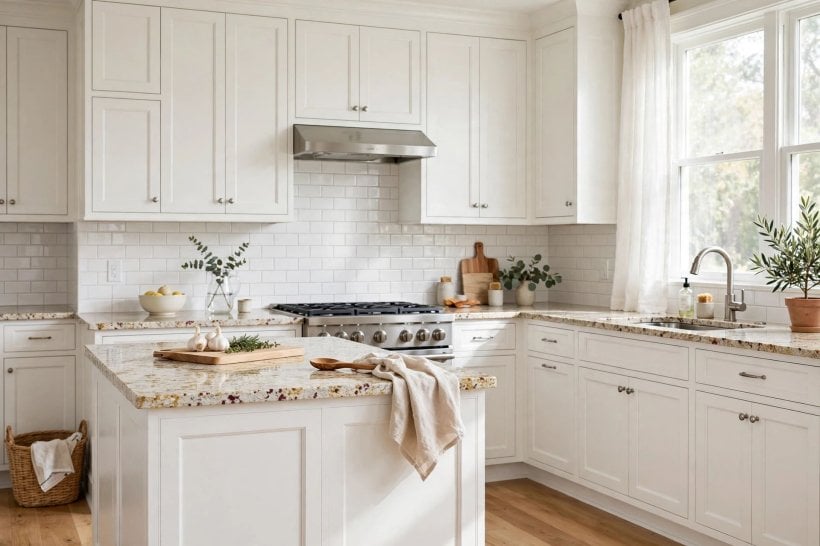
Cabinet choice is where St Cecilia kitchens succeed or stumble. The safest and most popular pairing is a warm off-white or cream door: it lifts the stone’s light background, keeps small kitchens bright, and lets the flecks provide the interest. Pure brilliant white can clash with the cream in the granite, making the worktop look yellow by comparison, so always compare actual door samples against the slab — in the yard or showroom, not from memory.
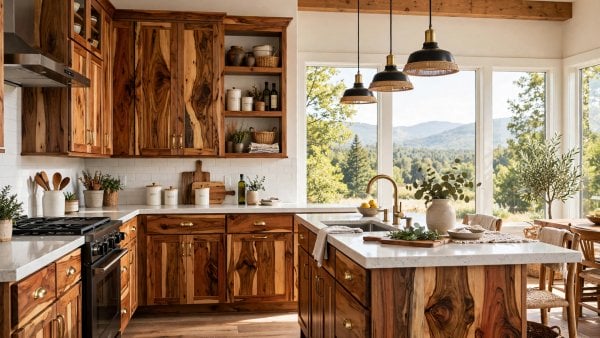
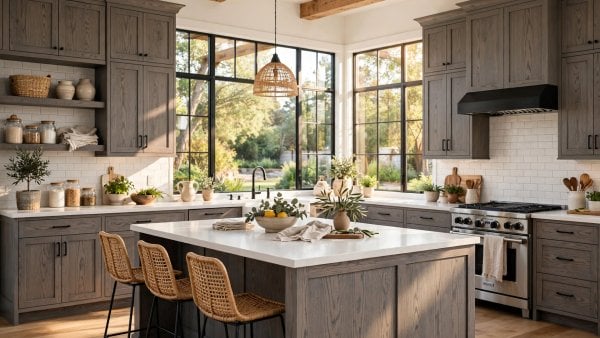
Natural wood is the other classic partner. Light oak and maple echo the stone’s honey tones for a seamless, country feel; mid and dark woods — walnut, stained hickory, cherry tones — create contrast and pick up the darker flecks, giving a richer, more formal kitchen. Painted colours can work beautifully too: sage and olive greens flatter the warm minerals, deep navy gives a handsome traditional contrast, and soft greiges bridge the stone and stainless appliances. What rarely works is a busy door style plus a busy stone: choose flat or simple shaker fronts so the granite remains the pattern in the room.
Hardware is the jewellery. Warm metals — brushed brass, antique bronze, copper — amplify the golden flecks and feel cohesive; brushed nickel and stainless sit happily with the grey minerals and appliances; matt black gives crisp definition against the light background and suits a more modern take. Handles in a single finish, repeated consistently, tie the scheme together far more than any single statement piece.
5. Edges, Sinks, Splashbacks and the Finishing Details
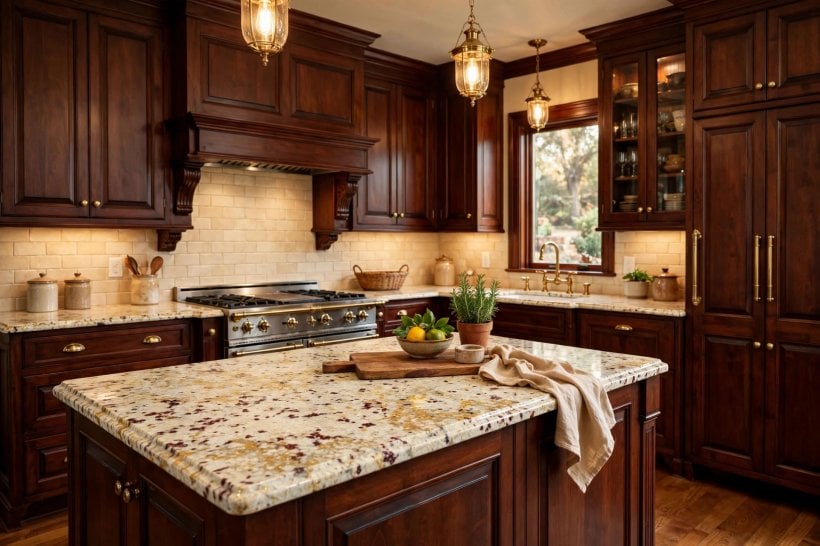
The details at the edges of the stone decide how finished the kitchen feels. Edge profiles range from simple, slightly rounded or bevelled edges — practical, forgiving of knocks and usually the most economical — to more elaborate curved profiles that cost more to fabricate and suit traditional rooms. In a family kitchen, a softly eased edge is hard to beat: it sheds crumbs, resists chipping better than a knife-sharp square edge, and does not date. Ask your fabricator to show you profile samples against your slab, because an edge changes how the stone’s thickness and layers read from across the room.
Sink choice interacts with the stone daily. Undermounted sinks give that clean sweep from worktop into the bowl and show off the granite’s finished edge around the cut-out — which is precisely why the cut-out must be well made and sealed. Inset sinks sit on top, are kinder to budgets and simpler to replace. Either way, talk through tap holes, draining grooves and the position of the sink relative to windows and dishwashers before templating; changes after cutting are expensive or impossible.
For splashbacks, you have three sensible routes: a short granite upstand in the same stone for a neat, wipeable line; a full-height granite splashback for maximum drama and maximum cost; or tiles, which let you introduce a quieter or contrasting surface — plain cream, soft sage or handmade-look tiles all sit well with this stone’s warmth. The splashback logic mirrors good small-bathroom planning, where one material should dominate and others support; our tiny house bathroom ideas guide applies the same discipline in a smaller room.
6. Costs: What Actually Drives the Price
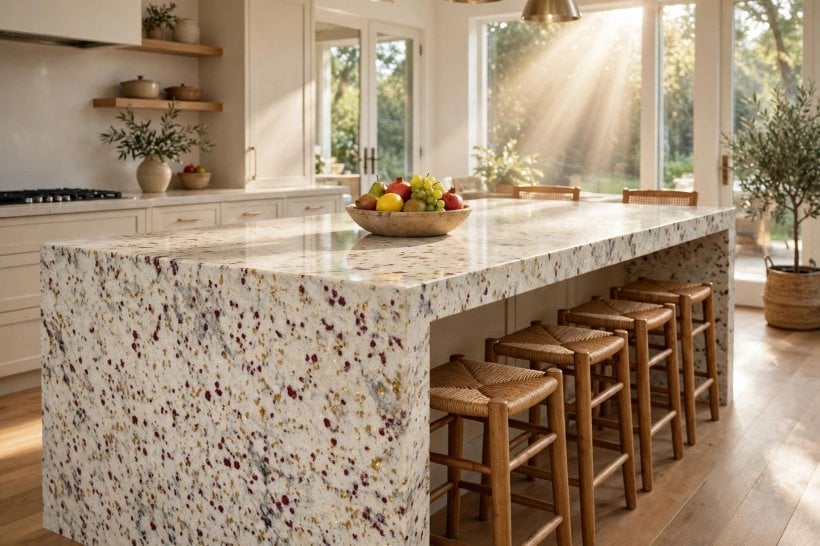
Granite pricing is rarely a single figure, and honest budgeting means understanding the components rather than chasing a headline rate. The stone itself is one element — slabs vary in price by source, availability and how the granite is graded by the supplier. Around it sit the fabricator’s work: templating your kitchen precisely, cutting and polishing the slab, forming the edge profile, cutting sink and hob apertures, and finishing any joins. Delivery and installation add further cost, particularly where access is tight, the kitchen is upstairs, or the pieces are large and heavy enough to need extra hands.
Your choices move the total in predictable directions. Thicker stone, elaborate edges, waterfall ends, full-height splashbacks and numerous cut-outs all add fabrication time and material. Long runs with few joins cost more in slab but less in fitting complexity than many short pieces. Islands are often the single most expensive element because of their size. None of this means the stone is poor value — a well-fitted granite worktop serves for decades — but it does mean quotes should be compared like for like: same thickness, same edge, same cut-outs, templating and fitting included or clearly separated.
Get itemised quotes from more than one fabricator, ask what is excluded (plumbing reconnection, old worktop removal and disposal are common exclusions), and keep a contingency for the surprises any kitchen project finds — an out-of-square wall or a floor that needs levelling before the stone can sit safely. Money spent on accurate templating is never wasted; money saved by skipping it usually reappears as a problem.
7. St Cecilia in Small and Tiny Kitchens
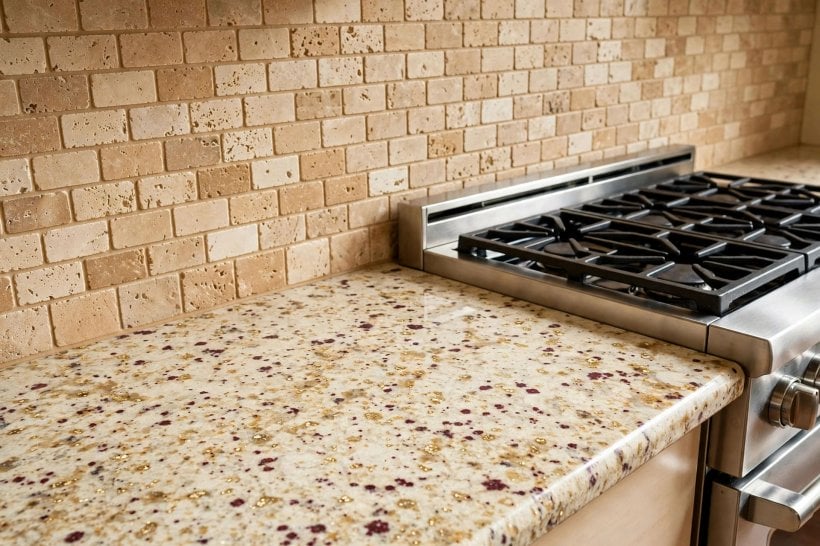
Compact kitchens are where this stone quietly shines, provided you use it with restraint. In a small santa cecilia granite kitchen, one continuous run of the stone, paired with plain light cabinets and a simple upstand, gives you the material’s warmth and durability without visual clutter. The pattern hides the crumbs and marks that would show instantly on a plain pale worktop in a hard-working small space, and the reflective polish bounces light around, which helps a little room feel bigger.
Restraint is the watchword. Avoid full-height splashbacks in the same stone in a tiny room — a short upstand plus painted wall or plain tiles above keeps the proportions light. Keep worktop clutter ruthlessly low: in a small kitchen the stone is the decoration, so store appliances away and let the surface show. Open shelving above a granite run can work if what sits on it is plain and useful; glass-fronted or closed cabinets are more forgiving.
The small-space lessons apply across the home: our tiny house bedroom ideas make the same case for calm surfaces and one texture doing the talking. And if your kitchen sits in an open-plan tiny home, carry one of the stone’s tones — the cream, the burgundy or the charcoal — into the living area textiles so the spaces feel designed together rather than stitched together.
8. Care, Sealing and Everyday Living
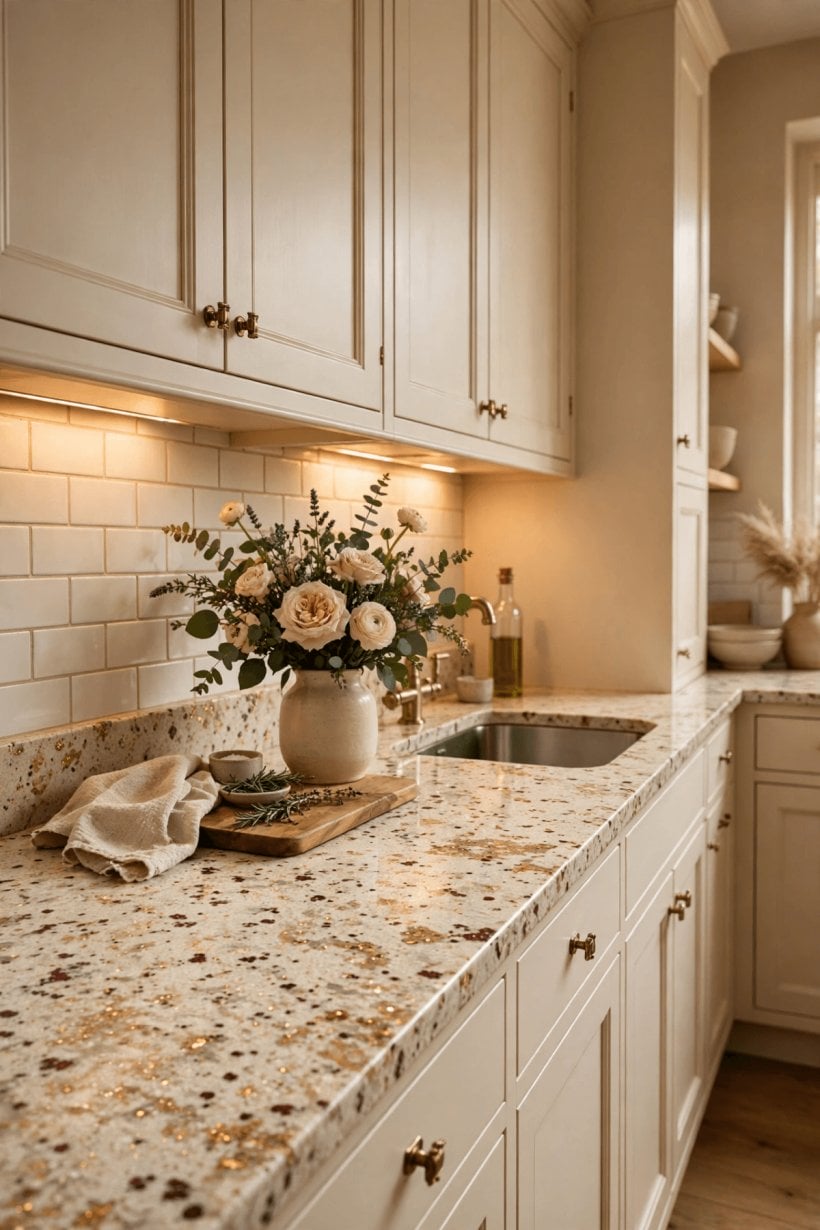
Granite has a reputation for toughness that is largely earned — it resists heat and scratches far better than most worktop materials — but it is a natural, slightly porous stone and rewards sensible habits. Wipe spills as they happen, especially wine, oils, citrus and strongly coloured foods, which can mark lighter areas of the stone if left to sit. Use trivets or mats under very hot pans rather than testing the stone’s limits daily, and use boards for chopping: granite will shrug off a knife, but your knife will not shrug off granite.
Cleaning needs nothing exotic. Warm water, a soft cloth and a mild, pH-neutral cleaner made for stone will handle daily life; avoid abrasive pads and harsh acidic or alkaline cleaners, which can dull the polish and degrade sealant over time. Sealing is the one maintenance task to plan for: fabricators typically seal the stone at installation and advise when it is likely to need refreshing, based on the slab and your use. The water test — watching whether a small puddle beads or soaks in and darkens the stone — is a common way to judge whether sealant is tiring, but follow your own fabricator’s guidance above any general rule.
Day to day, owners tend to love this granite more over time, not less. Its pattern forgives a working kitchen, crumbs vanish into the flecks between cleans, and the stone does not show every fingerprint the way dark, plain surfaces do. For a busy household, that forgiveness is a genuine practical feature, not a compromise.
9. Styling Around the Stone
With the stone carrying so much pattern, styling is an exercise in editing. Choose a small number of worktop objects and make them count: a wooden board in a warm tone, a plant in a terracotta or cream pot, a rail of utensils in one metal finish. Groups of two or three, with space between them, read as intentional; a dozen small ornaments scattered across the granite read as clutter and fight the stone for attention.
Textiles are your cheapest colour tool. Tea towels, a runner or seat pads in one of the stone’s fleck colours — burgundy for warmth, sage for calm, charcoal for definition — pull the scheme together and can change with the seasons. Window dressings in plain linen or cotton keep the light soft and the focus low. If the kitchen opens to a garden or terrace, echo the stone’s natural warmth outside too; the layering approach in our tiny house landscaping ideas — stone, wood and planting in balance — is exactly the same palette working outdoors.
Floors deserve a final word. Warm wood or wood-effect floors are the natural partner and keep the room cohesive; stone-look tiles in a soft cream work well too. The one pairing to test carefully is a second busy pattern — a strongly figured tile or a speckled floor plus speckled worktop can leave the room buzzing. Take samples home, lay them together at floor and worktop height, and live with the combination for a day before deciding.
10. Comparing, Choosing and Avoiding the Usual Mistakes
Before you finally commit, stand back and compare honestly with the alternatives you considered. Against quartz, granite offers unique natural pattern and excellent heat tolerance, in exchange for periodic sealing and slab-to-slab variation. Against laminate lookalikes, it offers weight, coolness to the touch and decades of service, in exchange for a higher upfront cost and professional fitting. Against other granites, St Cecilia’s case is its warmth and its forgiving pattern: darker stones feel more dramatic but show crumbs relentlessly, paler plainer stones feel calmer but show every mark. Knowing which trade-offs suit your household is the real decision; the stone is simply where it lands.
The common mistakes are all avoidable. Choosing from a tiny sample alone. Pairing the stone with a second loud pattern. Forgetting that brilliant white can fight the cream in the slab. Underestimating the fitting part of the budget. Ordering without discussing seams on long runs. Each disappears with one habit: slow down at the decision points, view big pieces in real light, and get the fabricator’s advice in writing before the slab is cut.
Finally, buy from people who will show you the actual slab and explain its individual character — a fissure that is part of the stone’s nature, a larger patch of quartz, a drift of colour. Understanding your particular slab turns surprises into features, and it is the surest route to a kitchen you still enjoy in ten years. If your project grows beyond worktops into planning whole small homes, our guide on how to build your own tiny house follows the same choose-in-person, decide-slowly philosophy at full scale.
Final Considerations
St Cecilia granite endures because it balances character with kindness: warm, unique and patterned enough to forgive real life. Choose the actual slab, pair it with plain cabinets in a tone tested against the stone, keep edges and splashbacks simple, budget for templating and fitting as well as the material, and seal and clean it as your fabricator advises. Do those things and this classic stone will anchor a kitchen that feels welcoming from day one — and still will years from now.

0 Comments