

Higher tables need higher seats, and guessing rarely ends well. This guide explains how to measure your own table and chairs, how to read retailer specifications with care, and how to check comfort before you commit to a taller dining set.
1. At a Glance: Seat Height Key Points
Seat height sounds like a small detail until everyone sits down and knees meet the table apron. The short version is simple: measure from the floor to the underside of your tabletop, decide how much legroom feels comfortable for the people who eat with you most often, and only then compare chair measurements. Retailer listings describe the same chair in different ways, so your own tape measure is always the final check.
| Question | Key point |
|---|---|
| What does seat height mean? | It is the distance from the floor to the top of the seat surface, measured on an uncompressed, un-cushioned seat unless the seller states otherwise. |
| Why do high tables need taller chairs? | A higher tabletop lifts the eating surface, so a standard seat can leave diners feeling low, with elbows below a comfortable working height. |
| How much legroom should I allow? | Most households aim for a comfortable gap between the top of the thighs and the underside of the table or apron; test it with a chair you already own. |
| Can I trust the number in a listing? | Use it as a starting point only. Check whether it includes a cushion, casters, or a footrest, and confirm the measuring method in the product details. |
| What if my table is between sizes? | Sit at it with chairs of different heights, borrowed if needed, and judge by posture and legroom rather than by a chart alone. |
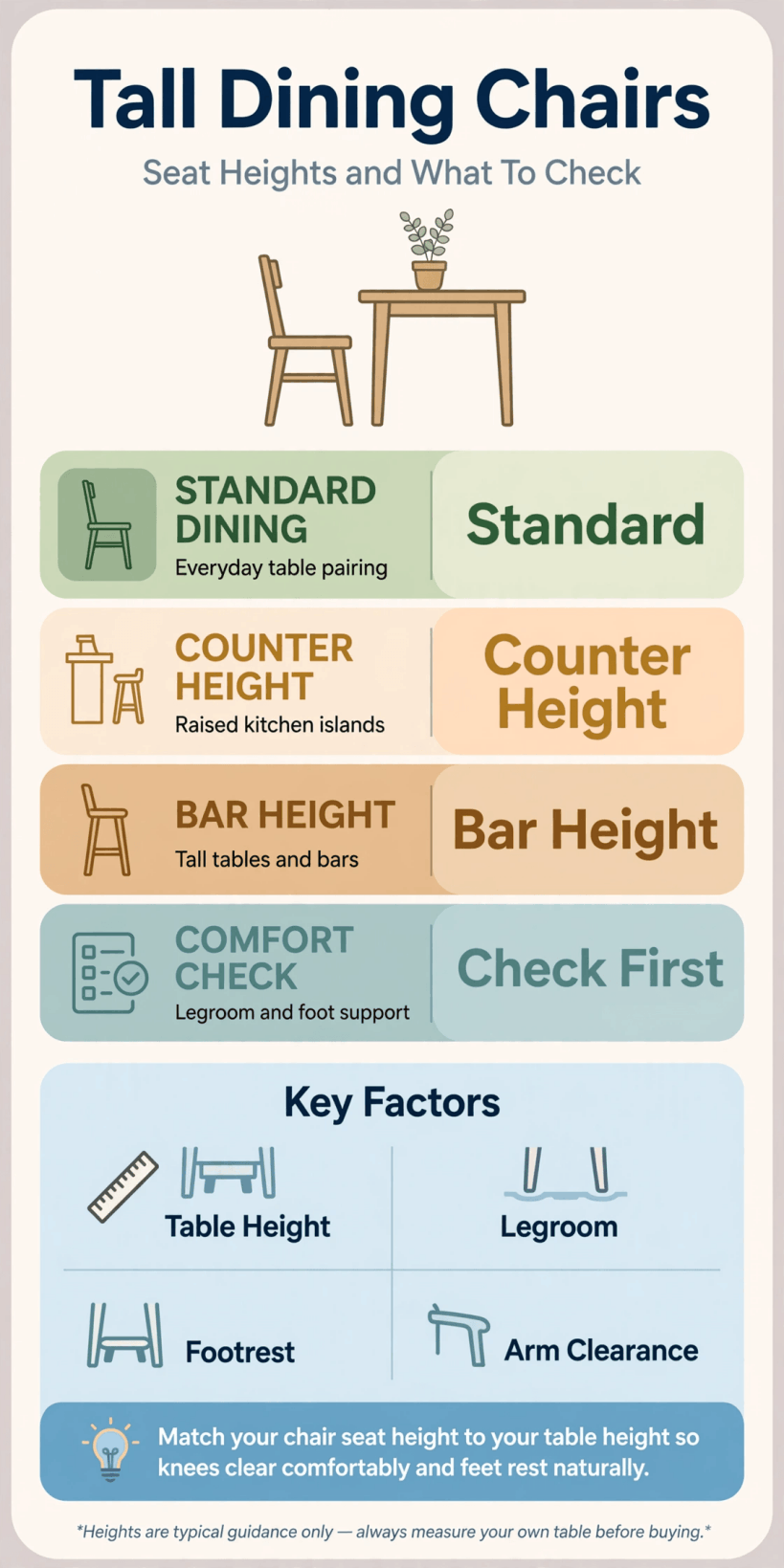
A quick visual summary of how seat height, table height and legroom work together.
Everything that follows expands on those five answers. You will learn a repeatable measuring routine, the difference between seat height and overall chair height, how aprons and stretchers change the fit, and how to sanity-check a delivery before the return window closes. If you are furnishing a compact home, the same routine scales down neatly, much like the planning in our small home interior design ideas guide.
2. Why Taller Tables Change the Seat You Need
A dining table is not just a top on legs. Its height sets the working surface for eating, writing, board games and laptops, and every inch it rises pulls the ideal seat up with it. Standard-height tables feel familiar to most adults, while farmhouse, gathering and pub-style tables sit noticeably higher and are often chosen because they double as extra preparation space or because taller household members prefer the stance.
When a seat is too low for the table, the signs are easy to spot. Shoulders creep upward, forearms rest at an awkward angle, and plates feel oddly distant even though they are in the usual place. Children sometimes enjoy the novelty, but adults usually notice the strain within a single meal. When shoppers talk about looking for 22 inch dining chairs, this mismatch is almost always the problem they are trying to solve: a much-loved high table paired with chairs that were bought for a lower one.
The opposite error is just as uncomfortable. A seat that is too high leaves feet dangling, presses the underside of the thighs against the seat edge, and can make sliding in under an apron a squeeze. The goal is a middle ground where feet rest flat or on a footrest, knees bend comfortably, and the tabletop sits roughly at elbow height when arms are relaxed. Treat every published range as a starting hypothesis, then test it against real bodies at your own table.

3. Measure Your Table First, Not the Chair
Start with the table, because it is the fixed point in the room. Measure from the floor to the top of the tabletop, then from the floor to the underside of the tabletop, and finally from the floor to the bottom edge of the apron, the wooden or metal skirt that runs beneath the top on many designs. Write all three numbers down. The apron measurement matters most for legroom, because knees and thighs must clear that lowest hanging edge, not the tabletop itself.
Repeat the measurements at two or three spots. Floors in older homes are not always level, and a table that stands on a rug at one end and bare boards at the other can measure differently by enough to feel. If the table has a leaf or an extending section, measure in the configuration you actually use day to day, since some designs add bracing underneath when opened.
Now measure a chair that currently feels comfortable at a different table, if you have one, recording floor to seat top, floor to the top of the back, and the seat depth from front edge to backrest. Comparing a known-good chair against your high table numbers tells you how much taller the new seat needs to be, rather than how tall it is in the abstract. This compare-what-you-own approach is the same habit we recommend in our dining room interior design ideas for tiny houses, where every measurement has to earn its place.
4. The Legroom Gap: Finding Your Comfort Zone
Comfort lives in the gap between the seat and the table. As a working method, seat a willing volunteer on a chair of known height at your table, then measure the space between the top of their thighs and the underside of the apron while they sit naturally, not perched or slouched for the tape. Crossed legs, winter jumpers and a relaxed lean all eat into that gap, so a reading that looks fine on paper can still feel tight in real life.
People differ more than furniture does. A household of tall adults needs more clearance than a household with younger children, and anyone who likes to sit cross-legged or sideways needs more again. If your household spans a wide range of heights, prioritise the people who use the table daily and consider one or two adjustable or cushioned options for guests instead of forcing a single compromise on everyone.
Cushions complicate the maths in a useful way. A firm cushion raises the sitter a little and compresses only slightly, while a soft, thick cushion can compress a great deal, so its shelf height overstates the seated height. When you test, test with the actual cushion in place and someone sitting on it for a few minutes, because foam settles. If a chair is nearly right, a cushion is a legitimate fine-tuning tool; if it is wrong by a lot, no cushion will rescue it, and forcing the fit usually ends in a return.
5. Reading Retailer Specifications Without Guesswork
Retailer pages are written to sell, not to standardise, so the same dimension can hide behind several labels. Seat height may be listed as seat height, seating height, or floor-to-seat distance, and it may or may not include a cushion. Overall height is a different number entirely: it measures to the top of the backrest and matters for sightlines and for whether chairs tuck visually under beams or shelves, but it tells you nothing about where your body will sit.
Look for a dimensions diagram rather than a single headline figure. Diagrams usually separate seat height, seat depth, seat width and overall height, and they reveal whether a footrest bar is included in the design. Where a listing gives a range instead of one number, it may be describing an adjustable model or a family of sizes; check which variant the price actually buys before assuming the taller option is the one in the basket.
Reviews can help if you read them for measurements rather than opinions. Comments that mention a table style, an apron, or a sitter’s height are gold; star ratings alone are not. If the details page stays vague, contact the seller and ask three precise questions: where exactly was the seat measured, does the figure include the cushion, and what is the distance from the floor to any footrest? A seller who can answer those clearly is also a seller whose other dimensions you can trust a little more. The same verify-before-you-buy mindset runs through our gift shop interior design ideas guide, where listed sizes and in-person reality often differ.
6. Footrests, Stretchers and Why They Matter More Up High
The taller the seat, the more your feet need somewhere to go. On a standard chair, feet rest flat on the floor without thinking. Raise the seat and shorter diners, and most children, lose that anchor. A well-placed footrest bar or side stretcher restores it, letting feet rest supported instead of swinging, which in turn keeps posture steadier through a long meal.
Not all stretchers are placed to be used as footrests. Some sit high and close to the seat, designed purely to brace the legs of the chair, and resting shoes on them can scuff finishes or strain joints over time. When you view a chair in person or study its photos, judge the lowest horizontal bar: if it sits roughly where a relaxed foot would land and looks sturdy enough for daily weight, it will probably serve; if it looks delicate or awkwardly placed, plan on feet finding the floor or a separate footstool instead.

Footrests also change how a chair ages. Bars that take daily shoe contact wear faster than any other part, so a metal bar or a replaceable wooden rung is a practical advantage in a busy household. In a compact dining corner like those in our tiny houses for sale in Charlotte buyer’s guide, a footrest can double as the detail that makes a tall set feel welcoming rather than perched, especially when floor space is too tight for everyone to spread out.
7. Seat Depth, Width and the Rest of the Fit
Height gets the headlines, but depth decides whether a chair supports the whole thigh or cuts off mid-leg. A seat that is too deep pushes shorter sitters forward, away from the backrest; a seat that is too shallow feels perchy and insecure, which higher seats exaggerate because there is further to feel unsteady. Sit fully back when you test: you should feel supported with a small gap behind the knees, not pressure on the calves and not a ledge ending abruptly.
Width matters in two directions. The sitter needs room to shift position during a long dinner, and the set needs to fit around the table without arms colliding or chairs wedging shoulder to shoulder. Measure the table length, decide how many chairs must live along each side full-time, and divide honestly, remembering that people take up more room than chair frames do. Armchairs at the ends are a pleasure only if the apron height lets those arms slide underneath; otherwise the end chairs sit marooned away from the table and meals feel oddly distant.

Back height and shape finish the picture. A taller seat paired with a very low back can look sleek but offers little support for lingering; a high, rigid back supports well but can dominate a small room and block light. In open-plan spaces like those toured in our tiny houses for sale in Nashville guide, mid-height backs often balance support and sightlines best, though the honest test remains sitting through a full, unhurried meal.
8. Materials and Build at Taller Heights
Leverage is unforgiving. A taller chair has longer legs, and longer legs flex and rack more under the same sideways forces, so joints, bracing and material quality matter more than they do on a standard chair. When you handle a display model, sit down, shift your weight gently side to side, and listen. Creaks and visible sway on the shop floor rarely improve at home.
Solid timber and well-braced metal frames both perform well when they are made properly; the material matters less than the joinery and the honesty of the construction. Check how legs meet the seat: corner blocks, through-tenons and metal brackets all inspire more confidence than a single screw into end grain. Upholstered seats hide their frames, so ask what the frame is made from and whether the seat base is solid, webbed or sprung, because that base decides how the chair feels in year three, not week one.
Floor protection deserves a thought at height too. Taller chairs get dragged and twisted more as people climb in and out, which is rough on both floor and feet of the chair. Felt or glide pads that suit your floor surface, checked and replaced as they wear, prevent the slow scratching that otherwise appears around a busy table. Homes planning bigger upgrades alongside furniture, like readers of our guide to solar panels for a tiny house, often fold these small protective habits into the same refresh, and the dining set benefits just as much as the energy system.
9. Testing In Store and At Home
A two-minute sit in a showroom tells you surprisingly little, so make your test deliberate. Wear the kind of shoes you normally wear at home, sit as you would for dinner, rest your forearms on an imaginary table at the right height, and stay put while you talk through what you feel: feet supported or dangling, thighs clear or pressed, back supported or reaching. If the store has a table of a similar height to yours, ask to pair them; most retailers would rather move a chair than process a return.
At home, use the delivery window wisely. Many households searching for 22 inch dining chairs order one chair first, live with it through several real meals, and only then complete the set, which turns an expensive guess into a small, reversible experiment. Keep packaging until the decision is final, photograph the chair beside your table for your own records, and note the measured seat height of the keeper so any later additions, a bench, spare chairs, or a matching pair for the ends, can be matched by measurement rather than by name.

Include everyone in the verdict. The cook who eats standing half the time, the teenager who studies at the table, and the grandparent who needs a steady seat to lower into all experience the same chair differently. A set that passes only one person’s test will generate quiet workarounds for years: cushions migrating between seats, one favoured chair, and guests steered to the good end. Five extra minutes of honest testing now prevents all of that.
10. Common Mistakes and How to Avoid Them
The most common mistake is shopping by overall height. A tall back looks like a tall chair, so the set arrives, the backs tower impressively, and everyone still sits at standard height feeling low at the table. The second mistake is forgetting the apron: the seat-to-tabletop gap looks generous in the listing, but the apron’s bottom edge steals the legroom the calculation promised. Measure to the apron, always.
Third, shoppers forget the floor. A thick rug under the table raises the chair relative to nothing, the chair sits on the rug too, but glides, casters and rug edges change how a chair slides and settles, and a chair measured on hard floor in a warehouse behaves a touch differently at home. Fourth, people buy a full matching set for a table they plan to replace, locking the next table choice to an unusual seat height. If a table upgrade is coming, buy the table first, or choose chairs with the next table already measured in mind.
Finally, do not let a sale deadline do your measuring for you. Dimensions do not change because a discount ends on Sunday, and an uncomfortable set on offer is still an uncomfortable set. Readers furnishing a first small home, like those browsing our tiny house for sale in Dallas guide, meet the same pressure in every category; the tape measure remains the calmest voice in the room.
Final Considerations
Finding the right tall dining chair is a measuring exercise dressed as a shopping trip. Measure the tabletop, the underside and the apron. Measure a chair you already like. Decide the legroom gap your household actually needs, then read every retailer specification as a claim to be verified, in the diagram, in reviews written by people who mention their own tables, and, when the listing stays vague, by asking the seller directly.
Test like you mean it: one chair first if you can, real meals, real shoes, every regular diner given a vote. Pay attention to footrests, depth and build quality, because at taller heights those details decide whether a set feels like a perch or a pleasure. Do that, and the high table you already love finally gets the seating it has been waiting for, measured to fit your home rather than hoped into place.




0 Comments