
The smallest apartment in a decent block and the smartest tiny house are aimed at exactly the same person: one or two people, a modest amount of stuff, and a wish to spend less on space and more on life. They look like cousins, and they are opposites. The apartment is a service — a home rented month by month, where somebody else owns the roof, the boiler and the risk, and can have the whole arrangement back with a few weeks’ notice. The tiny house is an asset — a home you own outright, in full, from the first night you sleep in it — which then asks the question renting never asks: where, exactly, do you intend to put it?
Anyone weighing tiny house vs apartment renting is really comparing a tenancy with an ownership, and the six dimensions below are where that difference stops being philosophy and starts being arithmetic: monthly cost, upfront cash, flexibility and exit, equity, maintenance responsibility, and the placement — the land — problem. We price both over the honest horizon of five years, because renting wins almost every comparison shorter than that and the tiny house wins most of the longer ones, and knowing where your own crossing point falls is the entire decision.
1. Tiny House vs Apartment Renting at a Glance
Read the table as two contracts side by side. The renter buys convenience, liquidity and a landlord’s shoulders for every structural problem; the tiny owner buys quiet months, a paid-for roof and total responsibility. The sections put numbers and nuance behind each row.
| Criterion | Owning a tiny house | Renting an apartment |
|---|---|---|
| Monthly cost | After the purchase, the quietest months in small living: small utility appetite, insurance, and a placement cost that runs from nothing on owned land to a site fee below most rents. | Rent is the headline and it is not stable — renewals reset it on the landlord’s timetable, so the five-year total is partly somebody else’s pricing decision. |
| Upfront cash | A house price — even a small one — plus delivery, set-up and placement costs: the largest entry ticket of any small-living option. | A deposit, the first month and moving costs: by far the cheapest door into a small home, and mostly recoverable. |
| Flexibility and exit | Leaving means selling a niche asset or paying to relocate it — a process of months, priced in section 5. | A notice period and a van hire. The most liquid housing arrangement that exists. |
| Equity | An owned asset that can hold or repay value — tempered by depreciation on wheels and transformed by a legal placement travelling with it. | None, by design. What renting offers instead is the invested difference — but only for households that actually invest it. |
| Maintenance responsibility | Everything is yours, from roof seals to the water heater: the costs and the control arrive together. | The landlord’s legal burden. Your maintenance budget is a phone call — plus patience, and a deposit hostage to the handover inspection. |
| Placement and land | The defining problem: an owned home needs a legal place to stand, solved before purchase or not at all. | Solved invisibly: the building’s land, zoning, taxes and compliance all arrive inside the rent. |
| Best for | Settlers with a placement solved and a multi-year horizon, who want costs that fall quiet after year one. | The mobile, the undecided, and anyone whose next five years refuse to be predicted. |
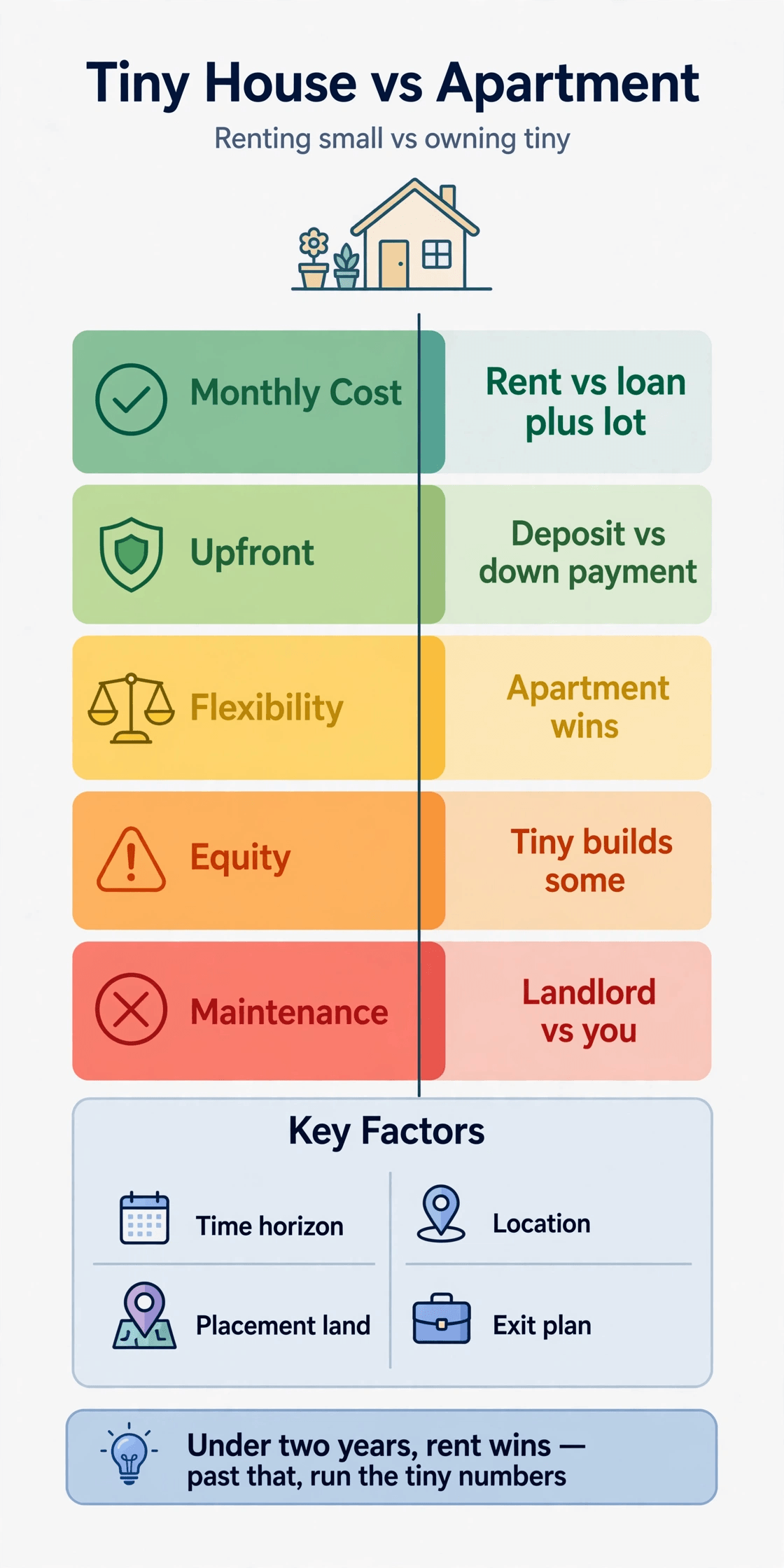
Infographic: a tenancy priced monthly against an ownership priced once.
2. The Two Contenders: What a Lease Buys vs What a Title Buys
Start with what renting actually purchases, because it is more than floor space. A lease buys a compliant, maintained, legally placed home, with the structural risks — roof, boiler, building insurance, the tax on the land beneath — carried by the owner, plus an address in a building that already exists in a neighbourhood that already works. The tiny house buys none of that scaffolding and all of the substance: the building itself, yours, with every one of those scaffolding problems transferred to your own desk. Our guide to tiny homes for sale near me shows the substance side of the market — what builders sell is the house; everything in this comparison about placement and responsibility is the part that arrives afterwards, unpriced in the listing.
The two products also fail differently, which previews the whole comparison. A tenancy fails socially — a bad landlord, noisy neighbours, a renewal that prices you out — and the remedy is moving. A tiny ownership fails logistically — a placement lost, a repair bill, a buyer who cannot be found — and the remedy is money and time. Neither is safer in the abstract. They hold their risks in different pockets, and the dimensions below are a tour of the pockets.
3. Monthly Cost: The Whole Month, Not the Headline
The renter’s month has one dominant line and a tail: rent, utilities for a small flat, contents insurance, perhaps parking and the small premiums of city life. Its shape is simple and its level is not yours to set — each renewal is a negotiation you attend with your bags theoretically packed. The honest summary of renting’s monthly cost is that it is known twelve months at a time and unknowable at five years.
The tiny owner’s month is a bundle of small lines: utilities for a small, well-insulated volume — the heating-fuel arithmetic of our propane vs electric comparison and the efficiency of the unit in our guide to installing a mini-split in a tiny house both describe an appetite far below a conventional home’s — insurance, consumables, and the placement line, which is the whole game: zero housing payment on land you own beyond taxes and upkeep, or a site fee in a park or community that typically runs below comparable rents while buying less legal security than a lease. Add a maintenance reserve line — owners who skip it are borrowing from section 7 — and the owner’s month is still, in most regions, the cheaper of the two by a visible margin. It is also the more honest month: every line in it is a cost of housing itself, not a landlord’s margin on housing.
The trap in this dimension is comparing levels instead of shapes. Rent is a cost that recurs at market rates forever; the tiny owner’s cost stack, once the purchase is behind them, decays to utilities, insurance and placement. Households that will stay put for years are buying that decay. Households that will move in eighteen months never collect it.
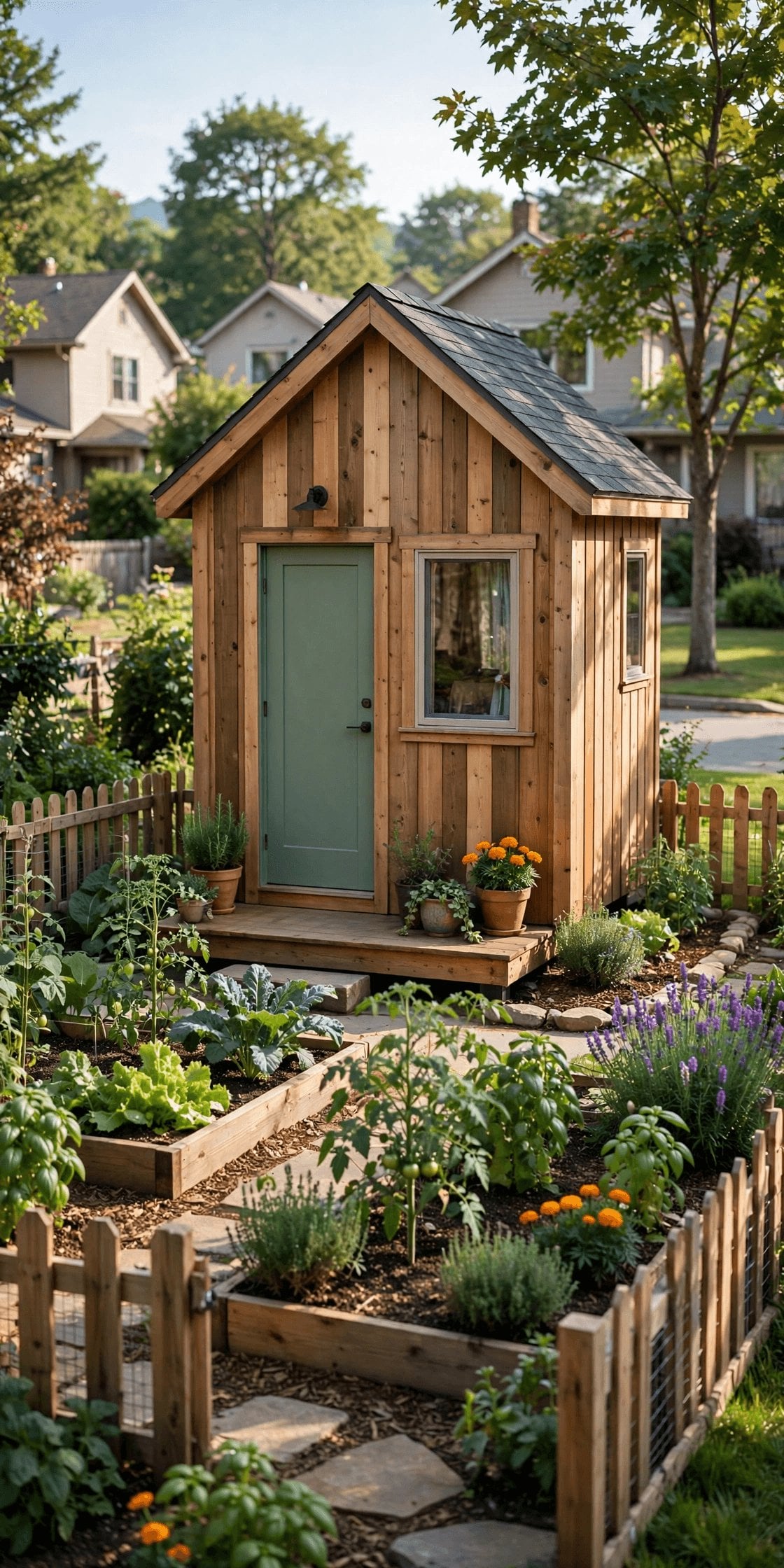
Pin it: the renter’s biggest cost has the landlord’s name on it; the owner’s biggest cost is the one they chose on the map.
4. Upfront Cash: Deposit Economics vs Purchase Economics
Renting’s entry ticket is famously light: a deposit — commonly a month or so of rent, held against damage and returned in the ordinary course — the first month paid in advance, agency or moving costs where they apply, and furniture if the place comes bare. Nearly all of it is either consumed knowingly or recoverable, and the total is small enough that renting remains the default first home of almost every adult life for good reason.
The tiny house’s ticket is a purchase: the build or buy price — with the used route of section 10 as the discount door — plus delivery and set-up, utility connections or off-grid kit, skirting, steps and the placement’s own deposits or land costs. Even at the modest end of the tiny market this is a five-figure decision, commonly several years of a renter’s deposits, and the financing routes in our guide to how to finance a tiny house: loans and lender options show how much harder lenders make it than a mortgage on a conventional home. Add the honest line nobody prints: the opportunity cost of that cash. Money placed in a tiny house is money not invested elsewhere for those years — renting’s defenders are right about this, and section 6 gives their argument its full weight. The upfront comparison is therefore not small ticket versus big ticket; it is liquidity preserved versus liquidity converted into a roof, and the right answer depends on what the roof then does for your monthly costs and your five-year total.
5. Flexibility and Exit: Notice Periods vs Sales Processes
Renting is the exit champion of all housing. A job in another city, a relationship beginning or ending, a family growing, a neighbourhood changing — the renter’s answer is a notice period measured in weeks, a deposit negotiation, and a van. Even mid-lease, most tenancies bend through break clauses, permitted assignments or negotiated surrenders. This flexibility is not a lifestyle garnish; for anyone whose income or household is still changing shape, it is the single most valuable property a home can have, and it cannot be bought later by the person who sold it for equity.
The tiny owner’s exit is a project. The usual door is selling the house — into the thinner, regional, documentation-sensitive market this series has described in every comparison — or, less often, paying to move it to a buyer’s placement. Either takes months and both are exposed to the placement question: an owner whose site cannot transfer sells a house that must be hauled away, the hardest version of the listing. The mitigation is bought on day one, not at exit: choose placements with transferable tenure where possible, keep the certification and maintenance file complete, and treat the exit as a known cost of the cheap years rather than a surprise at the end of them. If your honest five-year forecast contains a likely relocation, price this section as heavily as the monthly savings — it is where renting quietly wins back its premiums.
6. Equity: What, If Anything, You Own at the End
Five years of rent leaves a household with exactly what it started with, plus whatever it saved from the difference — that last clause being where this dimension is genuinely argued. Five years of tiny ownership leaves a household owning a house: an asset whose resale behaviour this series has covered from every side — real but niche demand, value defended by certification, condition and documentation, depreciation while it sits on wheels, and a transformation when it stands somewhere legally permanent. The established, lawful end of the market described in our guide to tiny house villages and successful legal communities shows houses holding value the way small homes do when the placement question is answered by the address itself.
The renter’s counter-argument deserves its strongest form: the upfront cash the owner committed, invested instead over the same five years, plus the monthly discipline of investing the difference, can rival or beat a depreciating tiny asset — on paper, for households that actually run the discipline. Most do not, and the rent simply gets spent, which is why the equity argument is less about arithmetic than about machinery: the tiny house is a forced-savings device that happens to be a home, converting monthly discipline into a retained asset automatically. Choose your machinery honestly — the spreadsheet you will actually follow beats the optimal one you will not — and note that neither route builds equity in land, the appreciating part of conventional housing, unless the tiny owner also buys the plot, which moves the whole comparison into section 8.
7. Maintenance Responsibility: Whose Problem Is the Boiler?
In the apartment, the boiler is a phone call. Structural repairs, appliance failures, roof and common areas, the slow war against damp — the landlord carries them in law, at a standard that varies with the landlord, on a timetable that is the renter’s daily tax on the arrangement. The renter pays for this service inside the rent whether they use it or not, keeps no equity in the improvements, and hands the home back at the end owing its condition, fair wear excepted, to the deposit negotiation.
In the tiny house, the boiler is a line item, and so is everything wearing out around it: the plumbing anatomy of our tiny house plumbing layout guide, the weatherproofing stewardship behind our walkthrough of tiny house skirting options that protect pipes and insulation, roof seals, running gear ageing in place. In exchange, the owner controls quality, timing and tradespeople, and every repair defends the asset they will sell. The honest budget line from section 3 — a real reserve, funded monthly — is what separates owners who find this dimension satisfying from owners who find it a drip-feed of emergencies. Renting’s maintenance is worse service at a bundled price; owning’s is better service at an itemised one. Households that hate phone calls to landlords and love a maintained home should notice which side they are already nodding at.
8. The Placement Problem: The Land Question Renting Never Asks
Every previous dimension bends around this one. The apartment’s rent quietly contains land, zoning, minimum-size and occupancy compliance, and a building that the law already accepts as a home — the renter never meets any of these problems, which is a large part of what rent is. The tiny owner meets all of them personally, before purchase: most jurisdictions zone dwellings by rules written before tiny houses existed, and a bought house with nowhere legal to stand is the category’s defining catastrophe. The routes through are known and mapped: buying a plot that accepts the house — the search method of our guide to where to buy tiny house lots — taking a pitch in a tiny-house community found through our tiny home communities locator, or a park placement under the rules compared in our guide to tiny house communities vs RV parks. Each route prices differently and secures differently, and the choice among them does more to decide this whole comparison than the house itself.
So the practical sequence inverts the renter’s habits: land first, house second. Sign the placement, verify it in writing against the actual rules of the place, and only then shop for the building. The households for whom owning tiny crushes renting are invariably the ones who solved this section first — family land with permission, a community pitch with durable tenure, a plot bought cheap in a permissive county. The households it burns are the ones who fell in love with a floor plan in month one.
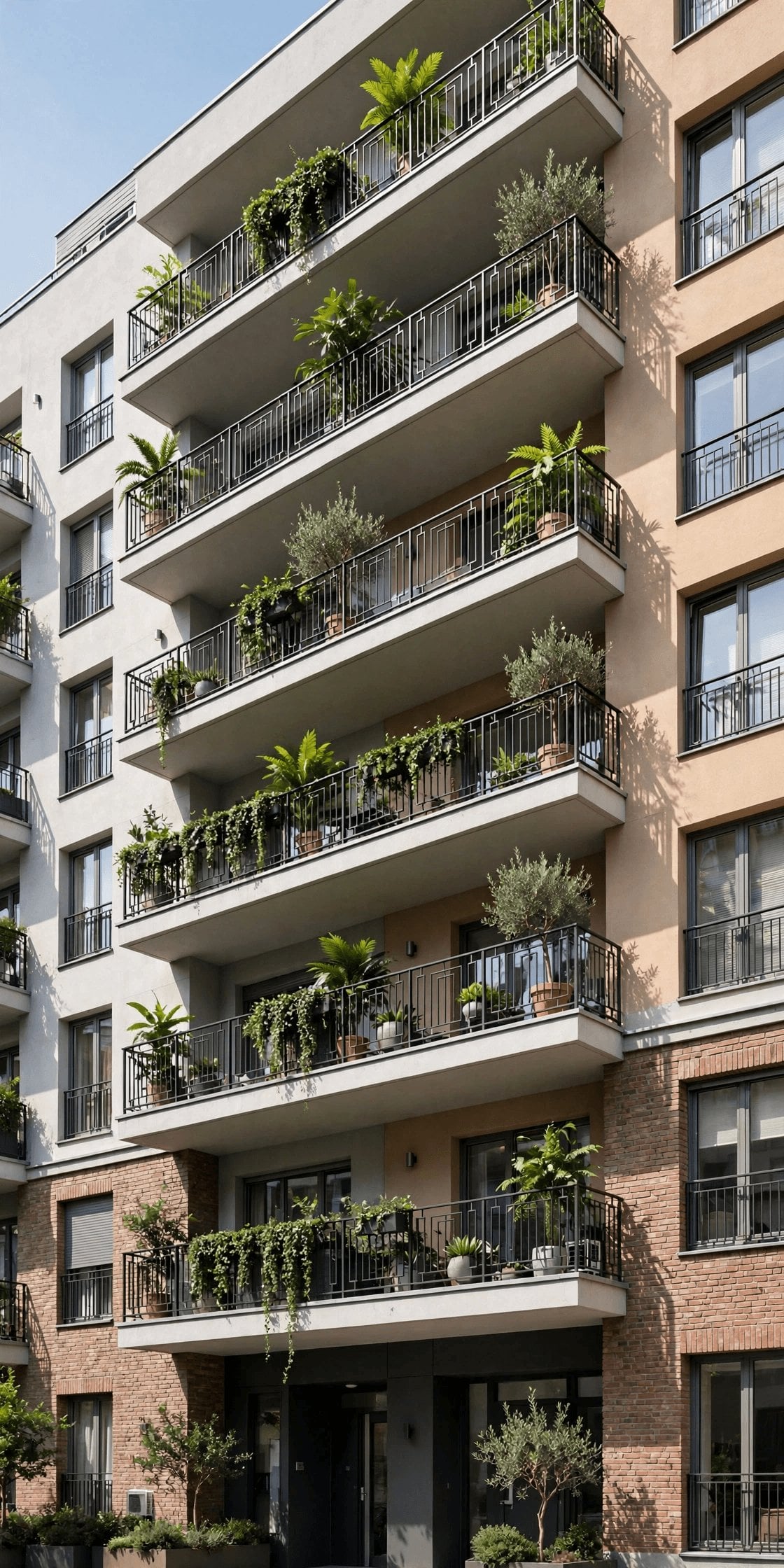
Pin it: renting hides the land inside the rent; owning tiny makes the land your first purchase and your permanent homework.
9. Life Inside: Rules, Neighbours and Your Own Walls
Daily life differs in texture as much as in cost. The apartment brings neighbours through the walls, shared systems, house rules and a lease’s fine print — pets, guests, decorating, noise — enforced by somebody whose property it is. Much of modern renting is perfectly pleasant; all of it is conditional. The tiny house brings your own walls and your own rules inside them — paint what you like, keep the dog, hang the shelf — with the community or park’s rules standing where the landlord stood, usually thinner, and your nearest neighbour often a garden away rather than a ceiling away. Insurance mirrors the split: contents cover and liability for the renter, a proper owner’s policy for the house — the classifications unpacked in our tiny house insurance guide for wheels vs foundation are the owner-side homework. Neither life is objectively freer; they are free in different rooms.
There is also the unglamorous matter of space itself: the small apartment and the tiny house offer similar floor areas, but the apartment’s is stacked into a serviced building in a walkable place, while the tiny house’s is arranged around your own plan, your own storage design and your own outdoors. People who experience the city as their living room should rent the city’s smallest room happily. People who experience home as the living room should own theirs.
10. The Five-Year View: Two Households Priced Honestly
Run the dimension totals over five years and two patterns emerge, whichever region’s prices you insert. The renting household spends more in total in most scenarios — rent at market rates, renewed upward, with professional moving costs at each change — and finishes liquid, mobile and owning nothing, exactly as designed. The owning household spends the large sum once, then runs years of quiet months, absorbs its maintenance years, and finishes owning a house whose value depends on documentation and placement — ahead on paper in the scenarios where the placement held still and the horizon stretched, behind in the scenarios where life moved them in year two. The break-even is not a universal number; it is the product of your local rents, your placement cost and your probability of moving, and any honest version of this article would rather teach the worksheet than quote a figure: your rent times sixty, against the tiny purchase plus sixty quiet months plus one maintenance reserve, minus a conservative resale.
One door deserves a final mention because it moves the worksheet most: buying the tiny house used. The inspection discipline in our walkthrough on how to inspect a used tiny home before buying exists because a sound used build at a second-owner price collapses the upfront gap that decides so many of these comparisons — the tiny house’s worst dimension is the only one the used market directly discounts.
Final Considerations
The verdict. Rent the apartment if your next five years are genuinely unwritten — career in motion, household in flux, city itself the amenity you are buying — or if no legal placement is available to you where you need to live, because renting’s premiums purchase exactly the flexibility and invisibility-of-land that those years require. Own the tiny house if your placement is solved in writing before purchase, your horizon runs five years or beyond, and you want the monthly cost of housing to fall quiet after year one while converting discipline into an asset you hold. The comparison’s one unforgivable method is also its most common: this month’s rent set against the tiny house’s purchase price. Price five years against five years — rent, renewals and exits on one side; purchase, quiet months, maintenance and a defended resale on the other — and the right answer for your household stops being an argument and becomes arithmetic.


0 Comments