
Van life and the tiny house fly the same flag — freedom from rent, a life aimed at places rather than possessions — and then they go about it as opposites. A converted van is a vehicle with a home engineered into it: every cupboard is a compromise with payload, and the whole machine exists to move. A tiny house is a dwelling with an address that occasionally changes: a real house in miniature, engineered to park. Both genuinely work as full-time homes, which is why the choice confuses people. The costs give the game away, because the two products bill you in opposite order — one takes its money at the door, the other takes it by the mile and by the month.
This comparison prices the two options across six dimensions, in the order a buyer meets them: buy-in cost, daily and monthly running costs, comfort and workspace, parking and stealth, maintenance, and the exit. People who search tiny house vs van life cost figures usually arrive expecting a winner, and what the honest maths shows instead is two cost curves that cross: the van is cheap to start and charges for motion, the tiny house is expensive to start and then cheap to stay in. Which side of the crossing you live on is decided by one number — how many nights you spend in each place you stop.
1. Tiny House vs Van Life Cost at a Glance
The table below scores the six dimensions head-to-head. Treat it as two profiles rather than a scorecard: almost every row the van wins is about starting and moving, and almost every row the tiny house wins is about staying and living — the sections put the real costs behind each.
| Criterion | Tiny house | Van life |
|---|---|---|
| Buy-in cost | The expensive door: builder prices for a house-grade product, plus delivery, set-up and a placement solution in the first year. | The cheapest door in nomadic living at the self-build end — a used van and a staged conversion — climbing to motorhome money for factory campers. |
| Running costs | Low and stable when parked: small utility appetite, and a site fee only where the placement is rented. | Fuel-led and behaviour-led: a touring month can cost like rent; a stationary month, where legal free or cheap stays exist, can cost remarkably little. |
| Comfort and workspace | Stand-up rooms, a real bathroom, a desk that stays a desk, and a four-season residential envelope. | A beautifully efficient capsule: convertible furniture, seated headroom in most builds, and a workspace that is possible daily but never spacious. |
| Parking and stealth | Cannot hide and does not try: needs a legal placement, negotiated in advance, for stays measured in seasons. | Can sleep anywhere a vehicle may legally park, subject to local rules — stealth and spontaneity are the product’s core capabilities. |
| Maintenance | House systems on house rhythms, plus trailer running gear that ages quietly in place. | A working vehicle carrying a house: engine, drivetrain, tyres and conversion systems, all maintained at once, all the time. |
| Exit and resale | A slow, thin, regional market where documentation and condition defend the price. | The liquid vehicle market: priced as a van plus conversion appeal, depreciating on a vehicle’s curve, sellable almost anywhere. |
| Best for | Basecamp lives: one legal base per season, work and routines anchored, travel taken in trips away from home. | Itinerant lives: stops measured in days, weather followed, the itinerary itself as the lifestyle. |
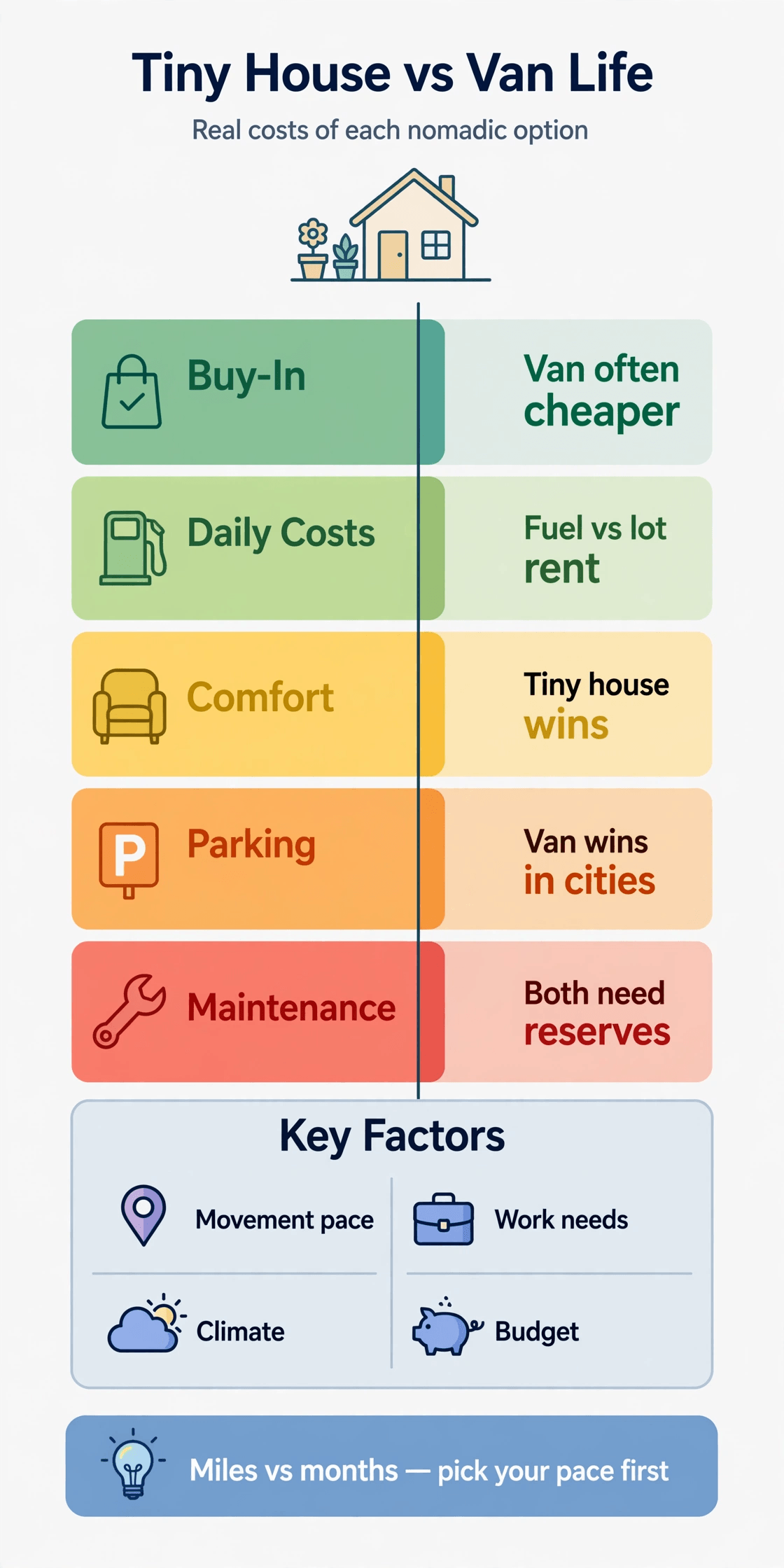
Infographic: two cost curves that cross — cheap to start against cheap to stay.
2. The Two Contenders: A Portable House vs a House in a Vehicle
Define the van first, because “van life” covers two different purchases. The self-build starts as a cargo or passenger van — bought new or, far more commonly, used — and gains a bed platform, insulation, a simple kitchen, storage, power and ventilation in whatever order the owner’s budget allows, sometimes over years. The factory camper van arrives finished, warrantied and priced accordingly, a small motorhome in van clothing. Both share the van’s essential geometry: a metal shell you can stand in only if it is a high-roof model, one sliding door as the threshold between home and world, and a payload budget that disciplines every possession. Our overview of alternative housing options, from earthships to container homes and domes, sets both products in the wider family of escape routes from conventional housing.
The tiny house answers with domestic geometry: framed walls with depth for real insulation, a ceiling you live under rather than inside of, house windows, house plumbing, and rooms — however small — that stay what they are all day. It sits on a trailer, which makes it transportable in the logistical sense rather than mobile in the daily sense. The cost philosophies follow the geometry exactly. The van concentrates cost in the vehicle and asks little of any place; the tiny house concentrates cost in the building and asks a great deal of one place — its placement. Every dimension below is that sentence with numbers attached.
3. Buy-In Cost: What the First Year Really Takes
The van’s buy-in is a ladder with a genuinely low first rung. A serviceable used van plus a staged, self-built conversion — bed, insulation, ventilation, a camping-grade kitchen, portable power — is the cheapest respectable entry into full-time nomadic living that exists, and many lifers start exactly there and upgrade in place. Climb the ladder and the numbers climb honestly: newer vans, professional conversions with proper electrical and water systems, and finally factory campers priced like the RVs they are. The discipline at every rung is the donor vehicle: its age, mileage and mechanical condition are the foundation the conversion sits on, and a cheap van with an expensive drivetrain problem is the category’s classic false economy. The routes in our guide to how to finance a tiny house apply in spirit — vehicle lending for the van, personal credit for conversions — since both markets finance improvisational housing reluctantly and paperwork well.
The tiny house’s buy-in is a house purchase wearing a trailer. Professional builds price by the specification; self-builds trade money for a year of weekends; and the sticker is only the visible layer. Delivery and set-up, utility connections or off-grid systems, skirting and steps, and the placement itself — deposit and first months on a rented site, or the land purchase behind a private placement — all land in year one. Comparing sticker to sticker, the van wins buy-in almost every time; comparing finished, legal, livable first years, the gap narrows but rarely closes. Browse both markets side by side through our guide to tiny homes for sale near me and the difference in what “for sale” includes becomes obvious.
One buy-in line hides on both sides: the stuff. Van life demands a ruthless edit of possessions and then charges storage rent to those who flinch from it; a storage unit quietly reinstates a monthly bill the lifestyle was meant to kill. The tiny house absorbs more of a life as bought. Price your actual possessions into both first years — the van’s low door has a way of invoicing the difference monthly.
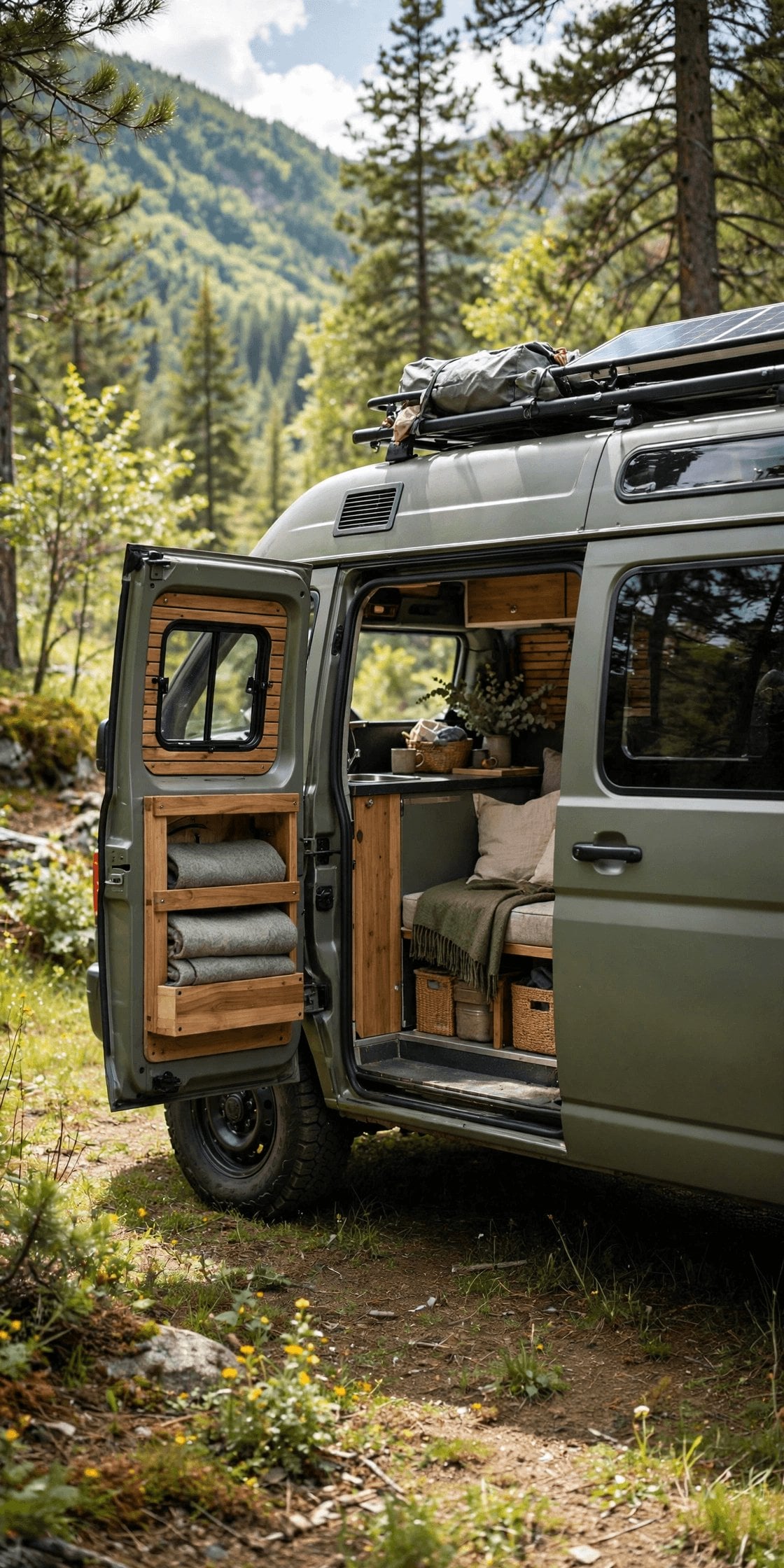
Pin it: the van’s door is cheap and its corridor is the highway; the tiny house charges at the door and then leaves you alone.
4. Running Costs: Daily and Monthly Reality
A parked tiny house runs like a small flat with better PR. Its energy appetite is modest — a small volume to heat, cool and light — and its monthly shape is dominated by the placement: nothing but utilities on owned land, a site fee where rented, and household consumables in either case. Energy strategy moves the needle for both products in this comparison: the sizing logic in our guide to solar panel kits and battery banks for tiny homes applies to any small roof that wants independence, and the fuel arithmetic in propane vs electric in tiny houses describes the heating and cooking choices both homes make in different sizes.
A van’s running costs are a driving diary. Fuel is the headline — every horizon is purchased — and behind it comes the service economy of a life without fixed utilities: water fills, waste disposal, laundromat cycles, showers and gym memberships bought as infrastructure, and food logistics in a small cold box that rewards planning and taxes impulse. Campsite fees are optional in a way rent never is: a skilled van lifer mixes paid sites, permitted public-land stays and legal overnight parking into a monthly figure that can undercut every alternative — while a touring month of daily drives and nightly sites can cost as much as the rent the lifestyle escaped. Both statements are true; your itinerary decides which one is yours.
The honest method is the two-budget method from our RV comparison: price a stationary month and a moving month for each product, in your region, with your habits, then weight them by the year you actually intend. The tiny house’s two budgets are near-twins. The van’s are strangers. That variance — not the averages in forum arguments — is the real running-cost difference between the products.
5. Comfort and Workspace: Living and Working in Each
Comfort divides on physics first. The tiny house offers a residential envelope — the insulation and systems thinking behind our guide to how to heat a tiny house — full standing height, a bathroom with a door, and separation: one person can sleep while another works, a distinction no convertible furniture fully erases. The van offers an ingeniously fitted capsule whose comfort is real but conditional: on weather that lets life spill outside, on a build that insulated and ventilated properly, and on occupants who keep the daily conversion rituals — bed to bench, bench to table — cheerfully for the five-hundredth time. Both homes are warm in the testimonials. Only one is warm in February with the door shut for a week.
Workspace is the dimension the remote-work era promoted from footnote to headline. A tiny house can hold a dedicated desk, a real chair, a monitor at eye height and a door between work and bed — the full apparatus of a professional life, minus the commute. A van workspace is a negotiation: the passenger seat swivelled, the bed folded, the laptop on the table the kitchen also uses, connectivity hunted through signal and data plans, and the café and library network as overflow office. Plenty of people run careers from vans; they run them as logistics, with the workspace rebuilt daily. Score this dimension by your job, not by the photographs: the more your income depends on calls, screens and routine, the more the tiny house’s boring separations are worth.
The kitchen tells the same story in miniature: the fitted logic of our compact kitchen appliances guide at full strength in the tiny house, and at half strength — fewer burners, smaller cold storage, outdoor cooking in fair weather — in the van. Neither starves anyone. One of them hosts dinner.
6. Parking and Stealth: Being Somewhere, Legally and Quietly
The van’s superpower is being unremarkable. It is a vehicle, and the world is full of places vehicles may stop: trailheads and rest areas where rules allow, dispersed camping on permitted public land, campground pitches, and — the urban art — ordinary street parking where local ordinances permit overnight stays, kept legal and neighbourly by arriving late, leaving early and looking like nobody’s problem. That last clause is the honest fine print: rules on sleeping in vehicles vary town by town and change; stealth is partly a vehicle property and partly a behaviour discipline, and it fails where it is practised carelessly at scale. Check the current local position wherever you actually roam; this dimension is law, and law is local.
The tiny house inverts the problem completely. It cannot pretend to be anything but a house, so its parking is a placement: a tiny-house community, a park that accepts them, or private land where zoning allows — the models compared in our guide to tiny house communities vs RV parks, findable through our tiny home communities locator. In exchange for surrendering stealth entirely, it receives what the van never has: a negotiated, durable, legal right to be somewhere, with hookups, an address and no morning knock. The products are not better and worse at parking. They are playing different sports — one rents invisibility by the night, the other rents legitimacy by the season.
Cost hides inside this dimension too. The van’s free nights are subsidised by motion, risk and research; the tiny house’s legal nights are a line item. Over a year, a settled van lifer and a site-renting tiny houser can spend surprisingly similar totals on being somewhere — one in fuel and fees, the other in rent — while the touring van lifer and the land-owning tiny houser live in different economies altogether.
7. Maintenance: Two Machines, Two Chore Lists
The van maintains as a vehicle first, because it is one: engine and drivetrain on their service schedules, tyres and brakes consumed by the lifestyle’s core activity, and the whole conversion riding on a chassis whose failures are mobility failures and housing failures simultaneously. Payload discipline is its preventive medicine — the weight thinking in our guide to the weight limits of tiny houses: GVWR and axle ratings applies with interest to a van, where every cabinet is cargo. Conversion systems — leisure electrics, water pump, heater — are maintainable by the owner-mechanic the lifestyle tends to produce, and parts travel with the vehicle or not at all.
The tiny house maintains as a house: the plumbing anatomy of our tiny house plumbing layout guide, roof and seals on a seasonal rhythm, residential parts from any trade counter, and local tradespeople who need no briefing. Its one vehicle inheritance — trailer tyres, brakes and bearings — ages by calendar while it sits, and must be budgeted as the price of keeping the exit option real.
Both lists reward the handy and tax the helpless, but they fail differently: the van’s failures strand you, the tiny house’s failures drip on you. If your temperament handles roadside problems better than household ones, that is data; the reverse is also data. Choose the chore list you will actually keep up, because in both products the deferred item compounds.
8. Exit and Resale: Getting Out Whole
The van exits through the deepest used market on wheels. It will be priced as what it is — a vehicle of a certain age and mileage, plus a premium or discount for the conversion’s quality and taste — and it depreciates on the vehicle’s curve, which means the self-builder’s sweat equity is partly a gift to the next owner. In exchange: liquidity. A fairly priced van sells in any town in the country, to buyers with ordinary vehicle financing, in weeks rather than seasons. For a lifestyle entered as an experiment, that exit is a form of insurance, and it is priced into the van’s whole proposition.
The tiny house exits through the niche market described in our earlier comparisons: slower, regional, documentation-driven. The inspection routine in our walkthrough on how to inspect a used tiny home before buying is what your buyer will bring, and the insurance classification behind our tiny house insurance guide for wheels vs foundation is part of what their lender will ask about — so the certified, papered, well-kept build defends a price that the undocumented one cannot. A tiny house sold with a transferable legal placement exits best of all, as a home; sold for removal, it exits as a logistics problem with a house attached.
Buy with the exit in view. If the plan is a year or two of trying the life, the van’s liquidity caps the cost of changing your mind. If the plan is a decade, the tiny house’s slower exit matters less than its cheaper years — and keeping its file complete from day one is the highest-return maintenance either product offers.
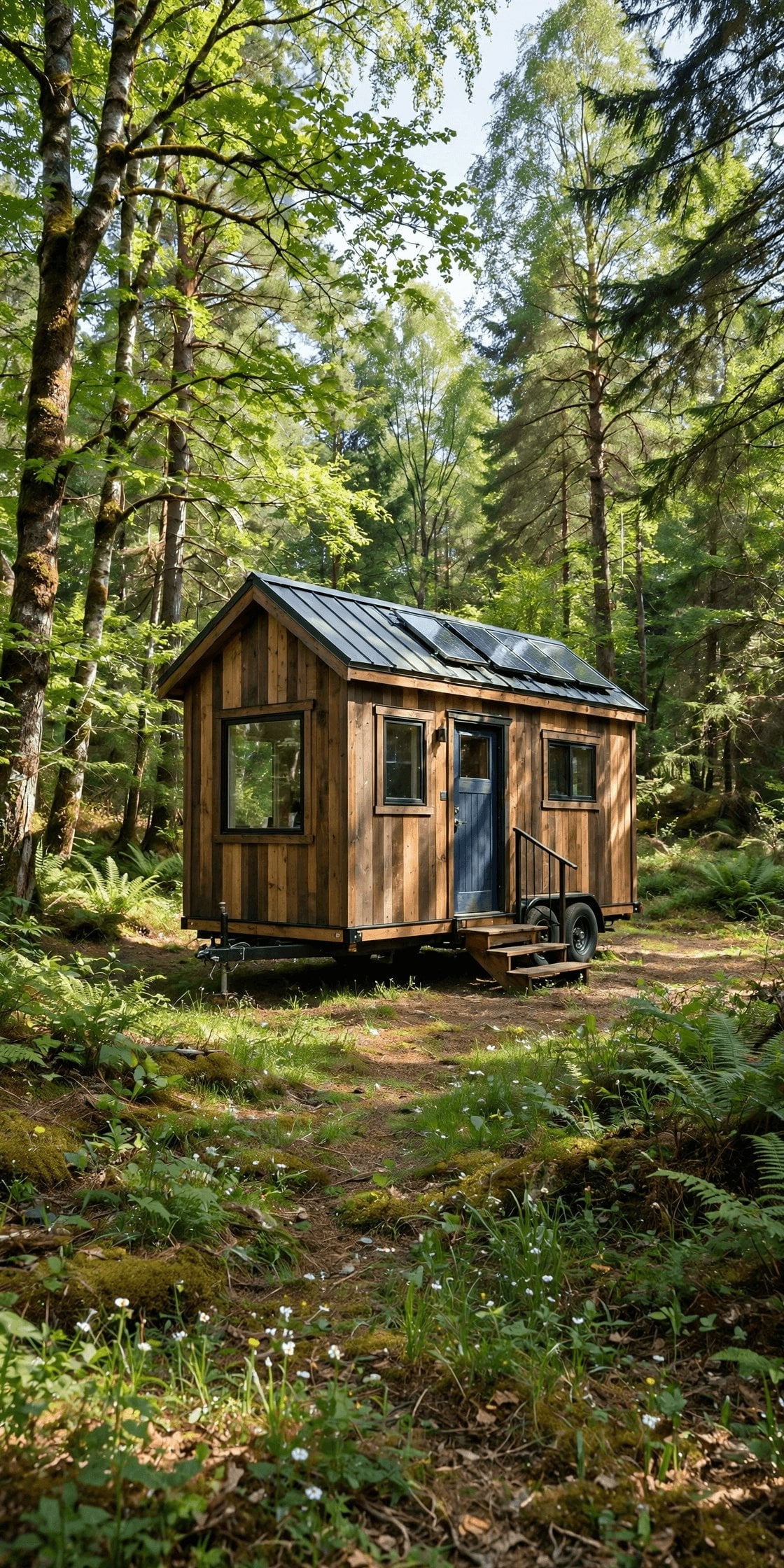
Pin it: sell the van in a weekend at vehicle prices; sell the tiny house in a season at defended prices — buy knowing which exit is yours.
9. The Costs Nobody Budgets: Health, Weather and Belongings
Three cost lines appear in no spreadsheet and every long-term account. Health first: sleep quality on a real mattress in a real bedroom, posture at a real desk, the morale arithmetic of a door that closes — the tiny house buys these wholesale. The van buys, instead, the health dividend of motion and outdoors, and charges for it in broken sleep on bad nights, in weather confinement in a capsule, and in the healthcare logistics of no fixed base. Neither is the healthy option in the abstract; each protects a different system.
Weather is the second line. The van’s answer to a bad week is a road: it can outrun a forecast, and pays for the privilege in fuel and dislocation. The tiny house sits in its weather with residential defences — insulation, real heating, a roof that expects storms — and pays nothing at all, having prepaid in the build. Belongings close the list: the van life’s overflow goes to storage units and family garages (a rent by another name), while the tiny house keeps a life’s objects at home; and security thinking from our guide to how to keep your tiny house safe — locks, trackers, anchoring the home and its contents — applies to both, with the van’s version practised nightly rather than once.
Budget these lines honestly and the comparison’s averages stop mattering: your health, your climate and your stuff are specific, and they will vote.
10. Choosing Your Rhythm: Movement Patterns That Fit Each
Step back from the dimensions and the choice resolves into rhythm. The van fits lives whose unit of travel is days: seasonal workers following contracts, climbers and surfers following conditions, the retired-and-curious on a continental lap, anyone whose joy is the next place. The tiny house fits lives whose unit is seasons: remote workers with a base and a travel habit taken in trips, snowbirds with two legal placements, savers running a multi-year plan on one cheap site. The logistics of the tiny rhythm — its moves are the events priced in our tiny house moving guide on transport costs — are a feature when they happen twice a year and a punishment when they happen twice a month.
The hybrid deserves its honest paragraph, because it is what many people actually build toward: the tiny house as the owned base, placed legally and cheaply, and travel taken by car, rail or a cheap second vehicle — van life’s highlights without its housing compromises, at the price of maintaining a base you are sometimes away from. Its mirror image is the van kept for years with a rented room or pitch for winters. Both hybrids concede the same truth: the pure products are optimised, and real lives are not.
So choose by the calendar you will actually keep. Count your intended nights per stop, price both products against that number with the two-budget method, and let the crossing of the curves — not the loudest lifestyle account — make the decision.
Final Considerations
The verdict. Pick van life if the itinerary is the lifestyle: if stops are measured in days, weather is something to follow rather than endure, you can work from a rebuilt-daily workspace or not at a desk at all, and you value the cheapest buy-in and the liquid exit over domestic depth. Pick the tiny house if the basecamp is the lifestyle: if stops are measured in seasons, your work and your winters need a real house’s envelope and rooms, you have a legal placement solved before purchase, and you are happy to pay once at the door for years of cheap, stable months. The expensive mistakes are the crossed ones — the van bought by a settler, paying vehicle compromises for a parked life; the tiny house bought by a wanderer, paying a mover’s invoice for a travelling one. Match the product to the rhythm and both of these are what their owners promise: the cheapest honest ways yet found to live a life on purpose.


0 Comments