
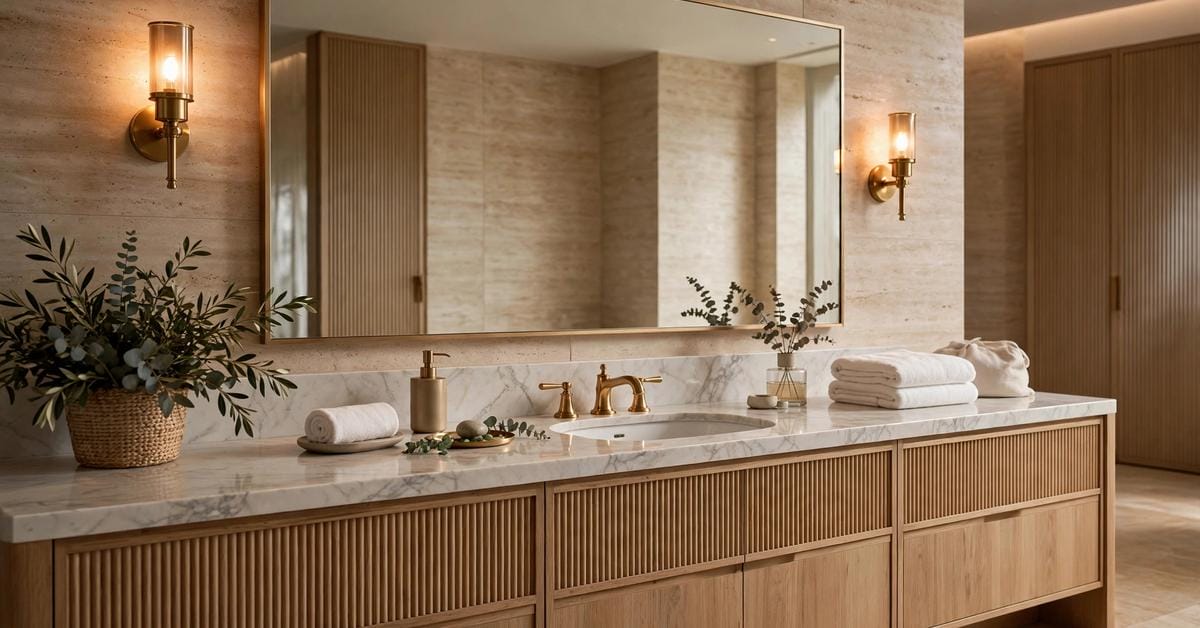
The mirror is not lying to you in the morning. The light above it is — one bulb overhead, and every face gets shadows where its kindness should be.
This guide fixes bathroom vanity lighting properly: where the light belongs, which fittings put it there, and the colour, control and safety checks that make a vanity a pleasure to use — with all electrical work placed, as it must be, with qualified professionals.

1. Bathroom Vanity Lighting at a Glance
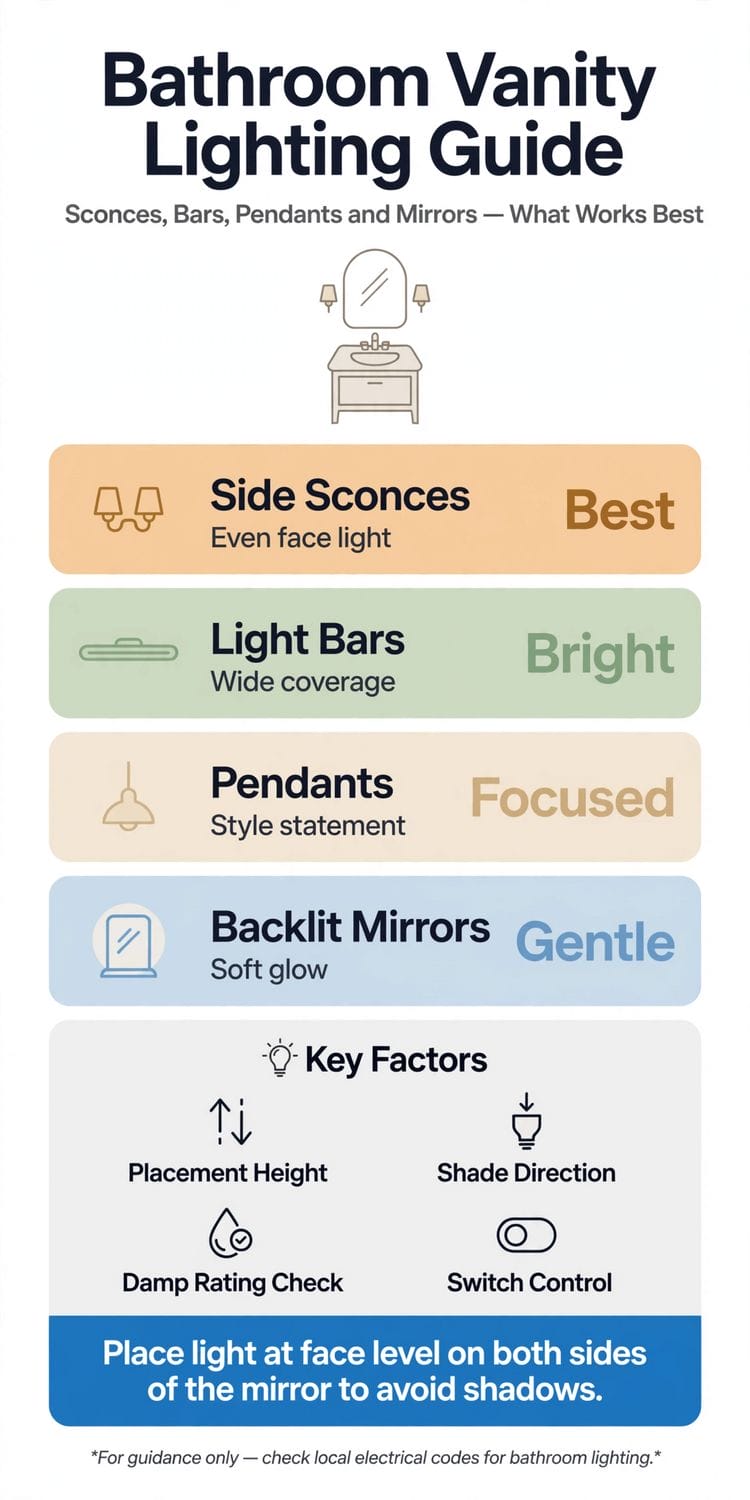
Vanity lighting has one job before all others: to light a face evenly, from the front, at the mirror where people shave, apply makeup, check teeth and start their day. Almost every disappointing bathroom fails that job in the same way — a single light overhead or above the mirror, shining down, carving shadows under the eyes, nose and chin. The fix is placement, not power: light at face level, on both sides of the mirror, as this post’s infographic puts it in a single sentence. This guide stays strictly with lighting at the vanity — the fittings, their placement, their light colour and their controls. The wider bathroom around it lives in the pillar survey at bathroom ideas, and the mirror the light serves gets its own treatment in mirror over vanity ideas — here, the light itself is the subject, and everything is stated generally, with fittings, ratings and wiring always to be confirmed against the manufacturer’s instructions and the rules where you live.
| Question | Short answer |
|---|---|
| Where should vanity light sit? | At face level, on both sides of the mirror — light from the front, never only from above |
| Which fitting works best? | Side sconces for most faces; bars, pendants and backlit mirrors each have honest uses, covered below |
| What light colour suits a vanity? | A warm-to-neutral white that renders skin honestly — check the bulb’s stated colour and rendering quality before buying |
| Can one fitting do the whole bathroom? | No — the vanity needs its task layer, and the room still needs its own general light |
| Who should fit bathroom lights? | A qualified electrician — bathroom electrics are regulated work in most places, and water is unforgiving |
2. Why Faces Need Light From the Front

Every other decision in this guide follows from one piece of geometry: light reveals what it falls on, and shadows gather wherever it cannot reach. A face lit only from above is a face in partial shadow — and a mirror doubles whatever the light does, good or bad.
The overhead-light problem
A ceiling light or a bar above the mirror shines down the forehead and stops. The eye sockets, the underside of the nose and the chin fall into shade, which is why people lean, squint and misjudge makeup and shaving under the commonest bathroom lighting in the world. The fitting is rarely too weak; it is simply in the wrong place, lighting the top of a head beautifully and the face hardly at all.
Two lights, face level, both sides
Light placed at face height on both sides of the mirror crosses in front of the face and cancels its own shadows — each light fills the shade the other would leave. That is the infographic’s whole verdict: side sconces take its top row and its plainest praise, even face light. The effect is immediate and slightly miraculous the first time a household tries it: the mirror suddenly seems larger, kinder and more honest at once.
The mirror’s part in the arrangement
The mirror is not a passive screen — it returns light into the room and reflects whatever brightness sits opposite it. A very wide mirror can borrow a sconce’s light across a double vanity; a small mirror in a dark-tiled room gives nothing back. Mirror size and light placement are one decision, which is why the mirror survey linked in section one and this guide belong together: choose them as a pair, not as strangers.
3. Side Sconces: The Benchmark Fitting
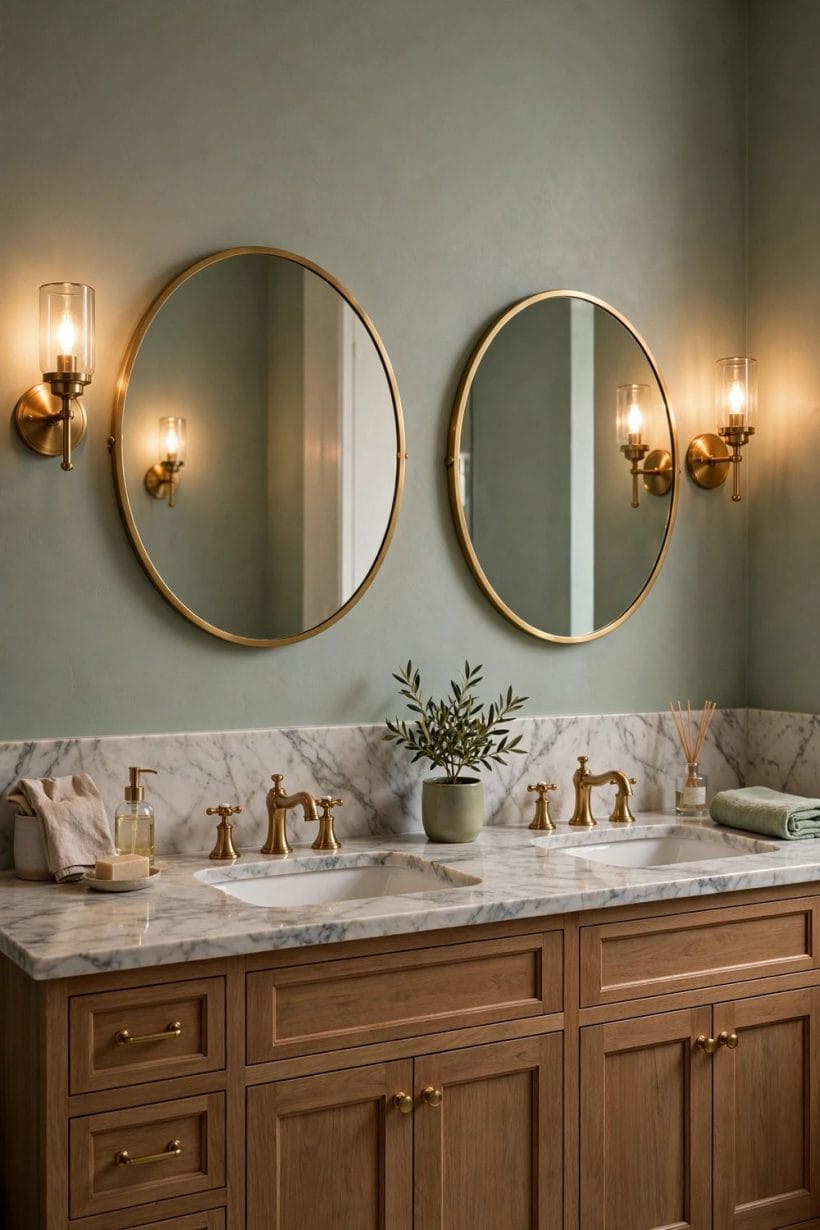
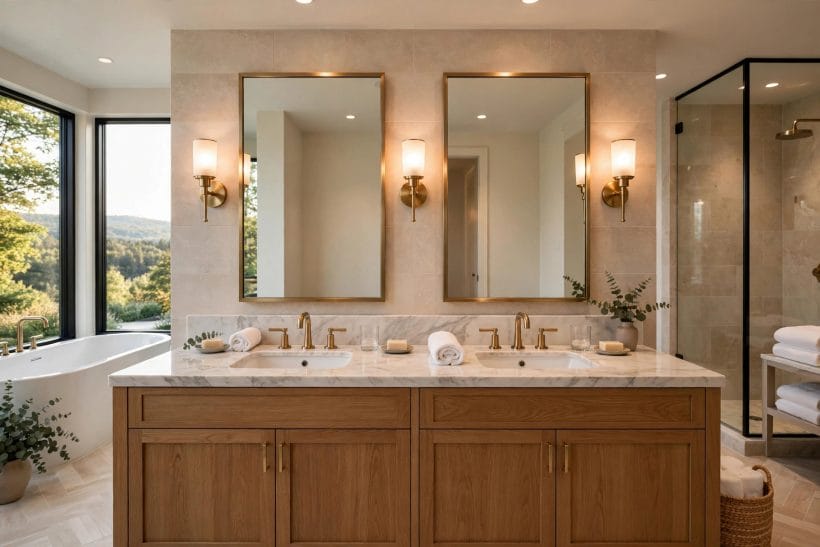
The feature photograph shows the benchmark exactly: a pair of brass sconces flanking a wide mirror over a timber vanity, their shades glowing at the height of a standing face. When wall space allows them, sconces are the fitting every other option is measured against.
Height and spacing, stated generally
The working rule is face level: the centre of the light should sit roughly at the eye height of the people using the vanity, so the light meets the face rather than descending on it. On a shared vanity, a height that serves the household’s middle ground serves everyone adequately. Spacing follows the mirror — one sconce each side, close enough that their light overlaps in front of the face, far enough that neither crowd the mirror’s frame.
Shades that soften, not dim
The infographic names shade direction as a key factor, and it is: a shade that throws light up and down the wall gives a softer, more flattering wash than one that fires it straight at the face, while a clear glass shade around a bright bulb glares at exactly the moment the eyes are closest. Opal, fabric-look and frosted shades earn their place at a vanity; the bulb inside should be one the shade was designed for, per the manufacturer’s guidance.
Pairs, singles and double vanities
One sconce is never the answer for one face — the unlit side simply shadows. A double vanity wants either a pair per person or a shared arrangement of three, spaced so each basin gets its cross-light. In a very small bathroom where wall space beside the mirror does not exist, the honest alternatives are the next section’s fittings, chosen knowingly rather than a single sconce chosen hopefully.
4. Bars, Pendants and Backlit Mirrors
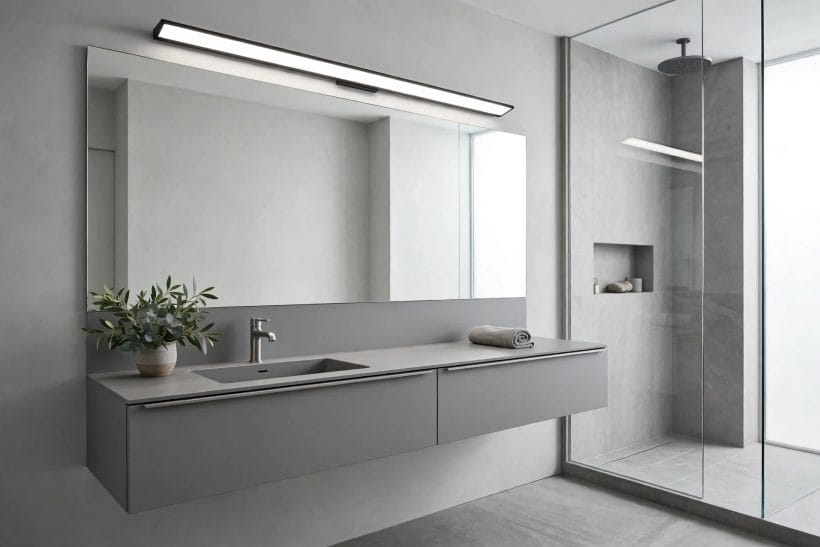
Not every vanity can take sconces — narrow walls, wide mirrors and corner basins all argue otherwise. The infographic grades the three main alternatives fairly, and each has a real case to make.
Light bars: wide coverage, honestly placed
A bar above the mirror gives the broad, even coverage the infographic calls bright — the practical choice over wide and double mirrors. Its weakness is the old one: light from above alone. A bar does its best work mounted as low over the mirror as its design allows, with shades that throw light outward onto the face as well as down, and it improves further when the room’s general light fills in from behind the user.
Pendants: the style statement that works
Pendants hung beside the mirror put light at face level from the ceiling’s wiring — the solution where wall space is taken by the mirror itself or by cabinets. Hung as a pair at face height, they light like sconces with more ceremony. Their cautions are swing, splash and head clearance: a pendant over a basin is in the splash zone and in the leaning-in zone, and both facts belong in the placement decision, with a qualified electrician confirming the fitting’s suitability for the spot.
Backlit and lit mirrors: the gentle layer
A mirror with light built around or behind it gives the soft, shadowless glow the infographic calls gentle — lovely for ambience and for night-time visits, and kind to faces at close range. Its limit is reach: the glow is local to the mirror, so a lit mirror is best treated as one layer — beautiful at the glass, supported by the room’s other light for everything beyond it. Households that groom carefully usually pair a backlit mirror with one more source rather than asking it to work alone, as the layered schemes in tiny house interior lighting ideas show at small scale.
5. Light Colour and Honesty at the Mirror
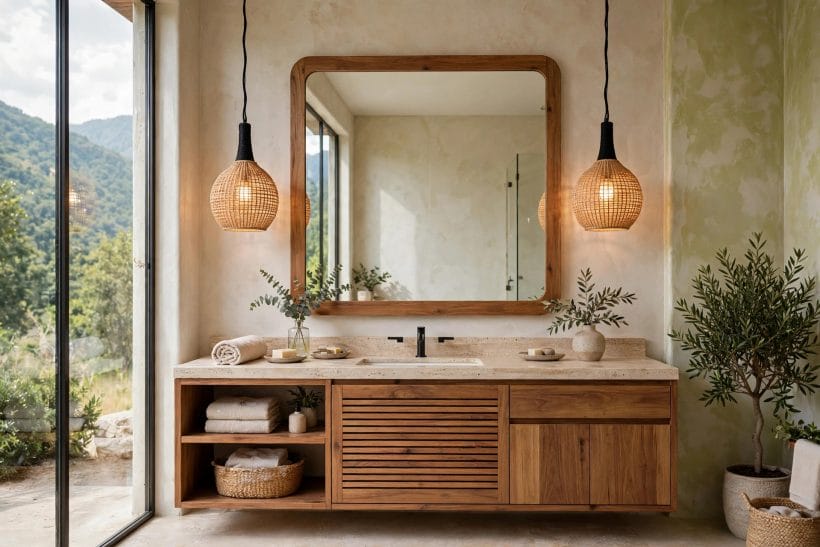
A vanity is where a household checks how it looks before facing the world, so the light there has a truth-telling duty no other room imposes. Colour — the light’s own colour — is where that duty is met or betrayed.
Warm, neutral and the daylight question
Very warm light flatters everyone and lies to everyone: makeup blended under it can startle in daylight. Very cool light tells a colder truth than most faces meet outdoors. The honest middle — a warm-to-neutral white — is the vanity standard for good reason. Whatever is chosen, the bulb’s stated colour belongs on the buying checklist, and both basins of a double vanity, and every layer in the room, should share the same colour family, or the mirror will show two different faces at once.
How faithfully light renders colour
Beyond its own colour, light varies in how faithfully it shows the colours it falls on — the quality makers describe as colour rendering. At a vanity this is not a subtlety: lipstick, foundation and the redness of a shaving nick all depend on it. The manufacturer’s stated rendering figure for a bulb or fitting is a general guide only, but it is a real one — choose the higher-rendering option for the vanity layer, and save the bargain bulbs for the linen cupboard.
Glare: the enemy of a close mirror
A vanity is used at arm’s length, with eyes raised toward the light. Bare bulbs, clear shades and mirror-gloss reflections all glare at exactly that range. Diffused shades, bulbs set back within their fittings, and matte finishes around the mirror keep brightness high and glare low — the combination that makes a brightly lit face a comfortable one to look at while it is being washed, shaved or made up.
6. Layering the Bathroom’s Whole Light
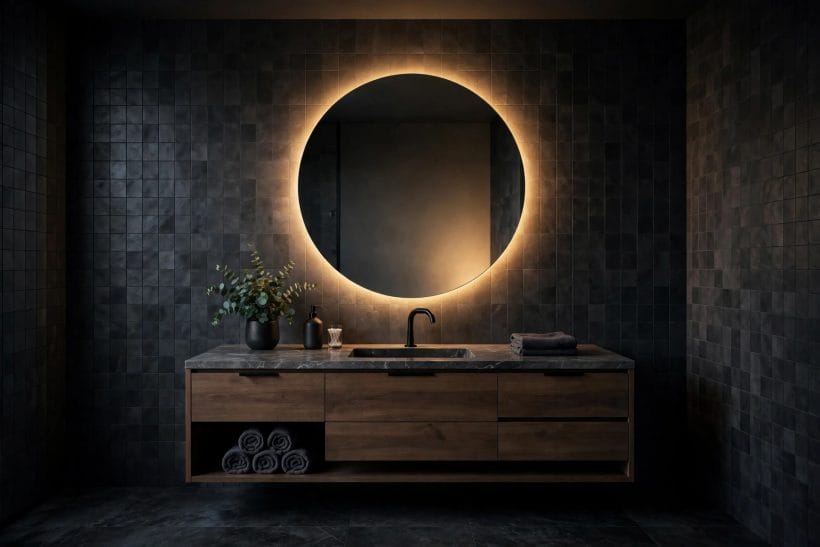
Vanity light is the bathroom’s task layer, not its whole lighting. A room lit only at the mirror leaves the shower in gloom and the bath in shadow, and a room lit only from the ceiling fails the mirror. The whole room wants layers, each doing its own job.
The general layer
A ceiling fitting or discreet downlights give the room its base brightness — the light for cleaning, for finding things, for moving safely on wet floors. It should be present without being theatrical, and it should never be asked to light faces: that demotion is what frees the vanity layer to be chosen purely for faces.
The bath and shower layer
Light over a bath wants to be soft and indirect — a soak is not a task. In a shower, the fitting must be one made and rated for that wet position, full stop: this is the manufacturer’s and the local rules’ territory, and a qualified electrician’s choice, not a stylistic one. Warm colour here ties the wet zone to the vanity’s palette and keeps the room one place rather than two.
Accent and night light
A low, warm accent — a small fitting near the floor, a lit niche, the backlit mirror’s glow left on — serves the night-time visit without the full assault of the main lights. In family bathrooms this gentle layer is the one households report loving most per penny, and it costs its place in the plan rather than in the budget, as the compact schemes in tiny bathroom ideas demonstrate.
7. Controls: Switches and Dimmers
The infographic lists switch control among its key factors, and a bathroom’s light is only as good as its switching. The same fittings delight or irritate daily depending on how their light is called up and calmed down.
Separate the layers on separate switches
Vanity light, general light and accent light on their own switches let the room be lit for its actual moment — a bright mirror in a dim room for an early start that spares a sleeping household, or the full scheme for a Saturday clean. One switch for everything is the false economy behind most bathroom lighting regret.
Dimming, where the fittings allow it
A dimmer turns the vanity layer from task light to evening glow in one gesture — genuinely useful at a mirror used first thing and last thing. Dimming is a partnership between switch, bulb and fitting, and not every combination the shelf offers actually works together; the manufacturers’ stated compatibilities, checked before purchase, are the general rule, and a dimmer that flickers or hums is a mismatched partnership, not a faulty household.
Switch position and bathroom rules
Where switches may sit in a bathroom, and which kinds are permitted there, is set by the rules where you live — pull-cords, out-of-room switches and specially rated fittings all exist because water and electricity are a serious combination. This is qualified-electrician territory in the plainest sense: the design decision is which layers you want to control; the placement and hardware are decided with the professional who fits them.
8. Small Bathrooms, Shared Bathrooms and Guest Rooms
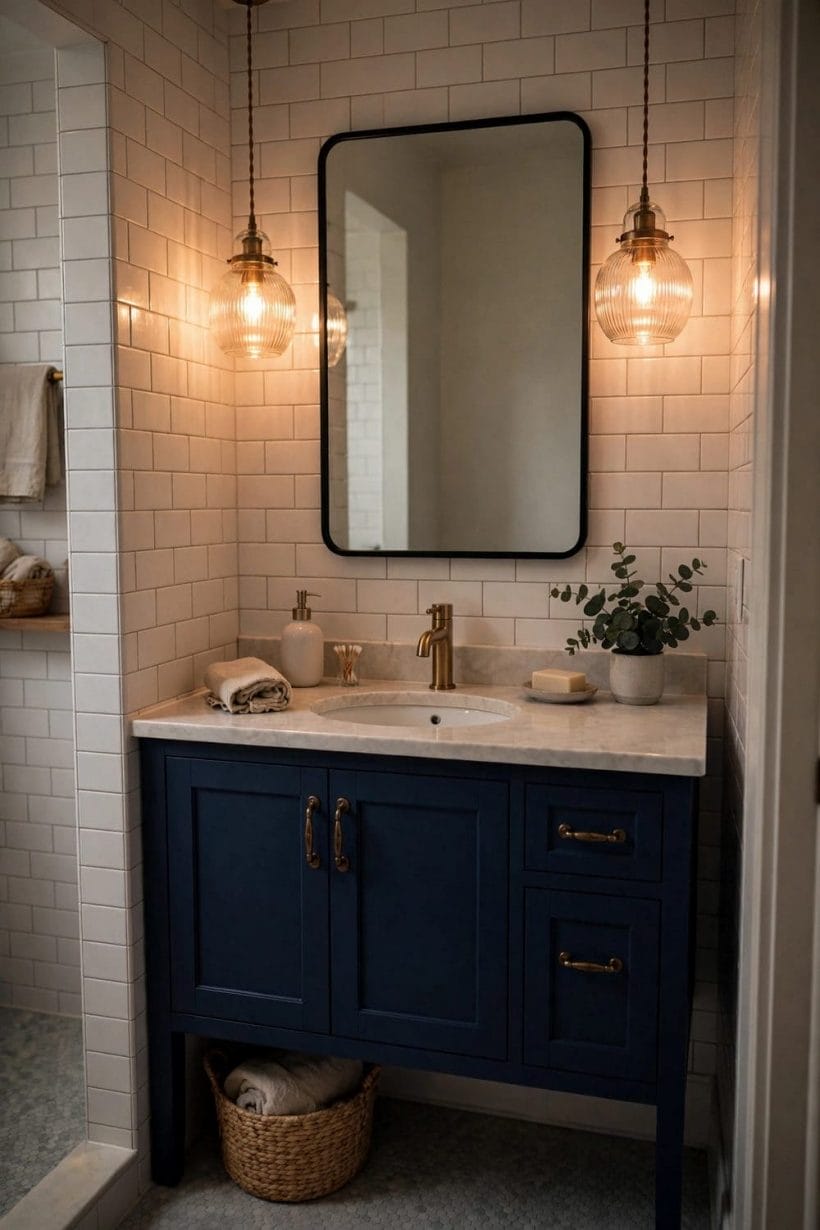
The principles do not change with the room’s size or its users — but their sharpest tests come in the smallest rooms and the busiest ones, where the layouts in tiny house bathroom layouts have been solving the same problems at tiny scale for years.
The small bathroom: light as space
In a compact bathroom the vanity layer doubles as the room’s sense of space: a well-lit mirror wall reads larger, and a backlit mirror’s halo fakes depth the room does not have. Sconces may genuinely not fit, and the honest small-room answers are a low bar, close pendants or a lit mirror — chosen from section four’s trade-offs with the wall measurements in hand.
The shared family bathroom
Two heights of user, peak-hour queues and makeup beside shaving: the shared vanity wants the most even light of all, at a height that splits the difference between its tallest and shortest regular users, on a switch a child can reach that is legal where you live. A double vanity under one long bar, or with three sconces, serves the morning rush better than any single statement fitting.
The guest bathroom and the en-suite
Guest bathrooms forgive almost anything except darkness at the mirror — visitors will not complain about a sconce’s style, but they will remember squinting. En-suites add one refinement: light discipline at night, where a dimmed vanity layer or accent glow respects the sleeper through the door in a way the full ceiling scheme never will, a courtesy the wet-room planning in waterproof tiny house bathroom wet bath design also builds in.
9. Choosing Fittings and Planning the Work
Good vanity lighting is decided on paper and in the showroom, in a particular order — mirror first, because the light serves it; then placement; then fittings; then bulbs and controls. The planning points below keep that order honest.
Ratings and suitability come first
The infographic’s damp-rating check is the first filter on any fitting shortlist: a bathroom fitting must be made and rated for the damp position it will occupy, with stricter suitability the closer it sits to bath and shower spray. The manufacturer’s stated rating for the exact fitting is the document that matters, and a fitting without a clear one does not make the shortlist, however pretty its photograph.
Measure the wall before falling in love
Mirror width, basin centres, cabinet doors that swing through the sconce’s space, and the heads that will stand at the glass — measure them all, and mark the intended light positions on the wall in tape before anything is ordered. Most vanity-lighting disappointment is a measurement that was never taken meeting a fitting that was bought on hope.
Costs as drivers, and the professional’s part
The money in a vanity-lighting project sits in the fittings themselves, the bulbs and controls, and — the part DIY estimates forget — the qualified electrician’s time to wire, position and certify the work where certification applies. Moving a light point costs more than using the one that exists, which is a genuine design input: plan the mirror around an existing point before paying to move the point around a mirror. Local quotes give the real figures where you live; the driver’s seat, as ever, is occupied by how much wiring the plan honestly needs.
10. Living With It: Bulbs, Cleaning and Small Failures
The best vanity lighting asks little of its household — a spare bulb, a soft cloth and an honest eye once in a while. The points below are the whole maintenance story, stated generally.
Keeping a matched set of bulbs
When one bulb in a pair fails, its replacement must match the survivor’s stated colour and character, or the mirror will show the difference across the face every morning. Keeping one labelled spare of the exact bulb — bought with the originals, from the same family — is the small discipline that keeps a pair a pair for years.
Cleaning shades and mirrors
Dust and bathroom mist dim light quietly: a shade that has lost its brightness to film is a fitting working at half its promise. A soft, dry or barely damp cloth — with the power off and the fitting cool, and always per the manufacturer’s care guidance — restores it. Steam-heavy rooms earn their fittings a more frequent wipe, which is also the moment to notice a shade cracking or a finish spotting in the damp.
When to call the professional back
Flicker that survives a bulb change, a fitting that runs hot, a switch that crackles, moisture inside a shade: none of these are household repairs in a bathroom. They are the qualified electrician’s list, promptly. The general rule that built the room’s lighting — design decisions at home, electrical work with professionals — holds for its whole life, not just its first fitting.
Final Considerations
Perfect vanity lighting is mostly a matter of position: light at face level, on both sides of the mirror, in an honest colour, on its own switch — and every other decision in this guide is a refinement of that one.
Place the light where faces actually are, let professionals place the wires, and the mirror becomes what it was always meant to be: the kindest, clearest start to the day the house can offer.




0 Comments