
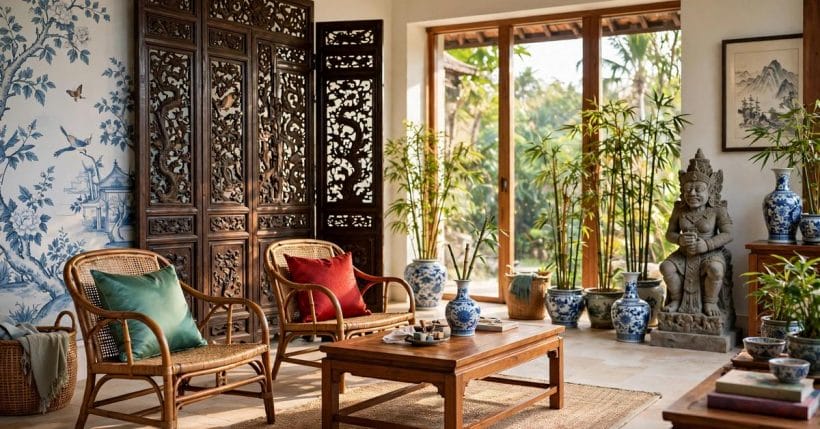
A carved screen, a low table, a single orchid — the rooms in this collection share a discipline that crosses a continent: natural materials, uncluttered layouts, and one beautiful object allowed to speak at a time.
These 45 ideas gather the design language in general terms — screens and carved wood, rattan and teak, porcelain, bamboo, low furniture and garden connections — drawn from several regional traditions and stated plainly as design, so each one can be borrowed honestly for an ordinary home.
Related Guide: 10 Asian Bedroom Ideas: Calm Layouts, Natural Materials and Restful Styling
1. The Four Families at a Glance
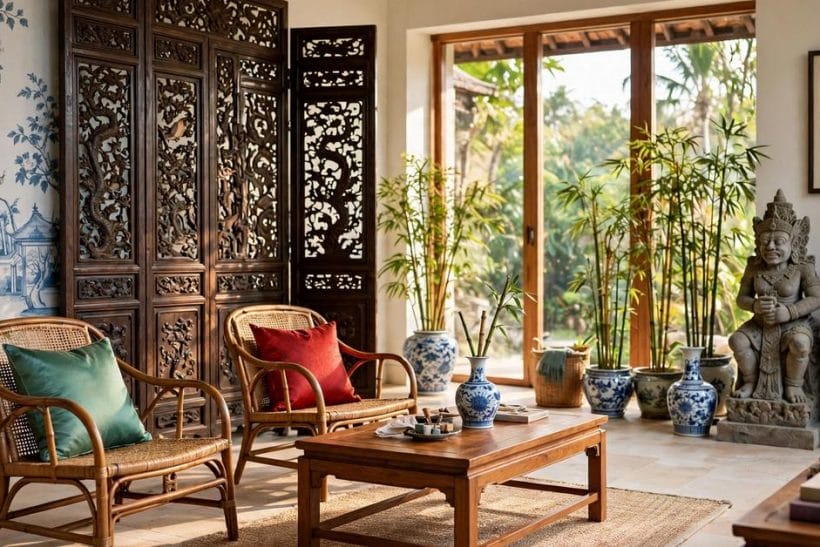
The living room above holds the whole argument: carved dark screens, easy rattan chairs, porcelain on the table and green life at the glass. Four families organise everything that follows, and the table below is the post in miniature. The meditative end of the family is explored in the zen interior design for tiny houses collection, and its pared-back cousin in the minimalist tiny house interior guide; this post stays with the wider, warmer mix.
| Family | What it brings | In a word |
|---|---|---|
| Carved Wood Screens | Chinese-inspired divider | Statement |
| Rattan & Teak | Southeast Asian furniture | Warmth |
| Porcelain & Chinoiserie | Wallpaper and vases | Elegant |
| Bamboo & Silk | Natural soft textures | Serene |

Four factors run under every idea: natural materials — wood, bamboo and stone; a balanced layout, calm and uncluttered; rich texture from lacquer, silk and weave; and indoor greenery, plants and orchids treated as furniture in their own right. Keep those four in balance and any single idea below can stand alone in a room that borrows nothing else.
2. Dining Rooms You Eat Slowly In
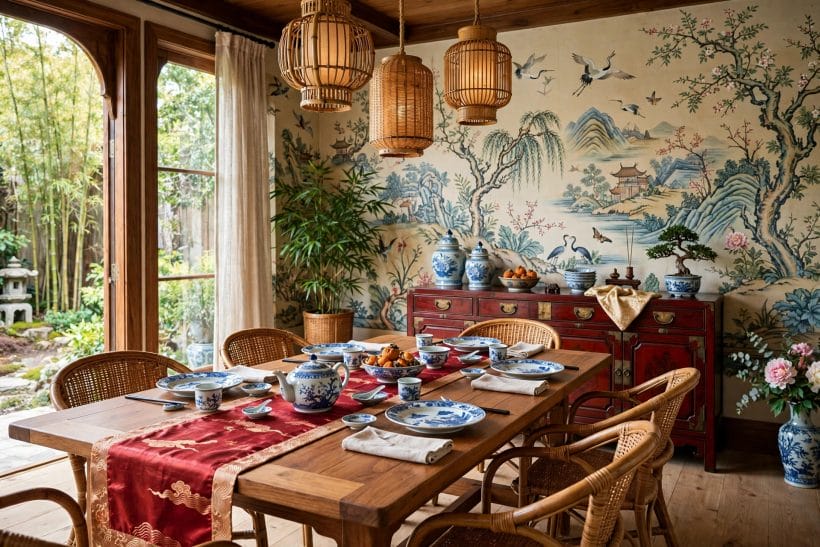
The dining room in this photograph — a long timber table, scenic painted wallpaper, rattan pendants in a row and the garden close outside the glass — shows the style at its most sociable. Rooms that open to green borrow half their decoration from outdoors, a trick the tiny house exterior ideas collection uses from the other side of the wall.
1. A Long, Low Wooden Table
One generous timber table, lower and simpler than a formal dining suite, anchors the room and invites shared dishes in the middle. The wood is the decoration: grain showing, finish matte, nothing between the diners and the material.
2. Scenic Wallpaper Behind the Table
A painted-landscape or blossom-branch wallpaper on the dining wall gives the room its picture, in place of hung art. Kept to one wall and paired with plain surfaces elsewhere, it reads as a window onto a calmer landscape rather than as pattern for its own sake.
3. Woven Pendant Lamps in a Row
Rattan or bamboo pendants hung in a line over the table pool warm light along its length and repeat the woven note of the chairs below. Even spacing matters more than size — the rhythm is the effect.
4. Porcelain as the Table’s Colour
Blue-and-white bowls, plates and serving pieces carry the colour of the meal setting against plain wood and linen. Because the porcelain is used daily rather than displayed, the room’s elegance stays lived-in instead of museum-like.
A runner in a deep woven red down the table’s centre, low bowls of fruit and the garden framed by the glass complete a scheme that asks very little of walls or budget: the table setting is the decoration, changed with the seasons and the meal.
5. A Lacquered Cabinet for Serving
A deep-toned lacquered side cabinet gives the dining room its one glossy surface, storage for linen and dishes, and a stage for a fruit bowl or a single vase. One lacquered piece per room is the rule — the second one starts an argument.
3. Entryways and the Carved Door
The entry in this portrait makes its statement before the door even opens: heavy carved timber, stone figures at either side, orchids at the threshold and a low bench waiting. The threshold ritual itself — shoes off, a seat provided, a place for everything — is shared with the Japanese genkan entryways collection, which designs the same moment for small homes.

6. A Carved Statement Door
A deeply carved wooden door — or a carved panel mounted beside a plain one — gives the entry its single hero. The carving does the work that paint colours and hardware do elsewhere: pattern, shadow and unmistakable arrival.
7. A Low Bench at the Threshold
A simple low bench just inside the door serves sitting, shoe-changing and bag-setting in one piece of furniture. In woven cane or plain timber it also sets the material key for the rooms beyond.
8. Stone Against Timber
A stone step, plinth or pair of carved figures against dark wood gives the entry its weight contrast: mineral against grain, cool against warm. The pairing recurs at every scale of this style, from doorsteps to table vases.
9. Orchids and Greenery at the Door
Living green at the threshold — orchids in baskets, leafy pots at either side — softens the formality of carved timber and tells a visitor the house is tended. Group plants in odd numbers and let one tall specimen carry the height.
10. One Warm Pendant
A single woven or paper-shaded pendant over the entry bench pools the light where people actually stand, instead of flooding the hall. Warm-toned light on timber and stone is the style’s signature welcome.
Entries in this style succeed by sequence rather than size: something carved to arrive at, somewhere to sit, something green to soften it, and light pooled exactly where people pause. A small hall that stages those four moments feels grander than a large one that stages none.
4. Screens and Carved Wood
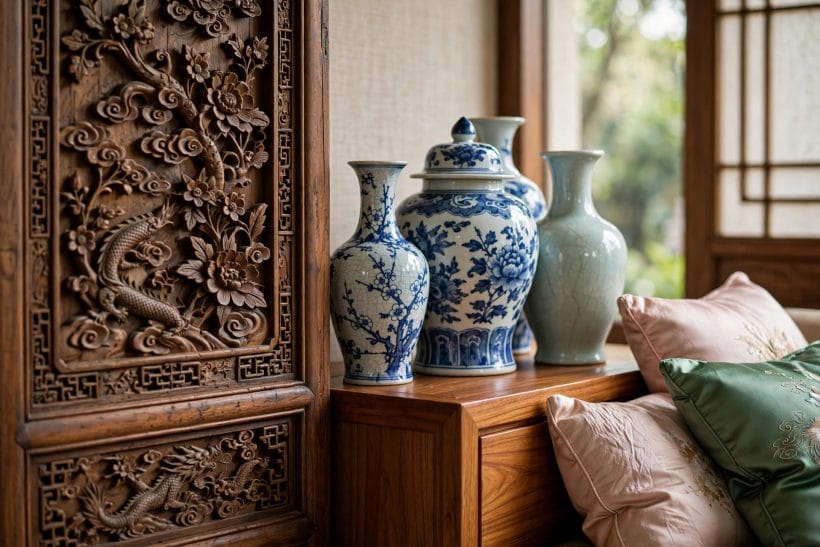
Look closely at this photograph: a panel carved deep enough to cast its own shadows, porcelain standing on the cabinet beneath it. Carved wood is the style’s oldest voice, and screens are how it speaks in a modern room — dividing, filtering and decorating at once.
11. Freestanding Screens as Dividers
A folding carved screen zones an open room without building anything: a sleeping corner, a desk, a dining bay each gains a wall that can move. Choose carving open enough to pass light, so the divided room borrows brightness from its neighbour.
12. Lattice Screens That Filter Light
Plain lattice panels — timber grids without carving — do the quieter half of the screen’s work: privacy with daylight, pattern made of shadow. They suit windows, wardrobe fronts and the space above a half-wall equally well.
13. A Carved Panel Hung as Art
A single carved panel, hung alone on a plain wall, is read as sculpture rather than furniture. Give it empty wall on every side; the style’s confidence is in what it leaves out.
14. Porcelain Grouped on Dark Timber
Blue-and-white jars and a celadon vase, grouped on a dark wooden cabinet, form the style’s most portable idea: three vessels, heights varied, colours cooling the wood beneath them. It assembles in an afternoon and moves house with you.
The same grouping principle scales from a cabinet top to a whole wall: vessels first, carving second, everything else silent. Where a room already owns a carved piece, porcelain is the cheapest way to give it company without giving it competition.
15. One Hero Piece Per Room
Carving competes with itself. A room with the screen does not need the carved door as well — the discipline that keeps these rooms calm is rationing: one carved hero, everything else plain, woven or smooth.
5. Rattan, Teak and Woven Texture
The living room in this photograph is the warm counterweight to the carved rooms: a rattan sofa deep in cushions, a plain teak table, woven art on the wall and plants doing the rest. No carving at all — texture is the whole palette.
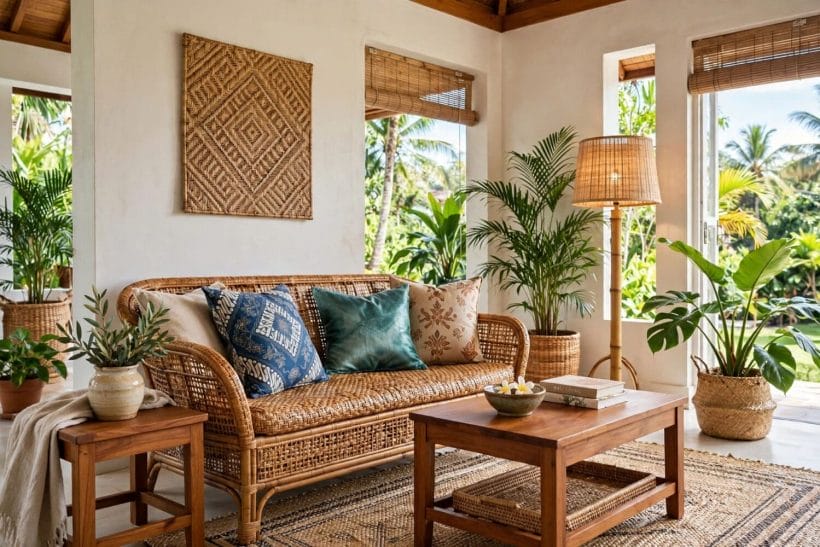
16. A Rattan Sofa as the Anchor
A woven rattan or cane sofa carries a living room in this style almost alone: light in frame, generous in seat, honest in material. Dress it with cushions in the room’s two or three colours and let the weave show between them.
17. Teak Tables and Side Stools
Plain teak — coffee table, side stools, a low bench — grounds the rattan with weight and grain. The two materials are the style’s oldest partnership: one woven, one solid, both better unvarnished by paint.
18. Woven Wall Panels and Blinds
A woven wall hanging or bamboo blinds repeat the furniture’s texture on the room’s vertical surfaces, tying seat to wall. Natural weave also filters daylight into the soft, shaded quality these rooms are known for.
19. Patterned Cushions on Plain Weave
Against plain rattan, cushions carry the pattern: indigo prints, embroidered motifs, one silk cover among cottons. Three patterns at most, all sharing a colour, and the sofa reads collected rather than busy.
20. Plants in Woven Baskets
Palms, leafy greens and orchids in woven baskets extend the texture story to the floor and give the room its living layer. Baskets hide plain pots, unify mismatched plants and cost almost nothing to refresh.
Notice what this room refuses: no carving, no lacquer, no wallpaper. The woven family proves the style is a material discipline before it is an ornament style — a household that owns rattan, timber and plants already owns most of the vocabulary.
6. Bedrooms That Breathe
This bedroom pairs its calmest elements: blossom-and-crane wallpaper, white bedding under one deep green throw, porcelain lamps in a matched pair and a carved bench waiting at the foot of the bed. Nothing shouts; everything is placed.
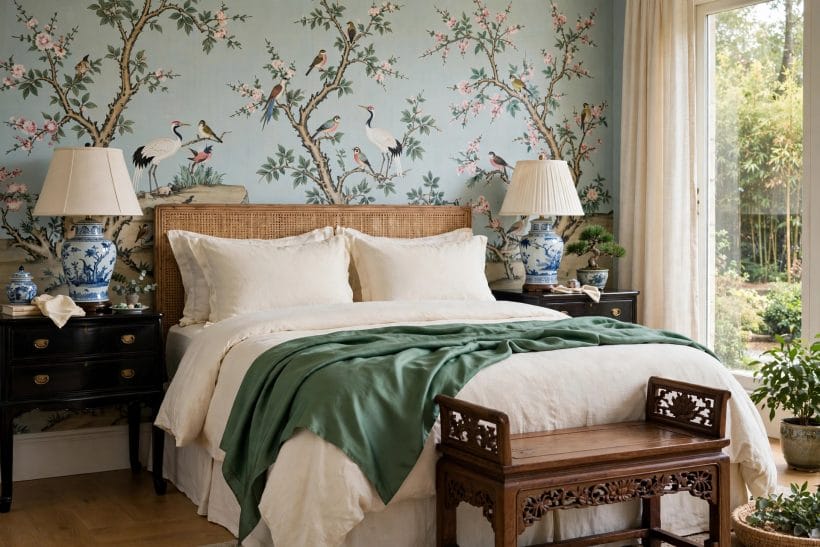
21. Blossom Wallpaper on One Wall
A branch-and-blossom or bird wallpaper behind the bed gives the bedroom its garden it cannot otherwise have. One wall only, with the other three plain, keeps the pattern restful instead of enclosing.
22. Porcelain Lamps in Pairs
Matched porcelain lamp bases with plain shades flank the bed with the style’s signature blue-and-white at eye level. Pairs are this tradition’s way of making a bedroom feel settled — symmetry reads as rest.
23. A Carved Bench at the Foot
A low carved bench or trunk at the foot of the bed holds the folded throw, tomorrow’s clothes and the room’s one carved note. It also gives a bed made mostly of bedding its architectural full stop.
24. White Bedding, One Deep Throw
Plain white or undyed linen bedding, with a single deep-coloured throw — jade, indigo, lacquer red — folded across the foot, is the fastest of all these ideas to copy and the one guests remember.
25. Dark Lacquered Bedside Cabinets
Small dark cabinets beside the bed anchor the porcelain lamps and echo the carved bench’s timber. Against pale bedding and blossom paper, the black notes keep the room composed rather than sweet.
Bedrooms borrow this style more successfully than any other room, because its rules and sleep’s rules are the same: few objects, natural fibres, matched pairs, light that dims warmly and nothing in the room asking to be looked at after dark.
7. Garden Rooms and Open-Air Living
The pavilion room in this photograph — a daybed under a bamboo roof, orchids and carved panels around it, the garden a step away — is the style’s destination: a room that is half outside. The planting discipline behind it is kin to the Japanese rock garden layouts collection, and the sheltered-sitting craft to the tiny house porch ideas in this site’s own porch collection.
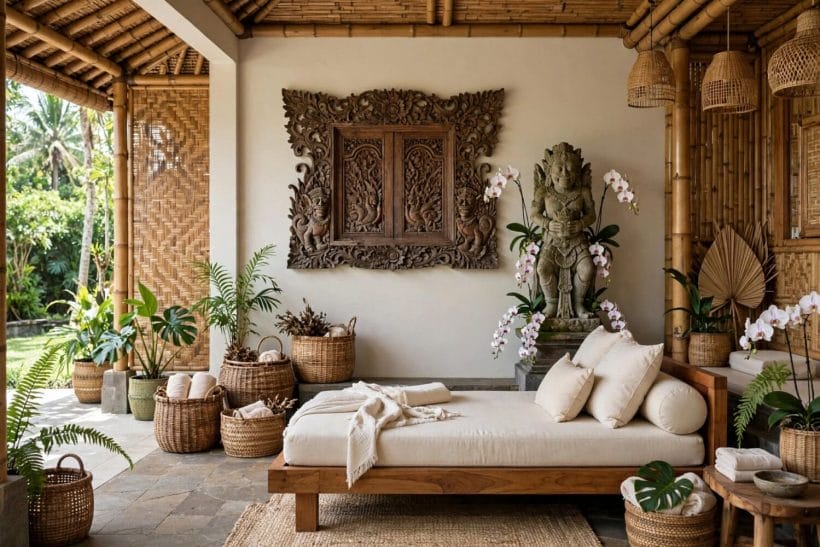
26. A Daybed Under a Roof
A deep daybed on a covered terrace or in a garden room is the style’s favourite seat: for reading, tea and afternoon sleep alike. Cushions in outdoor-worthy natural fabrics keep it honest to its setting.
27. Bamboo as Structure and Screen
Bamboo poles serve as posts, rails, blinds and screens in the same room, ageing from green-gold to silver. As a material it is the style’s scaffolding — light, renewable-looking and unmistakably itself.
28. Orchids at Sitting Height
Orchids in baskets hung or stood at the height of a seated person’s eye turn a garden room into a conservatory of one plant family. Their long bloom suits rooms meant for lingering.
29. Carved Panels as Garden Walls
Carved screens and panels used as a garden room’s walls filter breeze and view together, so the room feels sheltered without being shut. Weather finds them, and the patina is part of the point.
30. A Room That Opens Completely
Wide doors or open sides between house and garden are the idea under all the others in this section: the room borrows the garden’s size, scent and light, and the house feels twice built for half the cost.
Climate decides how literally to take this section: in warm regions the garden room is a daily room, in cooler ones a summer one with sliding screens against the shoulder seasons. Either way, the furniture stays light enough to migrate indoors when the year turns.
8. Small Rooms, Quietly Done
The small bedroom in this portrait — pale panelling, a low bed, one deep-red cabinet, a branch in a vase — shows the style scaling down gracefully. Small rooms are where its discipline pays best, because nothing spare is available to waste.
31. Pale Wood Panelling
Pale natural wood on walls and ceiling wraps a small room in one calm material, removing the visual joins between surfaces. The room reads as a single crafted box rather than an assembly of parts.
32. A Low Bed, Close to the Floor
A low platform bed increases the air above the sleeper and makes a small ceiling feel taller. It is also the style’s oldest furniture decision — the bed as a mat on a timber base, dressed simply.
33. Bamboo Blinds Instead of Curtains
Woven bamboo blinds filter light without the bulk of curtains, stack neatly at the window’s head and repeat the room’s natural materials. In small rooms, every saved centimetre of visual bulk counts double.
34. One Branch in a Tall Vase
A single flowering or bare branch in a tall floor vase gives a small room its sculpture — seasonal, replaceable and free of the clutter of ornaments. The arrangement is the art; the vase is the frame.
35. One Small Cabinet in a Deep Colour
Against pale wood, one small cabinet in lacquer red or ink black becomes the room’s jewellery: storage, colour and heirloom note in a single cubic foot. Restraint everywhere else is what lets it glow.
Small rooms also expose the style’s one hard rule: scale is honesty. A carved screen sized for a hall will bully a box room; the same money spent on a modest panel, a blind and a branch gives the small room three true notes instead of one false one.
9. Low Furniture and Floor-Level Calm
This last room — floor cushions on a low platform, a table at cushion height, celadon vases, one paper lantern — is the style reduced to its essence. Floor-level living is its boldest borrowing for Western homes, and the one that changes how a room feels most completely.
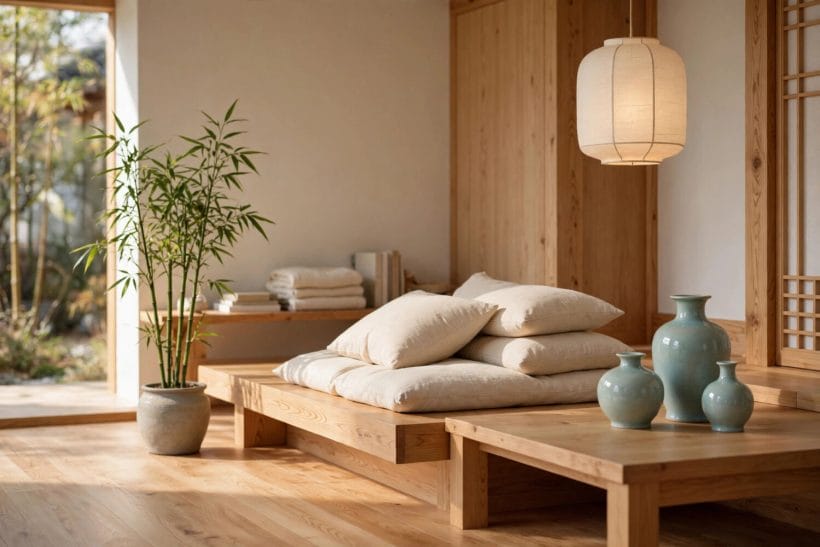
36. A Low Platform as the Room’s Base
A shallow timber platform defines the sitting zone like a rug made of wood, warming the floor plane and gathering cushions, table and people into one composed island within a larger room.
37. Floor Cushions as the Seating
Large firm floor cushions, in natural fabrics with one or two patterned covers, replace the sofa entirely in a dedicated corner. The posture they invite — cross-legged, unhurried — is the room’s real furniture.
38. A Table at Cushion Height
A low wide table at the height of the cushions serves tea, books and laptops at the same level as its sitters. Keep its surface mostly empty; in this style, the empty table is the decorated one.
39. Celadon as the Only Colour Note
Pale celadon vases — grey-green, quiet, luminous — can carry a whole room’s colour when everything else is timber and undyed cloth. Two or three pieces, grouped, and the palette is done.
40. A Paper Lantern Pendant
One large paper lantern over the low table softens light the way the style likes it: diffused, warm and shadowless. It is also the least expensive hero piece in this entire collection.
Floor-level rooms ask one practical kindness of their owners: keep the platform’s edge visible and the route to the door uncluttered, so the calm survives bare feet at night. A low lamp at the platform’s corner, rather than more objects, is the usual answer.
10. Colour, Porcelain and What It Costs
Every room above ran on the same tight palette, and it deserves its own short section — as does the honest question of cost, answered here in drivers, as the site’s tiny house colour palette guide answers it for small homes.
41. Blue-and-White Porcelain as a Palette
The recurring blue-and-white is not an accident: it cools timber’s warmth, sharpens in daylight and forgives mixing across centuries of makers. A room short on colour can borrow the whole scheme from three vases.
42. Lacquer Red as the Accent
Deep red — a cabinet, a runner, one cushion — is the palette’s exclamation mark, used once per room. Against timber and porcelain blue it reads as celebration; used twice, it starts to read as a theme.
43. Ink Black With Warm Timber
Black lacquer notes — cabinet, frame, lamp base — give the pale woods their contrast and the rooms their composure. The pairing is the palette’s skeleton: dark, warm, pale, in that order of quantity.
44. Jade and Celadon Greens
The greens of jade, celadon and living plants form the palette’s soft middle — cooler than timber, warmer than porcelain blue. A room missing its green layer is usually missing its calm as well.
45. Costs: One Hero Piece, Honestly Made
The honest cost driver in this style is concentration. One genuinely well-made carved screen, door or cabinet carries a room whose other elements — rattan, bamboo, plain timber, plants — are among the least expensive in furnishing. Rooms assembled from many small themed purchases cost more and convince less; the budget follows the hero.
Second-hand markets serve this style unusually well, because its materials — solid timber, rattan, porcelain, lacquer — were made to outlast fashion and mostly have. A household can assemble half of this collection pre-owned, and the rooms will look more, not less, convincing for the patina.
Final Considerations
Borrowed with respect and used with restraint, these ideas travel well: natural materials, a balanced layout, one hero piece and living green, arranged differently by every region that contributed them and stated here only as design. Start with a single room and a single family from the table — the style rewards the household that edits, not the one that accumulates.

0 Comments