
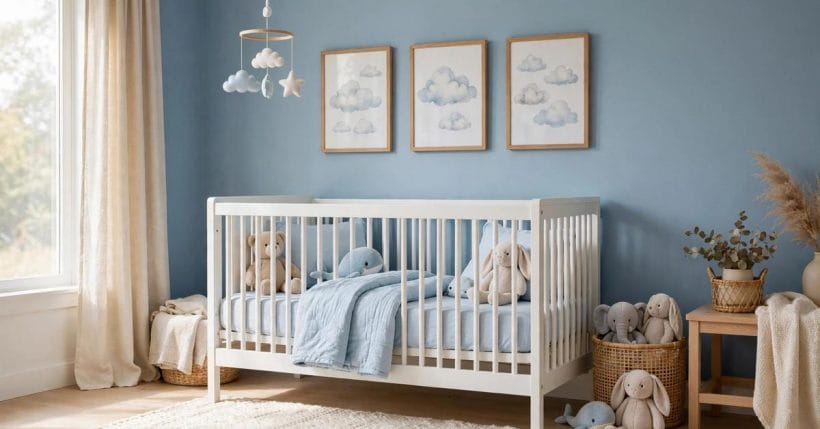
A boy’s nursery has one job in its first year: be calm at 3 a.m. Everything else — the soft blues, the baskets, the little wooden toys — is in service of a room where a baby sleeps, a parent can find things one-handed, and nothing needs to be beautiful at the expense of being easy.
These 75 ideas cover layouts, colours, costs and practical details in that spirit: storage that keeps up, corners for feeding and play, walls that carry the theme so the furniture does not have to, and a room planned from the start to grow past the baby stage.
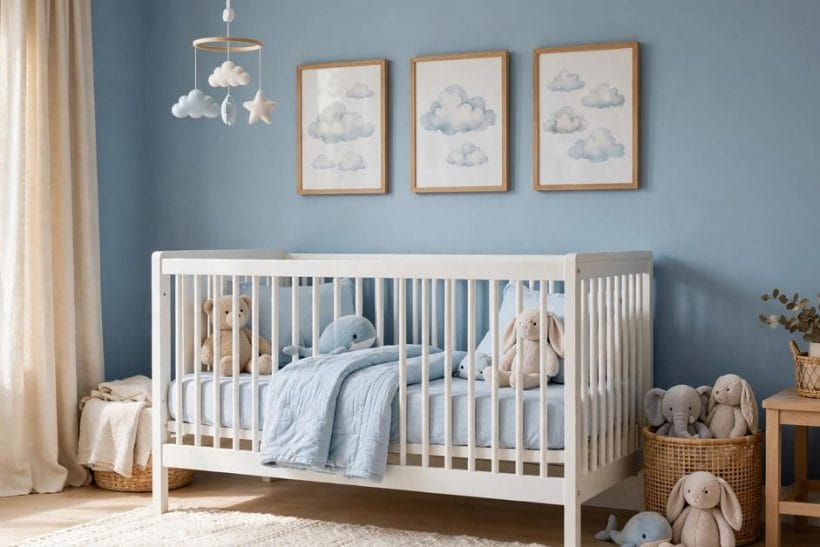
1. Boy Nursery Ideas at a Glance
Scope first. This post owns the boy’s nursery as a designed room. Its closest relative is the tiny house nursery ideas in the small-space series — same furniture, tighter footprint — while everything here assumes an ordinary room and an ordinary, happy level of chaos arriving in it.
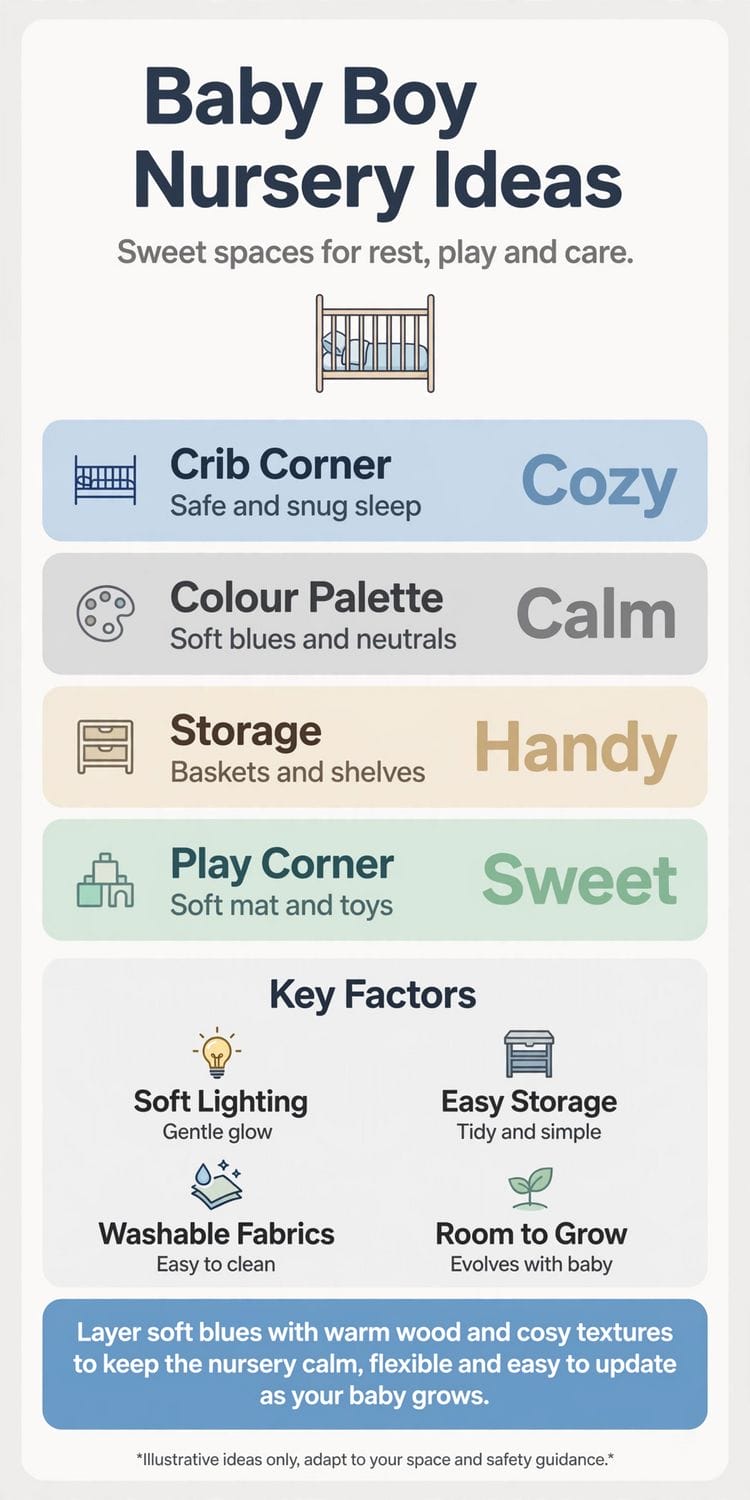
The four elements in the table, which mirror this post’s infographic, organise the seventy-five ideas that follow. Safety appears throughout in general terms only: a bare, firm sleep space, everything anchored and checked, and current official guidance followed — no product claims anywhere.
| Element | Character | What it means |
|---|---|---|
| Crib Corner | Cozy | Safe and snug sleep at the room’s calm centre |
| Colour Palette | Calm | Soft blues and neutrals that forgive and adapt |
| Storage | Handy | Baskets and shelves within one-handed reach |
| Play Corner | Sweet | A soft mat and toys on the floor from the start |
2. Storage First: Shelves, Baskets and Cubes
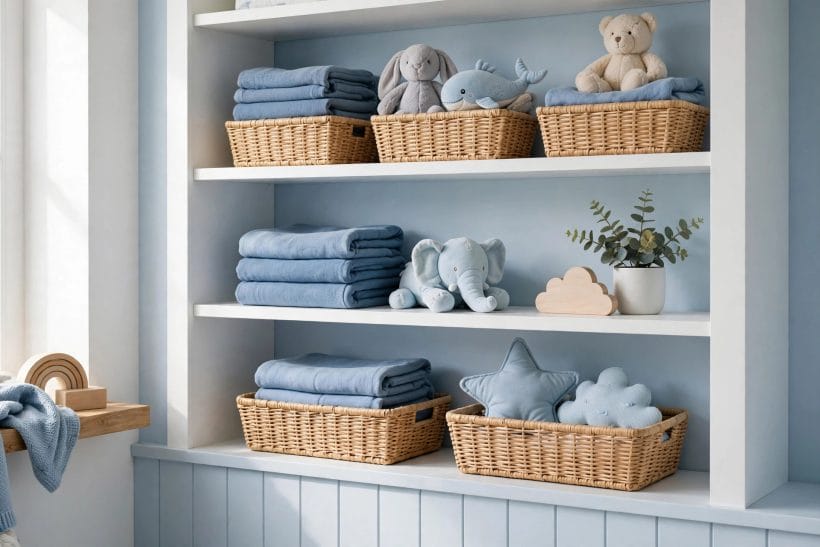
1. Built-in shelves at changing height
Shelves you can reach from the changing spot, stocked with the daily rotation, end the one-handed rummage. The nursery in the photograph runs them floor to ceiling and lets baskets do the tidying.
2. Wicker baskets as the unit of storage
One basket per category — clothes, blankets, toys, laundry — means anyone can tidy the room in two minutes without learning a system. Baskets also soften a room full of rectangles. The same shelf run doubles as the room’s gallery ledge in time — the fixings that hold baskets now will hold picture books at standing height within a couple of years.
3. Folded linens in open view
Keeping spare sheets and blankets folded on open shelves means the 3 a.m. change happens by touch. Reserve closed storage for the things a crawling baby should not reach first. A lidded basket at the end of the shelf row hides the necessary clutter — wipes, creams and spares — in plain sight and perfectly good order.
4. Cube storage that becomes toy storage
Low cubes holding fabric boxes now will hold toys, then books, then school things. It is the single most future-proof purchase in the room — the thinking behind spare room walk-in closet storage, scaled down to knee height.
5. A shelf for the soft-toy overflow
Plush toys arrive as gifts faster than any plan allows. One designated shelf or basket keeps them a collection instead of a tide across the floor and, importantly, out of the crib. A small washable rug under the baskets gives knees somewhere kind to land during the hundred small rescues of dropped dummies, socks and teethers.
6. Labels only adults need
Small tags on baskets — sizes on the clothing ones especially — save the daily guessing as babies outgrow clothes at unreasonable speed. Nobody else will ever see them; you will bless them weekly.
7. A closed cupboard for the unglamorous
Medicines, creams, batteries and the thermometer live behind a closed door or a high latch, stated plainly. A nursery is a room a toddler will eventually explore alone for thirty unsupervised seconds.
8. Wall hooks at two heights
Hooks low for the everyday blanket and bag, high for things that hang to dry or air. As the room grows, the low hooks become the child’s own — dressing independence in furniture form. When the cotbed arrives, the same corner takes it without a single new hole drilled in the wall — that is the test of a well-planned first layout.
9. Leave one shelf empty
The discipline nobody follows and everybody needs: one empty shelf, kept empty, for the thing that has not arrived yet. Nurseries fill; planned emptiness is what stops them bursting.
3. A Nautical Corner in Blues
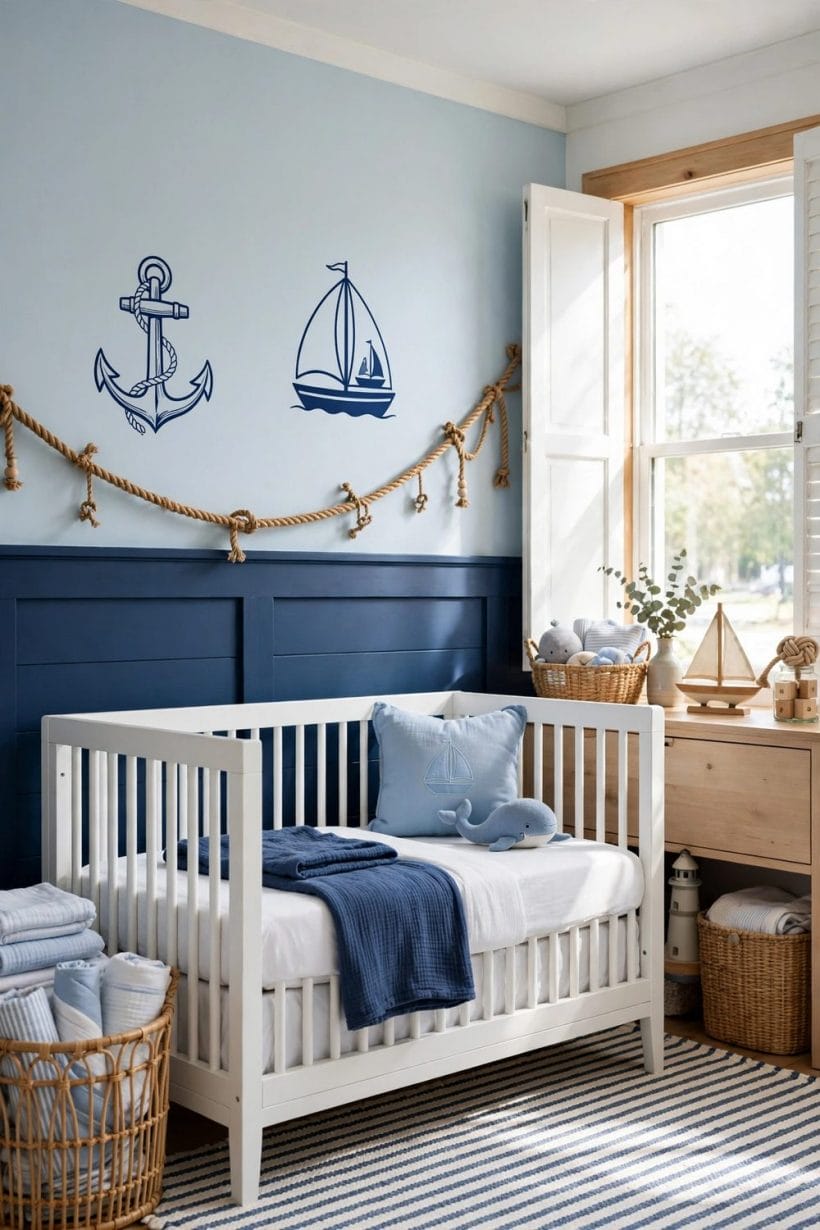
10. Navy wainscot, pale walls above
The pin’s room splits the wall — deep navy below, soft blue above — which grounds the crib and hides scuffs at pushchair height. Two-tone walls are the cheapest architecture a nursery can have.
11. Anchor and sailboat decals
Wall decals carry the whole nautical theme for the price of a pizza, and peel away when the theme retires. That reversibility is the correct way to theme a room you do not yet know the occupant of. Themed rooms work hardest when the theme stays in the textiles: a navy blanket is a season, while a painted wave is a commitment.
12. A rope-trimmed garland
A simple rope swag with small flags or stars gives the wall a handmade line at picture height. Keep every decoration fixed firmly and well out of the crib’s reach, as a matter of course.
13. Striped rug under the crib
A flat-weave striped rug in navy and white anchors the sleep zone and tolerates the washing regime of the first year. Choose washable, always — the rug will be tested.
14. A model boat on the dresser
One three-dimensional piece — a small wooden boat — does more for a theme than twenty prints. It also becomes, in time, the toy that was always there, which is how heirlooms start. The rocker’s glide matters more than its looks at three in the morning; test the motion in the shop with the patience the night will demand of you.
15. White crib against the dark wall
The white crib reads crisp and calm against deep blue panelling, and white is the finish most likely to be handed on or repainted. Contrast is doing the decorating here, not accessories.
16. Brass and rope accents
Warm metal catches and natural rope textures stop a blue room feeling cold. A lamp base, a basket handle, a frame — three touches are enough; the sea does not need a gift shop.
17. Keep the theme in two zones
Confine nautical pieces to the crib wall and one shelf, leaving the rest of the room neutral. Zoned themes can be half-removed later without redecorating — future you sends thanks. Books at this age are chewed as much as read, so board books in a low basket survive the scholarship better than shelves of paperbacks ever will.
18. Blue in layers, never one blue
Navy, mid blue, powder and grey-blue in one room read rich rather than matchy. Layering blues is the difference between a designed palette and a paint-chart accident.
4. The Rocking and Reading Corner
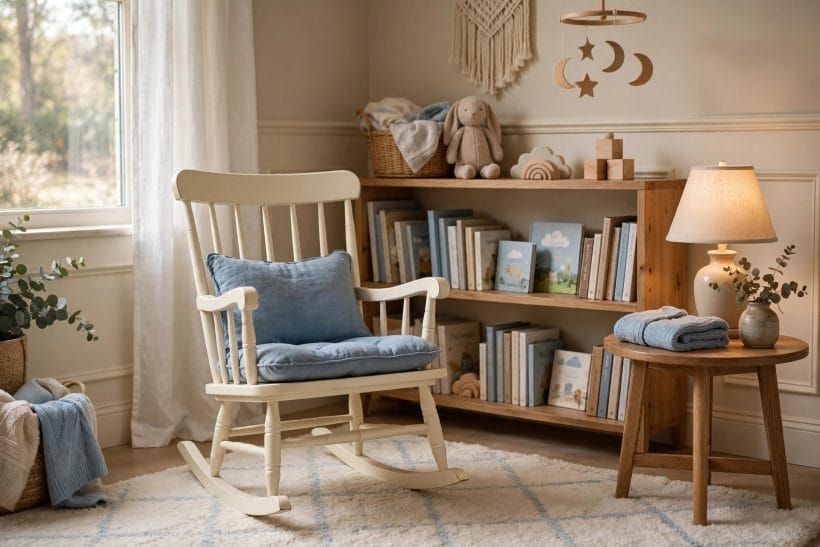
19. A rocking chair with real arms
Feeding and settling happen here for hours a day; arms at the right height are the difference between comfort and a numb shoulder. Test chairs sitting down, holding something the weight of a baby. Keep two full changes of bedding within reach of the cot; the night a complete change is needed is never the night for a trip to the airing cupboard.
20. A low bookcase within reach
Books at chair-arm height mean stories without standing up mid-cuddle. The low case later becomes the toddler’s own library, chosen by pulling books out — exactly as it should be. A small lidded bin within arm’s reach of the changing mat is the least glamorous and most appreciated object in the entire room.
21. A side table for the essentials
Water, a cloth, the book, the phone: the side table is mission control for night feeds. A small lamp on it, warm and dimmable, lights the corner without waking the room — and where naps need daytime darkness, double curtains without a double rod solve the blackout elegantly.
22. A cushion in the room’s blue
One firm cushion in the palette ties the corner to the crib wall and props an elbow at the correct angle. Small, washable, replaceable — the working definition of nursery soft furnishings.
23. Rug under the rockers
A rug quiets the rocker’s rhythm on hard floors and marks the corner as a place. Flat weave again, so the chair glides instead of gripping. Blackout lining behind the curtains is the quiet hero of every nap that outlasts the morning — plan the two layers together, not separately.
24. Wall space for first pictures
Leave the wall by the chair for the prints and photographs that accumulate across the first year. A corner designed to receive memories beats a corner finished and frozen in pregnancy.
25. A basket for tonight’s books
Two or three books in rotation, in a basket by the chair, rather than the whole library in play at bedtime. Rotation keeps stories fresh and the floor visible.
26. Position for the morning light
If the room allows, angle the corner toward the window: day feeds and stories get the good light, and the chair becomes the room’s favourite seat long after the baby stage. Paint the patch of ceiling above the mobile the palest tint of the wall colour and the hanging shapes will read against a sky instead of a ceiling.
27. A throw over the chair back
For the parent, at 4 a.m., in winter. The nursery’s kindness to adults is what sustains its kindness to babies — plan the throw, the cushion and the table lamp unapologetically.
5. The Changing Station
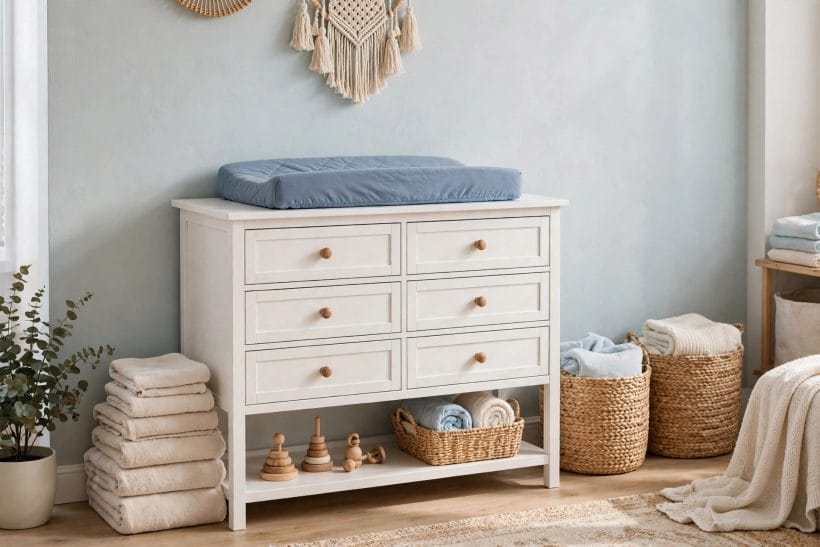
28. A dresser that becomes the changing table
A sturdy dresser with a changing top on it outperforms dedicated changing furniture: drawers at knee height now, a normal chest of drawers for the next fifteen years.
29. Everything within one arm’s reach
Nappies, wipes, creams and a change of clothes live where the changing happens, because one hand never leaves the baby. Layout here is not aesthetics — it is the safety system. If siblings arrive, this corner becomes shared territory; choose its storage tough enough for two childhoods rather than one.
30. Baskets under the changing shelf
The open shelf below holds baskets of the daily consumables, visible at a glance so restocking happens before the emergency. The photograph’s arrangement is the template: towels left, baskets right, nothing precious.
31. Folded towels stacked by the station
A stack of soft towels at the station handles baths, spills and the general weather of infancy. White or pale, washed hot, replaced without ceremony — utility as a design choice.
32. A lidded bin beside the dresser
Changing generates waste at arm’s length, so the bin lives at arm’s length too — lidded, lined, emptied often. Positioning it is a thirty-second decision with daily returns. The mat washes, or the mat leaves: at this age everything on the floor is tasted, dragged or slept on, and the play corner has to forgive all three.
33. A small lamp for night changes
Low, warm light at the station allows a full change without fully waking anyone. Overhead lights at 2 a.m. are how a household ends up awake until four. Low, soft and washable is the whole brief in this corner; anything precious lives on the shelf above, safely out of the splash and tumble zone.
34. Wall hanging above, kept soft
A fabric hanging or soft wall piece above the dresser gives a supine baby something gentle to look at — and keeps hard frames off the wall directly over the changing surface.
35. Spare clothes in the top drawer
The top drawer holds complete spare outfits for baby and one spare top for the adult. Changing stations serve two people’s dignity; plan for both. Cloud-shaped shelves at toddler eye height turn tidying into a game of parking every toy in its own sky garage at bedtime.
36. The laundry basket parked alongside
Small clothes generate small laundry constantly. A basket at the station ends the trail of garments across the landing and keeps sorting to one trip.
6. Soft Toys and the Play Corner
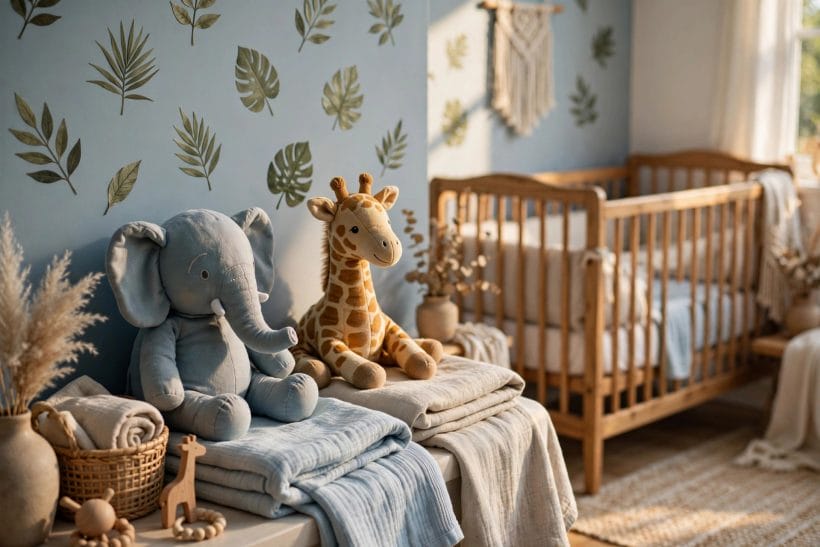
37. A soft mat as the play address
One defined mat on the floor is where play lives from the first tummy time onward. The room’s other zones stay calmer because this one has a job.
38. Two oversized soft toys, no more
A giant elephant and giraffe, as in the photograph, give the corner its cast. Two is company; twelve is storage with faces. The crib, of course, stays bare — soft toys live on the mat, never in the sleep space. Place the night light in warm tones near the door rather than the cot, and it draws the midnight parent across the room without waking its tenant.
39. Leaf decals for a gentle jungle
Soft green leaf decals above the play corner suggest a theme without committing the room to one. They pair with the woodland pieces later and peel off when tastes change.
40. Folded blankets as play props
The stack of folded blankets beside the mat becomes forts, tunnels and picnic grounds across the years. Nursery textiles that work twice earn their shelf.
41. Wooden toys on a low tray
A few wooden pieces — an animal, a vehicle, stacking rings — on a tray at floor level invite the crawling investigations to come. Heavy, simple, unbreakable, quiet on the floor. The safari palette hides a multitude of small marks along the way; mid-tone walls are the working parent’s quiet ally in this.
42. A basket that is the toy box
End-of-day tidying is one basket, carried around the room once. If putting toys away takes longer than playing did, the storage is wrong, not the child.
43. Keep the play corner off the sleep sightline
Position play where it is not the last thing seen from the crib. Rooms teach habits; a calm view at sleep time is a habit worth teaching early.
44. Texture within reach
Woven baskets, a knitted throw, a nubby rug: babies read the world by hand long before by eye. The play corner is where the room’s textures concentrate on purpose. Leave one stretch of wall deliberately plain: nurseries grow busier entirely by themselves, and the eye needs somewhere to rest by month three.
45. Floor space left genuinely empty
Resist filling the middle. Crawling, then cruising, then toddling need a runway, and an empty centre is what makes every other corner in the room usable.
7. Clouds, Stars and Wall Decor
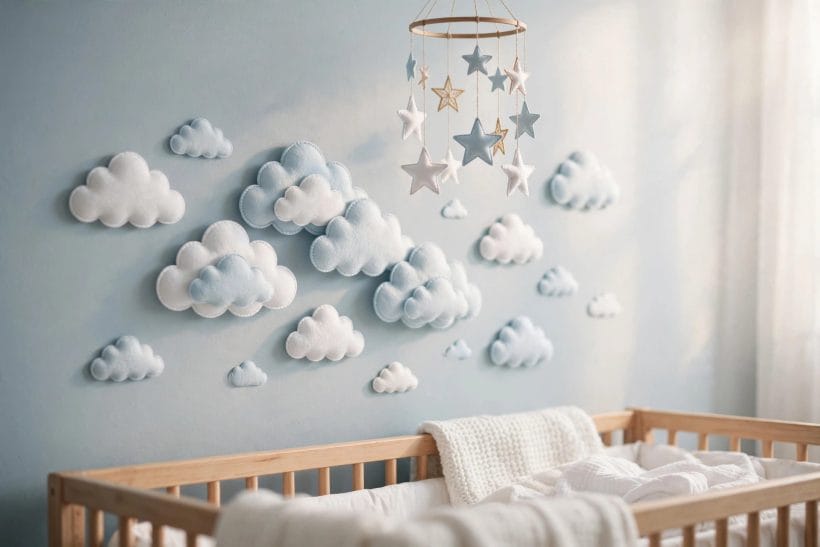
46. Soft cloud shapes across the crib wall
Padded cloud forms scattered like the photograph’s wall give the sleep zone a sky. Arranged rising from the crib, they draw the eye up and make low ceilings feel taller.
47. A star mobile, hung with care
A slow mobile of stars and moons is the classic above-crib piece — hung securely, well out of reach, and retired the moment the baby can pull to standing, as standard guidance advises. Wainscot height set at cot-rail height now becomes dado height in the older child’s room later — measure once and benefit twice.
48. Decals before paint for renters
Everything in this section can be done in decals or removable forms, which matters in rented homes. A nursery does not need a landlord’s permission to be lovely.
49. One wall decorated, three walls calm
The decorated wall carries the room; the other three stay quiet in the palette’s palest tone. Babies, like adults, rest better in rooms that are not shouting from every side.
50. Name letters, if you must, in wood
Simple wooden letters in a natural finish age better than any novelty font. Place them on the dresser wall rather than over the crib, and fix them like you mean it. Match the nursery’s palette to the hallway’s and the room stops being a themed island, becoming instead the house’s youngest room.
51. Framed prints at adult eye height
The prints are for the parents, who spend the night hours awake in this room. Put the art where adults look — above the dresser, beside the chair — in the room’s blues and natural wood frames.
52. A growth chart on the door frame
One painted or wooden growth chart becomes the room’s longest-serving decoration. Start it at the first birthday and it will outlast every other idea on this list.
53. Bunting for the window wall
A simple fabric bunting softens the window wall and moves gently in the airing breeze. Keep cords and strings entirely out of the crib’s neighbourhood — softness never outranks sense. A deep window-seat cushion in the nursery palette becomes the reading throne of the five-year-old who once napped in the room beneath it.
54. Paint the ceiling a whisper of blue
The person who looks at the ceiling most is lying in the crib. The palest blue overhead completes the sky the clouds began, at the cost of one extra tin of paint.
8. A Woodland Room in Greens
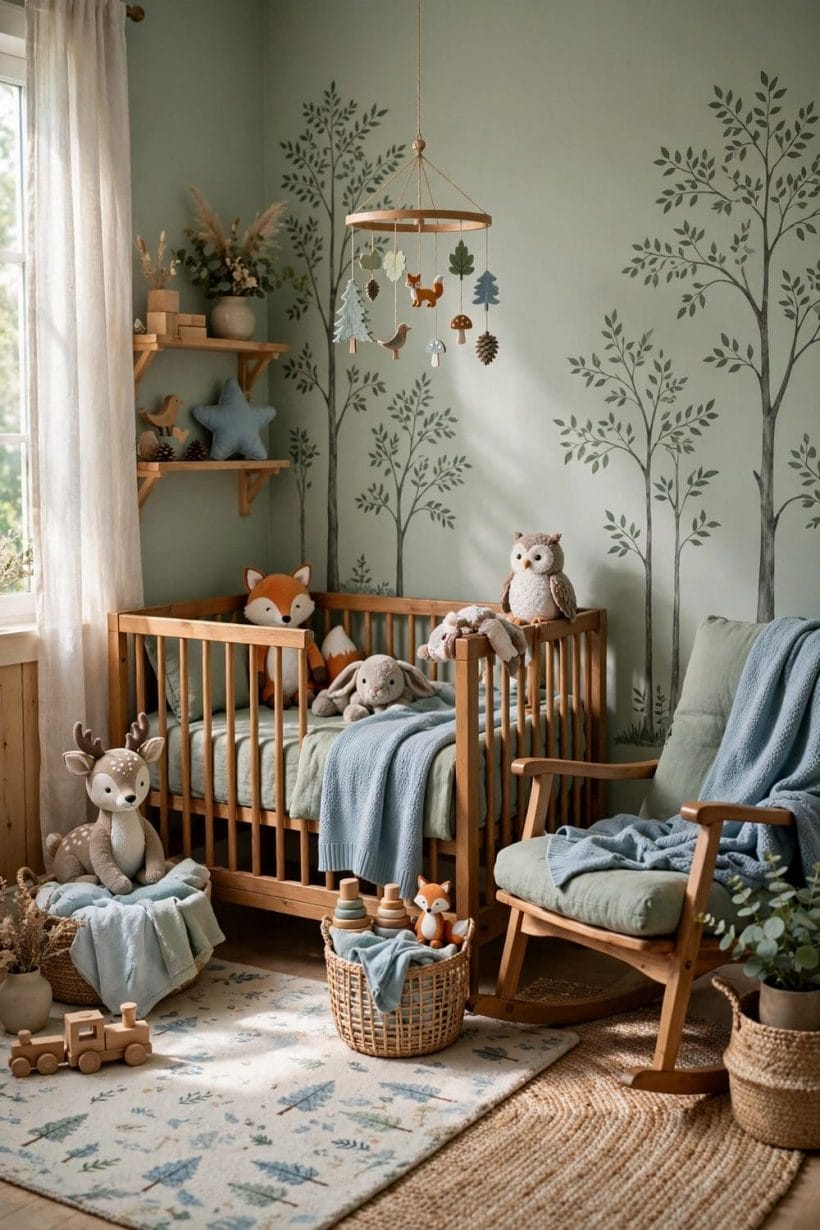
55. Tree decals on a sage wall
The pin’s woodland room swaps blue walls for sage green with slender tree decals — proof the whole nursery works in green. Woodland is the most forgiving theme for hand-me-downs of every colour.
56. A wooden crib in a warm finish
Natural wood against green walls reads as the forest floor’s furniture. Warm timber also hides the dents of the toddler years better than any painted finish. Cool blues recede and calm while warm whites beside them keep the scheme kind rather than clinical — test both under the room’s real light bulb.
57. Forest animals as the soft cast
A fox on the crib rail, an owl on the shelf, a deer by the basket: three characters carry the theme. Keep them out of the sleep space itself, arranged as the room’s welcoming committee. Test the pale blue from cot height rather than standing height; the room’s most important viewer sees it lying down, by lamplight.
58. A patterned rug like a clearing
A soft rug with a scattered leaf or animal pattern marks the room’s clearing — the play space defined by pattern rather than furniture. It also forgives the year’s small accidents gracefully.
59. Corner shelves for tiny treasures
Small floating shelves in the corner hold the pinecones, stones and first treasures that woodland children collect. Nature tables start young; give them a shelf before they colonise the windowsill. Tonal dressing — blanket, cushion and rug in three shades of the same blue — is the easiest sophistication a nursery can wear.
60. The rocking chair in green
An upholstered rocker in the wall’s green, with a blue throw to tie back to the palette, shows how one room carries two gentle schemes. Mixing the nursery’s blues and greens is a feature, not an error.
61. A mobile of forest pieces
Leaves, acorns and small animals turning slowly overhead continue the theme at crib height — with the same rule as every mobile: secure, high, and retired when standing begins.
62. Baskets of wooden toys below
At floor level the theme turns practical again: baskets of wooden vehicles and animals. A wooden train on the rug in the photograph is doing more developmental work than any flashing plastic. Keep the receipts and a note of the paint colours together in one labelled box in the wardrobe; touch-ups years later match only if the numbers survive.
63. Keep the green restful, not themed-loud
Woodland works because the greens stay sage, moss and cream. Cross into bright primary green and the room stops being a nursery and becomes a play centre — a different, louder ambition.
9. Two-Tone Walls and Soft Blue Palettes
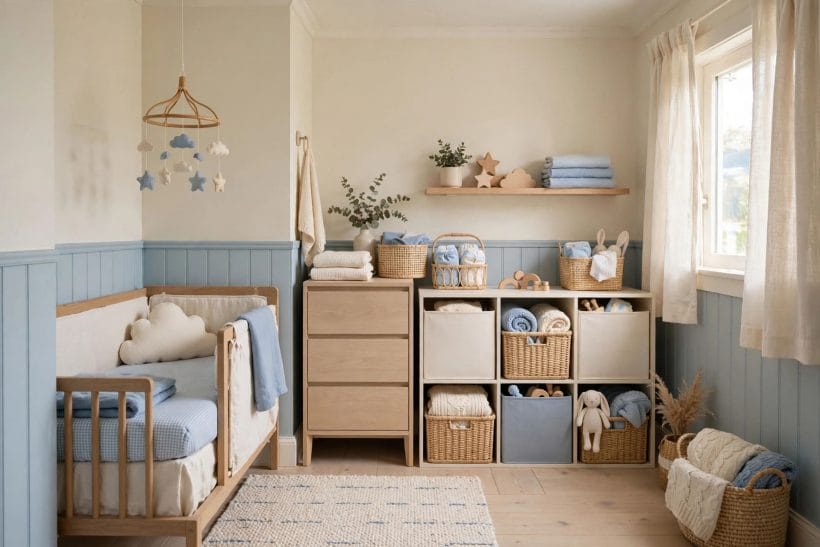
64. Wainscot in mid blue, cream above
The gallery’s room runs blue panelling to dado height with a warm cream above — the most practical nursery wall ever devised. Scuffs land on the washable half; light lives on the upper half.
65. The palette, written down
Choose four tones — deep, mid, pale, neutral — and buy nothing outside them for a year. The discipline sounds strict and feels like relief: every gift and bargain either fits or is exchanged kindly. The wallpaper’s spare roll, stored flat at the back of the wardrobe, is worth more than its price the first time furniture rearranges itself against the wall.
66. Blue-grey for a north-facing room
Cool daylight flatters blue-greys and turns bright blues chilly. Let the room’s aspect choose the blue’s temperature — the same colour logic the bedroom with purple walls ideas apply to their own strong colour.
67. Warm the blue with wood and cream
Every blue nursery in this list is warmed by natural wood, cream textiles or both. Blue alone is a swimming pool; blue with timber is a bedroom.
68. Test the colour at cot height and lamplight
Paint a board, not a wall, and view it at floor level in daylight and at night-feed lamplight. Nursery colours are judged by tired eyes at low light — test them that way. Warm light by the feeding chair, dim light by the door and darkness by the cot: three small decisions that quietly structure every night feed.
69. One stronger accent, once
A single deeper note — the navy wainscot, a denim cushion, a dark frame — gives the pale scheme its backbone. One accent, repeated nowhere, is the mark of a calm hand.
70. Paint that wipes clean
Choose a washable finish for the lower walls at least. Nursery walls meet hands, toys and substances unlisted in any catalogue; washability is the palette’s silent fifth colour. Keep the room’s technology deliberately boring: cords well out of reach, the monitor placed thoughtfully, and nothing in the cot beyond the baby and the bedding you have chosen.
71. Carry the palette into the textiles
Curtains, rug, bedding and baskets in the four chosen tones make the room coherent even on days when it is not tidy. Coherence is a property of colour, not of housekeeping.
72. Leave gender’s leftovers out of it
Soft blue survived as the boy’s colour because it is genuinely restful, not because it is compulsory. Everything here works in green, grey or cream tomorrow — the palette serves the sleep, not the stereotype. A hand-me-down carrying a family story earns its place over a new thing without one; leave a little shelf room for the family’s travelling objects.
10. Rooms That Grow With the Baby
73. A crib that converts
Cribs that convert to a toddler bed and beyond are the nursery’s best long-term value, bought once and used for years. Whatever its form, the sleep space stays bare and firm, per current official guidance — growth never trades against that.
74. Storage that changes jobs
The cube unit that held fabric boxes of sleepsuits will hold toys, then homework. This is the whole argument of tiny house with kids design, applied to one room: furniture that changes jobs never needs replacing.
75. A ceiling and walls ready for the next stage
Choose the lasting shell — palette, wainscot, a ceiling treatment like those in tray ceiling bedroom ideas — and let themes stay removable. The room that grows is the room whose bones were never babyish, only whose accessories were.
Final Considerations
A good boy’s nursery is a calm machine for sleeping, feeding and finding things in the dark, dressed in soft blues and honest storage. Build the four elements — crib corner, palette, storage, play corner — keep safety in its general, non-negotiable terms, let decals carry the theme and furniture carry the years, and the room will serve from the first night home to the first day of school with nothing but small, happy adjustments.


0 Comments