

Yes — you can buy a tiny house. Tiny houses are sold every day in the United States: brand new from professional builders, used from private sellers, as partly finished shells, and as kits and plans for people who want to build their own. There is no special license you need before you buy one.
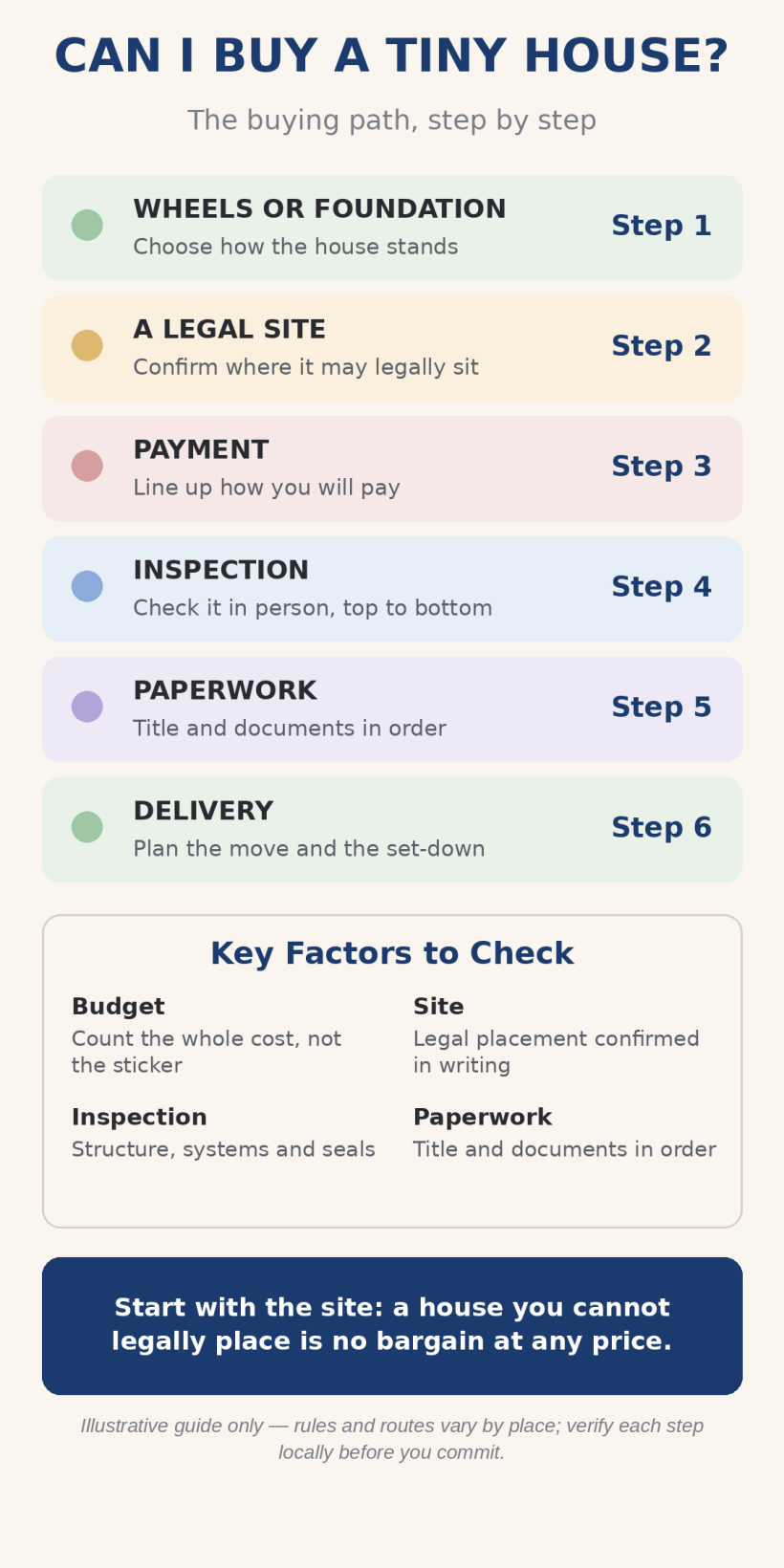
Before the process starts — before shortlists, tours, and contracts — a purchase has to pass five gates. Can a tiny house legally stand where you plan to put it? Does the kind of house you want open the financing, insurance, and siting routes you need, or close them? Can you fund the whole project, not just the asking price? Do you have land, or a lawful place, to put it on? And can the seller legally transfer this house to you, with clean paperwork? A “no” at any gate does not end the dream, but it changes the plan — a different house type, a different place, a different route to the money, or a different seller. This guide works through each gate in turn, so you find out which ones you pass before money changes hands. For the buying process itself — budgeting, touring, inspection, contract, and delivery, in order — see the step-by-step buying guide, and for where to buy, see the channels guide.
1. First Gate: What Kind of House You Are Buying — and Why It Decides Everything Else
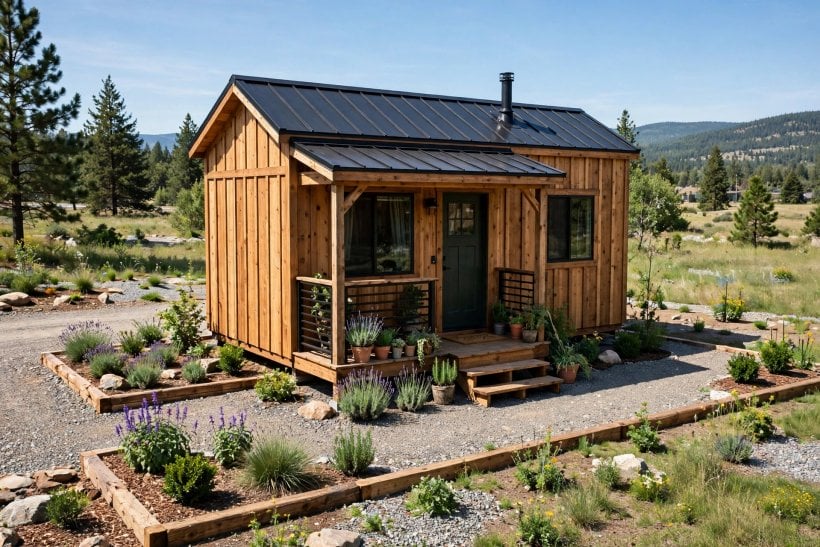
A tiny house is not one single kind of product, and the kind you buy decides most of what follows. The first fork in the road is wheels versus foundation. A house on wheels is built on a trailer chassis and can be towed away; in the eyes of many lenders, insurers, and officials, it is treated much more like a recreational vehicle than a house. A house on a permanent foundation is fixed to the land, built and inspected like a small conventional home, and treated that way by the systems around it.
That distinction follows the house through its whole life: it affects which loans are available, which insurance will cover it, which local rules govern where it can stand, and what paperwork you receive — a vehicle-style title in some cases, a property deed in others. Wheels suit people who expect to move; a foundation suits people who own their land and plan to stay.
So ask every seller the same opening questions: Is this house on wheels or a foundation? What standard, if any, was it built and certified to? What paperwork comes with it? The answers sort the market quickly — and they are the same answers lenders and officials will want later.
That is why classification is the first eligibility gate, not a detail to sort out later. A house whose type, standard, or certification does not match what your lender requires, what your insurer will cover, or what your locality allows is a purchase that stalls at the next gate — however much you like the house itself. Settle the type and its paperwork first, and every gate after it gets easier to answer.
2. Second Gate: Are You Eligible to Buy This Way?
Each route to owning a tiny house carries its own eligibility questions, and the route you want has to be open to you — not just attractive. A builder purchase asks whether you can enter a build contract on terms you can meet: a specification agreed in writing, a payment schedule you can fund through the build, and a builder who can document the standard the house is built to. If any of those is missing, the builder route is not yet open, whatever the model home looked like.
A used purchase asks a different set of questions, and they are all about standing: is the seller the person named on the documents, is the title clean, does the paperwork match the house in front of you, and is there an outstanding loan attached to it? A private sale usually carries no builder warranty, so your protection is the paperwork and the inspection — if the paperwork does not stand up, the purchase does not either, however good the price. The channels guide compares builders, marketplaces, dealers, and the used market in full; this section asks only whether the route you have chosen is one you can actually complete.
A shell, kit, or self-build asks the hardest eligibility questions of all, because you are creating the house rather than buying a finished one. An uncertified self-build can be harder to insure, harder to finance, and harder to resell later — three gates that close after the work is done, not before. If you go this way, answer those three questions first, in writing from an insurer and a lender if you can, before you buy materials. The time, tools, and learning curve matter too, but they are questions of capacity; insurability, financeability, and resale are questions of eligibility, and they decide whether the route is open at all.
Whichever route you are considering, ask it the same way: what has to be true for this purchase to complete, and can I show it? If the answer to any part is “I don’t know yet,” that is the next thing to find out — not a reason to push ahead and hope.
3. The Permission Gate: Can a Tiny House Legally Stand Where You Plan to Put It?
The single most common buying mistake is purchasing a tiny house with nowhere legal to put it. The right to live in one full-time is granted place by place — by the state rules that frame the question and by the county or city rules that decide it on your parcel. Some areas welcome tiny houses, including as backyard accessory dwellings. Others allow them only in particular zones, only on foundations, only in approved parks or communities, or only as temporary dwellings. Private restrictions, such as neighborhood covenants, can add another layer on top.
Start with the broad picture in our guide to tiny house laws by state, then go local, because local is what counts. Our advice on zoning laws for tiny houses explains how to approach the officials who enforce the rules and what to ask about a specific address before money changes hands: Can a tiny house be a full-time residence here? Must it be on a foundation? What permits and connections are required? Confirm the answers with the county or city, and keep them in writing where you can.
If you do not already have land, the search for a place is part of the purchase. Options include buying a small parcel, renting a lot, placing the house in a tiny house community or a park that allows long stays, or siting it on a family member’s property where the rules allow. Our guide to where to buy tiny house lots covers where such lots are found and what to check. Wherever you land, confirm the practical essentials too: road access for delivery, water, power, and a lawful way to handle waste.
Permission is a gate with three possible answers, and only the first lets you proceed as planned. The first is yes, in writing, for a full-time residence at your address. The second is yes, with conditions — only on a foundation, only in an approved park or community, only as a temporary dwelling, or only as an accessory dwelling behind an existing home. Conditions are not a refusal, but they narrow the house you can buy: a home on wheels does not satisfy a foundation-only condition, and a temporary permission does not support a permanent home. The third answer is no, or no clear answer at all. An unclear answer is not a yes — if the officials who enforce the rules cannot confirm permission for your address, treat the gate as unpassed and keep asking, in writing, until they can. Private restrictions can still close a gate that public rules leave open, so check covenants and community rules with the same care, and keep every confirmation you receive where you can find it again.

4. The Budget Gate: Can You Fund the Whole Project, Not Just the House?
Cost is an eligibility gate, not just a budgeting exercise: a purchase you can fund through the asking price but not through delivery, siting, connections, permits, insurance, and the land itself is a purchase you cannot yet complete. The full breakdown of how the price is built up lives in the cost guide — read it before you set your ceiling, and set the ceiling on the whole project.
The working rule: budget the whole project, not the house — the house, the place, the setup, and a reserve for surprises. A buyer stretched by the asking price alone has no room for the costs that arrive immediately after it.
5. The Qualification Gate: Can You Finance This House, by This Route?
Cash is the simplest route, and it removes one gate entirely: a cash purchase involves no lender, no approval to wait for, and no interest. The discipline is the same as in the budget gate — hold back a reserve rather than spending every saved dollar on the house, because delivery and setup costs follow immediately behind. Where no borrowing is involved, credit does not enter the question at all.
Where borrowing is involved, three things decide together whether a route is open to you: the house, its certification, and your credit. Many tiny houses — particularly those on wheels — are not treated as conventional real estate, so the routes commonly considered are recreational vehicle loans for certified houses on wheels, personal loans, builder-arranged financing, or, for foundation houses, more house-like lending where it is available. Which of those is open depends on the house type, whether it carries the certification that route requires, and what the lender asks of you. The financing guide walks through every loan type and what lenders generally look for — read it before you fall for a house, because a house whose type does not match any route open to you is a house you cannot yet buy.
Weaker credit does not close every route, but it narrows them: fewer lenders, more documentation, and less favourable terms are the usual shape of it. Improving your position and saving a larger share of the price both help, and any specific promise about approval should be checked directly with the lender, not taken from a seller or a listing. The honest test is the same as for every gate in this post: can you show, before you commit, that the money route you are counting on is actually open for this house, for you?

6. The Standing Gate, Part One: Can This Seller Be Checked?
Vetting is a process, and the step-by-step buying guide covers it in full — track record, references, finished examples, contract terms for a builder; story, history, documents, and evasiveness as an answer for a private seller. As an eligibility question it reduces to one test: can this seller be checked before you commit? A builder with completed houses, past buyers willing to talk, and a written contract passes it. A seller who cannot show a workshop, a finished home, or a past buyer willing to talk does not — and that is a reason to keep looking, not a detail to overlook. If the seller cannot be checked, the purchase cannot be verified, and an unverifiable purchase is not yet an eligible one.
7. The Standing Gate, Part Two: Does the House Itself Pass?
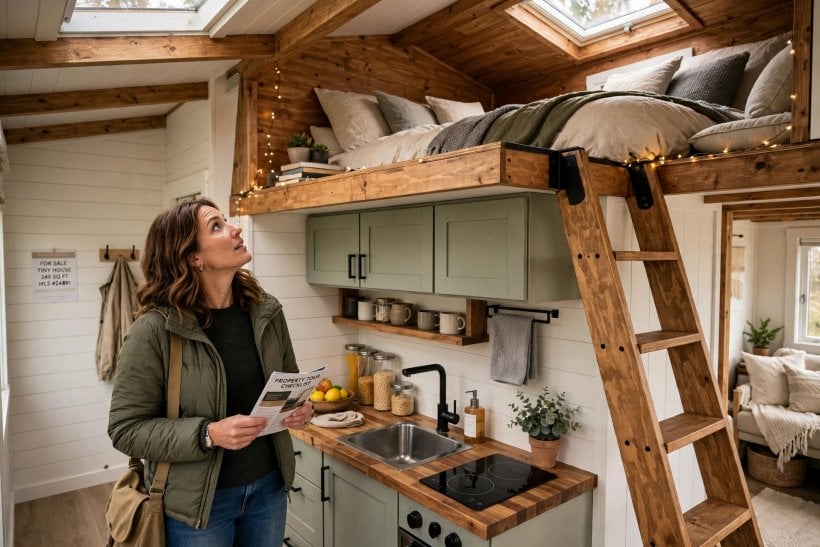
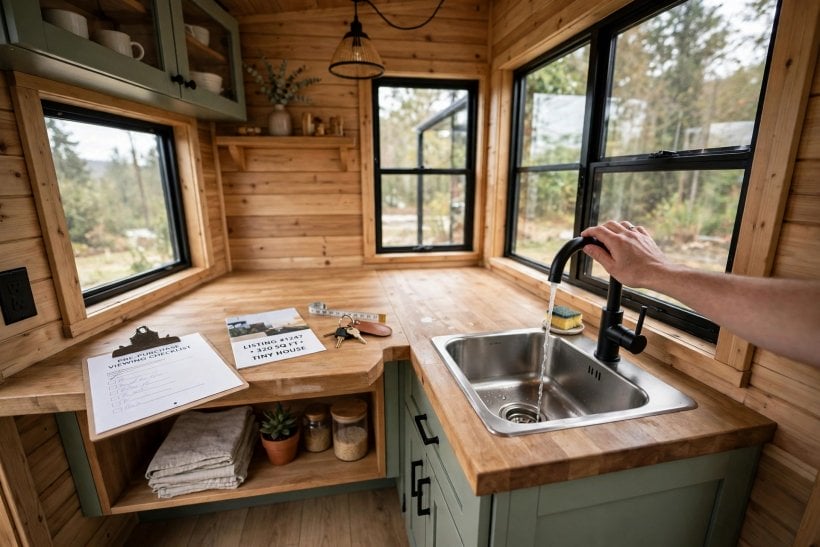
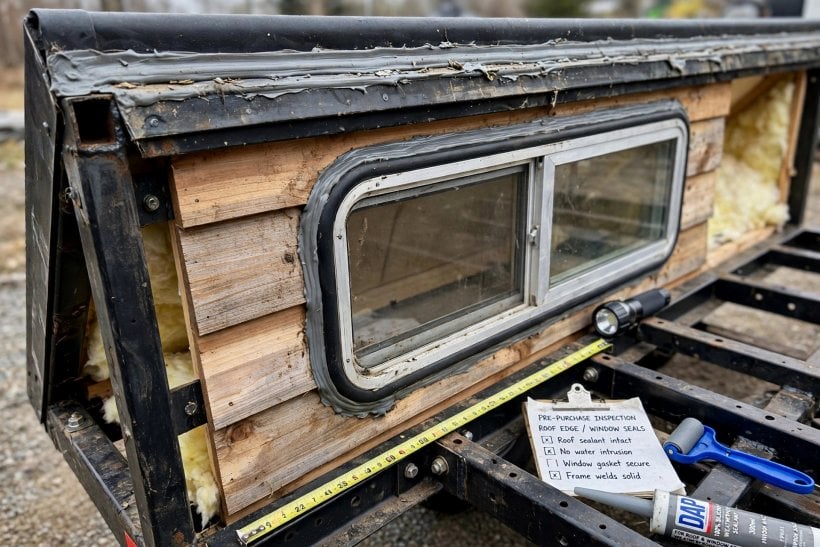
Inspection is also a process — trailer and frame, roof and seals, water, electrics, heating, appliances, condensation and ventilation — and the buying guide covers it step by step. As an eligibility question it reduces to one test of its own: does the house pass, or does it fail in a way that blocks the purchase? A failed inspection is not a disappointment to negotiate around at any price; it is a gate outcome. A house with water damage, a compromised trailer, or systems that do not work is a house whose purchase should pause until the fault is understood, priced, and either fixed or walked away from. Never let a bargain price hurry you past a check you would otherwise make.
8. The Standing Gate, Part Three: Can This Seller Legally Transfer This House to You?
Paperwork is what turns a payment into ownership, and what you should receive depends on the kind of house. A house on wheels is commonly transferred with a vehicle-style title and a bill of sale; a house fixed to land may transfer as part of a property transaction. In every case, confirm before you pay that the seller is the person named on the documents, that the paperwork matches the house in front of you, and that no outstanding loan is attached to it.
For a new build, the contract is the key document — specification, price, payment stages, delivery terms, and warranty, all in writing before the build begins. For a used purchase, a written bill of sale recording the parties, the house, the price, and the date protects both sides. Keep the build documentation, certification papers, manuals, and receipts: they matter again when you insure the house, repair it, and eventually sell it. Resolve anything missing or unclear before the purchase, while you can still walk away.
Transfer standing is the gate where purchases quietly fail. A seller who is not the person named on the documents, paperwork that does not match the house in front of you, or an outstanding loan attached to the house each block the transfer, whatever the price and however good the house. Resolve anything missing or unclear before the purchase — that is the last moment you can still walk away at no cost but time, and it is the moment this gate exists for.
9. The Last Gate: Can the House Reach the Site and Be Set Up There?
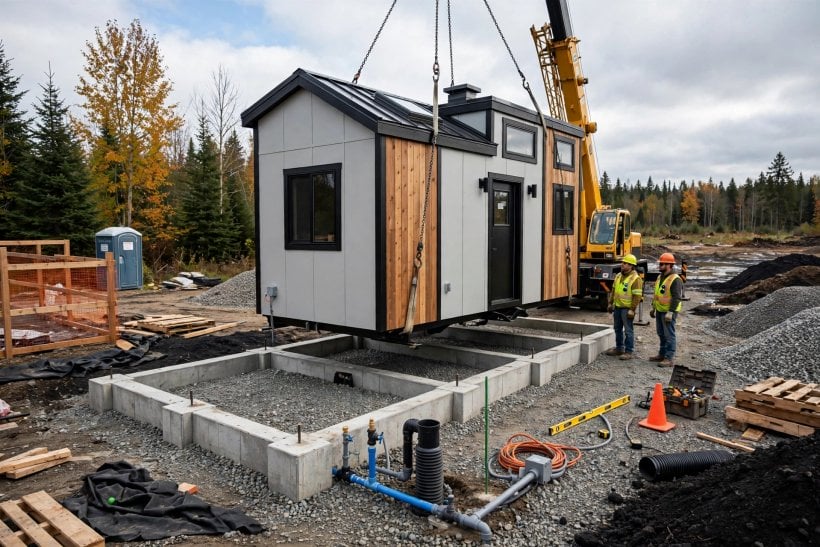
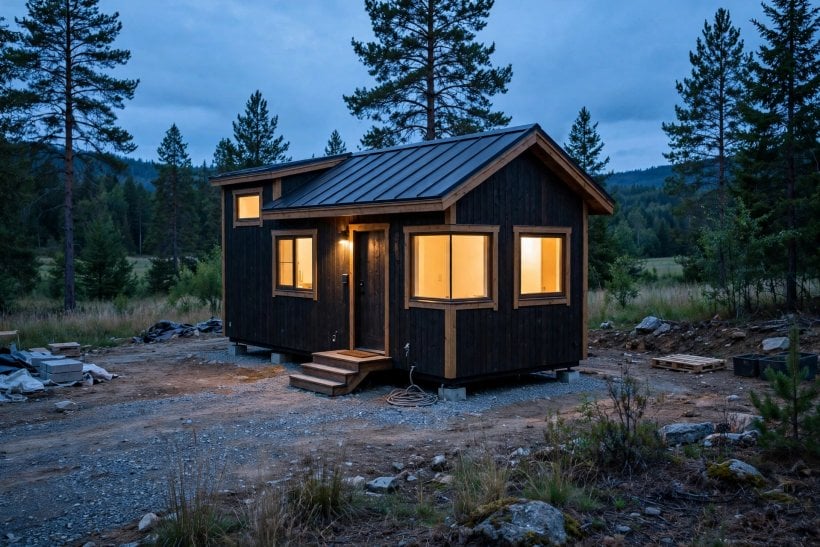
Delivery and siting are a process — route, towing, levelling, connections, steps, skirting, anchoring — and the buying guide and the land-preparation guide cover them in full. As an eligibility question they reduce to access and readiness: can a tall, heavy load reach your site, can the site be prepared before delivery day rather than started after it, and do the permits or escorts for an oversized move apply? A site the house cannot reach, or cannot be set up on lawfully, is a gate unpassed — confirm it before delivery day, not on it.
10. The Eligibility Checklist: Answer These Before You Commit
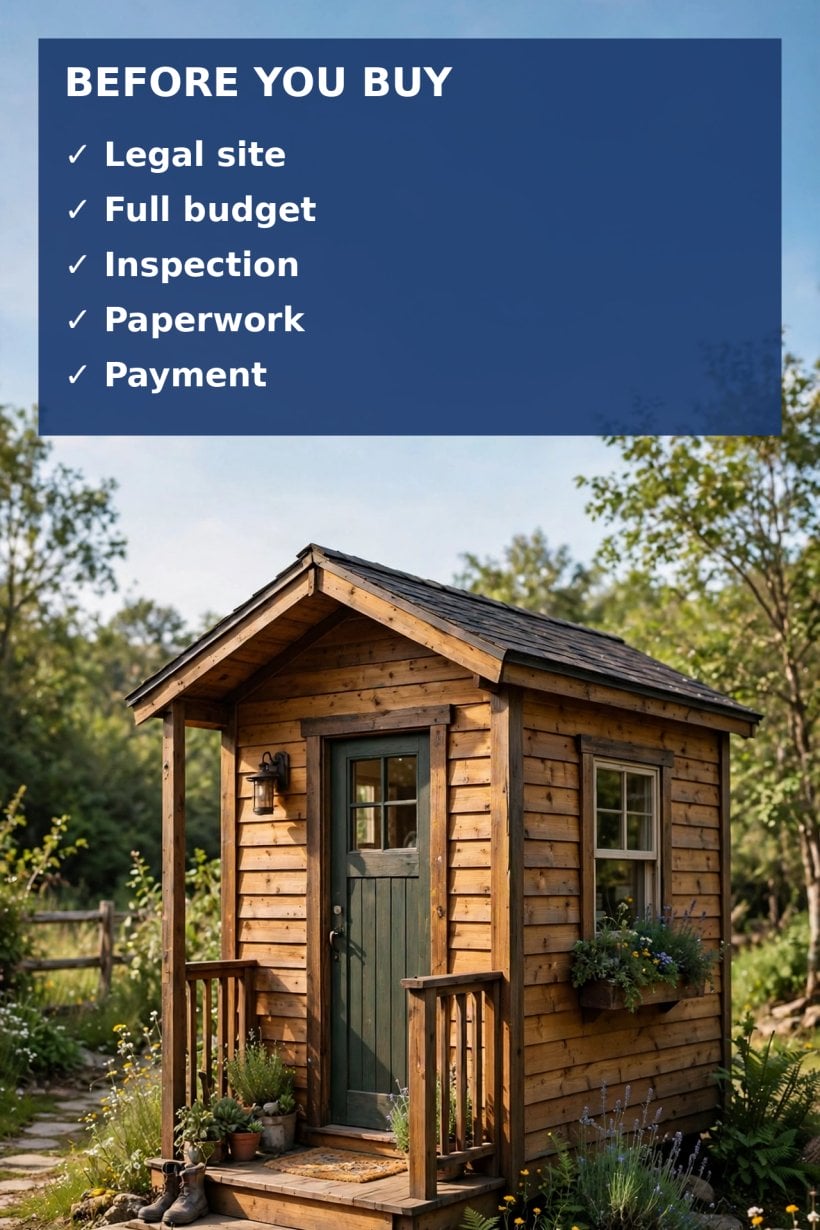
Work through the gates in order, and do not let a later gate distract you from an earlier one that is still unpassed. One, permission: can a tiny house be a full-time residence at your address, confirmed with the county or city, in writing? Two, classification: is this house on wheels or on a foundation, built and certified to what standard, and does that open the lender, insurer, and siting routes you need? Three, route: is the way you want to buy — builder, used, shell, kit, or self-build — one you can actually complete, with its own standing questions answered? Four, budget: can you fund the whole project — house, place, setup, and a reserve — not just the asking price? Five, qualification: is the money route you are counting on actually open for this house, for you, checked with the lender? Six, standing: can the seller be checked, does the house pass inspection, and can the seller legally transfer it to you with clean paperwork? Seven, site: can the house reach the site and be set up there lawfully?
The costly mistakes repeat so often they are worth listing plainly, and every one of them is a gate skipped: buying sight unseen; buying before confirming where the house can legally live; skipping the inspection because the house looks charming; signing nothing and paying in ways that leave no record; stretching the budget to the asking price with nothing left for delivery, siting, and setup; and rushing, as if a home were a limited-time offer. A skipped gate does not go away — it arrives later, more expensive, when walking away costs more than time.
What if one of the gates fails?
Change the plan, not the standard. A failed permission gate can mean a different place, or a different house type that the place allows. A failed financing gate can mean a different route, a larger saved share, or a smaller house. A failed standing gate means a different seller or a different house — never a weaker standard of proof. And a gate with no clear answer is an unpassed gate: keep asking, in writing, until the answer is clear.
Final Considerations
Can you buy a tiny house? Yes — if the gates pass. The buyers who end up happy treated the purchase as a set of questions to answer before they committed: a legal place confirmed with the county or city, a house type whose classification opens the routes they need, a route to ownership they can actually complete, a budget covering the place and setup as well as the house, money they can show is open for this house, a seller who can be checked, a house that passes inspection, and clean paperwork that transfers it to them. Answer those first, and what remains is the process itself — and choosing the house, and taking the keys.
Note: prices, availability, and regulations change — verify current details with sellers, lenders, and local officials before you buy. This guide is general information, not financial or legal advice.



0 Comments