

Where can you buy a tiny house? The market has matured from a handful of builders to a full ecosystem: specialized builders, national marketplaces, dealers, and even mainstream retailers. But “tiny house” covers several very different products — a THOW, a foundation tiny home, a park model — and where you buy depends on which one you want. This guide maps every legitimate buying path.
The first decision isn’t where to buy, but what to buy. A tiny house on wheels (THOW) is mobile personal property; a foundation tiny home is real estate; a park model sits in between. Each has different sellers, different financing, and different legal implications. If you haven’t settled the type yet, read what a tiny house actually is first — it will save you from shopping in the wrong market.
This guide stays on one question: where to buy, channel by channel. It compares builders, marketplaces, dealers, and the used market, and shows what to check in each one before money changes hands. For the buying process itself — budgeting, touring, inspection, contract, and delivery, in order — see the step-by-step buying guide.
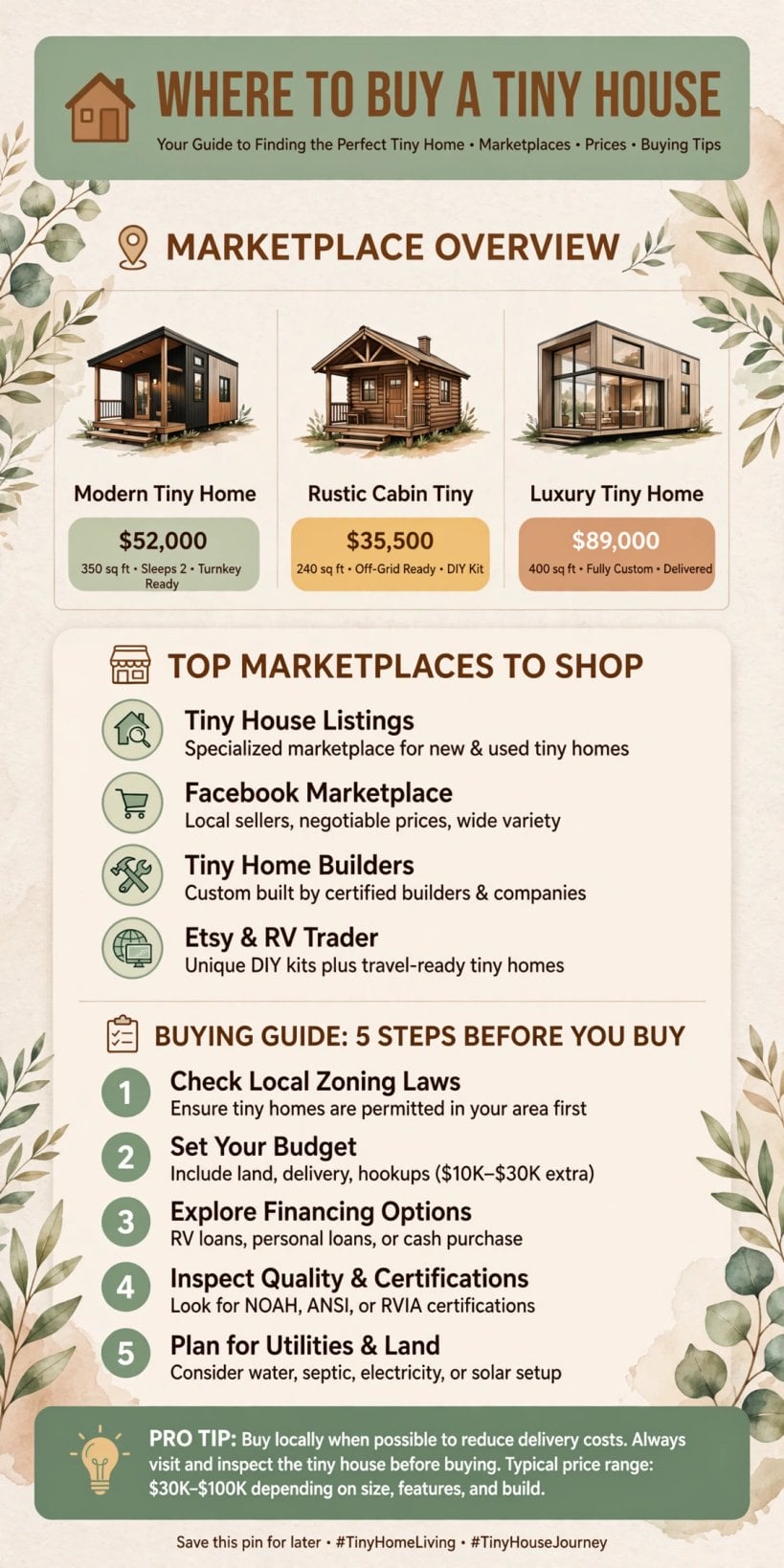
Buying from Specialized Tiny House Builders
Buying from an established builder who constructs tiny houses full-time is the most supported path, and the one most first-time buyers start with. A builder typically offers a written warranty, handles code compliance for the build, and has a track record you can check before you commit. What you pay depends on size, specification, and whether the home is on wheels or on a foundation, so compare finished specifications rather than headline prices — two homes at similar prices can differ widely in what is included.
What separates a sound builder from a risky one is checkable before you sign anything: a physical workshop you can visit, completed homes you can see or speak to owners about, named references from past buyers, and a written warranty with clear terms. Be cautious of any builder who asks for full payment upfront — staged payments tied to build progress are the norm, and the payment schedule should be written into the contract. If a builder cannot show you a workshop, a finished home, or a past buyer willing to talk, treat that as a reason to keep looking, not a detail to overlook.
Find builders through builder directories, tiny house festivals and expos where you can walk through models, and owner communities. Owner groups are especially useful: people who already live in a builder’s home will tell you plainly how the build went, how snags were handled, and whether the builder answered the phone after handover. Ask every builder the same questions — warranty terms, build timeline in writing, what the price includes and excludes, and how changes mid-build are handled — so your comparisons are honest.
Marketplaces: New and Used Listings
Online marketplaces gather listings from many sellers in one place, and they split into four kinds worth telling apart, because the buyer protection differs in each.
Dedicated tiny house marketplaces list new and used tiny houses from builders and private sellers, filterable by price, location, size, and type. They are the best way to see the full national market at a glance and to learn what a given size and specification typically sells for. Builder-direct listings are a second kind: established builders list spec homes — pre-built and ready now — and occasionally take trade-ins. A spec home skips the wait of a custom order, but check exactly what is included, since a spec home’s specification was chosen by the builder, not by you.
General marketplaces are a third kind, and they are surprisingly active for used tiny houses, especially homes on wheels. Prices often run lower there, but so does buyer protection: there is no marketplace vetting standing behind the seller, so inspect in person and verify the title before paying anything. RV listing sites are the fourth kind: park models and some homes on wheels appear on RV classifieds, which makes them useful for comparing park models against high-end RVs, a market they compete with directly.
Whatever the marketplace, read the listing the same way: does it name the builder, give the home’s age and size, show clear photos of the structure and systems rather than styling alone, and state the title position? A listing that hides the builder, the age, or the title is a listing to question, and a seller who will not allow an in-person inspection is a seller to walk away from.
Dealers and Builders With Models on the Lot
Dealers sit between builders and marketplaces: they hold stock, often with model homes you can walk through on the lot, and they handle the sale rather than the build. The advantage is immediacy — you can see, touch, and compare finished homes in one visit, and you can usually move faster than a custom order allows. The trade-off is choice: you are choosing from what the dealer holds, not specifying a home from scratch, so check the specification carefully against your needs rather than falling for the model on display.
When you visit a dealer, treat the visit as an inspection, not a sales tour. Open every cupboard, test the stairs or ladder, stand in the loft, run the taps, and ask what the warranty covers and who honours it — the dealer or the builder. Ask whether the price includes delivery, siting, and connection, or whether those are charged separately, and get the answer in writing. A dealer who answers plainly and in writing is a good sign; a dealer who waves those questions away is not.
Dealers also suit buyers who want a guided purchase: someone to explain the options, arrange viewing, and handle paperwork. If you are confident about specifications and happy to manage the details yourself, buying direct from a builder or through a marketplace may serve you better. Neither channel is better in itself — the right one is the one that matches how much guidance you want and how much choice you need.
Buying Used: The Value Play
A used tiny house from a reputable builder is often the best value in the market — the new-construction snags are usually already found and fixed, and the price reflects that the home is no longer new. That value only holds if you inspect carefully, because a used home carries its previous owner’s maintenance history with it, good and bad.
What to check on a used tiny house, in order: water damage first — soft floors, stained ceilings, and musty smells are the signs that matter most, since water damage is the hardest problem to put right. Then the trailer: rust, tyre condition, and brakes. Then weight: have the home weighed, because owners add heavy modifications that can push a home over its trailer’s rating. Then the title: is the trailer titled, and are there any liens? Finally, ask the reason for selling — a genuine reason (a move, a growing family) reads very differently from an evasive one. If you are not experienced at inspecting, hire a certified inspector and use a used-home inspection checklist to brief them on what to examine.
Where used homes differ from new ones is recourse: a private seller offers no warranty, so your inspection is your protection. Take your time, inspect in daylight, and never let a bargain price hurry you past a check you would otherwise make.
Financing Your Purchase
How you pay shapes where you can buy: some channels and some home types only work with certain kinds of finance, and a home on wheels, a foundation home, and a park model are financed differently. Get pre-approved before you shop seriously — it tells you which channels are actually open to you and stops you falling for a home you cannot finance. The step-by-step buying guide covers lining up the money in order, and the financing guide walks through every loan type in full.
Red Flags and Scams
- Too-good-to-be-true pricing: A “luxury” 30-foot THOW for $25,000 is fraud.
- No physical presence: Legitimate builders have workshops you can visit.
- Wire transfer only: Reputable sellers accept cashier’s checks or escrow.
- Can’t inspect: Never buy without walking through in person.
Three more checks catch most of the rest. First, the seller’s story should stay consistent: if the home’s age, builder, or specification changes between the listing, the conversation, and the paperwork, stop and ask why. Second, the paperwork should exist before payment — title documents, a written contract, and a receipt for any deposit, not promises to send them later. Third, pressure is itself a red flag: a genuine seller can wait for your inspection, while a scammer needs you to decide before you check. Any one of these is a reason to pause; two together are a reason to walk away.
Matching the Channel to the House Type
The right channel depends on which kind of tiny house you are buying. A home on wheels is the most channel-flexible: builders, dealers, marketplaces, and private sellers all trade in them, so you can afford to be picky and compare across channels. A foundation tiny home narrows the field — builders and dealers dominate, and the purchase sits closer to a conventional property sale, with land and placement questions that a marketplace listing alone will not answer. A park model sits in between: dealers and RV classifieds are strong channels, and the community or park it will sit in matters as much as the home itself.
Work backwards from the home, not forwards from the channel. Settle the type first — wheels, foundation, or park model — then ask which channels genuinely trade in that type, and judge sellers only within those channels. Shopping in the wrong market wastes time and invites bad comparisons: a foundation home and a home on wheels are different products at different prices, and a channel that looks cheap for one may simply not sell the other.
If you have not settled the type yet, settle it before you shortlist sellers. The buying guide’s opening step covers deciding what you are actually buying, and it is worth doing properly — every channel comparison after it gets easier.
How to Vet Any Seller, Whatever the Channel
Every channel rewards the same five checks, and running them in the same order keeps comparisons honest. One, identity and presence: a real workshop, lot, or address you can visit, and a seller who welcomes a visit. Two, track record: past buyers you can speak to, and finished homes you can see. Three, paperwork: title, contract, and warranty terms in writing before any deposit. Four, inspection: an in-person walk-through, and a certified inspector if you are not experienced. Five, payment: staged payments tied to progress or handover, never full payment upfront and never a wire transfer to an unverifiable account.
Apply the checks in full even when the seller feels trustworthy — the checks are what make trust reasonable, not a substitute for it. And keep a shortlist of two or three sellers rather than committing to the first one that feels right: comparison is what turns a good feeling into a good decision, and it costs nothing but a little patience.
Frequently Asked Questions
Where is the best place to buy a tiny house?
For quality: an established builder. For value: a used tiny house via marketplace. For convenience: a dealer with models on lot.
Should I buy new or used?
Used wins on value if you inspect carefully, because the price reflects that the home is no longer new. New wins on customisation and warranty.
Should I buy through a dealer or direct from a builder?
Buy through a dealer when you want models to walk through, a guided purchase, and a faster move. Buy direct from a builder when you want a custom specification and are happy to manage the details yourself. Neither is better in itself — match the channel to how much guidance you want and how much choice you need.
Final Considerations
Where you buy your tiny house matters as much as what you buy. The established builder costs more but answers the phone when the roof leaks. The marketplace offers selection but demands diligence. The used market rewards careful inspectors with genuine bargains. Verify the seller, inspect the house, confirm the title, and never let excitement override due diligence.
Once you have chosen a channel, the buying process itself takes over — budgeting, touring, inspection, contract, and delivery, in order — and if you are still asking whether buying is right for you at all, the eligibility questions are answered separately.


0 Comments