

Brick alone can look uniform; stone alone can look heavy. Together, they correct each other. Brick brings the warmth, the rhythm and the craftsmanship of small repeated units; stone brings weight, texture and the feeling of a house that grew out of its own ground. The brick-and-stone combination is one of the oldest exterior recipes there is — and, handled with a little discipline, still one of the best.
This post stays with the combination itself: how to balance the two materials’ colours, where each one earns its place on the facade, and the mortar and craft details that decide whether the mix looks designed or accidental.
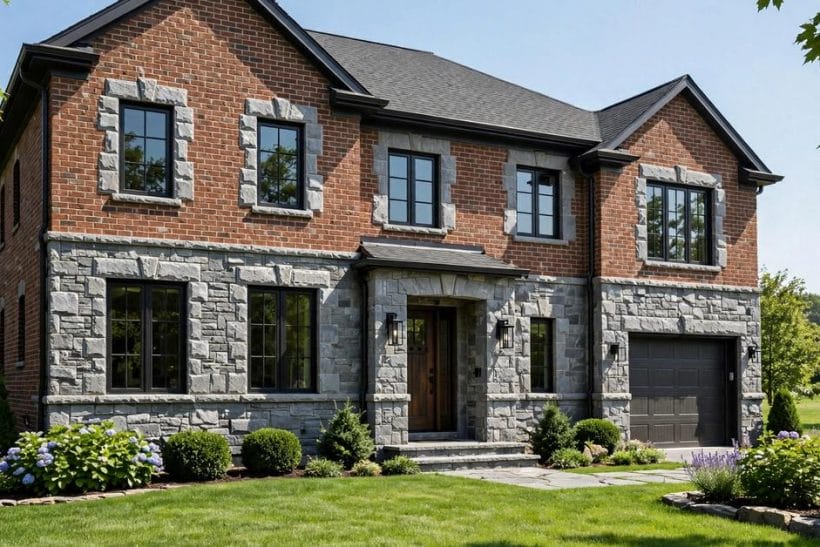
1. Brick and Stone at a Glance
Scope first. This post owns one pairing: brick and stone on the OUTSIDE of the house. The neighbouring reading lives elsewhere on the site: brick wall living room ideas for brick indoors, and interior brick: paint it or leave it for the interior paint question — the interior/exterior split is deliberate. Here, everything is the facade, and the facade is two materials at once.
One rule governs the whole post: the two materials must share something. A tone echoed between brick and stone, a mortar that serves them both, a clear decision about which material leads — a mix with a shared thread reads as architecture; a mix without one reads as leftovers.
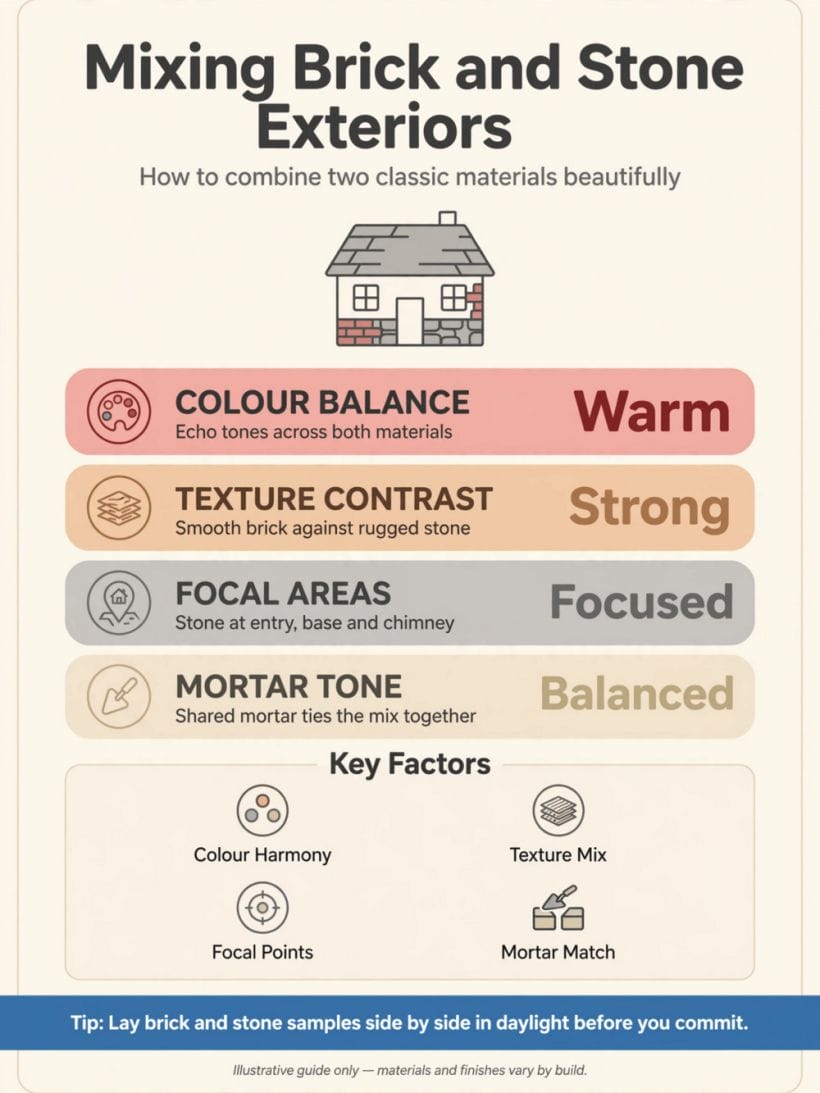
| Element | Character | What it means |
|---|---|---|
| Colour Balance | Warm | Echo tones across both materials |
| Texture Contrast | Strong | Smooth brick against rugged stone |
| Focal Areas | Focused | Stone at entry, base and chimney |
| Mortar Tone | Balanced | Shared mortar ties the mix together |
2. Why Pair Brick With Stone
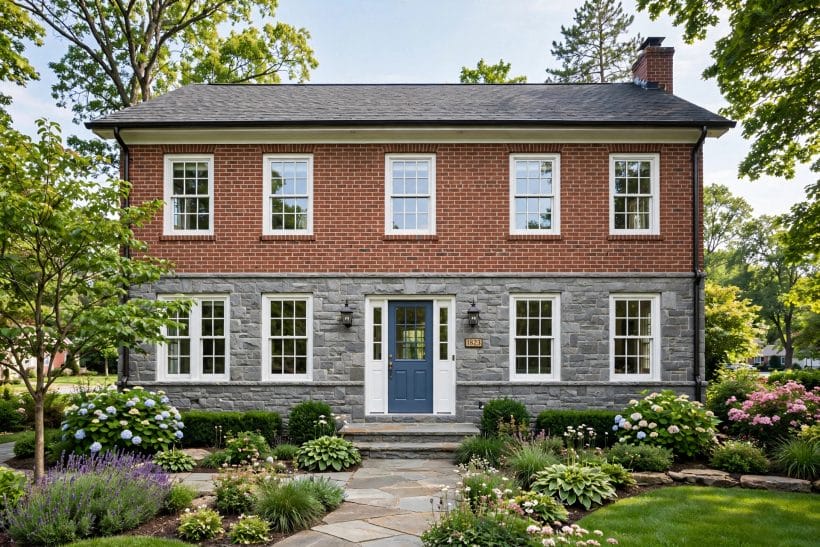
1. Each material fixes the other
A whole house of brick can flatten into wallpaper; a whole house of stone can loom. Brick’s regular courses give stone’s randomness a frame, and stone’s irregular weight gives brick’s repetition a soul. The pairing is not decoration — it is structural criticism, built in.
2. The vernacular argument
Farmhouses and cottages were built from what the land offered: stone from the fields for the base and chimney, brick from the local kiln for the walls. A brick-and-stone house still reads as belonging to its place in a way single-material houses rarely manage.
3. Warmth with weight
Brick runs warm — reds, oranges, buffs — while stone runs cool and grounded. Together the facade holds both temperatures at once, which is why the combination suits so many climates and house styles without ever looking themed.
4. A house that ages gracefully
Both materials weather by mellowing rather than failing — brick softens, stone darkens and gathers moss in the joints. A brick-and-stone exterior at thirty years old usually looks better than it did at three, which cannot be said of most cladding.
5. Value you can see
Two real masonry materials give a facade a substance that visitors register instantly, even if they could not name it. For houses competing on the same street, the mixed-masonry house is the one that photographs like the expensive one.
6. Zoning a big facade
Large houses need their facades broken into readable parts, and material change is the classic tool: stone where the house meets the ground and the guests, brick across the broad calm fields. The mix gives scale to a house that would otherwise read as one huge wall.
7. Repair and extension friendliness
A two-material house forgives additions gracefully: extend in one of the two materials, match its mortar, and the new work joins the family. Single-material perfection is far harder to continue convincingly.
8. Fire, weather and the practical case
Masonry is masonry — non-combustible, storm-calm and quiet. Beyond the looks, a brick-and-stone house is a practical object in fire country, hail country and everywhere the weather takes walls seriously. Local rules and construction details are your builder’s territory; the material case is simple.
9. The mix among other mixes
Brick and stone is the masonry member of a wider family of mixed exteriors — siding with stone, render with brick, timber with masonry. The site’s mixed siding ideas cover the siding side of the family; here, both materials are the heavy, permanent kind.
Regional traditions prove how flexible the recipe is. In limestone country the stone is pale and the brick does the warming; in millstone-grit country the stone is dark and the brick runs buff to meet it; in brick country with no building stone at all, imported stone appears only at the church-like details — quoins, lintels, the porch. Read your own street and your own geology before choosing: the best brick-and-stone houses look like they were quarried and kilned within walking distance, even when they were not.
3. Colour Balance Between the Two
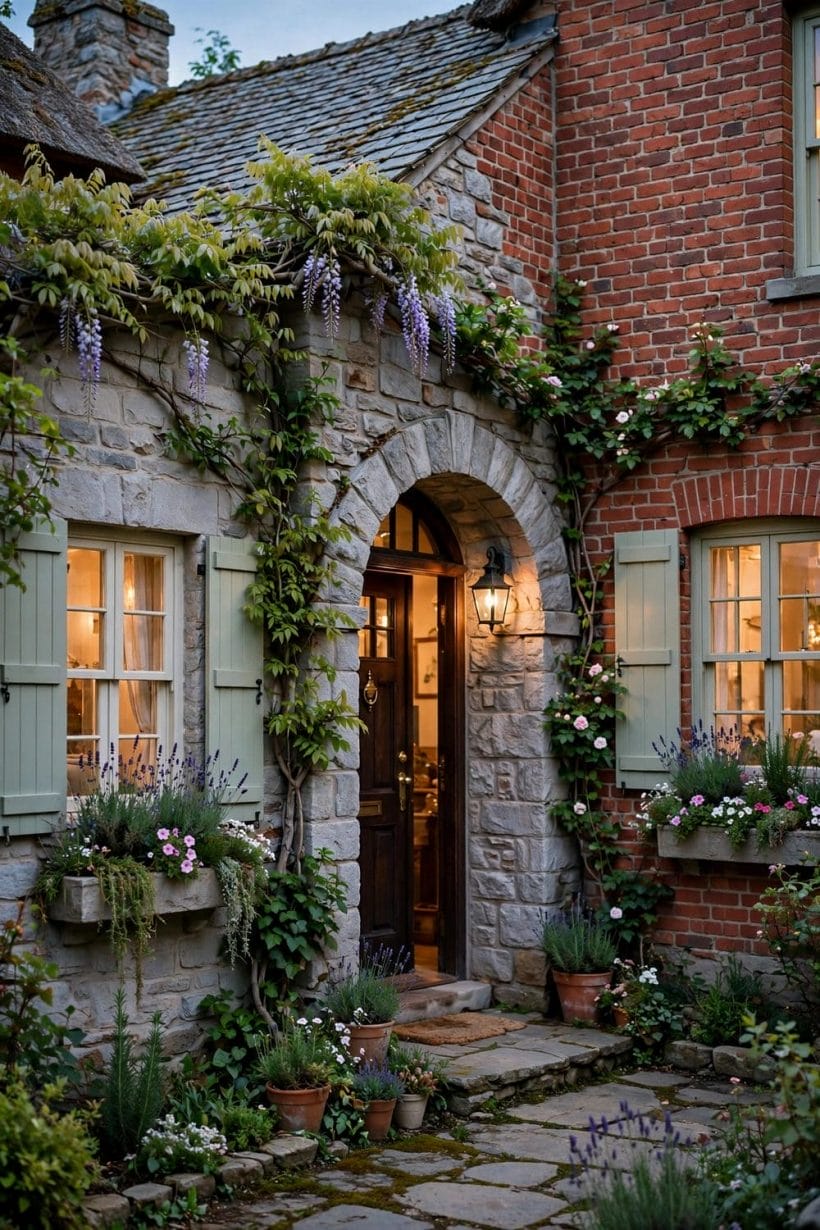
10. Echo one tone across both
The infographic’s first rule: find a tone that exists in both materials — a buff fleck in the stone that matches the brick’s base colour, a grey in the brick blend that answers the stone — and let that shared note be the marriage. Without an echo, the two materials argue.
11. Warm brick, warm stone
The easiest harmony: red or buff brick with sandstone, limestone or warm fieldstone. Everything sits in the same temperature family, the mortar warms to match, and the facade feels sunlit even on grey days.
12. Cool stone against red brick
Grey granite or blue-grey stone against red brick is a stronger, more graphic contrast — handsome on traditional and colonial shapes, where the formality can carry it. Keep the mortar mid-toned so neither material shouts across it.
13. Buff brick with grey stone
The quiet, almost monochrome version: pale brick, grey stone, pale mortar. It reads calm and architectural, suits modern-traditional houses, and lets planting and the front door supply the colour.
14. Dark brick with pale stone
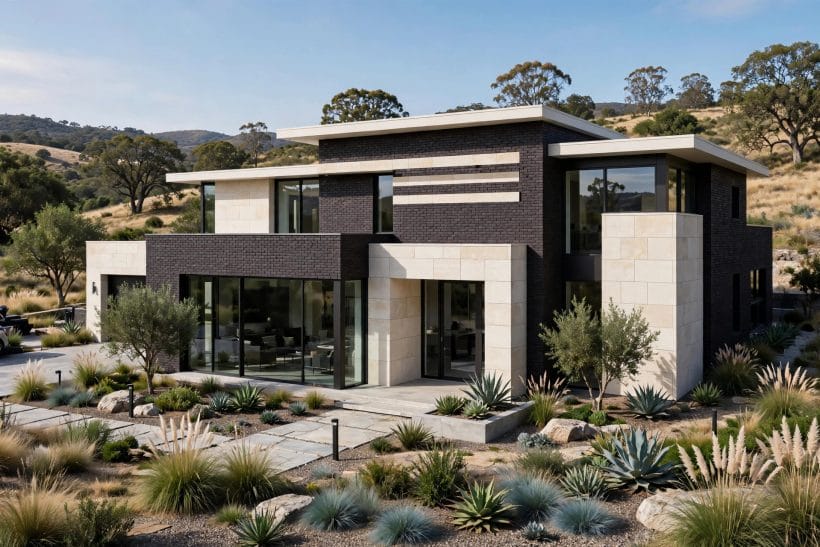
Deep brown or near-black brick with light limestone accents gives a facade real drama — stone reserved for the base, the entry and the lintels so the pale material draws the eye exactly where you want it.
15. Multi-toned brick needs calm stone
A busy, multi-coloured brick blend is already a pattern; pair it with the plainest, most uniform stone you can find. Two busy materials at once is the classic way this combination goes wrong.
16. Plain brick can carry busy stone
The reverse bargain: a smooth, single-tone brick — especially a pale or whitewashed one — is the perfect calm field for rugged, variegated rubble stone. One star, one supporting actor, in either direction.
17. Match the mortar to the marriage
Mortar is the third colour of every masonry facade. A shared mortar across both materials is what literally ties brick courses to stone blocks; choose its tone to sit between the two, and the whole wall knits together.
18. Test in daylight, at distance
The infographic’s tip, and the discipline that saves this whole combination: lay brick and stone samples side by side outdoors, prop them up, and walk across the street. Masonry colour is a daylight-and-distance judgement; no showroom wall can make it for you. The same test-first spirit governs the white exterior palette, where light does similar mischief.
4. Texture: Smooth Against Rugged
19. The core contrast
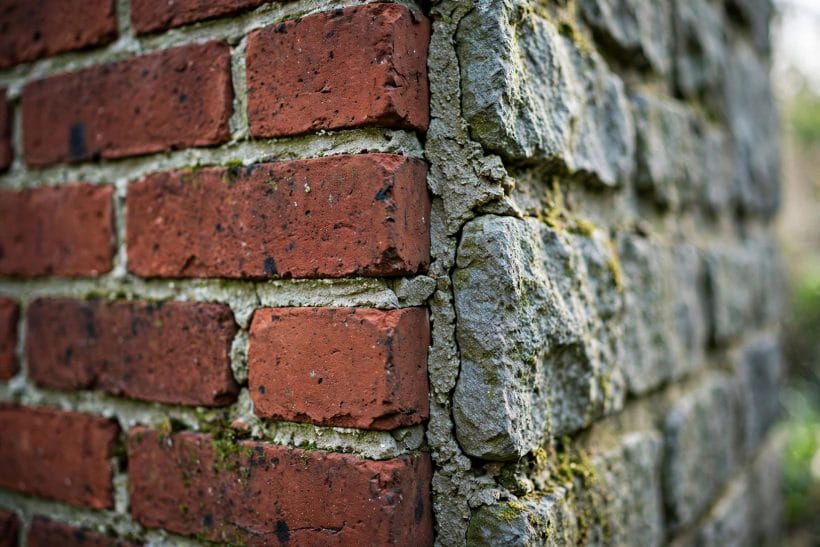
Brick is manufactured rhythm — small, regular, coursed. Stone is geology — irregular, shadowed, deep-jointed. The combination works because the eye enjoys both at once: order and nature on the same wall.
20. Smooth brick, rugged stone
The classic distribution of texture: let the stone be the rough one. Smooth-faced brick above a rubble-stone base gives the house a crafted top and a grounded bottom, like a good pair of boots under a pressed suit.
21. Textured brick, dressed stone
Reverse it for a different accent: wire-cut or tumbled brick with sawn, even stone. The brick supplies the movement, the cut stone the tailoring — a combination that suits more formal, symmetrical houses.
22. Rubble stone’s wild energy
Uncoursed rubble is the most characterful stone and the least forgiving partner. Give it large calm fields of brick around it, plain openings and a quiet roof, and it becomes the facade’s beloved eccentric rather than its chaos.
23. Ashlar’s calm geometry
Squared, coursed ashlar stone is almost brick-like in its order — the two materials meet as cousins. This is the pairing for homeowners who want the mix’s substance with the least visual argument.
24. Ledgestone’s modern rhythm
Slim, stacked ledgestone panels bring a horizontal, contemporary texture that pairs well with smooth brick in matching tones. Use it in panels — an entry wall, a chimney breast — rather than everywhere at once.
25. Brick texture is a choice too
Extruded-smooth, sand-faced, tumbled, glazed — brick’s own texture range is wide. When you choose the brick, you are choosing half the facade’s touch; run your hand over the samples, not just your eye.
26. Depth of joint, depth of shadow
Deep, raked joints make stone look more rugged; flush, struck joints make brick look smoother. The mason’s jointing is a texture dial for the whole facade — discuss it before the wall goes up, not after.
27. Where texture should calm down
Around windows and doors, let the textures quieten: smooth stone lintels and sills, neat brick arches. Openings are the facade’s face; they deserve the tailored version of both materials.
5. Stone at the Base, Brick Above
28. The oldest arrangement
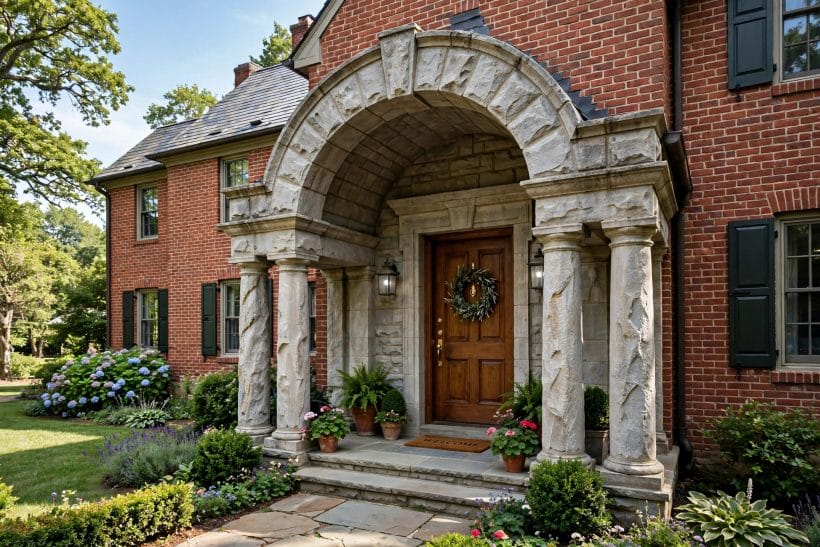
Stone below, brick above is the arrangement vernacular building settled on centuries ago: the heavy, water-shedding material at the splash zone, the lighter crafted material above. It still looks right because it is right.
29. How high should the stone climb?
Common answers: to the ground-floor sill line, to the full ground storey, or just a low plinth. The taller the stone, the more cottage-weight the house gains; the lower, the more the brick dominates. There is no formula — proportions of your own facade decide.
30. The full stone ground floor
A complete stone ground storey under brick gives a house real presence — the “manor” arrangement. It suits larger houses and deep plots, where the facade has room to carry the weight without looming over the garden.
31. The low stone plinth
Just a few courses of stone at the base — a visual boot for the house. It is the budget-friendliest version of the mix and still delivers the grounded feeling, especially with stone repeated at the entry steps.
32. Stone wainscot on one elevation
Not every wall needs the treatment. Stone at the base of the FRONT elevation, with brick wrapping the sides, concentrates the money and the effect where both are seen — a perfectly respectable economy.
33. Quoins: stone at the corners
Alternating long-and-short stone blocks at the corners — quoins — are masonry’s oldest tailoring trick. Against brick they read as structure and ornament at once, and they give plain brick elevations an instant upgrade in perceived craft.
34. The transition line
Where stone stops and brick starts deserves a deliberate detail: a projecting stone course, a row of brick laid on edge, a slight set-back. The homes where the mix looks accidental are usually the ones where nobody designed the seam.
35. Water and the base
The base is where rain splashes and snow piles, which is part of why stone belongs there — it shrugs off the wet zone that stains brick and rots lesser claddings. Keep the ground and paving sloping away, and both materials will mind their own business.
36. Steps and porch in the base material
Carry the stone into the front steps, the porch floor and the garden wall by the gate, and the base of the house joins the landscape. Repetition at ground level is what makes a material choice feel like a place, not a facade treatment.
6. Focal Areas: Entries, Chimneys and Gables
37. The stone entry
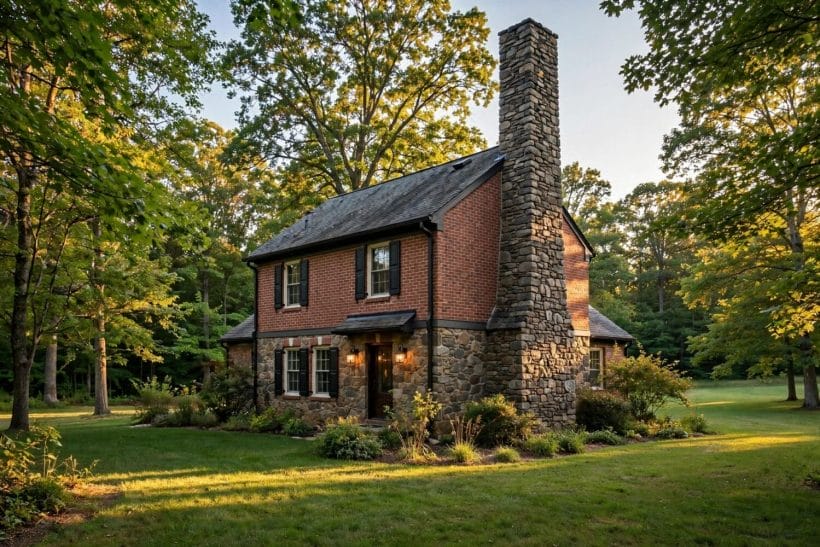
The front door is where guests arrive and photographs happen; it is the natural place to spend the stone. A stone surround, porch or full entry gable against brick walls gives a house its portrait.
38. The stone chimney
A chimney is a tower of masonry rising through the roof — build it in stone and it becomes the house’s landmark, with brick as its field. Even houses that are otherwise all brick gain enormously from this single stone gesture.
39. Gable ends in stone
Stone in the gable triangle — with brick below — draws the eye up and gives the roof a masonry crown. It is a traditional device on cottages and barns, and it lightens the perceived weight exactly where weight is least wanted.
40. The bay window in stone
A projecting bay is a natural focal point; cladding it in stone against brick walls articulates it beautifully. The bay reads as a piece of furniture attached to the house — deliberate, crafted, finished.
41. Garage doors framed in stone
Where a garage faces the street, a stone surround and piers domesticate the big door and tie the garage into the house’s material family instead of leaving it a brick box that happens to be attached.
42. Garden walls that continue the story
A low stone garden wall or brick-and-stone pillars at the drive carry the facade’s materials into the plot. The house then sits in a setting made of itself — the cheapest form of landscape architecture there is.
43. One focal area is enough
Restraint is the difference between focal and fussy. Entry OR chimney OR gable as the single stone gesture (plus the base) is usually the sweet spot; all three plus quoins plus wainscot belongs to genuinely grand houses.
44. Stone where hands touch
There is a tactile argument too: stone at the entry — the door surround you brush past, the step your foot knows — puts the most characterful material where the body meets the house. Design for touch, not only for photographs.
45. Lighting the focal stone
A wash of warm light across rugged stone at the entry doubles its texture after dark. Plan the entry lighting with the material, and the focal area earns its title day and night. Roof colour interacts with all of this — the black roof house pairings show the dark-roof version of the same thinking.
The base course has one more job worth naming: the water table. Traditional masonry bases often project very slightly and carry a sloped or moulded course at the top of the stone, throwing drips clear of the wall below and marking the transition with a shadow line. It is a small detail with three payoffs — weather protection, a designed seam, and a visible lift to the whole composition. If your mason suggests one, the answer is yes.
7. Which Material Leads
46. The honest ratio question
Every brick-and-stone house answers one question: which material is the field and which is the accent? Roughly even splits rarely work — the eye wants a host and a guest. Decide the ratio on paper before the first sample is ordered.
47. Brick-led: the classic majority
Mostly brick, with stone at base, entry and chimney, is the proven majority scheme — warm, crafted, and the easiest to build and extend. It suits suburban streets and traditional shapes of every size.
48. Stone-led: the country statement
Mostly stone, with brick at gables, upper storeys or the chimney, feels older and more rural — the farmhouse and barn-conversion register. It wants a landscape setting; on a tight urban plot it can feel like a castle in a car park.
49. Storey by storey
Splitting the materials by floor — stone ground, brick upper — gives the clearest hierarchy of all and flatters tall houses, whose upper walls benefit from brick’s lighter visual weight.
50. Wing by wing
On a house with a main block and a side wing, give each its own material: brick for the formal block, stone for the humbler wing (or the reverse). The house then reads as a place that grew — which is often exactly its history.
51. Front formal, sides plain
Stone accents concentrated on the street elevation, plain brick elsewhere, is the pragmatic distribution most real houses actually use. Nothing about it is a cheat; streetscape is what facades are for.
52. The single stone wall
One entire wall in stone — the chimney wall, the garden-facing wall — against three brick walls is a bold, modern-traditional move. It works best where that wall is genuinely seen: from the garden, the drive or the lane.
53. Changing materials at an inside corner
If materials must change mid-elevation, change them at an inside corner, a downpipe line or a step in the wall — anywhere the eye accepts a break. A change mid-flat-wall always looks like the budget ran out.
54. Additions in the second material
An extension built in the house’s other material reads as intentional growth rather than imitation: a stone kitchen wing on a brick house, a brick bedroom wing on a stone one. Matching mortar keeps the family resemblance.
8. Mortar, Joints and the Craft Details
55. Mortar: the third material
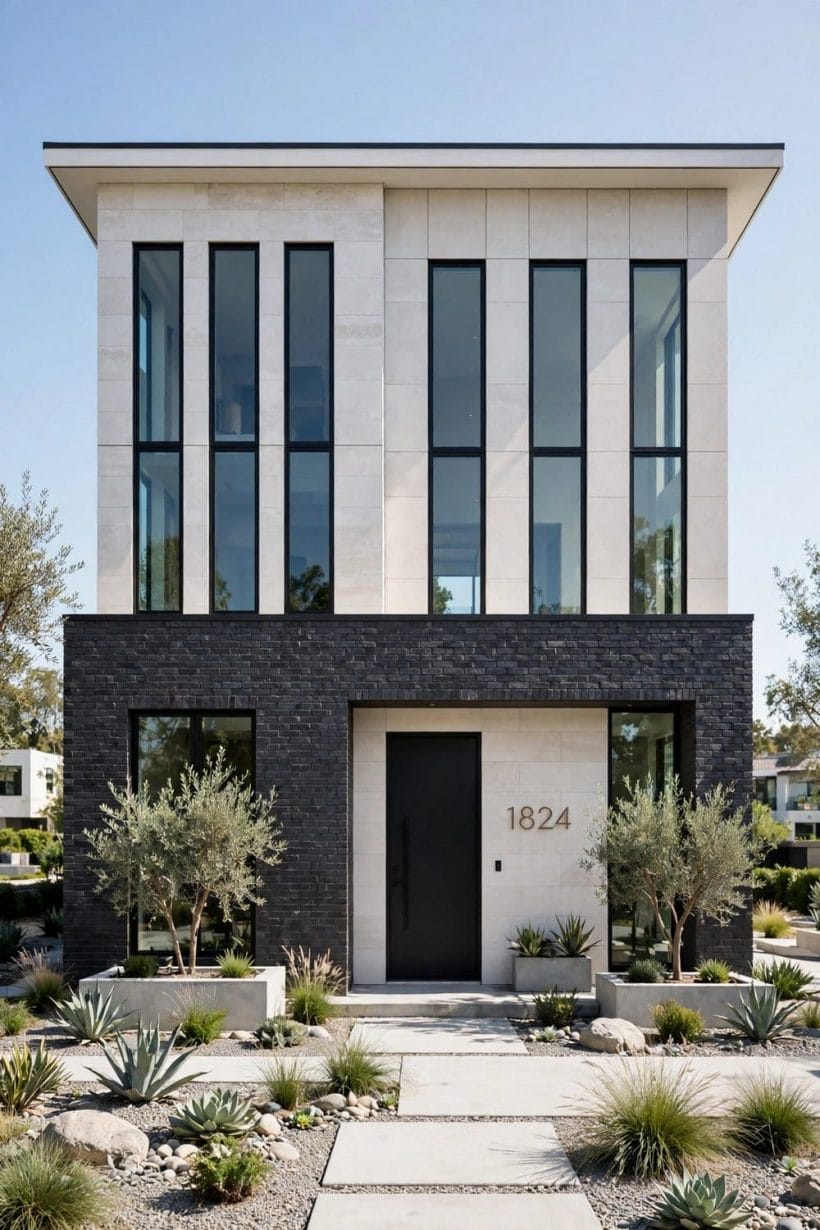
Mortar can be a third of a masonry wall’s visible surface — on rubble stone, even more. Its colour decides whether the wall reads as one fabric or as units in a grid, so choose it with the same ceremony as the brick and stone themselves.
56. One mortar for both
The infographic’s key factor — mortar match — is literal: the same mortar, in tone and joint profile, across brick and stone is what makes two materials into one building. Two different mortars is the mix’s most common quiet failure.
57. Joint profiles and shadow
Concave joints shed water and shadow softly; flush joints read modern; deeply raked joints ruggedise stone but hold water on ledges. Profile is both a look and a weather decision — take your mason’s advice for your climate.
58. Lintels and sills that mediate
Stone lintels and sills over openings in brick walls (and brick arches over openings in stone) are the handshake details between the two materials. They cost little area and do a great deal of the combination’s convincing.
59. Arches and soldier courses
A flat brick arch or a course of upright “soldier” bricks above a window adds a craftsman’s signature to plain brickwork — and it pairs naturally with a stone sill below. Small brick details keep the brick half of the mix from feeling like the cheap half.
60. Corners and the turning of walls
Watch how show houses turn corners: one material wraps, the other stops, or quoins mediate. The corner detail is where the budget versions of this combination give themselves away — insist on seeing your mason’s corner before the wall rises.
61. Sample panels are not optional
Have the mason build a small sample panel of each material AND of the junction between them, with the actual mortar, and approve it in daylight. It is the standard professional practice, and it is how expensive mistakes get made cheaply, on a panel instead of a house.
62. Repointing and repairs later
Both materials will outlive their mortar. When repointing day eventually comes, matching the original mortar’s tone matters doubly on a mixed facade, because it is the shared thread. Keep a note of the mix and a photograph from day one.
63. Flashings and the unglamorous essentials
Where stone meets brick, where walls meet roofs, the water management is hidden metalwork and membranes — not a design topic, but the reason mixed masonry must be built by people who have done it before. Choose the mason for the junction, not the day rate.
9. Styles That Love the Mix
64. The English cottage
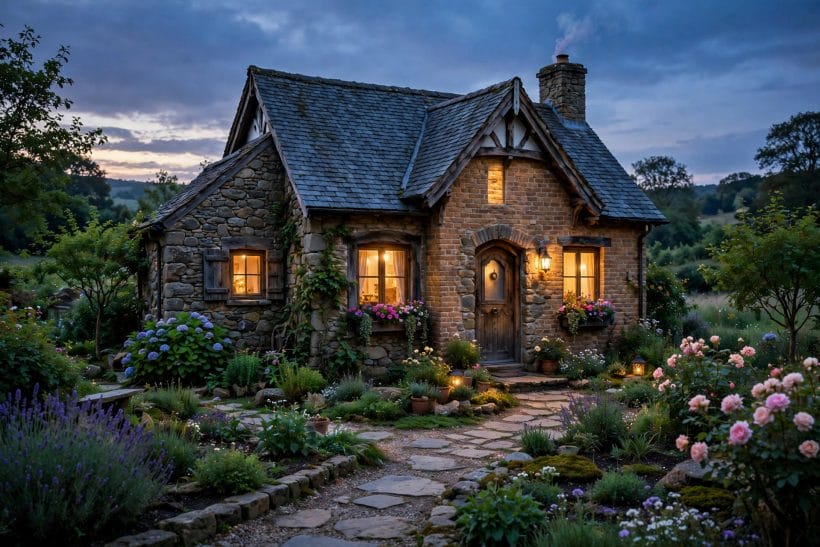
Stone base, brick walls, stone chimney, steep roof: the cottage is this combination’s ancestral home, and it remains the surest recipe for a small house with enormous charm.
65. The farmhouse
Farmhouses wear the rougher version — rubble stone, handmade-looking brick, lime-pale mortar — and look best slightly imperfect. If your heart is here, choose materials with the most texture variation you can find.
66. The colonial and Georgian register
Formal, symmetrical houses take the tailored version: ashlar or neat coursed stone at the base and quoins, smooth brick above, pale struck joints. The mix supplies gravitas; the symmetry supplies the manners.
67. Tudor echoes
Stone ground floors, brick with dark timber above, tall stone chimneys — the Tudor revival ran on this combination. Even a hint of it (a stone chimney and entry on a brick house) buys some of that storybook gravity.
68. The modern-traditional house
Contemporary shapes wear the mix in its smoothest form: pale brick, sawn limestone panels, flush mortar, big glass. The materials are ancient; the detailing is minimal; the combination proves itself genuinely style-proof.
69. The mountain and lake house
Where the landscape is stone already — hillsides, lakeshores, rocky plots — a stone base grows the house out of the ground and brick warms the upper walls against the sky. Site-responsive and beautiful.
70. The urban townhouse
In town, a stone ground floor (or just a stone entry and steps) under brick gives a narrow house a public dignity out of proportion to its width — the classic townhouse arrangement on three continents.
71. Barn conversions and true barns
Converted barns often arrive with stone walls already; adding brick for new openings, gables and extensions is both honest repair and good design. The mix tells the building’s biography on its face.
72. When NOT to mix
Honesty requires the exception: very small houses can be overwhelmed by two materials, and some bricks — highly glazed, strongly contemporary — have no natural stone partner. A single material done superbly beats a mixture done nervously, every time.
10. Costs and Practical Details
73. What actually drives the cost
Labour first: two materials mean two setting-out disciplines and a mason comfortable in both, and the junction details are handwork. Then the materials themselves — stone generally costs more per wall area than brick, which is exactly why the accent strategy exists — plus scaffolding time on slower stone sections, and the sample panels you should never skip.
74. Full masonry, veneer and the honest middle
Real stone and brick can be structural, or applied as veneer over a framed wall; both are legitimate, with different costs, weights and detailing, and your designer and local rules decide which suits the build. What matters is that the visible craft — corners, junctions, mortar — is done to the same standard either way, and that you know which you are buying.
75. The house that settles in
Build the mix with a shared tone, a shared mortar and one clear leader, and a brick-and-stone house does something rare: it improves. The stone darkens a little, the brick mellows, the mortar silvers — and a decade on, the house looks less like a project and more like a place. For the other great siding partnership, the site’s clapboard exterior ideas tell the timber version of the story.
Final Considerations
Brick and stone are the two materials houses were made of for a thousand years, and their combination is not a trend but a tradition with rules: echo a tone, share a mortar, let one material lead, and spend the other where eyes and hands land. Follow those, and the facade will look after itself — and look better — for generations.
And take the long view while you plan. Planting will soften the base, weather will blend the tones, and a decade of sun will marry brick and stone more completely than any sample board can promise. The owners of the old mixed-masonry houses on every established street did not design the beauty you are admiring — time did most of it. Your job is simply to give time good materials to work with.

0 Comments