

White is the oldest exterior colour there is and still the hardest to get right — not because it is complicated, but because it is honest. A white house shows its architecture without decoration to hide behind: every proportion, every trim line, every shadow the sun draws across the siding is part of the design.
These seventy-five white exterior home ideas collect the full range of the colour — crisp modern whites, warm farmhouse whites, rose-covered cottage whites and dusk-lit traditional whites — with the shade, roof, trim and landscaping judgements that keep white looking intentional rather than unfinished.
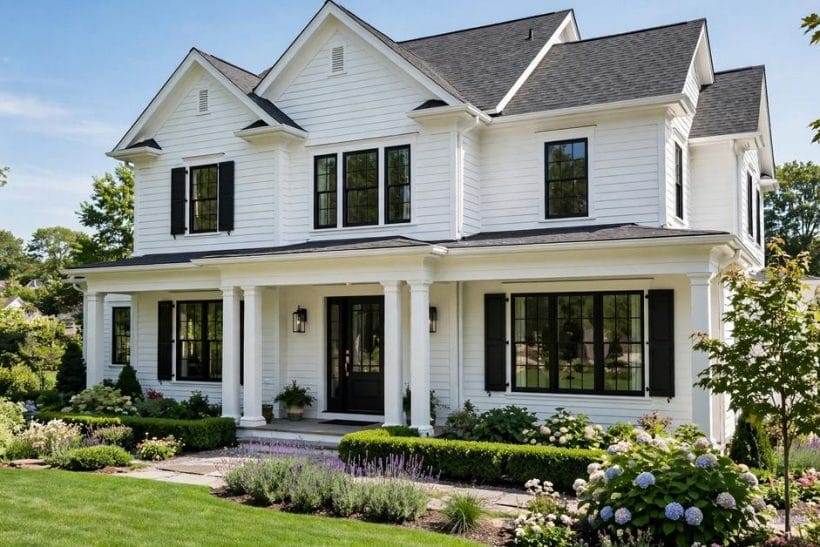
1. White Exteriors at a Glance
Scope first. This post owns the white exterior as a colour composition: the shade of white, the roof it sits under, the trim and door colours that finish it, and the planting that frames it. The wider exterior survey lives in exterior home ideas, where every colour and material competes; the material-led sibling is mixed siding exterior ideas, and the tiny-scale application is in the published tiny house exterior ideas. The monochrome pairing is deliberate: this site’s black-exterior post completes the pair in a later batch (the black house to this white one), and the two will be read together as the colour extremes of the same street. Here, everything is white — and the argument of the post is that white is never one colour, but a family of decisions.
One discipline runs through every section: a white exterior is chosen in layers, and the layers are judged in daylight, not in the showroom. The shade reads differently at noon and at dusk, against green planting and against grey sky, beside a dark roof and beside a pale one. Every idea below names its layer — shade, style, roof, trim or setting — so the composition can be rebuilt layer by layer on a real house.
| White family | Character |
|---|---|
| Crisp bright white | Clean and architectural — the modern and colonial default |
| Warm creamy white | Soft and sunlit — farmhouse, cottage and traditional homes |
| Cool white | Blue-leaning and sharp — coastal light and modern forms |
| Greige-white | Muted and grounded — white that behaves like a neutral colour |

2. Classic and Traditional Whites
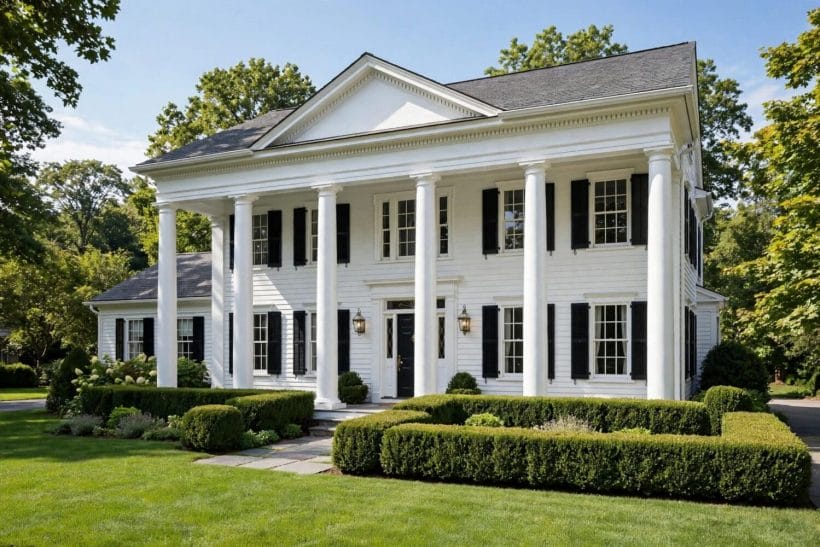
The colonial in gallery-1 is the traditional white at full strength: symmetrical, columned, black-shuttered, the paint doing exactly what it has done for two centuries — giving the architecture a clean ground against which its orders and proportions perform. Traditional whites are the colour’s home territory, and the ideas in this section are its grammar.
1. The columned colonial
Tall white columns against white clapboard, as in gallery-1, read as one carved composition because the colour refuses to separate the parts. It is the white of civic confidence, and it asks for symmetry in everything else — windows, planting, path — to complete it.
2. Black shutters on white
The black shutter is the traditional white’s oldest partner: it gives each window a drawn frame, repeats down the facade in a rhythm, and makes the white read whiter by contrast. Shutters that match the front door close the composition.
3. The symmetrical front
White rewards balance because it hides nothing. A centred door, matched windows and paired planting — the Georgian discipline — look inevitable in white and merely tidy in any other colour.
4. White with a charcoal roof
A dark grey roof over white walls is the traditional pairing of the feature image: the roof draws the house’s top line, the white carries the middle, and the planting grounds the base. Three bands, each legible — the classic exterior section drawing.
5. The wraparound-porch classic
A deep porch painted white with the house turns the facade into a shaded gallery; the porch in the feature image shows the effect — columns, ceiling and railings all in the house white, the shadow doing the decorating.
6. White-painted brick
Painting brick white keeps the material’s texture and loses its colour argument — the softest of the traditional whites, because the mortar lines and brick relief still model the wall in sunlight. It suits older brick houses whose brickwork was never the point. (The brick family on this site is anchored indoors by brick wall living room ideas — the same material in its interior register; this post is its exterior counterpart.)
7. Dormered whites
White dormers on a dark roof read as the house’s eyebrows, and painting them with the walls ties the roof storey into the composition. On Cape-style and colonial houses it is the detail that makes the top floor feel designed rather than added.
8. White with stone at the base
A stone plinth or stone steps under white walls give the colour a geological foundation — the white starts above the splash zone, stays cleaner, and gains the gravity that stone lends any composition.
9. The shuttered cottage-traditional
At cottage scale the same grammar miniaturises: white walls, one shutter colour, a painted door. It is the traditional white with the formality turned down and the charm turned up — the bridge to the farmhouse family in section 3.
3. Farmhouse and Country Whites

The pin’s farmhouse — vertical siding, black metal roof, black windows, a deep working porch — is the modern farmhouse white: warmer than the colonial’s, rougher in texture, and always in conversation with timber, metal and gravel. The porch furniture of these houses belongs to front porch ideas; here the subject is the white itself and what it is paired with.
10. Board-and-batten white
Vertical battens give white walls a shadow rhythm that changes all day, which is why the farmhouse style chose the profile: the colour stays plain, the texture does the talking. It is the most forgiving white for large, plain wall areas.
11. White under a black metal roof
The pin’s pairing — white walls, black standing-seam roof — is the modern farmhouse signature. The roof’s dark cap makes the white read as the house’s body rather than its coating, and the black repeats in the window frames to close the set.
12. The deep-porch farmhouse
A farmhouse porch is a room, and painting it white with the house makes it the facade’s shaded middle storey. Rocking chairs, a porch swing and potted herbs complete a composition the colour started.
13. White barn-style gables
Borrowing the barn’s gabled silhouette — tall, plain, big-doored — and painting it white turns an agricultural form into a clean country house. The white keeps the scale friendly; the form keeps the character.
14. White with a natural timber door
One unpainted timber door in a white facade is the farmhouse family’s warmest accent: the wood’s grain becomes the house’s jewellery, and every other element can stay white and black without the composition cooling.
15. Galvanised and stone accents
Weathered metal planters, a stone chimney, a gravel drive — the farmhouse white’s supporting materials are the ones that age in public. White paint beside materials that patina keeps the house looking settled rather than new.
16. The gabled country white
Steep gables, white walls, minimal trim: the country white relies on roof geometry the way the colonial relies on columns. It suits houses whose charm is their silhouette against trees and sky.
17. White with grasses and gravel
Ornamental grasses, unmown edges and pale gravel are the farmhouse white’s landscape register — soft, dry-toned planting that never competes with the walls and makes the white look warmer by company.
4. Cottage and Rural Whites
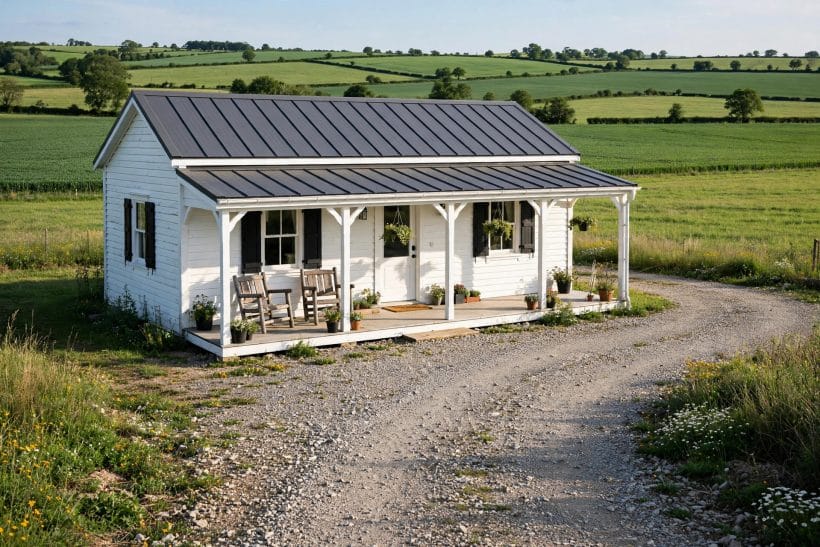
Gallery-2’s cottage stands alone in farmland — white walls, dark roof, a porch with two chairs and a view of fields. Rural whites are read at distance and against landscape, so their judgements are about silhouette and setting more than detail.
18. The lone rural cottage
A small white house in a big landscape is a landmark by default: the colour carries across fields and seasons, which is why farm cottages were limed and whitewashed long before it was a style. The white is the house’s visibility and its dignity.
19. White with a dark standing-seam roof
Gallery-2’s roof — dark, ribbed, agricultural — caps the white the way a hat brims a face. On small rural houses the roof is half the visible building, and the dark-over-white pairing is the proportion that makes it read as shelter.
20. The two-chair porch
The smallest porch composition there is: a roof, a deck, two chairs. Painted white with the house, it reads as the cottage’s outdoor room and its social signal — the house is inhabited, and the evening is sat in.
21. White against open land
Unhedged and unhidden, a rural white house takes its planting from the landscape itself — a tree or two, grass to the walls. The white must be a shade that holds in hard, unshaded light: the warmer whites of the infographic’s family behave best.
22. Shuttered rural windows
Working shutters in a colour — black, green, weathered timber — give a small white cottage its facial expression. On rural houses the shutters also still work, closing against storms and summer sun, and the white frames their honesty.
23. Timber porch posts
Leaving the porch posts in natural timber, as many rural cottages do, threads wood through the white composition at exactly the point where hands and eyes land. It is the farmhouse door accent, structural edition.
24. The small white homestead
House, shed and fence in one white unifies a working homestead’s buildings into a single composition. The colour becomes the property’s identity — visible, maintainable, and honest about being paint rather than pretence.
25. White with a garden gate
A white picket or ledged gate in front of a white cottage doubles the welcome: the fence line reads as the house reaching toward the lane. It is a small composition with an outsized effect on how the house is remembered.
26. Meadow-setting white
Where the garden is a meadow — long grass, wildflowers, a mown path — the white house is the composition’s calm centre. The less the planting is gardened, the more the white must carry, and the simpler its details should be.
5. Modern and Minimalist Whites
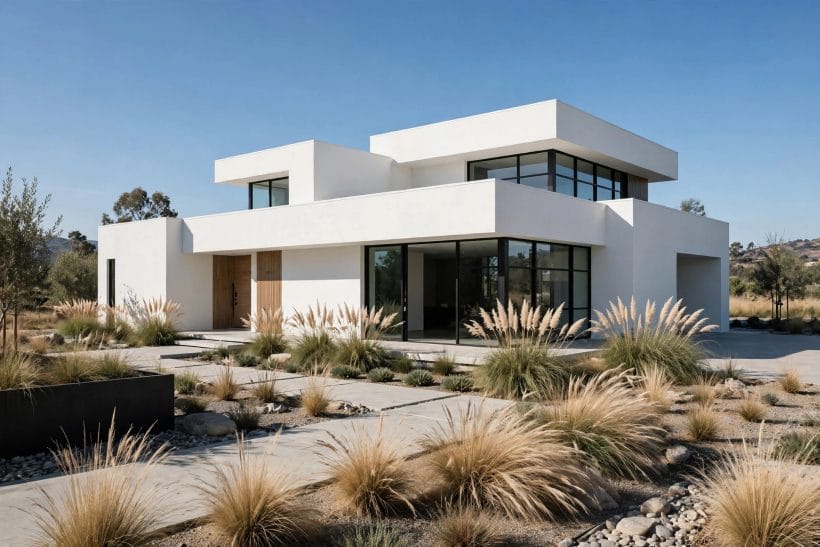
Gallery-3’s house — flat roofs, white render, walls of glass, grasses in gravel — is white as modernism’s founding colour: the shade of galleries, studios and the Mediterranean modern. Modern whites are judged on surface and shadow, because the forms are too plain to hide behind anything else. The regional modern dialect has its own post — Scandinavian exterior home ideas, exterior only — and this section keeps to the universal modern grammar it shares.
27. The flat-roof white composition
Stacked white volumes with flat roofs read as sculpture — the colour unifies what the geometry separates. It is the boldest white there is, and the least forgiving of a dirty wall or a careless detail.
28. White render and glass
Gallery-3’s pairing — matte white render against full-height glass — works because the two materials share a neutrality: the glass reflects the sky, the render holds the light, and the house becomes a study in both.
29. White with black window walls
Black-framed glazing in a white modern facade draws the openings the way the colonial’s shutters did, in a modern accent. The rhythm of dark rectangles is the ornament; the white is the paper it is drawn on.
30. Sculptural white curves
Curved white walls — the stucco tradition modernised — model sunlight into gradients no flat wall can make. White is the only colour that shows a curve’s full shading, which is why the sculptural houses choose it.
31. Desert-modern white
In dry landscapes the modern white keeps its oldest job: reflecting heat and light. Paired with gravel, stone and architectural grasses, as in gallery-3, it is the colour of shade made visible — the bright wall against the shadowed recess.
32. White and concrete
Grey concrete — steps, planters, a plinth — grounds white render the way stone grounds the traditional house. The two neutrals share a mineral honesty, and the composition reads as one material weathering into another.
33. White with a timber screen
A slatted timber screen over white render adds the modern facade’s favourite shadow-play, and the wood warms the white without painting it. Screens also shade glass — the detail is decorative and functional in the same gesture.
34. The gallery-white box
Some modern whites borrow the art gallery wholesale: plain walls, hidden gutters, flush details, planting reduced to specimens. The house presents itself as the frame, and the landscape as the picture.
35. White on white modern trim
Where traditional houses contrast their trim, the modern white often matches it — fascias, frames and walls in one white, the distinctions drawn only by shadow and material change. It is the quietest composition in this post and the hardest to keep clean.
6. Garden and Romantic Whites
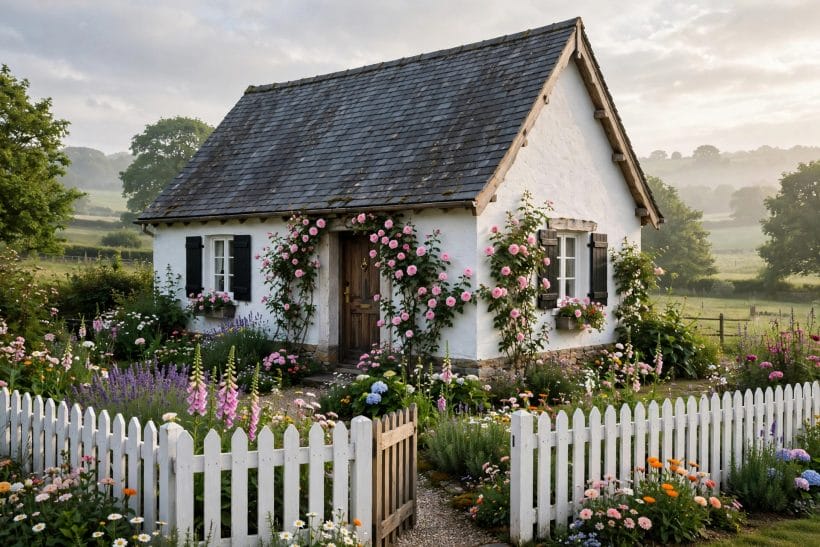
Gallery-4’s cottage — roses over the door, foxgloves at the fence, a white picket gate — is the romantic white: the colour as a garden wall, chosen to make flowers look more themselves. In this family the planting is not the frame; it is half the design.
36. The rose-covered cottage
Climbing roses need a ground that flatters every colour they bloom in, and white is that ground — the cottage in gallery-4 disappears behind its roses in June and is still handsome in January. The white is the garden’s canvas.
37. Picket-fence white
A white picket fence in front of a white cottage extends the house into the garden in the same paint, so the boundary reads as part of the home. Repainting both in the same campaign keeps the set matched — the discipline this family lives by.
38. White with pastel planting
Pale planting — lavender, white roses, silver foliage — against white walls composes the garden in one tonal key. It is the romantic family’s calmest register, and the one that photographs like a painting.
39. The cottage-garden white
Dense, informal cottage planting forgives a white wall everything: splashes, shadows, the odd green streak. The white in return gives the overflowing garden a legible backdrop — each partner covers the other’s weaknesses.
40. Lavender against white
Lavender’s grey-green foliage and purple flower are the white wall’s most reliable companions — the feature image’s front garden uses them along the path. The pairing works in every style family in this post, from colonial to modern.
41. Hydrangea drifts
Big hydrangea plantings — white, blue and pink, as around the feature house — echo the wall colour in flower form. A white house with white hydrangeas composes in monochrome; with blue ones, it composes in the coastal palette of section 8.
42. White with climbing vines
Beyond roses: jasmine, clematis and climbing hydrangea all use a white wall as their trellis and their backdrop. The vine softens the architecture; the white keeps the vine from reading as overgrowth.
43. The white gatehouse welcome
A small white gatehouse, arch or arbour at the plot’s edge announces the house’s colour before the house is seen. It is the romantic family’s punctuation mark — the composition’s first sentence.
44. Evening-garden white
White walls hold light after the garden loses it, which is why romantic whites glow at dusk. Planting chosen for evening — white flowers, pale foliage — extends the effect, and the house becomes the garden’s lamp.
7. Trim, Doors and Siding Detail
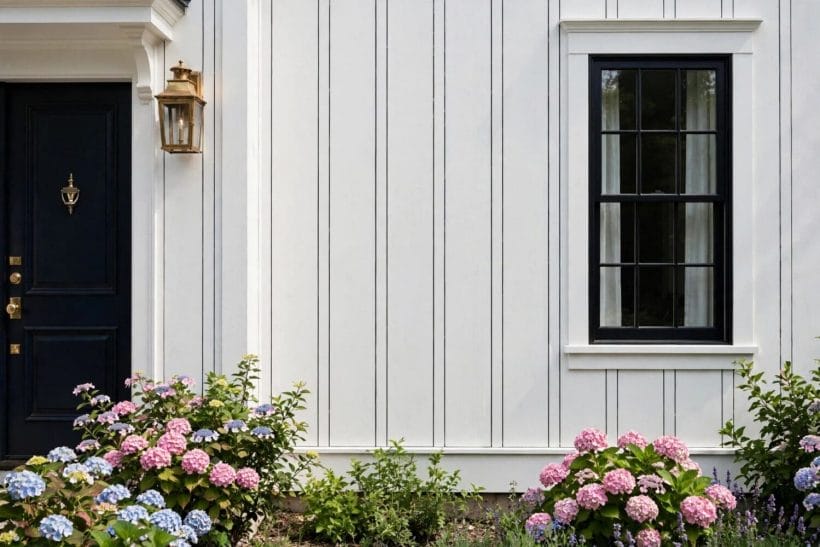
Gallery-5 closes in: white board-and-batten, a black door with brass, a black window, hydrangeas below. At this distance the white exterior stops being a colour and becomes a set of decisions — profile, contrast, metal, sheen — and this section is those decisions.
45. The black front door
A black door in a white house is the composition’s full stop: the darkest element at the point of arrival, as in gallery-5. It pairs with black windows or stands alone, and it never argues with the planting.
46. Black window frames
Black frames draw each opening and modernise any white style family — the same gesture on a colonial, a farmhouse and a modern box. The frames’ repetition is the facade’s rhythm section.
47. White-on-white trim
Matching the trim to the walls in a different sheen — satin trim against matte walls — gives the traditional composition a tailored subtlety. The detail is read by light, not colour, and it suits houses whose architecture is detail enough.
48. Board-and-batten texture
Gallery-5’s siding shows why profile matters to white: the battens’ shadow lines are the only decoration a plain white wall needs. Smooth siding asks for colour contrasts; profiled siding composes with light alone.
49. Brass and lantern light
Warm metal — the brass lantern and door furniture in gallery-5 — is the white facade’s jewellery: small, warm points against the cool field. Exterior lighting on white should always be warm; the wall amplifies whatever temperature it is given.
50. Soft-colour shutters
The alternative to black: shutters in a soft colour — sage, stone blue, weathered grey — give a white house a regional accent. The coastal cottage in section 8 wears the idea in pale blue.
51. White above a stone plinth
Raising the white on a stone base course protects the paint where weather strikes hardest and gives pale walls a grounded start. It is also the traditional repair: the plinth takes the wear the wall would take.
52. Crisp modern trim lines
Flush fascias, concealed gutters and shadow-gap details keep a modern white’s edges drawn in line rather than moulding. The trim still exists — it has simply been reduced to geometry.
53. Matching the outbuildings
Garage, shed and studio in the house’s white — the homestead principle of idea 24 at suburban scale — make a plot read as one composition. The white becomes the family’s surname, worn by every building on the land.
8. Coastal and Light-Drenched Whites
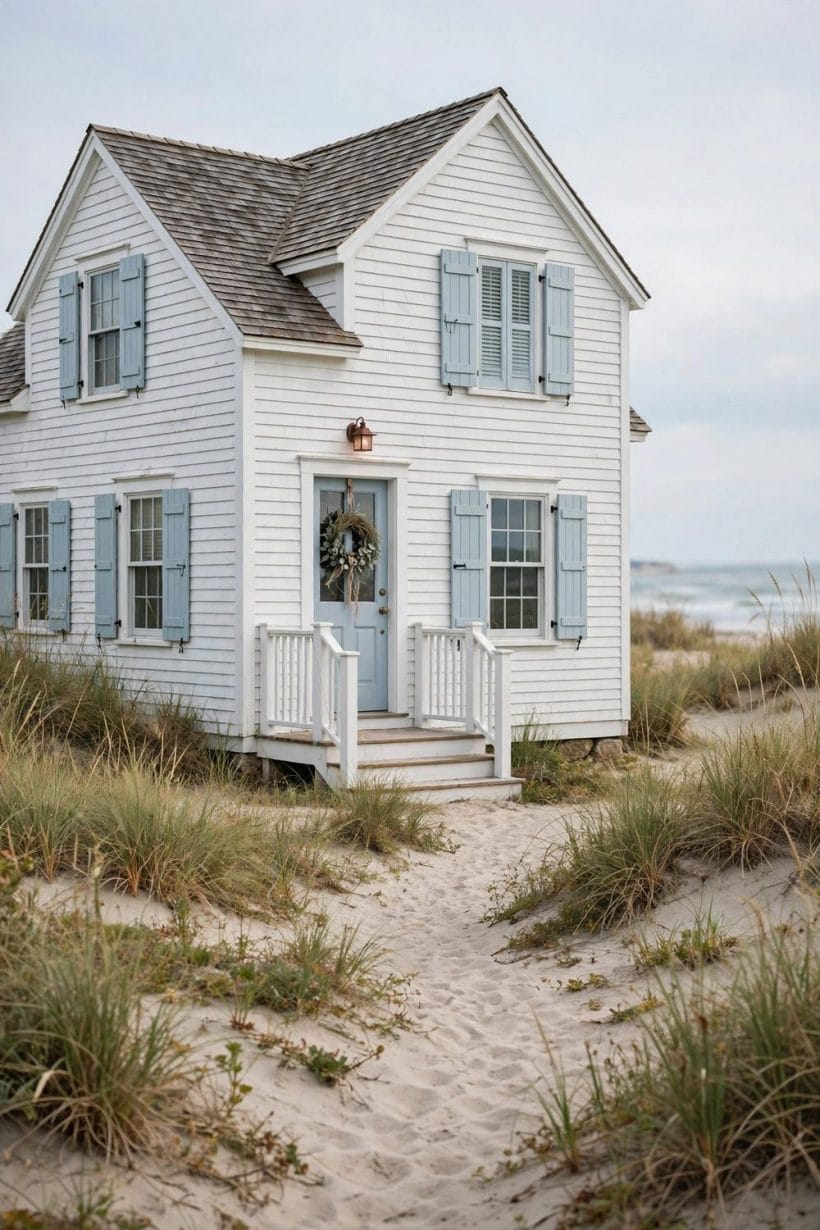
The second pin’s cottage — white weatherboard, pale blue shutters, grey shingle roof, a wreath on the door — is the coastal white: the colour of bright air and reflected water light, softened by weathered timber and salt-tolerant planting.
54. Pale-shutter coastal white
Pale blue or sea-glass shutters on white weatherboard are the coastal family’s signature — the soft-colour shutter of idea 50 in its home waters. The pairing reads as sky and foam, and it belongs within sound of the sea.
55. The shingle-roof white
A weathered grey shingle roof over white walls is the coastal roof pairing — softer than charcoal, silvery with age. The roof and the walls weather together, which is the coastal composition’s whole charm.
56. White with a timber deck
Silvered decking boards against white walls continue the weathered register at ground level. The composition is finished when the timber, the roof and the planting have all been allowed to go gently grey together.
57. Sea-grass planting
Grasses, lavender and salt-tolerant shrubs plant the coastal white in its element — the same grasses that framed gallery-3’s desert house, here doing seaside work. Movement is the point: coastal planting should move in the wind the house shelters from.
58. The veranda white
A shaded veranda painted with the house gives coastal and colonial homes their outdoor room; white reflects the sea light into the shade and keeps the veranda the coolest seat on the plot.
59. Driftwood tones
Driftwood greys — in furniture, fencing and gates — are the coastal white’s natural wood register, the bleached alternative to the farmhouse’s warm timber door. Choose one wood register per house; the two do not share a facade happily.
60. White with navy accents
Navy — a door, shutters, a porch floor — is the coastal white’s deep note, the harbour colour. It is stronger than the pale shutters of idea 54 and suits houses that face the water directly.
9. Roofs, Light and Dusk

Gallery-6 catches the white house at its second daily performance: dusk, windows lit, porch lanterns on, the walls still holding the sky’s last light. A white exterior is a lighting design as much as a colour, and this section reads it by the clock.
61. The dark-roof cap
Every family in this post caps its white with a dark roof more often than not, and the reason is compositional: the dark band gives the pale walls a horizon. Roofs in charcoal, black or weathered grey are the white house’s hat — chosen once, worn for decades.
62. Natural timber roof tones
The alternative cap: cedar or tile in natural tones warms the white and suits the farmhouse and cottage families. The roof’s weathering becomes part of the composition’s ageing, planned rather than suffered.
63. White at dusk
Gallery-6’s hour is white’s gift: the walls return the day’s last light and the lit windows read as the house’s eyes. No other exterior colour performs at dusk — the romantic family’s idea 44 at whole-house scale.
64. Lanterns and porch light
Warm lantern light on white walls pools and glows rather than glaring; the porch lighting of the feature and gallery-6 houses shows the register. Fit warm lamps, keep them shaded, and let the white do the amplifying.
65. Sun-facing whites
On a sun-drenched elevation, bright whites can glare and cool whites can look blue; the warm family behaves best. The shade decision of section 2 is made per elevation — a house may honestly wear two whites, sun side and shade side.
66. Shade-side whites
North and shaded walls make every white cooler and greyer, and they grow green films fastest. Choose the shade by the house’s shadiest wall, keep planting off it, and let the sunny elevations take care of themselves.
67. White and tree shade
Dappled light through trees is the white wall’s most flattering condition and its dirtiest — falling leaves and sap streak pale paint. The composition is worth the cleaning; site the most detailed facade where the dapple falls.
68. The all-white composition
Walls, trim, fence, gate and outbuildings in one white family — the monochrome end-to-end. It is the boldest choice in this post and the most coherent: a plot composed like a sculpture garden, with planting as the only colour.
10. Keeping White White: Care and Choosing Checks
The last attribute is the one the colour lives with. White’s honesty extends to dirt: it shows every streak, splash and green film, and the houses that stay beautiful in white are the ones whose care was designed in from the start.
69. The wash-down rhythm
White exteriors stay white by washing — a gentle annual wash of the walls, more often where trees overhang or roads splash. Stated generally: soft water, soft brushes, the manufacturer’s guidance for the siding material, and no aggressive pressure on painted surfaces.
70. Gutters, drips and streaks
Most white-wall staining arrives from above — overflowing gutters, dripping edges, rusting fixings. Keeping the water details sound is the white house’s real maintenance; the paint itself is the easy half.
71. Splash zones and plinths
Rain bouncing off paths dirties the lowest band of any white wall. The stone plinth of idea 51, a gravel margin, or simply accepting a repaint rhythm for the bottom course — one of the three belongs in every white house’s plan.
72. Sample boards in real light
The choosing check that outranks all others: paint large sample boards, stand them against each elevation, and read them at morning, noon and dusk before committing. White is the colour most changed by light; the board ritual is its due diligence.
73. Reading the undertone
Every white leans somewhere — warm, cool, green or grey — and the lean shows against true-white trim and against planting. The infographic’s families are the map; the sample board is the territory. Choose the lean deliberately or it will be chosen for you.
74. Street and neighbour context
A white house among brick neighbours is a landmark; among white ones, a citizen. Neither is wrong, but the choice should be made knowingly — and the street’s light, trees and road colour all vote on how the shade will read.
75. The maintenance-honest choice
The final idea is the honest one: choose the white your household will actually maintain. A warm white washed yearly will outshine a crisp white neglected for a decade. The best white exterior is the one that still looks chosen in ten years’ time.
Final Considerations
Choose the white by its undertone, the roof by its contrast, the trim by its rhythm and the planting by its company — then maintain the composition like the design it is. The seventy-five ideas here span colonnades and cottages, sculpture and roses, and every one of them is the same colour worn with intent. White is never the absence of a decision; done deliberately, it is the decision every other element of the house is judged by. Its pair — the black exterior — completes the monochrome set later in this series; until then, the white stands alone, as it has always been content to do.



0 Comments