

A large appliance is one of the biggest single purchases a household makes, and one of the hardest to undo. A sofa that disappoints can be collected; a fitted fridge that arrives damaged, measures wrong, or turns out to be returnable only at your expense is a problem with plumbing attached. When the seller is a discount retailer rather than a familiar high-street name, the appliance may be identical — what varies is the terms around it, and the terms are exactly what this guide checks.
Nothing here reviews or rates any retailer. These are the questions to put to any seller of major appliances before money moves: what the goods actually are, what delivery really includes, what happens if something is wrong, and what the paperwork promises. A good retailer answers all of them in writing, happily. That willingness is itself the first check.
Related Guide: Should You Tip Appliance Delivery People? What To Know Before They Arrive
1. Appliance Retailer Checks at a Glance
Scope first. This guide owns the buying checks for a major appliance bought from any retailer — the delivery, returns and paperwork questions that decide whether a bargain stays one. The kitchen it lands in is covered elsewhere on the site: the canon in kitchen ideas, small-space planning in compact kitchen appliances for tiny houses, the neighbouring buying checks in the microwave buying guide and how to choose a blender, the care companion in how to choose dishwasher detergent, and the construction-checking method in the furniture quality check guide. Here, everything serves the order.
One rule governs the whole guide: the appliance is the manufacturer’s; the experience is the retailer’s. Check the retailer on the things only the retailer controls.
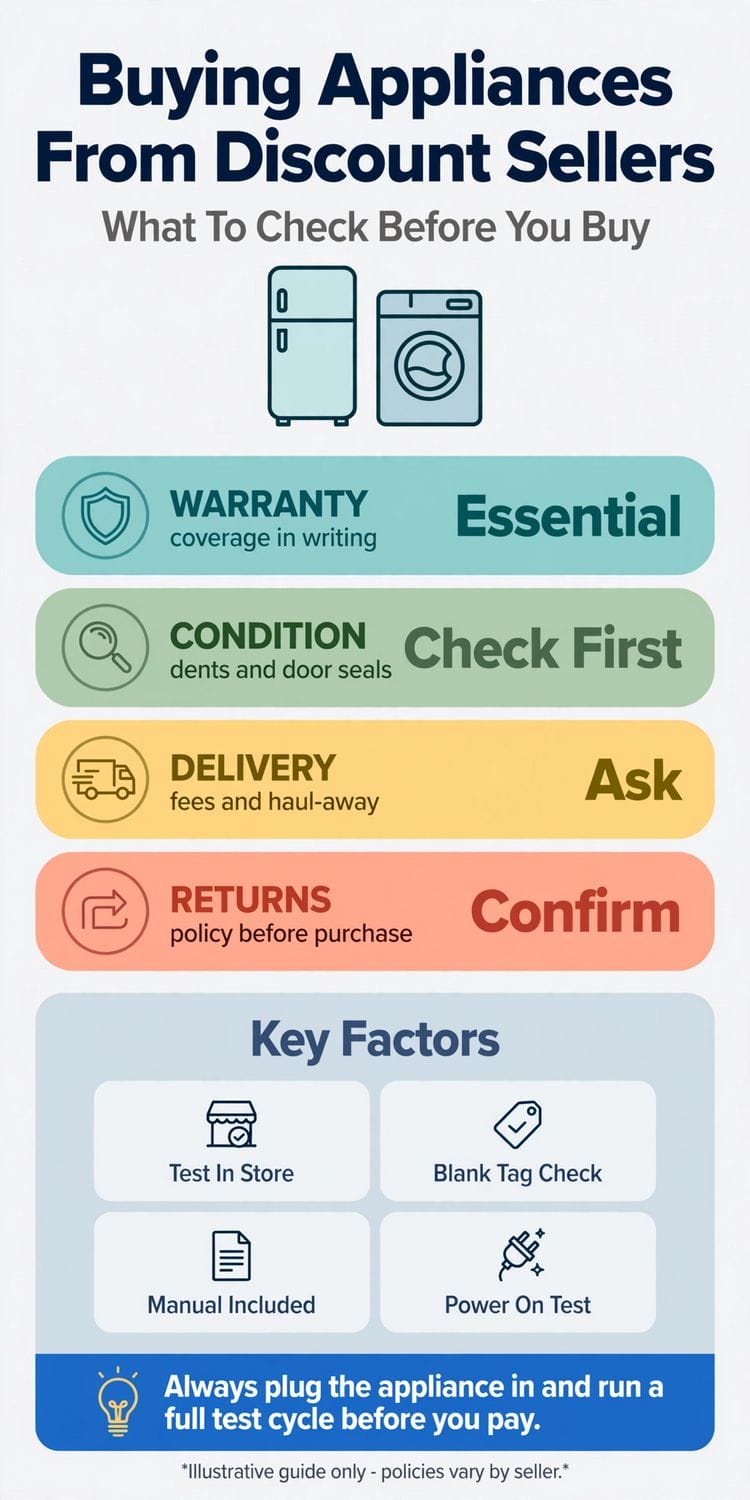
| Check | What to settle | Why it matters |
|---|---|---|
| The goods | Exact model, grade and condition stated | Decides what actually arrives |
| Delivery | What the charge includes, in writing | Decides whether “delivered” means fitted or doorstep |
| Returns | Window, condition and collection costs | Decides your exit if it is wrong |
| Warranty | Manufacturer cover versus retailer promises | Decides who fixes it in year two |
| Paperwork | Invoice, terms and serial records | Decides every later conversation |
2. Before You Order: The Retailer Itself

1. A real business leaves a real trail
Check that the seller names itself properly: a trading name, an address you could write to, a working way to reach a person. Discount prices are not a warning sign — anonymity is. A retailer that hides who it is before the sale will not become easier to find after it. Trading history matters at a gentler level too: a business that has sold appliances under the same name for years has a reputation it cannot afford to burn on your order, and that is a quiet form of security no policy document quite replaces.
2. The terms should be findable before the basket
Delivery, returns and warranty terms that only appear after payment are terms designed not to be read. A sound retailer publishes them where a cautious buyer can study them in advance, and a cautious buyer does exactly that — before comparing anything else. Save or print the pages as you read them. Terms are occasionally updated, and the version that governs your order is the one in force when you placed it; your saved copy is the evidence of what that version said.
3. Ask one question before you buy anything
Send a single practical question — about access, a delivery detail, a measurement — and note how the answer comes back. The reply’s speed matters less than its substance: a specific answer from someone who understood the question is the best available preview of after-sales service. Keep the exchange. If a later dispute turns on what was said, the thread is the record, and a retailer who answered carefully once has set a standard it will usually keep.
3. What You Are Actually Buying
4. Pin the exact model, not the family resemblance
Appliance ranges contain near-identical models differing in features, efficiency and finish. The listing should state the full model reference, and the invoice should repeat it. “Same range” substitutions offered at delivery time are a change of contract, not a favour.
5. New, graded and returned are different goods
Discount channels legitimately sell graded stock — ex-display, packaging-damaged or factory-refurbished appliances — and it can be excellent value. What matters is that the grade is stated plainly before purchase, with what it means for condition and cover. A price that only makes sense as graded, described as new, is the oldest trick in this market.
6. Efficiency and running-cost claims should trace to the label
Energy figures belong to the appliance’s official rating, not the retailer’s adjectives. Compare like with like using the model’s own published rating, and be wary of listings whose savings claims cannot be followed back to it.
4. Delivery: What the Word Actually Includes

7. Doorstep, room of choice and fitted are three different promises
“Free delivery” can mean a pallet at the kerb. Establish which service you are buying: carried in, positioned, levelled, connected, or simply transported. Each step up that ladder is worth money and is exactly where misunderstandings breed, so get the level of service named in the order confirmation. The gap matters most with the heaviest appliances: a large refrigerator or range cooker is not something two household members can casually carry up a flight of stairs, and discovering that at the kerb, with the delivery crew’s clock running, is how doorframes and tempers get damaged.
8. Access is your information to give
Stairs, narrow halls, tight turns and door widths decide whether delivery succeeds. Measure your route and tell the retailer before the day; a failed delivery you warned about is their problem, while a failed delivery you concealed is billed as yours, and both outcomes are set by what was said in advance.
9. Packaging, old appliances and the small print of the day itself
Settle the extras before they become doorstep negotiations: whether packaging is taken away, whether the old appliance is collected and at what charge, how the delivery window is communicated, and what happens if nobody is in. None of these is a detail on the day — they are the day.
5. Installation and Connection Promises
10. Connection is a skilled job with boundaries
Water, waste and electrical connections each carry their own rules, and some work must legally be done by qualified tradespeople. If the retailer offers connection, ask who performs it and to what standard; if the offer is vague, assume the appliance will be positioned but not commissioned, and plan accordingly.
11. “We install” should survive one more question
Ask what installation includes for your exact situation: levelling, door reversal on a fridge, stacking a dryer, testing a full cycle. The answers distinguish a genuine installation service from a delivery driver with a screwdriver, and they cost nothing to obtain beforehand.
12. Keep the first run supervised
Whoever connects the appliance, be present for its first full run and check for leaks, noise and errors before the packaging leaves the house. Faults found in the first hour are a delivery conversation; faults found in the first month are a warranty one.
6. Returns: The Terms That Decide Your Exit

13. The returns window, in days and in conditions
Find the actual window for changing your mind and the condition the appliance must be in — unused, uninstalled, packaging intact, or some combination. Large appliances are commonly excluded from the easiest returns once fitted, which is precisely why the pre-fitting checks in this guide matter. Note also when the window starts: from order, from dispatch or from delivery are three different clocks, and with slow delivery the first of them can quietly expire before the appliance reaches your kitchen. The fair retailers count from delivery; make sure yours is one of them, in writing.
14. Who pays for collection is the real question
A “free returns” promise that requires you to freight a cooker back at your own cost is not free. Establish who arranges and who pays for collection of a large item, and what a failed collection attempt costs, before the order — not from the doorstep.
15. Faulty on arrival is a separate, stronger position
An appliance that arrives damaged or faulty is not a change-of-mind return, and consumer law in most places treats it accordingly — but the process still runs on evidence. Photograph damage before signing anything, note it on the delivery record where you can, and report it immediately rather than after the weekend.
7. Warranty: Whose Promise Is It?
16. The manufacturer’s warranty travels with the appliance
Whatever the retailer, a new appliance carries its manufacturer’s warranty, and registering the purchase and keeping the invoice are what make that cover easy to claim. Ask how registration works and do it in the first week, not the first breakdown.
17. Retailer promises are worth what the retailer is
Extended cover sold by the retailer is a separate contract with the retailer or an insurer behind it. Read who actually stands behind it, what it excludes — installation faults and cosmetic damage are common exclusions — and what a claim requires you to produce.
18. Graded stock carries graded cover
Refurbished and graded appliances often carry shorter or retailer-only warranties, which is legitimate when stated. The check is that the cover described matches the grade described, and that both appear on the same invoice you will one day wave at someone.
8. Payment and Paperwork

19. Pay in a way that leaves a trail
Payment methods differ in the protection they carry if a seller fails to deliver, and in many places card payments bring statutory protections that cash and direct transfers do not. For a purchase of this size, the trail is part of the product — choose the method that keeps it. Be equally careful at the other end of the scale: a deposit structure that asks for full payment long before a delivery date exists deserves a question, and staged payment against confirmed dispatch is the pattern reputable sellers use.
20. The invoice is a document, not a receipt formality
It should name the retailer, the exact model, the grade, the price broken into goods and services, and the delivery terms agreed. If anything you were promised is not on it, that promise does not exist — ask for the corrected invoice before the delivery is booked, not after. Read the small print against your saved copy of the terms as well; an invoice that quietly narrows the published returns policy is telling you something about the firm that issued it.
21. Keep the serial number with the paperwork
Record the appliance’s serial number from the rating plate when it arrives, alongside the invoice and warranty documents. Warranty claims, safety recalls and resale all run on that number, and the time to capture it is while the appliance is new and the plate is easy to reach.
9. Signals Worth Walking Away From
22. Pressure that expires today
Genuine stock turns over, but a discount that evaporates unless you pay within the hour is a sales device, not a market fact. A retailer confident in its terms can survive your reading them.
23. Terms that change between listing and checkout
If the delivery charge multiplies, the returns window shrinks, or installation quietly becomes an extra as you move through checkout, stop. Inconsistency between a seller’s own pages is the cheapest due diligence you will ever perform.
24. No answer to the returns question
Ask directly: “If it arrives damaged, what exactly happens?” A retailer with a process answers in sentences. Evasion on this question, before any money has moved, is the whole review you need.
10. The Pre-Order Walk-Through

25. Measure the space, then measure the route
Confirm the appliance fits its home — including door swing, ventilation clearance and connections — and then confirm it can physically reach that home through your doors and halls. More appliance orders fail on the route than on the room.
26. Read your order confirmation like a contract
Because it is one. Model, grade, price, delivery level, installation, removal of the old unit, returns terms: if each agreed item is present and correct, the order is sound. If any is missing, the time to fix it is while it is still a sentence, not a truck.
27. Decide your walk-away point in advance
Before the delivery day, know what you will refuse: the wrong model, visible damage, a connection service that does not materialise. Refusals are easy when they were decided calmly in advance and hard when they must be improvised in a hallway.


Final Considerations
Discount appliances are not a gamble; undocumented ones are. The retailer who states the grade, names the delivery service, publishes the returns terms and invoices exactly what was promised has done everything a famous name does, at a better price — and the checks in this guide are how you tell that retailer from the other kind. Ask the questions while they are still questions, get the answers in writing, and the bargain stays a bargain all the way into the kitchen.




0 Comments