

Every supermarket shelf insists the answer is a brand. It is not. Clean dishes come from the match between three things — your water, your machine and the detergent format you put in it — and once those three agree, the name on the box matters far less than the shelf wants you to believe.
This guide explains how to choose dishwasher detergent on those terms: how water hardness drives the decision, what each format does well, what rinse aid and salt are actually for, how to read a label, and the loading and running habits that outweigh any product claim.

1. How to Choose Dishwasher Detergent at a Glance
Scope first. This guide owns one question: how a householder should choose and use dishwasher detergent, in general terms, with no dated ranking and no brand verdicts. It belongs to the site’s household what-to-check family: the kitchen itself is surveyed in kitchen ideas; judging what you pay for in the kitchen is covered in kitchen cabinet quality guide; living with dark kitchen surfaces is in dark cabinets dark floors; the kitchen’s other invisible chemistry is in home dehumidification guide; small-space machines are in compact kitchen appliances tiny houses; and the same read-the-evidence approach applied to furniture is in furniture quality check guide. Here, everything serves the wash.
One discipline runs through the guide: detergent is a system, not a product. Water, machine, format and habits interact, so change one variable at a time, judge by your own dishes, and treat every label claim as a hypothesis your kitchen gets to test.
The tour follows the decision itself: water first, then the three formats, the supporting cast of rinse aid and salt, the machine maker’s own guidance, the label, the habits, and finally troubleshooting when results disappoint.
| Factor | What to check | Why it matters |
|---|---|---|
| Water | Hardness at your tap | Decides dose and whether salt is needed |
| Format | Powder, gel or tablet | Control versus convenience |
| Machine | The maker’s own guidance | Dispensers and settings differ by model |
| Extras | Rinse aid and salt | Drying and softening support |
| Habits | Loading and cycle choice | Outweigh any claim on the box |
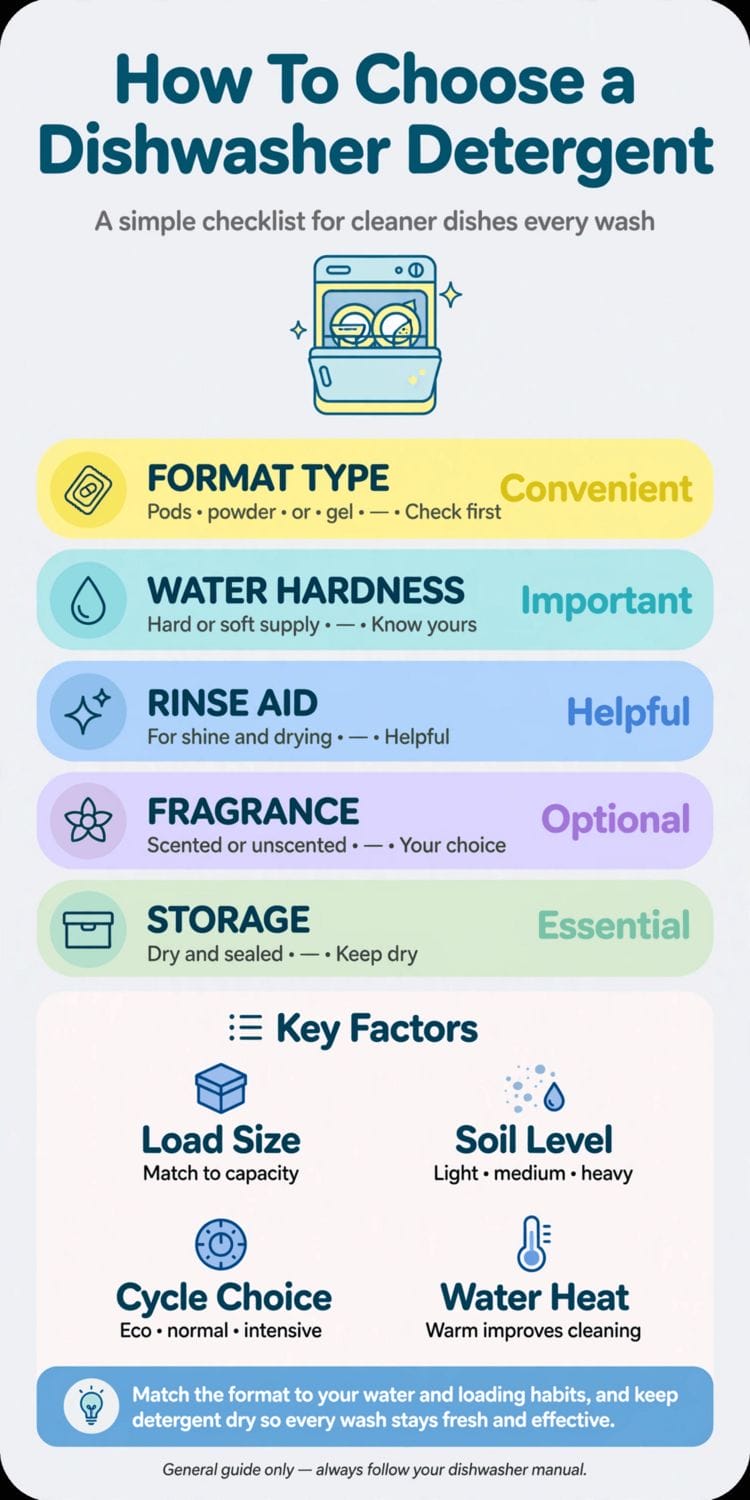
2. Start With Your Water: Hardness Decides

The first gallery shows the symptom that starts most detergent searches. Before comparing products, compare waters: hardness is the variable that decides how much detergent you need, which extras matter and why a product that shines in one kitchen disappoints in another.
1. Hard water leaves its signature
Hard water carries dissolved minerals, and a dishwasher concentrates them: the signature is cloudy film on glasses, spots that dry into marks and a slow dulling of stainless steel. If that is your picture, your problem is water chemistry first and detergent choice second — no format fully compensates for untreated hard water. The same minerals also build slowly inside the machine itself, which is why hard-water kitchens end up fighting the identical film on the dishwasher’s own steel.
2. Soft water needs a lighter hand
Soft water lets detergent work at full strength, so the same dose that struggles in hard water can overshoot here: too much detergent in soft water leaves its own film, slippery residue and, over time, a risk of permanently hazed glassware. Softer water generally means using less, not more.
3. Find out which water you have
Your local water supplier publishes hardness information, and simple test strips sold for home use give a quick kitchen answer. Knowing which side of the line your tap falls on turns detergent shopping from folklore into arithmetic: dose, salt and rinse aid all follow from this one fact.
3. The Formats: Powder
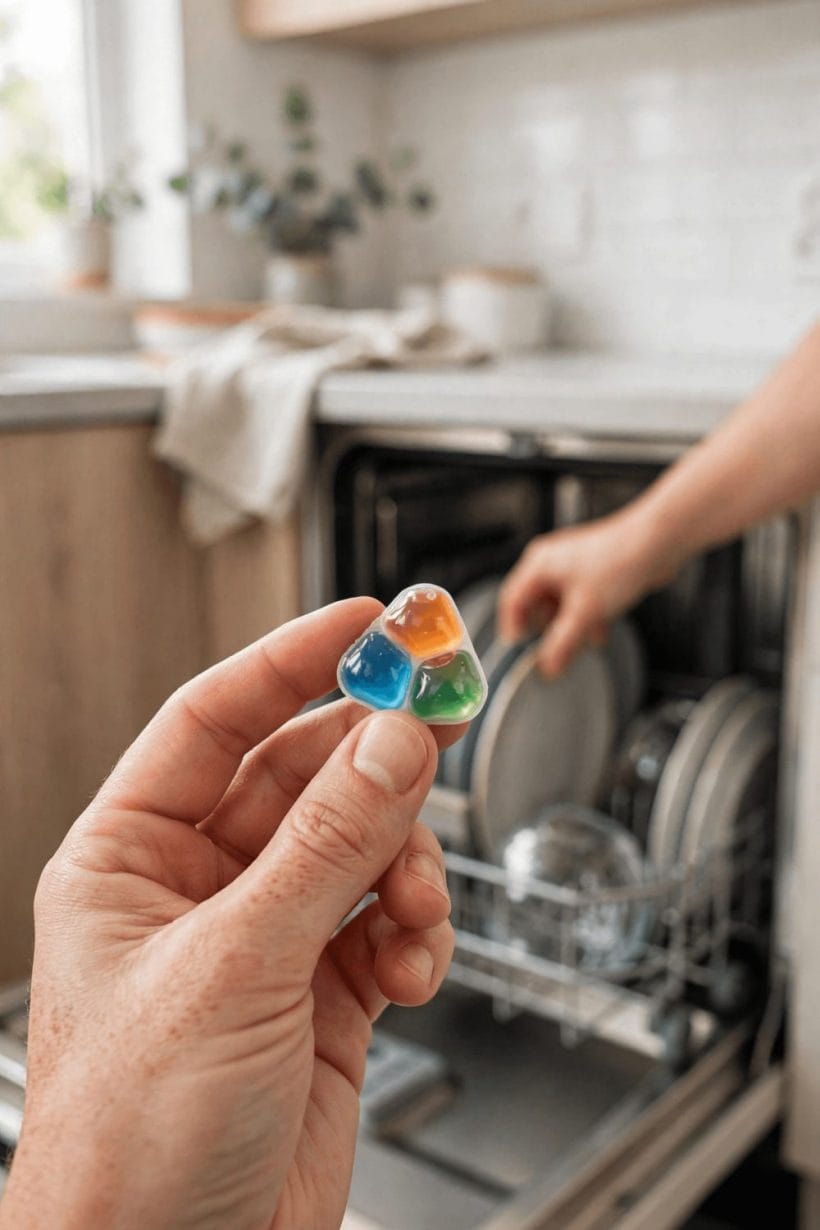
The pin opens the format tour with the oldest of the three. Powder is the flexible format — the one that lets you respond to your water and your load instead of accepting a fixed dose decided by a manufacturer.
4. Powder gives you dose control
With powder you measure the dose yourself: more for a baked-on casserole load in hard water, less for a light load in soft water. That adjustability is powder’s whole case, and for households whose loads vary wildly it is worth more than any single product feature.
5. Powder rewards dry storage
Powder absorbs moisture and clumps, and clumped powder doses badly and dissolves worse. Kept sealed in a dry cupboard away from the sink’s steam, it stays free-flowing and honest; left open in a damp under-sink space, it quietly becomes a different, worse product.
6. Powder suits deliberate washers
Powder pairs naturally with the habits in the later sections: choosing the dose per load, filling both dispenser cups when the machine offers them, and adjusting when the results say so. If you like a system you can tune, powder is the tuner’s format. The quiet bonus is economy of attention: one box serves every load in the house, from delicate glasses to the roasting pan, at the turn of a measuring spoon.
4. Gels and Liquids
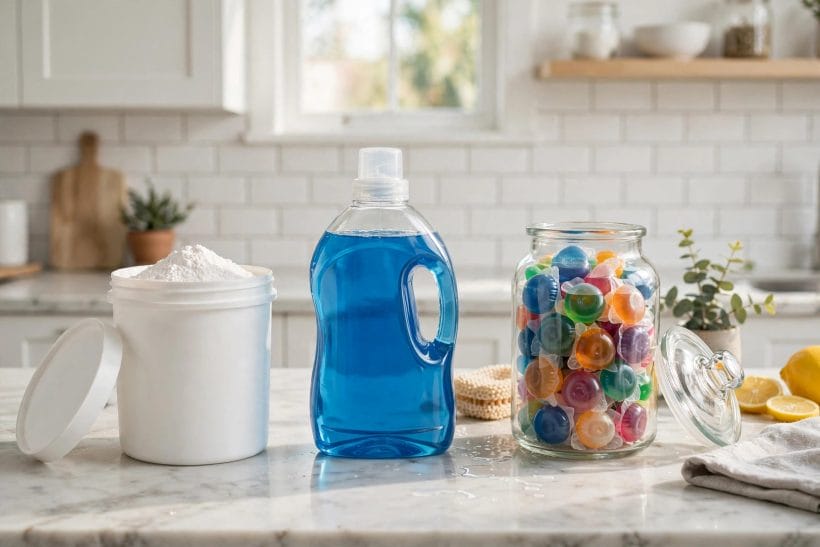
Gallery-2 shows the pourable format mid-dose. Gels and liquids trade powder’s punch for gentleness and speed, and understanding that trade is the whole of choosing them well.
7. Gels dissolve fast and suit short cycles
A gel is already dissolved, so it goes to work the moment the wash starts — an advantage on quick and eco cycles where a slow-dissolving dose may barely finish its work. For lightly soiled everyday loads on short programmes, gel is the format that keeps pace.
8. Gels are the gentler, weaker cleaners
The same mildness that makes gel kind to delicate loads makes it less determined on baked-on and dried-out soils. If your household’s loads lean towards roasting pans and porridge pots, gel alone will often leave you re-washing — a format mismatch, not a defective product.
9. Liquid doses are easy to overshoot
The pour that feels right is usually too much: gel clings, drips and measures generously. Overshooting wastes product and can leave residue that a correct dose would not. Use the dispenser’s fill lines rather than the bottle’s cap or your eye, especially in soft water. Cap the bottle straight after pouring and wipe its neck; small rituals, but they are what keep a gel dose honest from the first wash to the last.
5. Tablets, Pods and Capsules

Gallery-3 shows the pre-measured format in its place. Tablets and pods remove dosing from the decision entirely — which is their convenience, their cost, and their limitation, all in one compressed block.
10. Pre-measured means consistent
Every tablet carries the same dose, so results stop varying with whoever loaded the machine. For households that value repeatability over tunability — and for anyone tired of powder on the cupboard floor — that consistency is a genuine feature, not a gimmick.
11. All-in-one tablets bundle the supporting cast
Many tablets combine detergent with rinse-aid and water-softening functions in one dose. In soft-to-moderate water that bundle may be all a machine needs; in hard water the built-in softening has limits, and the separate systems later in this guide still earn their place. Read the bundle honestly, too: a tablet cannot know your water, and its fixed softening dose is a compromise struck for the average tap rather than for yours.
12. Pods demand dry hands and the dispenser
The film on pods dissolves on contact with moisture, so handle them dry and place them in the dispenser rather than the cutlery basket, where they can dissolve too early. Store them sealed, dry and — as with all detergents — out of children’s reach; the packaging’s own directions govern here.
6. Rinse Aid and Salt: The Supporting Cast

Gallery-4 moves from the detergent itself to its two supporting ingredients. Rinse aid and salt are constantly confused with each other and with detergent; these points separate their jobs.
13. Rinse aid is about drying, not washing
Rinse aid does not clean; it makes water sheet off surfaces in the final rinse so droplets drain instead of drying into spots, and loads dry faster and clearer. If your wash is clean but spotty and slow to dry, this reservoir — not a new detergent — is the first place to look.
14. Salt serves the machine’s own softener
Many machines carry a built-in water softener, and dishwasher salt is what regenerates it — the salt never touches the dishes. In hard-water homes this system is the difference between film and clarity, and it only works if the salt reservoir is kept filled and the machine’s hardness setting matches your water. Most machines announce an empty salt or rinse-aid reservoir with an indicator; believe it promptly rather than waiting for the glasses to deliver the same news.
15. Bundled functions have hard-water limits
An all-in-one tablet’s built-in softening handles everyday conditions, but in genuinely hard water the separate salt-and-softener system, correctly set, still does the heavier work. Treat the tablet’s extras as convenience for easy water, and the machine’s own systems as the answer for hard water.
7. What Your Machine’s Maker Says

Gallery-5 shows the most ignored authority in the whole subject. Before any shelf or guide — including this one — your machine’s own documentation has the first word, because dispensers, softeners and cycles differ by model.
16. The manual’s detergent pages come first
The manual states which formats the dispenser is designed for, how the softener should be set for your water, and how the rinse-aid dial should be adjusted. Those pages were written for your exact machine; no general guide, however careful, can overrule them.
17. Follow the maker’s format and dose guidance
Where a maker recommends a format or a dosing approach for a model, it is usually because the dispenser’s timing and the programme design assume it. Depart from the guidance if you like — but depart knowingly, and judge the results against the recommended baseline first.
18. Care instructions are part of the system
The same documentation covers the filters, spray arms and cleaning routines the wash depends on. Detergent cannot compensate for a clogged filter or a blocked arm; the maker’s care schedule is the quiet half of clean dishes, and it costs nothing but attention.
8. Reading a Detergent Label

The second pin turns to the box itself. Labels mix genuine information with decoration; these points sort the ingredient families and claims into what a chooser actually needs to know.
19. Learn the ingredient families, not the slogans
Behind the marketing sit a few working families: builders that handle water hardness, enzymes that digest food soils, oxygen-based bleaches that lift stains, and surfactants that help water wet and rinse. A label that tells you which families are present tells you more than a page of superlatives. Manufacturers are not obliged to print a full recipe, but the presence of enzymes and oxygen-based bleach is commonly declared in product descriptions and safety information — which is where a careful reader looks.
20. Treat environmental and fragrance claims precisely
Claims about phosphates, fragrance and packaging describe real choices — gentler formulations, scented or unscented washes, plastic wrapped or unwrapped — but they describe the product’s footprint and perfume, not its cleaning rank. Choose them on your own values; do not mistake them for performance grades.
21. The warnings and directions are information too
Storage instructions, child-safety warnings and dosing directions are the label’s least glamorous and most honest text. They tell you how the product behaves in a real kitchen — moisture-sensitive, dose-critical, to be kept from children — all of which is choosing information.
9. Habits That Matter More Than Brand
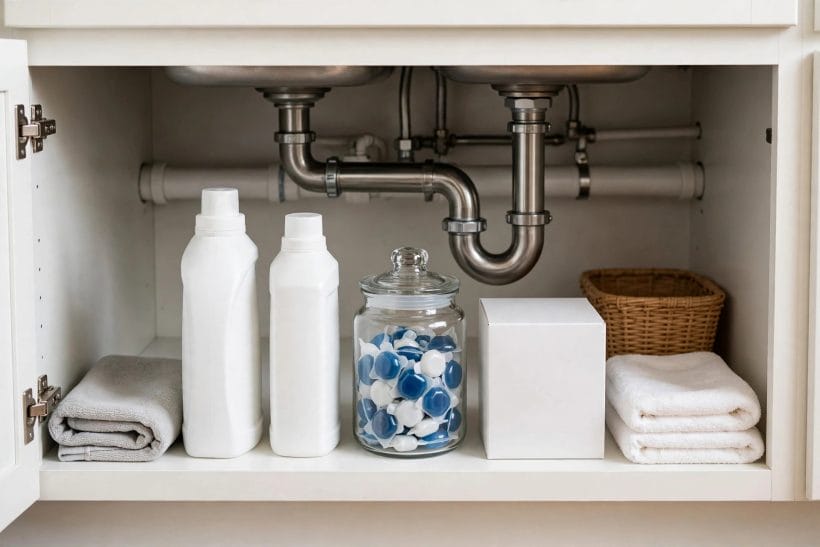
Gallery-6 shows the variable no shelf sells. Most disappointing washes are loading and running failures wearing a detergent’s name; these habits fix more kitchens than any product change.
22. Loading decides what the spray can reach
Water must reach every surface: plates spaced, bowls angled down, nothing nesting inside anything else, tall items clear of the spray arms’ rotation. A perfectly chosen detergent cannot wash a plate it never touches, and most ‘detergent failures’ are shadows cast by other dishes.
23. Scrape, do not pre-rinse
Modern detergents — especially enzyme-bearing ones — are formulated to work on food soil, and modern machines sense how dirty the water is. Scrape the chunks into the bin and load the rest as it comes: pre-rinsing wastes water and can leave detergent with nothing to do but attack your glassware. If a household’s glasses cloud in a machine whose loads always go in pre-washed, this habit — not the detergent — is the first suspect to eliminate.
24. Match the cycle to the load
The eco cycle with a light load and the intensive cycle with a baked-on one are different tools; running everything on one programme and blaming the detergent is the commonest household error. Let the machine’s programmes, chosen honestly, do the work they were designed for.
10. Troubleshooting: When Results Disappoint
The guide ends with the method for when the glasses still come out wrong. Work through these distinctions before changing products, because each symptom has its own cause and its own fix.
25. Separate filming from etching
A cloudy film that wipes or washes off points to mineral deposits or detergent residue — water and dose questions. A cloudiness that will not shift, worst on favourite glasses, may be etching: permanent surface damage, associated with soft water, high heat and too much detergent over time. The distinction decides whether to adjust or to grieve.
26. Grit and residue point to the machine, not the box
Gritty particles redeposited on dishes, food left in corners, a musty smell — these implicate the filter, the spray arms and the loading pattern far more than the detergent. Clean what the manual tells you to clean, re-check the arms spin freely, and only then suspect the product.
27. Change one variable at a time
The troubleshooter’s rule: alter the dose, or the rinse aid, or the hardness setting — never all three at once, or you will never learn which one worked. Keep a simple note of each change and its result, and within a few washes your kitchen will have told you its own answer. The written note matters more than it sounds: memory flatters every product change, while a few dated lines about dose and result do not.
Final Considerations
Choosing dishwasher detergent well is mostly an act of diagnosis: know your water, respect your machine’s own guidance, pick the format whose trade-offs suit your loads, and keep the supporting systems — rinse aid, salt, filters — in honest working order. Do those things and the space between a modest product and a celebrated one narrows to almost nothing.
When results disappoint, resist the shelf’s invitation to start again with a new box. Work the troubleshooting order instead — water, dose, loading, machine care, and only then the product — and you will usually find the fault was never in the detergent at all.




0 Comments