

A range that vents downwards instead of up into a hood sounds like a neat trick — and it can be, if your kitchen suits it. Before you fall for the clean lines, work through what a down draft gas range asks of your space, your ducting and your cooking habits.
This guide is a checklist, not a sales pitch: measure honestly, ask the awkward questions early, and confirm every detail against the manufacturer’s own instructions.
1. Down Draft Gas Range Checks At a Glance
| Question | What To Check | Where To Confirm |
|---|---|---|
| Will it fit my space? | The stated width, depth and height against your measured gap, plus clearance to nearby units and walls | The manufacturer’s dimension guide for the exact appliance |
| Can the venting work here? | Whether the extracted air has a realistic route out, or whether a recirculating arrangement is offered and suitable | The installation manual and a site visit from your installer |
| Is my gas supply suitable? | The supply type, its location and whether any alteration is needed | A qualified gas professional working to local rules |
| How do I actually cook? | How often you use tall stockpots, woks, griddles or several pans at once | Your own habits — be honest before you buy |
| What about the oven? | Whether the oven type, capacity and cleaning method suit your cooking | The product literature for the specific appliance |
| How will I clean it? | Which parts lift out, which filters need washing or replacing, and how often | The care guide supplied with the appliance |
| Who installs and signs off? | Whether installation, connection and any certification are included or arranged separately | Your retailer and installer, in writing, before delivery day |
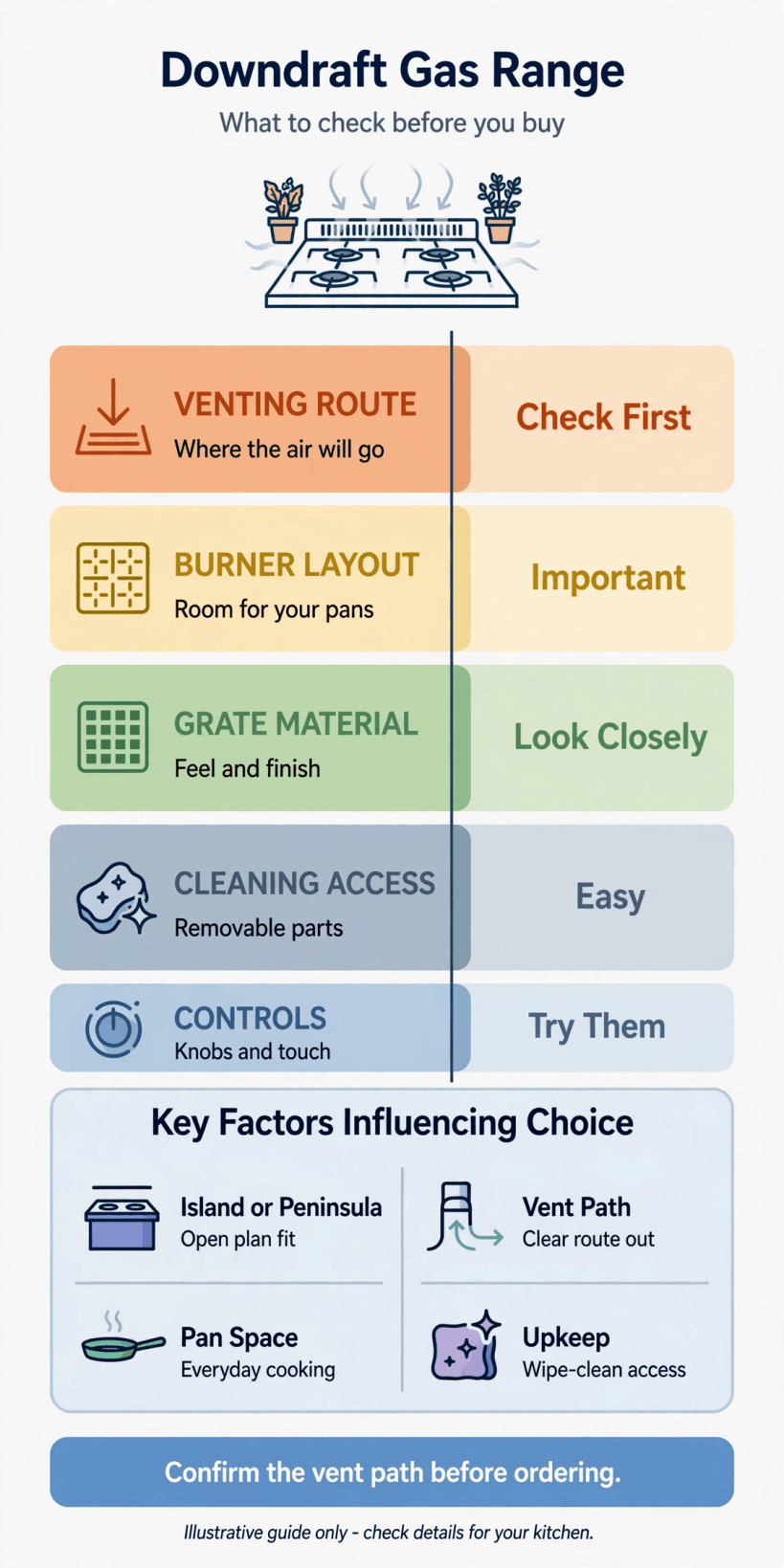
The seven questions to answer before you buy: fit, venting, supply, cooking habits, oven, cleaning and installation.
Work down the table in order, because the early answers shape the later ones. A range that fits the gap but has no workable vent route is the wrong range for that kitchen, however much you like its looks. Equally, a model with a vent route but an oven that fights your Sunday routine will annoy you for years. Keep your measurements, photographs of the space and the manufacturer’s documents together in one folder; every conversation with a retailer or installer gets easier when the facts are in front of you.
2. What Downdraft Venting Does — and What It Cannot Do
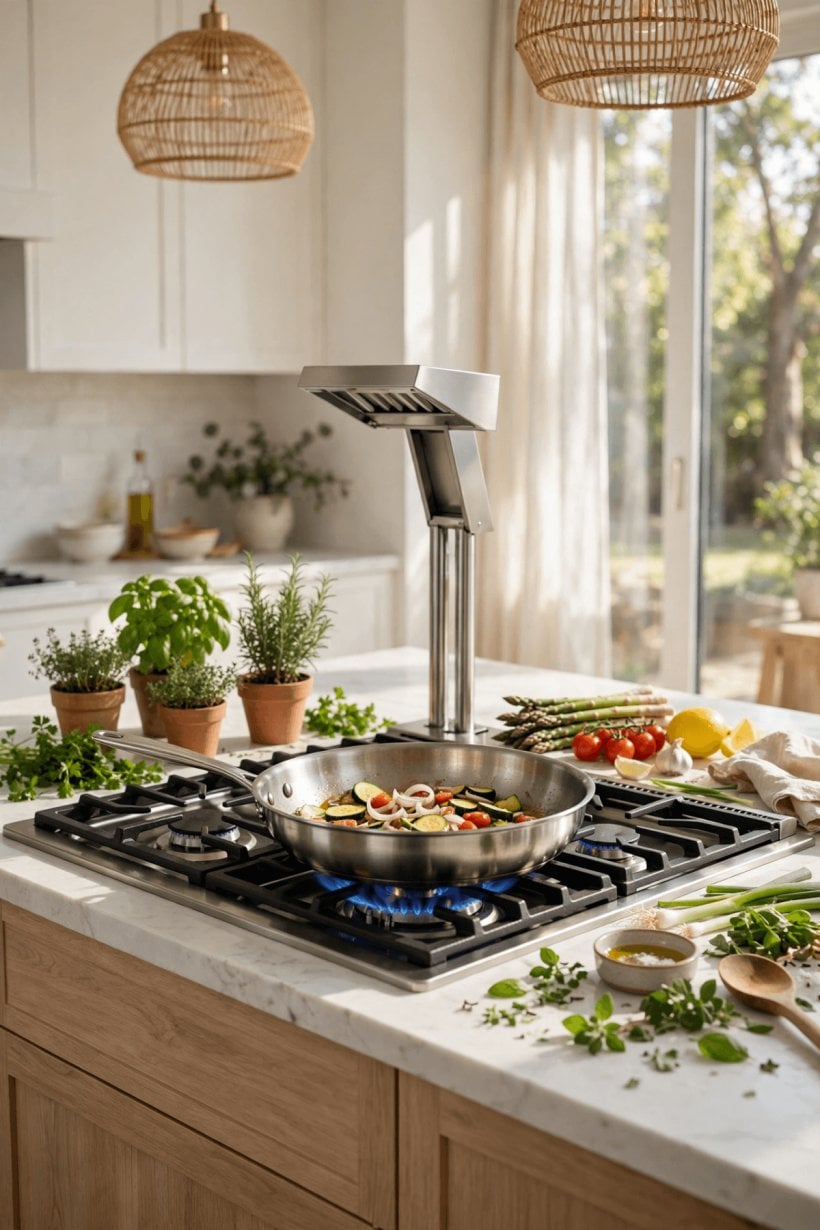
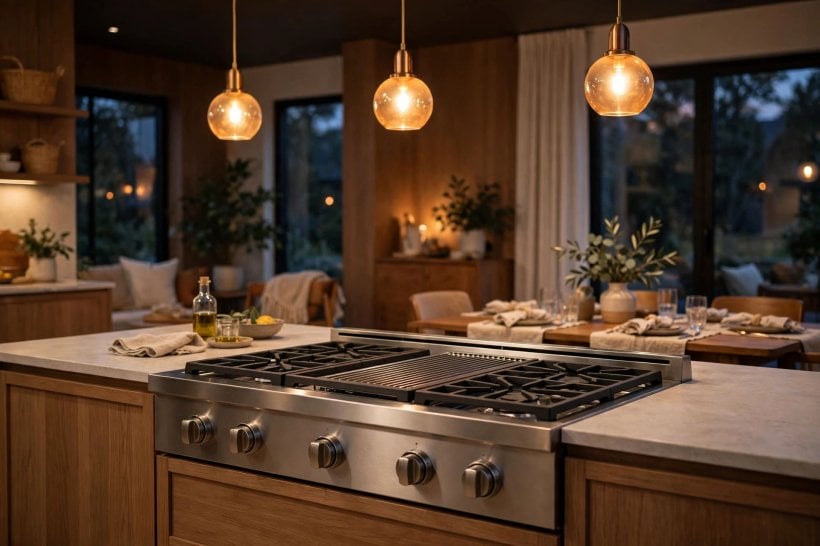
A downdraft system draws cooking steam, grease and odours downwards, through or beside the cooking surface, instead of relying on a hood above. The vent may sit behind the burners as a strip that rises when needed on some designs, or be built into the surface layout on others — designs vary, which is exactly why you should study the specific appliance’s manual rather than general descriptions, including this one. The attraction is clear: no overhead hood, open sightlines across an island, and a cooktop that works in front of a window where a hood would block the view.
The honest limits matter just as much. Steam from a tall pot starts its journey high above the surface, and any downward system has to work harder to catch it than a hood hovering overhead. Cross-draughts from doors and windows can pull steam away before the vent catches it. None of this makes the format wrong — it makes your cooking style the deciding factor. If most of your cooking is frying, simmering and oven work in ordinary pans, the format may suit you well; if you regularly boil huge stockpots, ask searching questions and read the manufacturer’s guidance on pan heights and vent use. The planning mindset in this tiny house kitchen design guide — matching equipment honestly to space and habits — is exactly the mindset to bring here.
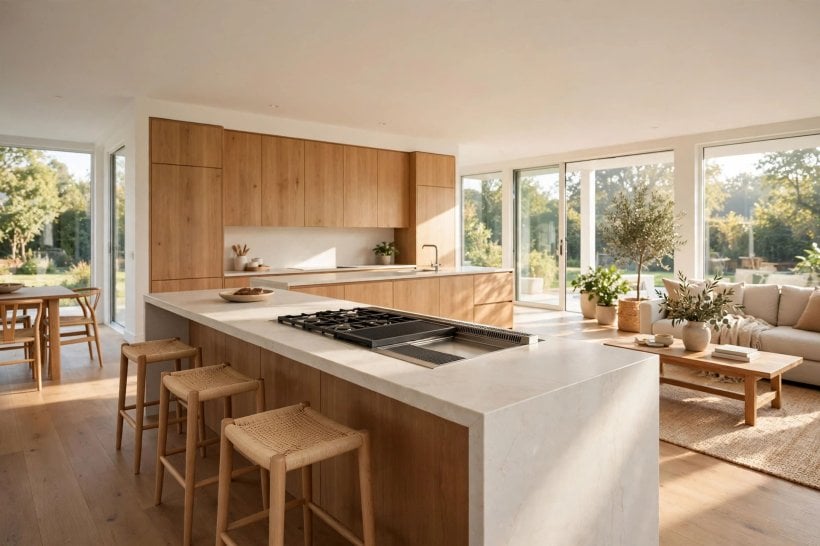
3. Measure First: Width, Depth and the Space Around
Every successful appliance purchase starts with a tape measure, and this format is less forgiving than most because the venting lives inside or behind the cabinet run. Measure the gap width at counter height and at floor level, the depth from the wall to the front of the units, and the route below: is the under-counter space empty, or do drawers, an oven housing or pipework already live where ducting might need to pass? Photograph everything, including the floor and the wall behind your current cooker if you can move it safely, or ask your installer to survey before you order.
Use the manufacturer’s stated dimensions for the exact model — never a retailer’s rounded summary — and compare them line by line with your measurements. Check clearances the manual asks for beside walls and tall units, the space needed for the oven door to open fully, and whether handles or knobs project beyond your worktop line. If your kitchen is compact, the discipline in these kitchen ideas for tiny houses and small spaces applies: in a small room, centimetres and door swings decide whether a big appliance feels generous or obstructive. Write the numbers down and take them shopping; memory is a poor measuring tool.

4. Venting Routes: Ducted, Ductless and Existing Ductwork
Where does the air go? That single question decides whether this purchase is straightforward or complicated. A ducted arrangement carries extracted air outside, and the route — down through the floor, along under the units, or through a wall — needs space at every step, with as few sharp turns as the installer can manage. An island position, the classic home for this format, often means the duct must travel under the floor, which is a very different conversation in a room with a solid floor than in one with a suspended timber floor and access below.
Some arrangements recirculate air through filters instead of ducting it out. If you are considering one, ask what the filters are, how often they need attention, whether replacements are readily available, and what the manufacturer says the arrangement does and does not remove — steam, in particular, behaves differently from grease and odours. Existing ductwork from a previous appliance is not automatically reusable: its size, route and condition all need checking against the new appliance’s requirements. Bring your installer into this conversation before you buy, not after delivery, and if your home project is wider than one appliance, the whole-space planning in this tiny house and small-space interior design guide will help you sequence the trades sensibly.

5. Gas Supply, Electrical Needs and Safety Checks
A gas cooking appliance connects to your home’s gas supply, and that connection is professional work. Before you buy, confirm what supply you have, where the connection point sits relative to the new appliance’s position, and whether the work needed is a simple connection or a reroute. Rules for gas work, ventilation of the room itself and who may legally carry out the work vary by place, so follow your local requirements and use appropriately qualified professionals; your installer and the manufacturer’s instructions are the authorities here, not general articles.
Do not forget the electrical side: ignition, controls, the vent motor and any oven functions all need power, and the manual will state what supply arrangement the appliance expects. Ask whether an existing socket or circuit suffices or whether an electrician joins the cast list. Safety checks to discuss include flame-failure features as described by the manufacturer, the room’s ventilation provisions, and carbon monoxide awareness for any gas-burning home — a working alarm appropriate for your home is a sensible companion to any gas appliance, and your gas professional can advise on placement. If a seller cannot answer these questions clearly, treat that as information in itself.

6. Burners, Oven and Everyday Cooking Questions
Specifications are only useful when translated into your dinners. Instead of comparing headline numbers in isolation, ask how the burner layout handles your real pans: your largest frying pan and your smallest milk pan, side by side; a stockpot centred where the vent can help, not stranded at the far corner; a wok, if you use one, and what support the manufacturer offers for it. Ask how the burners behave at a gentle simmer as well as at full power, because low, controlled heat is where many cooks feel the difference day to day, and confirm those answers in the product literature rather than relying on a showroom chat.
Then open the oven door — in a showroom if you can. Take your biggest roasting tray and your favourite casserole with you, literally or as measurements, and check they sit comfortably on the shelves. Ask how the oven heats, how its cleaning arrangement works in practice, and whether features you are paying for match meals you actually cook. A household that roasts twice a week needs different things from one that bakes, and both differ from a household where the oven mostly reheats. Honest answers here prevent the commonest disappointment: an impressive appliance that quietly fights your routine, a mismatch the calm planners behind these home designing ideas for a tiny house would spot a mile off.
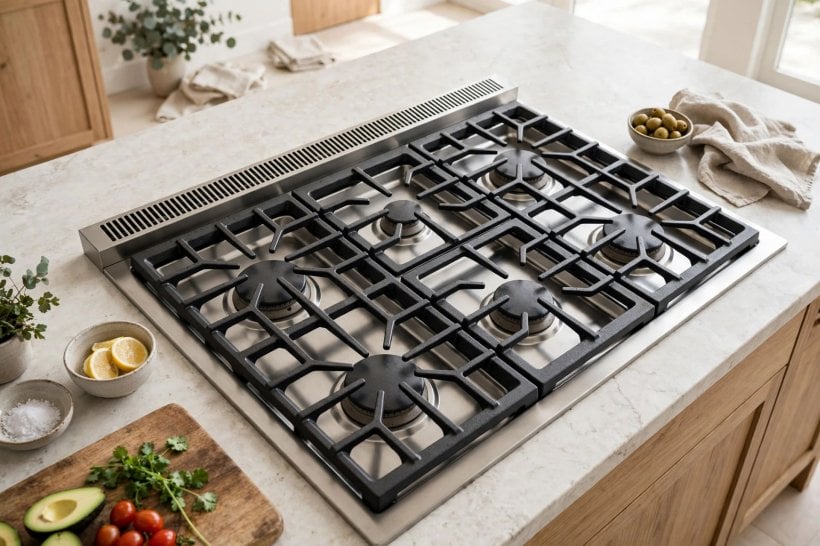
7. Controls, Cleaning and Living With It Daily
You will touch the controls every day, so test them like it matters: are the knobs or touch controls readable at a glance, usable with wet hands, and placed where a passing child or a swinging tea towel cannot nudge them? Where do the controls sit relative to the vent, and do they stay clean or collect grease? If the vent rises and lowers, operate it several times — listen to it, and imagine that sound across a quiet breakfast. Small frictions compound; small pleasures do too.
Cleaning deserves the same realism. Ask which parts lift off for washing, how the vent area and its filters are reached, and what the care guide actually recommends — then picture yourself doing it on a Sunday, not in a showroom. Spills head downwards in this format by design, so ask where liquids go and how that area is cleaned. Finishes differ in how honestly they show splashes; a darker or brushed surface may suit a busy household better than a mirror shine. If the household includes enthusiastic young cooks, weigh up control locks and other safety features the manufacturer describes, and plan where hot pans will land mid-cooking, the same landing-space question that matters in these apartment interior design ideas for tiny houses.

8. Installation Day: What To Ask Your Installer
Good installation is arranged long before the van arrives. Ask your installer to confirm, in writing, what the job includes: disconnecting and removing the old appliance, any gas or electrical alterations, building or adjusting the duct route, sealing and finishing around the new unit, testing every function, and registering or documenting the work as your local rules require. Ask what they need from you — cleared units, access under floors, pets elsewhere — and what could stop the job on the day, so surprises are priced and planned rather than discovered at lunchtime with the kitchen in pieces.
Ask also about the order of operations if other work is happening: flooring, worktops and tiling all interact with a range installation, and fitting the appliance at the wrong moment can damage finished surfaces or leave awkward gaps. Confirm who supplies ducting parts and trims, and keep the appliance’s packaging and documents until the installation is signed off and you have cooked on it. A careful installer will welcome these questions; they are the same questions on any well-run project list, much like the sequencing advice running through this tiny house living room ideas collection, where trades and finishes are planned as one job, not separate surprises.
9. Comparing Options Fairly: Paper Promises vs Life At Home
Comparison is where buyers most often mislead themselves, because brochures emphasise different things. Build your own shortlist table with the same rows for every candidate: dimensions against your gap, venting arrangement and route, fuel and electrical needs, burner layout against your pans, oven size against your trays, cleaning routine, warranty terms as stated by the manufacturer, and the full installed cost picture — appliance, parts, installation and any building work — using quotes you have actually obtained rather than guesses. A range that looks costly alone can look different once another option’s ducting work is priced in, and vice versa.
Read reviews for patterns, not verdicts: repeated comments about cleaning, vent noise or control feel are worth more than any single star rating, and always check whether a review describes the same format and a similar kitchen to yours. Where a claim matters to you — extraction performance, oven evenness, reliability — look for the manufacturer’s own published information and treat anything you cannot verify as unproven. If two options still tie, choose the one whose cleaning and daily controls you liked more in person; those are the interactions you will repeat thousands of times, long after the showroom shine is forgotten.
10. Running Costs, Care and Long-Term Ownership
Ownership costs are quiet but real, and they are mostly within your control. Filters that need replacing, professional servicing if the manufacturer recommends it, and the energy your cooking style uses all add up over years; ask what the care schedule looks like before you buy, and note it in the appliance folder with your receipts and warranty documents. Keep the area around burners and the vent clean as the care guide directs, because a vent path kept clear does its job better than a neglected one — and follow the manufacturer’s instructions over any generic cleaning tip, including ours.
Think about longevity practically: are spare parts and filters for this appliance easy to obtain, is there a local service network, and what exactly does the warranty cover and exclude, in the document itself rather than the sales summary? Register the appliance if the manufacturer offers it, keep proof of professional installation, and store the manual where the household can find it. A range is a decade-long relationship in most homes; the buyers who enjoy it longest are rarely the ones who chose fastest, but the ones whose questions were answered before the deposit, a patience that pays off across every room in these living room paint ideas for a tiny house just as much as it does in the kitchen.
Final Considerations
A downdraft design can be a genuinely elegant answer for an island or a window-side cooktop — provided the vent route works, the supply is right, and the format matches how you cook. Measure first, question the venting, translate every specification into a real meal, and get installation answers in writing. Do those four things, confirm the details against the manufacturer’s own documents, and whichever range you choose will have earned its place in your kitchen.



0 Comments