
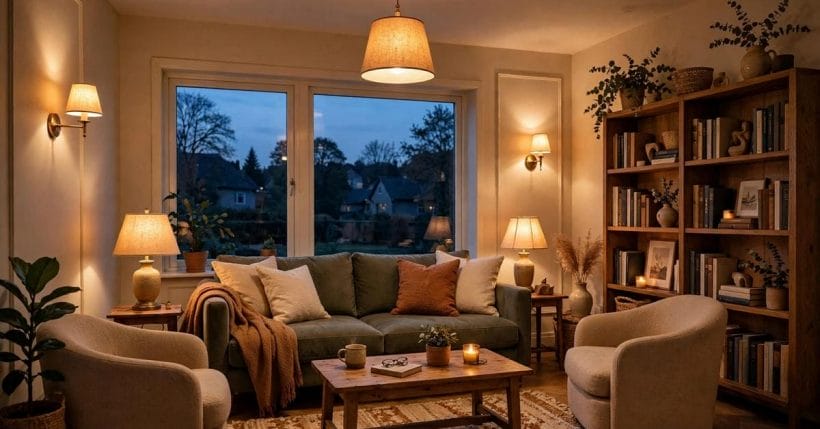
Two rooms can hold the same furniture and feel entirely different, and the difference is usually the light — one flat bulb in the middle of the ceiling flattens everything it touches, while layered light gives a room depth, warmth and purpose.
This guide gathers the lighting advice that holds up in real homes: build in layers, size fixtures to the room, keep the colour of the light consistent, and put the light where life actually happens.
1. Home Lighting at a Glance
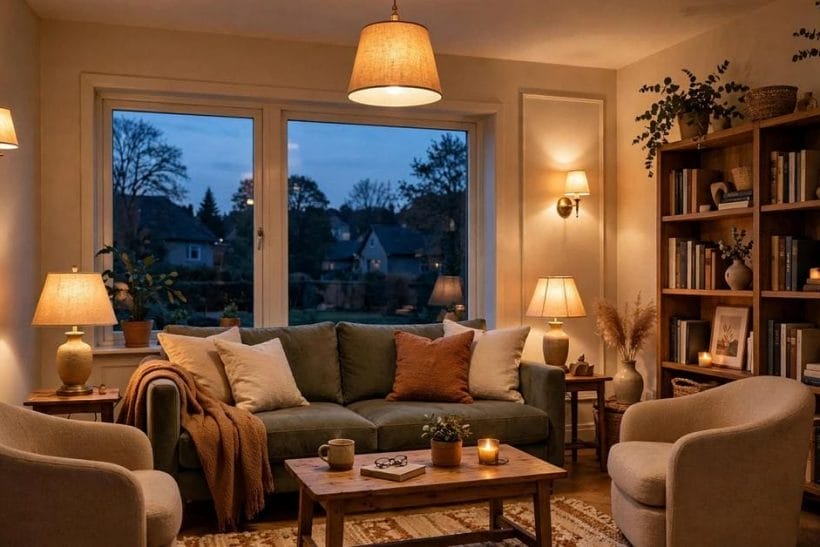
Good lighting is rarely about a single beautiful fitting. It is about several modest sources doing different jobs at once — the layered approach behind the welcoming rooms in kitchen ideas and every other well-planned space on this site. One layer washes the room in general light, one aims at the work, and one picks out the things worth looking at.
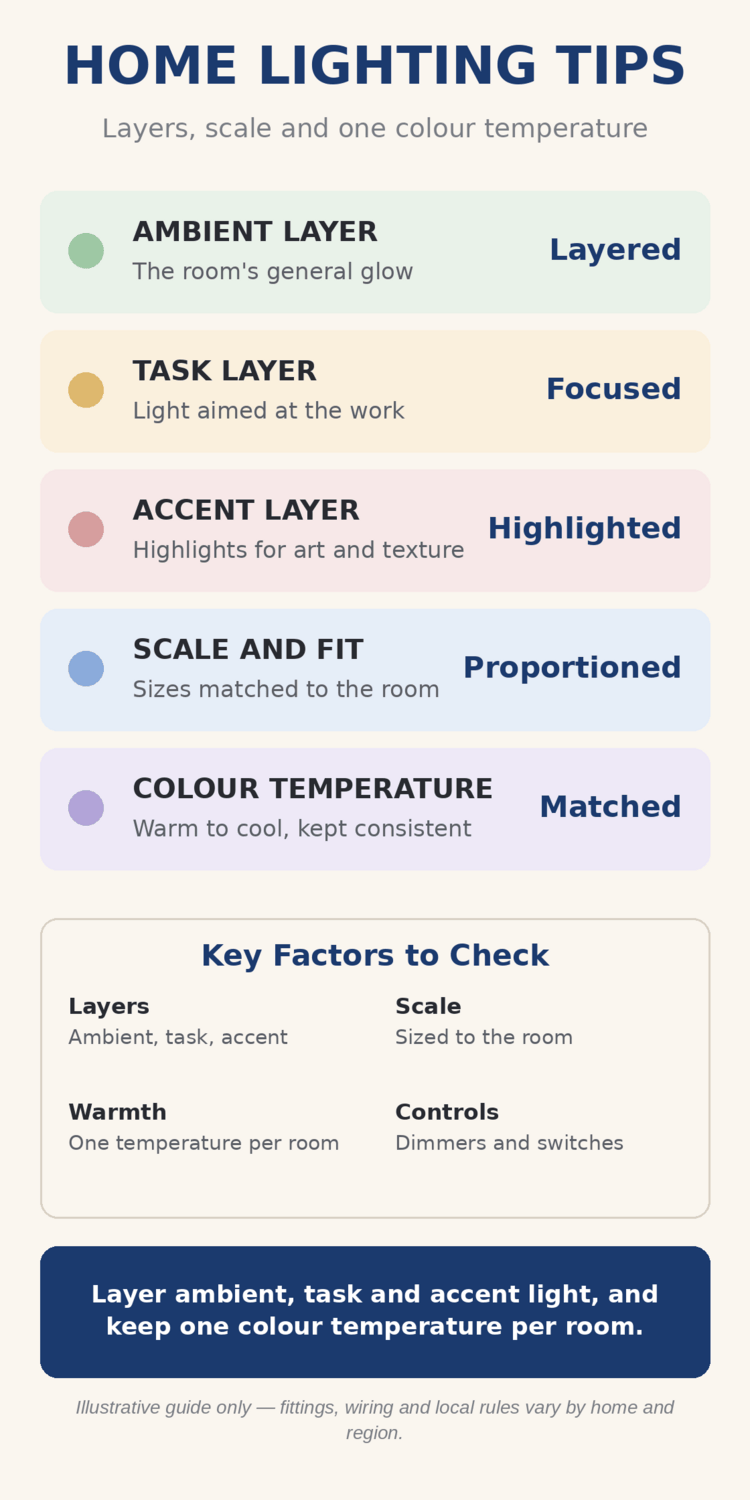
The five parts in the table below are the whole method in miniature. None of them needs a designer, and together they explain why a room with three ordinary lamps so often feels better than a room with one expensive chandelier.
| Family | Character | What it means |
|---|---|---|
| Ambient Layer | The room’s general glow | Layered |
| Task Layer | Light aimed at the work | Focused |
| Accent Layer | Highlights for art and texture | Highlighted |
| Scale and Fit | Sizes matched to the room | Proportioned |
| Colour Temperature | Warm to cool, kept consistent | Matched |
Everything that follows is stated in general terms, because rooms differ. Treat the principles as the fixed part — layers, scale, consistency — and your own ceiling heights, window directions and habits as the part that tunes them.
2. Start With the Ambient Layer
Ambient light is the room’s base layer: the even, general glow that lets you move about and see the room as a whole. Ceiling fittings provide much of it, but a single central fitting is the weakest way to make it — it throws light down in a pool, leaves the corners dark and puts glare in the eyes of anyone facing it.
Spread the Base Light Around
Several smaller sources spread around the room beat one big one in the middle. Recessed spots in a loose grid, a pair of wall lights, a shaded pendant — the fitting matters less than the spread. When the base light comes from more than one direction, faces soften, corners open up and the room stops looking like a stage set.
Let Daylight Do Its Share
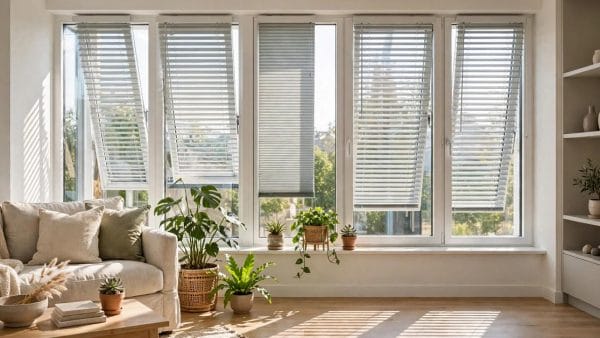
Daylight is the finest ambient light there is, and the fittings should be planned around it rather than against it. Notice which way the windows face and where the sun falls at the hours the room is used; the artificial layer then only has to fill the gaps daylight leaves, at the times daylight leaves them.
Bounce Light Where You Can
Light bounced off a pale ceiling or wall arrives softer than light aimed straight down. Uplighters, shaded pendants and fittings that throw some of their light upward all use the room’s own surfaces as a diffuser — one reason pale ceilings, the subject of so much of the ceiling design ideas cluster, earn their keep in a lighting plan.
3. Task Lighting Where Work Happens
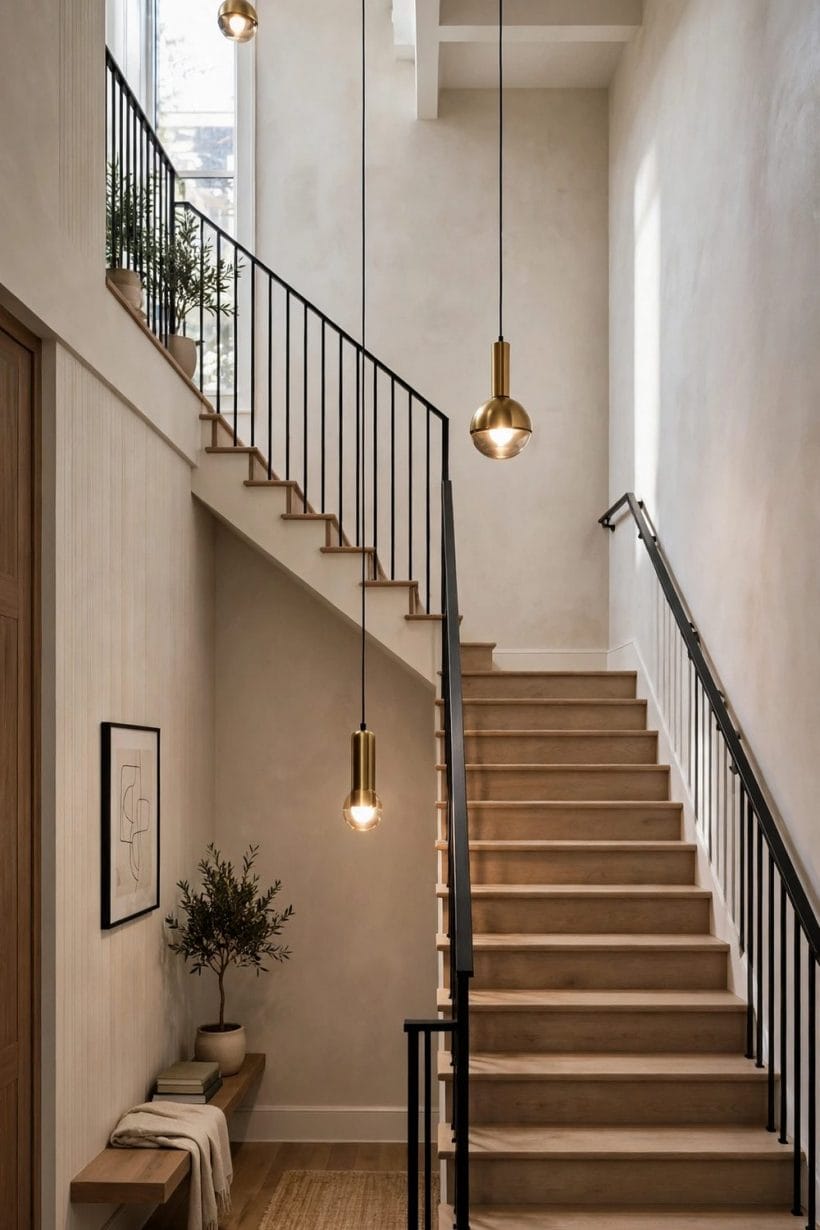
Task light is aimed light: brighter, closer and pointed at the thing being done — chopping, reading, sewing, shaving, writing. Most lighting complaints in a home are really task-light complaints: the room is lit, but the work is in shadow, often the worker’s own.
Put the Light in Front of the Work
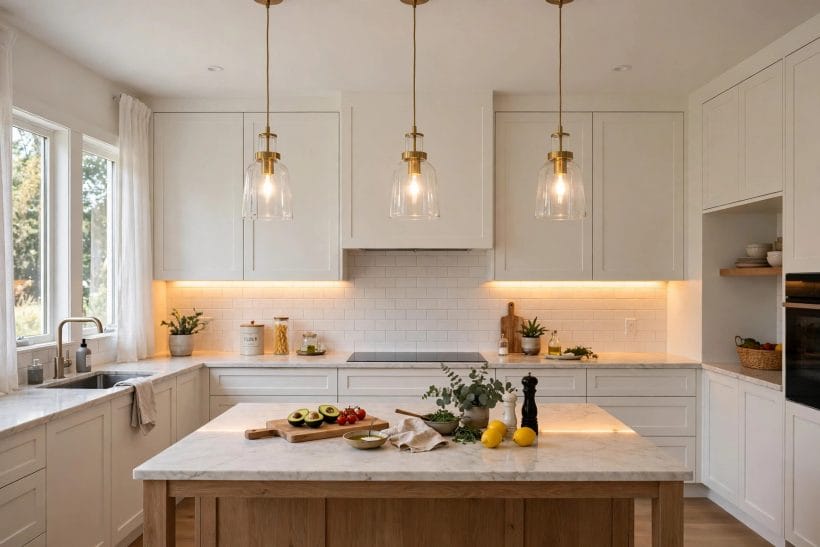
A task light should fall on the work from the front or the side, never from behind the person doing it. Under-cabinet strips light a kitchen worktop without the cook’s shadow; a lamp beside a reading chair lights the page, not the back of the head. Position first, brightness second — a modest lamp in the right place beats a powerful one in the wrong place.
Mirrors Want Light From Both Sides
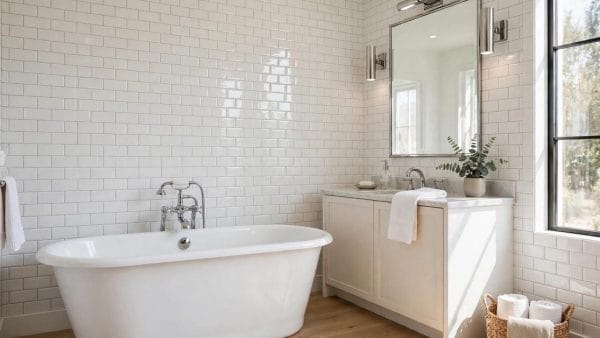
The bathroom mirror is the classic task-light failure: one fitting above the mirror lights the top of the head and shadows the face. Fittings at face height on both sides, the arrangement used throughout the bathroom ideas cluster, light the face evenly and make shaving and make-up honest work.
Make Task Lights Adjustable
Work moves, so task lights should move with it. Anglepoise lamps, swing arms, spot bars that can be re-aimed and plug-in lamps that can migrate between rooms all let the light follow the task. Fixed fittings are for the base layer; flexibility belongs to the layer you aim.
4. Accent Light for Art and Texture
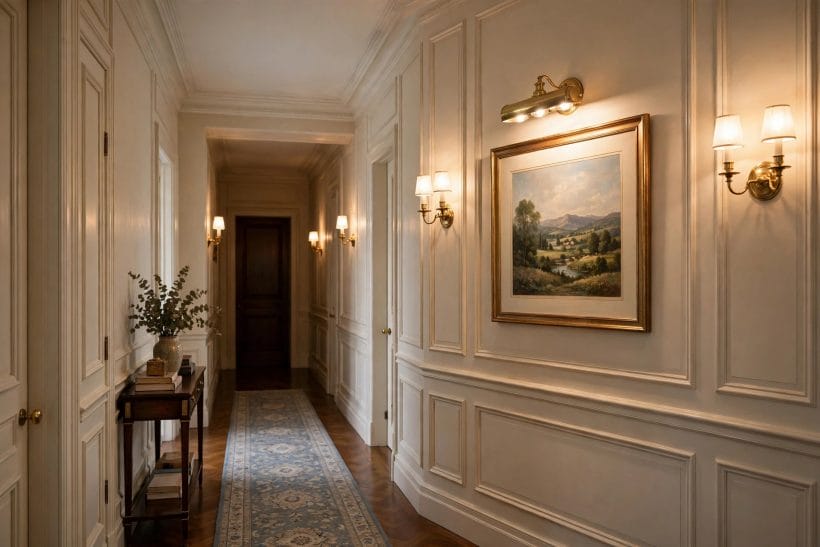
Accent light is the layer that makes a room interesting: a narrow beam on a picture, a wash down a stone wall, a small lamp glowing inside a bookcase. It contributes little to seeing by, and a great deal to how the room feels — it is where a home stops looking lit and starts looking intended.
Pick Out What Deserves It
Choose two or three things per room, no more: a painting, a plant, a textured wall, a shelf of objects you love. Accent everything and you accent nothing — the eye needs the quiet parts of the room to make the lit parts sing.
Mind the Glare Line
A picture light or spot should be angled so its beam lands on the work and its source stays out of the sightline of people sitting in the room. If you can see the bare bulb from the sofa, the fitting needs a shade, a baffle or a different angle.
Small Lights, Low Down
Not all accent light points at pictures. A small lamp on a low shelf, light inside a glazed cabinet, or a glow at skirting level along a hall gives a room its evening depth. Low, warm points of light are what make the tall spaces in cathedral ceiling ideas feel intimate instead of echoing after dark.
5. Scale: Fixtures Sized to the Room
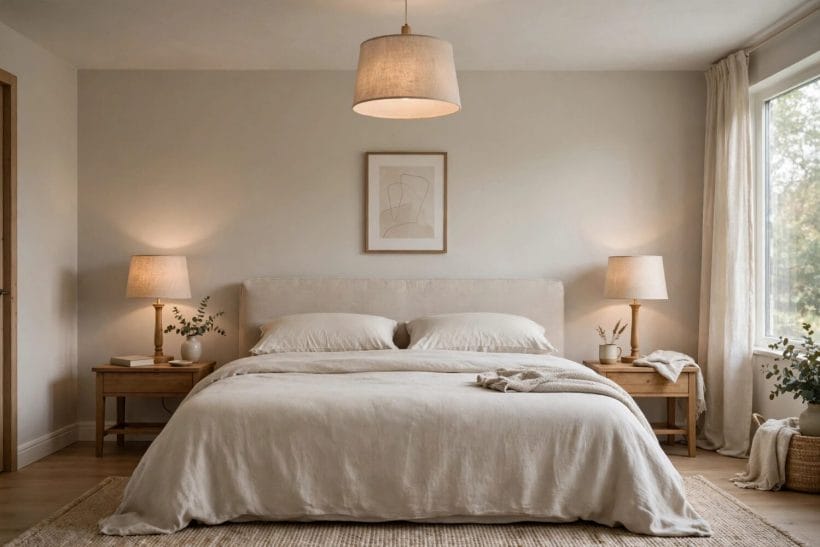
The commonest fitting mistake is not style but scale: a pendant the size of a dinner plate lost over a long table, or a chandelier so large it bullies a small room. Fittings are furniture in the air, and they obey the same rule as furniture — proportioned to the space they serve.
Match the Fitting to the Surface Below
A light over a table reads against the table, not the room. A pendant or group of pendants should sit comfortably within the table’s footprint and look deliberate from the doorway: too small reads as an apology, too large as an invasion. For a ceiling fitting with nothing below it, judge it against the room’s whole floor area.
Share the Load Across Fittings
When a room needs a lot of light, the answer is usually more fittings, not a bigger one. A row of three modest pendants over an island or table spreads light and shadow evenly, where one huge fitting concentrates both. Multiples also give the room rhythm — a run of fittings is a design feature in itself.
Leave Room for People
Scale is vertical as well as horizontal. A hanging fitting must clear heads, doors and sightlines: over a table it can hang lower, since nobody walks through a table; over a walkway it must sit high enough to forget. Measure the drop against the tallest person in the house, not the average.
6. Placement in General Terms
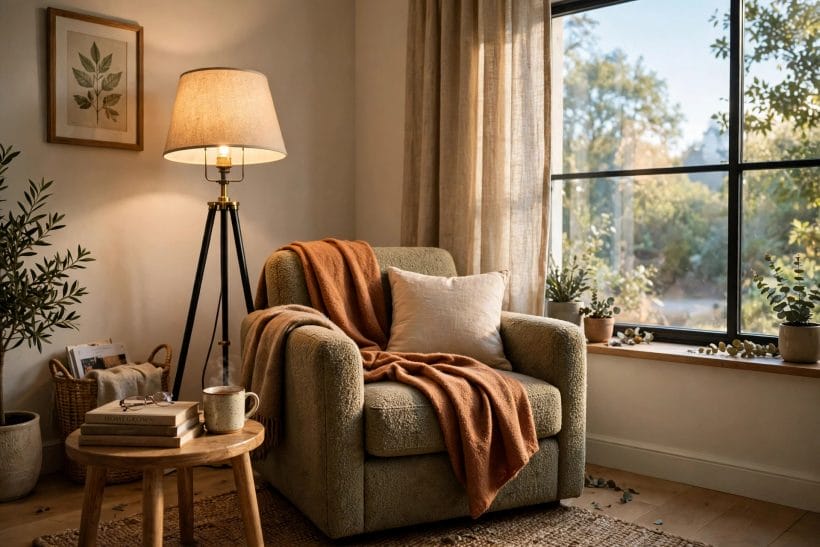
Placement turns a pile of fittings into a plan. The principles are few and forgiving: light the edges as well as the middle, keep sources out of the direct sightline, and think about the room from the chair, not from the ceiling plan.
Light the Walls, Not Just the Floor
A room feels larger when its walls are gently lit and smaller when only the floor is bright. Wall washers, sconces and lamps near the walls push the boundaries outward — the same trick that makes the small spaces in the how to lighten a dark room guide feel twice their size.
Work in Odd Numbers and Pairs
Pairs give symmetry where a room wants calm — either side of a bed, a mirror, a fireplace. Odd groupings — three pendants, a trio of lamps at different heights — give energy where a room wants life. Mixing the two across a house keeps it from feeling like a showroom.
Plan the View From the Seat
Before fixing anything, sit where people will sit and look where they will look. Glare that is invisible standing in the doorway glares for hours from the sofa. The cheapest lighting consultation in the world is ten minutes spent sitting in the room at night with the fittings held, taped or imagined in place.
7. Colour Temperature, Kept Consistent
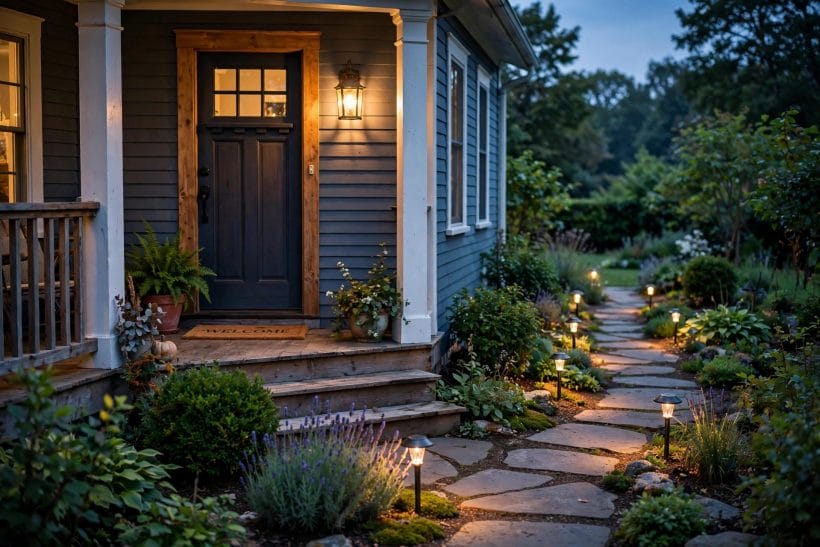
Every white bulb is somewhere on a scale from the warm amber of candlelight to the cool blue of an overcast sky, and manufacturers print that position on the packaging as the bulb’s colour temperature. The figure itself matters less than the habit of reading it — and of keeping it consistent.
One Temperature Per Room
The single most common lighting fault in homes is a muddle of temperatures in one room: a warm lamp in one corner, a cool white fitting in the middle, each making the other look wrong. Choose a temperature for the room — warm for living and sleeping spaces is the usual instinct, crisper for worktops and workshops — and buy every bulb in that room to match.
Warm and Cool Have Jobs
Warm light flatters skin, timber and fabric, and suits rooms meant for rest. Cooler, cleaner white shows true colour and fine detail, and suits the places where work is judged by eye. Neither is better; they are tools. The mistake is only ever the mixture — and the porch and entry lighting in gable roof front porch ideas shows the same rule working outdoors.
Buy Spares From the Same Batch of Thinking
Bulbs die one at a time, and a replacement bought carelessly can break a room’s consistency for years. Note the temperature of the bulbs in each room — a line in the household notebook — and keep a spare or two. When a fitting takes an unusual bulb, buy the spares when you buy the fitting.
8. Bulbs, Shades and Glare
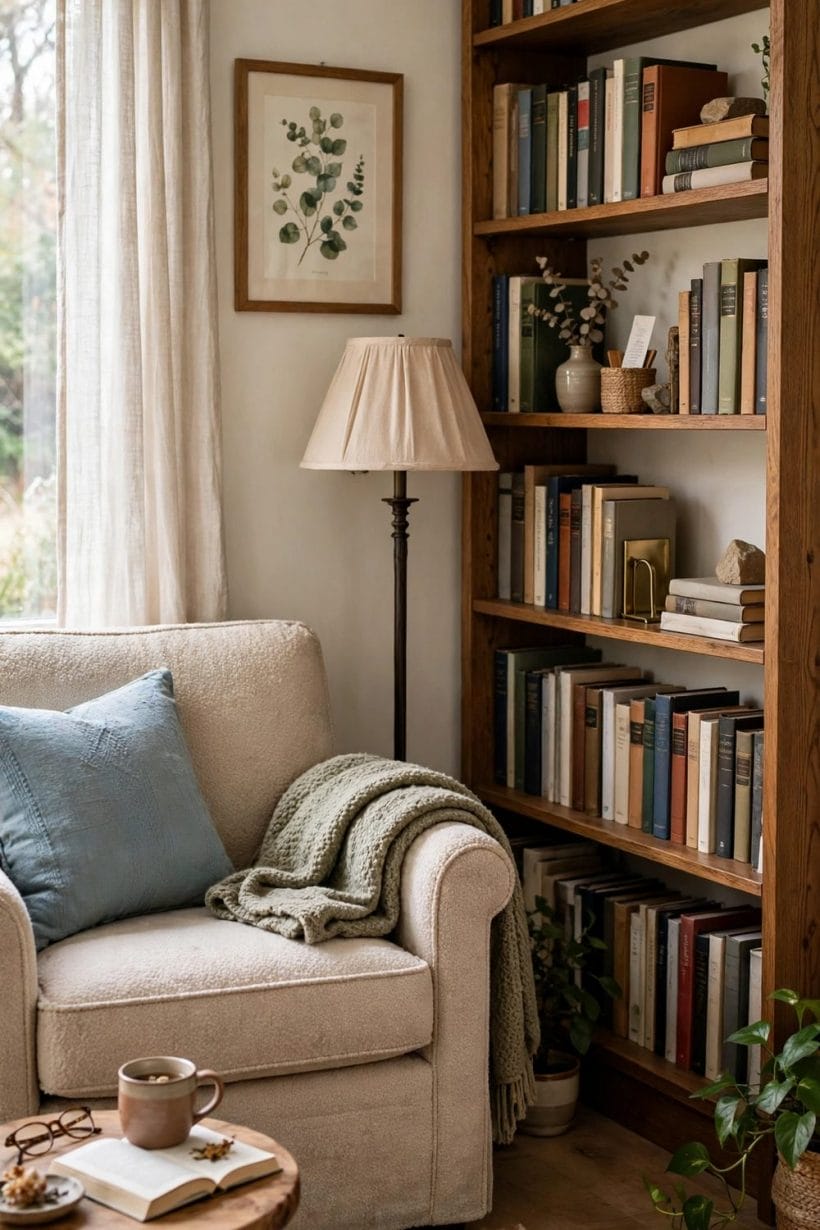
A fitting is only the holder; the bulb and the shade make the light. Two fittings that look identical on the ceiling can give utterly different rooms depending on what is screwed into them and what stands between the bulb and the eye.
Choose the Bulb for the Job
Modern bulbs state their brightness plainly on the box — read it in lumens, the honest measure, rather than the old wattage habit. Match brightness to the layer: gentle for ambient fill and accent, stronger for task. A bulb that renders colour faithfully matters anywhere colour is judged — at a mirror, over a painting, at a workbench.
Shades Shape the Light
An opaque shade throws light up and down and hides the bulb from most angles; a fabric shade diffuses it in all directions and glows itself; clear glass shows the bulb and all its glare. Neither is wrong — but know which you are buying, and remember that a shade’s inside colour tints everything it lights: white insides keep light true, gold insides warm it.
Glare Is the Enemy
Glare — a bright source in the field of view — tires eyes and cheapens rooms faster than any other lighting fault. Bare bulbs belong in cupboards and workshops, not living rooms. If a fitting glares, the fixes are simple ones: a shade, a diffuser, a dimmer, a different angle — comfort first, drama second.
9. Dimmers, Switches and Controls
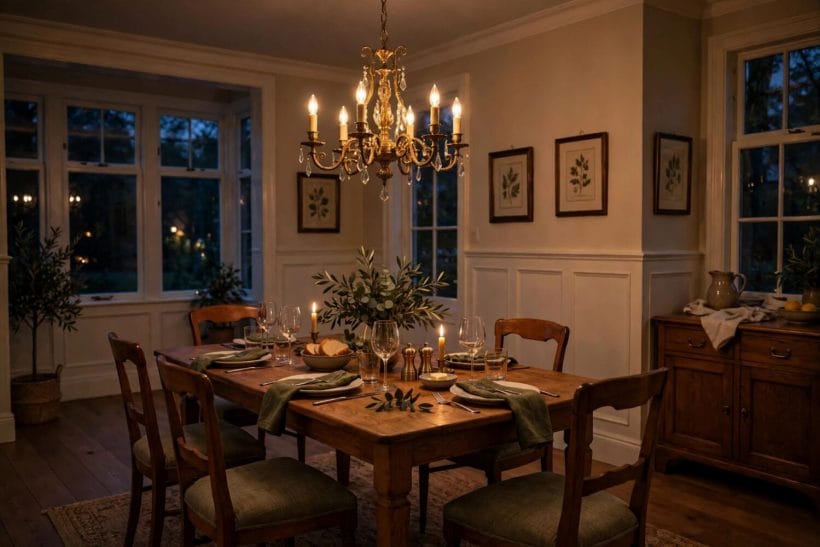
A room needs different light at breakfast, at work and at midnight, and controls are how one set of fittings serves all three. The goal is not gadgetry; it is that the right light for the moment should be the easiest light to switch on.
Dim the Layers Separately
Ambient, task and accent layers earn their keep when they can be controlled separately: full brightness for cleaning, task only for working, accent only for the evening’s last hour. Even one dimmer — on the main layer — transforms a room’s range; check that bulbs and dimmer are made to work together, and have the wiring done by a qualified electrician.
Put Switches Where Life Happens
Switches belong at the door you enter by, at both ends of a hall or stair, and beside the bed and the main chair for the lamps that serve them. A lamp that needs a walk across a dark room to reach it will simply not be used. Two-way switching on stairs and landings is a safety matter as much as a convenience, exactly as with the entries in porch ideas.
Keep Controls Simple Enough to Use
Smart bulbs and app controls suit some households and irritate others; a wall plate of eleven identical switches suits nobody. The test of any control scheme is a guest: if a visitor cannot light the room kindly in ten seconds, the scheme is too clever. Installations and alterations to fixed wiring are a qualified electrician’s work, in line with local rules.
10. Lighting Room by Room
The layers repeat, but each room weights them differently. Kitchens live on task light — worktops, hobs and sinks lit from the front, with the ambient layer filling in. Bathrooms live on the mirror. Living rooms live on flexibility: several low, warm sources, none of them fixed to a single arrangement of furniture.
Bedrooms want the softest ambient layer in the house and honest task light at the bedside and the wardrobe. Halls and stairs want safe, even light with no dark treads and switches at both ends. Entries and porches — the threshold rooms — want a warm welcome and a lit path, the same instinct that shapes the welcome in the porch cluster.
Work through the house room by room with the same three questions: where is the general glow, where does the work happen, and what deserves to be picked out? Answer those, with fittings sized to the room and one temperature throughout, and the lighting plan is done — no designer required, only attention.
Final Considerations
If this guide leaves one habit behind, let it be layering: an ambient base spread around the room, task light aimed at the work from the front, and one or two accents picking out what you love. Size the fittings to the surfaces they serve, keep one colour temperature per room, shade every bulb an eye can meet, and give each layer a switch of its own.
Light is the cheapest renovation there is — it asks for no builders, no dust and no permits beyond an electrician for fixed wiring, and it changes how every other thing in the room is seen. Start with the room that dissatisfies you most, and work in layers.

0 Comments