

An in-ground hot tub changes a garden in a way that a freestanding tub never quite manages. Set flush with the patio, its water sits level with the paving, its rim becomes a place to sit rather than a barrier to climb, and the whole garden reads as one outdoor room instead of a patio with an appliance parked on it. The eye travels across stone, water and planting without interruption, and the tub feels like part of the garden’s design rather than an addition to it.
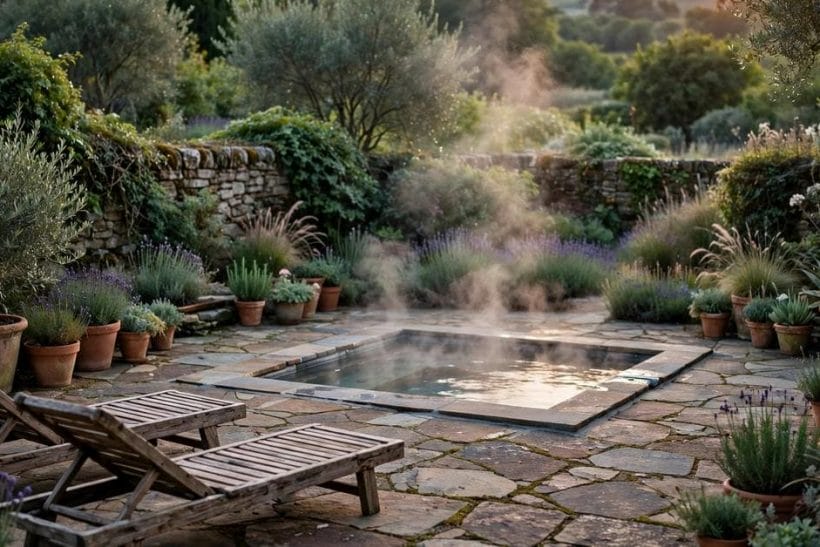
This guide treats the in-ground hot tub as a patio and garden styling subject only: placement, surround, privacy and access, with seating, planting, light and everyday care around them. It is written for readers gathering inground jacuzzi ideas for the look and feel of the garden, not for the build itself. A filled tub is extremely heavy, water sits next to electrics, and the structure beneath the patio matters, so structure, load and electrical work are stated in general terms throughout, local rules are checked before any work begins, and no installation, wiring or excavation instructions are offered here. Those parts belong to qualified professionals, and the styling in this guide assumes they have been handled properly first.
1. The In-Ground Hot Tub at a Glance
The appeal of the in-ground form is its quietness. Nothing rises above the patio line to block a view, nothing breaks the line of the paving, and the water becomes a calm, reflective surface in the middle of the garden. That quietness is also what makes the styling matter so much: with the tub itself so low and restrained, the surround, the planting and the seating carry the character of the space. Get those right and the tub feels generous and settled; leave them bare and the same tub can feel like a hole in the patio rather than a garden room.
| Element | What good looks like |
|---|---|
| Placement | Sheltered, private, close to the house |
| Surround | Stone or timber, level, barefoot-friendly |
| Privacy | Screens and planting, not high walls |
| Access | Wide, easy steps and a clear path |
| Setting | Seating and planting that invite lingering |
The in-ground tub also sits within a wider family of outdoor water features, and it helps to know where it belongs among them. For the raised, patio-based treatment, hot tub patios cover the patio story in full, while sunken spa patio stays on the deck-set form, where the spa sits flush with boards rather than stone. This post stays on the in-ground, patio-and-garden form, and on how that form is styled once the professional work underneath it is settled.
2. Placement: Sun, Shelter and the House
Placement decides how often the tub is actually used, and the best spot is usually the most sheltered corner of the garden that still feels connected to the house. A short, easy walk from a back door matters more than a dramatic view, because the walk is made in bare feet, often in cooler air, and often carrying towels. A tub tucked at the far end of a long garden looks romantic in a photograph and gets used far less than one that sits within easy reach of warmth, light and a dry place to change. Shelter matters just as much: a corner screened from prevailing wind feels calm and private, while an exposed spot can feel chilly and overlooked even on a mild evening.
Sun and shade need balancing rather than maximising either one. A spot that catches gentle sun through the day feels welcoming, while a spot in full glare all afternoon can feel harsh and makes the surrounding stone uncomfortably warm underfoot. Nearby trees or a pergola can soften the light, but overhanging branches drop leaves and debris into the water, so the canopy above the tub itself is best kept clear, with shade coming from beside the tub rather than directly over it. Watch the garden through a full day before settling anything, and notice where the light falls in the morning, where it falls at dusk, and where neighbours can see in from upstairs windows.
Think of the tub as the quiet end of a sequence that starts at the house. A patio that flows from the back door, past seating, and on to the tub reads as one outdoor room, while a tub isolated behind planting reads as a separate destination that needs a reason to visit. backyard patio ideas gather the wider patio treatments that help that sequence feel natural, and tiny house porch ideas cover the threshold itself, where the house meets the garden and the walk to the water begins. When house, patio and tub share materials and planting, the whole garden feels designed rather than assembled.
3. The Surround: Stone, Timber and Level Edges
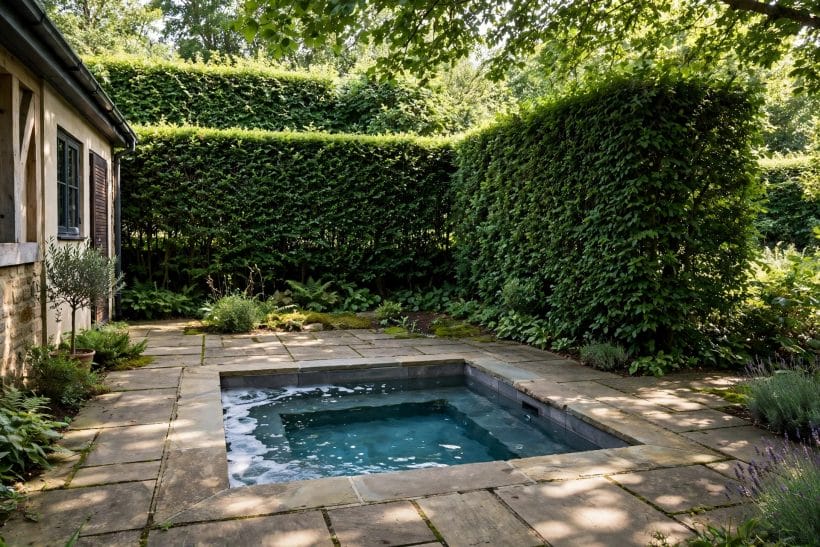
The surround is the part of an in-ground tub that the eye touches most, and it deserves as much attention as the water itself. Stone gives a calm, permanent feel: large, level slabs in a warm, natural tone make the tub look as though it has always been part of the patio, and their weight and texture ground the water beautifully. Timber gives a softer, warmer feel, with boards that feel kind under bare feet and a colour that weathers gently over time. Either material works, and the choice should follow the house and the rest of the patio rather than the tub alone, because a surround that matches its surroundings always looks more settled than one chosen in isolation.
Level edges matter more here than anywhere else in the garden. Because the water sits flush with the patio, any unevenness in the surround shows immediately, and a rim that dips or rises breaks the clean line that makes the in-ground form so appealing. The edge also becomes seating, a place for towels, and a step in and out of the water, so it needs to feel solid and comfortable to sit on, with a broad, smooth coping that does not snag or scratch. A slim, sharp edge looks elegant in a photograph but feels mean in use, while a generous, rounded coping invites people to sit, dangle their feet, and stay a while.
Colour and texture should stay restrained. Pale stone keeps the patio feeling bright and lifts the water’s colour, while darker stone gives a moodier, more enclosed feel that suits evening use and warm lighting. A mix of textures, such as smooth coping against rougher paving, adds interest without busyness, and a single accent material, such as a timber bench or a stone step, can tie the tub to the rest of the garden. Keep the palette to a small family of tones and let the water, the planting and the sky provide the colour, because the surround’s job is to frame the water quietly rather than compete with it.
4. Privacy Without High Walls
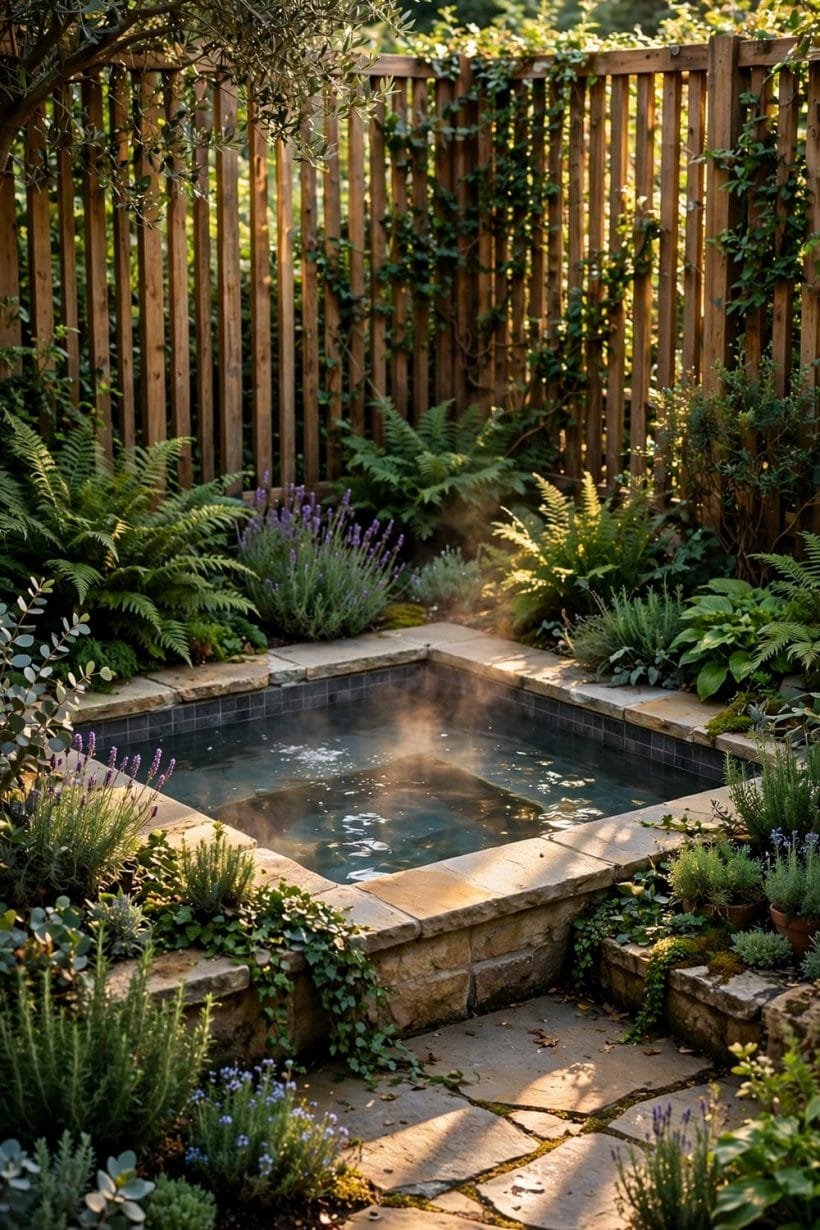
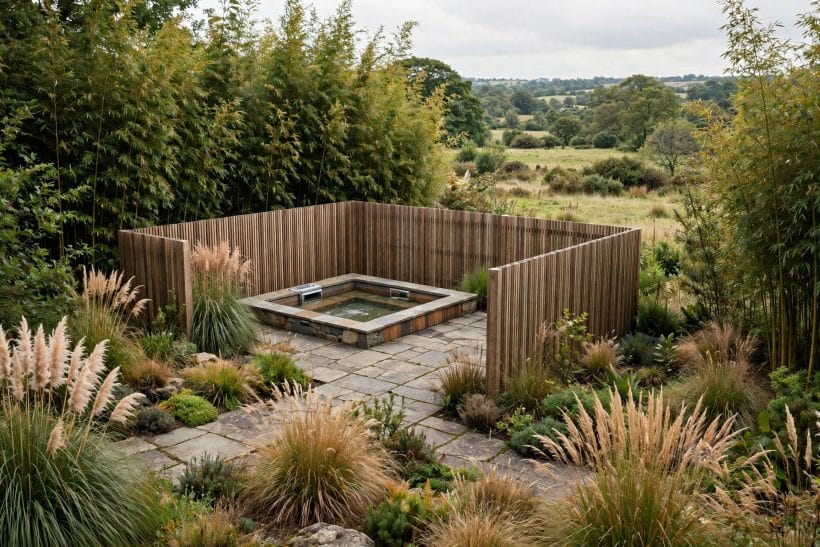
Privacy is the first thing most people ask about, and the best answer is rarely a high wall. Tall, solid walls enclose a garden, block light and breeze, and turn a relaxing spot into a compound, while layered planting and open screening give privacy without losing the garden’s air. Tall grasses, bamboo in containers, and clipped hedging soften sightlines from neighbouring windows while still moving in the breeze and letting light through, and a slatted timber screen gives a sense of enclosure on one side without closing the space in on every side. The goal is to feel unseen without feeling shut in.
Layering is the trick. A low hedge at the patio edge, taller planting behind it, and a screen or pergola post where a sightline is strongest will block far more than a single tall barrier, because the eye is stopped at several depths rather than one. Planting also changes with the seasons, which keeps the tub’s setting feeling alive rather than fixed: grasses turn gold in autumn, evergreen hedging holds the structure through winter, and flowering pots bring colour close to the water in summer. Choose plants that suit the spot’s light and wind rather than plants chosen for height alone, because healthy, well-placed planting gives better privacy than struggling tall specimens ever will.
Consider the view from the tub as well as the view into it. Sitting in warm water, the eye rests on whatever is directly ahead, so a blank fence at eye level feels dull while a planted border, a stone wall softened with climbers, or a glimpse of the wider garden feels restful. patio fireplace ideas show how a second focal point, such as a fire feature, can anchor the far side of a patio and give the tub’s outlook a destination, so the garden feels composed from inside the water as well as from the patio. Privacy and outlook are the same design problem seen from opposite sides, and solving them together is what makes the space feel complete.
5. Access: Steps, Paths and Easy Entry
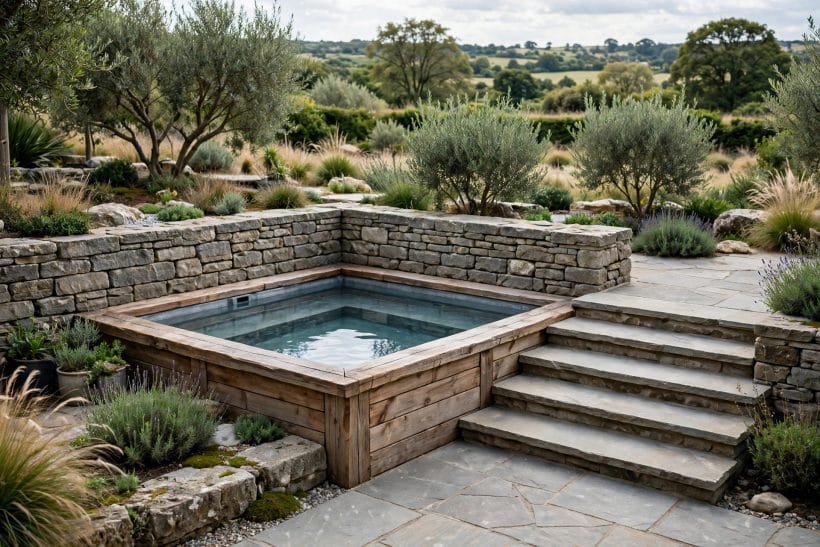
Access is where an in-ground tub either welcomes people or quietly discourages them, and the difference is in the steps and the path rather than the water. Wide, shallow steps with a solid handhold nearby feel easy for everyone, including guests who are less steady on their feet, while narrow or steep steps turn every entry into a careful negotiation. The steps should feel like part of the patio design, in the same stone or timber as the surround, rather than an afterthought bolted on at the end, and the tread surface should feel secure under wet, bare feet, because the approach to the water is always damp.
The path from the house deserves the same care. A clear, level route without loose gravel, raised edges or awkward turns makes the tub usable in the dark, in cooler weather, and with arms full of towels, while a winding, uneven path discourages use on exactly the evenings when warm water is most appealing. Lighting along the path, kept low and warm, helps without glare, and a dry, covered spot near the house for shoes and robes keeps the walk comfortable. Think of the route as part of the tub’s design, not as the leftover ground between house and water, because the journey shapes the mood of the soak that follows it.
Inside the water, entry should feel gradual and unhurried. A built-in bench or step within the tub’s edge lets bathers lower themselves in gently rather than dropping in, and a rim at sitting height gives a natural place to pause, chat, and step out again without scrambling. These are styling and comfort decisions, and they sit alongside the professional questions about structure and safety that are covered later in this guide. What matters for the garden design is that entry feels easy, dignified and safe, so that using the tub feels like a pleasure rather than a small expedition.
6. Seating and the Social Edge
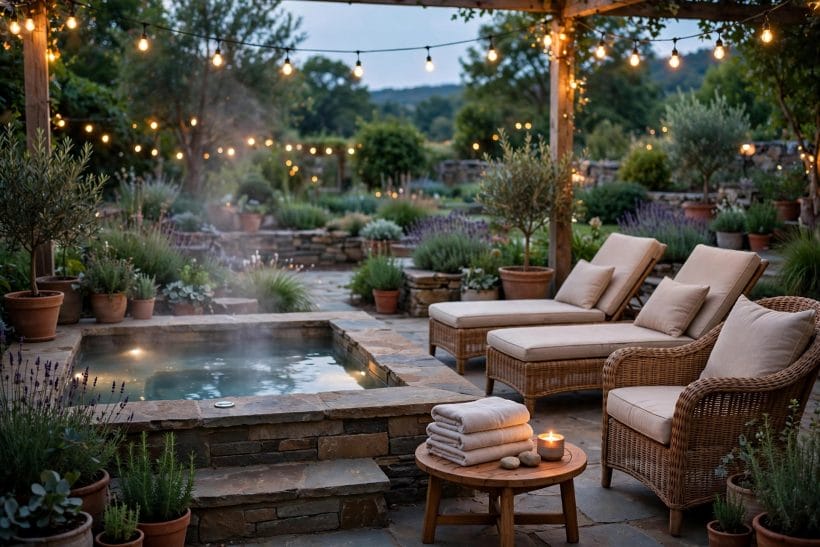
An in-ground tub is a social space as much as a solitary one, and the seating around it should reflect that. The rim itself is the first seat, and a broad coping invites people to sit with their feet in the water and talk, which is often how a tub is enjoyed most. Beyond the rim, a small group of loungers or a pair of comfortable chairs gives dry seating for those who want to watch, read, or keep company without getting in, and a low side table for drinks, towels and a book keeps the patio tidy and the water free of clutter. Seating that faces the tub as well as the garden keeps the group together, rather than splitting it into bathers and onlookers.
Keep the seating arrangement loose rather than formal. A tub patio works best when furniture can be moved with the sun, pulled closer for conversation, or pushed back to open the view, and heavy, fixed seating can make a small patio feel rigid. Weatherproof cushions in a calm, natural palette suit the stone and water, and a storage bench nearby keeps cushions and towels dry without a trip back to the house. A bench also doubles as extra seating when friends gather, which is useful because a tub patio tends to collect people on warm evenings, and a space that seats a group comfortably gets used far more than one designed for a single bather.
Shade and shelter for the seating matter as much as shade for the water. A pergola, a parasol, or a tree canopy beside the tub gives dry sitters a comfortable spot and gives the whole patio a sense of enclosure, while leaving the water itself open to the sky. The social edge of the tub, the ring of seating, planting and shade around the water, is what turns a soaking spot into an outdoor room, and it is worth designing with as much care as the tub itself. When the edge is comfortable, the tub becomes the centre of summer evenings rather than a feature visited alone.
7. Planting Around Warm Water
Planting softens everything about an in-ground tub: the hard stone, the level water, the straight lines of the patio. But planting around warm water needs a little more thought than planting elsewhere in the garden, because steam, splashes and humidity change the conditions right at the water’s edge. Tough, evergreen foliage close to the tub holds its shape through splashes and steam, while delicate flowers and soft leaves do better a little further back, where they can be admired without being constantly damp. Pots are the gardener’s friend here, because they can be moved, refreshed and swapped with the seasons, and a pot that struggles can be replaced without disturbing the patio.
Scent is a quiet luxury worth planting for. Lavender, rosemary and jasmine near the seating release fragrance in warm air, and their scent carries gently over the water without overwhelming it, while grasses add movement and sound as they catch the breeze. Avoid plants that drop heavy petals, sticky sap or large leaves directly into the water, because the surface of the tub is part of its beauty, and a water surface scattered with debris loses its calm at once. A ring of clean, structural planting close to the tub, with softer, more colourful planting further out, gives both a tidy waterline and a generous garden around it.
Think about the tub’s setting through the year, not just in summer. Evergreen hedging and grasses give the patio structure in winter, when the tub’s steam against cold air is at its most atmospheric, while spring bulbs in pots and summer flowers bring colour when the patio is used most. A garden that looks good around the tub in every season makes the tub feel like a permanent part of the home rather than a summer-only feature, and it rewards the effort of planting with a view that changes gently rather than disappearing for months at a time.
8. Evening Light and Atmosphere
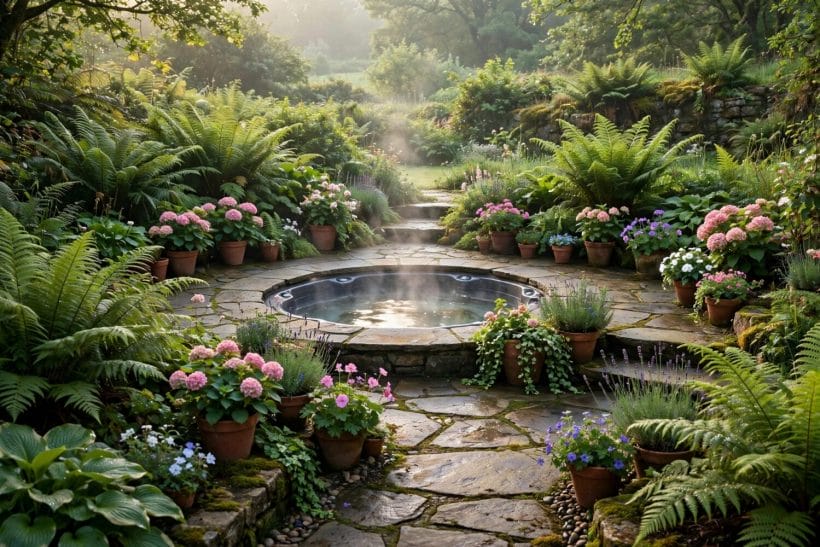
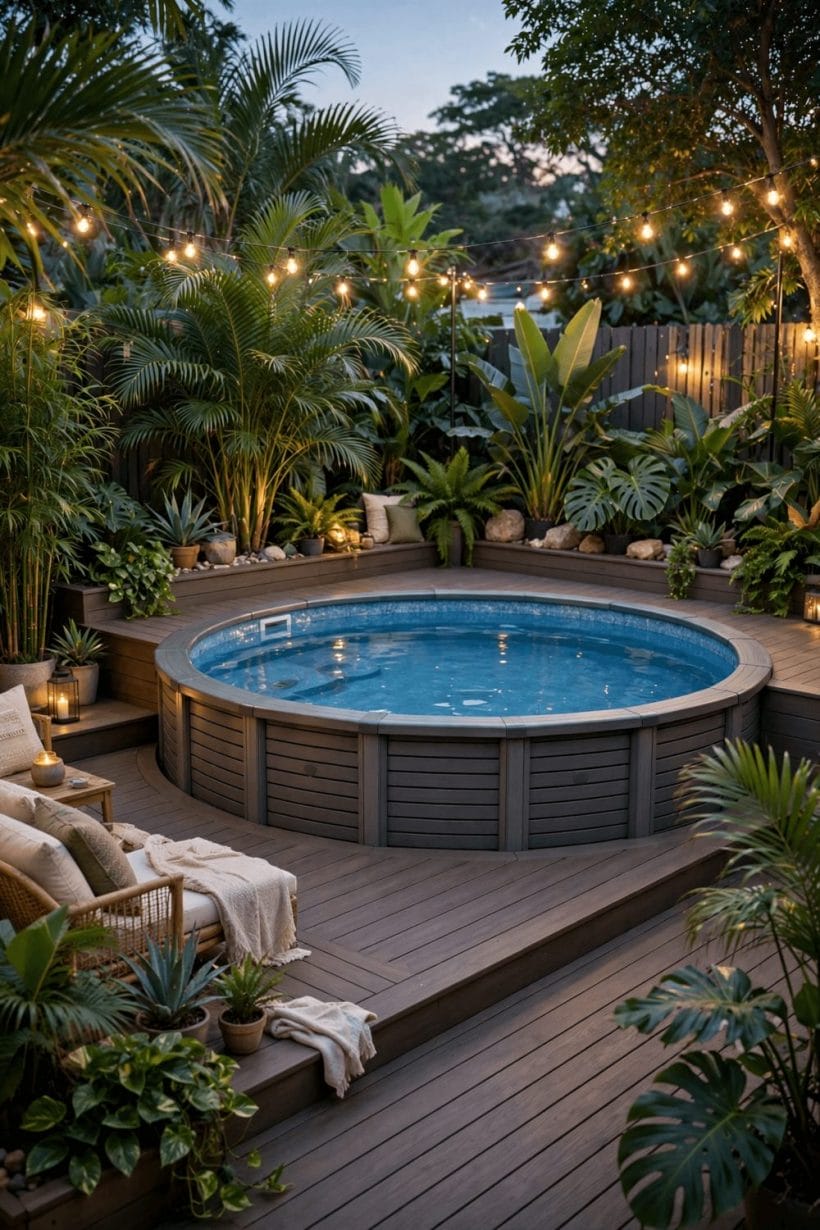
Evening is when an in-ground tub earns its place in the garden, and lighting makes the difference between a patio that glows and one that feels exposed. Warm, low light suits water best: string lights overhead, lanterns on the surround, and soft uplighting in the planting give a gentle glow without glare, and they make the water’s surface shimmer without turning the patio into a stage. Keep lights low and warm rather than bright and white, because the mood of an evening soak is calm and unhurried, and harsh lighting flattens that mood at once.
Light in the water itself, where it is part of the tub’s design, changes the whole patio after dark, turning the water into a lantern at the centre of the garden. Underwater light should be treated as part of the professional electrical picture, not as a styling add-on, and its colour and warmth should match the rest of the patio lighting so the garden reads as one space. Around the tub, a few well-placed lights in the planting and along the path are worth more than a blaze of light everywhere, because pools of warm light with soft darkness between them feel intimate, while uniform brightness feels public.
Atmosphere is also about what is not lit. Leaving the far end of the garden in soft darkness gives depth, and a single lit feature, such as a tree or a stone wall, draws the eye outward without competing with the water. pool ideas gather the wider garden-water picture, where larger pools use the same evening-light principles at a grander scale, and the lesson carries across: light the edges, let the water glow, and leave room for darkness. An evening tub patio should feel like a quiet, warm clearing in the garden, not like a room with the lights left on.
9. Covers, Care and the Everyday Routine
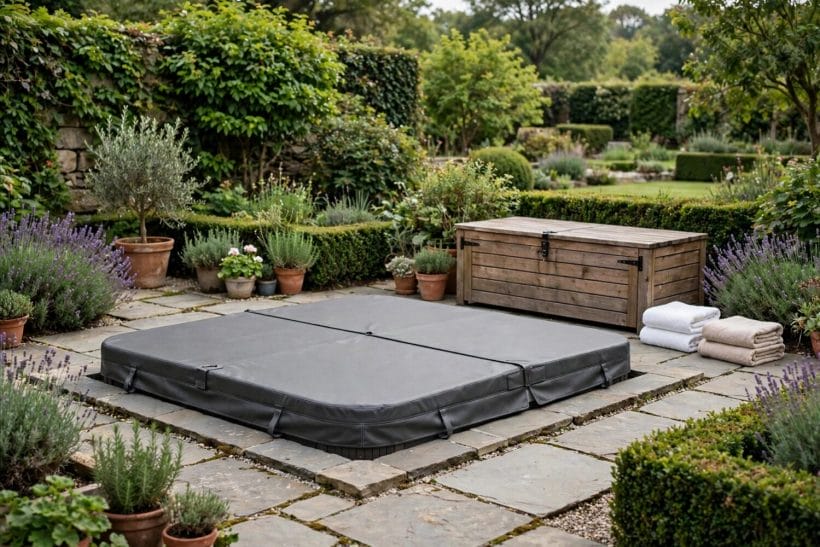
A cover is the most practical part of an in-ground tub’s styling, and it deserves to look like part of the patio rather than an apology for it. When the tub is covered, the patio becomes a clean, level terrace again, and a well-fitted cover in a calm, neutral tone keeps that terrace feeling designed rather than interrupted. A storage bench or a discreet cover lifter nearby keeps the daily routine simple, because a cover that is awkward to move will be left off, and a cover left off collects leaves and loses heat. The everyday routine should feel easy, or it will not happen.
Care around the tub is mostly about small, regular habits rather than grand gestures. Skimming leaves from the surface, wiping the surround after use, and keeping towels and robes in one dry spot near the house all keep the patio feeling fresh, and they take far less effort than a neglected tub takes to recover. Planting close to the water needs the same regular attention, with pots watered and trimmed so they frame the tub rather than encroaching on it, and the path kept clear so the walk to the water stays pleasant. A tub patio that is cared for little and often always looks better than one that is deep-cleaned rarely.
Seasonal care follows the garden’s rhythm. In autumn, falling leaves need clearing before they settle on the water or block the surround, in winter the cover and the patio need checking after frost and wind, and in spring the planting and the stone benefit from a fresh look before the season of heavy use begins. Keeping the routine tied to the garden’s seasons, rather than treating the tub as a separate machine to maintain, makes care feel like part of gardening rather than a chore apart from it, and a tub that is cared for as part of the garden stays beautiful far longer.
10. Structure, Electrics and Local Rules, Stated Plainly
This section is deliberately short, because its subject is not styling but responsibility. A filled in-ground tub is extremely heavy, and the ground and structure beneath the patio must be suited to that weight, which is a question for qualified professionals who can assess the site, not for a styling guide. Water next to electrics is equally serious: electrical work around a tub is work for a licensed electrician, and the supply, protection and lighting arrangements around the water are professional decisions governed by safety standards and local rules. Nothing in this guide replaces that professional judgement, and no part of the styling here should be read as a shortcut around it.
Local rules matter before work begins, and they vary by place, so checking them early is part of good design rather than an obstacle to it. Rules can cover where a tub may sit, how it is drained, how it is fenced or covered, and what electrical and structural checks are required, and a design that respects those rules from the start avoids costly changes later. A professional adviser can confirm what applies to a particular garden, and that confirmation should come before the patio is laid or the planting is planned, because moving a tub’s position after the surround is built is far harder than choosing the right position at the outset.
For the styling reader, the practical takeaway is simple: settle the professional questions first, in general terms, and then style with confidence. Once structure, load, electrics and local rules have been handled by the right people, the choices in this guide, placement, surround, privacy, access, seating, planting and light, can be made freely, knowing the garden beneath them is sound. A beautiful tub patio is one where the hidden work is as solid as the visible design, and where the styling never has to compensate for a shortcut taken underneath it.
Final Considerations
An in-ground hot tub earns its place when the garden around it feels considered rather than decorated. The water itself is quiet, so the surround, the planting, the seating and the light do the talking, and the best tub patios are those where every one of those elements feels calm, generous and easy to use. Start with placement, choose a surround that matches the house, layer privacy with planting rather than walls, and keep access wide and clear, because those decisions shape every evening spent in the water far more than any single decorative flourish.
For readers still gathering inground jacuzzi ideas, the thread running through this guide is worth holding on to: let the tub be the calm centre and let the garden gather around it. Seating for company, planting for scent and softness, warm light for evenings, and a simple cover-and-care routine for everyday life are what turn a water feature into an outdoor room, and they are all choices that can be made gradually, season by season, without rushing the garden. A tub patio that grows gently, with planting maturing and furniture settling into its place, often ends up more beautiful than one finished in a single hurried gesture.
Above all, keep the professional side of the tub in its proper place: handled by qualified people, checked against local rules, and never improvised. With that foundation settled, the styling in this guide can be enjoyed as it is meant to be enjoyed, as a way of making a garden calmer, warmer and more welcoming. The water will do the rest, quietly, at the centre of a patio designed around it.

0 Comments