

A laundry room works only as well as its cabinets. They hide the detergent, swallow the spare towels, keep the cleaning kit away from the clean washing — and their finish decides whether the room feels calm or clinical.
This collection works through laundry room cabinets by finish, style and layout: painted fronts, honest wood, two-tone schemes, tall storage and the small hardware choices that make daily wash day easier.
1. Laundry Room Cabinets at a Glance
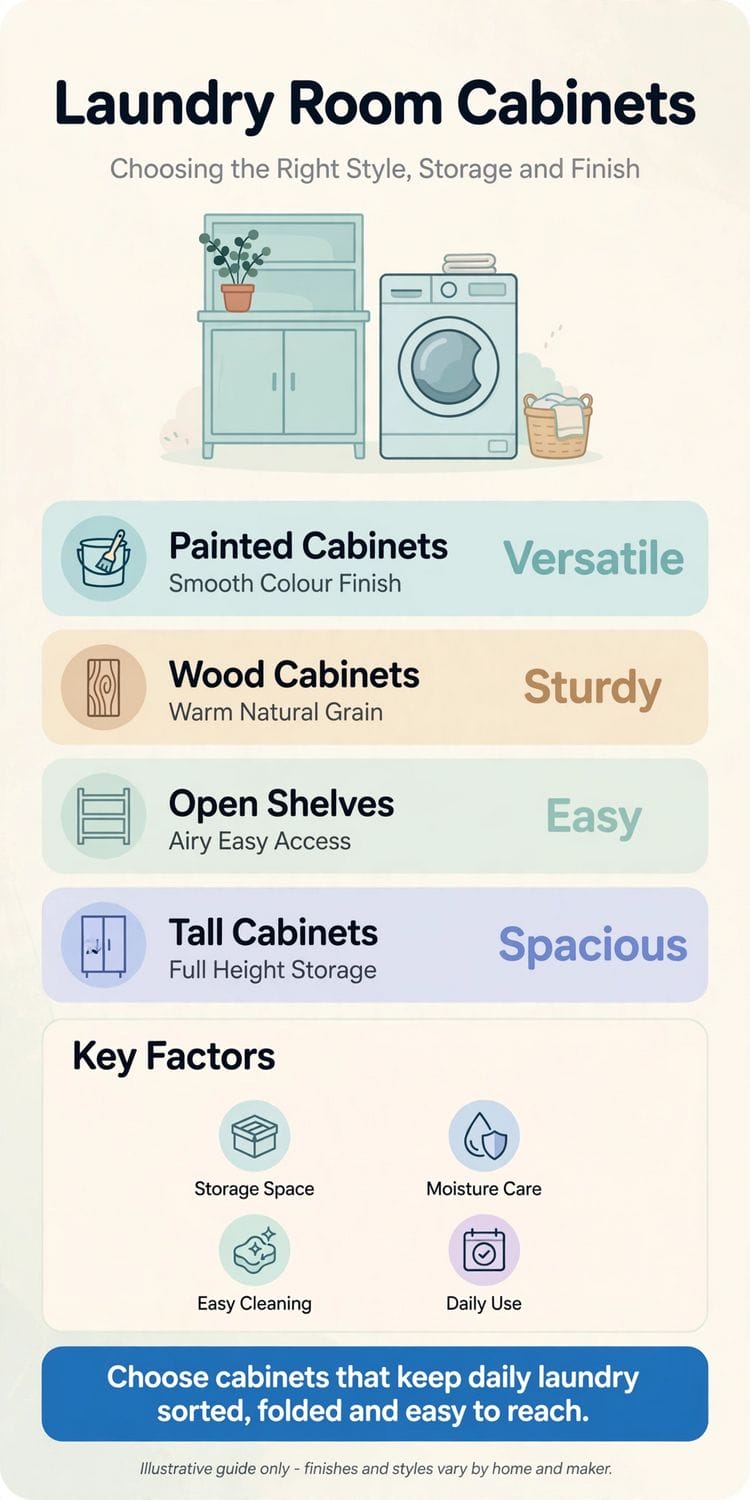
Every laundry room asks the same things of its cabinets: survive steam and splashes, open fully in a tight footprint, and keep a dozen awkward bottles standing upright and out of sight. The finish is where those demands meet the look of the room — paint gives colour and easy touch-ups, stain gives grain and warmth, and the two together give the flexible two-tone schemes so many laundries now wear. This post owns the cabinet angle of the laundry; for the room as a whole, the wider laundry room ideas collection plans layouts end to end.
Work through the finishes first, then the storage layouts. A laundry used daily by a family needs different cabinets from a small utility closet, but the logic is identical: closed storage for chemicals and clutter, open or glass storage only for the pretty things, and a finish you can wipe down without thinking twice about it.
| Finish family | Character |
|---|---|
| Painted | Any colour, smooth and modern or classic, easy to refresh |
| Stained wood | Visible grain, warmth, hides everyday wear gracefully |
| Two-tone | Colour below, light above — depth without darkness |
| Laminate and foil | Budget-friendly, wipe-clean, consistent colour |
| Raw and oiled timber | Natural, repairable, suits rustic and Scandi rooms |
2. Painted Finishes in Soft Neutrals
1. Sage green shaker cabinets
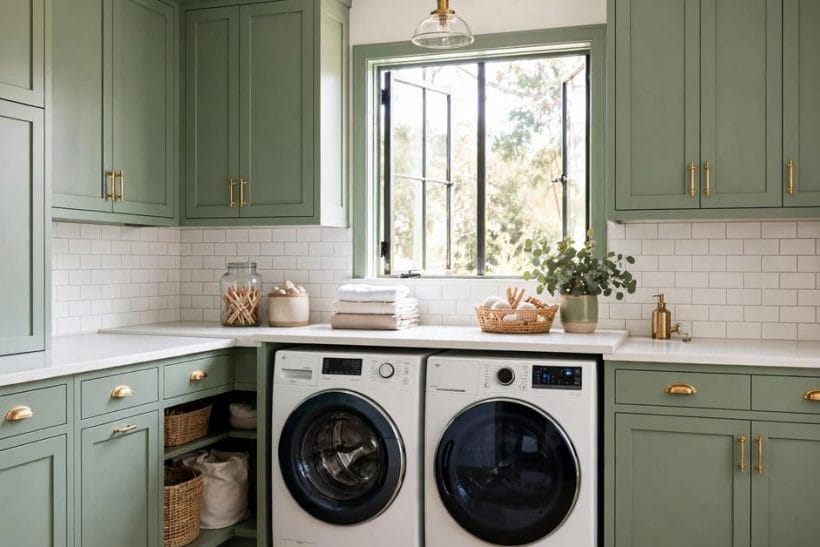
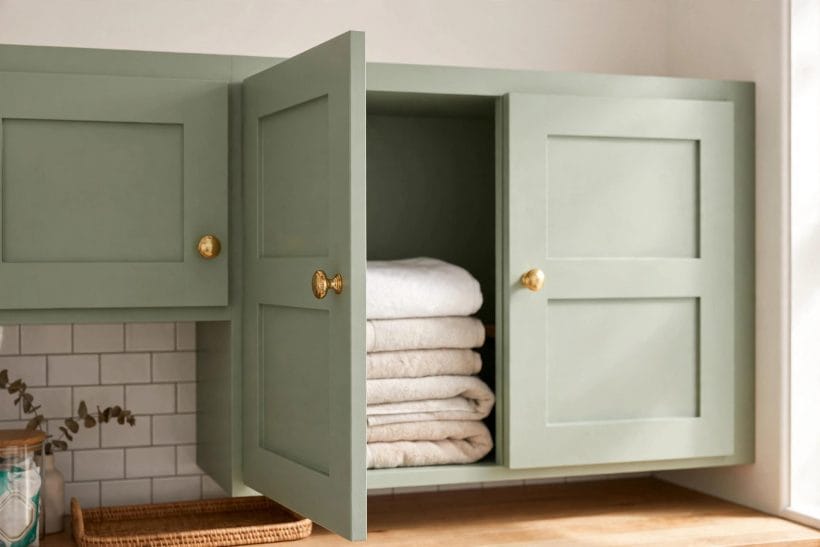
The feature room’s formula: sage-painted shaker doors, brass handles and a pale stone counter. Sage reads calm against white machines and subway tile, hides lint and splashes better than white, and pairs with both warm wood floors and cool chrome — the safest colour choice in the whole collection.
2. Warm white uppers and lowers
Warm white — the soft, slightly creamy branch of the family — keeps a small laundry bright without the blue glare of a brilliant white. It suits rooms with no window, where every finish has to earn its light, and it lets coloured baskets and jars do the decorating.
3. Greige cabinets for north-facing rooms
Grey-beige paint warms up cold northern light that turns pure grey cabinets chilly. Greige also bridges the common laundry mismatch — warm wood floor, cool grey machines — holding both sides of the palette in one finish that never quite commits to either.
4. Pale grey with chrome hardware
A light, clean grey with polished chrome handles gives the laundry a quiet, utility-modern feel. Grey is forgiving of the grey dust laundry generates, and chrome echoes the machine fascias, tying cabinets and appliances into one deliberate scheme.
5. Cream cabinets with cup handles
Cream paint and brass cup pulls are the farmhouse laundry’s backbone. Cream softens the industrial edge of front-loaders, cup pulls are easy to hook with a finger when your hands are full of washing, and the whole scheme tolerates hard wear gracefully.
6. Soft ivory with a wood counter
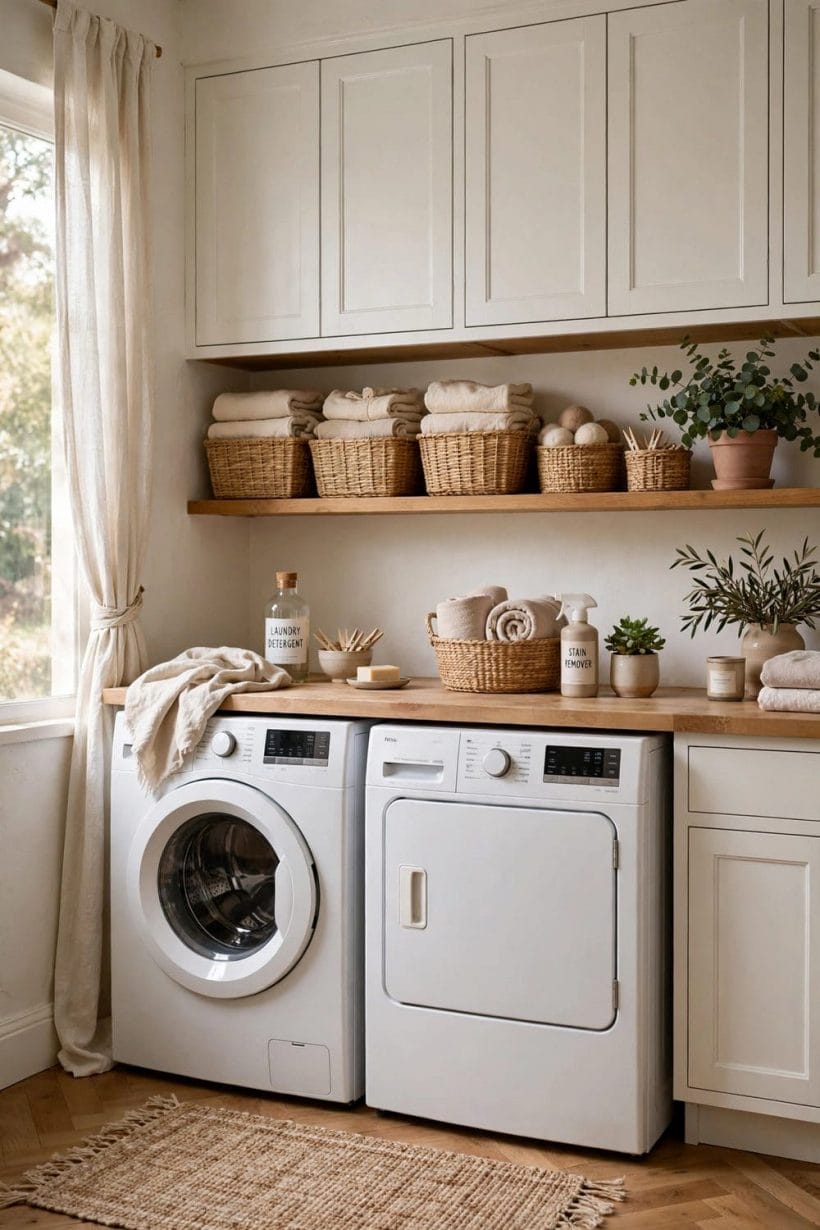
Ivory cabinets under a natural wood counter split the difference between painted and timber schemes: the paint keeps the room light, the wood brings the warmth paint alone can miss. It is a forgiving combination for rooms assembled in stages over time.
7. Mushroom and putty tones
Deeper neutrals — mushroom, putty, stone — give a laundry the feel of a considered room rather than a utility space. They pair with black hardware and pale counters, and they hide the scuffs around handles and kick plates better than any pale colour.
8. White cabinets, black handles
The crisp classic: plain white doors given their definition entirely by matte black handles and hinges. Cheap to achieve, easy to repaint, and endlessly photographable — the contrast does all the design work while the finish stays the simplest in the book.
3. Colour Finishes That Earn Their Place
9. Navy blue lowers
Deep navy base cabinets anchor a laundry the way they anchor a kitchen — grounding the machines and making pale counters and floors feel brighter by contrast. Navy hides drips and marks at exactly the height they happen, around the sink and machine tops.
10. Forest green wall cabinets
Dark green uppers over a pale counter bring a botanical calm to the room, especially with a plant on the sill and brass below. Green is the colour laundry products never clash with — every detergent bottle label already lives in a blue-green world.
11. Powder blue for a fresh feel
Powder blue is the laundry’s natural accent: clean, watery and cheerful without shouting. It suits coastal and cottage rooms, pairs with white tile and chrome, and makes a windowless utility feel like it borrowed light from somewhere.
12. Teal cabinets with warm wood
Teal sits between blue’s calm and green’s warmth, and it loves natural wood — a teal lower run under an oak counter or beside timber shelving reads rich rather than loud. Keep the walls pale and let the cabinets carry the colour alone.
13. Blush pink, kept grown-up
A dusty, greyed blush on laundry cabinets reads as a warm neutral rather than a novelty, particularly with aged brass and a stone-look counter. It flatters skin tones in the mirror-less room and makes folding laundry feel marginally less like a chore.
14. Mustard and ochre accents
Full mustard cabinetry is a commitment; a single ochre tall cabinet or a run of lowers under white uppers is a joy. Warm yellows suit laundries that double as mudrooms, where boots and baskets already bring earth tones through the door.
15. Charcoal for a tailored room
Charcoal cabinets with brushed steel handles give a laundry a tailored, almost dressing-room discipline. Charcoal swallows shadow gaps and plinth lines, so the cabinetry reads as one dark block — striking in a large room, best softened with pale floors in a small one.
16. Colour only inside the doors
The diplomat’s scheme: restrained cabinets outside, a painted interior in a saturated colour that flashes when doors open. It costs one small tin of paint, commits you to nothing in the room’s palette, and makes opening the detergent cupboard oddly cheerful.
4. Natural Wood and Stained Finishes
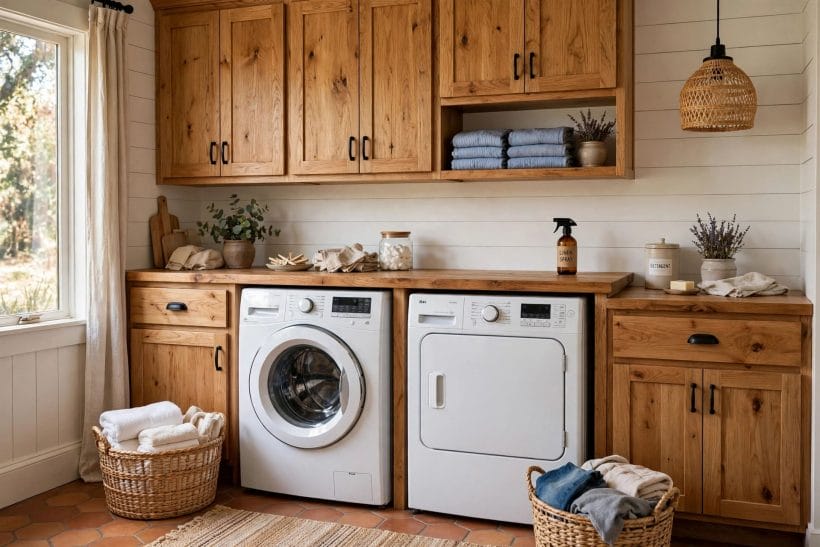
17. Knotty pine farmhouse cabinets
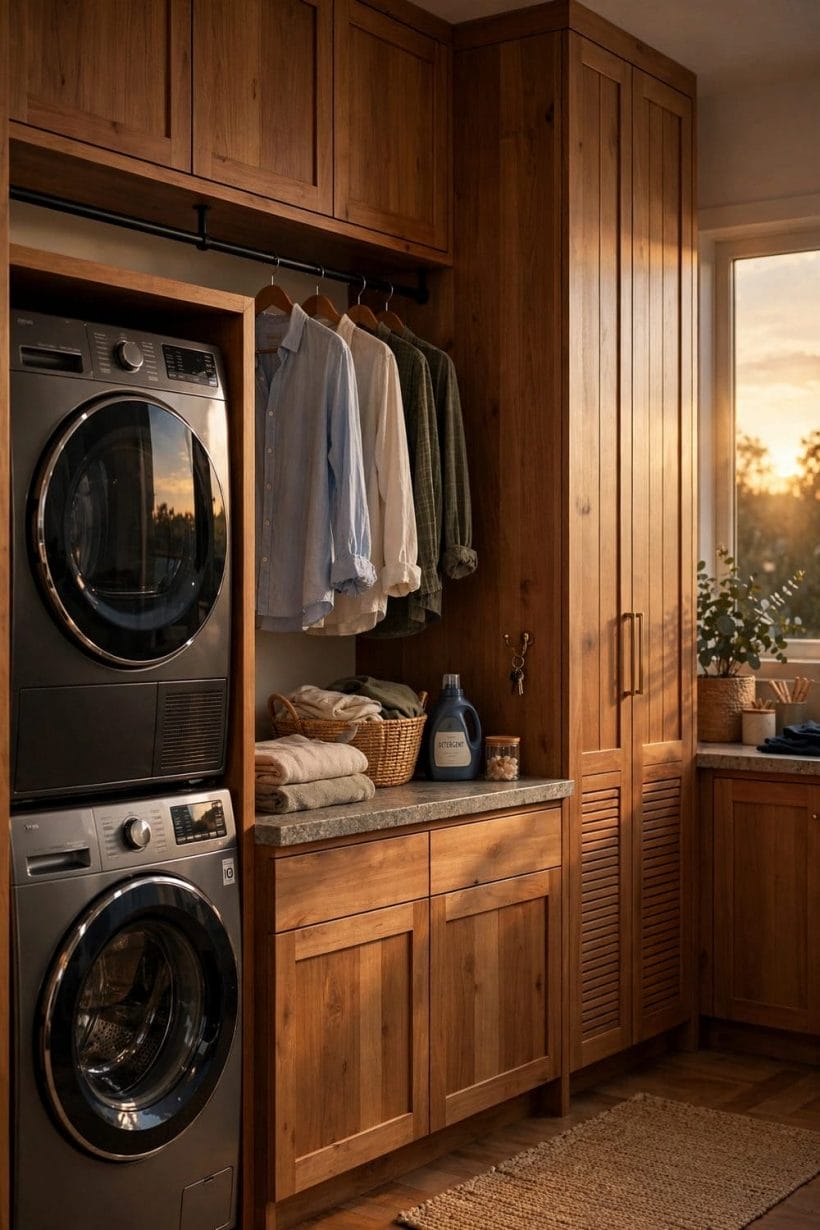
The second gallery’s room: knotty timber wall and base cabinets wrapping the machine pair, black iron handles, everything warm and unpretentious. Pine takes stain unevenly in the best way — the knots and grain are the decoration — and it suits farmhouses and cabins exactly.
18. Clear-oiled oak
Oak under a clear oil finish keeps its grain and honey tone while gaining a surface you can re-oil rather than strip. In a steamy room, oil finishes have a real advantage: local damage is a local repair, not a whole-door refinish.
19. Walnut-stained cabinets
A walnut stain on plain timber doors delivers the deep, chocolate grain of walnut at a friendlier point in the budget. Paired with pale counters and brass, walnut-stained laundry cabinets read like library furniture — dignified, dark and calm.
20. Whitewashed wood
A whitewash lets the grain ghost through a pale veil, giving coastal and Scandi laundries texture that flat paint cannot. It is the finish for rooms that want to feel bright and handmade at once, especially with woven baskets and linen in the mix.
21. Honey maple warmth
Maple’s fine, even grain under a honey stain brings a mellow glow that flatters older houses and low light. It coordinates with almost any floor tone and never fights the machines — a quiet, durable background for a hard-working room.
22. Weathered grey-stained timber
Grey stain over open-grained wood gives the driftwood effect without the driftwood supply problem. In laundries it bridges rustic texture and a modern grey palette, and it hides dust and lint in its tonal variation better than any flat colour.
23. Reclaimed-look cabinet fronts
Fronts built from salvaged boards — or new timber worked to look salvaged — bring instant history to a utility room. Keep the carcass modern and the fronts characterful, and seal them well: laundry steam is harder on rough timber than on smooth.
24. Bamboo and light timber veneers
Bamboo fronts and light veneers give flat, modern doors a natural face with a fine, consistent grain. They suit handleless schemes and small laundries where a strong grain would crowd the walls — texture at a whisper rather than a shout.
5. Two-Tone and Mixed-Finish Schemes
25. Colour below, white above
The two-tone default for good reason: saturated lowers ground the room and hide wear at working height, while white uppers keep the eye-level zone light and make a low ceiling feel taller. Almost any colour works below; the discipline is in keeping everything above the counter pale.
26. Wood lowers, painted uppers
Timber base cabinets bring warmth where hands and eyes linger longest, and painted uppers keep the scheme fresh and changeable. Repainting only the uppers is a weekend job, so this split is the flexible choice for anyone who tires of colours quickly.
27. Painted cabinets with open timber shelves
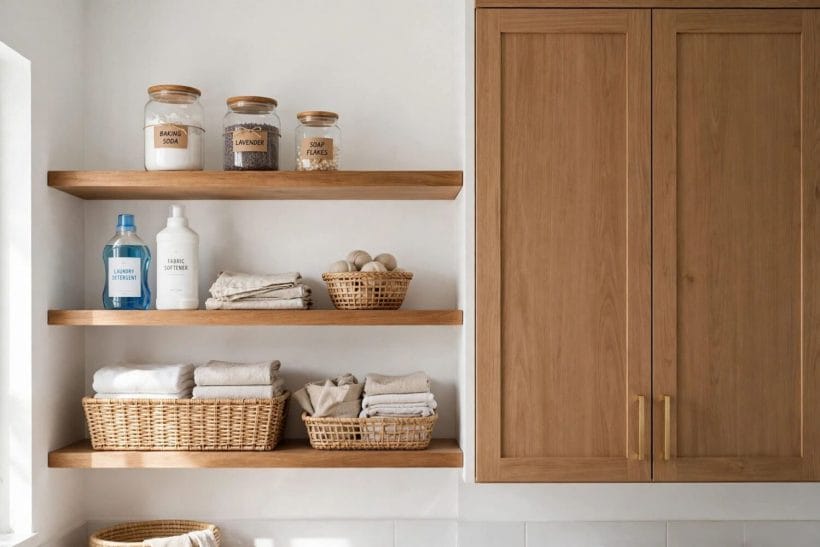
The third gallery’s arrangement — closed oak cabinets for the clutter, open wood shelves for folded towels, jars and baskets — is two-tone by texture rather than colour. The open shelves borrow the timber’s warmth while the closed doors keep their secrets.
28. Two shades of one colour
A tonal scheme — deep sage lowers, palest sage uppers — gives depth without a second colour decision. It suits small laundries where a hard contrast would chop the wall, and it lets hardware and counters stay neutral while the cabinets do something subtle.
29. Dark tall cabinet, light run
One dark full-height unit at the end of a pale run works like punctuation: it ends the cabinetry decisively and gives the tall storage — ironing board, mop, bulk buys — a presence of its own instead of blending into the row.
30. Mixed door colours on one wall
Alternating two door colours across a run — sage, cream, sage — is braver, and it works best kept to two colours and a strict rhythm. In a laundry it has a practical upside: colour-coding which cabinet holds what is genuinely useful in a busy household.
31. Stained island, painted perimeter
Laundries with a central folding island can borrow the kitchen’s best trick: stain the island timber, paint the perimeter. The island becomes furniture rather than fitted cabinetry, and its timber top doubles as the warm centre of the room’s palette.
32. Gloss lowers, matte uppers
Two-tone by sheen rather than colour: gloss base cabinets bounce light at floor level and wipe clean in a stroke, matte uppers avoid glare under ceiling lights. In one shared colour the effect is subtle in daylight and clearly deliberate by evening.
6. Tall Cabinets, Pantries and Broom Storage
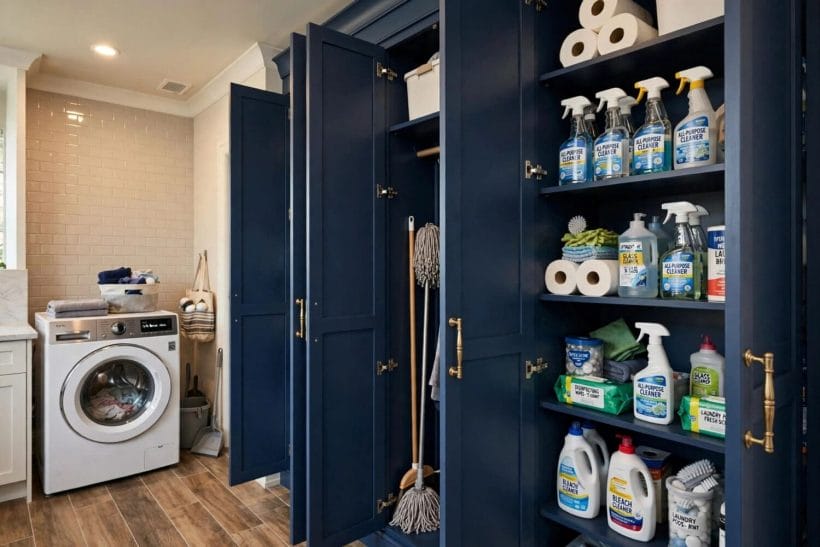
33. The full-height cleaning pantry
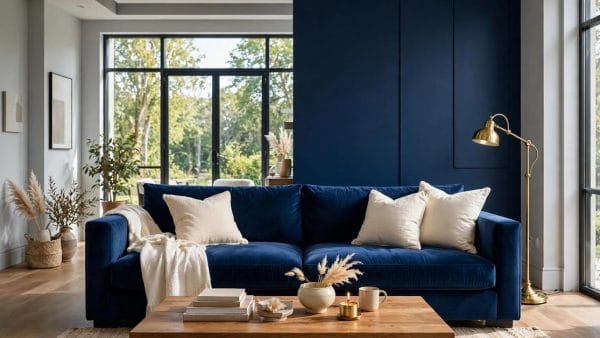
The fourth gallery’s navy bank is the model: full-height doors opening on shelves of bottles, sprays and paper goods, everything visible at once. A tall pantry near the door turns restocking into a glance — you see what is missing before it runs out.
34. The broom and mop cabinet
One narrow, tall, shelf-free cabinet swallows brooms, mops and the vacuum’s long attachments that fit nowhere else. Hooks inside the door take dusters and dustpans, and a small vent or a gap at the plinth keeps damp mop heads from souring the space. In the tightest footprints, the arrangements in the laundry closet collection show how one narrow tall cabinet can hold the whole cleaning store.
35. Ironing board storage
A shallow tall cabinet — or a fold-down board built into a drawer-front unit — ends the ironing board’s career of leaning behind doors. If the laundry presses as well as washes, giving the board a home is the single most civilising cabinet in the room.
36. Bulk-buy storage up high
Detergent pods, paper towels and spare bottles arrive in bulk and live awkwardly at eye level. Deep shelves in the top of a tall cabinet take the overflow, freeing the working shelves for daily items — the laundry’s version of a warehouse shelf.
37. A tall cabinet framing the machines
Full-height units either side of a stacked pair turn appliances into a composed wall. The arrangement suits the stacked layouts in the stacked washer dryer laundry rooms collection, where tall flanking storage balances the height of the machines themselves.
38. Larder-style pull-out tall units
A tall cabinet whose shelves pull out like a larder brings the back row to you — vital for deep units where bottles otherwise retire into darkness. Fit them where the cleaning store lives; the daily grab-and-go items deserve better than a rummage.
39. Tall cabinets with a laundry chute
Where the laundry sits below bedrooms, a tall cabinet can conceal a laundry chute door — dirty washing lands in a hamper inside the cabinet, out of sight and off the floor. It is an old idea that still feels like a magic trick.
40. The utility tower by the door
A tall unit beside the external door becomes the household’s service tower: vacuum below, cleaning caddy at hand height, batteries, bulbs and the torch on a labelled shelf above. Everything maintenance-related in one vertical address, findable in the dark.
7. Storage Layouts Behind the Doors
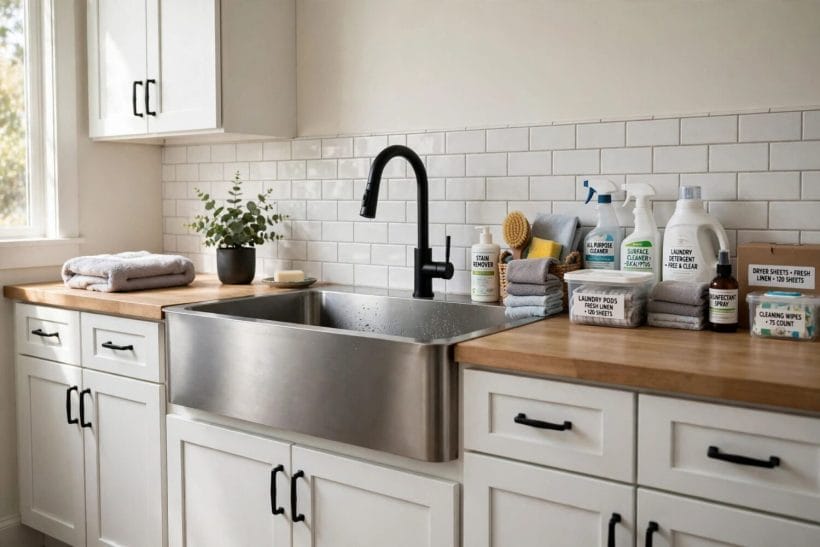
41. Deep drawers under the counter
Drawers beat doors at base level: a deep drawer pulls the whole store out to you, bottles upright in a divided insert, nothing lost at the back. Two deep drawers under the folding counter are worth four door cabinets in daily convenience.
42. A sink cabinet that works
The fifth gallery’s farmhouse sink sits in white shaker bases — and the cabinet beneath it earns its keep with a U-shaped drawer or a shallow tray that wraps the plumbing, holding sponges and scrubbers where the water work actually happens.
43. Hamper cabinets
Tilt-out or pull-out hamper cabinets sort laundry at the source: darks, lights, delicates, each behind its own door. Sorting as you undress beats sorting on wash day, and the hampers’ fronts can match the rest of the run to keep the scheme calm.
44. A dedicated detergent cabinet
One cabinet, ideally lockable or high, owns everything chemical: detergents, bleach, stain treatments. Concentrating them keeps them from migrating around the room, keeps them away from clean laundry smells, and makes the safety story of the room simple to keep.
45. Open-front folding station storage
Beneath the folding counter, open-front cubbies take baskets mid-sort — the laundry equivalent of in-trays. They interrupt the closed-door monotony, keep work in progress visible, and give every household member a labelled landing zone for their clean clothes.
46. Cabinets over the machines
The wall above front-loaders is prime storage squandered by a shelf in many rooms. Proper wall cabinets there hold the full detergent wardrobe at grab height — the arrangement the room-by-room guide to laundry room sinks also favours wherever a counter meets a wall of storage.
47. Corner cabinet solutions
Laundry corners eat storage unless the cabinet fights back: a carousel, a diagonal door, or simply open corner shelves for the iron and steamer. The corner above the counter is the natural home of the appliances used weekly rather than daily.
48. Glass-front uppers for the pretty store
Glass doors on one upper cabinet — folded white towels, decanted powders in jars, a small plant — give the room a display moment while the honest clutter hides elsewhere. Keep glass to a minority of the doors; a whole wall of it is a commitment to tidiness.
8. Cabinet Styles and Door Profiles
49. Shaker doors, the laundry default
The shaker profile — flat centre panel, square frame — dominates laundry cabinetry because it suits every finish in this post and never dates loudly. It also cleans easily: one ledge to wipe, no dust-trapping mouldings. When in doubt, shaker is the answer the room keeps giving.
50. Flat slab doors for modern rooms
Slab fronts with no frame or panel give a laundry a calm, architectural face, especially handleless. They show every fingerprint at handle height, so pair them with push-latches or a recessed channel — and choose a finish that forgives, like a matte laminate.
51. Beadboard panel doors
Vertical beadboard centres bring cottage texture to laundry doors and hide minor dents in their grooves. Painted cream or sage, they are the farmhouse room’s natural partner — and they make even flat-pack cabinets look deliberately chosen rather than defaulted.
52. Raised-panel traditional doors
Raised panels carry a formal, furniture-like air for laundries in traditional houses where the room continues the home’s joinery language. They ask more of cleaning day — dust gathers on the bevels — so save them for larger, lighter-use rooms.
53. Louvred doors for ventilation
Louvre-fronted cabinets breathe, which is exactly what the towel store and the damp-clothes hamper need. Use them selectively — one or two doors in the run — since a whole wall of louvres reads beach-hut; a pair reads considered and practical.
54. Handleless channel systems
A continuous aluminium channel behind the door tops lets fingers pull doors open without any visible hardware. The laundry gains a sleek, unbroken face and loses a dozen handles to clean around — a real trade in the room where hands are most often wet or soapy.
55. Inset cabinetry for a fitted look
Inset doors, sitting flush inside their frames, give laundry cabinets the built-in furniture quality of older houses. The tolerances are tight and the look is unmistakable; in a hard-working room, inset fronts also sit protected from knocks by their frames.
56. Open cabinets without doors
Removing doors from one run — leaving open, shelf-lined cabinets — suits the everyday grab zone: towels, the wash basket, the iron. Doorless storage fails only when it holds clutter; stocked with folded and jarred things, it reads as intentional as any door.
9. Hardware, Counters and Finishing Details
57. Brass handles on painted doors
Unlacquered or brushed brass warms painted cabinets — sage, navy, cream — and ages with them, darkening at the touch points. It is the hardware of the feature room, and it forgives the small knocks of laundry baskets better than polished finishes.
58. Black bar pulls for contrast
Matte black bar pulls give white and pale cabinets their outline. Keep the pull lengths consistent across drawers and doors, and the room reads designed rather than assembled — a small discipline that shows in every photograph of the finished space.
59. A fold-down counter over the cabinets
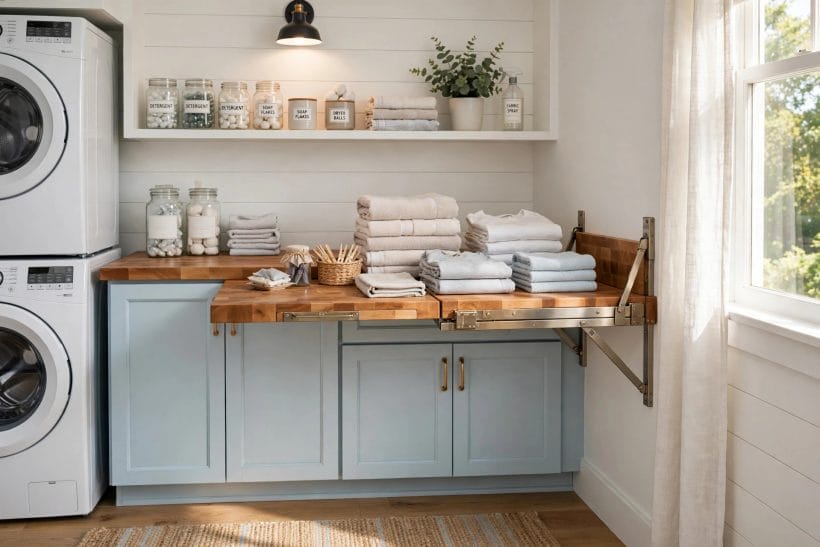
The sixth gallery’s trick: a timber counter hinged to fold down over pale-blue base cabinets, giving a full folding surface that disappears when the room needs floor space. It is the small laundry’s best cabinet-adjacent upgrade, bar none.
60. Butcher block counters with cabinets
A wood counter softens a wall of painted cabinetry and gives laundry a warm working surface that can be sanded back when life marks it. Seal it properly near the sink — the same care the bathroom laundry room ideas recommend wherever timber meets water daily.
61. Stone-look counters, pale and plain
A pale stone or stone-look counter brightens the working line of the room and reflects light onto the cabinets below. Plain beats patterned here: laundry rooms already contain enough visual noise from products and washing without the counter joining in.
62. Soft-close hinges and runners
Soft-close hardware is the upgrade you feel rather than see — doors and drawers that glide shut in a room where slamming echoes off tile and machines. It also protects painted finishes at their most vulnerable point: the closing edge.
63. Plinths, cornices and end panels
Finished ends make cabinets look built rather than placed: a matching end panel on the last unit, a cornice line at the top, a recessed plinth that lets feet stand close. These are the details that separate the laundry from the utility cupboard.
64. Under-cabinet lighting
A strip of light under the wall cabinets turns the counter into a proper workstation for treating stains and reading care labels. It costs little, wires invisibly along the cabinet base, and makes evening laundry noticeably less gloomy.
65. Labelled baskets inside the doors
Inside the calmest cabinets is a system: baskets or bins labelled by task — stain kit, delicates, sewing repairs, spare buttons. Labels end the rummage, and in a shared household they quietly teach everyone where things live without a single announcement.
10. Care, Repainting and Budget Notes
66. Wipe-down routines by finish
Painted cabinets want a soft cloth and mild detergent; stained timber wants the same, dried after; laminates forgive almost anything except abrasives. The rule beneath all of them: laundry chemicals spilled on a finish should be wiped at once, not at the weekend.
67. Steam is the laundry’s weather
Tumble dryers and hot washes fill the room with steam, so cabinet finishes here live harder lives than kitchen ones. Vent the room, leave cabinet doors ajar after heavy drying sessions, and choose finishes — catalysed paint, sealed timber — that shrug at humidity.
68. Repainting instead of replacing
Solid cabinets with tired paint are an asset, not a problem: a degrease, a sand, a bonding primer and two coats transform a laundry for the price of paint. Door-profile tricks from the replacing kitchen cabinet doors playbook — new fronts on sound carcasses — apply here unchanged.
69. Refacing and new fronts only
When the carcasses are straight but the style is wrong, new doors and drawer fronts on the existing boxes give a full visual refit at a fraction of the upheaval. In a laundry, keep one working cabinet throughout the job and the room never fully closes.
70. Where the money matters most
Spend on the carcasses, hinges and the tall storage — the parts that move and carry weight daily. Save on door exotica: a plain door in a good paint colour outperforms a fancy profile in a poor finish every year the room is in use.
71. Measuring for machines first
Laundry cabinets are planned around the machines, not the other way round: measure the pair, their door swing, the hoses behind them, and the height under the counter before a single cabinet is chosen. More laundry projects stall on a centimetre than on any colour decision.
72. Planning for the next machines
Machines are replaced more often than cabinets, so leave the cabinetry slightly forgiving: a filler panel that can move, a counter that overhangs a touch, plumbing access that does not require demolition. The cabinets you keep through two machine generations are the true bargain.
73. Small laundry, same rules
A closet laundry still deserves one proper cabinet — usually a tall, shallow one beside the stack — rather than a token shelf. The finishes and hardware rules scale down intact; only the quantities change, and a single considered cabinet beats three improvised ones.
74. Matching the laundry to the house
The most settled laundries echo the home’s other joinery: the kitchen’s door profile in a different colour, the bathroom’s hardware in a warmer metal. The room feels intentional because it belongs to the house rather than to a catalogue page of its own.
75. The calm test
Judge every finish and layout choice by one question: does it make wash day calmer? Cabinets that hide the mess, open where your hands are, and wipe clean without ceremony pass the test. Everything else — however beautiful — is decoration, and decoration comes second in the hardest-working room in the house.
Final Considerations
Laundry room cabinets succeed on three things: a finish that survives steam and splashes, storage shaped to the real contents — bottles upright, hampers sorted, tall things housed — and details like soft-close hinges and a folding counter that quietly remove friction from wash day. Choose the finish family first, plan the tall storage second, and let the hardware finish the sentence. A laundry built that way stops being a utility corner and becomes one of the most satisfying rooms in the house to use.


0 Comments