
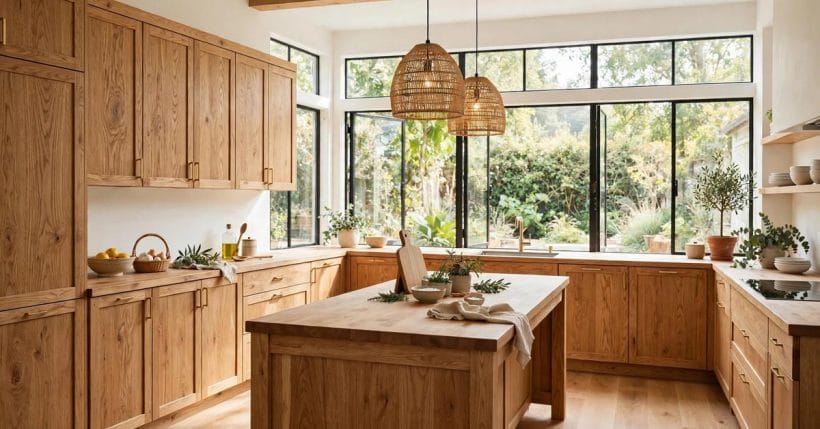
Wood cabinets are the warm heart of a kitchen. They soften the hard surfaces around them, carry the grain of a real material into a working room, and age with a character that painted finishes can only imitate. This article visits twelve kitchens where wood cabinets do the talking — twelve different ways to let timber lead, from pale oak to deep walnut, from rustic pine to refined alder. Each kitchen is counted honestly, and each one teaches something different about how wood behaves in a kitchen.
Read them as a set, not as a ranking. The point is not to pick a winner but to see the range: how tone, grain, layout and light change what wood cabinets feel like, and which of these twelve kitchens resembles the one you want to cook in. A note on how to use this article: notice which kitchens you return to as you read, because the ones that linger are usually the ones that match your room, your light and your cooking. A kitchen that photographs beautifully but feels wrong for your household is a warning, not an aspiration, and the honest reaction is the useful one.
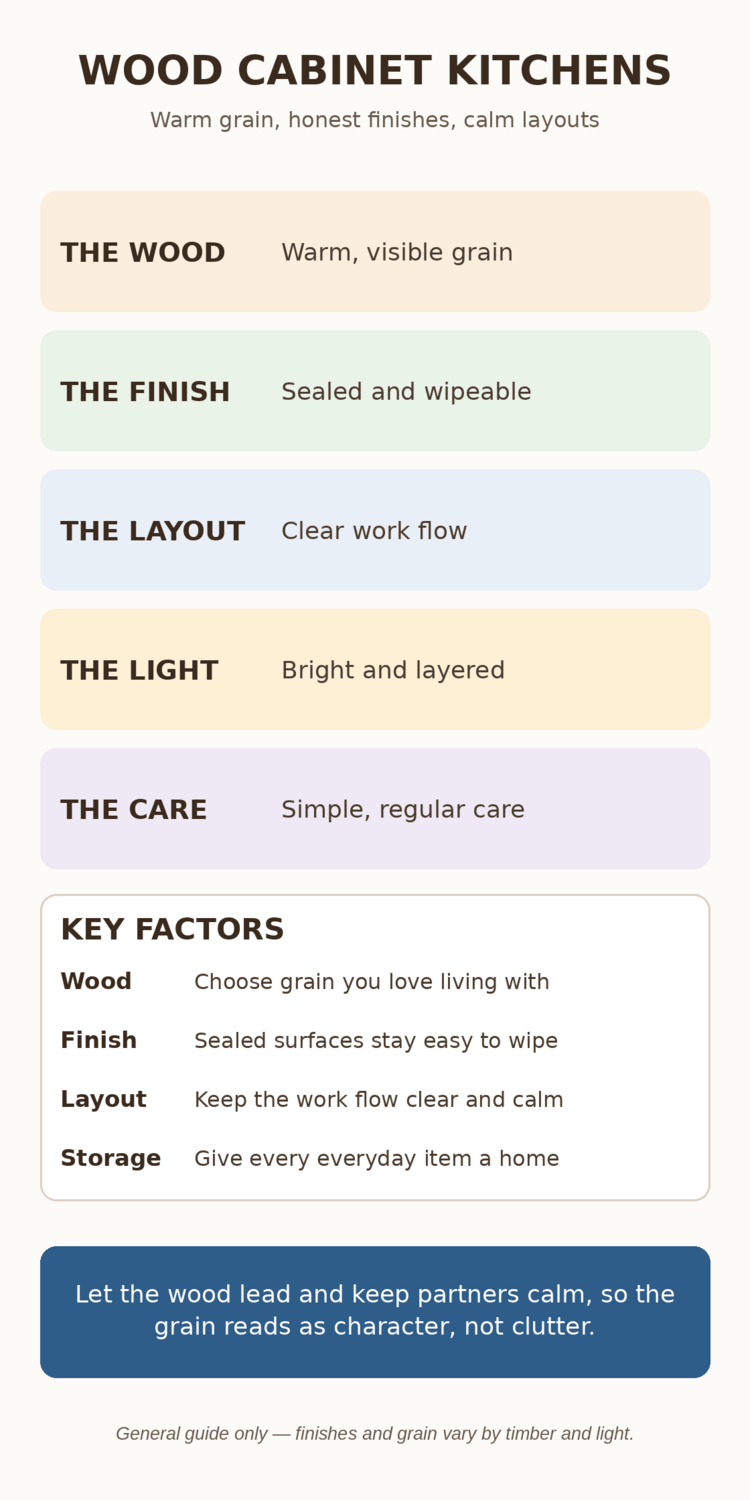
| Item | What it is |
|---|---|
| The Pale Oak Kitchen That Feels Like Morning | The first kitchen is pale oak throughout, and it feels like morning all day. |
| The Walnut Kitchen With Quiet Drama | The second kitchen goes dark, and it works because it commits. |
| The Pine Kitchen That Wears Its Knots Proudly | The third kitchen is pine, knots and all, and it is unapologetic about it. |
| The Alder Kitchen With Refined Grain | The fourth kitchen is alder, and it is the most refined of the twelve. |
| The Kitchen Where Wood Meets White | The fifth kitchen pairs wood cabinets with white counters and a white backsplash, and the pairing is a classic for a reason. |
| The Island Kitchen With Wood on Every Side | The sixth kitchen is an island kitchen, and the wood wraps the island as well as the walls. |
| The Kitchen With a Quartz Backsplash Partner | The seventh kitchen pairs wood cabinets with a quartz backsplash, and the pairing shows how a modern material can support a traditional one. |
| The Whitewashed Wood Kitchen | The eighth kitchen whitewashes its wood cabinets, and the result is timber with a lighter, softer voice. |
| The Kitchen Where Wood Frames the View | The ninth kitchen has a window worth framing, and the wood cabinets frame it rather than competing with it. |
| The Compact Kitchen That Proves Wood Scales Down | The tenth kitchen is compact, and it proves that wood cabinets are not only for large rooms. |
| The Dark Wood Kitchen With Brass Details | The eleventh kitchen is dark wood with brass details, and it is the most elegant of the twelve. |
| The Kitchen That Mixes Two Timbers | The twelfth kitchen breaks the rule that cabinets must match, and it works. |
1. The Pale Oak Kitchen That Feels Like Morning
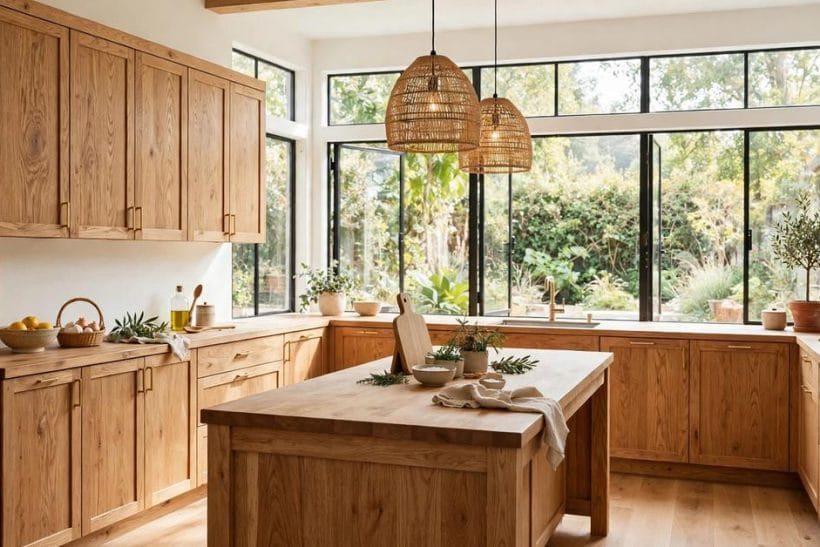
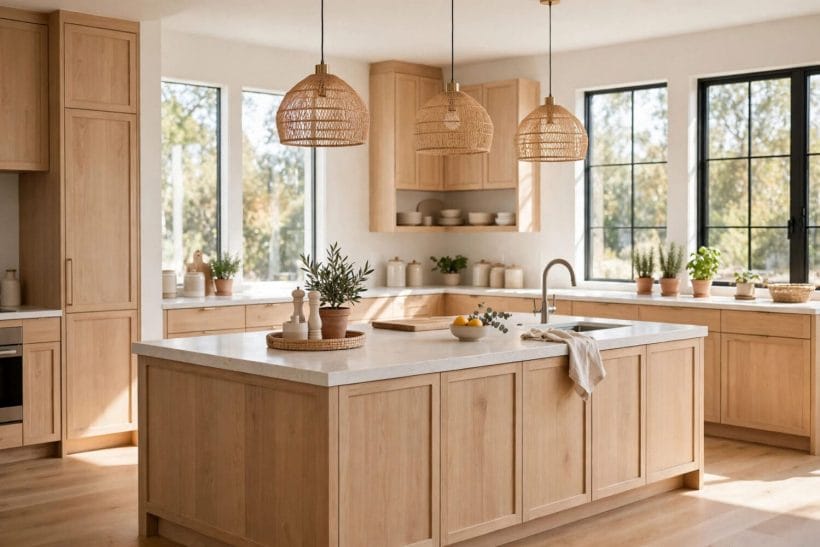
The first kitchen is pale oak throughout, and it feels like morning all day. Pale oak cabinets with a clear, soft finish keep the room bright, and their gentle grain gives the eye something to follow without demanding attention. The counters are pale too, and the room reads as one calm, continuous surface. This kitchen suits a household that wants warmth without darkness, and it shows why pale wood is the safest starting point for anyone nervous about timber in a kitchen: it is warm, but it never overwhelms.
What this kitchen teaches is restraint. The oak is allowed to be the only strong material in the room, and everything else steps back. That restraint is what makes pale oak work in small kitchens as well as large ones, because the wood adds character without adding visual weight. If your kitchen is short on light, this is the kitchen to study first.
2. The Walnut Kitchen With Quiet Drama
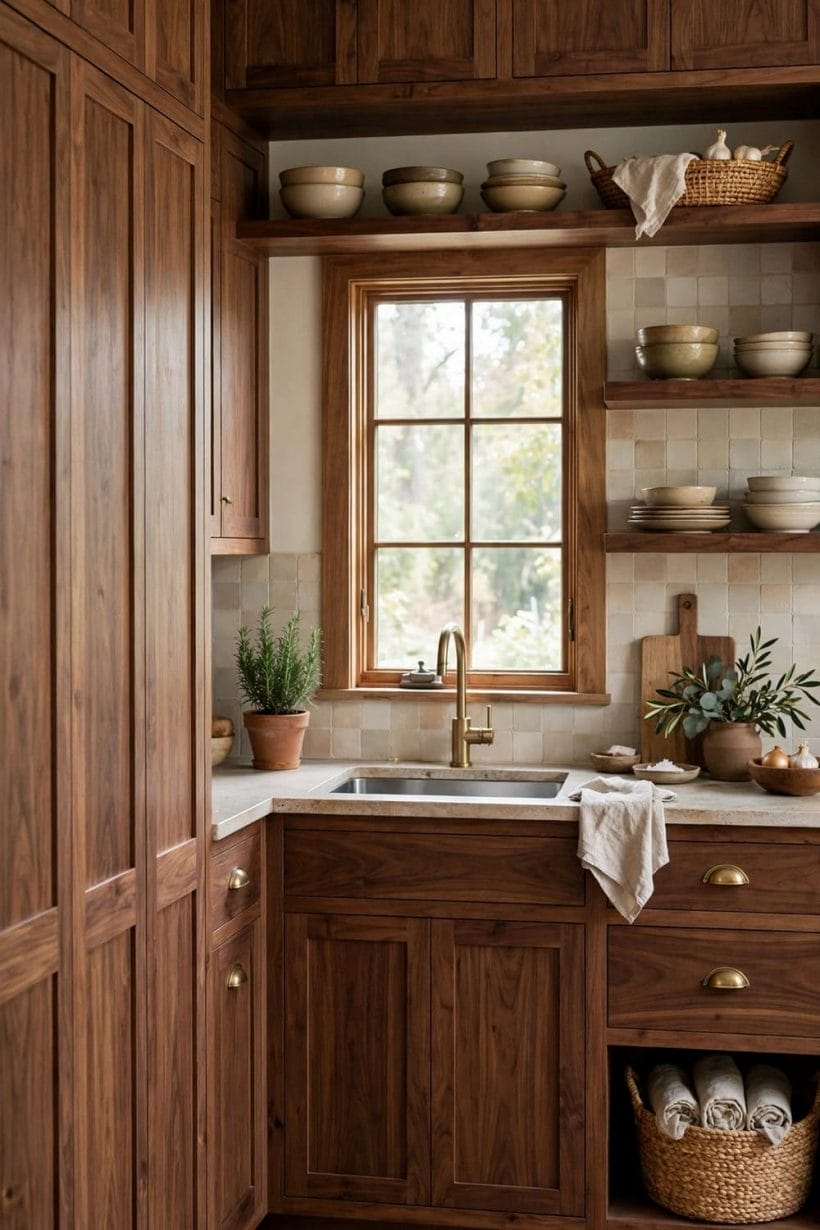
The second kitchen goes dark, and it works because it commits. Walnut cabinets with a deep, even tone give the room a quiet drama, and the contrast with pale counters and a light floor keeps the darkness from closing in. Walnut grain is more pronounced than oak, with long, flowing lines that reward a closer look, and in this kitchen those lines run horizontally, which makes the room feel wider than it is.
The lesson here is contrast. Dark cabinets need light partners — pale counters, a light backsplash, good lighting — and when they get them, the result is richer than an all-pale room. This kitchen suits a household that enjoys a moody, grown-up space and is willing to invest in lighting to support it. Dark wood is not a risk if the room is designed around it. Under-cabinet lighting is particularly important here, because it lifts the counters out of the cabinets’ shadow and makes the working surface bright even when the room itself stays moody. Without it, a dark kitchen can feel gloomy at the very counters where light matters most.
3. The Pine Kitchen That Wears Its Knots Proudly
The third kitchen is pine, knots and all, and it is unapologetic about it. Pine cabinets with visible knots and a warm honey tone give the room a rustic, lived-in feel that no other timber quite matches. This kitchen is the most casual of the twelve, and that casualness is its charm: it feels like a room where cooking is a pleasure, not a performance, and where a few marks on the timber are part of the story.
Pine teaches honesty about material. It is softer than oak or walnut, and it will show wear sooner, but in a kitchen that embraces that wear, the softness becomes character. Our knotty pine cabinets post explores this timber in depth, and it is worth reading before choosing pine, because pine rewards owners who love it as it is, knots included.
4. The Alder Kitchen With Refined Grain
The fourth kitchen is alder, and it is the most refined of the twelve. Alder cabinets with a smooth, even grain and a warm mid-tone sit comfortably between oak and walnut: warmer than oak, lighter than walnut, with a grain that reads as elegant rather than rustic. This kitchen feels tailored, and it suits a household that wants timber character without rustic associations. Alder also takes hardware well, because its even grain does not fight hinges and handles, and a well-chosen handle in brass or dark metal can lift an alder kitchen from pleasant to polished. If you enjoy details, alder gives them room to shine.
Alder’s lesson is the middle path. It offers the warmth of a darker timber with the lightness of a pale one, and it takes stain beautifully, which means the tone can be tuned to the room. Our knotty alder cabinets post covers this timber’s character in detail. If you are torn between light and dark, alder is the kitchen to linger on.
5. The Kitchen Where Wood Meets White
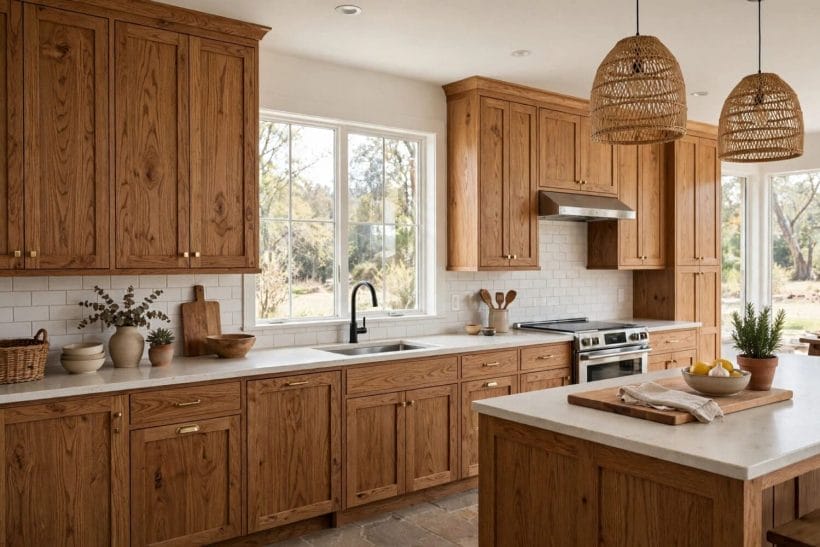
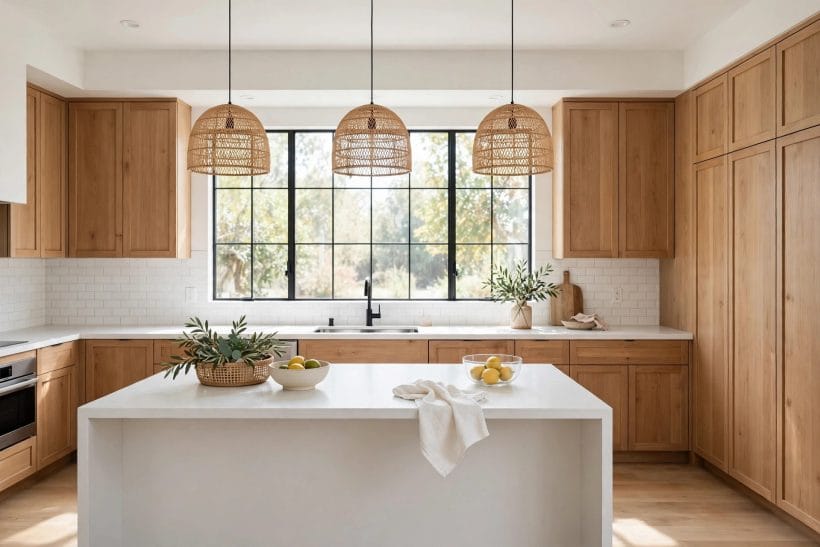
The fifth kitchen pairs wood cabinets with white counters and a white backsplash, and the pairing is a classic for a reason. White lifts the timber, keeps the room bright, and lets the grain read clearly against a calm background. The wood provides all the warmth the room needs, and the white provides the light. Neither fights the other, and the result is a kitchen that feels both warm and fresh.
This kitchen teaches pairing. Wood cabinets do not need wood partners everywhere; in fact, they usually look better with calm, pale companions that let the grain lead. White is the most forgiving of those companions, and it works with every timber in this article. If you are unsure what counters to choose, white is the safe partner that never argues with wood. The same logic applies to the floor: a pale or neutral floor keeps the room balanced, while a strongly patterned floor can compete with the cabinets. Let one material lead — the cabinets — and let the rest of the room support them quietly.
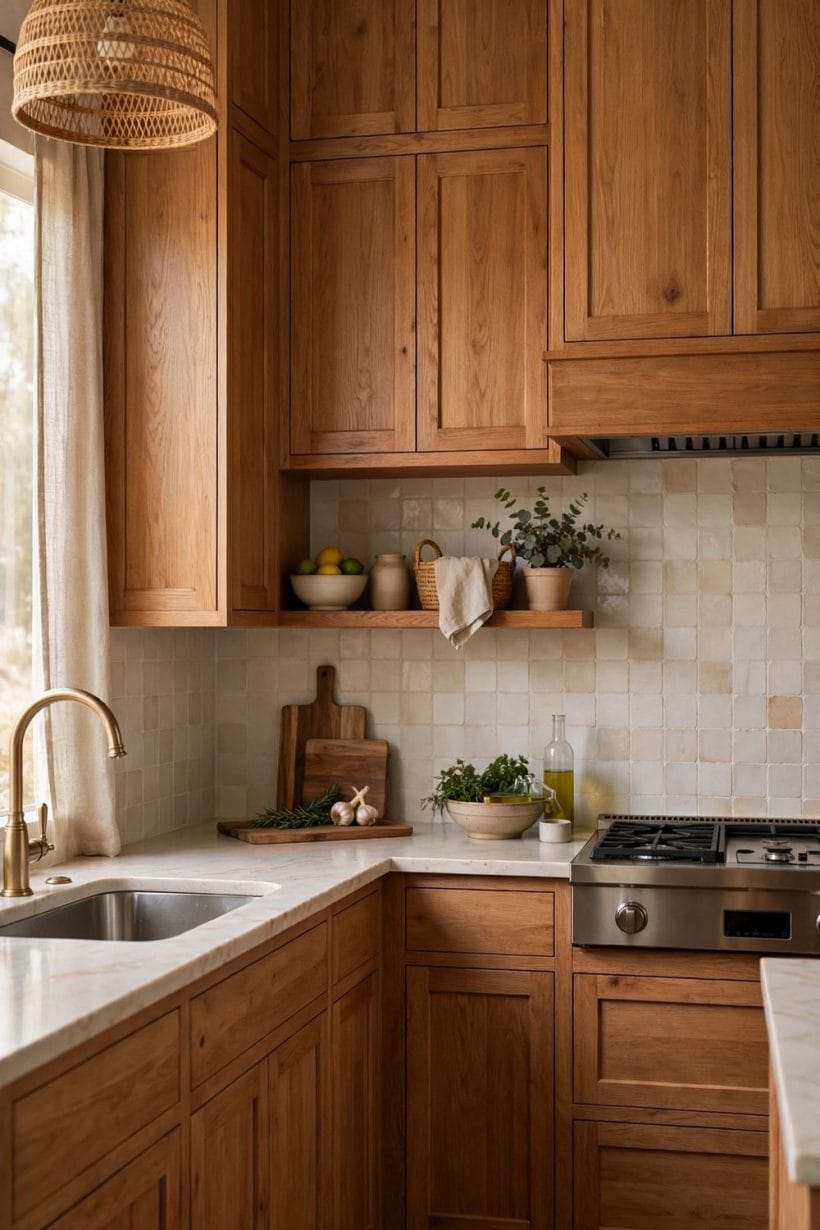
6. The Island Kitchen With Wood on Every Side
The sixth kitchen is an island kitchen, and the wood wraps the island as well as the walls. An island in matching timber makes the kitchen feel like one piece of furniture rather than a collection of units, and it gives the cook a generous working surface surrounded by warmth. The island also breaks up a large room, giving it a centre that the rest of the kitchen orbits.
The island lesson is scale. In a large kitchen, timber on the island as well as the walls prevents the room from feeling empty or cold, while in a small kitchen the same trick can overwhelm. This kitchen is large, and it earns its timber. If your kitchen is generous, an island in matching wood is one of the most satisfying choices you can make; if it is small, keep the island light and let the wall cabinets carry the timber. Seating at the island deserves a thought too: a timber island with an overhang for stools becomes a breakfast spot and a gathering place, which makes the kitchen social as well as practical, and that social role is often what a household remembers most.
7. The Kitchen With a Quartz Backsplash Partner
The seventh kitchen pairs wood cabinets with a quartz backsplash, and the pairing shows how a modern material can support a traditional one. The quartz is calm and continuous, with no grout lines to break the eye, and it lets the timber cabinets stand out against a clean background. The combination feels contemporary without losing the warmth that wood brings.
This kitchen teaches that wood and modern surfaces are not enemies. A quartz backsplash protects the wall behind the hob and sink while giving the cabinets a quiet stage, and the contrast between natural grain and engineered calm is genuinely pleasing. Our quartz backsplash ideas post explores this pairing further, and it is a useful companion to this kitchen.
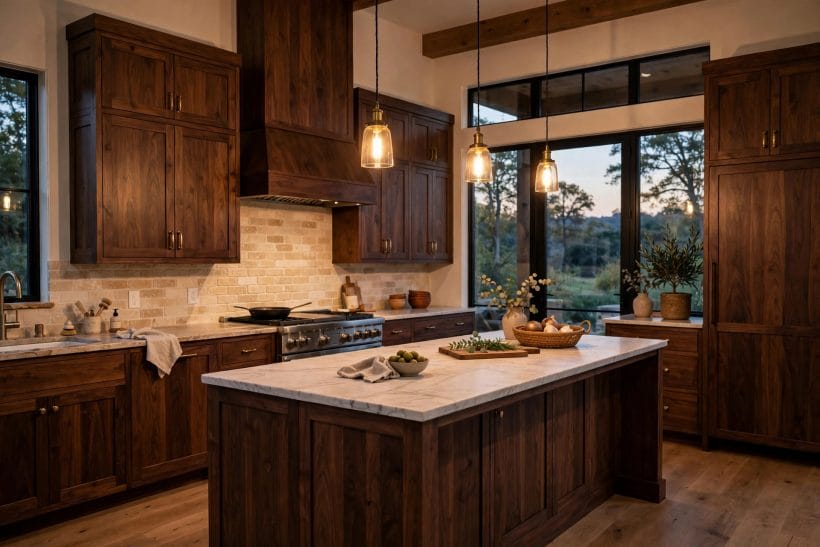
8. The Whitewashed Wood Kitchen
The eighth kitchen whitewashes its wood cabinets, and the result is timber with a lighter, softer voice. Whitewashing lets the grain show through a pale veil, which keeps the warmth of wood while lifting the room considerably. This kitchen feels coastal and calm, and it suits a household that loves timber but wants a brighter, airier room than natural wood gives.
Whitewash teaches that wood cabinets are not a single decision. The same timber can read very differently depending on its finish, and a wash or pale stain can transform a dark timber into a light one. Our whitewash knotty pine post shows this transformation on a wall finish, and the principle applies to cabinets too: finish is a second chance to get the tone right.
9. The Kitchen Where Wood Frames the View
The ninth kitchen has a window worth framing, and the wood cabinets frame it rather than competing with it. Cabinets run up to the window on both sides, in a warm mid-tone timber, and the window becomes the centrepiece of the room, with the wood acting as a generous frame. The kitchen feels connected to the garden outside, and the timber is part of that connection, because it reads as a natural material in a room open to nature.
This kitchen’s lesson is context. Cabinets do not exist in isolation; they sit against windows, doors and views, and the best kitchens let those neighbours shape the design. If your kitchen has a good view, let the cabinets frame it quietly rather than crowding it. Wood is particularly good at this, because it feels like part of the landscape rather than an interruption to it.
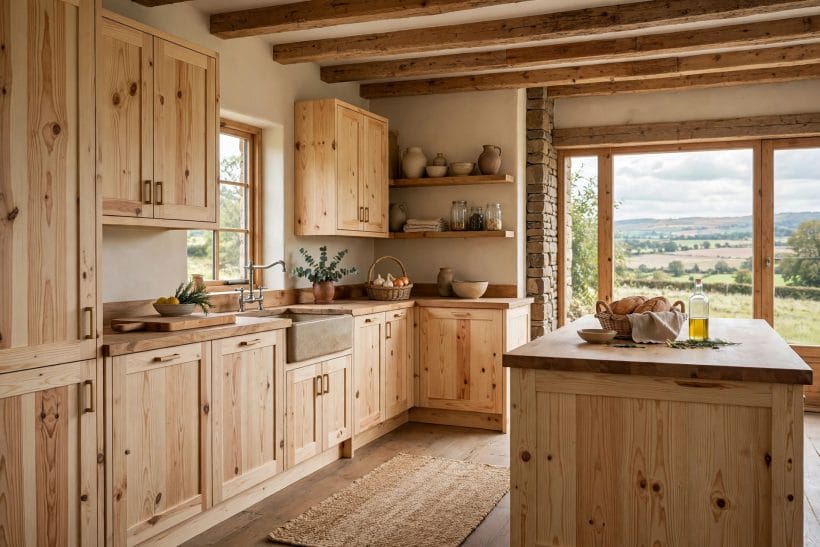
10. The Compact Kitchen That Proves Wood Scales Down
The tenth kitchen is compact, and it proves that wood cabinets are not only for large rooms. In a small kitchen, warm timber cabinets with a clear finish and simple handles make the room feel welcoming rather than cramped, because the eye reads the timber as warmth, not as bulk. The layout is simple — a single run with a small return — and the wood carries the whole room’s character.
Small kitchens teach editing. With less space, every choice counts more, and wood earns its place by doing two jobs at once: providing storage and providing character. If your kitchen is small, choose a timber and finish that you love looking at, because you will see it from everywhere in the room. Our kitchen ideas collection shows compact kitchens of every style, and wood appears in the most welcoming of them. Open shelving is worth considering in a compact wood kitchen, because a few open shelves break up a run of closed cabinets and give the room breathing space, though they also demand tidiness, so keep them for the pieces that look good on display.
11. The Dark Wood Kitchen With Brass Details
The eleventh kitchen is dark wood with brass details, and it is the most elegant of the twelve. Dark cabinets, brass handles and a brass tap give the room a jewellery-like quality, and the warm metal lifts the dark timber without lightening it. The combination feels deliberate and grown-up, and it shows how hardware can transform cabinets: the same dark timber with plain handles would feel plainer, while brass makes it feel considered.
Hardware is this kitchen’s lesson. Handles, hinges and taps are small, but they are touched every day and seen from across the room, so they deserve as much thought as the cabinets themselves. Brass suits dark wood particularly well, because the warm metal echoes the warm timber, but the principle is general: choose hardware that flatters your timber, and the cabinets will look more expensive than they are.
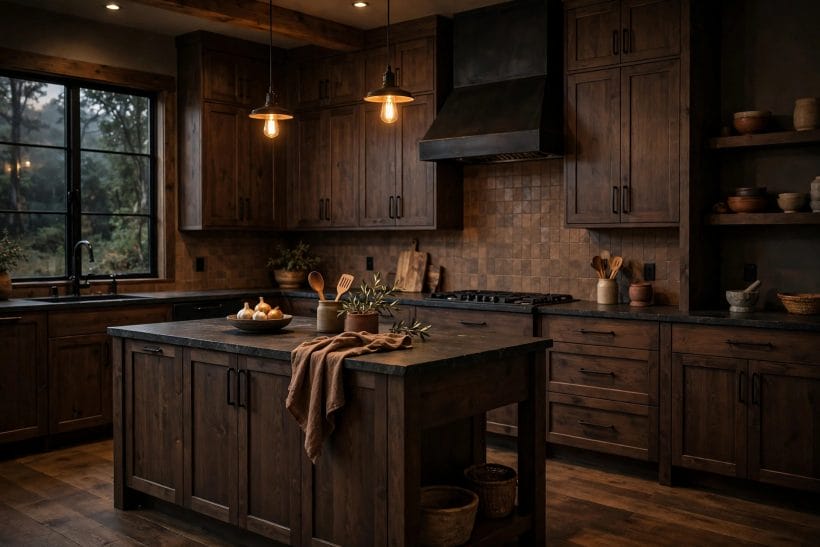
12. The Kitchen That Mixes Two Timbers
The twelfth kitchen breaks the rule that cabinets must match, and it works. Two timbers — a pale oak on the wall cabinets and a deeper walnut on the island — give the room depth and personality, because the contrast marks the island as a distinct piece. The mix succeeds because the two timbers share a warm undertone, so they feel related rather than random, and because the rest of the room stays calm.
Mixing timbers teaches confidence. It requires a shared undertone and a calm room, but when those are in place, a mixed kitchen feels more designed than a matched one, because it shows deliberate choices rather than a single default. For a broader sense of how kitchens come together, our tiny house designs and interior design ideas collections show kitchens where mixed materials are used with restraint, which is the discipline this kitchen rewards.
Final Considerations
Twelve kitchens, twelve ways to let wood lead. Pale oak for brightness, walnut for drama, pine for rustic honesty, alder for refinement, white partners for calm, islands for scale, quartz for a modern stage, whitewash for airiness, framing for views, compact layouts for small rooms, brass for elegance, and mixed timbers for confidence. The kitchen that suits you is the one whose timber, tone and layout match your room and your cooking — and whichever of the twelve that is, the wood will reward you with warmth that no other cabinet material quite matches.

0 Comments