
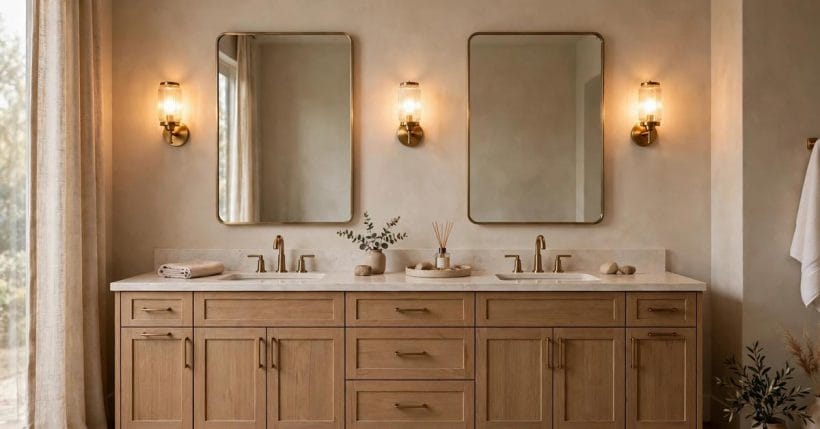
Bathroom mirrors do two jobs at once: they reflect the person using them, and they reflect the light around them. Get the lighting wrong and the mirror becomes an unforgiving surface, casting shadows exactly where you need clarity. Get it right and the whole bathroom feels brighter, larger, and easier to use, morning and evening alike. The secret is placement: light that falls on the face from the front and sides, rather than from above alone, flatters and reveals in equal measure.
These ten ideas cover the full range of vanity lighting and mirror choices, from the position of a single sconce to the pairing of mirrors with storage. Each idea stands alone, so you can borrow one for a small refresh or combine several for a complete rethink. Electrical work in a bathroom belongs to a qualified professional, and damp-zone fittings should always suit their location — the ideas below describe placement and effect, not wiring.
Idea 1: Flank the Mirror With Sconces at Face Height
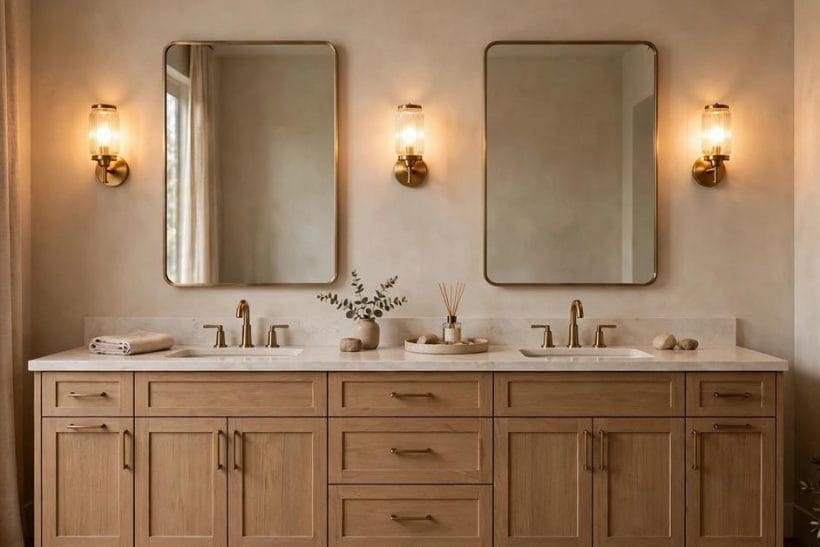
The single most effective vanity lighting move is also the simplest: place a light on each side of the mirror, roughly at face height. Side light falls evenly across the face, removing the under-eye and under-chin shadows that a lone ceiling light creates. It is the arrangement used in dressing rooms for good reason, and it works just as well in a family bathroom.
Choose sconces with shades that diffuse rather than glare, and keep them clear of splashes while still close enough to the mirror to do their work. If only one side has wall space, a single sconce on the open side plus a soft overhead light still beats an overhead light alone. The goal is even illumination on the face, not brightness for its own sake.
In a small bathroom, wall space beside the mirror may be too narrow for full sconces. Slim vertical fittings, or a pair of narrow bars mounted on the mirror itself, can achieve the same even face light in a tight footprint. The principle does not change with the room’s size: light from the sides, at face height, beats light from above alone in every bathroom, however small.
Idea 2: Let the Mirror Stretch the Light
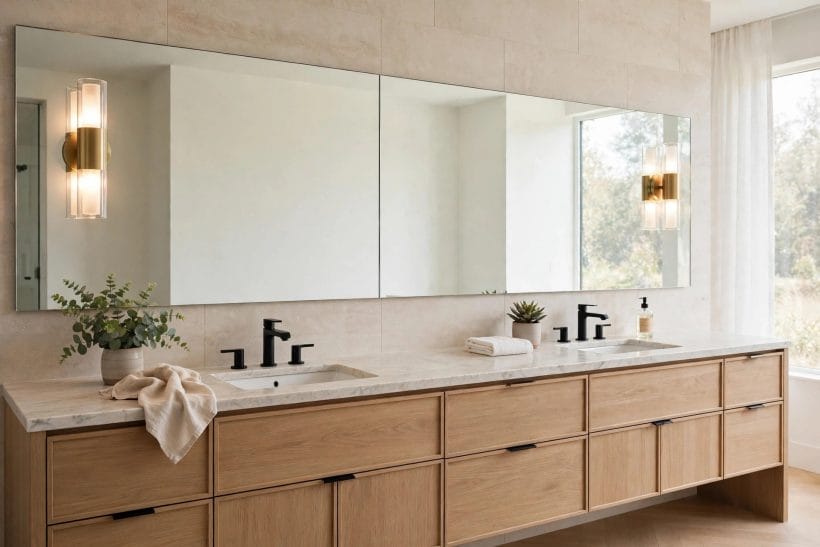
A large mirror doubles whatever light the bathroom already has, bouncing it back into the room and making the space feel wider. Extending the mirror across the full width of the vanity, rather than hanging a small framed piece in the centre, gives the lighting more surface to work with and gives two people room to use the vanity at once.
Keep the mirror’s edges clean and its surface easy to wipe, since a large mirror shows every splash. A frameless edge suits modern bathrooms, while a slim frame in a finish that matches the taps ties the mirror into the room’s fittings. Either way, the mirror should serve the light first and decoration second.
A mirror opposite the window is the most powerful placement in a bathroom with natural light, since it returns daylight deep into the room. If the layout does not allow it, a mirror on the wall adjacent to the window still catches and shares a useful share of the light. Avoid placing the mirror where it reflects only a blank wall, since it then doubles dullness instead of brightness.
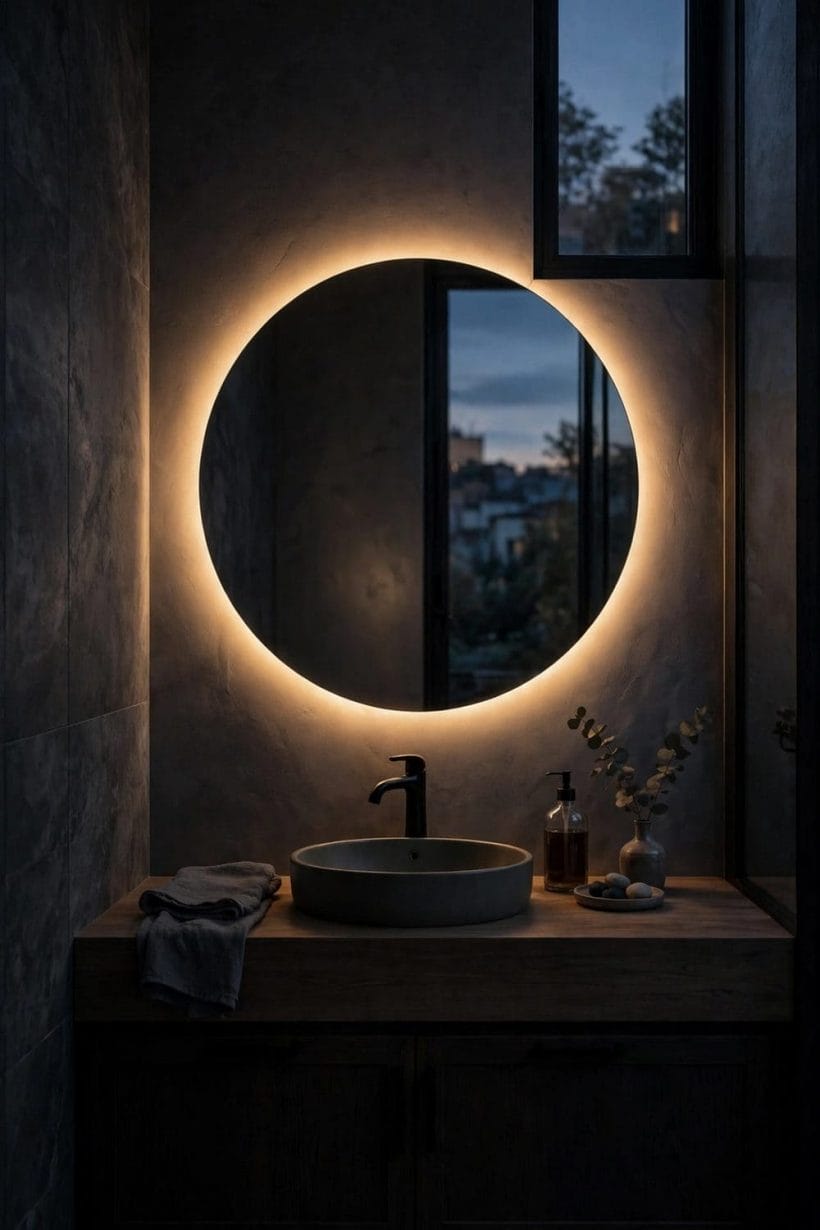
Idea 3: Add a Backlit Mirror for Soft, Even Glow
Backlit mirrors hide the light source behind the glass, washing the wall with a soft halo and lighting the face without visible fittings. The effect is gentle and modern, and it suits bathrooms where wall space beside the mirror is limited, since the mirror itself becomes the light.
Look for a model with a warm colour temperature and a dimmer if the bathroom serves both early mornings and late evenings. A backlit mirror pairs well with a small ceiling light for general brightness, but on its own it can already transform a dim corner into a pleasant grooming spot. Keep the wall behind it plain so the halo reads cleanly.
Backlit mirrors vary widely in brightness, and the brightest is not always the best. In a small bathroom, an overly bright halo can feel clinical, while a softer glow suits evening use. Where possible, choose a model with adjustable brightness, and test it in the evening light the bathroom actually receives. The halo should flatter the room, not dominate it.
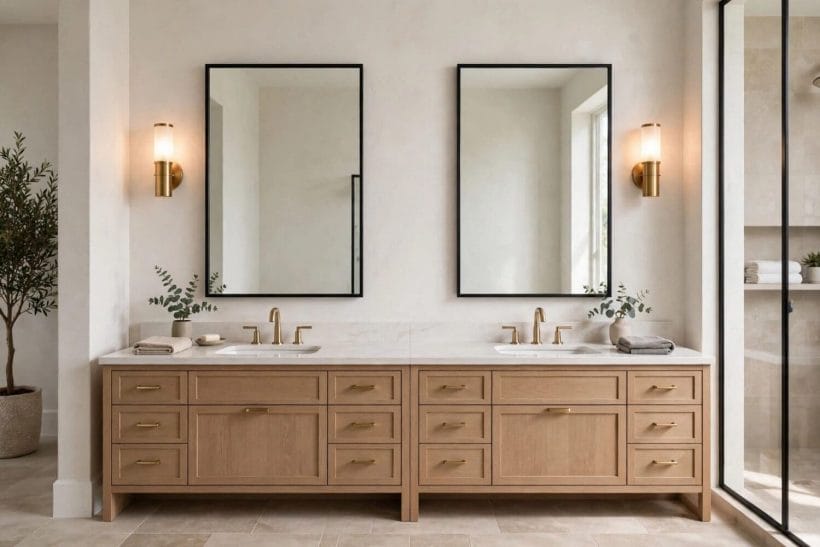
Idea 4: Pair Two Mirrors With a Shared Light Plan
Double vanities need a lighting plan that treats both mirrors equally. Two separate mirrors, each with its own pair of sconces, look balanced and give each user their own well-lit zone. A single long mirror over a double vanity can work too, provided the lights are spaced so neither user stands in shadow.
Symmetry matters here more than in a single vanity: mismatched heights or different fittings on each side draw the eye immediately. Measure from the centre line of the vanity outward, and check the arrangement from the doorway, where imbalance shows most clearly. When both sides match, the whole wall reads as one calm composition.
Shared bathrooms used by people of different heights need a lighting plan that flatters both. Side sconces at a middle height, rather than a single high fitting, serve a wider range of users more evenly. If one user is much taller, a slightly taller mirror with lights placed to cover the middle of its height is a better compromise than lights fixed for one person alone.
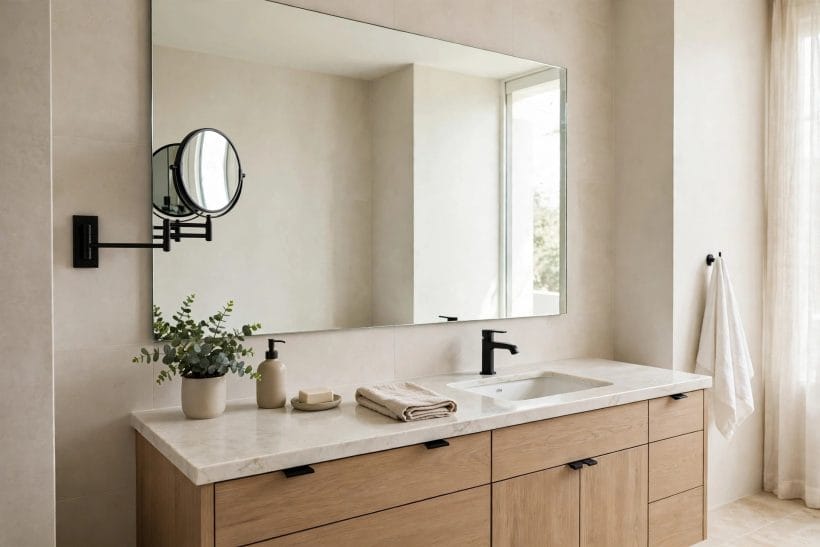
Idea 5: Use a Magnifying Mirror as a Second Layer
Even the best general vanity lighting cannot do close work. A small magnifying mirror on an extending arm or a weighted stand adds a second layer exactly where detail matters, for tasks that need a closer view. It keeps the main mirror free for the whole-face view while the magnifier handles precision.
Place it within easy reach of the vanity but clear of the main mirror’s reflection, and choose a magnification that suits its user rather than the strongest available. A lighted magnifying mirror can help in a dim bathroom, but it should supplement, never replace, the room’s main lighting plan.
A magnifying mirror needs its own light consideration: without it, the magnified view can fall into shadow from the user’s own head. A lighted model, or placing the magnifier where the room’s side light reaches it, prevents this. Keep the magnifier’s arm short enough that it does not swing into the main mirror’s reflection, which quickly becomes irritating.
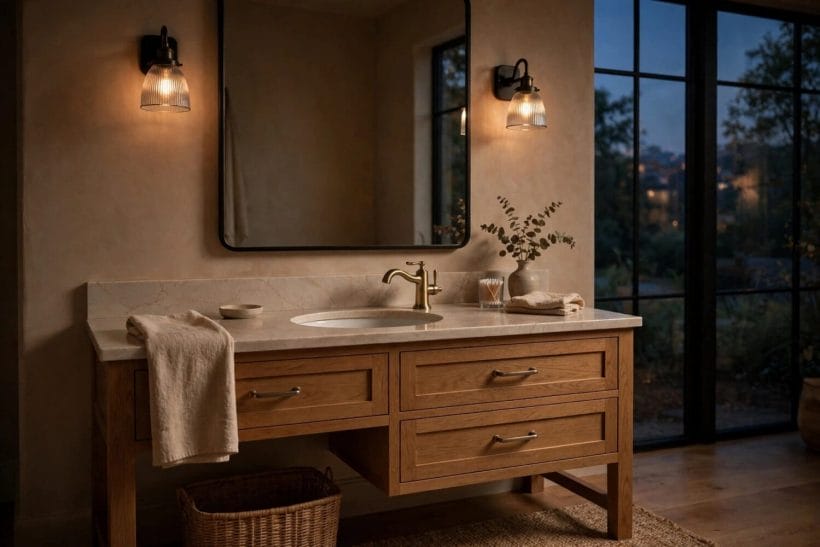
Idea 6: Warm the Light for Morning and Evening
Colour temperature changes how both the face and the bathroom appear. Cool, bluish light can make skin look washed out and tiles look harsh, while warm light flatters skin and softens hard surfaces. For a bathroom used at both ends of the day, warm to neutral light is the safer and more pleasant choice.
If the bathroom has a dimmer, use it: brighter light for morning routines, softer light for evening wind-downs. Check that all the vanity lights share the same temperature, because mixed warm and cool sources in one small room look untidy and make colour judgement harder. Consistency across fittings is a small detail with an outsized effect.
Makeup and shaving both depend on colour accuracy, which is why mixed colour temperatures cause trouble. If the bathroom’s fittings differ in temperature, the face looks different in each light, and colour choices made at the mirror may look wrong in daylight. Matching all vanity lights to one warm-to-neutral temperature removes this problem and makes the mirror trustworthy at any hour.
Idea 7: Light the Mirror From Above as a Complement
Overhead light above the mirror has a bad reputation, but only when it works alone. As a complement to side lighting, a slim bar or a pair of small downlights above the mirror adds general brightness and helps the room feel evenly lit. The key is balance: the overhead layer should support, not dominate, the face-level light.
Keep overhead fittings close to the mirror wall rather than in the centre of the ceiling, where they throw shadows forward onto the face. A frosted cover softens the output, and a separate switch lets the overhead layer be used only when needed. Used this way, top light becomes a useful second layer rather than the culprit it is often blamed for being.
Recessed downlights above a mirror deserve care in a bathroom, since steam and moisture reach the ceiling quickly. Fittings rated for their zone last longer and stay safe, and a qualified professional should confirm suitability during installation. A well-chosen overhead layer, properly rated and separately switched, adds brightness without adding risk.
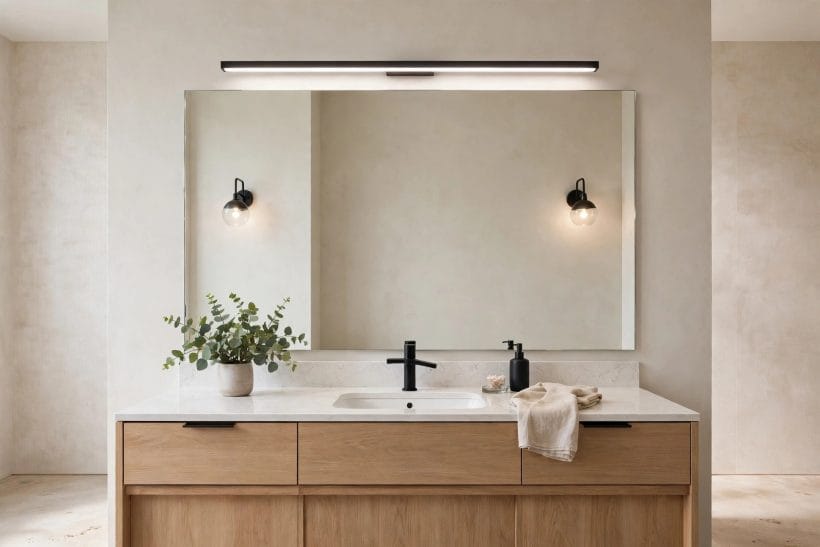
Idea 8: Choose Mirror Shapes That Suit the Vanity
Shape is not mere decoration: it changes how light moves and how the wall reads. A tall arched mirror suits a narrow vanity and draws the eye upward, while a wide rectangular mirror suits a long vanity and emphasises its breadth. A round mirror softens a bathroom full of straight lines and works well above a single pedestal basin.
Match the mirror’s scale to the vanity beneath it. A mirror much narrower than the vanity looks lost, while one wider than the basin unit overwhelms it. As a guide, the mirror should relate clearly to the width of the vanity it serves, with enough wall visible around it to let the shape breathe.
Frameless mirrors suit bathrooms where cleaning matters most, since there is no frame edge to trap moisture or cleaning residue. Framed mirrors suit rooms where the frame can tie into taps, handles, or woodwork elsewhere in the bathroom. Either choice works; the mistake is a frame that matches nothing else in the room and therefore looks like an afterthought.
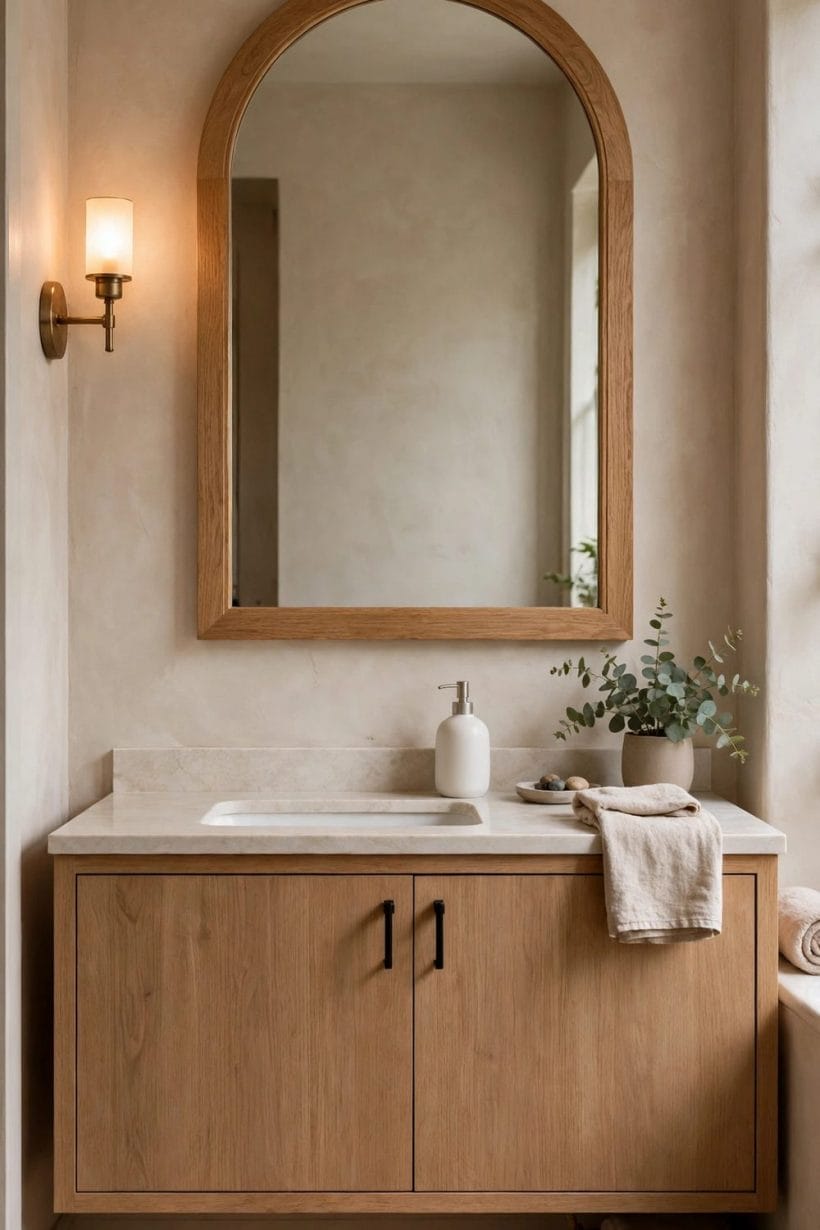
Idea 9: Add Storage Mirrors That Hide Clutter
Mirrored cabinets combine reflection with storage, keeping everyday items close without crowding the vanity top. A cabinet that spans the vanity width gives generous storage and a large reflective surface in one fitting, and its doors keep the wall looking calm when closed.
Check the cabinet’s depth and door swing before choosing, so doors open without striking lights or taps. Inside, simple adjustable shelves suit changing needs better than fixed compartments. Some cabinets include their own lighting, which can serve as the vanity’s main layer if the light falls evenly — test it at face height before relying on it alone.
Mirrored cabinets change the mirror’s height, since the cabinet body sits proud of the wall and its doors swing outward. Check that the cabinet’s mirror, when closed, still sits at a useful height for its users, and that open doors do not block the side lights. A cabinet that is too high forces users to stoop, undoing the benefit of its storage.
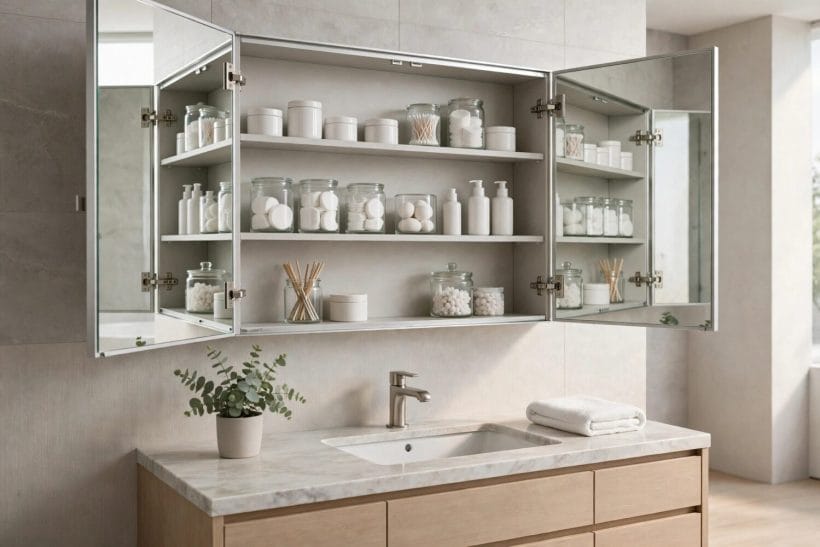
Idea 10: Keep the Glass Clean and the Light Unblocked
The finest lighting plan fails behind a spotted mirror or a blocked fitting. Steam, splashes, and dust dull both glass and light output, so a quick wipe as part of the weekly clean keeps the whole arrangement working. Ventilation matters here too: a bathroom that clears steam quickly keeps mirrors usable and fittings in good condition.
Check periodically that towels, tall bottles, or new accessories have not crept in front of a sconce or across the mirror’s edge. Light needs a clear path to the face, and the mirror needs a clear view of the room. A minute of tidying restores what a much larger change could not improve.
Hard water leaves marks that ordinary wiping may not remove, especially in areas with mineral-rich supply. A simple vinegar solution on a soft cloth handles most deposits, but abrasive pads will damage mirror coatings and should never be used. Regular gentle cleaning protects both the glass and its reflective backing, keeping the mirror clear for years rather than months.
Final Considerations
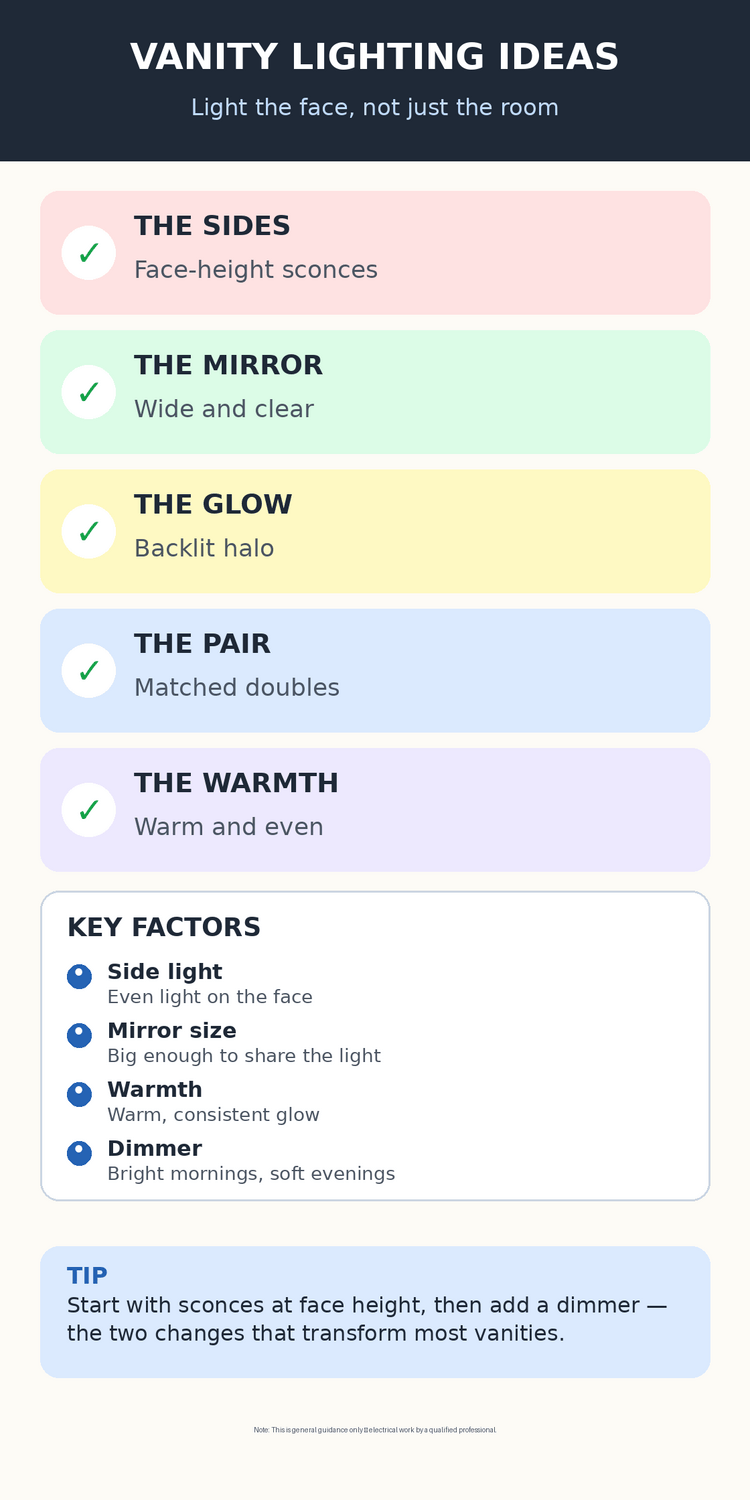
Vanity lighting rewards one principle above all: light the face, not just the room. Side light at face height, a mirror large enough to share the light, warm and consistent colour, and a second layer for detail will serve any bathroom better than a single bright ceiling fitting. Electrical fitting and damp-zone safety belong to a qualified professional throughout.
When planning a change, start with the cheapest fix that addresses the real complaint. If mornings feel dim, side sconces may solve it alone; if the room feels small, a larger mirror may matter more than any new fitting. Work through the ideas in the order of the problem, not the order of this guide, and let each change settle before adding the next. A bathroom improved one layer at a time ends up better lit than one changed all at once without testing.
For the bathroom pieces these ideas sit beside, see vanity lighting, built-in bathroom vanity, black cabinet bathroom ideas, tub surround ideas, double shower ideas, and tiny house designs. Start with the sconce positions, and let the mirror do the rest.


0 Comments