
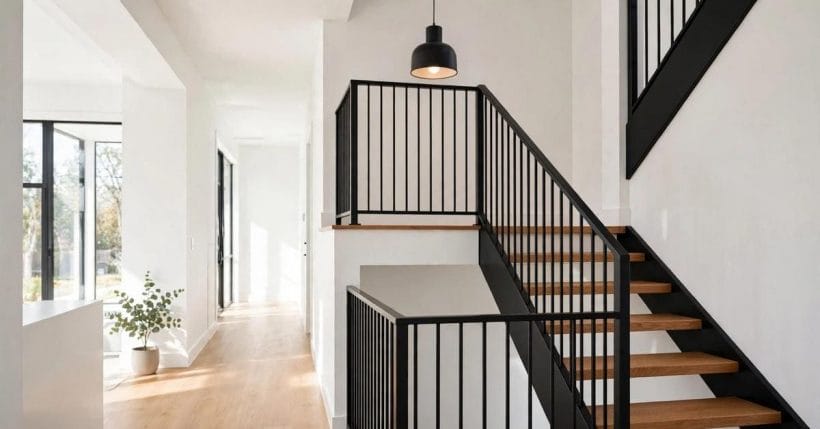
A modern staircase is mostly railing. The treads are a dozen flat boards; the railing is the long line your eye follows up the wall, the surface your hand trusts in the dark, and the guard standing between the household and the drop.
These 36 ideas are ordered the way the choice is actually made — the see-through options first, the black-metal classics next, then cable, timber and the floating stairs — with guarding and code stated honestly throughout, and every fitting question left to professionals.
1. Modern Stair Railings at a Glance
The central entity is the modern stair railing: the handrail, its balusters or panels, and the fixings that guard the open side of a flight. It is one element of the wider family gathered in our staircase ideas pillar — this post stays on the railing alone, and on its closest sibling, our stair railing ideas, which covers the broader traditional-to-modern range.
| Aspect | What to know | In a word |
|---|---|---|
| The Handrail | Oak, steel or a slim profile | Grip |
| The Balusters | Slim verticals, evenly spaced | Poised |
| The Glass | Panels that keep the light | Clear |
| The Cable | Fine lines, wide-open views | Taut |
| The Finish | Matte black, steel, warm oak | Calm |
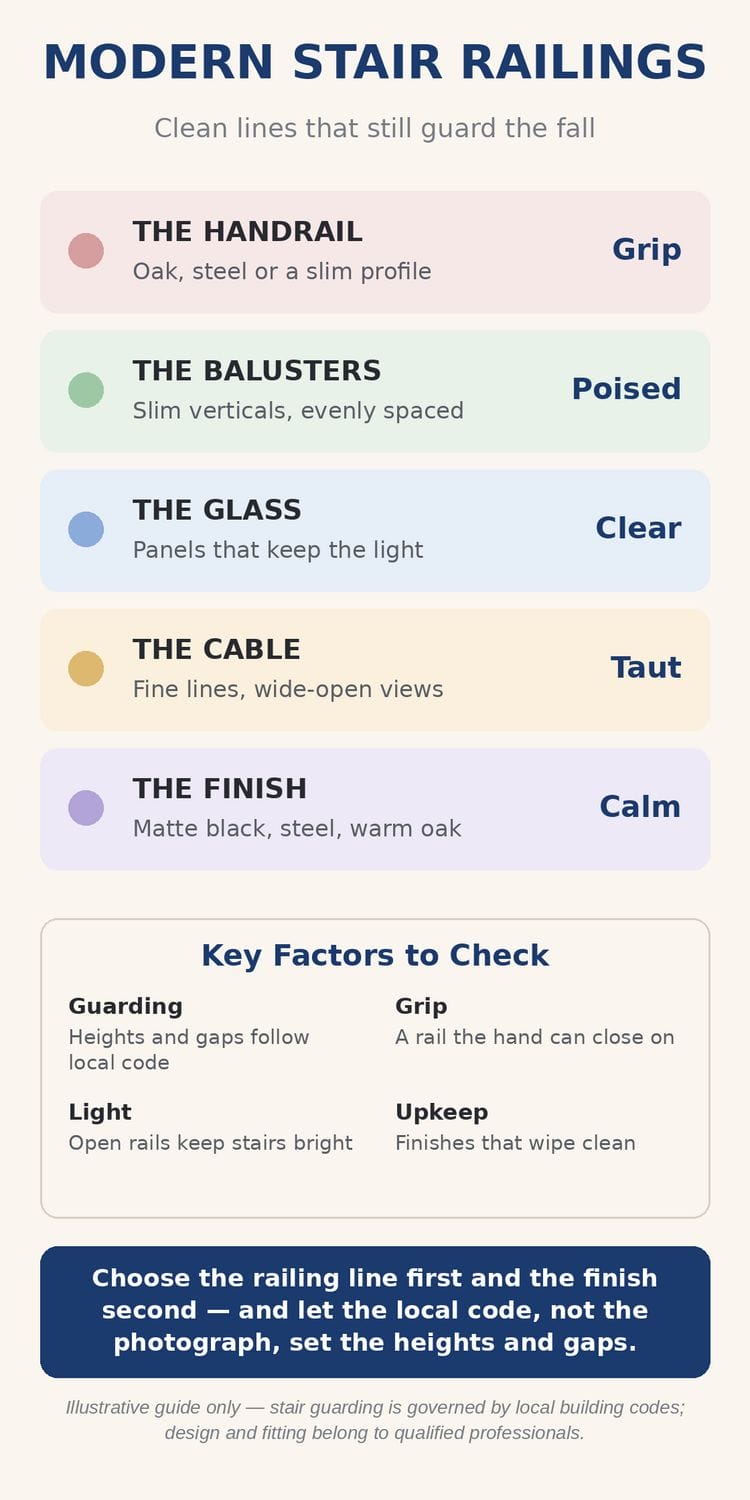
Choose the railing line first and the finish second — and let the local code, not the photograph, set the heights and gaps. Four checks sit behind the table: guarding, because heights and gaps follow the local code before they follow taste; grip, since a rail the hand can close around is the one that gets used; light, because open rails keep a stairwell bright; and upkeep, since the finish you choose is the finish you will wipe for years.
One promise governs everything below: no idea here teaches installation. Modern railings are structural safety components fitted to exacting rules, and their design and fitting belong to qualified professionals working to your local building code.
2. Glass Panels and Clear Views
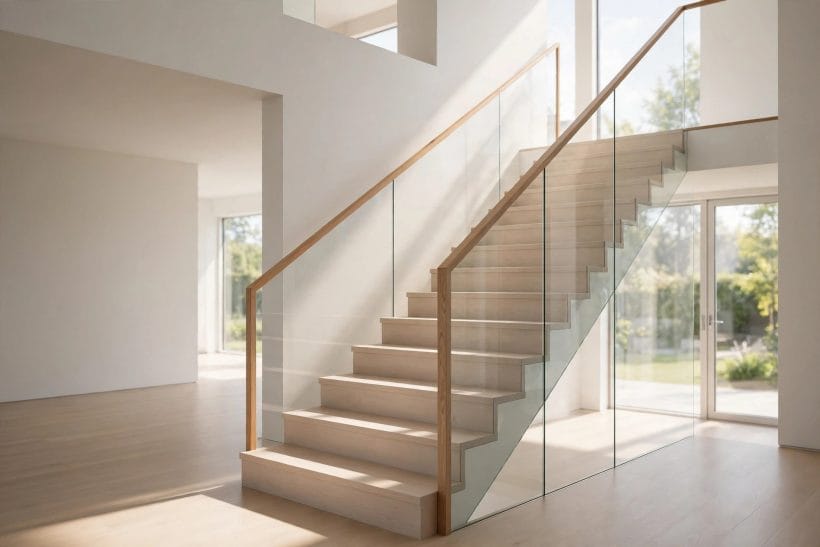
The staircase in this photograph keeps nothing back: pale treads, a slim oak rail, and glass doing the guarding invisibly. Glass is the modern railing at its most generous — the flight becomes light and view, and the guard disappears into both.
1. Frameless Glass With a Timber Cap
Panels held in a floor channel, capped with a slim oak rail, give the cleanest modern line. The timber warms the glass and gives the hand something kind to land on; the channel work and glass specification are professional territory throughout.
2. Glass With a Black Metal Rail
The same clear panels under a matte black handrail sharpen the whole flight — the glass keeps the light, the black line draws the route. It is the combination to choose when the room wants definition as much as openness.
3. Clamped Panels on Open Risers
Glass fixed with small metal clamps to the side of open treads lets the stair float twice over: no risers, no visible guard structure. Beautiful and demanding — every fixing is engineered, and the cleaning is forever.
4. Frosted Glass for Privacy
Where the stair passes a neighbour’s window or a bathroom door, frosted or graduated panels guard without surrendering the light. The frosting gradient can fade with height, clear at the hand, milky at the hip.
5. The Glass Landing Balustrade
Carrying the glass around the landing keeps the well of the stair bright from top to bottom and makes small landings feel like part of the room below. The curved flights among our curved staircase ideas show how far the clear-guard idea can travel.
6. Smoked Glass for Evening Rooms
A gentle smoke tint takes the clinical edge off glass and flatters warm lighting. It suits stairs serving evening rooms — snug, cinema, bar corners — where clear glass can feel like a shopfront after dark.
3. Black Metal and Slim Verticals
The tall stairwell in this photograph is drawn entirely in black lines: rail, balusters and shadow gaps composing a staircase that reads like a sketch. Black metal is the modern railing’s workhorse — graphic, forgiving and at home in almost every interior.
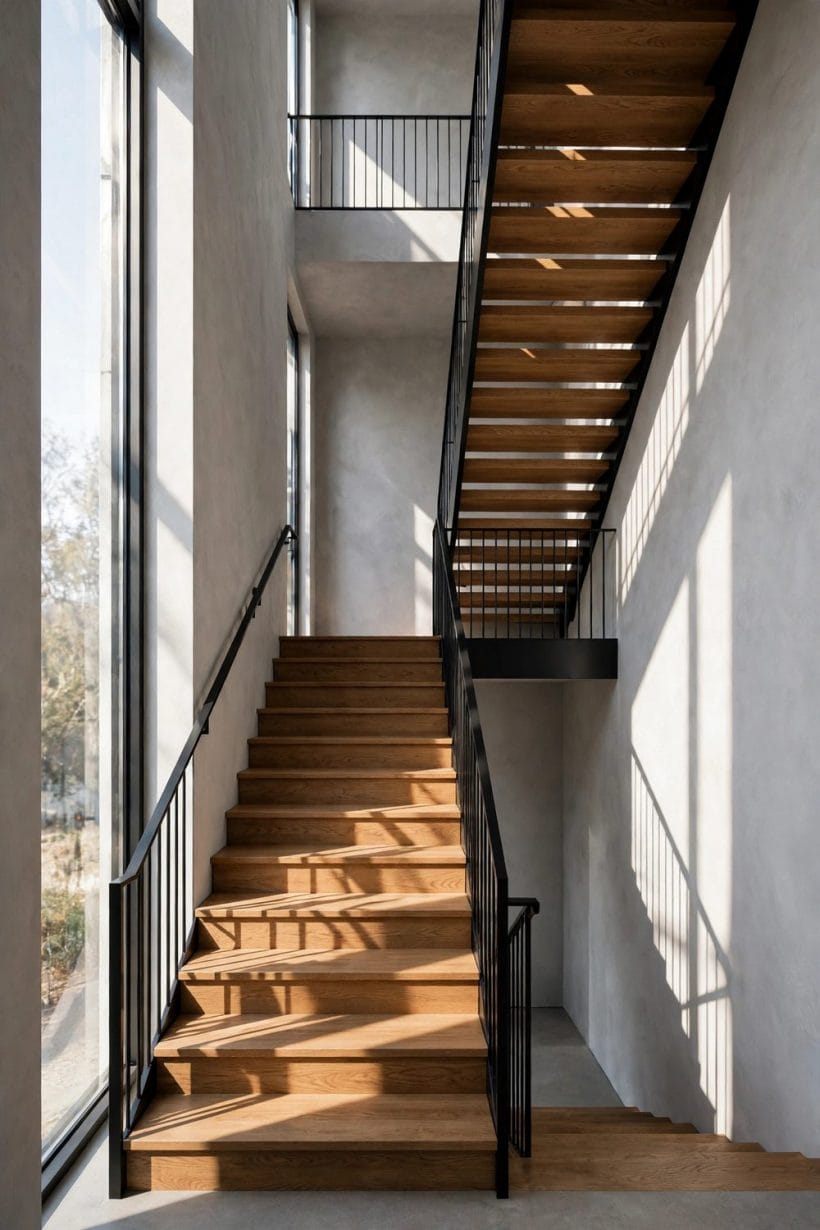
7. Matte Black Verticals, Oak Treads
The defining modern combination: slim black uprights, a black or oak handrail, and warm timber underfoot. The contrast does all the decorating, which is why this pairing anchors the metal end of our modern metal railing ideas as well.
8. The Full Black Frame
Take the black further — stringer, rail and balusters all in the same matte finish — and the stair becomes a single sculptural object against white walls. It asks for tidy rooms; clutter argues with it.
9. Slim Square Balusters
Square-section uprights read crisper and more architectural than round ones, and their shadows fall in clean stripes across the treads. Even spacing is the whole game — the eye forgives nothing here.
10. Round Bar Balusters
Round bars soften the black-metal language a fraction and are kinder in houses with a traditional skeleton. Paired with a timber handrail, they bridge modern and period without committing fully to either.
11. The Ladder-Back Landing Rail
Where the flight meets the landing, a run of verticals turned corner and carried along the gallery keeps the rhythm unbroken. Landings are where cheap railings confess; the continuous run is the fix.
12. Black Rail, White Stair, Nothing Else
The most restrained version: a white painted stair, one black handrail line, slender black balusters, bare walls. It costs the least to describe and the most discipline to keep — every object added afterwards is a negotiation.
4. Painted Stairs and Slim Balusters
The flight in this photograph is the classic renovation: white paint, a runner, black spindles and an oak rail. Painting the stair and slimming the balusters is how an ordinary staircase joins the modern family without rebuilding a thing.
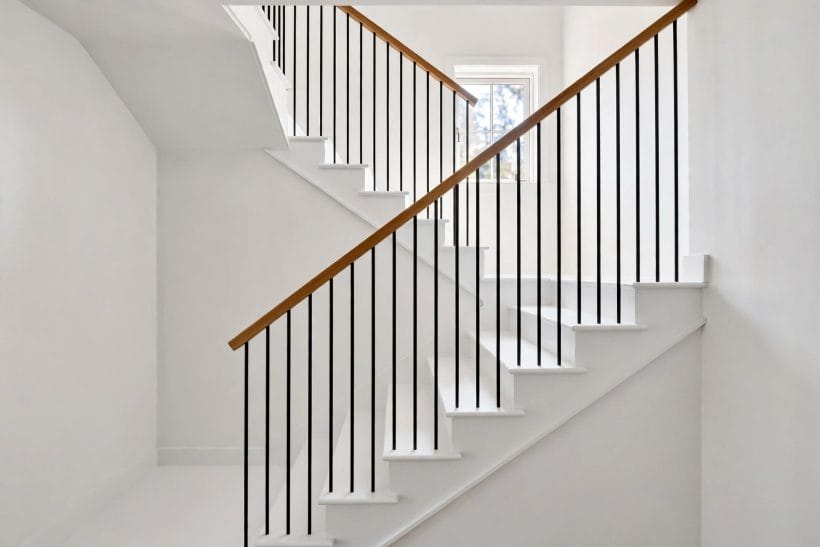
13. White Stair, Black Spindles
The high-contrast standard. White paint throws the black uprights into relief and brightens the whole well of the stair; the spindles’ slimness is what keeps it modern rather than merely painted.
14. The Oak Rail Over Painted Balusters
Paint the balusters the wall colour and let a single oak handrail carry the design. The flight nearly vanishes, leaving one warm line climbing the wall — minimalism with a handhold.
15. Two-Tone: Dark Rail, Pale Everything
A deep handrail — near-black, ink or forest — over pale balusters and treads inverts the usual contrast and suits hallways that open into darker, moodier rooms at the top of the stairs.
16. The Runner-Friendly Rail
Where a carpet runner dresses the treads, keep the railing quiet: slim uprights in the stair’s own colour, the handrail the only accent. The runner is the pattern; the rail should not compete.
17. Balusters in the Wall Colour
Painting uprights to match the wall makes the guarding recede and the handrail float. It is the cheapest modernising trick in this post and the one guests notice least — which is precisely its charm.
18. The Chunky Newel, Kept
An old staircase’s heavy newel post can stay, painted to match, while everything above it goes slim and modern. Keeping one honest piece of the original stair gives the renovation a memory.
5. Cable and Wire Railings
The concrete-walled flight in this photograph is guarded by little more than lines and light: horizontal cables on slim posts. Cable railings give the widest view of any guard — and ask the most questions of the code, as the next ideas make plain.
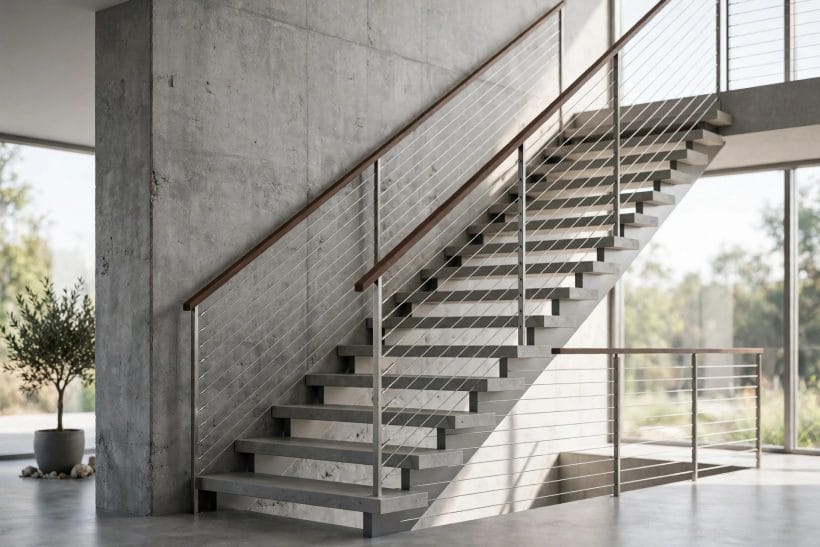
19. Horizontal Cables, Slim Posts
Fine steel cables run level between minimal posts, disappearing against the view. Tensioning, post strength and spacing are engineered and code-checked; in some places horizontal rails on stairs are restricted, so the design conversation starts with the local rules, not the catalogue.
20. Cable With a Timber Handrail
A warm oak rail over the cables rescues the system from industrial coldness and gives the hand a friendlier line to follow. The pairing suits houses that are modern in structure but rural in spirit.
21. Vertical Cable Drops
Cables hung vertically, like a fine curtain, answer the climbing concern that horizontal runs raise in some codes and some households, while keeping the see-through lightness that made you want cable at all.
22. The Rod Rail
Where cable feels too fine, slim horizontal rods in brushed steel give the same open geometry with more visual weight and no tensioning hardware. The lines read deliberate rather than delicate.
23. Mesh and Perforated Panels
Fine metal mesh or perforated sheet, framed slim, guards completely while staying semi-transparent — a stairwell veil. It flatters industrial interiors and hides a multitude of stored-under-stairs sins behind it.
24. Cable on the Garden Stair
Outside, stainless cable weathers gracefully and keeps garden views open. Exterior guarding has its own code and corrosion questions; the professional who fits it should be answering both in the same sentence.
6. Timber Handrails and Warm Metal
The carpeted flight in this photograph makes the counter-argument to everything minimal: an oak handrail with real presence, black spindles below, framed pictures climbing the wall. Warmth is a modern quality too.
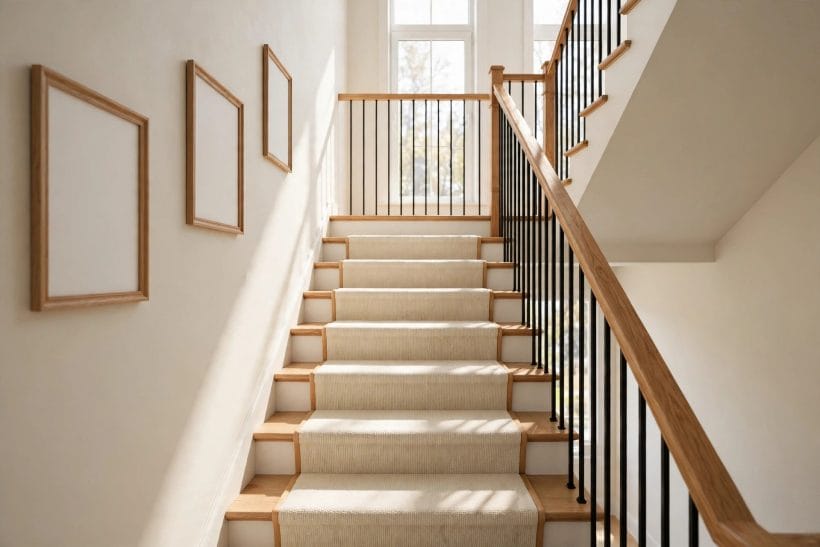
25. The Deep Oak Handrail
A generous, rounded oak rail is the most comfortable object in the house — shaped for the hand, warm in winter, improving with touch. Over slim black balusters it needs nothing else.
26. Walnut for Darker Rooms
Where oak is too honeyed, walnut gives the same comfort in a deeper register. It pairs with brass-toned or black uprights and with the lower light of north-facing stairwells.
27. The Wall-Hugging Timber Rail
On enclosed stairs, a continuous timber rail fixed to the wall does the guarding’s daily work — the hand’s route — while the open side, if any, takes the balustrade. Simple, kind, and kind to budgets.
28. Brushed Steel, Softly
Brushed rather than polished steel kills the airport gleam and leaves a quiet grey line that suits concrete, stone and pale timber. Fingerprints forgive it, which polished finishes never do.
29. Brass Accents, Used Once
A single brass handrail — or brass only on the landing return — warms a black-and-white stair without tipping into glamour. The rule is singularity: one warm metal, everywhere else restraint.
30. The Wrapped Rail
Leather or rope wrapping over a plain metal rail is the tactile wildcard: grip, warmth and a crafted note in one move. It belongs in houses with other handmade things for company.
7. Floating Stairs and Wall Rails
The stair in this photograph is barely there — treads cantilevered from the wall, a single steel rail, light falling from a sculptural skylight. Floating stairs are where railing design and structural engineering become the same conversation.
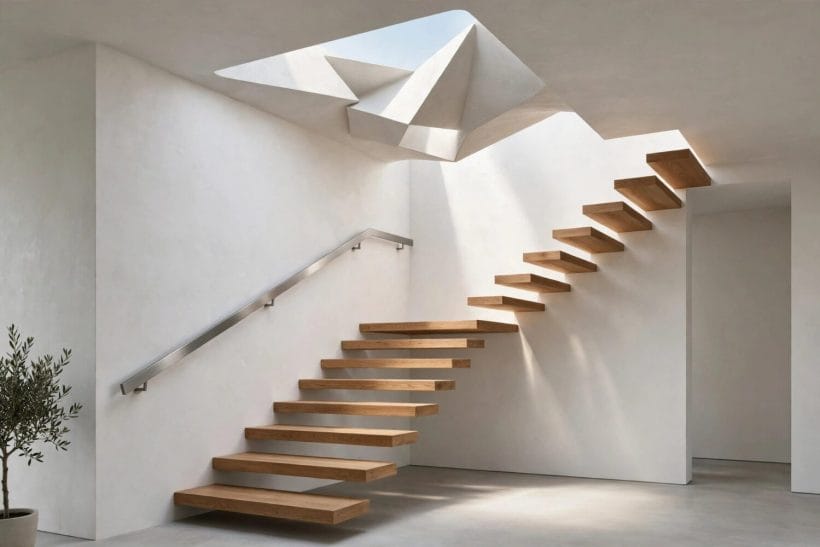
31. The Single Wall Rail
Where treads project from a solid wall, one well-fixed steel or timber rail on that wall can serve the climb, while the open edge is treated exactly as the code directs. The floating flights among our floating staircase ideas show the structural side of this partnership.
32. Glass on Cantilevered Treads
Glass panels rising from floating treads double the levitation. Every panel is a structural component fixed to an engineered tread; this is the least forgiving combination in the post and the most firmly professional.
33. The Recessed Handrail
A rail set into a channel routed along the wall — sometimes with light washed through the recess — keeps the profile perfectly clean. The channel is joinery and building work designed with the wall, not added to it.
34. Rope and Rigging Lines
For coastal and cabin stairs, taut rope rails on metal eyes borrow the boat’s vocabulary. Charming, grippable, and to be specified with the same seriousness as any other guard — the code does not grade on charm.
35. The Sculptural Rail
A handrail that bends, branches or flows in one forged piece turns the stair into the house’s artwork. Commissioned metalwork of this kind is designed with the maker and the building inspector in the same conversation.
36. Open Risers, Honest Guarding
The final idea is a discipline rather than a look: open risers and minimal rails tempt designers to treat guarding as decoration. It is not. Every beautiful flight in this post stands on unglamorous engineering, checked figures and a fitter’s signature.
8. Keeping the Stairwell Bright
The view up this photograph’s glass-railed flight is the argument for everything in sections two and five: light falls the full height of the house because the guarding declines to stop it. A stairwell is usually the darkest shaft in the home; the railing decides whether it stays that way.
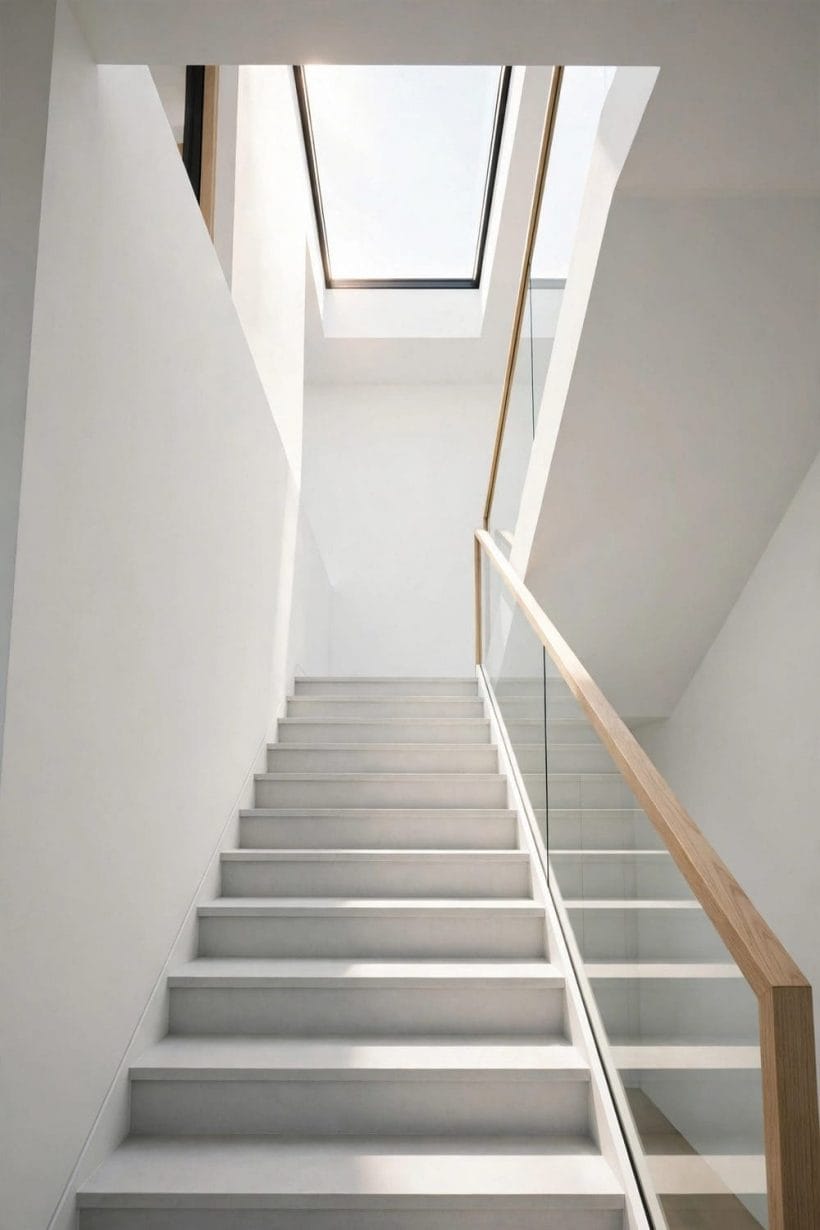
Open systems — glass, cable, slim verticals — share light between floors, which is why they dominate modern renovations of small houses. Solid balustrades still have their place where privacy or draughts matter more, but they should be chosen knowing the light is the price.
Finish plays its part: pale and brushed surfaces bounce what light there is, matte black absorbs it into outline. The railing is, in effect, a lighting decision wearing a safety component’s clothes.
9. Landings and Gallery Rails
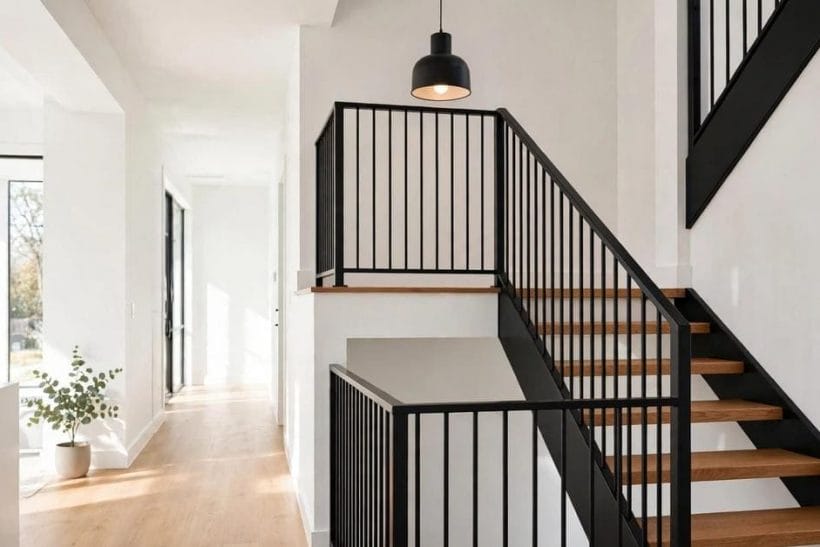
The landing in this photograph continues the flight’s black verticals around the gallery without a break in rhythm, and that continuity is the whole lesson: the railing does not end at the top step.
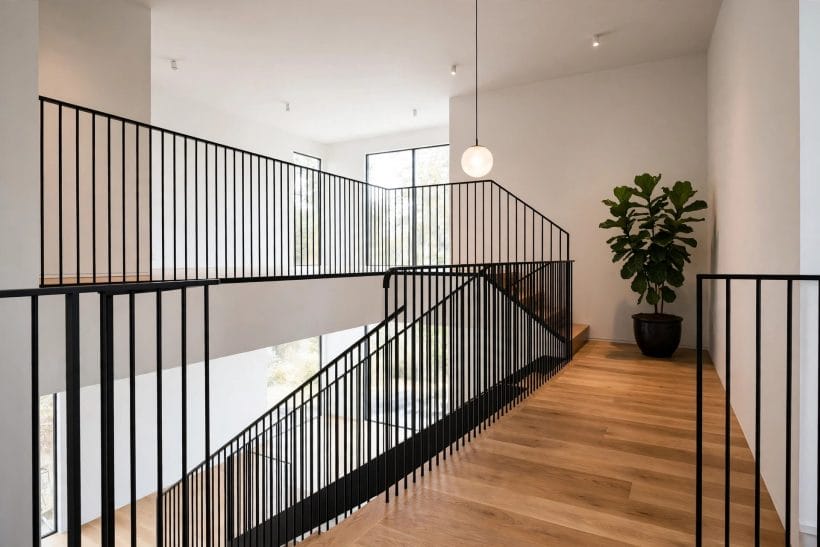
Gallery rails guard the same drop as the flight and deserve the same design attention — the same profiles, the same handrail, corners resolved deliberately rather than butted. Where the landing serves bedrooms, the rail also carries dressing gowns, trailing hands and half-asleep navigation; comfort at the top matters as much as style on the climb.
The outdoor cousins of these rails guard decks and terraces under weather rather than lamplight; our deck railing ideas take the same slim-vertical language outside, where materials and codes change but the geometry of guarding does not.
10. Guarding, Code and Fitting
Everything decorative in this post is negotiable; this section is not. A stair railing is a safety barrier with legal dimensions — the height of the guard, the gaps between its parts, the strength of its fixings — and those dimensions are set by your local building code, stated by your inspector, and met by your fitter. This post deliberately prints none of them, because the correct figures are the ones that apply to your house, your stair and your jurisdiction, and no photograph outranks them.
Three habits keep a modern railing honest. First, design with the code open on the table — several beautiful systems, horizontal cables among them, are treated differently by different codes. Second, have the whole guard — handrail height, baluster spacing, landing return — drawn and approved before anything is made. Third, use fitters who do stairs for a living; a railing is not general carpentry with thinner pieces.
Children change the calculation in ordinary ways: climbable geometry, gaps and gates at the top and bottom of flights are household decisions to raise with the fitter at design stage, not after the first toddler treats the balustrade as a ladder.
For the wider map of where these rails live — pillars, landings and the rooms they serve — the home design ideas hub gathers the house this staircase climbs through.
Final Considerations
A modern railing succeeds twice: once as a line, drawn cleanly up the wall, and once as a guard, standing silent and sufficient between the household and the fall. Choose the line you love — glass, black steel, cable, oak — then let the code set its heights, let a professional set its fixings, and let your hand, closing comfortably around the rail on a dark evening, deliver the only review that matters.

0 Comments