
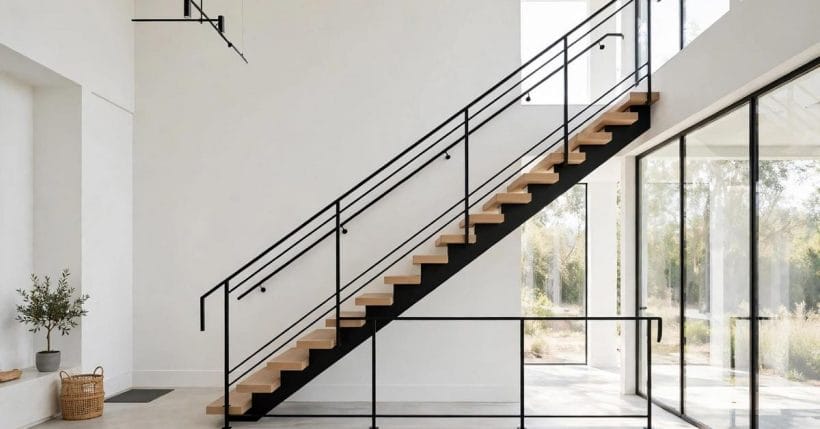
A modern metal railing does two jobs at once: it guards the edge of a stair, balcony or deck, and it draws the cleanest line in the room. Slim bars, fine cables and framed glass keep these systems light and sharp.
These 75 modern metal railing ideas stay with the metal systems themselves — black steel, cable, rod, panel and glass-and-metal — with finishes, settings and care, so you can choose well and have the railing fitted properly.
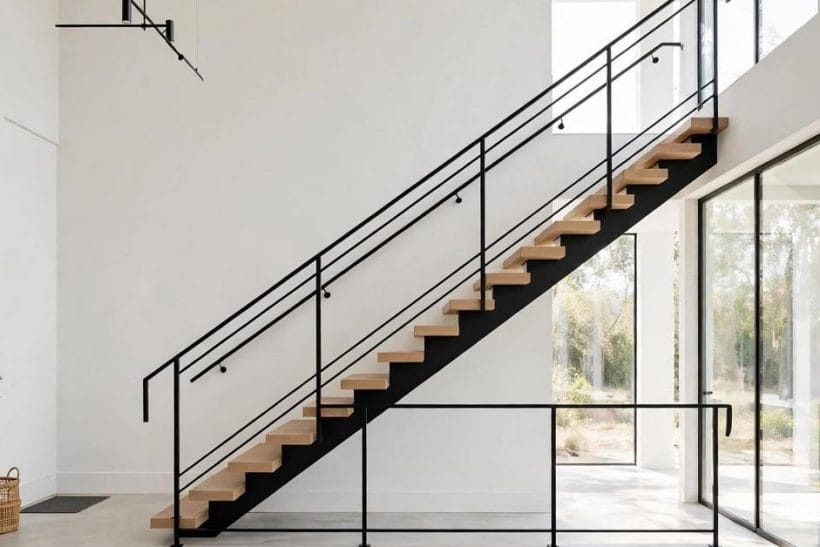
1. Modern Metal Railings at a Glance
Scope first. This post owns modern metal systems only: vertical bar, cable, rod, panel and mesh, and glass-and-metal railings, indoors and out. Traditional forged iron, timber rails and the general stair-railing survey live in their own posts, linked below; the pillar guide to staircase ideas owns stair shapes and layouts.
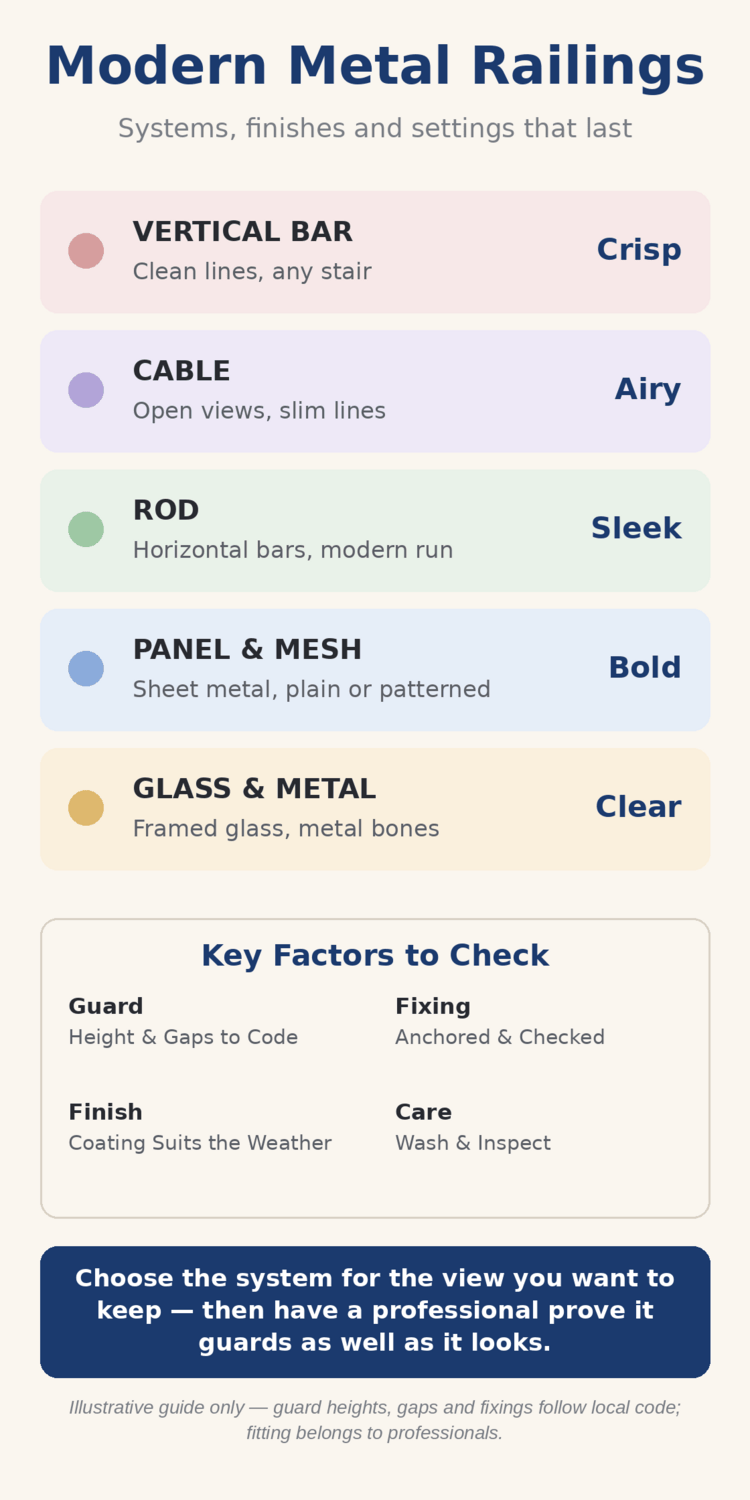
Read the system before the finish. The infill — bars, cables, rods, panels or glass — decides how open a railing feels and how much light it keeps. The table names the five systems below, so later sections can speak of each by name. Guards are described in general terms only: requirements follow local code, and fitting belongs to professionals.
| System | Character | What it means |
|---|---|---|
| Vertical Bar | Crisp | Slim upright steel bars, the modern default |
| Cable | Airy | Fine cables that keep views and light open |
| Rod | Sleek | Horizontal rods or bars running the length of the guard |
| Panel & Mesh | Bold | Sheet, perforated or mesh infill inside a metal frame |
| Glass & Metal | Clear | Glass panels in metal posts and rails |
2. Black Steel Railings
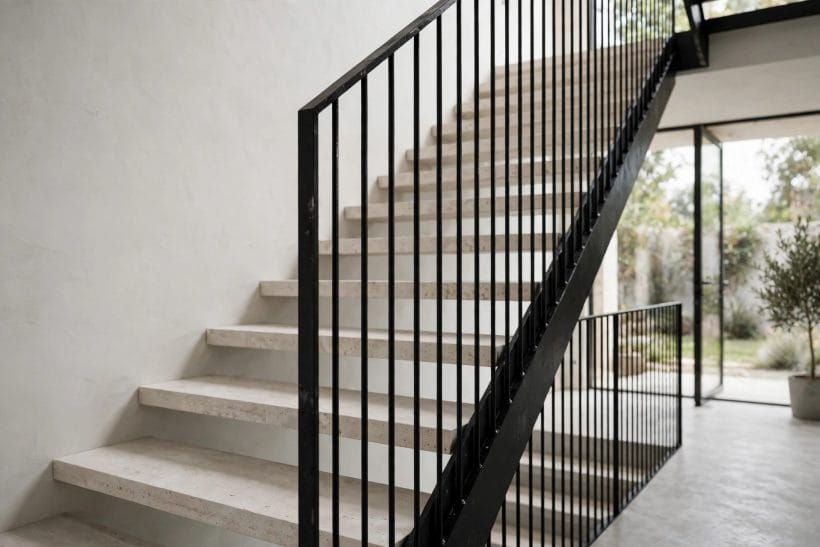
Black steel is the modern railing’s signature: a dark, drawn line against pale walls and light treads, strong enough to define a flight, quiet enough to suit almost any hall. Keep profiles slim, the finish matt or satin, and let contrast do the decorating.
1. Matt black vertical bars, straight flight
Slim upright bars in a matt black finish are the modern default: the line stays crisp, the flight reads clearly, and dark metal flatters pale treads and white walls without asking for any other decoration.
2. Black steel with a timber handrail
A timber handrail over black steel bars gives the hand something warm to hold and keeps a dark railing from feeling severe. The pairing suits family halls, where the stair should feel welcoming as well as sharp.
3. Slim black spindles in a period hall
Modern metal need not fight an older house. Slim black spindles echo traditional balusters at a fraction of their visual weight, so a period hall keeps its manners while gaining a cleaner, simpler guard.
4. Black box-section frame for a modern stair
A square, box-section frame gives a black railing an architectural edge: flat faces, sharp corners, a built look. It suits contemporary halls with steel-framed doors and black window frames, joining a wider metal language.
5. Twin black rails tracing a turning stair
Where a flight turns, a black railing traces the change of direction like a drawn line, making the turn legible from below. Have bends and joints fitted professionally so the line runs unbroken around the corner.
6. Black steel railing over open risers
Open risers lighten a flight, and a black steel railing keeps that lightness honest: the dark line defines each tread while light falls through the steps. Weigh openness against your household’s needs, and take professional advice first.
7. Powder-coated black in a bright white hall
A powder-coated finish gives black steel its smooth, even colour and a surface that wipes clean in a busy hall. Against white walls the railing becomes the room’s one strong line, so keep other details plain.
8. Black railing echoed in the door furniture
Repeat the railing’s black in handles, hinges and light fittings, and a simple stair starts to feel designed end to end. The echo costs little, ties the hall together, and makes a modest railing look planned.
3. Cable Railings
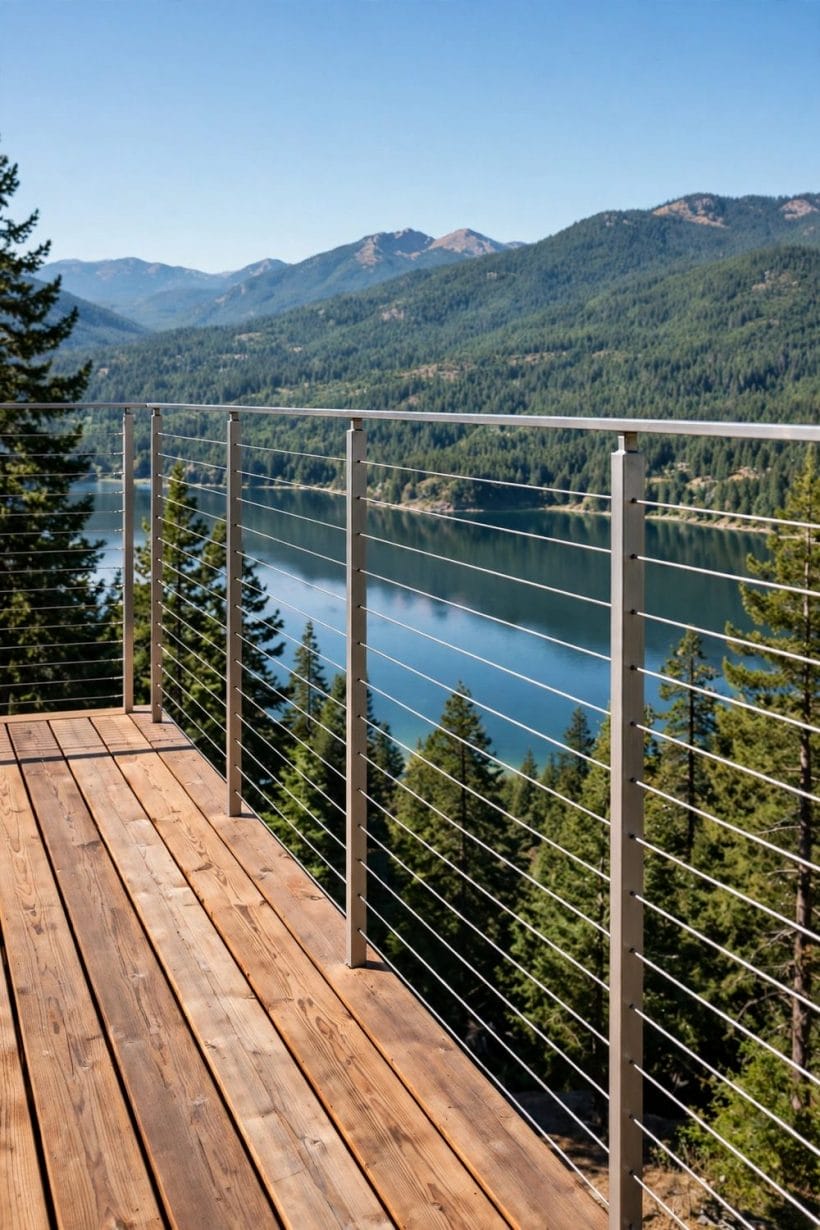
Cable railings guard an edge while barely interrupting it: fine horizontal cables between metal posts keep views open and light moving, on stairs and landings indoors, on decks and balconies out. The posts carry the design; the cables nearly disappear.
9. Horizontal cables on a deck
On a deck overlooking a garden, valley or water, cables guard the edge without fencing in the view. Sitting or standing, the eye passes straight through the fine lines, and the deck keeps its open feel.
10. Cable railing on a modern staircase
Cables running along a flight give a modern stair an airy, engineered character: slim posts, taut lines, nothing bulky. It suits open-plan halls where a heavier balustrade would block light and sightlines between floors.
11. Slim cable runs on a small balcony
A small balcony feels larger behind cables than behind bars, because the infill almost vanishes and the eye travels to the view. Keep the posts slim, the top rail comfortable, and the guard professionally fitted.
12. Cable railing with black metal posts
Black posts frame a cable run like a mount frames a picture: dark uprights give the eye its rhythm while cables stay quiet between them. The pairing suits houses with black window frames and other dark metalwork.
13. Cable infill along a landing balustrade
Landings are where cable earns its keep indoors: the guard stays present but transparent, so a landing borrows light from the hall below. It suits double-height spaces, where a solid balustrade would feel like a wall.
14. Cable railing around a raised terrace
Around a raised terrace, cables keep the edge guarded and the garden visible from every seat. Choose a finish suited to outdoor weather, have the posts anchored by a professional, and the terrace keeps its open feel.
15. Fine cables keeping a garden view open
Where a railing crosses a favourite view — a garden border, a line of trees, open country — fine cables are the least intrusive guard of all. From a chair the lines disappear, and the planting stays the picture.
16. Cable railing with a timber handrail
A timber top rail warms a cable system and gives the hand a friendlier surface than bare metal. The pairing works on stairs and decks alike, linking the guard to wooden floors, decking and doors nearby.
4. Rod and Horizontal Bar Railings
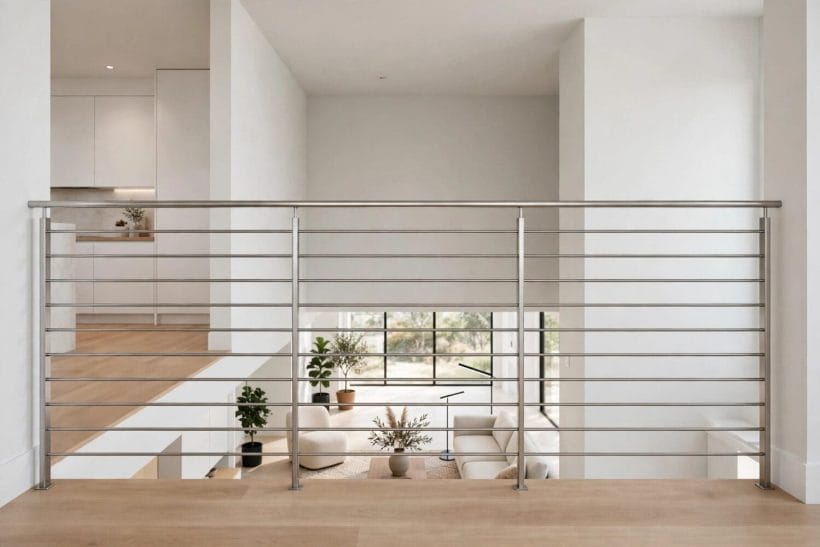
Rods and horizontal bars run the length of the guard instead of standing across it, giving a railing a low, sleek, modern sweep. They suit landings, mezzanines and long flights, where the horizontal line stretches out and widens the space.
17. Horizontal rods along a landing
A landing guarded by horizontal rods reads calm and architectural: long lines, slim metal, nothing fussy. The rods echo the floor’s direction, stretch the sense of width, and pair naturally with plain walls.
18. Brushed stainless rods on a white stair
Brushed stainless against white treads and walls is the quiet, gallery-like version of the rod railing: cool, reflective, restrained. The brushed finish shows fewer marks than a polished one, which helps on a busy family stair.
19. Strong horizontal bars in an industrial hall
Chunkier bars bring an industrial note that suits converted warehouses, lofts and halls with exposed structure. Keep the bars evenly spaced and the finish plain — the strength of the metal is the whole decorative statement.
20. Twin-rod railing for a minimal look
Two rods beneath a slim top rail guard an edge with the least metal possible, a look that suits landings and gallery edges in pared-back interiors. Minimal still means properly guarded: have it designed and fitted professionally.
21. Rods stepping around a turning flight
Rods travel in straight runs, so on a turning flight they step around the corner in angled sections between their own posts. Planned well, the stepped line looks deliberate and crisp, and the turn becomes a metalwork feature.
22. Black horizontal bars against pale walls
Black bars on a pale background draw confident horizontal lines that suit modern halls and stairwells. The contrast makes the guard easy to read at a glance, and the effect needs no other pattern.
23. Rod railing with a slim top rail
A slim top rail caps a rod railing neatly, giving the hand a smooth, continuous line from one end of the guard to the other. Match its finish to the rods, or contrast it in timber for warmth.
24. Horizontal bars guarding a mezzanine edge
Mezzanines ask for a guard that does not close the room down, and horizontal bars answer well: the edge stays guarded, the lines stay low, and the double-height space keeps its openness, the metalwork a quiet frame.
5. Panel and Mesh Railings
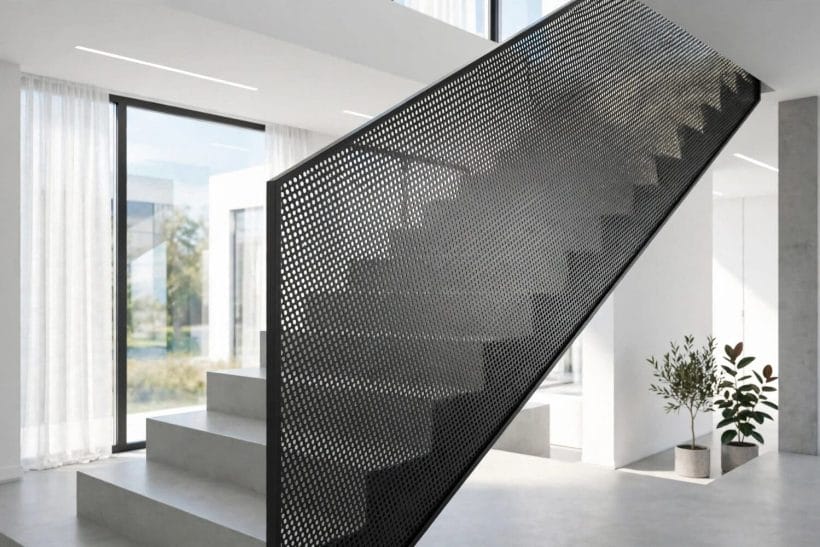
Panels and mesh fill the guard with a surface instead of lines: perforated sheet, woven or expanded mesh, plain plate. The effect is bolder and more private than bars or cables, with pattern, shadow and texture doing the decorative work.
25. Perforated metal panel on a staircase
A perforated sheet panel guards a flight and decorates it at once: the pattern of holes throws dappled light across the treads and makes the stair the hall’s feature. Keep the frame slim and the pattern regular.
26. Expanded mesh infill in a steel frame
Expanded mesh gives a panel railing its industrial honesty: a diamond grid under tension inside a steel frame, light and strong in character. It suits halls and studios where a utilitarian texture feels at home.
27. Patterned cut panel as a feature railing
A panel cut with a deliberate pattern — geometric, botanical or abstract — makes the railing the stair’s artwork. Light passes through the openings and draws the pattern on the wall beside it, changing through the day.
28. Plain sheet panel, bold and modern
A plain, unbroken sheet is the boldest panel of all: one smooth surface of metal guarding the flight, unapologetically modern. It gives privacy between floors, hides the stair’s underside, and pairs best with plain walls and simple treads.
29. Woven wire mesh in a black frame
Woven mesh softens the panel idea: finer than expanded mesh, with a fabric-like texture that catches light gently. In a black frame it reads smart and tailored, suiting homes that mix modern metal with softer furnishings.
30. Ribbed metal panel for texture and shadow
A ribbed or fluted panel brings rhythm without pattern: fine vertical ribs catch light and shadow along the run, so the guard feels alive in daylight. A good middle path between plain sheet and perforation.
31. Mesh panel railing on a balcony
On a balcony, a mesh panel guards the edge, filters the view rather than opening or closing it, and gives a little shelter from wind. The semi-private feel suits overlooked city balconies that would otherwise feel exposed.
32. Panel railing screening a landing
A landing doubling as a study corner or reading nook can use a panel railing as a screen: the guard stays complete while the activity behind it stays partly private, and perforation keeps the stairwell’s light moving.
33. Mixed panel and bar railing
Panels below, bars above — or a panel run giving way to open bars at a turn — mixes privacy with openness in one guard. It suits stairs serving different moods on different floors, and breaks up a long run.
6. Glass-and-Metal Railings
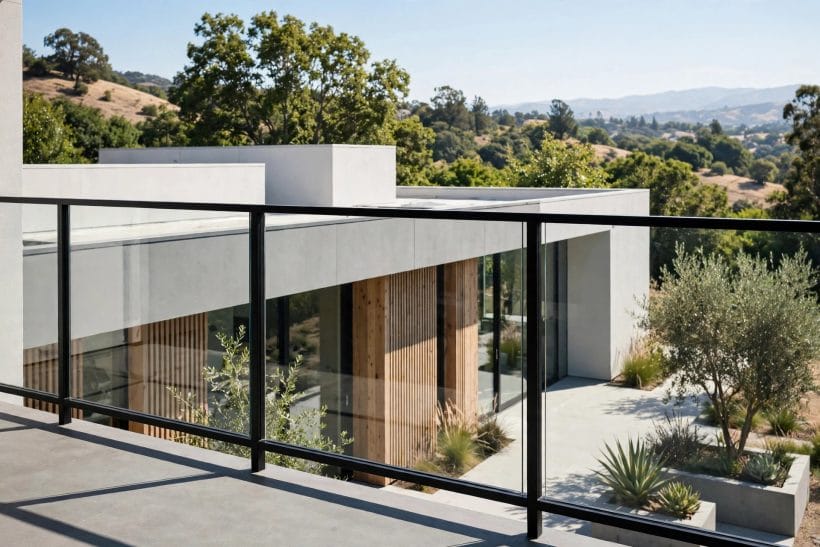
Glass-and-metal railings split the work: glass fills the guard as a clear, calm surface, while metal posts, clamps and handrails give it structure. The result is the most open railing of all, the metalwork reading as fine lines around each pane.
34. Framed glass panels on a balcony
Glass in a slim metal frame guards a balcony edge, keeps the view whole and shelters seats from the breeze. The frame is the design: black for a graphic outline, stainless for a quieter feel.
35. Glass panels held in metal posts
Glass clamped between metal posts gives a railing a neat rhythm — post, pane, post — for modern stairs and terraces. The posts carry fixings and handrail; the glass between stays clear and open.
36. Slim metal top rail over glass
A slim metal rail along the top of a glass guard gives the hand a defined line and a finished edge. It also ties the railing to metal details elsewhere — rails, handles, fittings.
37. Tinted glass in a black metal frame
A gentle tint takes the glare off a sunny balcony or south-facing stair and deepens a black frame’s graphic effect. Tinted panes also soften the view of a busy street below, keeping the balcony calm without screens.
38. Glass and stainless on a modern stair
Stainless fittings with clear glass are the classic bright pairing for a modern flight: cool metal points of light along a transparent guard. The stair becomes the exhibit, suiting pale, minimal halls with plenty of daylight.
39. Frosted glass panels for a private edge
Frosted or obscured glass guards an edge and keeps its privacy: light passes, outlines blur. It suits stairs near neighbours, landings outside bathrooms, and balconies in close company, where clear glass would feel too open.
40. Glass guard with a bracketed metal handrail
A metal handrail on brackets in front of a glass guard gives climbers a proper rail to hold while the glass guards below. The pairing suits busy family stairs, and the brackets become a neat repeating detail.
41. Clear glass keeping a small hall open
In a small hall, clear glass lets the stairwell borrow every scrap of light around it. With slim metal fixings the railing nearly vanishes, and a compact flight feels designed rather than squeezed.
7. Metal Railings for Stairs
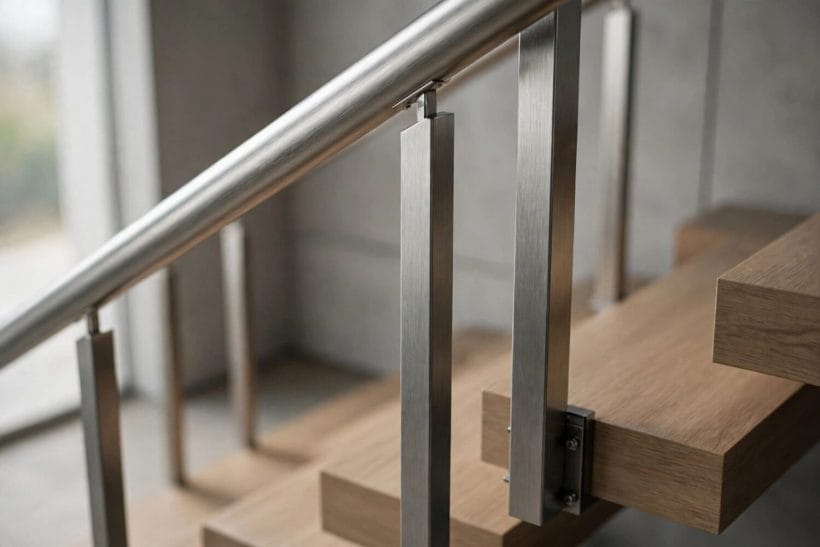
Stairs are where metal railings work hardest: the guard must follow the slope, turn with the flight, and give the hand a continuous line. The wider survey of stair railing ideas covers every material; neighbouring guides cover stairs railing designs in steel and marble staircase ideas — here the focus stays on modern metal on the stair.
42. Wall-mounted metal handrail on a closed stair
Where a stair runs between walls, a single wall-mounted metal rail is the honest answer: a clean line of steel on brackets, nothing more. Choose a finish that echoes something nearby — black, brushed stainless or warm bronze.
43. Continuous metal rail around a turn
A rail running unbroken around a turn is kinder to climb than one that stops and restarts, especially for children and older hands. Having it made continuous is a professional’s job, repaid daily by the smooth sweep.
44. Metal railing over open-riser treads
Open-riser flights and metal railings belong together: both lighten the stair, and slim metal sections leave the floating treads as the main event. Confirm the arrangement suits your household, check local code, and have it fitted professionally.
45. Slim spindles on a narrow flight
On a narrow flight, slim spindles guard the edge without crowding it: the stair keeps its width, the light keeps moving, and the railing reads as a fine vertical texture. Black looks modern; white nearly disappears.
46. Metal railing paired with stone treads
Metal is stone’s best partner on a stair: a slim black or stainless railing defines cool treads without competing with them. The contrast suits grand flights and modest ones, in stone or stone-look finishes alike.
47. Metal railing up a double-height stairwell
A tall stairwell gives a metal railing room to perform: long verticals, repeated bays and a handrail climbing through two storeys of light. Keep the sections slim and regular, and the height reads as elegance, not scaffolding.
48. Dark railing tracing a curved flight
On a curved stair, a dark metal railing traces the sweep like a drawn line, making the curve legible from below. Curved metalwork is a specialist’s job; done well, the railing makes shape the decoration.
49. Simple metal rail for a loft stair
A loft stair is usually steep, compact and unpretentious, and a simple metal rail suits it: one strong handrail, plainly fixed, easy to grip. Keep the line continuous, and take professional advice on the whole arrangement first.
8. Balcony and Terrace Railings
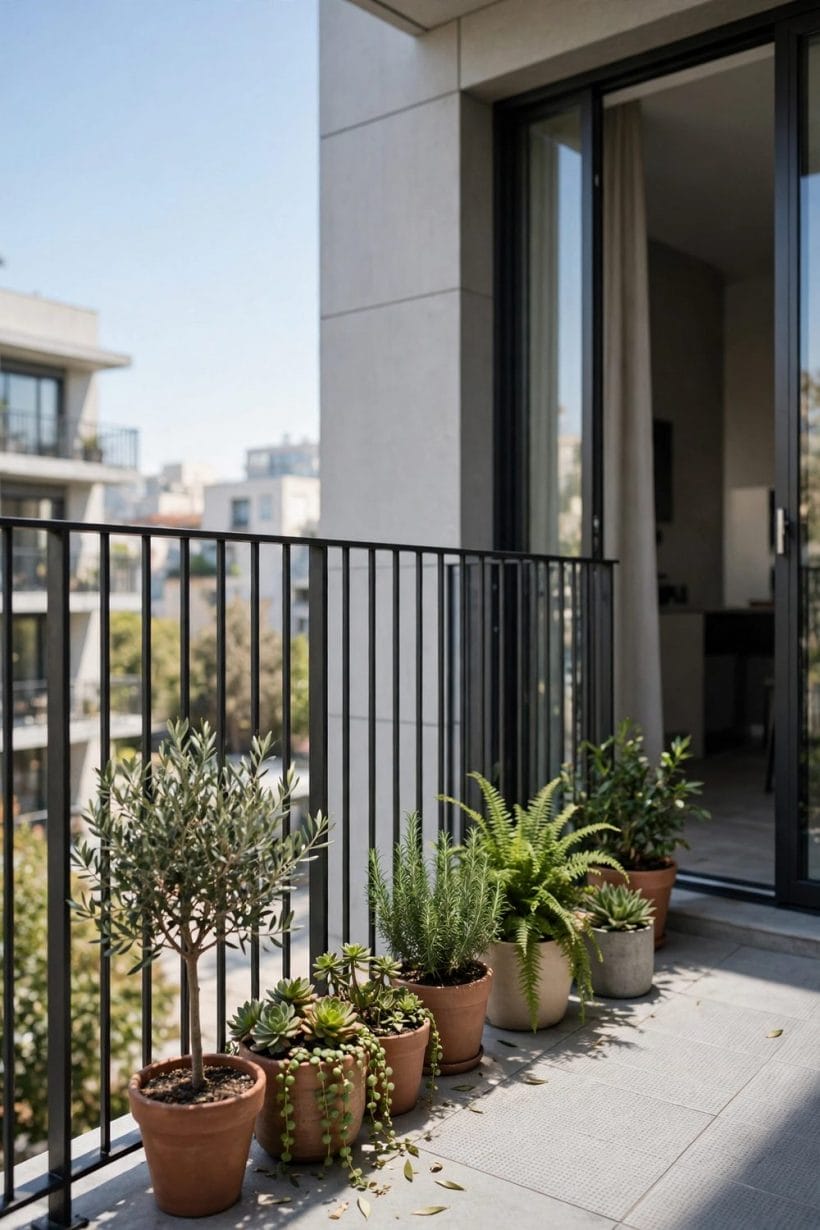
Balconies and terraces put a railing outdoors and on show: it frames the view from inside, defines the edge outside, and takes the weather all year. Metal answers well — slim sections, durable coatings, systems from cable to glass — given a climate-suited finish and professional fixing.
50. Black vertical bars on a Juliet balcony
A Juliet balcony asks only for a guard across tall doors, and black vertical bars answer with the least fuss: a crisp dark grille that suits brick, render and stone alike, and never competes with the facade.
51. Cable railing on a roof terrace
Roof terraces live for their outlook, and cables guard the edge while keeping sky and skyline whole. A weather-suited finish with professionally anchored posts keeps the system sound in its exposed, airy setting above the street.
52. Glass and metal across a wide balcony
A wide balcony can carry the calm of framed glass: the view stays entire, the seating stays sheltered, and the metal frame draws one long, level line across the house front. It is the most composed terrace option.
53. Mesh panel screening a terrace edge
Where a terrace is overlooked, a mesh panel guards the edge and softens the exposure without building a wall. Light and air still pass, outlines blur pleasantly, and the terrace gains a semi-private, room-like feel outdoors.
54. Slim rod railing on a small balcony
Horizontal rods suit a small balcony well: the lines run with the building’s width, the sections stay slim, and the guard feels lighter than vertical bars. A slim, comfortable top rail finishes it and invites leaning.
55. Balcony railing with pots along its base
Pots along the inside of a balcony railing turn the guard into a garden edge: herbs, grasses and trailing plants soften the metal. Keep the railing’s line clean above the green, and water pots, not fixings.
56. Corner balcony wrapped in metal railing
A corner balcony needs its railing to turn the corner gracefully, and metal systems do this neatly — bars, cables or glass running around the bend in one continuous guard, giving two outlooks from one small floor.
57. Terrace railing matched to the window frames
Matching a terrace railing’s colour and finish to the window and door frames makes the whole elevation look designed in one pass. One metal colour across frames, railing and furniture, and the facade settles.
58. Low-maintenance metal railing for a second home
A house used at weekends wants a railing that asks for nothing between visits: a sound powder-coated or stainless system, professionally fitted, that a quick wash restores. Metal’s indifference to weather suits lock-up-and-leave homes perfectly.
9. Deck, Porch and Garden Railings
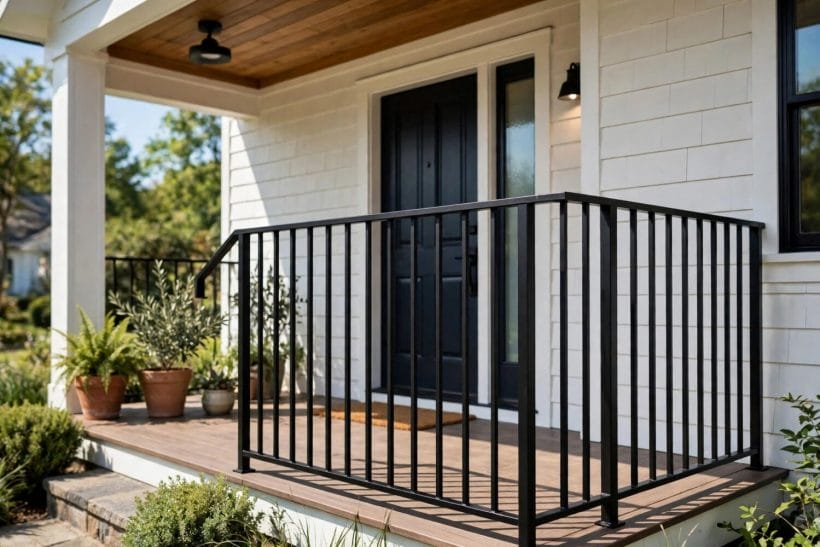
At ground level a metal railing does the welcoming and the guiding: across a porch, around a deck, down the garden steps. The guide to front porch railing ideas covers the porch; here modern metal systems take their turn outdoors, where coatings, fixings and local code matter as much as looks.
59. Metal railing across a front porch
A metal railing across a porch draws the house’s welcome in a few clean lines: slim bars or rods between honest posts, and nothing to rot or repaint. Black suits most facades and weathers gracefully.
60. Cable railing on a raised garden deck
A raised deck above a sloping garden needs its guard out of the view, and cables do that from every chair. Have posts anchored professionally, choose a weather-suited finish, and the garden remains the picture.
61. Black panel railing edging a patio
A black panel or mesh railing gives a patio a defined edge and some privacy, its dark finish receding behind planting. It suits modern gardens of crisp lines, gravel and grasses, where pale fencing would glare.
62. Metal railing down garden steps
Garden steps are where an outdoor handrail earns its keep: a simple metal rail, solidly fixed, gives climbers a steady line on wet mornings. Match its finish to porch metalwork so garden hardware reads as one set.
63. Rod railing around a deck
Horizontal rods frame a deck’s outlook in long, level lines — more present than cables, more open than bars. From a seat the rods align with the horizon, and the whole arrangement feels calm and deliberate.
64. Porch railing matched to the front door
Painting a porch railing the front door’s colour is a small decision with an outsized effect: entry, guard and door read as one composition from the street. Keep sections slim so colour charms rather than dominates.
65. Mesh panel railing for a garden terrace
A mesh panel around a garden terrace guards the edge, gives climbing plants something to weave through, and filters the boundary into a green blur by midsummer. The metal frame keeps the edge tidy as the planting romps.
66. Sturdy metal handrail beside outdoor steps
Beside any short run of outdoor steps — to a side gate, a shed, a raised bed — a sturdy metal handrail is cheap kindness: a firm grip in the wet, fitted once and forgotten. Choose solid, weather-suited fixings.
10. Finishes, Colours and Care
Finish is where a metal railing is won or lost: the coating decides its colour, its feel in the hand and how it weathers, indoors and out. Traditional wrought iron railing and warm wood stair railing ideas live in their own guides; here, the modern finishes, colours and simple care.
67. Powder-coated black for a crisp modern line
Powder coating is the modern finish of choice: an even, durable colour baked on, smooth to the hand and simple to wipe. Black is the classic colour — crisp against pale walls and forgiving of dust.
68. Brushed stainless that shrugs off marks
A brushed finish breaks up reflections along the metal, quietly hiding the fingerprints and scuffs a busy stair collects. Stainless suits bright halls and outdoor edges alike, and a soft cloth with gentle cleaner keeps it even.
69. Satin grey metal for a softer scheme
Where black feels too strong and white too stark, satin grey is the peacemaker: a soft, mid-tone metal suiting stone, pale timber and muted paint. It carries modern systems into calmer, traditional-leaning rooms without friction.
70. White-painted metal in a bright hall
White metal nearly disappears against pale walls and bright treads, leaving the flight’s shape to speak. It is the kindest choice for small, light-hungry halls, and flatters coastal schemes where the palette stays airy throughout.
71. Bronze-toned metal for a warmer welcome
A bronze tone brings metal closer to timber and brass in warmth, softening modern systems for halls with warm floors and lamplight. It suits panel frames and handrails, where its depth shows along the edge.
72. Weather-suited finish for outdoor railings
Outdoors, the finish is the railing’s defence: choose a coating or metal your supplier confirms suits your local weather, especially near the coast, and have it fitted so water sheds rather than sits. Sound finishing prevents shabby metal.
73. Washing metal railings with gentle cleaners
Routine care is simple: wash railings with a soft cloth, warm water and gentle cleaner, then dry the metal so no water sits in the joints. Avoid harsh, abrasive products, which dull coatings and shorten their life.
74. Checking fixings and touching up the coating
Once in a while, walk the railing and check it: posts firm, fixings sound, coating unbroken. Touch up chips promptly to keep moisture out — and if anything feels loose, call a professional.
75. A finish chosen for its weather
End where every railing begins: the finish must suit the life ahead of it — hall dust and family hands indoors, rain, sun and seasons outside. Choose honestly, keep the product records, and the railing stays handsome.
Final Considerations
Choose the system for the view and the light — bars for crispness, cable for openness, panels for privacy, glass for calm — then the finish for the weather and the household. Check every guard question against local code and have the railing fitted by a professional, and it becomes the cleanest line in the house.
Whether the result is black steel in a bright hall, cables over a garden deck or framed glass on a balcony, the principle holds: keep the metal slim, the fixing sound and the finish honest, and the railing repays its care.


0 Comments