

Every house has a door the family actually uses, and around that door, chaos accumulates: boots in a puddle of their own making, coats on the floor’s favourite chair, bags, leads, umbrellas and the post. A mudroom is that chaos given furniture and a system.
These 75 mudroom ideas build the system in order: the route first, the bench and the vertical wall after, floors that forgive, the overflow and the double-duty tricks, and the tiny-entry answers last — because the mudroom is not a room type, it is a landing done properly.
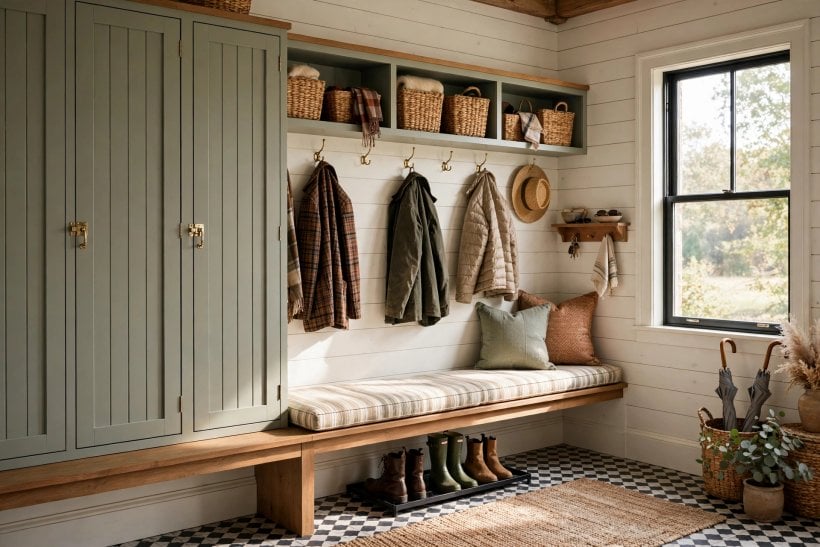
1. Mudroom Ideas at a Glance
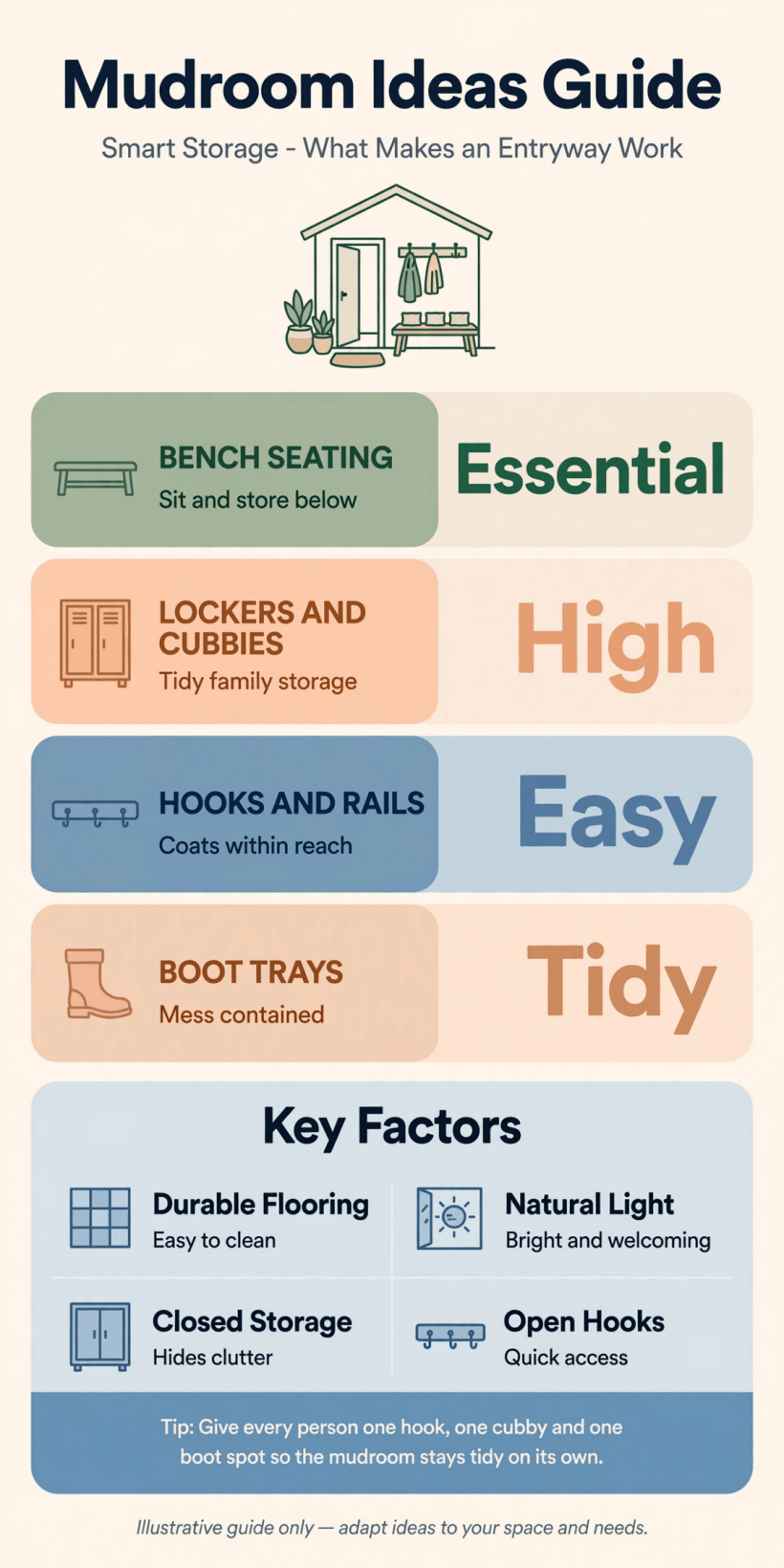
The central entity is the mudroom: the house’s working threshold, a transition zone between weather and interior defined by its attributes — the route it serves, the bench, the hooks and cubbies, the floor, the storage for seasonal overflow, and the second jobs (laundry, pets, utility) it absorbs. The first attribute governs the rest: a mudroom succeeds or fails as a route, and every fitting earns its place by serving the thirty seconds of arrival and departure, twice a day.
| What does a mudroom actually need? | A place to sit and pull boots off, hooks at honest heights, a floor that forgives mud, and storage for the current season. Everything else — lockers, sinks, dog showers — is an upgrade on those four. |
| How big must a mudroom be? | It must fit the household’s peak moment: everyone arriving at once, in wet coats, with bags. A wide corridor with one fitted wall can outperform a small dedicated room with none. |
| What is the mudroom’s worst enemy? | The pile. Any surface without an assigned job becomes a pile’s home. The system survives only when every arriving object has a hook, cubby or bin with its name on it. |
| Can a house without a mudroom have one? | Yes — a fitted wall, a bench and a washable floor turn a back hall, a garage corner or a wide entry into a working mudroom. The room is a system, not a floor plan label. |
2. The Route In: Layout for the Daily Landing
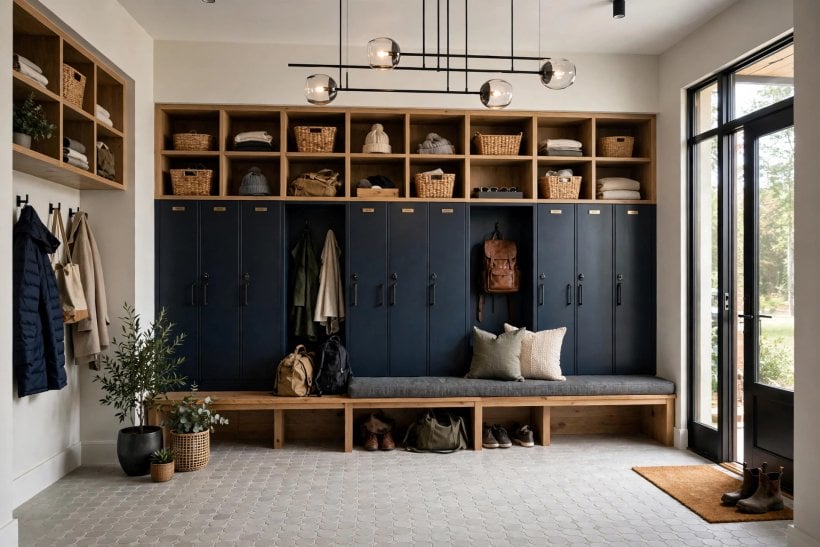
Layout in a mudroom means choreography: door, drip zone, bench, hooks, then the clean house — in that order, without crossings. The compact version of this route is mapped for small footprints in drop zone ideas; here the system is surveyed at every size.
1. Put the Drip Zone at the Door
The first step inside should land on the floor that forgives most: a mat well, a stone slab, the washable square. Wet boots travel exactly one step before the system takes over — design for that step.
2. Bench Within One Step of the Door
The boot-pull happens where the boots are, so the bench belongs beside the drip zone, not across the room. Every extra metre between door and bench is a trail of mud waiting for rain.
3. Hooks Next, at the Bench’s Shoulder
Coats come off sitting down or standing at the bench; the hooks should be reachable from both. A route that asks the household to cross the room in wet socks to hang a coat will be disobeyed daily.
4. Keep the Route Through Clear
A mudroom is also a passage — to the kitchen, the garden, the car. The fittings line the walls; the middle belongs to traffic with full hands and muddy paws, at speed, in the dark.
5. Give Each Person a Station
One hook run, one cubby, one boot space per household member, at their height. Shared anonymous storage becomes the strong eating the weak’s gloves; named stations keep the peace and the system.
6. Face the Fittings to the Light
Hooks and cubbies on the wall the door’s light falls on get used; the dark wall’s storage becomes the archive. If the room has one window, the working wall should be the one it illuminates.
7. Plan the Wet Route to the Laundry
Muddy kit travels to the wash weekly. If the mudroom adjoins or nearly adjoins the laundry, the route is a step; if it crosses the house, the house wears the evidence. Site the two as cousins.
8. Keep One Wall for the Tall Things
Brooms, mops, the vacuum, the snow shovel: every household owns tall, awkward equipment that needs a tall, honest home. A narrow tall cupboard on the route swallows the whole awkward family.
9. Let the Door Swing Serve the System
A door that opens against the hooks buries them fifty times a day. Rehang, slide or curtain the opening so the door’s arc and the fittings’ faces never argue — small carpentry, daily dividends.
10. Light the Route Like a Workspace
Arrivals happen at dusk half the year. Bright, honest light over the bench and hooks — not a mood lamp in the corner — because the mudroom’s beauty is that everything in it can be found.
11. End the Route With a Threshold to Clean
A clear visual and material line where mudroom ends and house begins — a change of floor, a doorway, a runner — tells feet where the rules change. Systems people can see are systems people keep.
3. The Bench: Sit, Pull and Stow
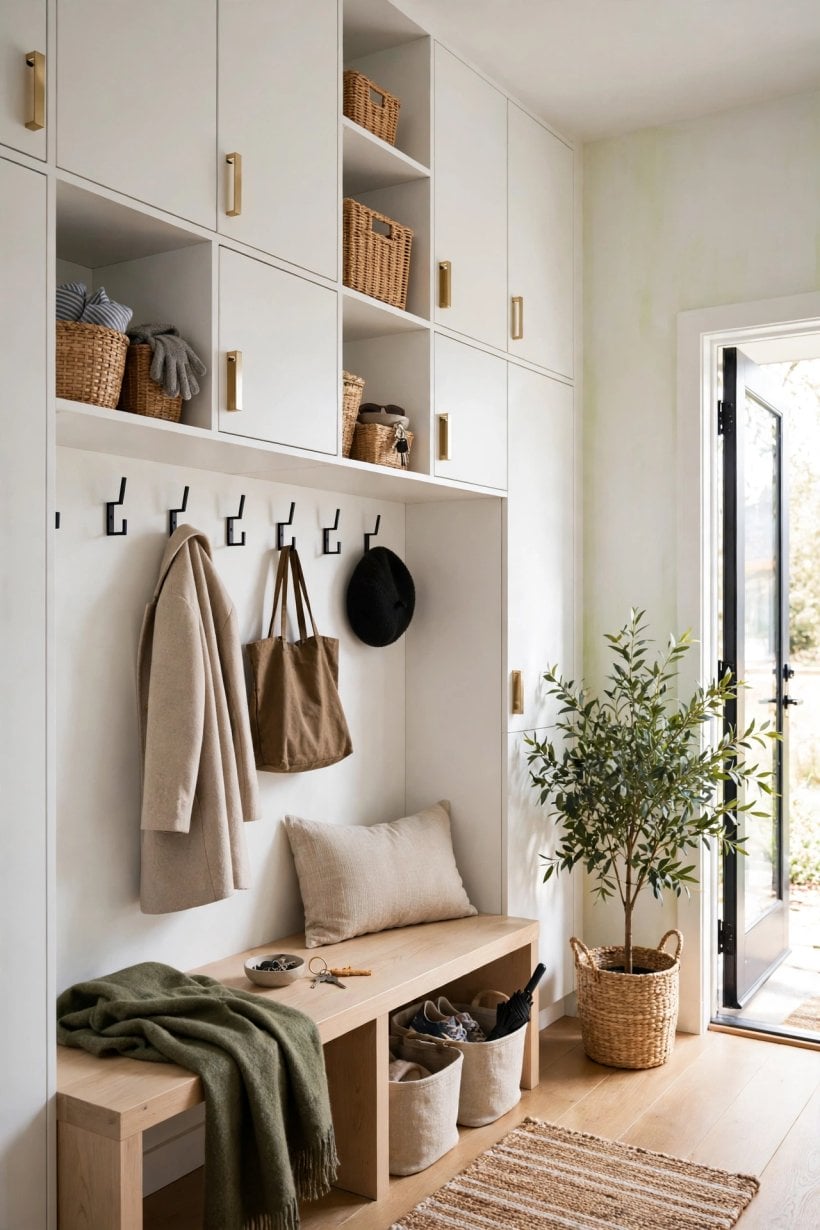
The bench is the mudroom’s hearth: the seat where boots surrender, bags land and children are de-coated. Build it like the room’s most-used furniture, because by hours of service, it is.
12. Size the Bench for the Whole Arrival
Two bottoms at once is the minimum honest size for a family mudroom; one person’s bench in a four-person house creates a queue in the rain. When in doubt, run the bench the wall’s whole length.
13. Set the Height for Boot-Pulling
A bench at comfortable chair height lets feet plant and boots lever off without acrobatics. Too low is a squat, too high is a perch — the boot is the measuring instrument, so test with one.
14. Build It Strong Enough to Stand On
Someone will stand on the bench to reach the top shelf — design for that person now, with honest structure and a top that grips. A bench built like furniture fails like furniture; build it like a step.
15. Store Boots Beneath, Off the Floor
An open boot bay under the bench, over a drained or washable tray, keeps wet footwear off the walking floor and under its owners’ sitting place. The puddle stays in its assigned parish.
16. Add Drawers for the Small Chaos
Gloves, hats, torches, dog treats, the tape measure of the threshold: one or two bench drawers give the small arrivals a home that is not the bench top. A clear bench top is the system’s flag.
17. Cushion Thinly or Not at All
A slim washable pad, or plain timber honestly finished — benches meet wet trousers and muddy sleeves. Deep upholstery in the drip zone is a sponge with ambitions.
18. Give the Bench a Back With Hooks
A back board carries the hook row at sitting reach and protects the wall from a thousand wet shoulders. Bench, back and hooks as one built piece is the classic mudroom wall, and it is classic because it works.
19. Leave a Gap for the Boot Jack
The humble boot jack by the bench end saves backs, socks and dignity daily. A notch, a hook or a stored spot for it keeps the tool where the boots are, which is the whole doctrine of this room.
20. Let Children Reach Their Own Bench Space
A low step-bench or a marked low end of the main bench lets small people manage their own boots and coats. Systems children can operate are systems adults stop having to operate for them.
21. Keep One End Clear as the Landing Shelf
Post, keys, the bag that must not be forgotten: the bench’s end section, kept deliberately empty, is the mudroom’s out-tray. Its emptiness is a feature — defend it like the system’s front line.
22. Finish the Bench to Match the House
The mudroom may be a workshop, but it is also the house’s daily hello. Timber and paint drawn from the home’s own palette keep the hardest-working room from looking like an apology.
4. Hooks, Cubbies and the Vertical Wall
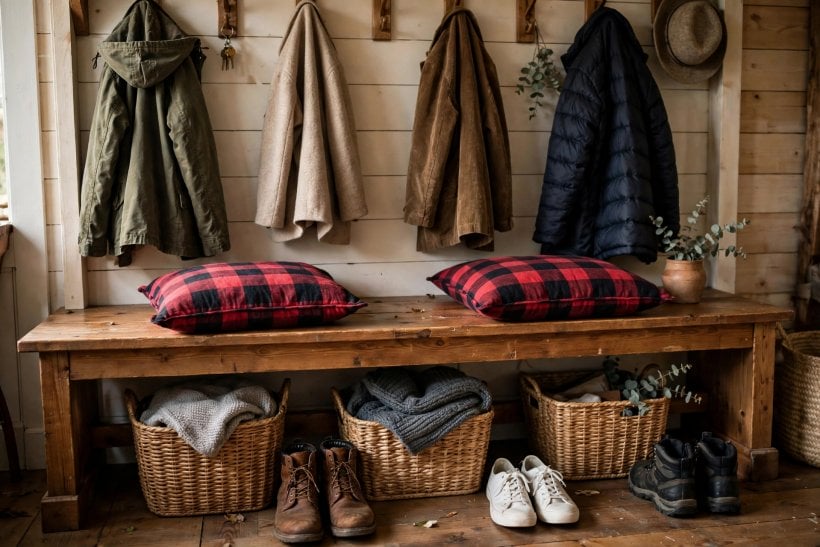
Walls do the mudroom’s heavy lifting: a fitted vertical system stores the household’s whole outdoor wardrobe in a hand’s depth of floor. The closet-depth version of this discipline lives in the tiny house closet design ideas survey; here it wears boots.
23. Run Two Hook Rows at Two Heights
Adults’ coats high, children’s and the day’s bags low: double rows double the wall without doubling the room. One row at one height wastes half the wall and all of the children’s independence.
24. Choose Hooks That Hold, Not Hooks That Decorate
A hook must take a wet coat’s full weight on a winter’s day, daily, for years. Test with the heaviest coat the household owns, loaded with its pockets’ usual cargo — that is the specification.
25. Space Hooks by Shoulders, Not by Symmetry
Coats are wide; hooks spaced for the drawing’s neatness crush them into a damp bundle. Shoulder-width spacing, staggered between rows, is what makes the wall a wardrobe instead of a thicket.
26. Cubby Per Person Above the Hooks
A shelf of open cubbies at head height takes hats, gloves and the small kit off every other surface. Open beats doored here — visible and grabbable.
27. Add One Lockable or Lidded Cubby
Keys, medicines on the way out, the good torch: one closed box among the open cubbies keeps the valuables of the threshold honest. Every open system needs one closed member.
28. Hang a Rail for the Airing Rotation
Wet coats need air more than they need storage. A short rail or a row of pegs near the door’s airflow lets today’s soaking dry before it joins the wardrobe — the mudroom’s laundry-before-laundry.
29. Put Bags at Hip Height, Off the Floor
School bags and work bags land where hands drop them. Hooks or a shelf at hip height catch them in the air; without one, they colonise the bench and then the floor, in that order, nightly.
30. Use the Wall Above the Door
The strip over the door frame is free storage for the rarely-used: the spare hats, the guest hooks, the seasonal box. In a room measured in hooks, free wall is never left unemployed.
31. Label Nothing, Zone Everything
Labels peel and households rebel; zones endure. One end for adults, one for children, one bay for sport, one for the dog — geography teaches faster than signage, and it never falls off.
32. Keep a Mirror by the Door, Small and Honest
The last-look mirror at the exit is the mudroom’s gift to the household’s dignity. Keep it small, well-lit and at face height — it serves the departure, not the décor.
33. Let One Bay Stay Empty for Guests
Visitors arrive with coats too, usually in the rain, usually when the system is fullest. One spare hook bay, kept empty by household law, is hospitality engineered into the wall.
5. Floors That Forgive Mud
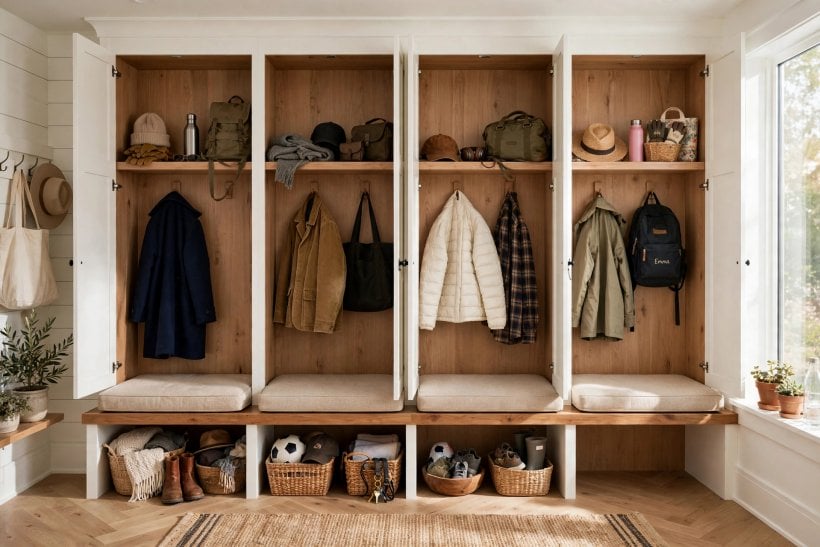
The mudroom floor takes the weather’s full evidence and is hosed, swept or mopped more than any floor in the house. Choose it as equipment first and as a surface second — this is the one floor whose beauty is measured in forgiveness.
34. Choose Stone, Tile or Sealed Concrete Without Fear
Hard, washable, unembarrassable: the classic mudroom floors earn their coldness. They take grit without scratching into sadness, water without swelling, and a decade of boots without a complaint.
35. Give Timber Floors a Sacrificial Skin
Where the house’s boards must run through, a sealed finish, a mat well and a washable runner carry the traffic’s damage instead. Timber can serve in a mudroom; it just cannot serve unarmoured.
36. Recess the Mat Well at the Door
A mat sunk flush with the floor scrapes boots without tripping feet or curling at the corners. The well is a small piece of joinery that removes the mudroom’s most annoying daily object: the wandering mat.
37. Tray the Boot Zone, Drain the Problem
A shallow tray — ideally drained, at least waterproof — under the boot bay collects the melt and the mud in one washable place. The floor’s job ends where the tray’s begins, and both stay cleaner.
38. Darken the Grout, Pattern the Tile
Mid-tone, subtly patterned surfaces hide the day’s evidence between cleanings; white grout in a mudroom is a diary of every arrival since spring. Choose the floor that forgives the household’s real rhythm.
39. Slope to a Drain Where the Climate Demands
Snow country and farm country earn a floor drain: melt-water and wash-downs leave by gravity, and the room can be hosed like the working space it is. It is infrastructure, invisible until it is priceless.
40. Keep a Runner That Washes, Not a Rug That Suffers
A flat-weave washable runner along the route catches grit and goes in the machine monthly. The mudroom is where washable stops being a label and becomes the entire furnishing philosophy.
41. Heat the Floor If the Budget Reaches
Gentle underfloor warmth dries boots, gloves and the floor itself overnight — the mudroom luxury that works hardest in the worst weather. In cold climates it graduates from luxury to system.
42. Edge the Floor Against the House
A threshold strip or a step of level change at the clean boundary keeps wash-water and grit from migrating. The mudroom’s dirt should be a resident, never a tourist in the rest of the house.
43. Store the Cleaning Kit in the Room
Broom, dustpan, mop and the floor’s own cleaner, hung inside the mudroom: a room cleaned in two minutes gets cleaned. Equipment stored three rooms away is a cleaning schedule’s obituary.
44. Let the Floor Run Under Everything
Finish the flooring wall to wall, under bench and cubbies alike, so furniture can move and systems can evolve. Patchwork floors fossilise the first layout; continuous floors let the room grow up.
6. Boots, Bags and Seasonal Overflow
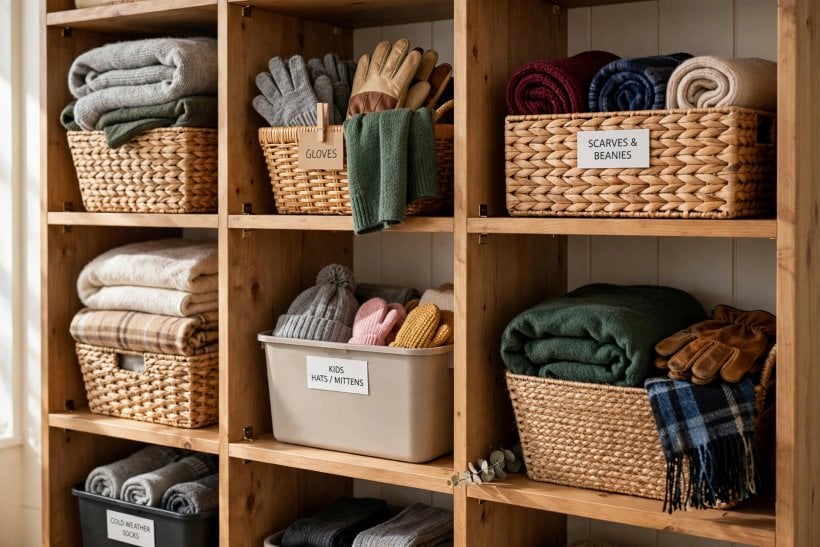
Every mudroom holds two wardrobes: today’s, and the season waiting its turn. Overflow handled badly evicts the working system; handled well, it lives high, deep or elsewhere — the same hidden-storage doctrine the site’s hidden storage plans apply to whole houses.
45. Store the Off-Season High and Labelled
The top shelf or a high run of closed boxes takes winter’s bulk in summer and vice versa. Seasonal storage belongs above eye level — reached twice a year, seen never, missed by the daily system not at all.
46. Give Boots a Rotation, Not a Heap
Daily pairs in the boot bay, occasion pairs in reserve, dead pairs out of the house. A boot heap is a system that stopped rotating; the mudroom’s shelf discipline exists to prevent exactly that archaeology.
47. Keep a Charity Bag in the Mudroom
Outgrown coats and dead boots leave by the same door they entered, into a bag that lives in the mudroom permanently. When it fills, it goes. Systems that export clutter survive.
48. Bin the Small Sports, Basket the Balls
Balls, rackets, helmets and the rest of the sporting diaspora need one open bin and one basket, by the door they actually use. Sport stored in bedrooms is sport carried through the house, daily, in muddy shoes.
49. Hang the Wet Gear to Drip in Peace
Waders, rain suits and soaked outer layers want a drip rail over the tray, not a hook among the dry coats. One wet garment in the dry wardrobe perfumes the whole system with its weather.
50. Shelve the Household’s Outdoor Library
Maps, field guides, the tide table, the bird book: the mudroom is the reading room of the outdoors. One shelf keeps the household’s expeditions literate and the books where the boots can consult them.
51. Keep a Lost-and-Found Hook
One hook, near the door, for the found glove, the borrowed scarf, the mystery keys. A household’s stray objects need an address or they colonise the bench — the system’s front line, defended elsewhere in this survey.
52. Store Umbrellas Wet-Side, in a Drip Pot
A tall, drainable pot by the door accepts umbrellas in their natural state. Stored dry-side they drip on the coats; stored outdoors they get forgotten; the pot is the treaty.
53. Reserve a Shelf for Parcels and Returns
The threshold now handles the household’s logistics. One shelf for arrivals awaiting opening and departures awaiting courier stops the boxes from besieging the bench — the modern mudroom’s newest duty, given a designed place.
54. Keep the Emergency Kit at the Exit
Torch, batteries, the car’s ice scraper, a charged power bank: the mudroom is where emergencies are met, in the dark, in a hurry. The kit lives by the door because that is where it will be needed.
55. Rotate the System Twice a Year
Spring and autumn, an hour: seasons swap shelves, dead gear leaves, hooks reassign as children grow. The rotation is the system’s heartbeat — skip it and the piles return.
7. Mudrooms That Work Twice: Laundry, Pets and Utility
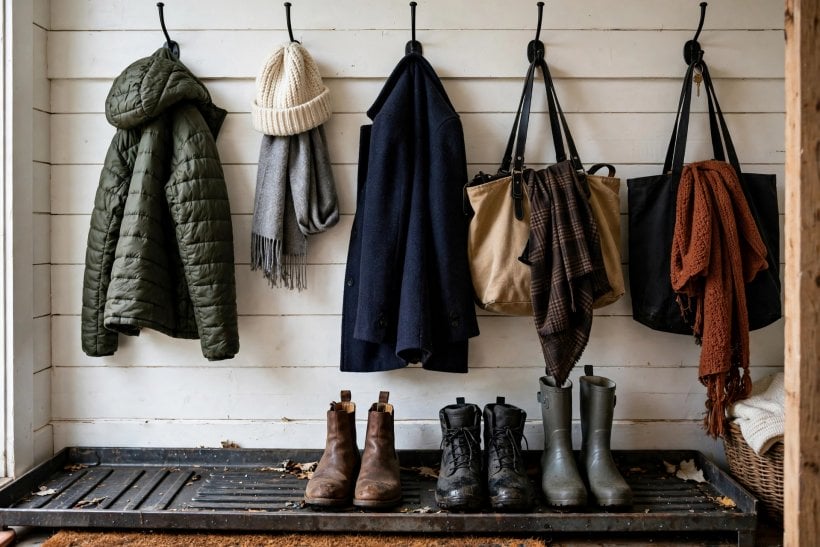
The mudroom rarely does one job for long. It absorbs the laundry, the dog, the utility kit — and done deliberately, the combinations strengthen each other, as the merged rooms in laundry room ideas show.
56. Marry the Laundry to the Mud Source
Muddy clothes travel metres, not rooms, when washer and mudroom share a wall or a space. The partnership is the hardest-working in the house’s plan, and the route discipline of section two becomes a straight line.
57. Add a Sink Sized for Boots and Dogs
A deep utility sink takes boot-washing, flower-arranging, paint brushes and small muddy dogs. It is the mudroom’s most versatile upgrade — the fixture that turns a landing into a workshop.
58. Give the Dog a Station, Not a Corner
Hooks for leads at dog-departure height, a towel on its own peg, treats in the closed cubby, a washable bed zone: one station ends the daily scavenger hunt at the door.
59. Shower the Worst Off, Where Winters Demand
A low dog-and-boot shower in serious mud country is infrastructure, not indulgence: a tiled corner, a hand shower, a drain. It pays for itself in floors not cleaned, every week, forever.
60. Keep Pet Food Out of the Traffic Line
Feeding stations belong to the room’s quiet edge, off the arrival route, with sealed storage. Bowls in the doorway turn every departure into an obstacle course with witnesses.
61. Hang the Household’s Tools at the Threshold
Torch, tape, scissors, string, the step stool: the mudroom’s utility drawer or board serves the garden and the house alike. Tools stored at the centre travel least to both frontiers.
62. Charge Everything in One Dock
Phones, torches, dog collars with lights, the doorbell’s battery: one charging shelf in the mudroom ends the household’s cable diaspora. Charge devices where they leave and return.
63. Sort Recycling at the Exit
Bins for the outgoing streams, sized to the council’s boxes, inside the mudroom’s door: recycling sorted where it exits gets carried out. Sorted in the kitchen, it commutes through the mud it came to avoid.
64. Keep a First-Aid and Fix-It Shelf
Plasters for garden injuries, the sewing kit for the coat button lost at departure: the mudroom is the house’s dressing station for the outdoors, and its small pharmacy belongs by the door it serves.
65. Let the Freezer Live Here If It Must
An overflow freezer at the mudroom’s far end is the classic second-job tenant: out of the kitchen’s way, on the garden’s route, unbothered by the traffic it shares the room with. Vent it, and it behaves.
8. Mudrooms in Small Homes and Tiny Houses
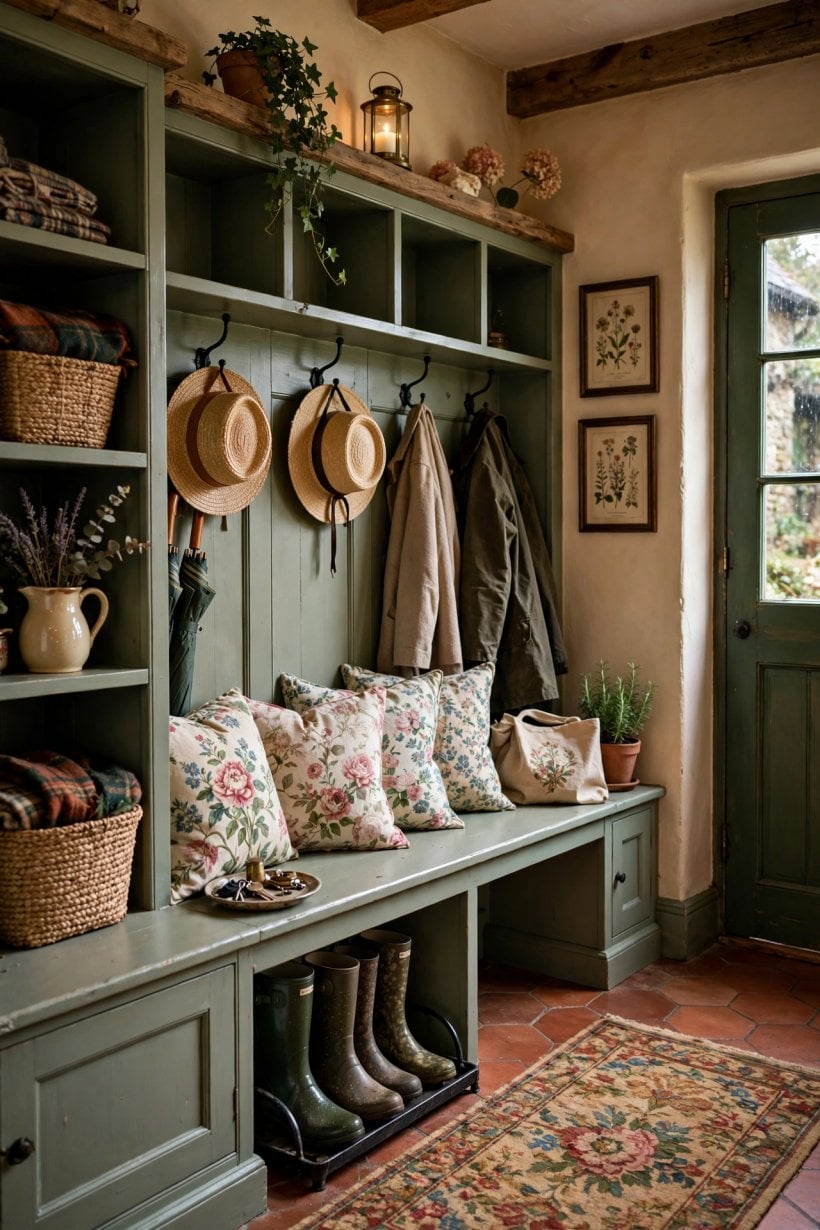
The tiny house has no square metre to waste, yet it needs the mudroom’s system most: one wet arrival can occupy a tenth of its floor. The genkan tradition answers with a sunken, disciplined threshold, explored in Japanese genkan tiny house entryways, and the plans that build gear zones in from the start are gathered in tiny house floor plans with mudrooms and gear zones.
66. Steal the Entry From a Cupboard’s Depth
A mudroom wall needs only a bench’s depth of floor and a door’s width of wall. In a small home, one fitted wall beside the used door is the whole room — and it is enough.
67. Drop the Entry a Step, Genkan-Style
A level change at the threshold makes the dirt line physical: shoes live below the step, the clean house above it. The oldest mudroom idea in the world is also the smallest, and it fits in a square metre.
68. Fold the Bench, Hook the Rest
A hinged bench that folds to the wall, hooks above, boots below in a tray: the tiny mudroom assembles for arrivals and vanishes for living. Folding is not a compromise at this scale; it is the design.
69. Put the Mudroom Outside the Door
A covered boot porch, a screened entry box, a lean-to landing: where interior metres are rationed, the landing moves outdoors under a small roof, and the house’s clean floor begins at a dry, organised threshold.
70. Use the Stair’s Underside
In two-level tiny homes the under-stair is the mudroom: hooks, a low bench, boot trays in the wedge. It is the one volume in a small house with nothing else to do, and it is exactly door-adjacent.
71. One Tray to Rule the Wet Stuff
Where nothing else fits, a single large drained tray — boots and dripping coats over it — is the mudroom reduced to its essence: a parish where wet things are allowed to be wet.
72. Hang It All, Floor Is for Feet
Tiny mudrooms store vertically or not at all: wall rails, over-door hooks, cubbies to the ceiling. The floor’s whole job in a small entry is landing feet and boots, in that order, and nothing else’s.
73. Share the Bathroom’s Wet Wall
An entry bench backed onto the bathroom wall borrows its waterproofing logic and sometimes its drain. Wet rooms cluster in tiny houses for plumbing sense; the mudroom is the cluster’s driest member and its natural neighbour.
74. Keep the Tiny System Ruthlessly Seasonal
Small entries hold one season only. The off-season goes to the loft, the shed or the storage box — the rotation of idea 55, enforced by square metres rather than by virtue.
75. Plan the Mudroom in the Floor Plan, Always
The tiny plans that work — like those gathered in tiny house plans with mudrooms — draw the landing at the first sketch, because retrofitting order onto a small entry is the hardest version of the problem. The system scales to a wall.
9. Checks and Mistakes: Before the Hooks Go Up
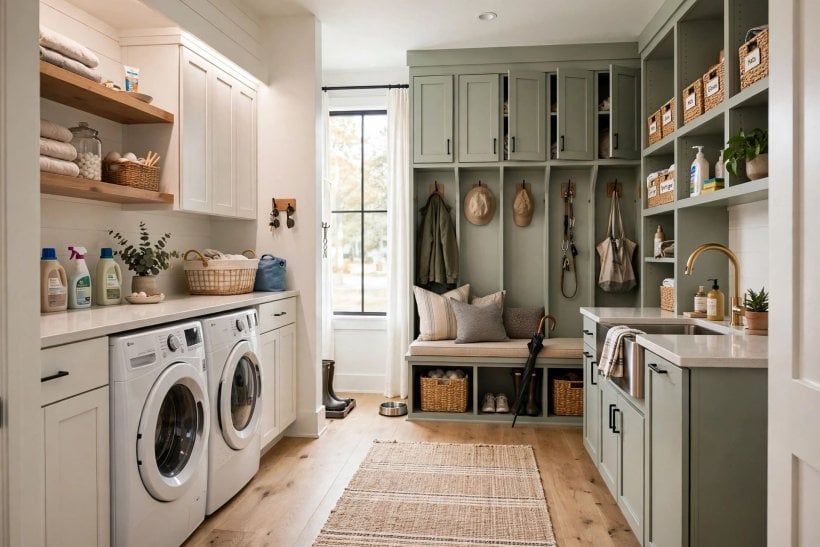
The standard mudroom failures are assignment failures: hooks too high for the children who own the coats, a bench too small for the household’s real arrival, storage built for three coats when the household owns thirty. The enemy is never mess itself; it is the unassigned object.
Check the design against the household’s worst fifteen minutes: a wet November dusk, everyone home at once, dog included. Can everyone sit, hang, stow and pass without queueing? Is every object in that scene assigned a hook, cubby, tray or bin? Can the floor be swept in two minutes? A mudroom that passes the worst quarter-hour will run itself for years; one designed for the average day will be defeated by the first storm.
10. Costs and Pulling It Together
Mudroom money divides into three tiers with unusual honesty. The first tier — hooks, a bench, a tray, a washable runner — is small change and transforms the used door in a weekend; every house should do it before debating the others. The second — fitted cubbies, lockers, a bench built in, floor replaced — is joinery money, spent once, that makes the system permanent. The third — the sink, the dog shower, the drain, underfloor heat — is plumbing money, justified by climate and household size rather than by taste.
Sequence by dependency: floor before fittings, bench before hooks (the bench’s height sets the hook rows). And measure in the only unit that matters — the household’s own bodies, coats and boots — because a mudroom is a garment the family wears twice a day: it fits, or it fails.
Final Considerations
A mudroom is the house’s handshake with the outdoors, given twice daily in all weathers. Built as a system — route, bench, wall, floor, overflow — it is the cheapest order a household can buy: no lost gloves, no muddy processions, no chair buried under coats.
Start with the door the family actually uses, and assign everything a home before buying a single hook. Get the landing right, and the rest of the house stays clean almost by itself.

0 Comments