
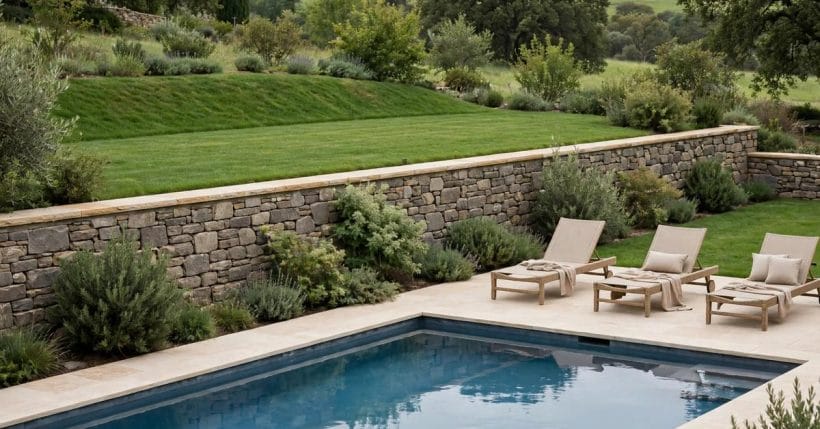
A swimming pool rarely sits on perfectly level ground, and that is where the retaining wall earns its place. On a sloping garden, the wall holds back the higher ground, shapes a level deck beside the water, and turns an awkward bank into a series of calm, usable surfaces. Done well, it barely announces itself as engineering. It reads as part of the garden, a stone or rendered line that gives the pool its setting and the garden its structure.
This collection gathers retaining wall design ideas for pools around one element only: the wall itself. The pool stays a simple sheet of water throughout, and the attention stays on what the wall is made of, how it meets the deck, how planting softens it, and how it behaves after dark. Each idea below looks at the wall from a different angle, so a reader can compare finishes, forms and planting without losing sight of the whole garden.
One caution runs through every section. A wall that holds back soil beside water is structural work, and water moving through soil is drainage work. Both belong to qualified professionals, who judge the slope, the soil and the water together. The ideas here are about appearance, layout and planting only, never about how a wall is built, drained or sealed. Anyone planning a wall should have a professional assess the site before anything is decided.
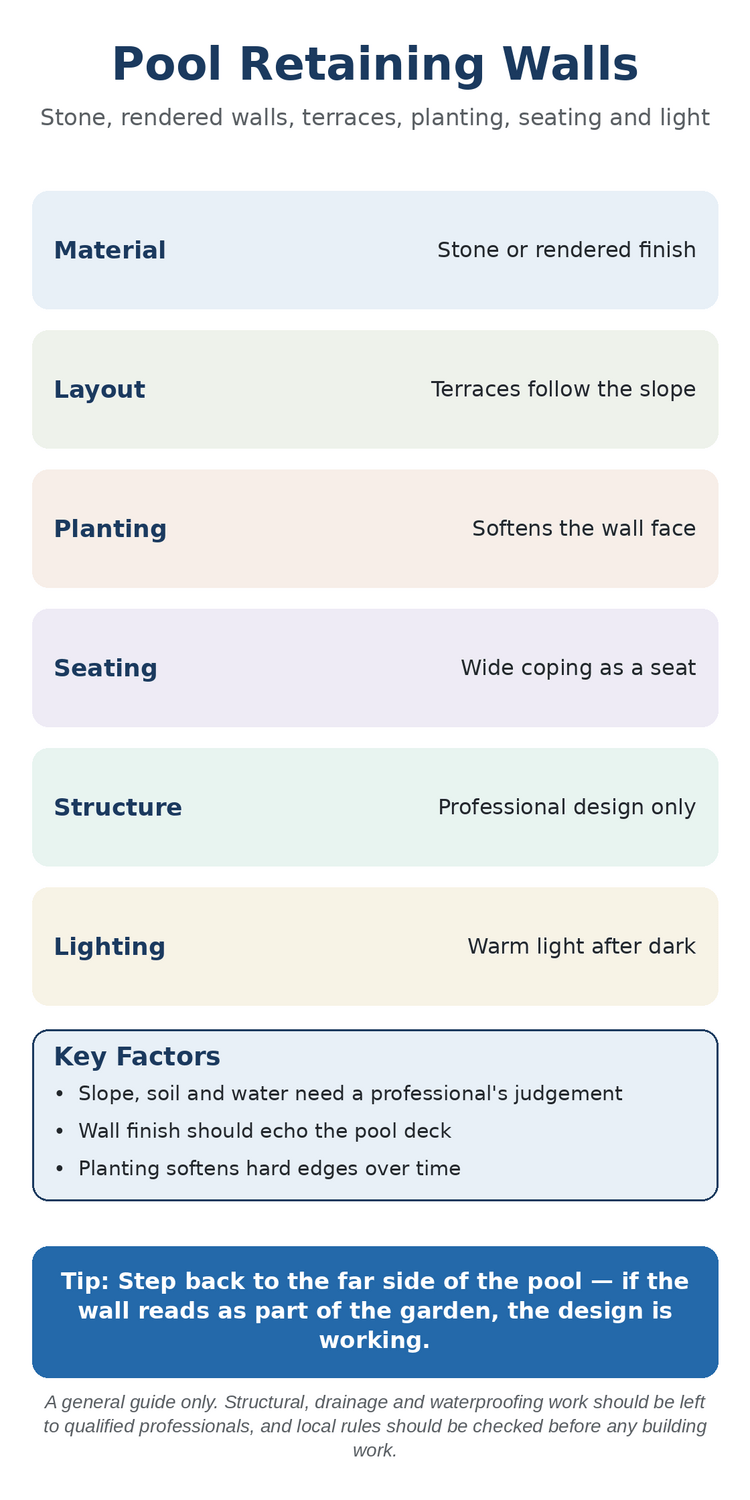
| Item | What it is |
|---|---|
| Let the Wall Hold the Garden, Not Just the Slope | The simplest retaining wall idea is also the most satisfying: a single strong wall that lets a lawn sit level above the pool while the deck sits level below it. |
| Match the Wall Finish to the Pool Deck | A retaining wall and a pool deck are neighbours, and neighbours look best when they share a palette. |
| Curve the Wall Around the Water | Most retaining walls run straight, but a curved wall changes the whole feeling of a pool garden. |
| Light the Wall for Evenings by the Pool | A retaining wall that looks good by day can look remarkable after dark, provided the lighting is planned with the wall rather than bolted onto it. |
| Turn Wide Coping into Poolside Seating | Some of the best poolside seating is not furniture at all. |
| Step the Garden Down in Terraces | Where a slope is too steep for a single wall, terraces offer a gentler answer. |
| Soften Hard Stone with Planting | A bare stone wall beside a pool can feel severe, but planting transforms it completely. |
| Keep the Wall Calm with a Rendered Finish | Not every pool garden wants the rustic character of stone. |
| Layer Walls, Light and Planting After Dark | The most dramatic pool walls are layered: several walls rising behind one another, each carrying its own planting, all lit warmly as evening falls. |
| Use a Low Wall as a Seat by the Water | The final idea returns to the simplest pleasure of all: a low wall beside the water, topped with cushions, waiting to be sat on. |
1. Let the Wall Hold the Garden, Not Just the Slope
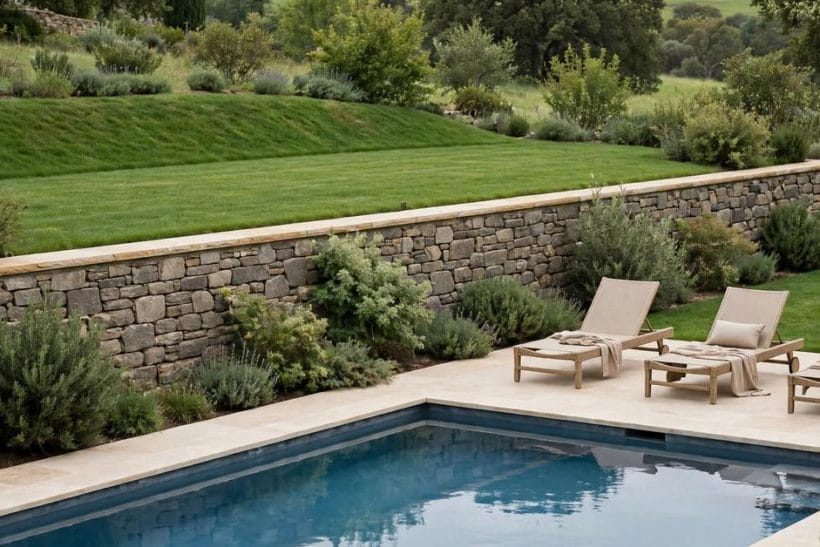
The simplest retaining wall idea is also the most satisfying: a single strong wall that lets a lawn sit level above the pool while the deck sits level below it. In the photograph above, a stone wall runs the full length of the pool, its top edge finished with smooth coping stones, and a generous lawn spreads out behind it. The wall does not fight the slope. It accepts it, and gives each level its own purpose.
Notice how the planting works with the wall rather than against it. Shrubs gather at the foot of the stonework, softening the junction where wall meets deck, while the lawn above stays open and calm. Nothing crowds the wall. The eye travels from water to stone to lawn without interruption, and the garden feels larger because each level is clearly defined.
A wall like this also frames the act of sitting by the pool. Loungers placed on the deck face the water with the wall at their backs, and the wall gives the seating area a sense of enclosure without any sense of confinement. The garden beyond the wall stays visible over its top, so the seating area feels sheltered and open at the same time.
When judging a single-wall layout, look at the line of the coping first. A level, continuous coping makes the whole composition feel settled, while a coping that wanders or breaks draws the eye to the wrong place. The coping is the wall’s handshake with the garden, and it deserves as much attention as the stonework below it.
2. Match the Wall Finish to the Pool Deck
A retaining wall and a pool deck are neighbours, and neighbours look best when they share a palette. Pale stone on the wall with pale stone on the deck gives a quiet, unified edge, while a warm-toned wall beside a pale deck creates a gentle contrast that still feels related. The finish of the wall should echo something already present beside the water, whether that is the deck, the coping, or the planting around it.
Stone walls carry natural variation in every block, so they sit easily beside irregular planting and lawns. Rendered walls, by contrast, offer a flat, even surface that suits a pared-back deck and crisp furniture. Neither finish is better in itself. The question is which one matches the mood of the rest of the garden, and which one the eye is happy to rest on.
Colour matters more than pattern here. A wall that picks up the grey-green of olive foliage or the warm buff of a stone deck will settle into the garden quickly. A wall that introduces an entirely new colour has to work harder, and it often ends up dominating the pool rather than supporting it. The wall is a supporting player, and its finish should let the water stay the star.
It is worth remembering that a finish is not only about looks. Stone, render and block each weather differently, and each asks for different care over the years. A professional can advise on how a finish will age beside water and in sun, so the wall that looks right on the first day still looks right seasons later.
3. Curve the Wall Around the Water
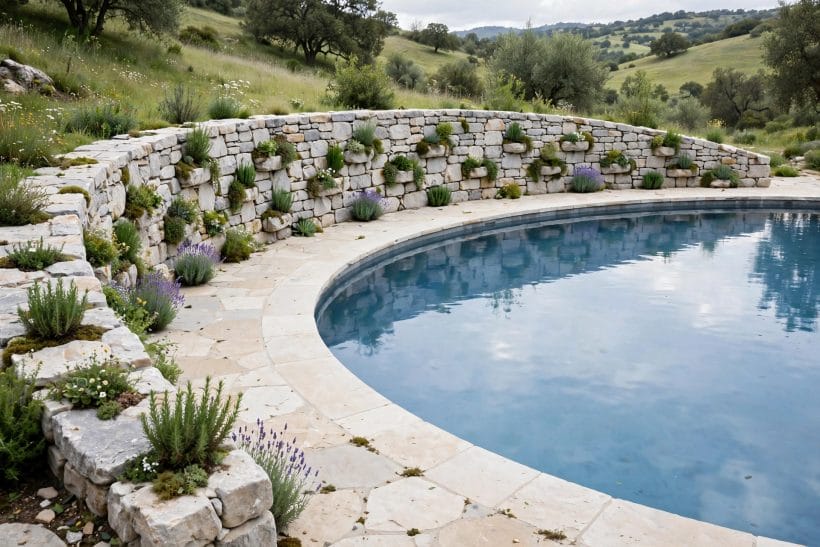
Most retaining walls run straight, but a curved wall changes the whole feeling of a pool garden. In the photograph for this section, a stone wall sweeps in a generous arc around a rounded pool, and the curve makes the space feel gathered in, almost like a courtyard, even though the garden beyond stays wide open. Curves soften the geometry of a pool and give the eye a line to follow.
A curved wall also creates natural pockets for planting. Small shrubs and flowering plants tucked into the stonework break the wall into a rhythm of green and grey, so the wall reads as a garden feature rather than a barrier. Lavender, rosemary and other scented plants suit these pockets well, adding fragrance to the walk beside the water.
The curve has a practical charm too. A rounded pool edge with a curved wall behind it gives swimmers a continuous edge to follow and gives the deck a shape that invites wandering rather than marching. The garden feels less like a corridor and more like a place to linger, which is exactly what a pool garden should be.
Curves ask for care in the detailing. The coping must follow the arc smoothly, and the stonework must keep an even face as it turns. These are matters for the professional designing the wall, but a reader can judge the result simply: if the curve looks effortless, the detailing is right.
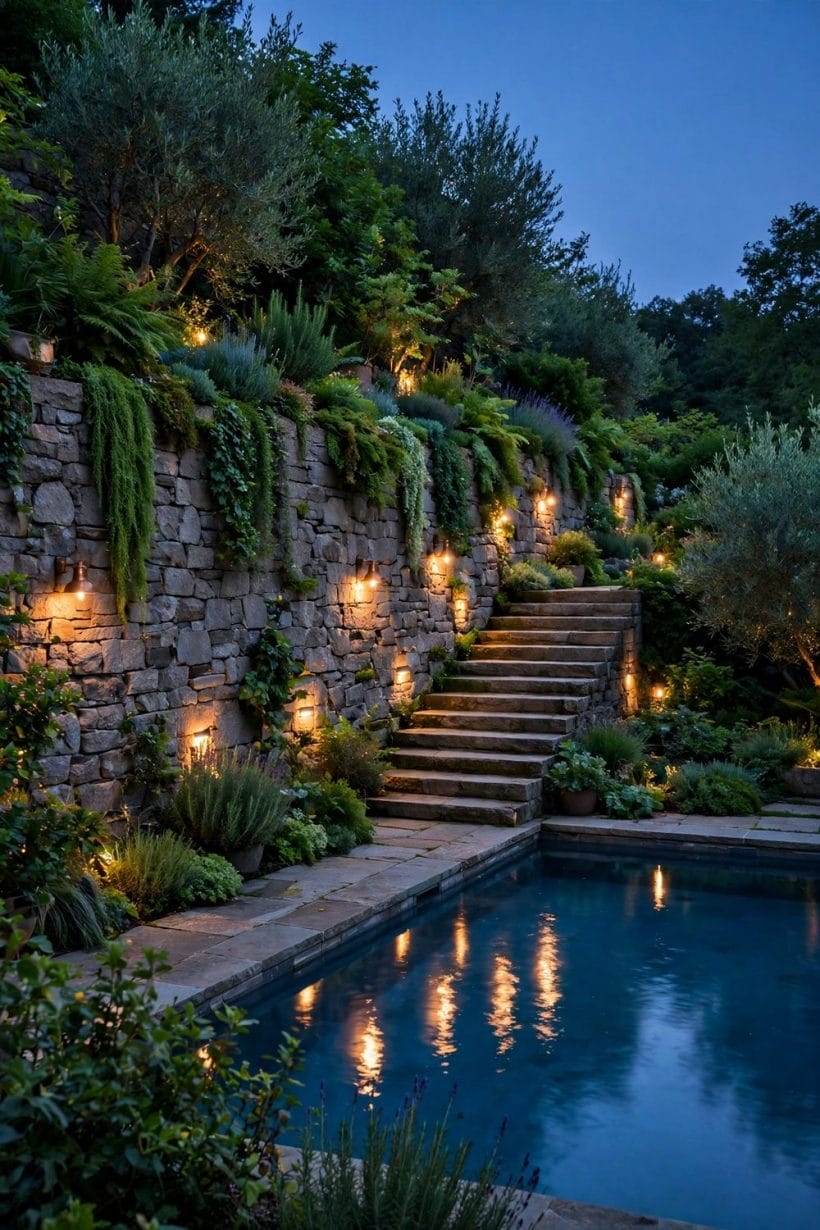
4. Light the Wall for Evenings by the Pool
A retaining wall that looks good by day can look remarkable after dark, provided the lighting is planned with the wall rather than bolted onto it. Warm lights set into or beside the stonework wash the texture of the stone, pick out the trailing plants, and throw a soft reflection onto the water. The wall becomes a lantern for the whole garden.
The photograph for this section shows the effect at dusk: a stone wall with steps, lit by small warm fittings, standing above a still pool. The light is gentle and low, never harsh, and it gathers the garden into a series of glowing surfaces. Steps are easy to read, the wall’s texture is visible, and the water carries the light back across the garden.
Lighting a wall is also about restraint. A few well-placed fittings that graze the stone will do more than a blaze of light that flattens every surface. The aim is to reveal the wall’s character after dark, not to turn the garden into a stage. Warm tones suit stone best, and fittings should sit where they will not dazzle anyone sitting beside the water.
Electrical work beside water is specialist work, and lighting design around a pool should be left to qualified professionals. The reader’s part is simpler: notice how light changes the wall, and prefer schemes where the wall glows softly and the water reflects it, rather than schemes where the fittings themselves steal the show.
5. Turn Wide Coping into Poolside Seating
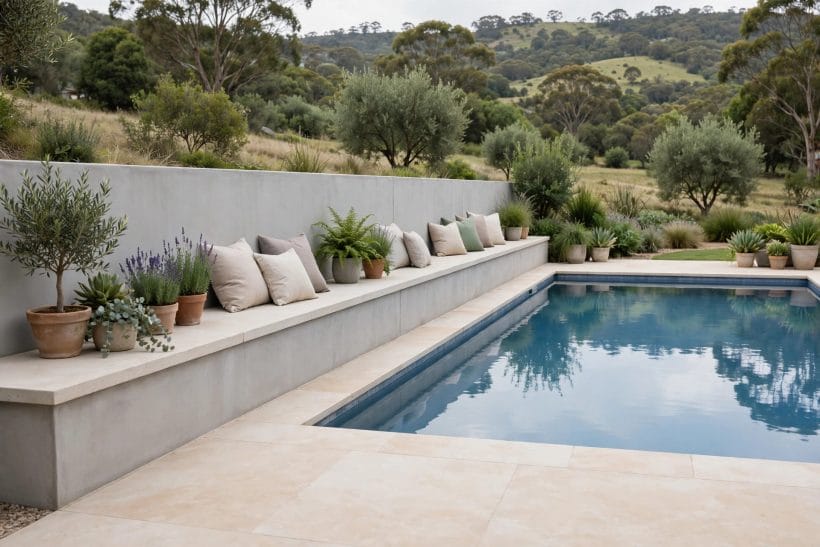
Some of the best poolside seating is not furniture at all. It is the top of the retaining wall itself, finished with a wide, flat coping that invites sitting. A wall built with a generous cap gives the pool a long, low seat that never needs storing, never blows over, and always faces the water. Cushions and a folded towel are all it needs to become the favourite spot in the garden.
The rendered wall in the photograph for this section shows the idea at its calmest. A smooth wall with a broad ledge runs beside the water, dressed with cushions and planters, and the whole composition feels like an outdoor room. The planters give the ledge rhythm, breaking its length into a series of smaller, more intimate seats.
A seat wall changes how a pool is used. It gives swimmers somewhere to perch between swims, gives watchers somewhere to sit without dragging chairs across the deck, and gives the garden a social edge that a plain wall never offers. Children gather on it, towels gather on it, and conversation gathers around it.
Comfort is in the detailing. A coping that is smooth, level and generous in depth will be used constantly, while a narrow or rough cap will be ignored. Shade matters too: a seat wall that catches the afternoon sun is a pleasure, and a seat wall under a canopy is a pleasure for longer. The neighbouring covered deck ideas show how shade structures can stretch the useful hours of a poolside seat.
6. Step the Garden Down in Terraces
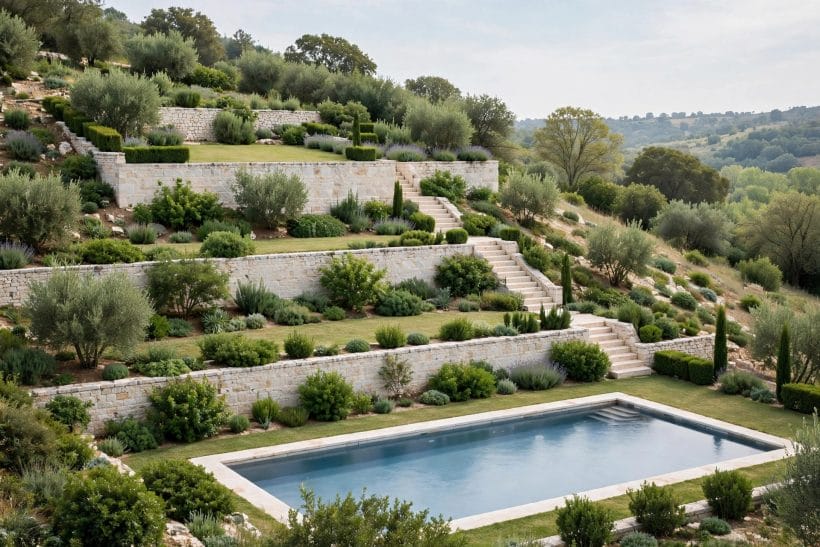
Where a slope is too steep for a single wall, terraces offer a gentler answer. A series of low walls steps the garden down toward the pool, and each terrace becomes its own small garden: a lawn here, a shrub border there, a path winding between them. The photograph for this section shows terraces descending to the water, each level planted and calm, with steps linking one level to the next.
Terracing changes the experience of arriving at a pool. Instead of a single drop from garden to water, the visitor descends gradually, and each terrace offers a new view of the pool below. The garden feels generous because it is revealed slowly, and the pool feels like a destination discovered at the bottom of a planted hillside.
Planting is what makes terraces work visually. Each wall top can carry a different character: clipped hedging on one level, loose shrubs on another, scented plants where the path passes close. The walls themselves stay consistent in material, so the terraces read as one composition even while each level has its own planting personality.
Terraces also suit gardens where the slope is part of the charm. Rather than flattening the whole garden, terracing keeps the sense of height and view while making every level usable. The backyard landscaping ideas collection shows how level changes can organise a whole garden, and terraces are one of the most graceful ways to do it.
7. Soften Hard Stone with Planting
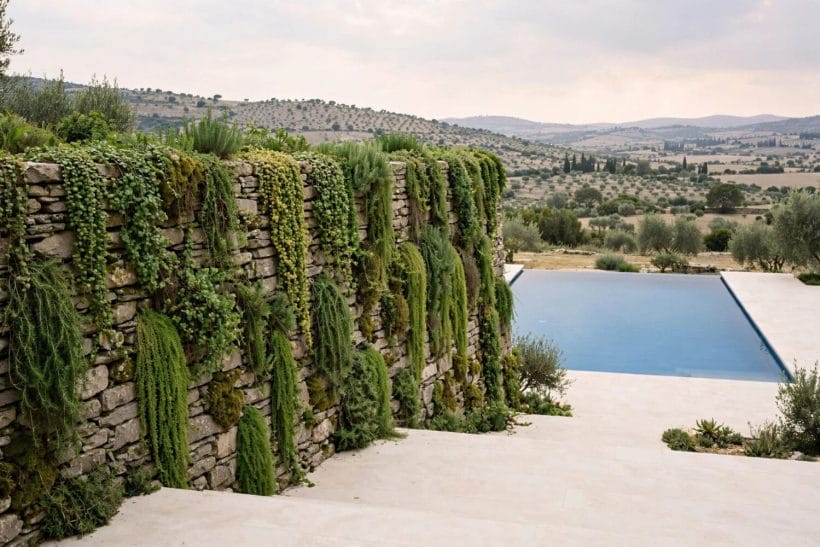
A bare stone wall beside a pool can feel severe, but planting transforms it completely. Trailing plants spilling over the top edge, shrubs gathered at the foot, and small plants tucked into crevices all soften the stone until the wall looks like it has grown out of the garden rather than been placed in it. The photograph for this section shows a dry-stone wall almost veiled in trailing green, with the pool calm beside it.
The trick is to let planting do the softening without hiding the wall entirely. A wall that disappears under foliage loses its structure, while a wall with no planting at all can dominate the pool. The happiest balance leaves the stone visible in places and green in others, so the eye enjoys both the craftsmanship of the wall and the softness of the planting.
Trailing plants deserve special mention beside pools. Plants that cascade down a wall face catch the light, move in the breeze, and blur the hard line where wall meets deck. They also give the wall a sense of age and permanence, as though the garden has settled around it over many seasons. Evergreen trailers keep the effect through the year, while flowering trailers add seasonal colour.
Planting beside a wall also needs a realistic eye. Roots, water and shade all affect what will thrive against stone, and plants that struggle will look worse than no plants at all. The tiny house garden ideas collection is a useful reminder that small, well-chosen planting beats ambitious planting that is never maintained. A few plants that thrive will soften a wall better than many that merely survive.
8. Keep the Wall Calm with a Rendered Finish
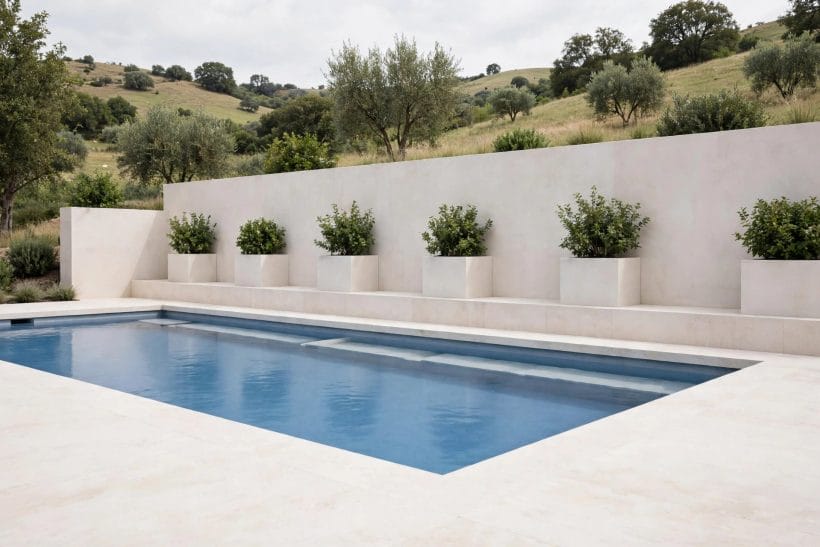
Not every pool garden wants the rustic character of stone. A rendered wall offers the opposite virtue: calm. A flat, pale, even surface beside the water gives the eye somewhere to rest, and it lets the pool, the planting and the furniture carry all the detail. The photograph for this section shows a pale rendered wall with a long bench ledge and a row of square planters, and the effect is serene rather than showy.
Rendered walls suit gardens where the architecture is simple and the lines are clean. They pair naturally with pale decks, minimal furniture and restrained planting, and they make a small pool garden feel larger by removing visual noise. Where a stone wall adds texture, a rendered wall adds quiet, and some gardens need quiet more than texture.
The planter row in the photograph is worth copying in spirit. Identical planters spaced evenly along a wall give rhythm without fuss, and the repetition makes the wall feel designed rather than merely built. The plants themselves can stay simple: one species repeated along the wall is often more effective than a mixed border competing for attention.
A rendered finish also shows the quality of its detailing more honestly than stone. Any unevenness in the surface or the coping will show, so the finish rewards careful professional work. The tiny house patio ideas collection shows how pale, even surfaces can make an outdoor space feel calm and generous, and the same lesson applies to a rendered pool wall.
9. Layer Walls, Light and Planting After Dark
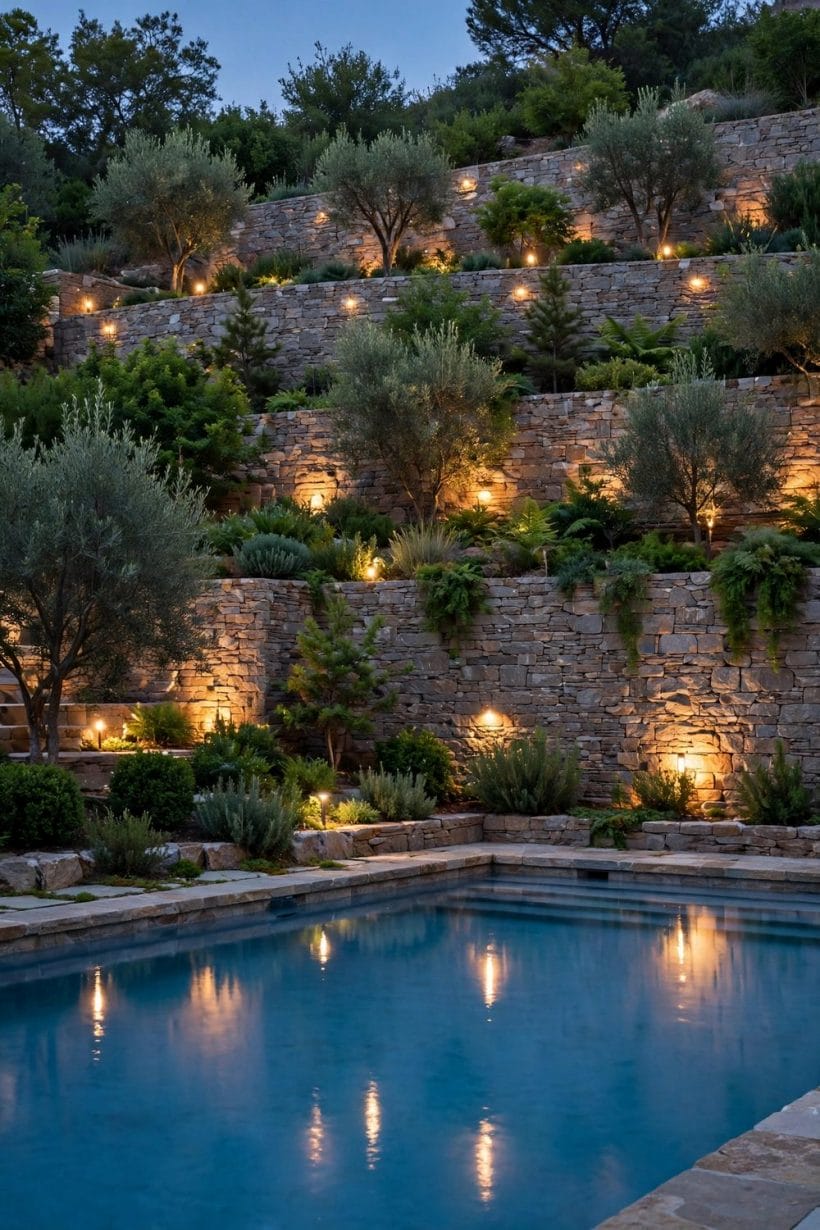
The most dramatic pool walls are layered: several walls rising behind one another, each carrying its own planting, all lit warmly as evening falls. The photograph for this section shows exactly that, with terraced stone walls, olive trees and shrubs glowing above a still pool. No single element dominates. The walls give structure, the planting gives softness, and the light gives the whole composition its evening mood.
Layering works because it gives the eye depth. A single wall is a backdrop, but several walls at different depths create a scene, with the nearest wall framing the pool and the furthest wall carrying trees against the sky. The pool sits at the front of the picture, and the garden rises behind it in stages, so the whole space feels both sheltered and expansive.
Evening is when layering pays off most. Warm light on each wall level picks out stone, foliage and trunk in turn, and the reflections in the water double the effect. A layered garden at dusk feels like a place designed for lingering, and the pool becomes the calm centre of a much larger composition.
Layered walls ask for a coherent hand. The materials should stay related across levels, the planting should share a palette, and the lighting should stay warm and low throughout. When one level breaks the pattern, the whole composition feels restless. When every level speaks the same language, the garden feels inevitable, as though it could not have been arranged any other way.
10. Use a Low Wall as a Seat by the Water
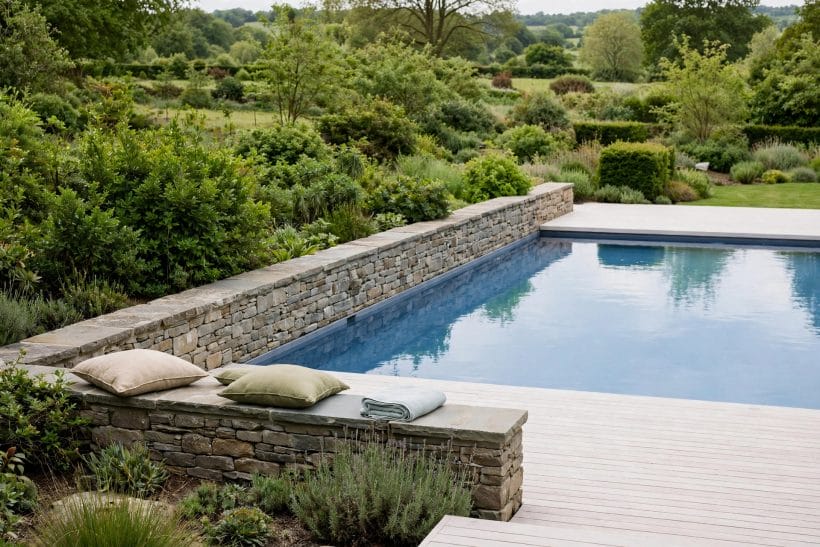
The final idea returns to the simplest pleasure of all: a low wall beside the water, topped with cushions, waiting to be sat on. The photograph for this section shows a low stone wall running beside a pool deck, its broad cap dressed with cushions and a folded towel, with shrubs behind it and open water beyond. It is not a grand gesture. It is an invitation.
Low walls have a particular charm because they never block the view. Sitting on a low wall, a person can watch the water, talk to swimmers, and enjoy the garden beyond, all without standing up. The wall defines the edge of the deck without enclosing it, so the pool area feels open while still feeling finished.
A low seat wall also ties the deck to the garden. On one side it borders the pool deck, and on the other it holds the planting, so it acts as a threshold between the two. Cushions make it comfortable, a towel makes it casual, and the stone itself makes it permanent. It is the kind of detail that makes a pool garden feel lived in rather than merely landscaped.
Deck surfaces matter beside a low wall, because the eye reads wall and deck together. The stone patio ideas, the flagstone patio ideas and the paver patio ideas all show surfaces that sit happily against stone walling, and any of them can give a seat wall the ground it deserves.
Final Considerations
A pool retaining wall is never just a wall. It is the line that organises the whole garden around the water: it levels the deck, holds the lawn, carries the planting, offers a seat, and glows after dark. The ideas in this collection all return to that one element, seen from different angles, and any of them can anchor a pool garden on its own.
The thread running through every section is restraint. Let the wall share the deck’s palette, let planting soften it without hiding it, let light reveal it gently, and let the structure stay in professional hands. A wall that is calm, consistent and well planted will outlast any fashion, and it will make the pool beside it feel more settled every season.
For readers comparing retaining wall design ideas for pools, the most useful next step is simply to look again at the photographs with the wall in mind rather than the water. Notice which finish feels right for the garden, which form suits the slope, and which planting softens the stone best. The wall that keeps drawing the eye back is the one to take to a professional for a proper site assessment.


0 Comments