
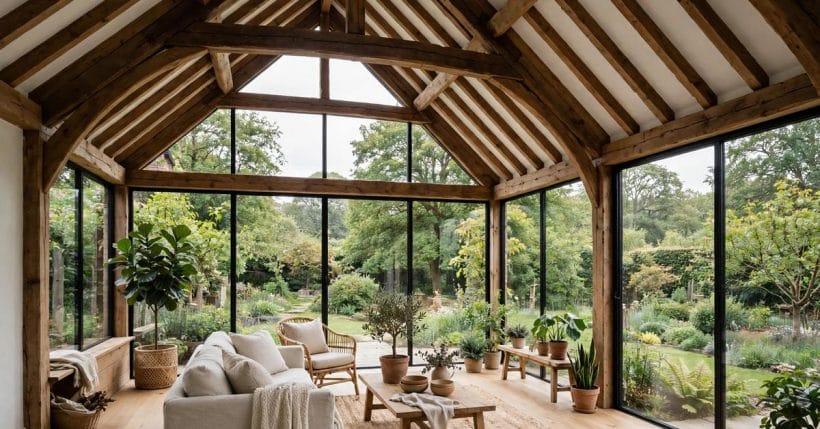
A sunroom is already a room that lives between house and garden, but raise its ceiling into a cathedral shape and the whole character changes. The eye travels upward, daylight reaches deeper into the room, and the garden feels closer, framed by glass on every side. Among sunrooms with cathedral ceilings, the best examples feel calm rather than grand: the height is there to enjoy, not to show off, and every choice below the ceiling works with it rather than against it.
This guide walks through the decisions that shape such a room, from the beams overhead to the chairs under them. It stays with the ceiling itself as the subject. Other ceiling treatments belong to their own guides, and this room is not a lesson in roof construction: anything structural, from the frame overhead to openings for glass and wiring for light, belongs with qualified professionals, following local rules. What follows is about how the finished room looks, feels and lives, so you can recognise good work and brief it well.
1. What Makes a Cathedral Ceiling Different in a Sunroom
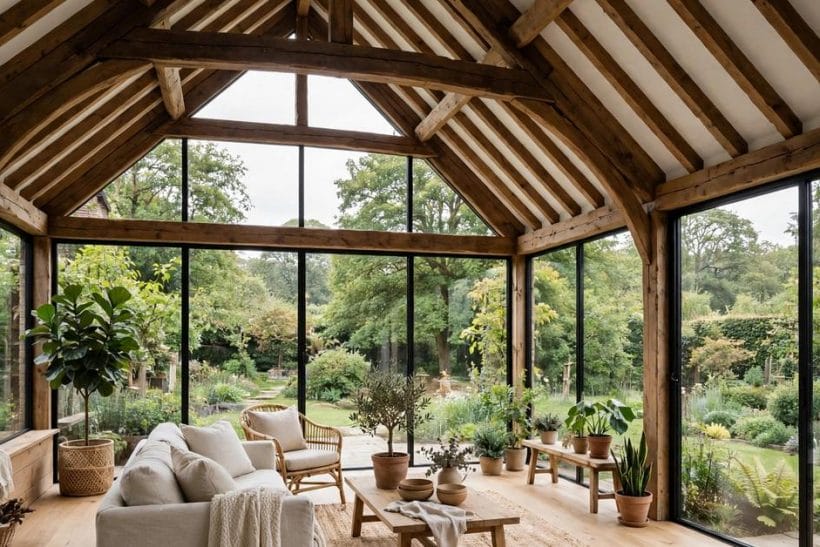
A cathedral ceiling follows the pitch of the roof on both sides, rising to a high central ridge instead of stopping flat overhead. In a sunroom that single move changes everything. The room gains a sense of airiness that no flat ceiling can offer, and the tall end wall, often filled with glass, becomes a natural focal point. Light enters at different heights through the day, so the room never feels flat or gloomy, even when the sky is overcast.
The difference is felt as much as seen. A flat ceiling presses a room down and hides its structure, while a cathedral ceiling opens it up and makes the structure part of the decoration. Beams, boards and the ridge line become features in their own right, and the room reads as one generous volume rather than a box with a lid. That is why these rooms photograph so well and why they feel so welcoming in person: the height invites you to look around, and the glass invites you to look out.
It also helps to know what this ceiling is not. A beadboard ceiling, for example, is a different treatment altogether, with its own rhythm and character, and it is covered in its own guide to beadboard ceilings. A coffered ceiling, with its grid of recessed panels, is another distinct idea, explored among coffered ceiling ideas. The cathedral ceiling here is defined by its open pitch and its height, and keeping that distinction clear stops the room from becoming a muddle of competing ceiling ideas. One strong ceiling idea, carried through cleanly, always beats several half-used ones.
For anyone browsing broader sunroom ideas, the cathedral version stands out for a simple reason: it makes a modest footprint feel generous. The floor area need not be large for the room to feel spacious, because the volume overhead does the work. That makes it a natural fit for homes where the garden room must earn its place, giving everyday moments, morning coffee, an afternoon read, a long evening with friends, a setting that feels special without trying too hard.
2. Reading the Room: Height, Light and Proportion
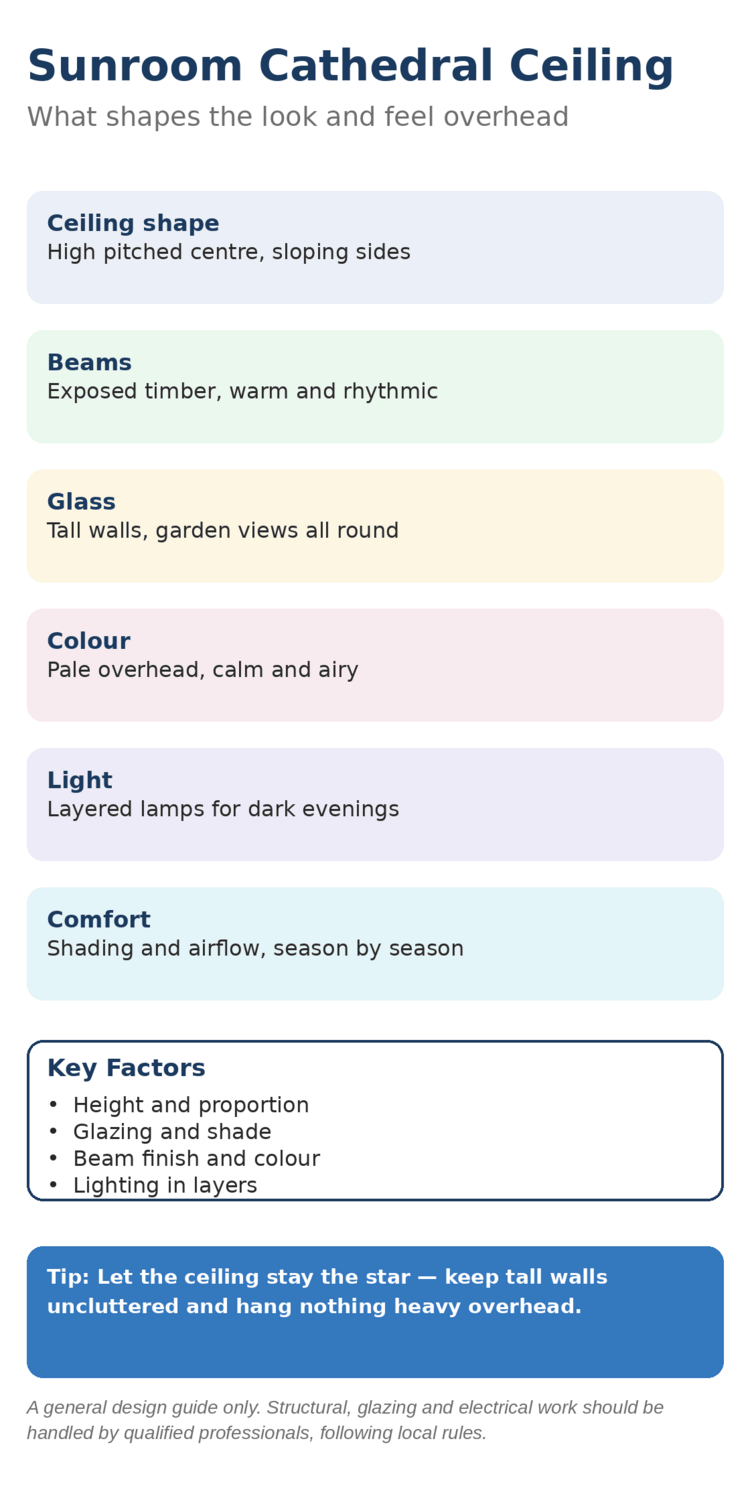
Before choosing finishes or furniture, spend time reading the room itself. Stand in the middle and notice where your eye goes. In a good cathedral sunroom it travels up the slope, rests at the ridge, then drops to the garden beyond the glass. If something interrupts that journey, a heavy fitting, a cluttered shelf high on the wall, a curtain that cuts the glass in half, the room feels less calm. The height is the room’s best asset, so protect the sightlines that show it off.
Proportion matters more than size. A tall ceiling over a narrow room can feel like a corridor, while the same height over a balanced room feels uplifting. The cure is not to lower the ceiling but to balance the room below it: a rug that anchors the seating area, furniture with enough presence to hold its own, and planting that rises in stages rather than sitting in a single low row. When the lower half of the room feels settled, the upper half feels soaring rather than empty.
Light is the other half of the equation. A cathedral sunroom gathers daylight from above as well as from the sides, especially where the gable end is glazed. Morning light will rake across one slope, evening light across the other, and the room changes mood through the day. That is a pleasure, but it also means glare and warmth need thought. Sheer layers, well-placed planting outside, and shades that can be drawn across the tallest glass all help, and they are worth planning early, while the room is still being finished, rather than as an afterthought.
Smaller versions of the same idea work beautifully too. The principles in this guide scale down gracefully, as the many small sunroom ideas show: a compact room with a pitched ceiling can feel far larger than its footprint suggests, provided the furniture stays low and the glass stays clear. Height is forgiving in that way. It asks little of the floor and gives a great deal back to the room.
3. Beams That Shape the Ceiling
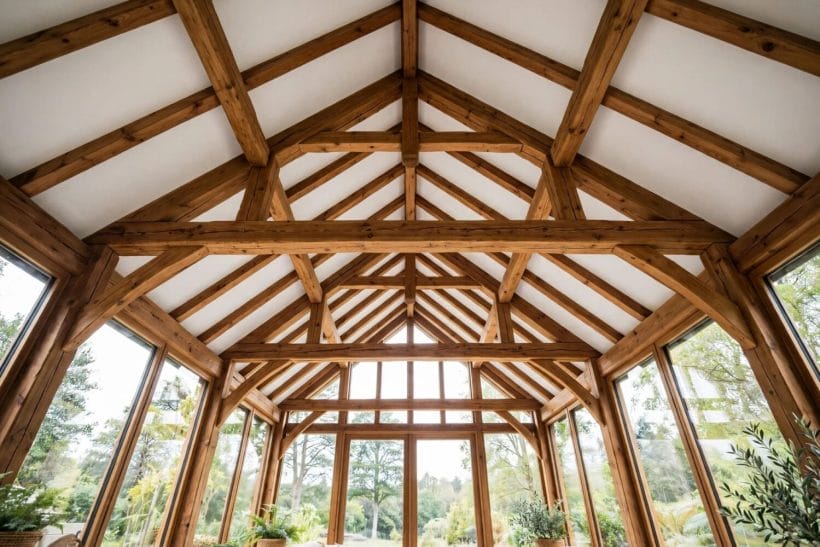
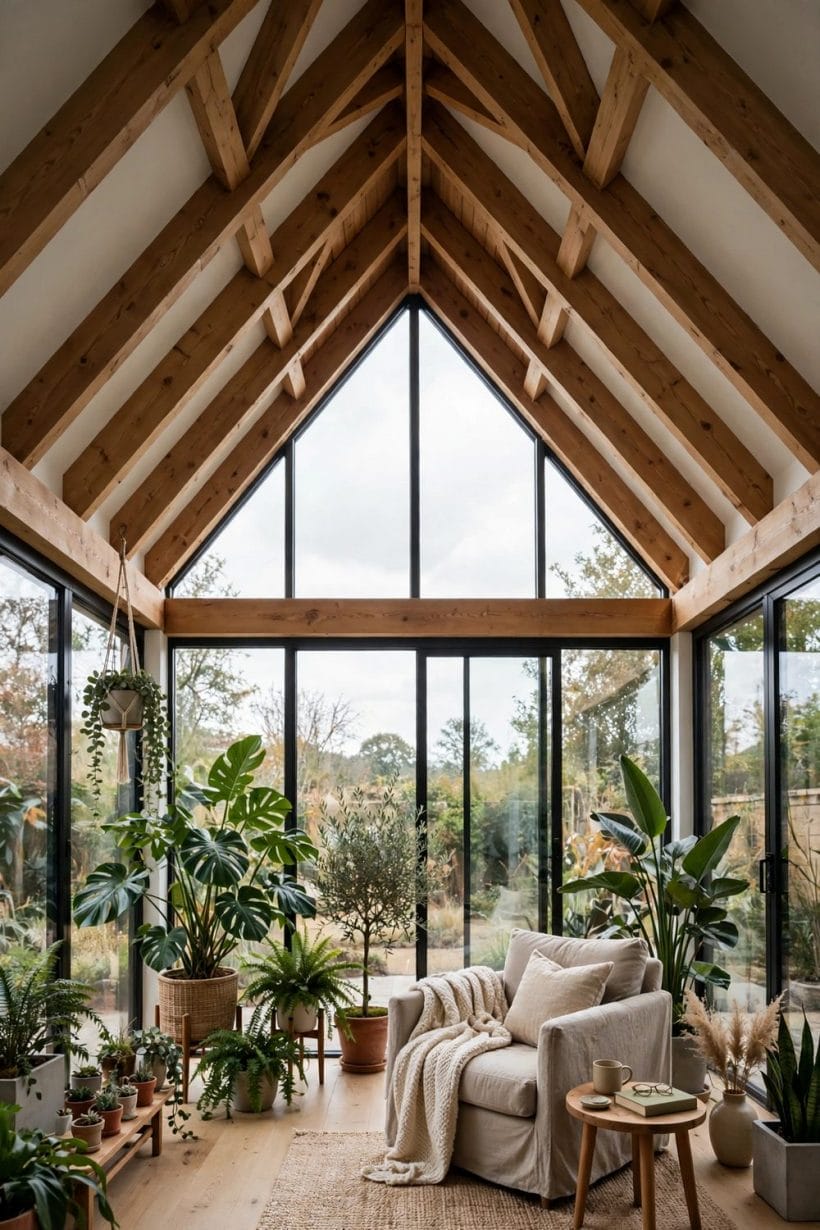
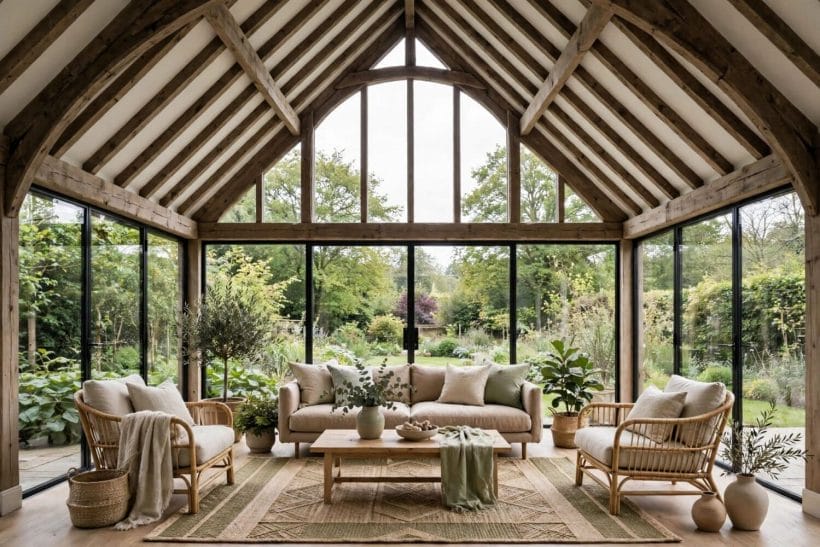
Beams are the most visible part of a cathedral ceiling, and they set its tone. Exposed timber beams bring warmth and rhythm, drawing the eye along the slope and giving the ceiling a crafted, hand-built feel. Painted beams feel lighter and more contemporary, letting the ceiling plane itself take the lead. Either approach works, but mixing too many beam styles in one room rarely does. Choose one language for the beams and let it repeat calmly across the ceiling.
The spacing and scale of beams matter as much as their finish. Closely spaced beams feel rustic and sheltering, while fewer, bolder beams feel modern and architectural. Neither is right or wrong; the choice should match the house and the furniture below. A room furnished with natural wood and woven textures welcomes chunky timber, while a room with pale walls and slim furniture suits quieter, painted beams that do not compete for attention.
One caution belongs here plainly. Beams in a cathedral ceiling are often structural, carrying real loads, and they must never be treated as decoration to be cut, moved or added to on a whim. Any work on the structure overhead, including adding beams, altering existing ones, or fixing heavy items to them, is work for qualified professionals, who will confirm what the structure can carry and how it must be fixed. The same applies to anything hung from the ceiling: pendants and fans need fixings suited to the structure, fitted by people who know what they are fixing into.
Done well, beams do more than hold a ceiling up. They give the room its rhythm, its shadows and its sense of craft. Photographs of these rooms almost always feature the beams, because the beams are what the eye remembers. Treat them as the ceiling’s handwriting, and keep them legible: clean lines, a consistent finish, and nothing cluttering the spaces between them.
4. Glazing and the Glass Wall
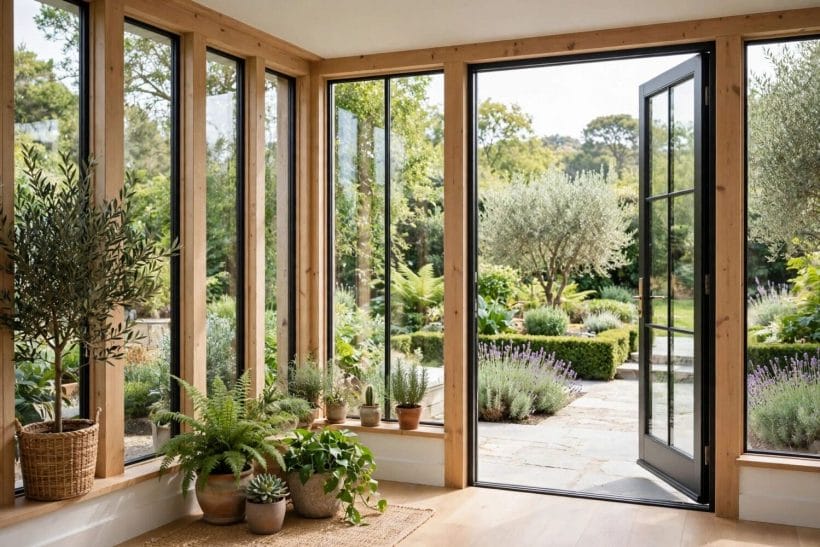
A cathedral ceiling earns its keep only when the glass below it is generous. Tall windows, a glazed gable end and doors that open fully to the garden all extend the room outward, so the height overhead and the view beyond work together. The most successful rooms treat glass as the wall, not as holes in a wall: slim frames, generous panes and as few interruptions as possible, so the garden reads as part of the room.
The gable end deserves special attention. Filling the triangular end wall with glass turns the ceiling’s highest point into a window, pouring light down the slopes and giving the room its signature view. It also frames the sky, so clouds and treetops become part of the interior. Where the gable faces a fine view, this is the single most rewarding choice in the whole room. Where it faces a neighbour or a blank wall, a smaller glazed area with well-chosen planting outside may serve the room better.
Doors matter as much as windows. A sunroom that opens fully to a terrace becomes an outdoor room in warm weather, and the threshold between inside and out almost disappears. Sliding or folding doors suit wide openings, while a pair of French doors suits a narrower wall. Whichever style is chosen, the door should feel like part of the glass wall, with matching frames and sightlines, rather than a separate feature fighting the glazing around it.
Glazing work, like structural work, is professional territory. Fitting tall panes, sealing a glazed gable and making doors operate smoothly all demand skill and the right materials, and poor glazing shows itself quickly in draughts, leaks and condensation. The same is true of any opening cut for a skylight or roof window: it belongs with qualified installers, following local rules. The reward for doing it properly is a room that stays bright, dry and comfortable through every season.
5. Colour on a Tall Ceiling
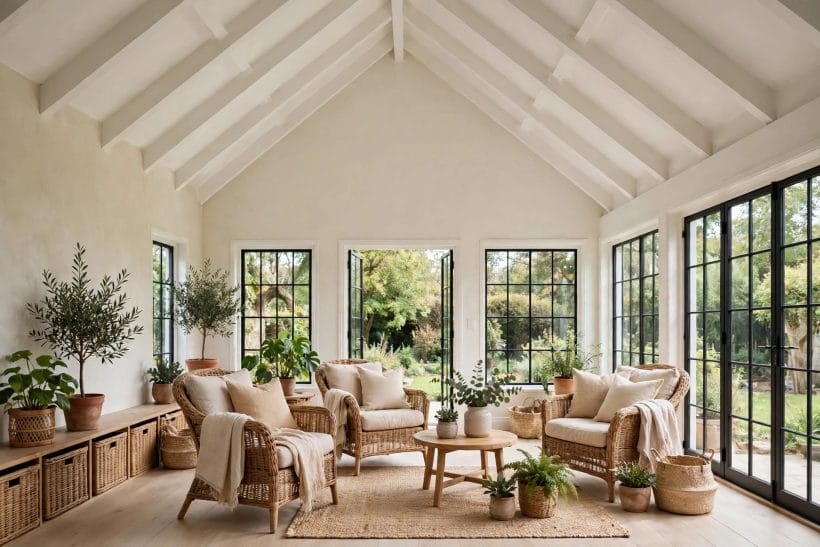
Colour behaves differently on a tall ceiling than on a flat one. A pale ceiling lifts the room further, bouncing daylight down the slopes and keeping the height feeling airy. White, soft cream and pale grey all do this well, and they flatter both timber beams and painted beams. When the ceiling is pale, the beams themselves become the contrast, and the room feels calm and bright even on dull days.
Darker ceilings have their own appeal, but they change the bargain. A deep wood ceiling or a richly coloured slope feels cosy and enveloping, drawing the room inward like a lodge. That can be wonderful in a large room with abundant glass, where the darkness overhead is balanced by light from the sides. In a smaller or north-facing room, though, a dark ceiling can press the height down and undo the very openness the cathedral shape was chosen for. The safer path in a modest room is to keep the ceiling pale and let colour live lower down, in cushions, rugs and planting.
Wall colour should follow the ceiling’s lead rather than fight it. Soft, warm neutrals let the ceiling and the garden carry the room, while a single accent wall in a muted green or dusty blue can ground the seating area without competing with the height. Strong, saturated colour on every wall, by contrast, can make a tall room feel restless, because the eye finds no place to rest. In a glass room, the garden is already the strongest colour in the space, and the interior palette works best when it lets that green take centre stage.
The lesson from vaulted ceiling living room ideas carries over here too, even though the room type differs: the ceiling is the room’s largest surface, so its colour sets the mood for everything beneath it. Choose it deliberately, test it in daylight and lamplight, and remember that a pale ceiling is easy to live with for years, while a bold one demands confidence and plenty of glass to balance it.
6. Furniture Layouts Under a High Ceiling
Furniture in a cathedral sunroom must hold its own against the height without trying to match it. Low, generous seating works best: sofas and armchairs with a relaxed profile, arranged around a rug that defines the conversation area. The rug is more important than it looks. Without one, furniture can drift across the floor and the room feels unanchored; with one, the seating becomes a clear destination, and the height above it feels intentional rather than empty.
Face the garden wherever possible. The finest view in the room is outside the glass, so the main seats should look toward it, not away from it. A sofa with its back to the glass wastes the room’s best asset, while chairs angled toward the view invite people to sit and stay. A secondary arrangement, a reading chair tucked near a side window, a small table for morning coffee, gives the room a second life for quieter moments, and stops the space feeling like a single formal arrangement.
Scale is the trap to avoid. Furniture that is too small and leggy can look lost beneath a high ceiling, while oversized pieces can crowd the floor and block the glass. The middle path is furniture with substance but not bulk: deep seats, solid frames, natural materials, arranged with breathing room between pieces. Leave clear paths to the doors and around the seating, so the room feels easy to move through, and resist the urge to fill every corner. Empty floor near the glass is not wasted space; it is what lets the room breathe.
The same thinking shapes the transition to the outdoors. A porch or terrace beyond the glass extends the living area, and the layout inside should lead the eye and the feet toward it. Readers looking for that indoor-outdoor connection will find it among tiny house porch ideas, where small spaces make the same move: seating oriented to the view, a clear path to the door, and nothing blocking the threshold. In a cathedral sunroom the effect is grander, but the principle is identical.
7. Layered Lighting for a Tall Glass Room
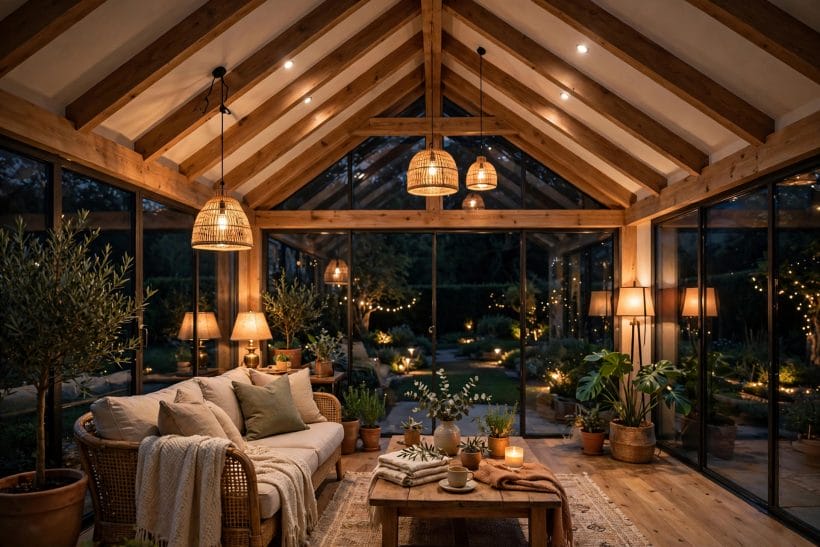
Lighting a cathedral sunroom is a layering exercise. Daylight does the heavy lifting by day, but after dark the room needs several kinds of light working together, or the height turns into a dark void overhead. The goal is a room that glows from several heights at once, so the ceiling feels present in the evening rather than disappearing into shadow.
Start low, with table lamps and floor lamps beside the seating. These give the warm pools of light where people actually sit, and they make the room feel intimate even with a high ceiling above. Add a middle layer next: pendants hung from the beams or the ridge, chosen for warmth rather than brightness, which draw the eye upward and give the ceiling a gentle wash of light. Keep pendants modest in size and hang them where they light a table or a seating area, never so low that they block the view or the conversation.
The ceiling itself can carry a third layer, with discreet fittings that wash the slopes or highlight the beams. This layer should be subtle: the aim is to reveal the ceiling’s shape, not to flood it. Dimmers matter enormously here. A room that can shift from bright daytime clarity to a soft evening glow is a room that gets used at every hour, and dimmers on every layer let you tune the mood without changing a single bulb.
All electrical work in a high ceiling belongs with qualified electricians. Running cable to a ridge pendant, fitting lights into a sloped ceiling and ensuring fixings are safe overhead are not tasks for improvisation, and the height itself makes safe access part of the job. Done properly, though, the result is magical: a glass room that glows like a lantern in the garden after dark, with its ceiling softly lit and its planting in silhouette against the glass.
8. Heating, Cooling and Year-Round Comfort
A glass room with a high ceiling asks more of its heating and cooling than an ordinary room, and comfort here is about planning, not gadgets. Warm air rises, so a cathedral sunroom can feel warm near the ridge and cool at seating level unless the room is designed to even itself out. Low-level heat sources near the glass, gentle air movement and shades that can be drawn across the tallest panes all help the room feel even from floor to ridge.
Shade is the quiet hero of summer comfort. External shading, planting that leafs out in summer, and blinds fitted to the tallest glass all reduce the sun’s strength before it enters the room, which matters far more than any cooling device working after the fact. In winter the same glass should be free to gather every scrap of sun, so shading that can be opened fully, and planting that drops its leaves, earns its place twice over. The room works best when it is allowed to follow the seasons rather than fight them.
Ventilation deserves equal thought. High openings that let warm air escape, low openings that draw cooler air in, and doors that open fully to the garden all keep the room fresh without machinery. A room that can breathe feels comfortable in a way that a sealed, mechanically cooled room rarely matches, and the tall ceiling itself helps, giving warm air somewhere to rise away from the people below. Where mechanical help is needed, it should be specified by professionals who understand glass rooms, not improvised after the room is built.
Used well, a cathedral sunroom becomes a room for every season: bright and cool in summer with shade drawn and doors open, warm and glowing in winter with lamps lit and the garden frosted beyond the glass. The small living room ideas collections show the same seasonal thinking at a smaller scale, proving that comfort is less about size than about shade, air and light, balanced thoughtfully through the year.
9. Finishes and Materials Overhead
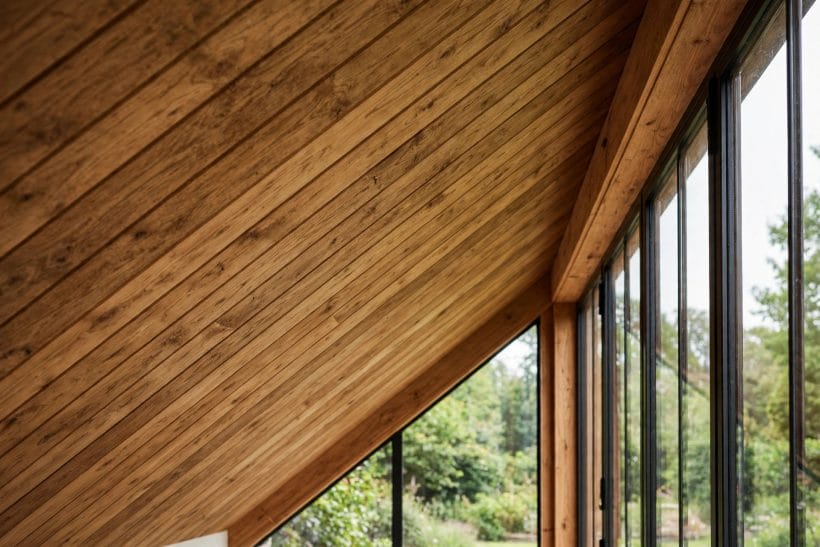
The ceiling’s finish is the surface you will look at most in this room, so it deserves the most deliberate choice. Natural wood boards bring warmth and texture, following the slope in long, calm lines that emphasise the pitch. Painted boards feel cleaner and more contemporary, and they bounce more light into the room. Plastered slopes feel smooth and architectural, letting the beams alone carry the detail. Each finish changes the room’s voice, so the choice should be made with the furniture and the house in mind, not in isolation.
Durability matters overhead too. A sunroom ceiling lives with strong sunlight, changing humidity and wide temperature swings through the year, so finishes must be suited to those conditions. Wood needs protection that suits a bright, sometimes humid room; paint needs to hold its colour under strong sun; any finish should be easy to maintain from below, since the ridge is not a place anyone wants to reach often. Ask suppliers and installers how a finish ages in a glass room, and favour finishes with a track record in that setting.
Detailing is where good ceilings separate from great ones. Where the slope meets the wall, where boards meet beams, where the ridge line runs: these junctions should be clean and consistent, with trims that match the finish rather than fighting it. Sloppy junctions draw the eye exactly where it should glide past, while crisp ones let the ceiling read as a single, confident surface. When you visit a finished room, look at the junctions before you look at anything else; they tell you how carefully the whole room was built.
Finally, keep the ceiling’s material palette narrow. One ceiling finish, one beam finish, and a consistent trim is plenty. A ceiling that mixes boards, panels and competing textures quickly feels busy, and busyness overhead is the enemy of the calm, soaring feeling the cathedral shape promises. Restraint overhead is what lets the garden, the light and the life below take their proper place.
10. Styling the Height: Plants, Art and Soft Furnishings
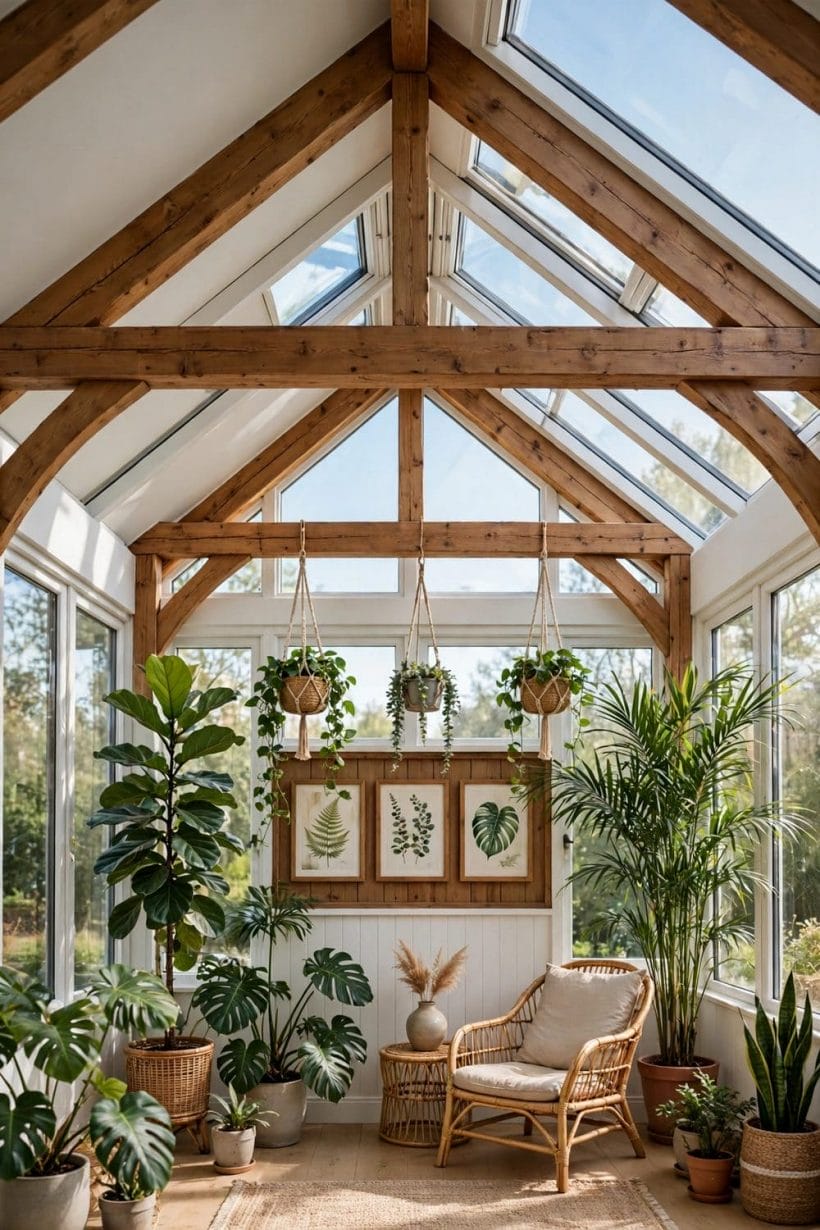
Styling a tall room is an exercise in staging height. Plants are the natural ally: tall specimens in generous pots rise toward the ceiling and soften the glass, while trailing plants hung low add a middle layer of green. Group plants in clusters of different heights rather than lining them in a single row, and let one or two statement plants anchor the corners where the glass meets the wall. The garden outside already supplies the backdrop; indoor planting should echo it, not compete with it.
Art needs care at height. A single large piece on the solid wall, hung at eye level, grounds the room far better than small pictures scattered up the slope. The tall wall is tempting, but pictures hung high are hard to see and harder to enjoy, and they pull attention away from the ceiling itself. If the room has a solid gable wall rather than a glazed one, that wall is the place for art, kept low and generous, with the ceiling left to speak above it.
Soft furnishings do the quiet work of making height feel homely. A thick rug, woven throws, linen cushions and natural textures all soften the hard surfaces of glass and timber, and they absorb sound, which matters in a tall, hard room. Without them a cathedral sunroom can echo and feel exposed; with them it feels sheltered, like a room that happens to have a wonderful ceiling rather than a hall that happens to have chairs. Choose textures that invite touch, and colours drawn from the garden just beyond the glass.
Above all, leave the height some empty space. Not every slope needs a hanging plant, not every beam needs a decoration, and the ridge itself needs nothing at all. The ceiling is the room’s finest feature, and the kindest thing styling can do for it is to frame it and then step back. A room styled with restraint lets the eye travel up, rest at the ridge, and return to the garden, which is exactly the journey a cathedral sunroom was built to offer.
The wood overhead plays its own part in that styling. Warm boards following the slope give the room a natural backdrop that needs no further decoration, and they tie the ceiling to the timber furniture and woven textures below. When the ceiling finish, the beams and the furnishings share one warm, natural language, the whole room feels composed, as if every choice were made in the same breath.
Final Considerations
A sunroom with a cathedral ceiling succeeds when one idea is carried through cleanly: an open, pitched ceiling, generous glass, and a calm room below it. Every decision in this guide serves that idea, from the beams to the rug, and the rooms that fail are usually the ones where a second or third competing idea crept in. Keep the ceiling clear, keep the glass clear, and let the garden do the decorating.
Among sunrooms with cathedral ceilings, the most liveable are rarely the most dramatic. They are the ones where the light is gentle, the seating faces the view, the lamps glow warmly after dark, and the room feels comfortable in every season. Drama comes free with the height; comfort has to be planned, through shade, air, layered light and soft textures that tame the volume overhead.
Before committing, visit finished rooms if you can, and notice how they feel at different times of day. Sit in the seating, look up at the ceiling, and check that the height feels uplifting rather than exposed. Ask how the room behaves in high summer and deep winter, and how the glass, the shade and the heating work together. Those practical answers matter as much as any photograph, because this is a room you will live in, not just look at.
And remember the standing rule that runs through this whole guide: structure, glazing and electrical work belong with qualified professionals, following local rules. The design choices are yours to enjoy, the ceiling’s shape is yours to admire, but the work that holds it all safely overhead is work to entrust to people trained for it. With that foundation sound, a cathedral sunroom becomes what it promises to be: a bright, soaring room between house and garden, made for long mornings, lazy afternoons and evenings that glow.



0 Comments