

A patio earns its keep on ordinary days, not just garden-party days — the morning coffee, the quick lunch outside, the chair dragged into the last of the sun. Pavers suit that everyday use better than most surfaces: warm underfoot, forgiving of furniture, and repairable one unit at a time.
These 75 paver patio ideas work through the decisions in the order you will meet them: material first, then pattern, borders, shade, firelight and planting, and the base and drainage details that decide whether the patio still looks good in ten years.
1. Paver Patios at a Glance
Scope first. This post owns one surface: the paver patio. Its neighbours cover the wider ground — the patio ideas pillar takes patios of every kind, while here everything serves the individual paver: its material, its laying pattern, and how the field is edged, shaded and lit.
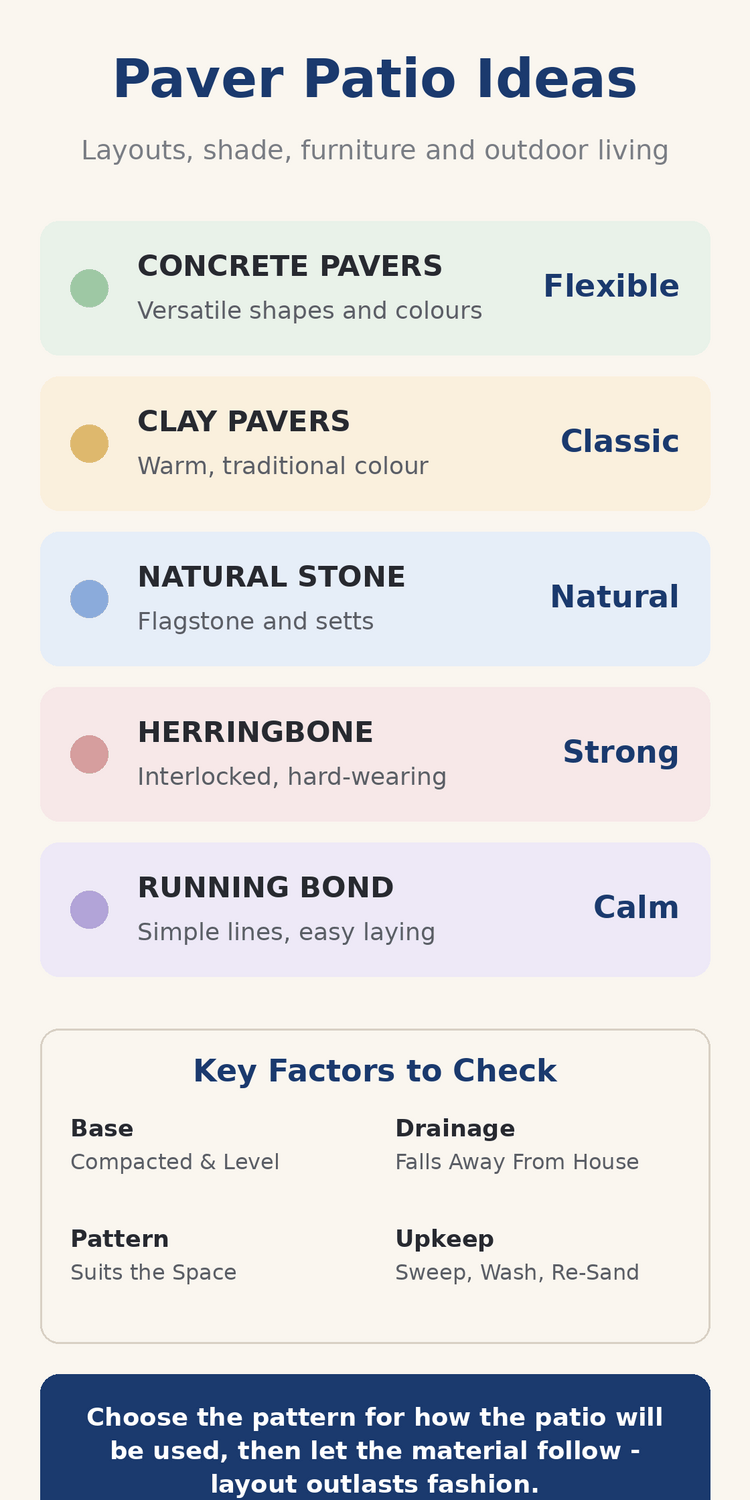
The five choices in the table are the whole project in miniature. Settle them in order and the rest of the patio largely designs itself.
| Choice | Character | What it means |
|---|---|---|
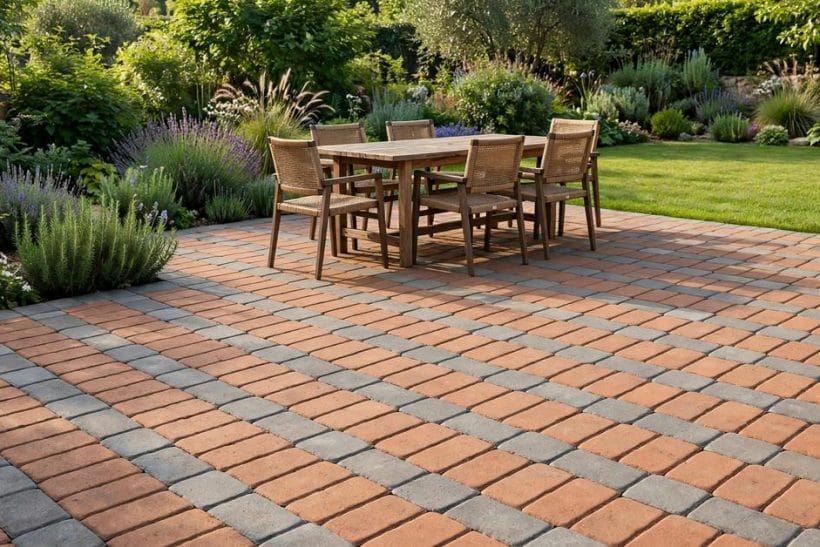
| Concrete Pavers | The Flexible Default | Wide shape and colour range, consistent sizes, straightforward laying and repair |
| Clay Pavers | The Classic | Warm fired colour that deepens with age and suits brick houses especially well |
| Natural Stone | The Individual | Flagstone and setts with natural variation; no two units exactly alike |
| Herringbone Pattern | The Strong Field | Interlocked units spread load well and read as energy in a plain space |
| Running Bond | The Calm Field | Simple offset lines, easy to lay, easy on the eye in small gardens |
2. Choosing the Paver Material
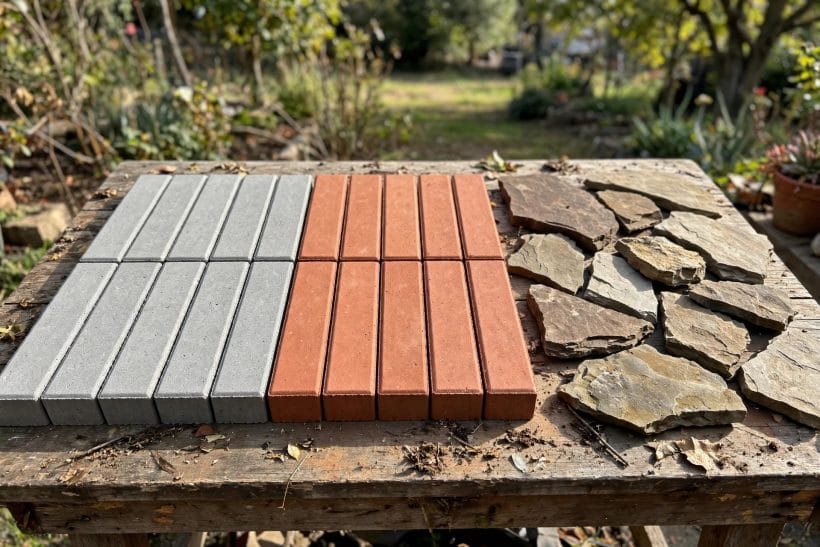
Material decides colour, texture, upkeep and how the patio ages. Compare samples outdoors, in your own light, wet and dry — a paver that looks gentle in a showroom can glare on a south-facing terrace.
1. Concrete pavers for range and consistency
Cast concrete units come in the widest range of shapes, sizes and colours, and their consistent dimensions make laying and later repairs simpler. Expect colour to soften gently over the years, and choose a shade that still pleases you once it has.
2. Clay pavers for warmth that deepens
Fired clay brings a warmth no coating quite matches, and its colour runs through the unit rather than sitting on it, so chips show less. Clay suits brick-walled gardens and older houses, mellowing rather than fading with age.
3. Natural stone for one-off character
Flagstones, granite setts and sandstone pavers each carry the marks of their quarry — veining, riven texture, colour shifts from unit to unit. That variation is the appeal. Lay a generous sample area before committing; the field effect differs from any single stone.
4. Porcelain pavers for a crisp, modern field
Dense porcelain units give a flat, even surface with sharp edges and low absorption, so stains sit on top rather than soaking in. They read contemporary and pair well with rendered walls and metal furniture. Their hardness makes cutting a specialist job — plan the layout to minimise cuts.
5. Mix two materials, keep one in charge
A stone field with a clay border, or concrete units broken by granite bands, adds design without chaos. Keep the split decisive — one material clearly the field, the other clearly the accent.
6. Match the house before the garden
Brick houses take clay and warm stone naturally; rendered and timber houses suit concrete and porcelain in cooler tones. Carry a sample home and lean it against the wall you will see it from.
7. Think about bare feet in July
Dark pavers in full sun can grow uncomfortably hot, and very pale fields glare at midday. Mid-tones are the forgiving middle. If the patio is a barefoot route, test your sample on a hot afternoon before ordering.
8. Texture where it matters
Smooth units feel refined but can be slippery when wet; riven and tumbled finishes grip better and hide dirt more kindly. Use the grippier finish on steps, slopes and the strip outside doors.
9. Buy the spares now
Order extra units from the same batch and store them dry. Colours and moulds change between production runs, and the paver you need in eight years for a repair may not exist then. A small stack in the shed is cheap insurance.
3. Patterns That Set the Layout
Pattern is the patio’s quiet architecture. The same paver laid three ways gives three different gardens, so choose the pattern for the space — its size, its sightlines, and how feet and furniture will move across it.
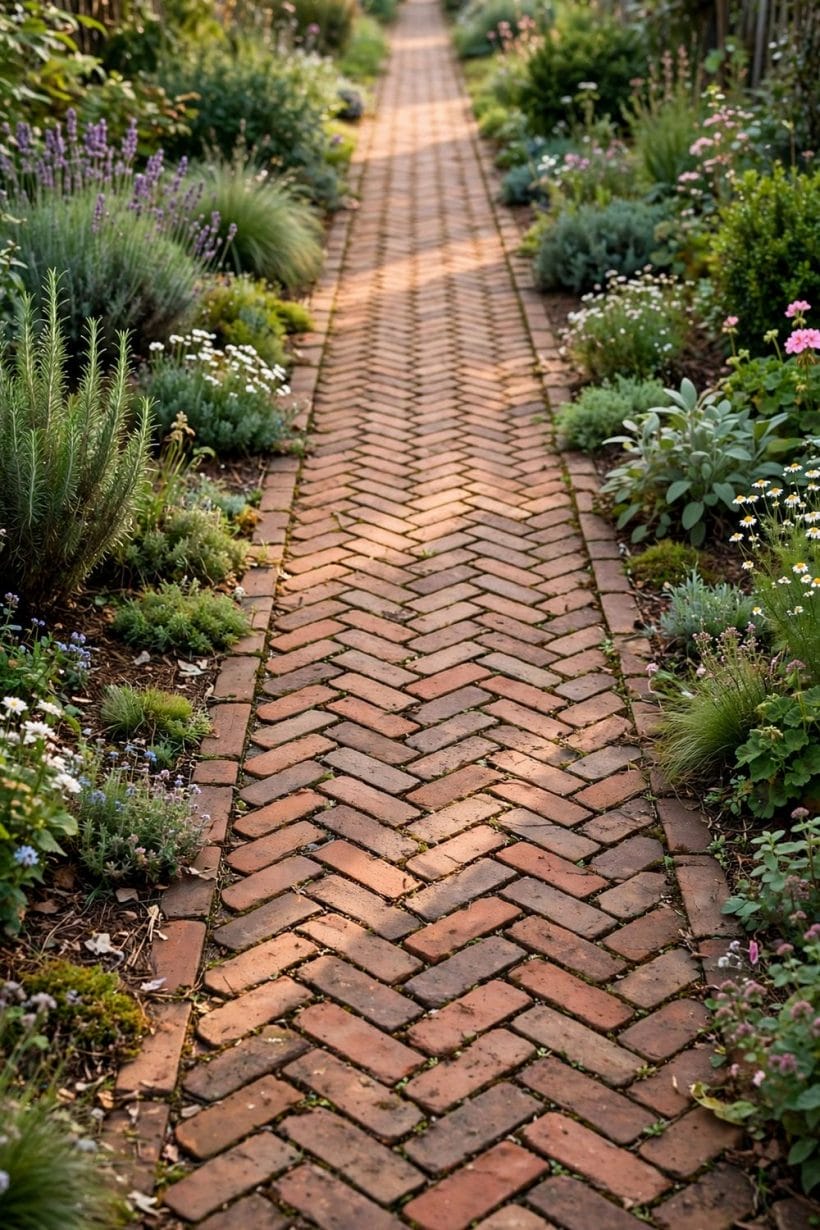
10. Herringbone for energy and strength
Units laid at an angle lock together tightly, which is why herringbone suits driveways and busy family patios alike. The zigzag energises a plain rectangle and disguises slight irregularities in the ground. It needs more cuts at the edges — budget the border to frame them.
11. Running bond for calm length
The simplest offset pattern stretches a short patio visually when the runs point down its length. Running bond is forgiving to lay, easy to extend later, and calm enough to let planting and furniture carry the interest.
12. Stack bond for modern grids
Units aligned in straight rows both ways give a crisp, architectural grid that suits large-format pavers and contemporary gardens. The grid shows every error, so the base must be true and the lines checked constantly.
13. Basket weave for cottage character
Pairs of units alternating direction make a woven field full of quiet movement — a natural partner for brick, roses and old walls. Basket weave uses rectangular pavers efficiently and hides the odd replacement well — the eye reads the weave, not the single unit.
14. A circular feature to anchor the middle
A laid circle at the centre of the field — or where paths cross — gives the patio a heart and a natural home for a table or fire bowl. Circle kits come pre-cut in most paver ranges, and the surrounding pattern runs plainly up to the ring.
15. Fan and European fan for old-world grace
Radiating fan patterns in small setts echo historic courtyards and suit entrances and aprons as much as full patios. They are labour-rich, so use them where they will be seen daily: the threshold, the gateway, the strip before your favourite bench.
16. Random courses for relaxed informality
Mixed lengths laid in loose courses give stone fields their countryside ease. Keep one discipline — consistent joint width — or random becomes scruffy. It is the most forgiving pattern for riven stone, whose size variation the layout absorbs.
17. Diagonal laying to widen a narrow plot
Any pattern turned forty-five degrees to the house makes a narrow patio feel wider, because the eye follows the long diagonal. Diagonal fields need firm edge restraint and more cutting, but on a tight terrace the gain is worth both.
18. Zones drawn in pattern, not fences
Change the pattern — not the material — to mark dining from lounging from the walk-through route. A herringbone dining field inside a running-bond surround reads clearly without a single barrier.
4. Borders, Edging and Finishing Lines
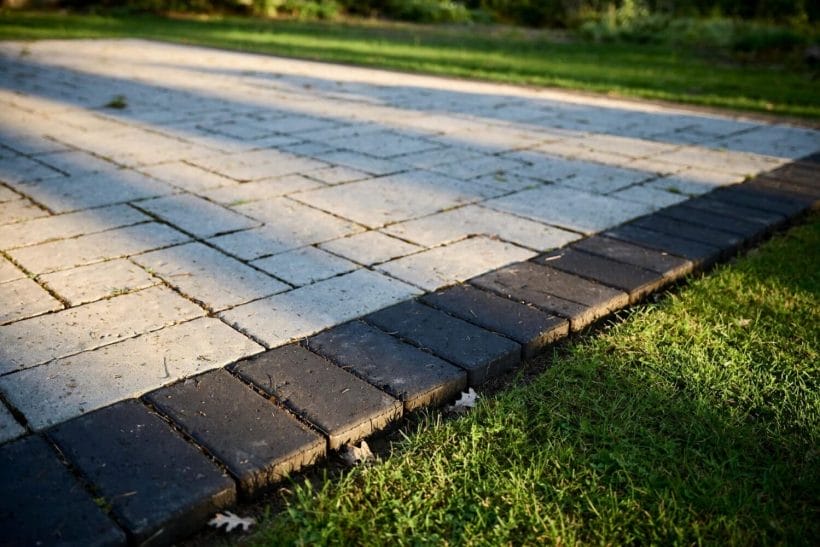
The edge is what the eye reads first, and it also holds the field together. A patio without a restrained edge creeps and gaps over time; a well-chosen border makes even a simple pattern look tailored.
19. A soldier course for a tailored frame
Units stood upright in a row around the field give the crispest outline — the patio equivalent of a picture frame. In the same material they keep things quiet; in a contrast colour they become the design’s main event.
20. A sailor course for a softer line
Units laid flat, length along the edge, frame the field with a lower-key line than soldiers. Sailor borders suit curved patios and natural stone, where a rigid upright row would fight the material’s character.
21. Double borders on larger fields
Two rows — an inner contrast band and an outer matching course — give big patios the finished weight they need. On a small patio one border is enough; the second row eats sitting space.
22. Stone setts as the edging course
Small granite or sandstone setts make a handsome, hard-wearing frame for concrete and clay fields alike. They also take the knocks of mower wheels and chair legs better than most edges.
23. Hidden restraint where lawn meets patio
Where grass runs up to the pavers, a concealed edge restraint keeps the last row honest without a visible border course. The lawn mows straight over the junction, and the field cannot creep.
24. A step down, deliberately detailed
Where the patio sits above the garden, one generous step in a contrast material is safer and better-looking than a shallow trip-lip. Light the step edge so the level change reads clearly at dusk.
25. Curves need small units
Tight curves are built, not bent: small-format pavers and setts follow a flowing line where large units would need endless cutting. Plan curves at the design stage, mark them with a hose, and live with the line for a day before building it.
26. Thresholds at the door
The strip outside patio doors takes the most traffic and the most weather. Use your hardest-wearing unit there, keep the level just below the internal floor with a proper drainage channel between, and never let the patio field bridge the house’s damp-proof course.
27. Keep one line unbroken
Whatever the border scheme, let a single strong line — the house wall, the main border, the path edge — run uninterrupted through the design. The eye rests on that line, and the patio feels ordered even when planting and furniture make the rest informal.
5. Patios for Dining and Entertaining
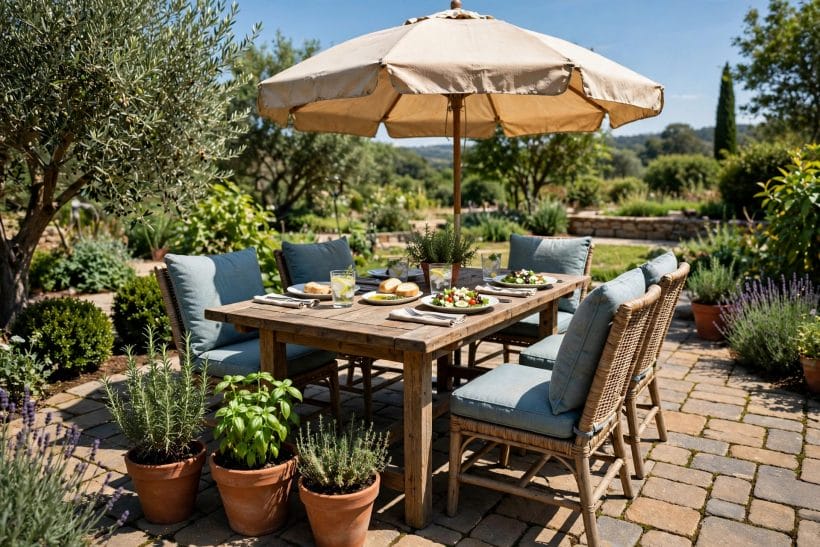
A dining patio is a room with the ceiling removed. Size it for the table plus chairs pulled out plus someone walking behind with a dish, and place it on the shortest honest route from the kitchen.
28. Size the dining field generously
Chairs need room to slide back and guests need room to pass behind them. A field that only fits the table makes every meal feel cramped. Sketch the furniture at full size on the plan, then add a walking margin on the kitchen side.
29. The short walk from the kitchen
Every metre between cooker and table is travelled dozens of times a meal, carrying hot dishes. The best dining patios sit directly outside the kitchen door on the same level, the route kept clear of planters and steps.
30. A serving ledge built into the edge
A low wall, wide step or built-in bench along one edge gives dishes and jugs somewhere to land that is not the table. Build it at the design stage and it looks like architecture.
31. Anchor the table with a pattern change
A circle, a rug-like panel of contrasting pattern, or a simple framed rectangle under the dining set grounds the furniture and stops it drifting visually. Guests read the cue instantly — this is where we eat — and the rest of the patio stays free.
32. Plan the barbecue’s own corner
Give the grill a small paved apron of its own — level, non-combustible, out of the through-route — close enough to join the conversation, far enough to keep smoke off the food.
33. Seating walls that earn their height
A low wall around two sides of the dining field seats extra guests and gives the patio its evening enclosure. Cap it with a wide, smooth unit, comfortable to sit on.
34. Overhead structure for long lunches
Dining under a pergola or sail keeps plates out of glare and guests out of the midday sun. Build the shade into the original plan — its posts need planned positions, not holes cut through finished work.
35. A courtyard mood for gatherings
Walls, hedges and the house itself can make a paved court feel like a private dining room, the way courtyard landscaping does with planting. Enclosed courts hold warmth and scent beautifully; keep one opening aligned with the view.
36. Evening dining needs planned light
Light the table, the steps and the route back to the kitchen before you light anything decorative. Low, warm sources at ankle and table height flatter food and faces; a single bright floodlight flatters neither. Section 7 takes the evening in full.
6. Shade, Shelter and Pergola Pairings
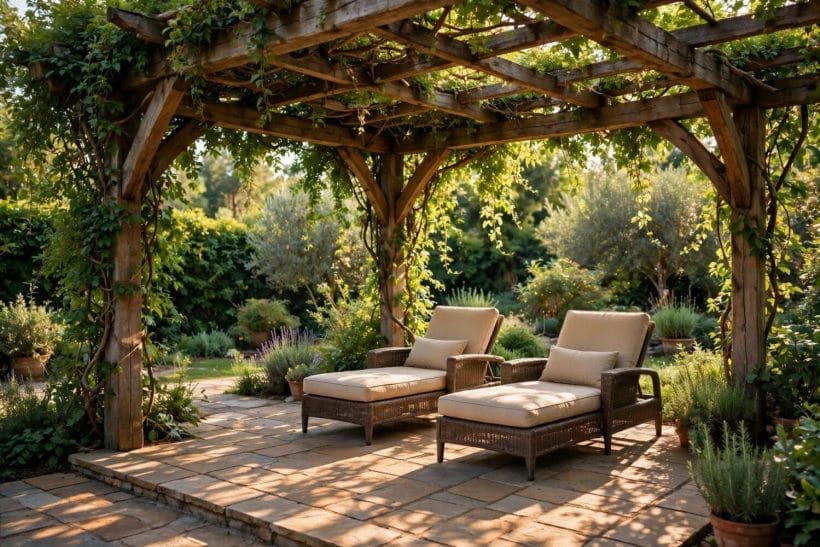
An unshaded south-facing patio is a part-time room. Shade decides how many hours a day — and months a year — the patio actually gets used, so treat it as structure, not an afterthought with a parasol.
37. A pergola on paved posts
Pergola posts should land on proper footings with the pavers cut neatly around them. Align the structure with the pattern grid and the whole composition settles.
38. Climbing plants to green the shade
A vine over a pergola gives dappled, breathing shade that no fabric matches. Plant into the ground beyond the patio edge, not into pots on it — roots in open soil grow the stronger canopy.
39. Shade sails for flexible cover
Tensioned sails give modern, sculptural shade and come down for winter or storms. Their anchor points carry real load, so fix to structure or dedicated posts, never to a fence panel.
40. A retractable canopy for both seasons
Where the patio doubles as a winter suntrap, retractable cover earns its cost: shade in August, open sky in February. Plan its drainage — a canopy that pours a waterfall onto one corner will stain the field below.
41. Use the house wall you already have
A lean-to veranda strip along the house gives the deepest, most reliable shade and keeps one side of the patio dry in light rain. It also extends the inside-out feeling of the room behind it. Check how far its shadow falls at midday before fixing the line.
42. Trees planted to grow into the job
A small tree just beyond the patio edge becomes the ceiling of the future. Choose a light-canopied species and give roots room away from the paving — most damage blamed on trees is really a base built too close.
43. Parasols need a paved stance
A cantilever parasol wants a heavy base on a firm, level spot, planned so the base does not rock on joints. Better still, sleeve the pole through a dedicated hole in the field into a ground socket — tidy and trip-free.
44. Shelter from wind, not just sun
A patio in a wind tunnel stays empty however sunny it is. Slatted screens, hedges and the L of the house itself can calm the sitting corner; even a partial screen on the prevailing-wind side transforms how often the space is used.
45. Rain cover over the door strip
Even a narrow canopy over the back door changes the patio’s usefulness — shoes, dogs and shopping stay dry, and the door can stand open in summer showers. Keep its fall away from the threshold channel.
7. Fire, Light and Evening Use
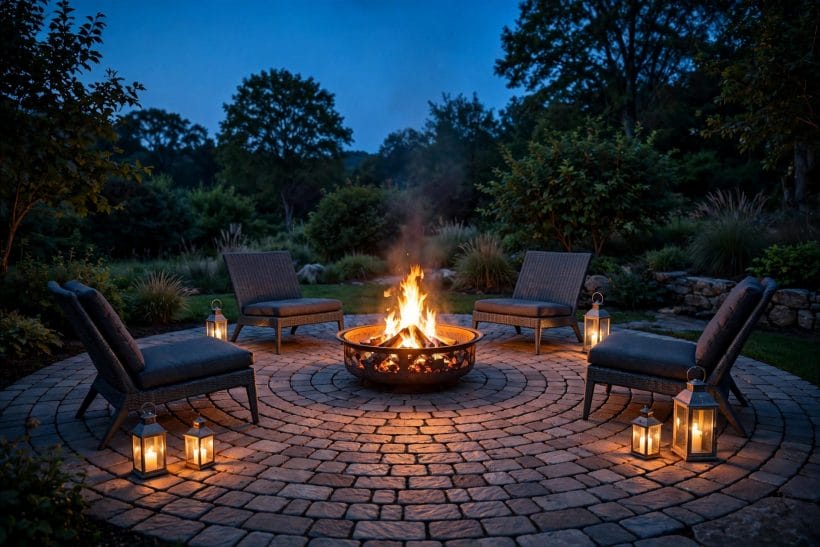
Evening is when a paver patio outperforms a lawn — dry underfoot, warm from the day’s stored sun, and ready for fire. The same thinking suits any outdoor fire feature; the deck with a fire pit designs make a useful cross-read for clearances and seating around a flame.
46. A fire bowl on a protected patch
Open fire bowls scorch and stain the unit beneath them. Stand the bowl on a pad of heat-tolerant stone or a metal plate, downwind of seating with a clear margin all round, well away from fences and planting.
47. A built-in fire pit as the centrepiece
A permanent pit ringed with a wide coping becomes the patio’s evening hearth. Build it only where local rules allow open fire, on a proper foundation, with a seating ring deep enough for stretched-out legs.
48. A chiminea for small patios
On a tight terrace a chiminea throws heat from a small footprint and directs smoke upward, away from faces. It still needs a non-combustible stance and clearance from walls — small fire is still fire.
49. Low lighting set into the field
Recessed lights in the paving mark edges without glare, but every fitting is a future maintenance point in a wet floor. Keep them to the few places that need them; do the rest with lanterns and wall lights.
50. String lights for instant evening
Festoon lighting strung from house to pergola gives the cheapest, happiest evening atmosphere there is. Support the spans properly — catenary wire, not the cable itself.
51. Lanterns and candlelight, planned safely
Real flame in storm lanterns on wide, stable bases suits paved surfaces well — no grass to scorch, no decking to mark. Group them at edges and steps rather than mid-route.
52. Warm stone holds the day’s heat
Dense pavers in sun store warmth and release it into the evening, taking the chill off bare feet. It is one of the quiet pleasures of a paved patio — and a reason to give part of the field full sun.
53. Light the steps and the edges
Whatever else is lit, the level changes come first: the step down to the lawn, the threshold, the path junction. A guest who can see the edges relaxes.
54. Keep a dark corner
Not every corner needs light. One unlit planted edge gives the eye rest, the moths somewhere to be, and the lit areas more drama by contrast. Evening design is as much about what you leave dark as what you switch on.
8. Planting, Pots and Green Edges
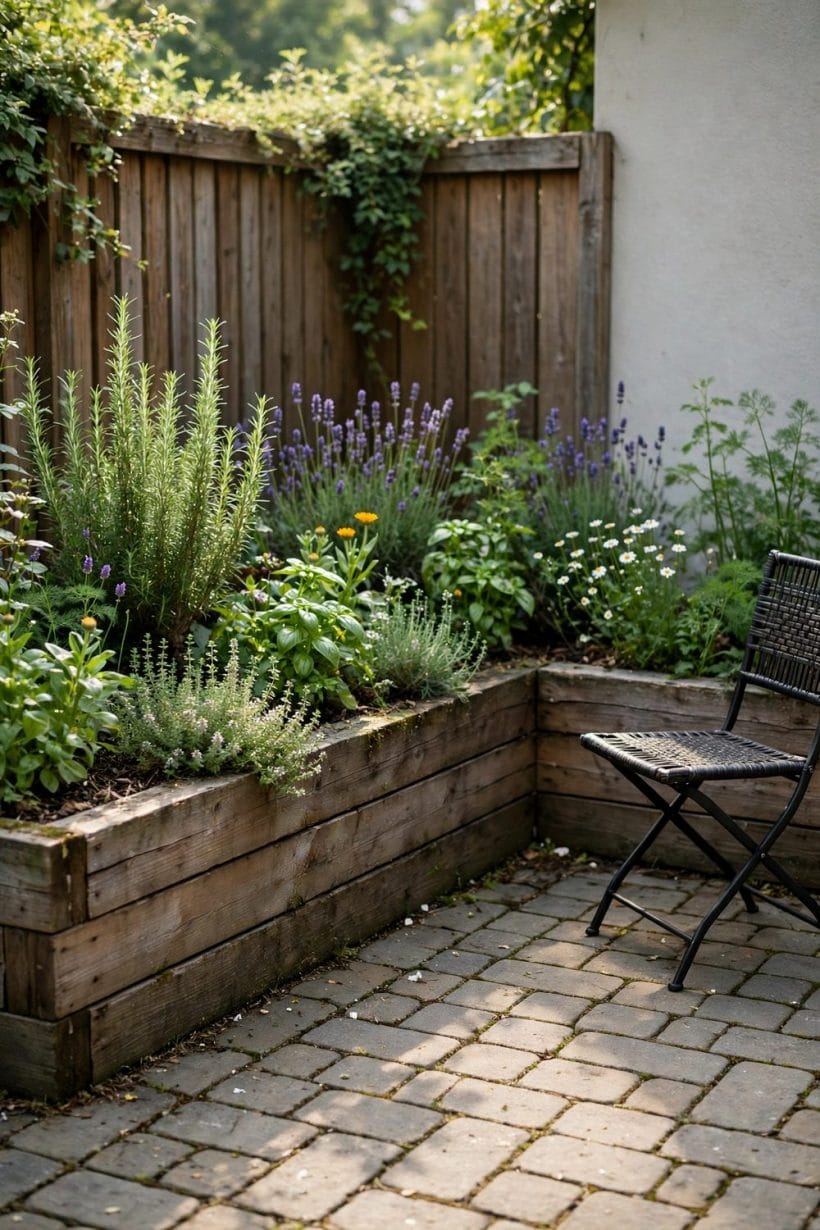
Planting softens the geometry, cools the edges and connects the patio to the garden it serves. The mulch and planting beds around the field matter as much as the paving — the mulch landscaping approach keeps those borders looking finished between the pavers’ clean lines.
55. Soften the rectangle with planted corners
Leave the two far corners of a rectangular patio unpaved and plant them generously. The field keeps its usefulness, the outline loses its hardness, and the sitting area gains a green enclosure.
56. Gaps and pockets in the field
Omitting a unit here and there for low, tough planting — creeping thyme, small sedums — gives a lived-in, cottage softness. Keep pockets out of chair-leg and walking routes.
57. Raised planters as the border
A raised bed along the patio edge does three jobs: border, extra seating and planting at a comfortable height. Build it as part of the paving works, and cap it at sitting height in a smooth unit.
58. Pots grouped, not dotted
Single pots scattered across a patio look like leftovers. Group them in threes at corners, steps and doorways, vary the heights, and repeat one plant through the group for rhythm.
59. A green wall on the boundary
Climbers on wires against the fence behind the patio give privacy, scent and a backdrop that makes furniture photograph well. Evergreen climbers earn their place in winter, when the patio is seen from indoors more than used.
60. Herbs within arm’s reach of the cook
A herb strip beside the barbecue and dining area gets used daily and scents the evening air when brushed past. Herbs like the patio’s conditions — sun, sharp drainage, reflected warmth — more than almost any planting.
61. Keep soil off the field
Beds that slope toward the patio wash soil across the pavers with every storm. Edge beds slightly below paving level or behind a sett course, and mulch them well, and your joints stay free of mud.
62. Shade planting under the pergola
The ground beneath a planted pergola suits ferns, hostas and other shade-lovers that would scorch in the open field. Use the contrast deliberately: sun plants at the bright edges, shade plants beneath the canopy.
63. One specimen to mark the spot
A single small tree in a generous pit, or a clipped standard at the corner, gives the patio a landmark. One strong specimen beats six weak ones competing for attention.
9. Small Patios and Tight Gardens
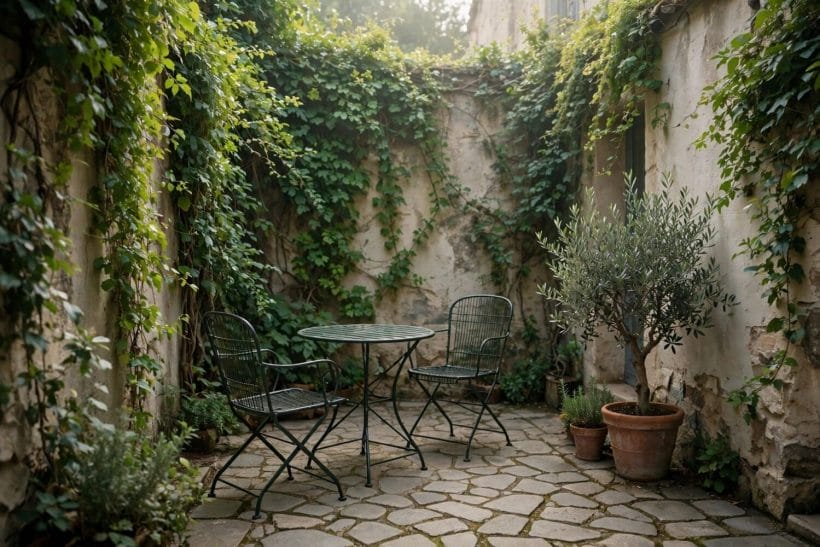
Small patios succeed through precision: fewer, better decisions, each one earning its place. The rules that govern big fields apply double here, because every unit is visible and every centimetre works.
64. Larger units make small spaces calmer
Counter-intuitively, big-format pavers make a small patio feel larger — fewer joints, fewer visual interruptions. Keep the pattern simple, run it to the very edges, and let one material do all the work.
65. Run the pattern diagonally
A diagonal field stretches a tight terrace visually, as section 3 noted, and on a small patio the effect is dramatic. Pair it with a simple edge course and furniture kept low, and the space reads a size up from its measurements.
66. A bistro corner, perfectly placed
Two chairs and a small table in the sunniest corner give a tiny garden its daily pleasure. Pave that corner first and best; the route to it can be simple stepping units through planting.
67. Built-in seating saves the footprint
A bench built along one edge seats four in the space of two folding chairs and never needs storing. Add outdoor cushions in summer; the rest of the year it makes a fine stand for pots.
68. Fold the table away
Wall-mounted drop-leaf tables and folding sets let a small patio be dining room at seven and open terrace at nine. Choose furniture that folds truly flat and stores against the wall it serves.
69. Light colours lift a shaded court
In a small, north-facing court, pale pavers bounce what light there is and make the space feel airier. Balance the brightness with dark furniture or one deep-green planting mass.
70. One mirror, carefully aimed
A weatherproof mirror on the boundary wall doubles a planting view and borrows light. Aim it at greenery, never at the seating itself or a neighbour’s window.
71. Keep the route through clear
In tight gardens the patio is often also the path. Mark the walking line with the pattern and keep furniture out of it; a space that flows is used daily, one that must be sidled through is avoided.
72. Vertical planting earns its wall
When floor space is precious, garden upward: wall planters, climbers and a shelf of herbs give the green enclosure without touching the footprint. Keep wall planting drought-tolerant — high pockets of soil dry fast.
10. Base, Drainage and Practical Details
The prettiest pattern fails on a poor base. This closing section is the unglamorous third of the project — excavation, foundation, falls and jointing — and it decides whether the patio is still level, tight and clean-jointed in a decade.
73. The base does the real work
Pavers are only the wearing surface; the compacted foundation beneath carries the load and keeps the field level. Skimping depth or compaction shows within two winters as dips and rocking units. With the same care you’d give a redwood deck’s footings, build the base for the traffic the patio will actually take.
74. Falls that move water away
The field must shed water gently away from the house toward drainage or planting — never toward the wall. The fall is subtle enough to dine on comfortably, but it must be continuous; one low corner will puddle and ice.
75. Jointing sand, edges and upkeep
Kiln-dried or polymeric jointing sand locks the units, and sound edge restraint keeps them locked. Expect to sweep, wash and top up joints occasionally, lift and re-bed any unit that rocks, and keep borders with brick and stone features pointed and clean. An afternoon a year keeps a paver patio looking newly laid.
Final Considerations
A paver patio is one of the most forgiving projects in the garden: units can be lifted, the layout extended, a mistake relayed over a weekend. Be ambitious with pattern and generous with size — the footprint and the base are the hardest decisions to change later.
Choose the material in your own light, choose the pattern for the life the patio will host, and build the unseen work properly. Do those three things and the field will quietly serve breakfasts, birthdays and ordinary Tuesdays for decades.

0 Comments